


Business legal calendar for September 2026 This is a set of mandatory deadlines that accountants and HR personnel must be aware of to avoid administrative penalties for violations related to taxes, labor, and social insurance. This month, businesses must simultaneously handle multiple obligations: filing value-added tax returns, excise tax returns, resource tax returns, environmental protection tax returns, reporting labor changes, and paying mandatory union fees and social insurance contributions. Missing even one deadline can result in retroactive tax collection and late payment penalties.
From this perspective MAN – Master Accountant Network, As a tax, accounting, and auditing consulting firm with over 30 years of practical experience in Vietnam, we understand that most late payment penalties do not stem from intentional violations by businesses, but rather from disorganized accounting departments lacking tools for monthly reporting. This article systematizes the entire legal business reporting calendar for September 2026, including legal basis, practical examples, and key points that accountants and HR personnel should pay special attention to.
Summary of key focuses on the corporate legal calendar for September 2026

- The September 2026 Business Legal Calendar is a summary of the deadlines that businesses must comply with for tax declarations, social insurance contributions, union fees, and labor reports during the month.
- This applies to all types of businesses that have tax obligations, employ workers, and participate in mandatory social insurance.
- Key deadlines: notification of labor changes before September 3rd, August 2026 tax returns no later than September 21st, union dues and social insurance contributions no later than September 30th.
- Main legal basis: Decree 252/2026/ND-CP, Decree 245/2026/ND-CP, Circular 89/2026/TT-BTC, Decree 105/2026/ND-CP, and the Social Insurance Law 2024.
- Businesses need to further check the regulations on quarterly consolidated personal income tax declarations from May 8, 2026, to avoid filing incorrectly.
What is the September 2026 Business Legal Calendar and who does it apply to?

Before delving into the details of each deadline, it's necessary to clarify the legal nature of this concept to avoid confusion between a company's own internal calendar and a legally mandated calendar.
What is the definition of a business legal calendar?
A corporate legal calendar is a list of administrative, tax, and labor obligations that a business must fulfill within a defined period, based on currently effective legal regulations. Unlike an internal work schedule, a corporate legal calendar includes specific penalties for deadline violations, including fines, late payment interest, and in some cases, tax enforcement.
Who should be aware of the September 2026 business legal calendar?
According to data compiled from current regulations, the applicable subjects include:
- Businesses of all types: joint-stock companies, limited liability companies with one or more members, and private enterprises.
- The employer experienced staff changes in the preceding month.
- The entity is subject to monthly tax filing for value-added tax, special consumption tax, resource tax, and environmental protection tax.
- Agencies, organizations, businesses, and cooperatives are obligated to pay trade union fees monthly.
- Employers participate in mandatory social insurance by making monthly contributions.
Why do businesses need to be aware of the September 2026 business legal calendar?
Proactively monitoring the September 2026 business legal filing schedule not only helps avoid administrative penalties but is also part of systematic tax risk management. Even a one-day late filing is still considered late, resulting in late payment penalties calculated on a daily basis on the tax payable.
According to experts at MAN – Master Accountant Network, The biggest risk lies not in a single obligation but in the overlap between multiple deadlines occurring close together. In September 2026, all four monthly tax returns fall under the same deadline of September 21st, plus two other obligations related to insurance and union due at the end of the month. Without a consolidated control sheet, the accounting department could easily miss an item, especially for infrequently occurring taxes such as resource tax or excise tax.
Key deadlines in the corporate legal calendar for September 2026
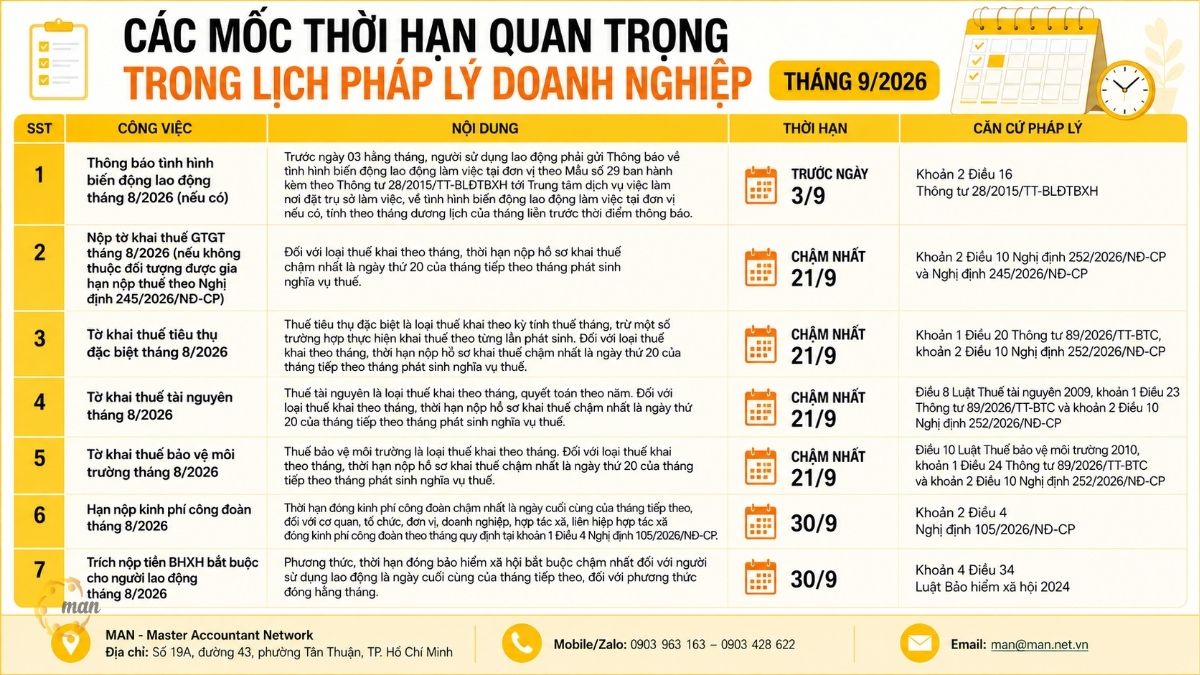
This section details each group of obligations in chronological order of execution within the month, making it easier for accountants to compare and plan internal handling. Overall, the milestones are spread across three clusters: the beginning of the month includes labor reports, the middle of the month includes four types of monthly tax returns with a common deadline, and the end of the month includes union fees and social insurance contributions.
Deadlines regarding labor and social insurance
Two obligations directly related to employees fall at the beginning and end of the month: notifying of labor changes before September 3rd and deducting and paying mandatory social insurance contributions no later than September 30th.
Deadlines for filing monthly tax returns.
All four types of monthly tax returns share a common deadline of September 21, 2026, for the August 2026 tax period. Since the 20th of the month falls on a holiday, the deadline has been moved to the next working day, as per the principle mentioned above. These four returns include value-added tax, special consumption tax, resource tax, and environmental protection tax.
Deadline for submitting trade union fees
Monthly trade union fees are due no later than September 30, 2026, the same date as social insurance contributions, and apply to agencies, organizations, units, enterprises, cooperatives, and cooperative unions that pay monthly.
The table below summarizes the content, deadlines, and legal basis of all seven obligations for quick reference.
| SST | Job | Content | Duration | Legal basis |
| 1 | Please provide updates on labor market changes in August 2026 (if any). | Before the 3rd of each month, employers must send a Notice of Changes in the Workforce at the Unit, using Form No. 29 issued with Circular 28/2015/TT-BLDTBXH, to the Employment Service Center where the workplace is located. This notice should detail any changes in the workforce at the unit, calculated based on the calendar month immediately preceding the notification date. | Before September 3rd | Clause 2, Article 16 of Circular 28/2015/TT-BLDTBXH |
| 2 | Submit your VAT tax return for August 2026 (if you are not eligible for tax payment extension under Decree 245/2026/ND-CP). | For taxes filed monthly, the deadline for submitting tax returns is no later than the 20th day of the month following the month in which the tax liability arises. | No later than September 21st | Clause 2, Article 10 of Decree 252/2026/ND-CP and Decree 245/2026/ND-CP |
| 3 | Excise tax return form for August 2026 | Excise tax is a tax declared on a monthly basis, except in certain cases where tax is declared on a transaction-by-transaction basis. For taxes declared monthly, the deadline for submitting tax returns is no later than the 20th day of the month following the month in which the tax liability arises. | No later than September 21st | Clause 1, Article 20 of Circular 89/2026/TT-BTC, Clause 2, Article 10 of Decree 252/2026/ND-CP |
| 4 | Resource tax return form for August 2026 | Resource tax is a type of tax that is declared monthly and settled annually. For this type of tax, the deadline for submitting tax returns is no later than the 20th day of the month following the month in which the tax liability arises. | No later than September 21st | Article 8 of the 2009 Law on Resource Tax, Clause 1 of Article 23 of Circular 89/2026/TT-BTC, and Clause 2 of Article 10 of Decree 252/2026/ND-CP |
| 5 | Environmental Protection Tax Declaration Form, August 2026 | Environmental protection tax is a monthly tax. For this type of tax, the deadline for filing the tax return is no later than the 20th day of the month following the month in which the tax liability arises. | No later than September 21st | Article 10 of the 2010 Environmental Protection Tax Law, Clause 1 of Article 24 of Circular 89/2026/TT-BTC, and Clause 2 of Article 10 of Decree 252/2026/ND-CP. |
| 6 | Deadline for submitting trade union fees is August 2026. | The deadline for paying trade union fees is no later than the last day of the following month for agencies, organizations, units, enterprises, cooperatives, and cooperative unions that pay trade union fees monthly as stipulated in Clause 1, Article 4 of Decree 105/2026/ND-CP. | 30/9 | Clause 2, Article 4 of Decree 105/2026/ND-CP |
| 7 | Deduction and payment of mandatory social insurance contributions for employees in August 2026. | The method and deadline for mandatory social insurance contributions for employers is the last day of the following month, for monthly contributions. | 30/9 | Clause 4, Article 34 of the Social Insurance Law 2024 |
Legal basis for the September 2026 business legal calendar.
Consulting the correct original documents is a mandatory requirement for accountants, as decrees and guiding circulars are often amended and supplemented each fiscal year. The table below lists the fundamental documents directly related to the September 2026 business legal calendar.
| Legal documents | Number / Scope of Application | Related content |
| Circular 28/2015/TT-BLDTBXH | Ministry of Labour, Invalids and Social Affairs | Form No. 29: Notification of labor changes, deadline before the 3rd of each month. |
| Decree 252/2026/ND-CP | Government | The regulations stipulate that the deadline for filing tax returns is monthly, on the 20th day of the following month. |
| Decree 245/2026/ND-CP | Government | Regulations on tax payment extensions and identifying those ineligible for extensions. |
| Circular 89/2026/TT-BTC | Ministry of Finance | Instructions for filing excise tax, resource tax, and environmental protection tax returns. |
| Decree 105/2026/ND-CP | Government | Regulations on the method and deadline for paying trade union fees. |
| Social Insurance Law 2024 | National Assembly | Methods and deadlines for paying mandatory social insurance contributions. |
| Civil Code 2015 | National Assembly | Principles for calculating deadlines when holidays coincide. |
| Circular 80/2021/TT-BTC | Ministry of Finance, Article 86 | Instructions on how to postpone tax filing deadlines when they coincide with holidays. |
| Circular 19/2021/TT-BTC | Ministry of Finance, Article 8 | Regulations allow for electronic tax filing 24/7, including holidays and weekends. |
| Decision 1109/QD-BTC of 2026 | Ministry of Finance, Section 6, Appendix I | Regulations on quarterly consolidated personal income tax declarations will take effect from May 8, 2026. |
Special considerations when implementing the September 2026 corporate legal calendar.
The following three points are often overlooked when businesses create internal tracking tables, even though they are clearly stipulated in legal documents.
Firstly, regarding personal income tax returns, from May 8, 2026, businesses and organizations paying income will be subject to withholding tax. personal income tax In the current month, consolidated declarations will be made quarterly instead of monthly, based on Section 6 of Appendix I issued herewith. Decision 1109/QD-BTC 2026. Therefore, the September 2026 business legal calendar no longer lists a separate personal income tax return for August. Accountants need to adjust their internal tracking records to avoid duplicate or incorrect filings.
Secondly, regarding the principle of calculating deadlines when a deadline coincides with a holiday, if the deadline for filing tax returns falls on a legally mandated holiday, the deadline will be calculated as the next working day, based on the 2015 Civil Code and the guidance in Article 86. Circular 80/2021/TT-BTC. This is why some dates in the table above are listed as the nearest working day instead of the exact 20th of the Gregorian calendar.
Thirdly, regarding the submission method, businesses can submit tax returns and pay taxes electronically 24 hours a day, 7 days a week, including holidays and Tet (Lunar New Year), according to Article 8 of Circular 19/2021/TT-BTC. This means businesses can proactively submit early to reduce pressure on the deadline.
Tax codes and sub-items for business type in 2026
Besides meeting deadlines, businesses also need to submit the correct budget code and sub-item when preparing tax payment documents in the September 2026 business legal calendar. This avoids situations where money has been paid but not correctly accounted for, resulting in being considered late payment. Based on Circular 130/2025/TT-BTC on the State Budget Classification System, the common code groups are as follows.
Group 1: Joint-stock companies and limited liability companies with two or more members
| Tax Type | Police Department | Provincial Administration | Subsection |
| Domestic VAT | 854 | 554 | 1701 |
| Import VAT | 854 | 554 | 1702 |
| Corporate Income Tax | 854 | 554 | 1052 |
| Corporate income tax on real estate transfers | 854 | 554 | 1053 |
| Corporate income tax on capital transfers | 854 | 554 | 1055 |
| Late payment of corporate income tax. | 854 | 554 | 4918 |
| Late payment of VAT | 854 | 554 | 4931 |
Group 2: Private enterprises, single-member limited liability companies
| Tax Type | Police Department | Provincial Administration | Subsection |
| Domestic VAT | 855 | 555 | 1701 |
| Import VAT | 855 | 555 | 1702 |
| Corporate Income Tax | 855 | 555 | 1052 |
| Corporate income tax on real estate transfers | 855 | 555 | 1053 |
| Corporate income tax on capital transfers | 855 | 555 | 1055 |
| Late payment of corporate income tax. | 855 | 555 | 4918 |
| Late payment of VAT | 855 | 555 | 4931 |
Group 3: Personal income tax, applicable to all types of income.
| Type of tax/revenue | Police Department | Provincial Administration | Subsection |
| Personal income tax from salaries and wages | 857 | 557 | 1001 |
| Personal income tax | 857 | 557 | 1003 |
| Personal income tax from capital investment | 857 | 557 | 1004 |
| Personal income tax from capital transfer | 857 | 557 | 1005 |
| Personal income tax from renting out property. | 857 | 557 | 1014 |
| Late payment of personal income tax. | 857 | 557 | 4917 |
| Non-agricultural land in rural areas | 857 | 557 | 1601 |
| Non-agricultural land in urban areas | 857 | 557 | 1602 |
| Non-agricultural land used for production and business purposes. | 857 | 557 | 1603 |
| Other non-agricultural land | 857 | 557 | 1604 |
According to Article 2 of Circular 130/2025/TT-BTC, the Chapter code is used to classify state budget revenues and expenditures based on the organizational system of agencies and organizations under a level of government, collectively referred to as the managing agency, which has its own budget management organization. Each budget level allocates an additional special Chapter to reflect revenues and expenditures not included in the budget allocated to agencies and organizations.
Regarding coding, the Chapter is coded using three characters corresponding to each level of management: central-level agencies use codes from 001 to 399, provincial-level agencies use codes from 400 to 599, and commune-level agencies use codes from 800 to 989. Each managing agency or economic unit/organization is assigned a unique code; subordinate units use the same Chapter code as their superior managing agency, while independent units and individuals with similar characteristics are assigned a common Chapter code.
In principle, when agencies and organizations under a level of government merge or consolidate without a new Chapter code, the unit may use the Chapter code of the unit with the largest proportion of recurrent expenditure in the total expenditure of the consolidated units, or the Chapter code of the unit with the first name in the consolidated name, or retain its own Chapter code as required for management purposes.
Regarding authorized collection cases, the agency or unit authorized by the collecting agency shall account for the collection under the Chapter of the authorizing agency. However, revenue collected under authorization from the tax or customs agency shall be accounted for under the Chapter of the payer. In cases where funds are used for authorized expenditures from other agencies, the accounting shall follow the Chapter of the authorizing agency. When implementing the urban government model, agencies and organizations shall continue to use the Chapter codes already assigned to them within their existing organizational structure.
The complete list of Chapter codes is detailed in Appendix I issued with Circular 130/2025/TT-BTC. The Departments of Finance of provinces and centrally-administered cities are responsible for guiding the accounting of Chapter codes at the local level to suit the actual organization, but are not allowed to issue codes different from those in this Circular.
Case Study: How does a business handle its corporate legal calendar for September 2026?
Real-world context
Company Y operates in the field of mechanical processing in Dong Nai, has approximately 350 employees, and simultaneously incurs tax declaration obligations. VAT, This includes environmental protection tax due to the use of taxable materials, along with monthly social insurance and union dues. In the previous quarter, the company was reprimanded for submitting the environmental protection tax return one day late, because the accountant only monitored the VAT tax schedule and overlooked this infrequently arising tax.
Solutions to be implemented
After being MAN – Master Accountant Network Reviewing the process, the company implemented three changes: creating a consolidated corporate legal calendar for September 2026 that includes all tax, labor, and insurance obligations in a single tracking file with five-day advance alerts; assigning one accountant to be primarily responsible for the group of infrequently arising taxes; and switching all filing to electronic form to take advantage of the 24/7 filing window instead of concentrating everything on the last day of the deadline.
The measured results
- Since adopting the consolidated payment schedule, the company has not experienced any consecutive late payments for three consecutive periods.
- The time spent compiling data before each tax filing period is reduced by approximately 40% because there is no need to look up numerous documents again.
- During the tax authorities' periodic review, the supporting documents with chapter and sub-item codes completely matched each payment, with no discrepancies requiring explanation.
Expert opinion: Common business risks when implementing the September 2026 corporate legal calendar.
Experts at MAN – Master Accountant Network With over 30 years of practical experience in tax risk management in Vietnam, we note the following four common risk groups.
- Risk 1: Confusion between monthly and quarterly tax filing periods. Since personal income tax returns were filed quarterly, some accountants have maintained their old habits and attempted to submit separate personal income tax returns for August 2026, leading to rejected returns or duplicate data on the electronic tax system.
- Risk 2: Missing out on taxes that arise infrequently. Resource tax and excise tax are not incurred monthly by all businesses, so they are easily overlooked when scheduling if only the previous month's template is copied without reviewing actual business activity during the period.
- Risk 3: Failure to update deadlines when they coincide with holidays. Some businesses submitted their data a day before the extended deadline due to it coinciding with a holiday, wasting time preparing the data, while others misunderstood the situation and submitted their data later than the actual extended deadline.
- Risk 4: Lack of cross-referencing of chapter and sub-item codes when preparing payment documents. Paying the correct amount but using the wrong sub-item code can cause the payment to be held up in the treasury system, not being recorded as a completed obligation on time, leading to disputes when reconciling data.
Conclude
The September 2026 business legal calendar focuses on seven main groups of obligations, ranging from labor reports at the beginning of the month, monthly tax returns in the middle of the month, to social insurance and union fees at the end of the month. The key to businesses avoiding being caught off guard is to promptly update on changes in filing periods, such as the shift of personal income tax to quarterly filing, and to correctly verify the chapter and sub-item codes when preparing payment documents for the state budget.
MAN – Master Accountant Network We are a tax, accounting, and auditing consulting firm with a team of experts boasting over 30 years of practical experience and a deep understanding of tax risk management in the Vietnamese market. We provide a full range of tax settlement services, tax accounting services, tax reporting services, and tax consulting services for both domestic and foreign-invested enterprises. To have your company's legal history reviewed to suit your specific business operations, please contact MAN – Master Accountant Network for personalized advice.
Frequently Asked Questions about the Business Legal Calendar September 2026
Do businesses established in September 2026 need to monitor this entire schedule?
It's not necessary to apply all of them. Newly established businesses only need to comply with obligations corresponding to their actual operations; for example, if they don't have employees yet, they don't have the obligation to report labor changes or pay social insurance.
If September 21, 2026 falls on a holiday, will the tax payment deadline change?
Yes. According to the principles in the 2015 Civil Code and Article 86 of Circular 80/2021/TT-BTC, the deadline is calculated on the next working day following that holiday.
Is it mandatory for businesses to file tax returns electronically?
Most businesses are now required to file and pay taxes electronically. The system operates continuously 24/7, including holidays and Tet (Lunar New Year), as stipulated in Article 8 of Circular 19/2021/TT-BTC, allowing businesses to proactively choose their payment times throughout the day.
Is personal income tax still included in the September 2026 business legal calendar?
No more monthly filings. From May 8, 2026, personal income tax withholding obligations will be declared quarterly, so there will be no separate personal income tax return for August in September 2026.
If there are no labor changes in August 2026, is it still necessary to submit a notification?
No need. The obligation to report labor changes using Form No. 29 only applies when actual changes occur, based on Clause 2, Article 16 of Circular 28/2015/TT-BLDTBXH.