
Do goods and services consumed internally need to be invoiced and subject to VAT? This is a question that almost every business encounters during its operations, from exporting products as employee gifts to using the company's own services for internal operations. Decree 181/2025/ND-CP and Decree 254/2026/ND-CP, The invoicing and VAT obligations for this item depend on the actual purpose of use and are not applied mechanically to all cases.
Many accountants still confuse the concept of internal consumption with circulating assets used in production, leading to incorrect declarations and the risk of being subject to back taxes during final settlement. This article, compiled from a professional perspective, is by... MAN – Master Accountant Network, With over 30 years of practical experience in Vietnam, our tax and auditing consulting firm will provide a detailed analysis of the legal basis, tax calculation methods, exemption cases, and a real-world case study to help businesses apply the correct principles right from the accounting stage.
Summary of key points regarding whether internally consumed goods and services require invoicing and VAT calculation.
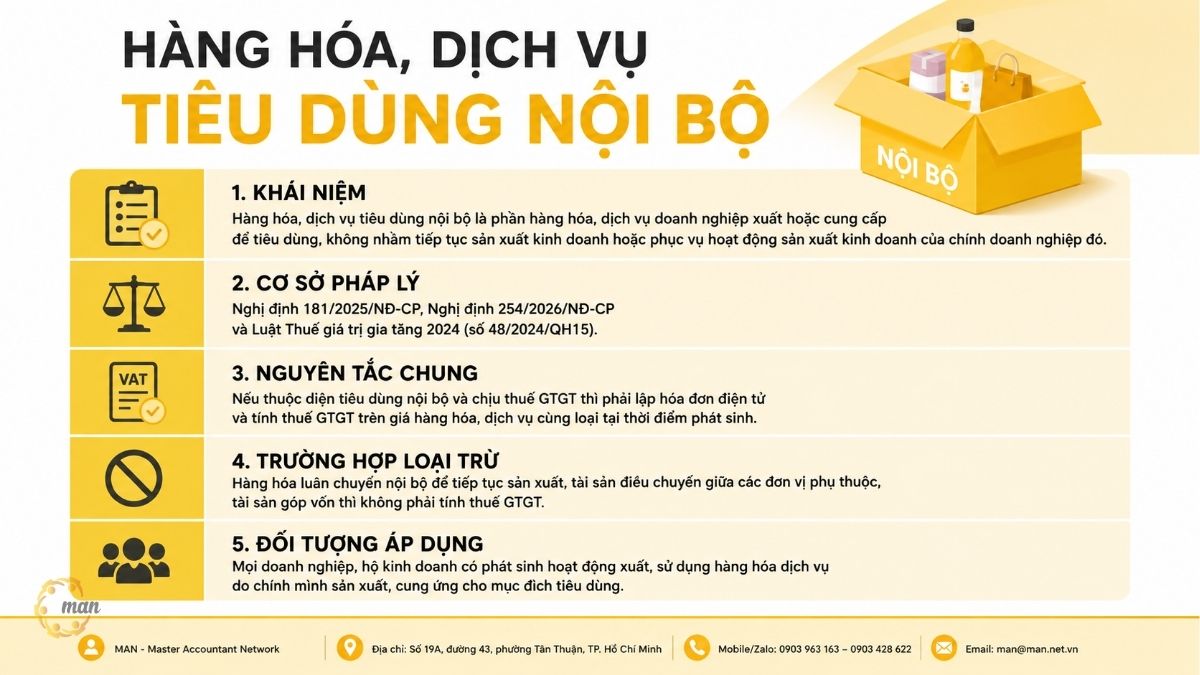
- Goods and services for internal consumption are the portion of goods and services that a business exports or provides for its own consumption, not for further production or business activities, or to support the business's own production and business operations.
- Legal basis: Decree 181/2025/ND-CP, Decree 254/2026/ND-CP and the Value Added Tax Law 2024 (No. 48/2024/QH15).
- General principle: If the transaction is for internal consumption and is subject to VAT, an electronic invoice must be issued and VAT calculated on the price of similar goods and services at the time of transaction.
- Exclusions: Goods transferred internally for continued production, assets transferred between subsidiary units, and assets contributed as capital are not subject to VAT.
- Applicable entities: All businesses and household businesses that engage in the export and use of goods and services they produce or supply for consumption purposes.
What constitutes internally consumed goods and services according to current regulations?
According to Clause 1, Article 6 of Decree 181/2025/ND-CP, goods and services for internal consumption are understood as goods and services exported or provided by a business entity for its own consumption purposes. This is a much narrower definition than the common understanding of businesses, which often lumps all internal circulation activities together into one category.
The key lies in the final purpose of use. If the goods are exported for consumption, for example as gifts, rewards, or for meals for workers beyond their assigned workload, then they fall within the scope of regulation. Conversely, if the goods are merely circulated to continue the production process, the regulations will apply quite differently.
Legal basis for determining internal consumption
Decree 181/2025/ND-CP clearly lists cases that are not considered internal consumption, including: goods transferred between internal warehouses, materials and semi-finished products transferred for continued production; goods and services serving production and business activities, including self-built and self-produced fixed assets; and assets transferred between dependent accounting units during separation, merger, or capital contribution.
Regarding the transfer of assets, the regulations further expand on a specific case: fixed assets currently in use and already depreciated, when transferred at their book value between a business entity and its member units, or between member units owned by the same business entity, to serve the production and business activities of goods and services subject to VAT, are also not considered internal consumption.
In terms of documentation, businesses transferring assets are required to have an asset transfer order accompanied by documentation proving the asset's origin. For assets contributed as capital to a business, the documentation must include a capital contribution agreement, a joint venture or partnership agreement, and a valuation report from the capital contribution acceptance committee between the contributing parties, or a valuation document from a qualified valuation organization, along with documentation proving the asset's origin.
Accurately defining these exclusion groups is the first and most important step before determining billing obligations., VAT of any items arising internally within the business.
Why do businesses need to understand regulations regarding goods and services for internal consumption?
Errors in identifying internal consumption lead to two direct consequences: neglecting the obligation to issue electronic invoices and underreporting. output VAT. Both are errors that tax authorities pay particular attention to during annual audits and inspections.
From this perspective MAN – Master Accountant Network, Through consulting with numerous manufacturing and trading businesses, we've found that the majority of retroactive tax collection related to internal consumption stems from businesses failing to separate goods used for gifts or bonuses from goods circulated for production. This is precisely the point businesses need to focus on reviewing right from the stage of establishing internal inventory withdrawal regulations.
Who is affected by internal consumption regulations?
This regulation applies to all businesses that engage in the export or supply of goods and services they produce or sell for consumption purposes, regardless of their type or size. Specifically, it includes:
- Businesses manufacture products for use as gifts, promotional items, and for internal conferences and events.
- Service businesses provide their own services to meet internal needs; for example, a transportation company uses its vehicles for non-business-related activities.
- Businesses pay employees with goods and services instead of wages.
- Businesses export goods in the form of loans or borrowings.
It is important to note that these regulations only apply when goods or services are actually used for consumption; not all internal inventory withdrawals fall under the scope of regulation.
Do goods and services consumed internally require invoices?
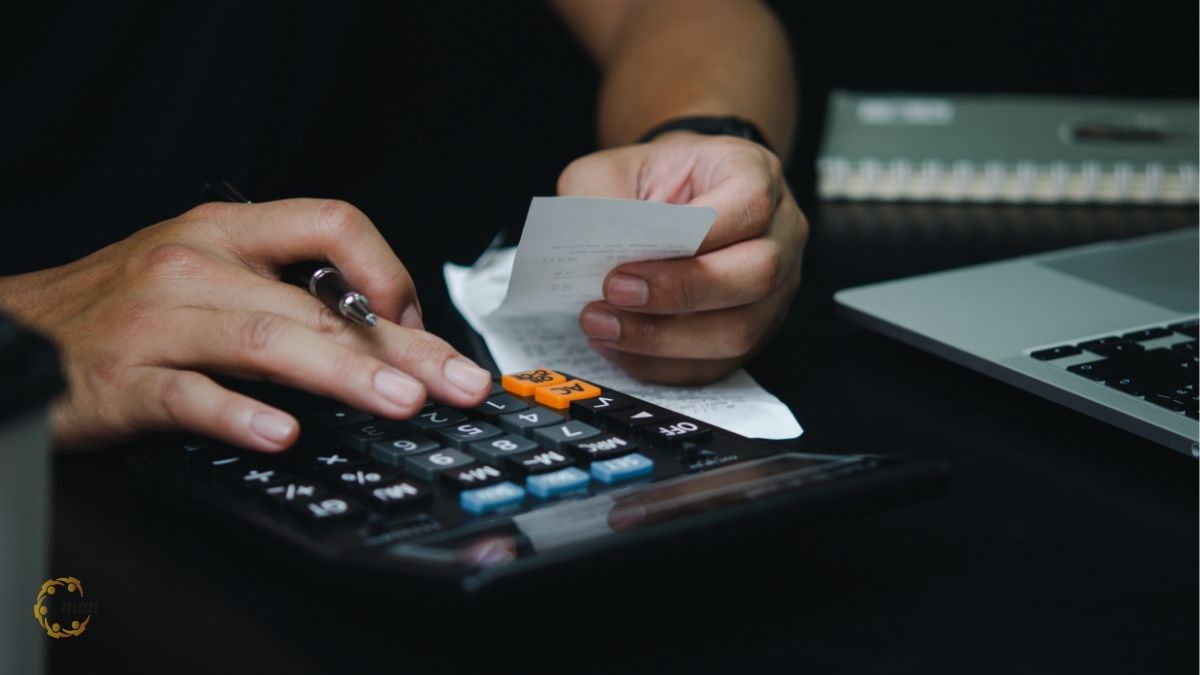
The direct answer is yes. According to Clause 1, Article 4. Decree 254/2026/ND-CP, When selling goods or providing services, sellers must issue electronic invoices to buyers. This regulation also applies to goods and services used for promotions, advertising, samples, gifts, exchanges, as payment in lieu of wages for employees, and internal consumption.
Therefore, once goods or services are identified as internal consumption in the narrow sense mentioned above, businesses are required to issue corresponding electronic invoices, unless they fall under a specific exemption group as stipulated in Article 7 of the same decree.
In which cases is it not necessary to issue an electronic invoice?
Article 7 of Decree 254/2026/ND-CP fully stipulates the cases where electronic invoices are not required, including:
- Household businesses and individual businesses selling goods and services are required to prepare a list of purchased goods and services in accordance with corporate income tax law, except in cases where they register to use electronic invoices.
- Household businesses and individual businesses that earn income from real estate rentals, or from providing digital content products and services related to entertainment, video games, digital films, digital photos, digital music, and digital advertising to organizations and individuals abroad.
- Household businesses and individual business owners acting as lottery agents, insurance agents, or multi-level marketing agents, where the lottery, insurance, or multi-level marketing companies have already deducted taxes in accordance with the laws on tax administration.
- Fees and other income arising from reinsurance activities, deposit taking, financing activities, debt sales, foreign exchange transactions, and derivative products. Specifically for foreign exchange sales transactions, at the end of each month, the entity must prepare a detailed summary of transactions occurring during the month based on its data management system, taking full responsibility for the accuracy of the information and providing this summary when requested by the tax authorities or other competent state agencies.
- Contributing assets of business organizations and individuals to economic organizations.
- Assets transferred from the parent company to a subsidiary and vice versa, between subsidiary units within the same business entity, or assets transferred during division, separation, merger, acquisition, or conversion of business type.
- Machinery and equipment provided on loan are considered fixed assets and tools used for processing goods by the lender, provided that no payment is collected and no ownership is transferred.
- Cases under points a and b of Clause 1, Article 6 and point b of Clause 1, Article 14 of Decree 181/2025/ND-CP, specifically goods and services used to continue the production and business process; goods and services serving production and business activities, including self-built and self-produced fixed assets; and revenues not related to the sale of goods or provision of services, such as monetary compensation, bonuses, third-party claims from insurance activities, amounts collected on behalf of others, fees from state agencies for collecting and disbursing funds on behalf of others, and financial revenues.
Businesses need to carefully review this entire list before concluding whether a transaction is exempt from invoicing, avoiding subjective interpretations or overlooking specific cases such as exported digital content services or lottery and insurance agency activities.
Are goods and services consumed internally subject to VAT?
According to point c, clause 1, Article 7 of the Value Added Tax Law 2024 (No. 48/2024/QH15), for goods and services used for exchange, internal consumption, gifts, or donations, the VAT taxable price is the taxable price of similar or equivalent goods and services at the time this activity occurs. Clause 1, Article 6 of Decree 181/2025/ND-CP also reaffirms the same principle.
In other words, if goods and services consumed internally are subject to VAT under general regulations, the enterprise must calculate output VAT based on the market price of similar goods, not on the cost of goods sold or production costs.
How to determine the VAT taxable value for goods consumed internally:
The principle for determining the taxable price is based on the actual selling price of similar or equivalent goods and services that the business is applying to external customers at the same time the transaction occurs. If the business does not have any sales transactions of similar goods to external customers, it is necessary to refer to the prevailing market price of equivalent products to determine a reasonable taxable price, avoiding reassessment by the tax authorities during an audit.
Conversely, the three groups of goods and services mentioned in the definition, including goods circulating for continued production, goods serving production and business activities, and assets transferred or contributed as capital under the specified conditions, are not subject to VAT.
Compilation of relevant legal documents
Businesses need to monitor subsequent implementation guidelines from the Ministry of Finance and local tax authorities, as practical application may be further clarified through individual case-by-case responses.
| Legal documents | Related content |
| Law on Value Added Tax 2024, No. 48/2024/QH15 | Regulations on the VAT taxable value for goods and services exchanged, consumed internally, or given as gifts are stipulated in point c, clause 1, Article 7. |
| Decree 181/2025/ND-CP | The definition of goods and services for internal consumption, exclusions, and methods for determining the taxable price are specified in Clause 1, Article 6. |
| Decree 254/2026/ND-CP | Article 4 stipulates the obligation to issue electronic invoices, while Article 7 outlines cases where electronic invoices are not required. |
Case Study: How do consumer goods manufacturers handle internal consumption?
Background
Company Y, a manufacturer of household goods, has a program of giving products to employees during annual holidays and Tet (Lunar New Year), and also regularly transfers materials between workshops to complete products. Before reviewing the process, the company's accountant combined these two types of transactions into a single internal inventory withdrawal item, without separating them in nature.
How to handle matters after review according to the new regulations.
Following advice from MAN – Master Accountant Network, the company implemented three corrective steps: first, reclassifying all inventory withdrawal transactions into two groups: those for continued production and those for actual consumption such as employee gifts; second, issuing electronic invoices and calculating output VAT for all employee gifts at the market price of similar products; and third, maintaining internal documentation and not issuing invoices for materials transferred between workshops for production purposes.
The measured results
- All employee gift-giving transactions are declared correctly for output VAT, avoiding the risk of being subject to retroactive tax collection during the annual tax settlement.
- Clearly categorized records help to expedite the periodic tax audit, avoiding the need for adjustment reports.
- The accounting department saves considerable time in year-end data reconciliation thanks to a transaction classification system implemented from the outset.
Comparison table of invoice and VAT obligations by case
Depending on the specific business transaction, a company may or may not have the obligation to issue invoices and calculate VAT. The table below summarizes common cases to help businesses easily compare and comply with regulations.
| Type of business | Is it necessary to issue an invoice? | Is VAT payable? |
| Goods given as gifts, bonuses, or as payment in lieu of wages to employees. | Have | Yes, at the price of similar goods. |
| Goods are circulated internally to continue production. | Are not | Are not |
| Goods and services that support the business operations of the enterprise itself. | Are not | Are not |
| Assets transferred between subsidiary units, during division or merger. | Are not | Are not |
| Assets contributed to a business | Are not | Are not |
Expert opinion: Common business risks and how to avoid them.
Experts at MAN – Master Accountant Network With over 30 years of practical experience in auditing and tax consulting in Vietnam, we note the three most common risks that businesses face when handling goods and services for internal consumption.
- The first risk is mistakenly classifying goods in circulation for production as internal consumption, leading to unnecessary over-invoicing and tax calculation, resulting in wasted accounting resources.
- The second risk, conversely, is failing to invoice goods actually intended as gifts or rewards, resulting in the business being subject to retroactive collection of output VAT plus late payment penalties when the tax authorities conduct an audit.
- The third risk lies in incorrectly determining the taxable price, especially for products that the business does not have external sales transactions to use as a basis for comparison.
The solution from MAN – Master Accountant Network for these risks is to establish detailed internal inventory withdrawal regulations at the beginning of the fiscal year, clearly classifying the purpose of each withdrawal transaction, and maintaining complete records of market prices for products used for internal consumption. This is a sustainable way to optimize tax costs in Vietnam, instead of resorting to piecemeal solutions when audits are conducted.
Conclude
Accurately determining whether internally consumed goods and services require invoicing and VAT calculation requires businesses to clearly distinguish the ultimate purpose of each inventory withdrawal transaction, instead of applying a single approach to all cases. Understanding the legal basis in the Value Added Tax Law 2024, Decree 181/2025/ND-CP, and Decree 254/2026/ND-CP will help businesses proactively avoid the risk of retroactive tax collection and optimize internal accounting processes.
MAN – Master Accountant Network We are a tax, accounting, and auditing consulting firm with a team of experts boasting over 30 years of practical experience and a deep understanding of tax risk management practices in Vietnam. We provide a full range of tax consulting services, tax accounting services, tax reporting services, and tax settlement services for FDI enterprises, domestic businesses, and individuals. For specific support tailored to your business needs, please contact MAN – Master Accountant Network for detailed consultation.
Tax services at MAN – Master Accountant Network
- Tax accounting services
- Tax consulting services
- Tax settlement services
- Tax reporting services
- VAT refund service
Service contact information at MAN – Master Accountant Network
- Address: No. 19A, Street 43, Tan Thuan Ward, Ho Chi Minh City
- Mobile/Zalo: 0903 963 163 – 0903 428 622
- E-mail: man@man.net.vn
- Google Business Profile: View MAN – Master Accountant Network's Google Business Profile
- LinkedIn Founder: View expert Le Hoang Tuyen's LinkedIn profile.
Responsible for production and professional content review by: Mr. Le Hoang Tuyen – Founder & CEO of MAN – Master Accountant Network, CPA Vietnam with over 30 years of experience in accounting, auditing, taxation, and corporate financial consulting.
Frequently Asked Questions about Internal Consumption of Goods and Services
Are goods used internally for promotional purposes subject to VAT?
Yes. Goods used for promotions, advertising, or as samples are still subject to electronic invoicing requirements under Article 4 of Decree 254/2026/ND-CP and VAT is calculated on the price of similar goods, except for promotional activities that are separately exempted under commercial law.
Do goods transferred between dependent accounting branches need to be invoiced?
No, if it is an asset transfer between dependent accounting units within the same business entity and there is a complete transfer order and documentation of the asset's origin as required.
How is the VAT taxable value for goods consumed internally determined if the business does not sell them externally?
Businesses need to refer to the selling prices of equivalent goods and services in the market at the time of transaction to determine a reasonable taxable price, avoiding situations where the tax authorities impose a price assessment during an audit.
Do contributed assets need to be invoiced electronically?
Electronic invoices are not required, but complete records of capital contribution, joint venture/collaboration agreements, and asset valuation reports from the capital contribution acceptance committee are mandatory as per regulations.
If a business pays employees with goods instead of wages, is it required to issue an invoice?
Yes. According to Decree 254/2026/ND-CP, the payment of goods and services in lieu of wages to employees is subject to the requirement of issuing electronic invoices and calculating the corresponding VAT.