


Official document 7533/TNI-QLDN2 The tax regulations issued by Tay Ninh Provincial Tax Department on August 25, 2026, have resolved important issues for businesses regarding the timing of invoice issuance, the exchange rate for value-added tax (VAT) invoices for exported goods, and tax declaration obligations. This is in the context of new regulations at... Tax Administration Law 2025 and Decree 254/2026/ND-CP As enforcement begins, a proper understanding of the legal nature of the regulations helps businesses comply accurately and prevent the risk of being subject to retroactive tax collection.
Incorrectly determining the timing of invoice issuance or applying the wrong exchange rate for accounting export revenue often leads to the risk of administrative penalties and cost discrepancies. corporate income tax. This article from the MAN – Master Accountant Network team of experts will comprehensively analyze the legal basis, practical lessons, and optimal invoice management solutions for businesses.
Summary of key points in Official Letter 7533/TNI-QLDN2
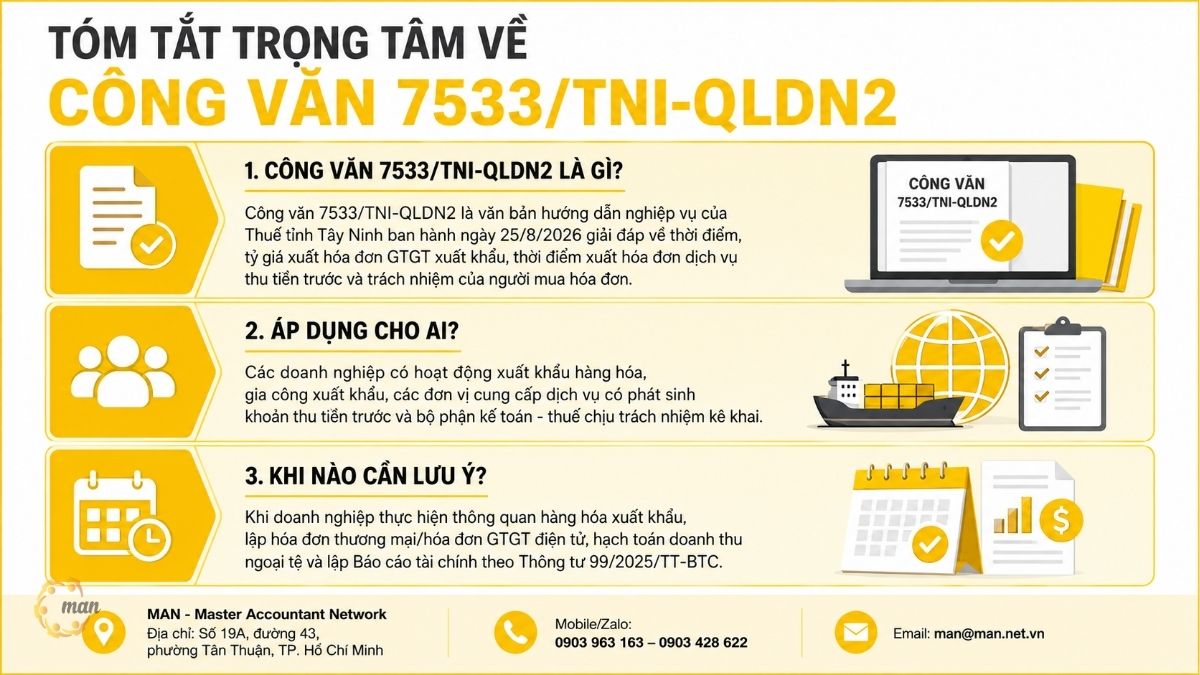
- What is Official Document 7533/TNI-QLDN2? Official document 7533/TNI-QLDN2 is a professional guidance document issued by the Tay Ninh Provincial Tax Department on August 25, 2026, clarifying the timing and exchange rates for issuing VAT export invoices, the timing for issuing invoices for services with advance payments, and the responsibilities of the invoice buyer.
- Who does this apply to? Businesses engaged in exporting goods, processing for export, and service providers that receive advance payments are responsible for declaring these transactions to their accounting and tax departments.
- When should we take note? When businesses carry out customs clearance for export goods, issue electronic commercial invoices/VAT invoices, account for foreign currency revenue, and prepare financial statements in accordance with Circular 99/2025/TT-BTC.
Legal context for the issuance of Official Letter 7533/TNI-QLDN2 in 2026

The period 2025-2026 marks a major turning point in the legal framework for tax administration and invoicing in Vietnam. The enactment of the 2025 Tax Administration Law and its implementing decrees has set stringent standardization criteria for electronic transactions and revenue management.
Businesses must simultaneously compare multiple legal documents when conducting economic transactions. Applying the correct document at the right time is mandatory to ensure the legality of deductible expenses and input and output VAT.
Specifically, the Tay Ninh Provincial Tax Department issued Official Letter 7533/TNI-QLDN2 based on a foundational legal framework including:
- Clause 1 of Article 9, point c of clause 3 of Article 6, and clause 4 of Article 14 of Decree 254/2026/ND-CP regulate invoices and documents.
- Point c, Clause 8 of the Appendix on the content of invoices issued together with Decree 254/2026/ND-CP.
- Clause 9, Article 1 of Decree 167/2025/ND-CP amends and supplements a number of articles on tax management.
- Clause 6 of Article 12 of the 2025 Tax Administration Law stipulates the principles of tax declaration and tax calculation.
- Article 1 of Circular 99/2025/TT-BTC provides guidance on the accounting regime for enterprises.
Experts at MAN, with 30 years of experience, note that the combination of these documents requires accountants to not only be familiar with tax laws but also have a deep understanding of financial accounting processes.
The role and value of Official Letter 7533/TNI-QLDN2 in financial management and auditing.
Import and export businesses often face a mismatch between customs clearance and invoice issuance. This guidance document resolves a long-standing legal bottleneck.
Through these directives, the tax authorities clearly define the boundary between VAT obligations and revenue accounting. This provides a solid legal basis for independent audits and tax settlements.
From MAN's perspective, clarity in invoice timelines helps the accounting department establish standardized internal control procedures. This addresses discrepancies between customs declarations and other declarations. VAT It will be minimized as much as possible.
Furthermore, the document protects the rights of businesses against disputes regarding the timing of deductible expenses when determining corporate income tax. Businesses can easily provide logical explanations to tax inspectors during tax settlement periods.
Which entities are directly affected by Official Letter 7533/TNI-QLDN2?
The scope of this guideline is not limited to Tay Ninh province but also serves as a reference for the entire Vietnamese business community. Accurately identifying the affected groups helps all parties proactively implement the guidelines.
- The first group consists of businesses operating in the export and processing of goods for export. These entities often engage in complex foreign exchange transactions and transport goods through multiple customs checkpoints.
- The second group includes organizations and individuals providing services with advance payment transactions or receiving deposits from customers. Managing the timing of invoicing in this case is very prone to errors.
- The third group consists of accounting personnel, internal auditors, and tax agents. These are the people directly responsible for operating the documentation system and declaring financial obligations to the State.
How to determine the timing and exchange rate for issuing VAT invoices for exported goods according to Official Letter 7533/TNI-QLDN2?
Incorrectly determining the timing of export invoice issuance is one of the most common errors leading to administrative fines for invoice violations. The guidance in the official document clarifies the maximum time frame and rules for determining exchange rates for export activities. Businesses engaged in exporting goods (including processed goods for export) must strictly adhere to principles regarding the timing and exchange rates of transactions.
Time of invoicing for export goods
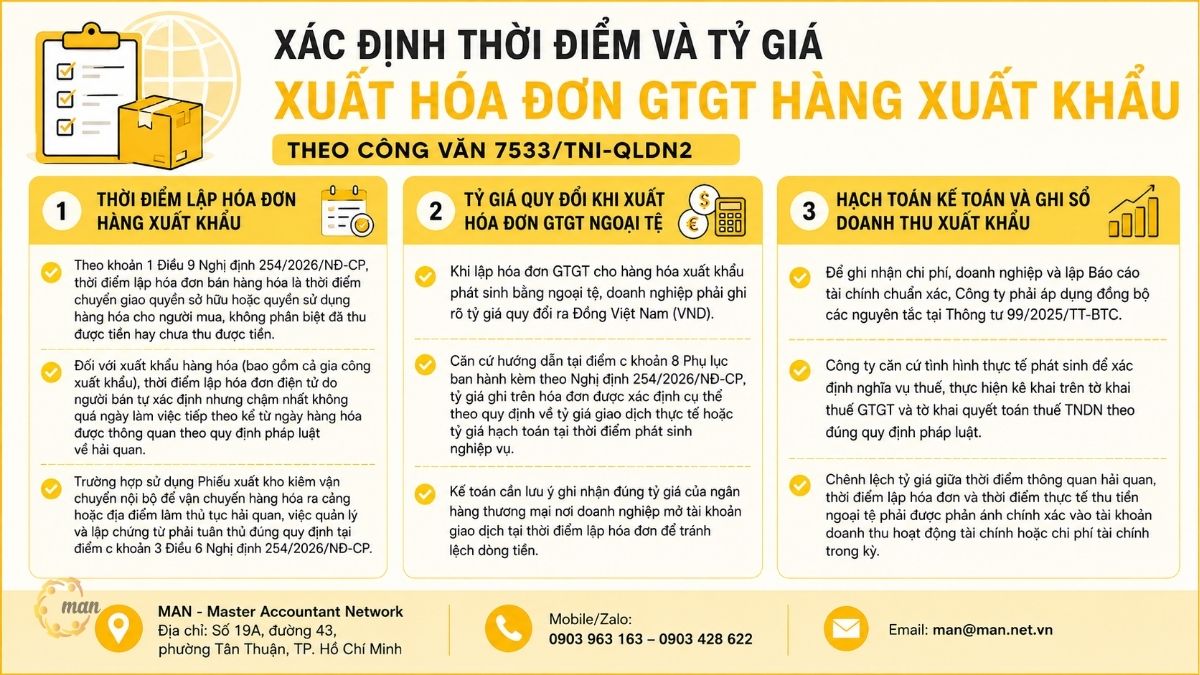
According to Clause 1, Article 9 of Decree 254/2026/ND-CP, the time of issuing a sales invoice for goods in general is the time of transferring ownership or the right to use the goods to the buyer, regardless of whether payment has been received or not. However, for goods exports (including processing for export), the time of issuing the electronic commercial invoice, electronic VAT invoice, or electronic sales invoice is determined by the seller, but no later than the next working day from the date the goods are cleared through customs as stipulated by customs law. In cases where businesses use internal warehouse release and transportation slips to transport goods to ports or customs clearance locations, the management and documentation must comply with the regulations specified in point c, clause 3, Article 6 of Decree 254/2026/ND-CP.
Exchange rate when issuing VAT invoices in foreign currency.
When issuing VAT invoices for exported goods denominated in foreign currency, businesses must clearly state the exchange rate to Vietnamese Dong (VND). Based on the guidance in point c, clause 8 of the Appendix issued with Decree 254/2026/ND-CP, the exchange rate recorded on the invoice is determined specifically according to the regulations on the actual transaction exchange rate or the accounting exchange rate at the time the transaction occurs. Accountants need to be mindful of recording the correct exchange rate of the commercial bank where the business has its transaction account at the time of invoice creation to avoid discrepancies in cash flow.
Accounting and recording of export revenue
To accurately record expenses and prepare financial statements, the company must consistently apply the principles set forth in Circular 99/2025/TT-BTC. The company determines its tax obligations based on the actual circumstances and makes declarations on the VAT tax return and the corporate income tax final settlement return in accordance with the law. Exchange rate differences between the time of customs clearance, the time of invoicing, and the time of actual collection of foreign currency must be accurately reflected in the financial operating revenue or financial expense account for the period.
What are the regulations regarding the timing of issuing service invoices when payment is collected in advance?
Many businesses often confuse advance payments for services with deposits, leading to delays in invoicing and subsequent tax audits by the tax authorities. (Clause 2, Article 9) Decree 254/2026/ND-CP These legal boundaries have been clearly defined.
For service provision activities (including providing services to foreign organizations and individuals), the general principle is that the time of invoice issuance is the time when the service is completed, regardless of whether payment has been received or not.
If the service provider collects payment before or during the provision of services, the time of invoice issuance is the time of payment.
The only exception: In cases where a deposit is collected in accordance with the Civil Code to guarantee the performance of a service contract, an invoice does not need to be issued at the time the deposit is received.
In cases of multiple deliveries or handover of individual items or service stages, an invoice must be issued for each delivery or handover, specifying the quantity and value of goods or services delivered, in accordance with Clause 3, Article 9 of Decree 254/2026/ND-CP.
Experts at MAN emphasize that the nature of the contract and payment receipts will determine whether the amount is an "advance payment" or a "deposit." If the contract states it's a deposit but it's essentially a prepayment according to the progress schedule, the tax authorities have grounds to consider it a delay in issuing the invoice.
Legal responsibilities of buyers of goods and services when using invoices.
Not only is the seller responsible for the legality of the invoice, but the buyer also bears strict legal obligations when including the invoice in the accounting of deductible expenses and input VAT deductions.
According to Clause 3, Article 18 of Decree 254/2026/ND-CP, buyers of goods and services have two core responsibilities:
- Use invoices for their intended purpose: Purchase invoices must directly serve the legitimate production and business activities of the enterprise. The buying, selling, and use of fictitious or illegal invoices to legitimize expenses is strictly prohibited.
- Provide invoice information: It is the responsibility to proactively and promptly provide the information recorded on invoices to competent state agencies when requested for inspection or audit.
When the buyer fails to fulfill this responsibility, all related costs may be disallowed as deductible expenses for corporate income tax purposes, and they may also be subject to retroactive collection of VAT and late payment penalties.
Summary of legal documents and comparison of invoice issuance cases.
To help corporate accountants quickly find information, MAN has systematized legal documents and a table differentiating the timing of invoice issuance according to current regulations.
The legal framework is regulated in Official Letter 7533/TNI-QLDN2.
| Document number | Text type | Key regulations |
| Tax Administration Law 2025 | Law | Clause 6 of Article 12: Principles of tax declaration, tax calculation, and legal responsibilities of taxpayers. |
| Decree 254/2026/ND-CP | Decree | Articles 6, 9, 14, 18 & Appendix: Detailed regulations on electronic invoices, issuance time and exchange rate. |
| Decree 167/2025/ND-CP | Decree | Clause 9 of Article 1: Amending and supplementing certain regulations on tax procedures and management. |
| Circular 99/2025/TT-BTC | Circular | Article 1: Guidelines on enterprise accounting system, account recording, and financial reporting. |
| Official document 7533/TNI-QLDN2 | Official document | Guidelines for determining the timing and exchange rate for issuing VAT invoices for exported goods. |
Comparison table of billing timing for specific transactions
| Criteria | Selling domestic goods | Exporting goods | Prepayment service | Deposit service (Civil Code) |
| Invoice date | Transfer of ownership or right of use. | Self-determined, no later than the next working day following the customs clearance date. | Time of payment collection. | No invoice needs to be issued upon receipt of payment. |
| Please provide supporting documents. | Delivery and receipt records, contracts, and warehouse release forms. | Customs declaration form and bill of lading have been cleared. | Receipt, bank statement, service contract. | The deposit agreement and deposit receipt are genuine. |
| Applicable exchange rate (if any) | The buying/selling exchange rate of commercial banks at the time of calculation. | The exchange rate is based on the Appendix to Decree 254/2026/ND-CP at the time the invoice is issued. | Exchange rate at the time of receiving the advance payment. | No charges have been incurred because no invoice has been issued yet. |
Practical Case Study: Managing Exchange Rate Risk and Invoice Timing in Export Businesses
Below is a real-life case study that tax consultants at MAN directly assisted in resolving for a client in the agricultural processing and export sector in Tay Ninh in Q3/2026.
Situational context
Moc Xanh Joint Stock Company is exporting cassava starch to the European market.
- September 10, 2026: Goods completed customs clearance procedures (Green channel declaration). Shipment value: USD 100,000. Exchange rate on the customs declaration: VND 25,400/USD.
- September 12, 2026 (Sunday): Weekend holiday.
- September 15, 2026: The new accountant will issue the electronic VAT export invoice. Bank exchange rate on September 15, 2026: 25,500 VND/USD.
Legal risks and expert analysis
Upon reviewing the records, MAN's tax risk management department identified two serious violations:
- Regarding the timing of invoice issuance: The customs clearance date is Friday (September 10, 2026). According to Clause 1, Article 9 of Decree 254/2026/ND-CP, the next working day should be Monday (September 13, 2026). The business issuing the invoice on September 15, 2026, is two working days late. This action violates the regulations regarding the timing of invoice issuance.
- Regarding accounting exchange rate differences: The accountant used the exchange rate of September 15, 2026 (25,500 VND/USD) to record revenue on the invoice instead of the accurate exchange rate on the date of the legally issued invoice (September 13, 2026, which is 25,420 VND/USD), causing discrepancies in revenue for VAT and corporate income tax purposes.
The solution from MAN
To correct errors and minimize penalties, the solution from MAN – Master Accountant Network is implemented as follows:
- Proactively prepare a record to correct erroneous electronic invoices, adjusting the issuance date and exchange rate to the correct date of September 13, 2026.
- Submit supplementary VAT tax returns and adjust accounting records in accordance with Circular 99/2025/TT-BTC before the tax authority issues an inspection decision.
- Providing detailed written explanations of objective reasons helps businesses minimize administrative penalties to the minimum level stipulated by tax regulations.
MAN experts' assessment of tax risks and practical audit experience.
From MAN's perspective, the new regulations in Official Letter 7533/TNI-QLDN2 and Decree 254/2026/ND-CP have tightened data connectivity between Customs and Tax authorities. Any discrepancies in time and value are automatically alerted by the tax sector's risk management system.
In practice, auditing and tax settlement for hundreds of FDI enterprises and large import-export businesses in Vietnam have revealed the following common errors:
- Not closely monitoring the customs clearance date: Accountants often wait for original documents or notifications from the logistics service provider before issuing invoices, resulting in invoices exceeding the "next business day after customs clearance".
- Confusion between customs exchange rates and invoice exchange rates: The exchange rate on the customs declaration is used to calculate import and export taxes. The exchange rate on the electronic invoice is used to account for sales revenue. Using the wrong exchange rate will lead to discrepancies in corporate income tax obligations.
- Deliberately recording advance payments as deposits: The purpose was to postpone the issuance of the VAT invoice. When the tax authorities inspected the economic contract and cash flow, the entire amount of output VAT was collected retrospectively, along with a late payment penalty of 0.031 TP3T/day.
With over 30 years of experience, MAN's team of experts advises businesses to immediately establish an automated coordination process between the Import/Export and Accounting departments. Simultaneously, businesses should conduct periodic tax health checks to detect and address invoice discrepancies promptly before the tax settlement period.
Conclude
Official document 7533/TNI-QLDN2 provided very specific and timely guidance to help businesses resolve difficulties regarding the timing of invoice issuance, exchange rates for export goods, and services with advance payments. Strict adherence to customs clearance deadlines and the correct application of accounting standards according to Circular 99/2025/TT-BTC not only helps businesses fulfill their tax obligations but also builds a safe and transparent financial management system.
If your business is struggling with handling import/export invoices, exchange rate differences, or needs to optimize its tax compliance process, MAN – Master Accountant Network Ready to partner with you. As a leading consulting firm in Vietnam, MAN provides comprehensive solutions including: tax settlement services, tax accounting services, tax reporting services and tax consulting services. MAN's team of experts with over 30 years of experience is committed to providing absolute peace of mind and sustainable value for your business's growth.
Tax services at MAN – Master Accountant Network
- Tax accounting services
- Tax consulting services
- Tax settlement services
- Tax reporting services
- VAT refund service
Service contact information at MAN – Master Accountant Network
- Address: No. 19A, Street 43, Tan Thuan Ward, Ho Chi Minh City
- Mobile/Zalo: 0903 963 163 – 0903 428 622
- E-mail: man@man.net.vn
- Google Business Profile: View MAN – Master Accountant Network's Google Business Profile
- LinkedIn Founder: View expert Le Hoang Tuyen's LinkedIn profile.
Responsible for production and professional content review by: Mr. Le Hoang Tuyen – Founder & CEO of MAN – Master Accountant Network, CPA Vietnam with over 30 years of experience in accounting, auditing, taxation, and corporate financial consulting.
Frequently Asked Questions about Official Document 7533/TNI-QLDN2 (FAQ)
If the customs clearance date falls on a weekend, what is the deadline for issuing the export invoice?
The deadline is the next working day following the holiday. If goods are cleared on Saturday or Sunday, the next working day is no later than the following Monday, as stipulated in Clause 1, Article 9 of Decree 254/2026/ND-CP.
Are exporting businesses required to issue electronic VAT invoices?
Yes. According to current regulations, exporting businesses must issue electronic commercial invoices or electronic VAT invoices (depending on the type of business and management requirements) to declare VAT and corporate income tax.
Do I need to issue a VAT invoice when receiving advance payments for construction services?
Yes. Clause 2, Article 9 of Decree 254/2026/ND-CP stipulates that the time of receiving payment in advance for services is the time when an invoice must be issued, except in the case of a deposit to guarantee contract performance according to the Civil Code.
What should be done if the wrong exchange rate is applied to an export invoice?
Businesses must issue electronic invoices to correct or replace invoices with exchange rate errors, and simultaneously file supplementary VAT tax returns and adjust accounting records.
What are the consequences of using invoices for purposes other than intended?
According to Clause 3, Article 18 of Decree 254/2026/ND-CP, buyers who use invoices for improper purposes will not be entitled to deduct input VAT, will have their expenses disallowed when calculating corporate income tax, and may be subject to penalties for fraud or tax evasion.