


Form No. 05/QTKT-MC This is an important form issued together with Decision 1161/QD-CT The 2026 regulations of the General Department of Taxation serve as a key legal basis for compiling the results of tax refund audits for taxpayers. This is in the context of the tax sector accelerating digital transformation and applying automated risk management mechanisms. Circular 89/2026/TT-BTC, Understanding the structure and nature of this report helps businesses proactively prevent risks arising from tax arrears or denied tax refunds.
The tax authorities currently use a system for analyzing electronic invoice data combined with artificial intelligence to identify high-risk files before issuing Form No. 05/QTKT-MC. Therefore, a thorough understanding of the inspection report preparation process and the reconciliation mechanism of the tax inspection team will help chief accountants and business owners develop optimal explanations and protect the legitimate interests of their units to the fullest extent.
Download Form No. 05/QTKT-MC here.
Summary of key points regarding Form No. 05/QTKT-MC
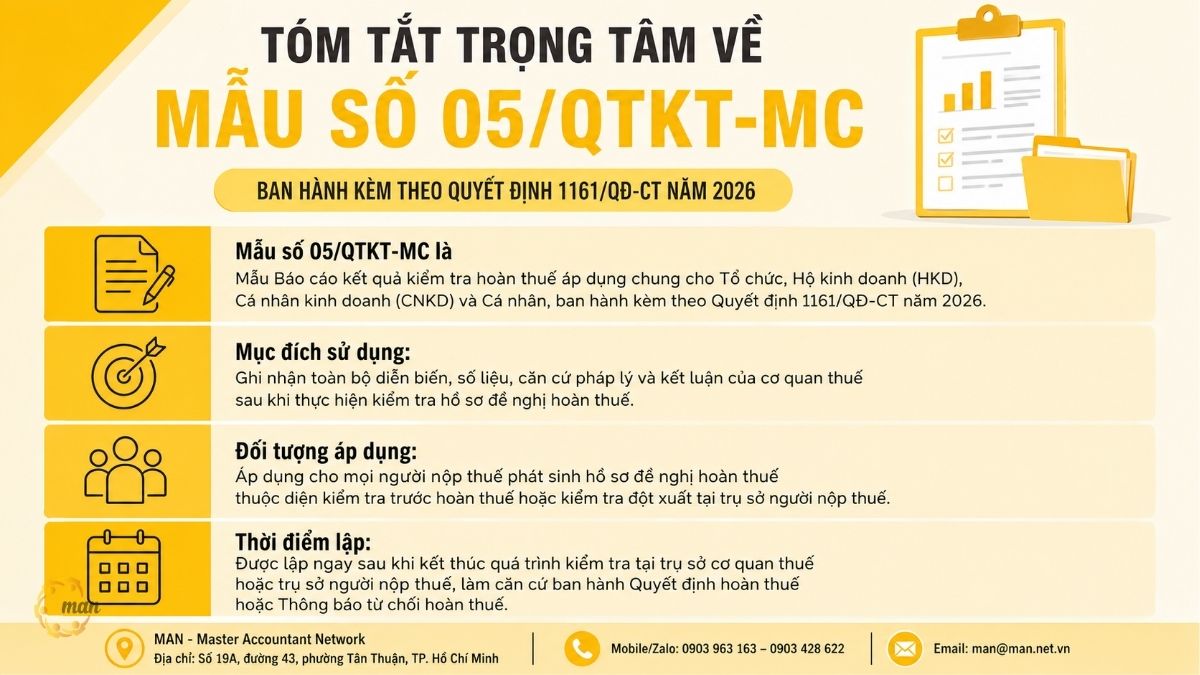
- Form No. 05/QTKT-MC is The Tax Refund Verification Report Form, applicable to Organizations, Household Businesses (HKD), Individual Businesses (CNKD), and Individuals, is issued together with Decision 1161/QD-CT of 2026.
- Purpose of use: Record all developments, data, legal basis, and conclusions of the tax authorities after conducting an inspection of the tax refund application.
- Applicable objects: This applies to all taxpayers whose tax refund applications are subject to pre-refund audits or unannounced audits at the taxpayer's premises.
- Date of creation: Prepared immediately after the completion of the inspection at the tax authority's headquarters or the taxpayer's premises, it serves as the basis for issuing the Tax Refund Decision or the Tax Refund Refusal Notice.
What is Form No. 05/QTKT-MC and what are the basic legal regulations in 2026?
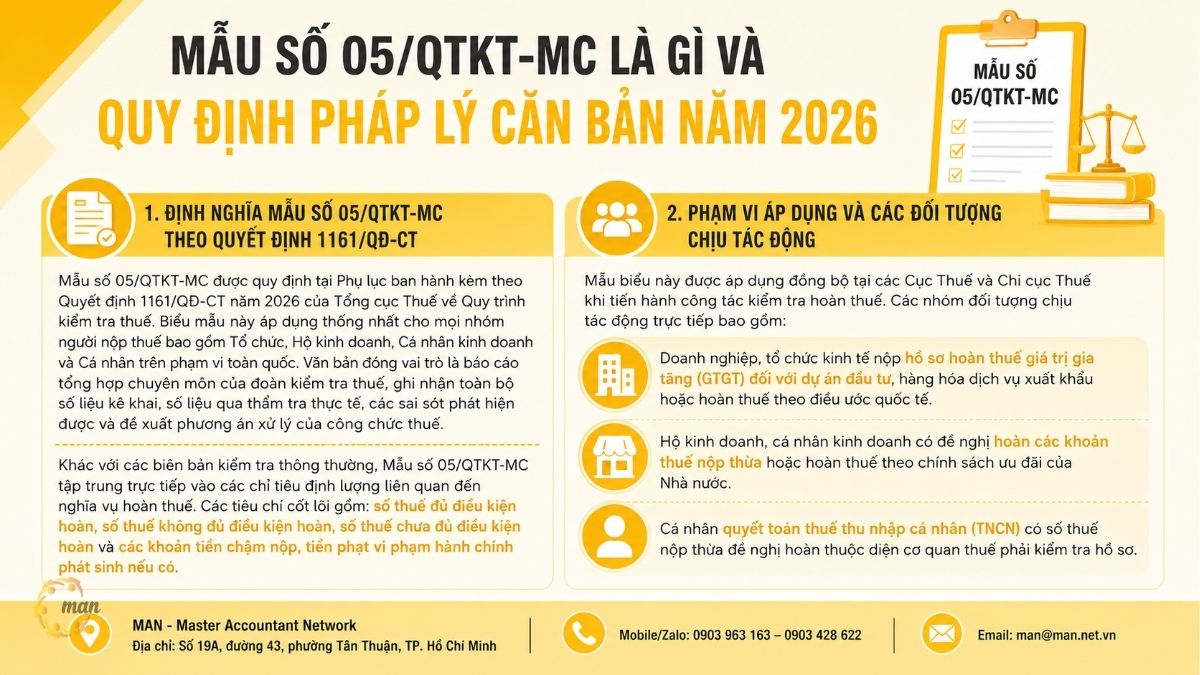
Definition of Form No. 05/QTKT-MC according to Decision 1161/QD-CT
Form No. 05/QTKT-MC is stipulated in the Appendix attached to Decision 1161/QD-CT of 2026 by the General Department of Taxation on the Tax Inspection Process. This form is uniformly applied to all groups of taxpayers, including organizations, household businesses, individual businesses, and individuals nationwide. The document serves as a comprehensive professional report of the tax inspection team, recording all declared data, data verified through on-site inspection, detected errors, and proposed solutions by tax officials.
Unlike standard inspection reports, Form No. 05/QTKT-MC focuses directly on quantitative indicators related to tax refund obligations. The core criteria include: the amount of tax eligible for refund, the amount of tax ineligible for refund, the amount of tax not yet eligible for refund, and any late payment penalties or administrative fines incurred.
Scope of application and affected subjects
This form is applied uniformly at all Tax Departments and Tax Branches when conducting tax refund audits. The groups directly affected include:
- Businesses and economic organizations pay Value Added Tax (VAT) refund application for investment projects, Exported goods and services, or tax refunds under international agreements.
- Household businesses and individual business owners may request a refund of overpaid taxes or a tax refund under the State's preferential policies.
- Individual Personal income tax settlement There are cases where overpaid taxes are requested for refund and the tax authorities are required to review the records.
The role of Form 05/QTKT-MC in tax risk management and tax refunds.
Legal review of the tax refund verification document
Form No. 05/QTKT-MC serves as a bridge between the on-site inspection and the administrative tax decision. Without this report, the tax authority cannot issue a tax refund decision or a decision on handling tax violations. The document demonstrates the transparency and accountability of tax officials before the law.
From MAN's perspective, the figures recorded in Form 05/QTKT-MC are highly binding. Once tax officials have concluded that expenses or input taxes are ineligible for refund in this report, appealing or providing further explanations at a later stage will be very difficult and time-consuming.
Impact on the company's cash flow and financial plans.
The results recorded on Form 05/QTKT-MC directly affect the speed of tax refund disbursement for businesses. A clean audit report allows businesses to receive their refunds within a few working days. Conversely, if the report points out unresolved issues, the business's cash flow will be significantly disrupted.
The team of experts with over 30 years of experience at MAN notes that many export-oriented manufacturing businesses are heavily dependent on cash. VAT refund to reinvest working capital. The backlog of applications due to inspection reports identifying risks can disrupt the supply chain or result in unnecessary interest expenses for businesses.
When does the tax authority prepare Form No. 05/QTKT-MC? Key timelines.
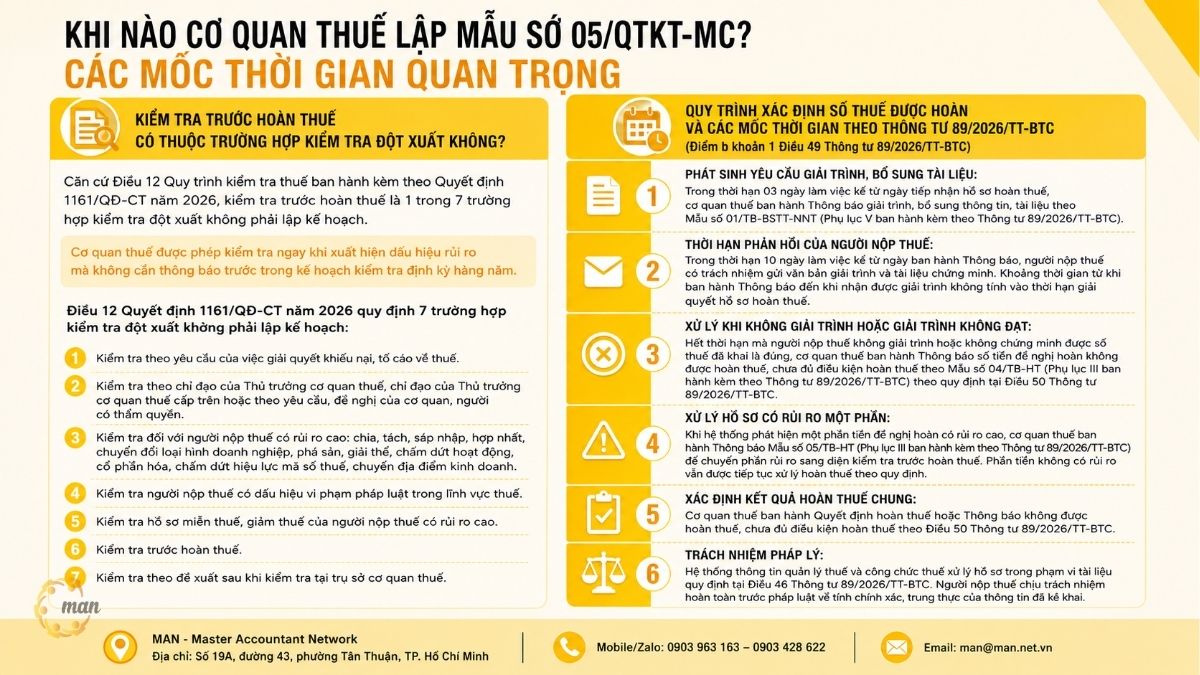
Does a pre-refund audit fall under the category of a surprise audit?
Based on Article 12 of the Tax Inspection Procedure issued with Decision 1161/QD-CT of 2026, pre-refund inspection is one of seven cases of unscheduled inspections that do not require planning. This regulation allows tax authorities to conduct inspections immediately upon the appearance of risk signs without prior notice in the annual periodic inspection plan.
Specifically, Article 12 of Decision 1161/QD-CT of 2026 fully stipulates 7 cases of unannounced inspections that do not require planning, including:
- Inspections are conducted as required in the resolution of tax-related complaints and denunciations.
- Inspections are conducted as directed by the head of the tax authority, as directed by the head of a higher-level tax authority, or at the request or suggestion of an authorized agency or person.
- High-risk taxpayer audits are conducted in the following cases: division, separation, merger, consolidation, conversion of business type, bankruptcy, dissolution, cessation of operations, privatization, termination of tax identification number, and relocation of business.
- Investigate taxpayers for signs of violating tax laws.
- Review tax exemption and reduction records of high-risk taxpayers.
- Pre-refund verification.
- The inspection will be conducted as requested following the inspection at the tax office headquarters.
The process for determining the amount of tax to be refunded and the timelines are outlined in Circular 89/2026/TT-BTC.
According to point b, clause 1, Article 49 of Circular 89/2026/TT-BTC, the determination of the tax refund amount for tax refund applications eligible for early refund is carried out through the Tax Management Information System with specific timelines:
- In case further clarification or additional documentation is required: Within 3 working days from the date of receiving the tax refund application, the tax authority shall issue a Notice of Explanation and Supplementation of Information and Documents according to Form No. 01/TB-BSTT-NNT (Appendix V issued with Circular 89/2026/TT-BTC).
- Taxpayer response deadline: Within 10 working days from the date of issuance of the Notice, the taxpayer is responsible for submitting a written explanation and supporting documents. The period from the issuance of the Notice to the receipt of the explanation is not included in the processing time for the tax refund application.
- What to do when an explanation is not provided or the explanation is unsatisfactory: If, after the deadline, the taxpayer fails to explain or prove that the declared tax amount is correct, the tax authority will issue a Notice stating that the requested refund amount is not eligible for refund or does not meet the conditions for a refund, using Form No. 04/TB-HT (Appendix III issued with Circular 89/2026/TT-BTC) as stipulated in Article 50 of Circular 89/2026/TT-BTC.
- Handling applications with partial risk: When the system detects that a portion of the requested refund is high-risk, the tax authority issues Notice Form No. 05/TB-HT (Appendix III issued with Circular 89/2026/TT-BTC) to transfer the high-risk portion to the pre-refund verification category. The non-risk portion continues to be processed for refund according to regulations.
- Determine the overall tax refund result: The tax authority issues a Decision on tax refund or a Notice of non-refundable tax, indicating that the applicant does not meet the eligibility requirements for a tax refund, in accordance with Article 50 of Circular 89/2026/TT-BTC.
- Legal responsibility: The tax management information system and tax officials process documents within the scope of the documents stipulated in Article 46 of Circular 89/2026/TT-BTC. Taxpayers are fully responsible before the law for the accuracy and truthfulness of the information declared.
Compilation of legal documents related to Form No. 05/QTKT-MC
To ensure proper compliance with procedures and protect their rights when dealing with tax audit teams, businesses should take note of the following legal regulations:
| Legal documents | Date of issuance / Effective date | Summary of information related to tax refunds |
| Decision 1161/QD-CT of 2026 | Issued in 2026 | Regulations on tax inspection procedures, issuance of Form No. 05/QTKT-MC and a list of 7 cases for unscheduled inspections. |
| Circular 89/2026/TT-BTC | Issued in 2026 | Guidance on the Law on Tax Administration, detailing Articles 46, 49, and 50 regarding tax refund documents and procedures, and notification forms 01/TB-BSTT-NNT, 04/TB-HT, and 05/TB-HT. |
| Law on Tax Administration 38/2019/QH14 | Effective from July 1, 2020 | The legal framework provides a foundation for regulating the rights and obligations of taxpayers, the tax refund process, and tax audits. |
| Decree 125/2020/ND-CP | Effective from December 5, 2020 | Regulations on administrative penalties for tax and invoice violations based on errors discovered during tax refund audits. |
The 5-step process for handling applications during pre-refund audits.
When a business's tax refund application is transferred to the pre-refund audit category, the processing time from receipt to issuance of Form No. 05/QTKT-MC goes through 5 standard steps:
- Step 1: Receive and classify documents on the system: The tax management information system automatically cross-checks the tax declaration data of businesses with the industry-wide database. If signs of risk are detected, the tax authority issues Notice Form No. 05/TB-HT to transfer the file to the pre-refund audit category.
- Step 2: Review the invoice and cash flow database: Tax officials conduct cross-checking of businesses' electronic input invoices with those of their suppliers. The system automatically scans invoices issued by businesses that have absconded, ceased operations, or show signs of illegal invoice trading.
- Step 3: Request explanations and gather additional documents: The tax authority sends Notice Form No. 01/TB-BSTT-NNT. Businesses have 10 working days to prepare contracts, bank payment documents, customs declarations, delivery and receipt records, and related accounting books as stipulated in Article 46 of Circular 89/2026/TT-BTC.
- Step 4: On-site inspection at the taxpayer's premises: For complex cases, the tax inspection team conducts on-site inspections at the business premises. The inspection focuses on production capacity, warehousing, machinery and equipment, workforce, and the authenticity of exported goods.
- Step 5: Prepare Report Form No. 05/QTKT-MC and make a decision: After completing the verification, the Head of the Inspection Team compiles the data and prepares Form No. 05/QTKT-MC to submit to the Head of the Tax Authority. Based on this report, the tax authority issues a Decision on tax refund or a Notice Form No. 04/TB-HT for the amount that is not eligible for refund.
Real-world case study: Managing VAT refund risks for import-export businesses.
Situational context
In March 2026, An Khanh Agricultural Products Co., Ltd. (name changed) submitted an application for a refund of VND 12.5 billion in VAT for agricultural exports from June to December 2025.
However, the Tax Management Information System scanned the data and discovered that three businesses supplying raw materials to An Khanh were on the list of high-risk businesses in other localities. The tax authorities immediately transferred the files to the pre-refund audit category and conducted an on-site inspection.
Risk defects detected during inspection.
During the inspection, the inspection team discovered several inconsistencies:
- A shipment worth 3.2 billion VND purchased from Company X had bank payment documents, but after being transferred to Company X, the money was immediately withdrawn in cash at an ATM by an individual not affiliated with the management team.
- The export freight contract lacks a detailed list of vehicle numbers and driver names involved in the transportation.
- The material loss rate during export processing is 15% higher than the initially registered standard.
Intervention solutions from a MAN expert's perspective.
Upon receiving this case, experts at MAN, with 30 years of experience, collaborated with An Khanh's accounting department to implement the following key processing steps:
- Provide factual evidence: Collect all vehicle weighing slips at the receiving warehouse, GPS location data from the outsourced shipping company, and actual photos of the container loading process.
- Prove the legitimacy of the cash flow: Working with the bank to confirm that An Khanh's payment transaction to Company X was entirely in accordance with the regulations and guidelines for money transfers, An Khanh was not involved in or aware of the seller's cash withdrawal activities.
- Explanation of the loss rate: An independent inspection unit is invited to reassess the quality of agricultural inputs for the 2025 harvest season (affected by bad weather which increased the spoilage rate) in order to provide a reasonable explanation for the loss figures.
Actual results achieved
Thanks to the transparent and thorough documentation, the tax inspection team accepted the explanation for the requested tax refund of 10.8 billion VND. Regarding the 1.7 billion VND tax related to Company X, which is currently under investigation for invoice verification, the tax authorities recorded it in Form 05/QTKT-MC as "not yet eligible for refund" pending verification from relevant authorities, instead of concluding that it was a violation and imposing penalties.
An Khanh received 10.8 billion VND in tax refunds just 5 working days after signing Report Form No. 05/QTKT-MC, helping the company relieve financial pressure.
Comparison table of pre-refund audit and post-refund audit
To help managers clearly distinguish the tax authority's processing mechanisms, here is a detailed comparison table between the two forms of tax refund verification:
| Distinguishing criteria | Pre-refund check | Post-refund audit |
| Legal basis | Clause 6, Article 12 of Decision 1161/QD-CT | Post-refund verification process |
| Time of execution | This must be done before the tax authorities disburse the refund. | This must be implemented within 05 years from the date of issuance of the tax refund decision. |
| Applicable objects | Businesses classified as high-risk, businesses established less than 24 months ago, and businesses showing signs of violations. | The company has a good history of tax compliance, and its records qualify for a "refund first, audit later" policy. |
| Sample results report | Use Form No. 05/QTKT-MC. | Use the General Tax Audit Results Report Template. |
| Impact on cash flow | The tax refund will be held until a satisfactory audit is concluded. | Businesses receive tax refunds first, and then are subject to audits and reviews later. |
| Financial risks | The main risk is not receiving a tax refund or experiencing delays in receiving the money. | The risk is that the tax received will be reclaimed, along with a penalty of 20% and a late payment fee of 0.03%/day. |
Expert opinion from MAN – Master Accountant Network on Form No. 05/QTKT-MC
Common filing pitfalls that delay tax refund applications.
Through practical consulting experience with hundreds of businesses in Vietnam, the solution from MAN – Master Accountant Network indicates that the main reason why Form 05/QTKT-MC results in an unfavorable outcome for a business is not always due to intentional fraud. Many cases stem from carelessness in document management.
- The discrepancy between tax returns and electronic invoices: Businesses declare taxes based on the date the invoice is issued, but the date of payment transfer or delivery documents falls in a different period.
- Buying from high-risk businesses: Businesses do not proactively check the operational status of their partners on the General Department of Taxation's portal at the time the transaction occurs.
- Customs documents are incomplete: There is an inaccuracy in matching the information on the export customs declaration form with the international payment transaction code data from the bank.
Methods for risk assessment of invoices and reconciliation of electronic invoices.
Experts at MAN, with 30 years of experience, note that tax authorities are currently operating highly sophisticated invoice chain analysis algorithms. These systems can trace back from the direct seller to intermediate supply chain layers to identify the points of failure in tax obligations.
To prevent the risk of being recorded negatively in Form 05/QTKT-MC, businesses need to proactively establish internal control procedures. All high-value input invoices must be verified at three points: the operating status of the seller, the actual supply capacity of the seller, and the bank payment documents of the rightful owner.
Sustainable risk management strategy for tax refund applications
An effective tax refund strategy doesn't begin when filing the refund application, but rather in the daily accounting process. Businesses should:
- Conduct a quarterly tax health check.
- Prepare explanatory documents for large or unusual expenses in the period in which they are incurred, in accordance with Article 46 of Circular 89/2026/TT-BTC.
- Utilize professional tax consulting services to assess the risk level of your filing before submitting it to the tax authority's system.
Conclude
Form No. 05/QTKT-MC, as per Decision 1161/QD-CT of 2026, is a crucial operational document that determines the outcome of the entire tax refund audit process. Understanding the evaluation criteria, preparation procedures, and relevant legal regulations, such as Circular 89/2026/TT-BTC, helps businesses shift from a passive to an active approach, controlling risks and protecting their rightful tax refunds.
Having partnered with the business community for over three decades, MAN – Master Accountant Network proudly stands as a leading provider of comprehensive tax and accounting solutions. With in-depth tax consulting services, full-service tax accounting, tax settlement services, and professional tax reporting services, MAN's team of experienced experts is always ready to support businesses in optimizing tax costs, reviewing risks in tax refund applications, and working effectively with tax authorities nationwide.
Tax services at MAN – Master Accountant Network
- Tax accounting services
- Tax consulting services
- Tax settlement services
- Tax reporting services
- VAT refund service
Service contact information at MAN – Master Accountant Network
- Address: No. 19A, Street 43, Tan Thuan Ward, Ho Chi Minh City
- Mobile/Zalo: 0903 963 163 – 0903 428 622
- E-mail: man@man.net.vn
- Google Business Profile: View MAN – Master Accountant Network's Google Business Profile
- LinkedIn Founder: View expert Le Hoang Tuyen's LinkedIn profile.
Responsible for production and professional content review by: Mr. Le Hoang Tuyen – Founder & CEO of MAN – Master Accountant Network, CPA Vietnam with over 30 years of experience in accounting, auditing, taxation, and corporate financial consulting.
FAQ – Frequently Asked Questions about Form No. 05/QTKT-MC
Is Form No. 05/QTKT-MC a record of administrative violation penalties?
No. Form 05/QTKT-MC is the Tax Refund Inspection Report, used to summarize the content and propose solutions by the inspection team. If violations are detected, the tax authority will use this report to issue a separate Administrative Violation Report and a separate Penalty Decision.
Can businesses sign Form No. 05/QTKT-MC directly?
Form No. 05/QTKT-MC is a document prepared and signed by the Head of the Inspection Team and its members, and submitted to the Head of the Tax Authority. The taxpayer will work with and sign the Tax Inspection Report attached to this report.
How long does it take to complete Form 05/QTKT-MC after the inspection is finished?
According to the tax audit procedures issued with Decision 1161/QD-CT of 2026, within 3 working days from the date of completion of the audit at the taxpayer's premises or the completion of the document assessment, the audit team must complete Form No. 05/QTKT-MC to submit to the competent authority.
What should a business do if it disagrees with the conclusions in Form No. 05/QTKT-MC?
Businesses have the right to record their reservations in the Tax Audit Report. After the tax authority issues a Decision on Non-Refund or a Decision on Tax Handling based on Form No. 05/QTKT-MC, the business has the right to initiate administrative appeal procedures or file a lawsuit in court as prescribed by law.
Will the amount deemed ineligible for refund in Form No. 05/QTKT-MC be lost?
No. This amount has not been completely rejected. Once the business provides complete supporting documentation or once the tax authorities receive verification results from relevant agencies, the business can resubmit a request for further processing of this tax amount.