

The new personal income tax provisions in 2026 mark a comprehensive transformation of Vietnam's tax legal system, based on Law on Personal Income Tax No. 109/2025/QH15, as amended and supplemented at Law No. 09/2026/QH16, Decree No. 253/2026/ND-CP and Circular No. 87/2026/TT-BTC. These changes aim to adapt to the digital economy, modern financial markets, and ensure social security for the people.
Keeping up-to-date with new legal regulations helps businesses and taxpayers proactively optimize financial costs and avoid legal risks arising during tax audits and settlements. Experts at MAN, with 30 years of experience, note that inaccurate tax data updates can lead to unnecessary financial losses for businesses in this accounting year.
Summary of key points regarding the new personal income tax regulations in 2026.

- Nature: The new points regarding personal income tax in 2026 include changes to taxable subjects, tax exemptions, family deductions, and the progressive tax rate schedule, effective from July 1, 2026, according to Law 109/2025/QH15.
- Purpose of use: Determine the correct amount of personal income tax payable, the portion of income exempted, and the new deductions when settling your tax return.
- Applicable objects: Individuals, both resident and non-resident, who have income from salaries, wages, business activities, capital investments, and property transfers in Vietnam.
- Effective date: Starting from the July 2026 tax period, a review is mandatory during the 2026 tax settlement (deadline March 2027).
Legal framework for personal income tax 2026
The 2026 personal income tax legal system is built on three core documents. The issuance of these documents aims to address practical bottlenecks in tax administration that have existed for many years.
- Personal Income Tax Law No. 109/2025/QH15Approved by the National Assembly on December 10, 2025, and amended and supplemented by Law No. 09/2026/QH16 dated April 24, 2026. This is the highest-ranking legal document directly regulating taxable income groups and tax schedules.
- Decree No. 253/2026/ND-CPIssued on June 30, 2026, this document provides detailed regulations and organizational measures for the implementation of the Personal Income Tax Law. It specifically guides the determination of income from business activities, salaries, wages, and tax exemptions and reductions.
- Circular No. 87/2026/TT-BTCIssued on June 30, 2026, these regulations provide detailed provisions for the Law and Decree, focusing primarily on dependents and derivative securities. These documents form a complete legal framework for tax auditing and accounting in Vietnam.
New points in the Personal Income Tax Law No. 109/2025/QH15 and Law No. 09/2026/QH16

The new law brings about many fundamental changes to the income structure and the method of calculating taxpayers' financial obligations.
1. How taxes are calculated and taxable income categories
Revise and improve the method of calculating taxes and taxable income for each type of income; restructure and adjust the titles of some articles to correspond with the revised content.
Adding other taxable income categories to include the transfer of Vietnamese national domain names. .vn, The results include reductions in greenhouse gas emissions, carbon credits, gold bars, auctioned license plates, and digital assets.
For other capital transfer transactions, when the purchase price and related costs cannot be determined, personal income tax It is calculated by multiplying the selling price by the rate of 2%. This regulation applies uniformly to both resident and non-resident individuals.
2. Tax-exempt income from science, technology, high-quality human resources, and other fields.
The personal income tax incentive policy for 2026 will pay special attention to the fields of science and technology, innovation, highly skilled human resources, green economy, and investment.
- Science and technologyIncome from salaries and wages of individuals performing scientific, technological, and innovative tasks is exempt from tax.
- High-quality human resourcesTax exemption for 5 years on income from salaries and wages of high-quality digital technology industry personnel; tax exemption for 5 years on income from salaries and wages of high-tech personnel conducting research and development of high-tech or strategic technologies.
- Labor, pensions, green economy, and investmentTax exemption applies to interest on local government bonds, all night work wages, overtime pay, and wages paid for non-holiday work. Tax exemption is also extended to pensions paid by the Social Insurance Fund and income paid by supplementary pension insurance funds and voluntary pension funds, including both monthly and lump-sum payments.
- Green economy and investment funds: Exemption from transfer tax on the first transfer of greenhouse gas emission reductions, carbon credits, green bond interest, and the first transfer of green bonds after issuance. Exemption from transfer tax on open-ended fund certificates held for 2 years or more, and a reduction in tax on income from securities investment funds and real estate investment funds for a period stipulated by the Government.
3. Personal income tax for household and individual businesses.
Tax policies for household and individual businesses have undergone a landmark change aimed at reducing the compliance burden.
The revenue threshold for exemption from personal income tax under Law No. 109/2025/QH15 was raised from 200 million to 500 million VND per year. Subsequently, Law No. 09/2026/QH16 tasked the Government with making adjustments, and Government Decree No. 141/2026/ND-CP dated April 29, 2026, further raised it to 1 billion VND per year, allowing for the deduction of this threshold before calculating tax based on a percentage of revenue.
For revenue between 1 and 3 billion VND, the applicable tax rate is 15% on income, and individuals have the right to choose whether to calculate it as a percentage of revenue or as a percentage of income. Revenue between 3 and 50 billion VND applies a tax rate of 17% on income, and revenue exceeding 50 billion VND applies a tax rate of 20% on income.
Real estate rental activities, excluding accommodation businesses, are taxed by multiplying the annual revenue exceeding 1 billion VND by 5%. Digital information content products and services are subject to the 5% tax rate for certain income from entertainment, video games, and specific activities.
4. Personal deductions and other deductions
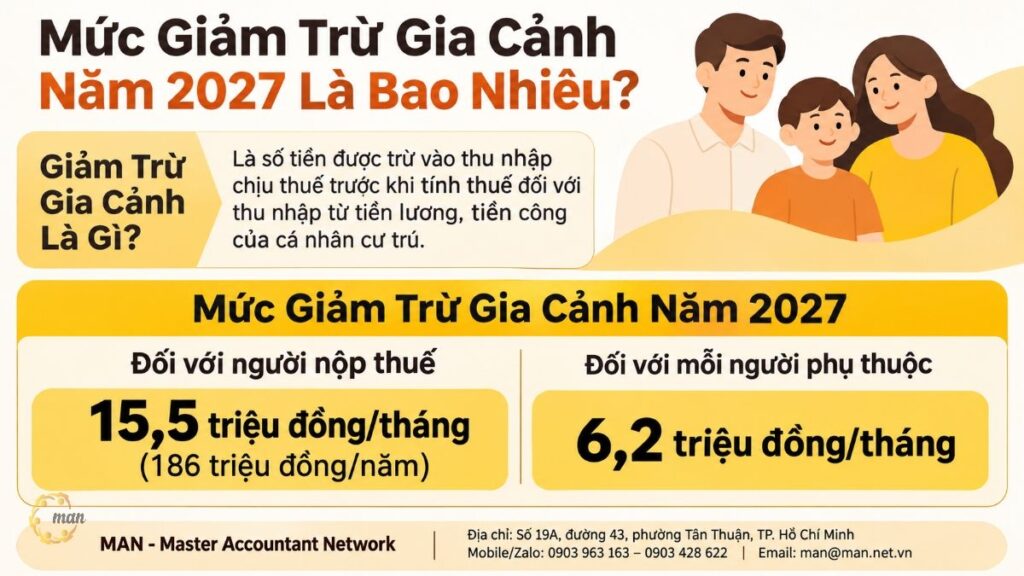
The personal tax deduction has been increased to VND 15.5 million per month. The deduction for each dependent has been increased to VND 6.2 million per month.
The Government is tasked with submitting to the Standing Committee of the National Assembly a proposal to adjust the tax deduction based on price and income fluctuations, no longer requiring the Consumer Price Index (CPI) to fluctuate above 20% before any adjustments can be made.
Add deductions for medical and educational expenses before calculating taxes for taxpayers.
5. Progressive tax rate schedule and tax thresholds
This applies to resident individuals with income from salaries and wages. The number of tax brackets has been reduced from 7 to 5, while the gap between brackets has been widened to simplify the tax schedule and better reflect actual income levels.
The tax threshold for certain income sources has been raised to the amount exceeding 20 million VND, instead of the previous threshold of 10 million VND. This regulation applies to income from lottery winnings, royalties, franchise fees, inheritances, and gifts.
New points in Decree No. 253/2026/ND-CP
Decree No. 253/2026/ND-CP provides detailed regulations and organizational measures to guide the implementation of the Personal Income Tax Law, with many specific contents regarding each tax type.
1. Taxpayers and identification of resident and non-resident individuals (Articles 2 to 5)
The regulations specify the scope of application in a separate article, encompassing taxpayers, tax authorities, and other relevant organizations and individuals. The regulations concerning taxpayers, resident and non-resident individuals essentially inherit the provisions of the current personal income tax guidelines.
2. Income from business activities (Article 7)
Expand and specify income categories, including insurance agents, lottery, multi-level marketing, brokerage, business partnerships with organizations and enterprises, e-commerce, and digital platform-based businesses.
Independent professional income is defined as the income of an individual holding a professional license or certificate and registered business. The regulations are designed to be consistent with commercial law and tax management policies for household and individual businesses.
3. Income from salaries and wages (Article 8 and related provisions)
Remuneration for services provided by individuals who are not registered for business or tax purposes, whether or not they possess a license or professional certificate, is considered income from salaries and wages.
The regulations stipulate that only the portion exceeding 1.2 million VND per person per month for meal allowances during work shifts and lunches will be included in taxable income, effective from July 1, 2026. In cases where meals are provided directly, meals are purchased, or meal vouchers are issued, no tax will be applied.
Housing benefits provided by the employer are not included in taxable income, including electricity, water, and related services, regardless of location. If the employer pays for the rent, the amount is calculated based on the actual amount paid, including electricity, water, and related services, but not exceeding 15% of the total taxable income generated at the unit.
Additional allowances for hazardous and dangerous work, and in-kind compensation, are provided for occupations or jobs with hazardous or dangerous elements. Allowances, subsidies, and living expenses paid by Vietnamese agencies abroad to their members, spouses, and accompanying children are exempt from tax. Amounts from trade union funds that are not considered salaries or wages are also exempt from tax. Nutritional and special health and physiological care benefits for female members of sports teams, as stipulated by regulations, are also exempt from tax.
Severance pay and unemployment benefits as stipulated by law are not included in taxable personal income. If internal regulations, rules, collective labor agreements, or employment contracts stipulate a higher severance pay amount than that specified in the Labor Code, the excess amount is also not included in taxable income.
Regarding deductible insurance and dependent registration under Article 46, in addition to mandatory insurance, voluntary social insurance, and voluntary health insurance, taxpayers are also allowed to deduct supplementary retirement insurance, voluntary retirement insurance, and life insurance. The maximum deduction is VND 3 million per month per person, including the employer's and employee's contributions for retirement and life insurance products. Dependent registration must be completed along with supporting documents before December 31st of the tax year and remains consistent for subsequent years unless otherwise stated.
Regarding deductions for medical and educational expenses in Article 49, the regulations apply to expenses incurred by the taxpayer themselves and their dependents when calculating income from salaries and wages. The total deduction for medical examination and treatment expenses at domestic medical facilities covered by health insurance is no more than 23 million VND per year. The total deduction for educational expenses at domestic institutions is no more than 24 million VND per year, including tuition fees for all levels of education and other professional skills training.
Article 50 raises the 10% withholding threshold for contracts under 3 months or without a contract from VND 2 million per payment to VND 5 million per payment. Organizations and individuals paying VND 5 million or more per payment must withhold, declare, and pay tax at the 10% rate before paying the income. Payments under VND 5 million per payment are subject to 10% withholding when the individual requests it. This regulation also applies to payments to employees whose employment contracts have been terminated.
Article 50 clearly distinguishes between bonus shares and ESOP shares To protect taxpayers' rights, tax does not arise when receiving shares but only when individuals transfer them. For bonus shares, taxable income is based on the amount recorded in the books; if this cannot be determined, it is calculated based on the actual number of shares received multiplied by their par value or market price (if the transfer price is lower than the par value). For ESOP shares, the same basis applies, but the amount already paid to the employee is deducted; if the difference is negative, no tax on salary or wages arises.
Article 51 raises the average monthly threshold for incidental income not subject to tax settlement from 10 million to 15 million VND per month. Individuals with additional income from other sources, averaging no more than 15 million VND per month during the year and already subject to withholding tax, are not required to settle this additional income. When individuals file their tax returns directly, the tax management system will assist in aggregating all income sources and the amount of tax already withheld.
4. Capital Transfer (Article 10)
Income from contributing capital in the form of equity or securities to establish a business or increase business capital is defined as income from capital transfer. Individuals, both domestic and foreign, selling their entire private enterprise or single-member limited liability company, in the form of capital transfer involving real estate, is defined as income from real estate transfer.
5. Other income groups subject to tax (Article 16, Article 62)
The 5% tax rate applies to the portion of income exceeding 20 million VND per transaction for domain name transfers. .vn, Income is determined based on reduced greenhouse gas emissions, carbon credits, and auctioned license plates. For auctioned license plates, taxable income is calculated by subtracting the remaining value of the vehicle based on the registration fee from the transfer price exceeding 20 million VND. For digital assets, personal income tax is calculated by multiplying the transfer price by 0.1%, including virtual assets, crypto assets, and other digital assets as defined by law. Income is determined when the organization or individual makes the payment or when the taxpayer receives the income.
6. Detailed cases of tax exemption and reduction.
- Real estate, cooperatives, and agriculture: Exemption from real estate transfer tax between parents-in-law, spouses, and daughters-in-law/sons-in-law, even in cases where the spouse has died. Exemption from dividend tax for members of agricultural cooperatives and cooperative unions. Individuals participating in large-scale farming, afforestation, and aquaculture must have legal right to use or lease land and water surface and actually reside in the locality where the activity takes place.
- Interest on bonds and certificates of depositInterest on local government bonds issued by provincial People's Committees is tax-exempt. Interest on certificates of deposit, including interest received from the transfer of certificates of deposit, is also tax-exempt.
- Labor and vacation days: Full exemption from wages and salaries for night work and overtime work that meets the conditions and time limits stipulated by labor law, no longer just for the higher portion. Businesses must prepare a statement or provide proof through payroll records, time sheets, labor contracts, and other legal documents. Exemption from tax on wages and salaries paid for non-leave days if they meet the conditions and rates stipulated by labor law for civil servants and public employees.
- Pension fundIncome tax exemption applies to contributions from supplementary pension insurance funds and voluntary pension funds, regardless of whether they are paid periodically or in a lump sum, before or after retirement age.
- Green economy and scientific tasksGreen economy benefits from tax exemptions on the first transfer of greenhouse gas emission reduction results, carbon credits, green bond interest, and the first transfer of green bonds after issuance. Scientific tasks funded by the state budget are exempt from salaries and wages as remuneration for participation in tasks approved by competent authorities. Tasks not funded by the state budget, approved and implemented by enterprises using legitimate funding sources, require enterprises to have internal procedures and be responsible for the suitability of the task.
- Copyright and Creative StartupsIncome tax exemption for copyright of scientific, technological, and innovative projects when the project results are commercialized in accordance with the law. Income tax exemption for capital investment by individual investors in innovative startup projects, founders of innovative startup businesses, and investors contributing capital to venture capital funds. Exemption from salary and wage tax for experts supporting innovative startups from innovative startup projects or businesses as prescribed by law.
- Peacekeeping forces and business ownersIncome tax exemption for salaries and wages of individuals participating in peacekeeping forces. Income tax exemption for owners of private enterprises and individuals who are owners of single-member limited liability companies established under Vietnamese law, received after the enterprise has fulfilled its corporate income tax obligations.
- Digital and high-tech workforceTax exemption for 5 years on salaries and wages from digital technology industrial projects in concentrated digital technology zones; income from research, development, and production projects of key digital technology products, semiconductor chips, and artificial intelligence systems; and income from training human resources for the digital technology industry. Tax exemption on salaries and wages from research and development of high-tech technologies included in the List of High-Tech Technologies prioritized for investment and development, and research and development of strategic technologies included in the List of Strategic Technologies or the List of Strategic Technology Products.
- Investment fund: Exemption from personal income tax on the transfer of open-ended fund certificates held for 2 years or more from the date of purchase. Reduction of personal income tax on dividends received by individual investors from securities investment funds or real estate investment funds established under the Securities Law, applicable from July 1, 2026 to June 30, 2031.
7. Tax thresholds for lottery winnings and royalties.
Raise the tax threshold from income exceeding 10 million VND to income exceeding 20 million VND. This applies to winnings, royalties, franchise fees, inheritance, gifts, and other income as stipulated in Articles 58 to 61 of the Decree.
8. Tax deductions, tax declarations and tax payments on behalf of others (Article 67)
The regulations add responsible entities including the owners of e-commerce platforms, digital platforms with ordering and payment functions, organizations acting as agents selling insurance, lottery tickets, and multi-level marketing products at fixed prices, and organizations that sign brokerage contracts. This includes organizations and individuals paying income to non-resident individuals, and Vietnamese parties reimbursing salaries and wages to foreign parties. The regulations also stipulate the responsibility for withholding, declaring, and paying taxes on income generated through e-commerce and digital platforms.
Non-deductible income, including income declared and paid on behalf of others, includes certain income of resident individuals from business activities, capital transfers, real estate transfers, inheritances, and gifts. Tax withheld on salaries and wages is determined based on the tax payable and the provisional tax paid according to the Decree. For resident individuals with business income, the tax withheld, declared, and paid on behalf of others is determined based on the tax rate on the generated revenue, conducted through platforms governed by tax management laws. If no tax has been withheld during the year but the individual is subject to tax at the end of the year, they can self-declare and pay annually, or self-declare when receiving income from foreign organizations not registered for tax in Vietnam.
New points in Circular No. 87/2026/TT-BTC

Circular No. 87/2026/TT-BTC provides detailed regulations on the Personal Income Tax Law and Decree No. 253/2026/ND-CP with the following three core contents.
1. Income level for determining dependents
A dependent is a person who has no income or whose average monthly income from all sources during the year does not exceed 3 million VND. This level is determined based on the average income, average expenditure, and income criteria of poor and near-poor households in the period 2026–2030.
2. Documents identifying dependents eligible for personal allowance deductions.
The regulations inherit the current documentation requirements and add supplementary documentation for new cases such as individuals lacking legal capacity. The regulations specify more clearly the criteria for individuals unable to work and other dependents who are directly supported by the taxpayer. The tax authorities prioritize accessing data from the National Public Service Portal, the administrative procedure processing system, national databases, and specialized databases. Only when data cannot be accessed will the taxpayer be required to provide relevant documents to prove dependent status.
3. Personal income tax on the transfer of derivative securities.
Circulars guiding the implementation and trading of derivative securities in the form of futures contracts on the market stipulate that personal income tax (PIT) is calculated as the transfer price multiplied by 0.1% for each transfer. The transfer price of each futures contract is calculated as the settlement price multiplied by the contract multiplier multiplier, the number of contracts multiplied by the initial margin ratio, divided by 2. The time of income determination is the time of matching buy or sell orders on the Stock Exchange system or the time the futures contract expires.
Comparison table of key new features of personal income tax
Personal income tax in 2026 will see several notable changes, from family allowance deductions and progressive tax rates to tax-exempt revenue thresholds and conditions for determining dependents. These adjustments aim to reduce tax obligations for many individuals while simplifying declaration and settlement procedures. The table below summarizes the core new points for easy reference and comparison.
| Content criteria | Previous regulations | New regulations in 2026 | Legal basis for application |
| Tax-exempt revenue for household businesses | 200 million VND/year | 1 billion VND/year | Decree No. 141/2026/ND-CP |
| Taxpayer's personal deduction | 11 million VND/month | 15.5 million VND/month | Personal Income Tax Law No. 109/2025/QH15 |
| Dependent deduction | 4.4 million VND/month | 6.2 million VND/month | Personal Income Tax Law No. 109/2025/QH15 |
| Progressive tax schedule | 7 tax brackets | 5 tax brackets | Personal Income Tax Law No. 109/2025/QH15 |
| Short-term contract discount threshold | 2 million VND/time | 5 million VND/time | Decree No. 253/2026/ND-CP |
| Maximum dependent income | 1 million VND/month | 3 million VND/month | Circular No. 87/2026/TT-BTC |
Expert analysis of risks and practical tax management solutions.
Experts at MAN, with 30 years of experience, believe that the biggest risk for businesses in the 2026 tax year lies in misclassifying income from salaries and independent service fees. Many businesses incorrectly apply the 10% deduction rate to itinerant service contracts under 5 million VND when the individual has not made a specific request.
Furthermore, the application of a 5-year tax exemption policy for high-tech personnel requires extremely rigorous documentation proving that the research project adheres strictly to the Government's list of strategic technologies. Without prior preparation, the tax authorities will invalidate these tax exemptions during inspections.
The solution from MAN – Master Accountant Network is that businesses need to proactively review their entire HR software system, internal spending regulations, and employment contracts at the beginning of the tax period to ensure data consistency with government agencies.
Conclude
The new personal income tax regulations for 2026 bring many positive signals, helping to alleviate the financial burden on workers and business households, while creating a transparent legal framework for new economic sectors. Accurately understanding the regulations from the new Law, Decree, and Circular is key to ensuring sustainable business development.
Tax services at MAN – Master Accountant Network
- Tax accounting services
- Tax consulting services
- Tax settlement services
- Tax reporting services
- VAT refund service
Service contact information at MAN – Master Accountant Network
- Address: No. 19A, Street 43, Tan Thuan Ward, Ho Chi Minh City
- Mobile/Zalo: 0903 963 163 – 0903 428 622
- E-mail: man@man.net.vn
- Google Business Profile: View MAN – Master Accountant Network's Google Business Profile
- LinkedIn Founder: View expert Le Hoang Tuyen's LinkedIn profile.
Responsible for production and professional content review by: Mr. Le Hoang Tuyen – Founder & CEO of MAN – Master Accountant Network, CPA Vietnam with over 30 years of experience in accounting, auditing, taxation, and corporate financial consulting.
Frequently Asked Questions about the new personal income tax regulations in 2026
Household businesses with revenue of 1 billion VND or less are exempt from paying personal income tax and value-added tax as stipulated in Decree No. 141/2026/ND-CP.
The personal allowance for taxpayers has been increased to VND 15.5 million per month, as stipulated in the Personal Income Tax Law No. 109/2025/QH15.
Income from the transfer of greenhouse gas emission reduction results and carbon credits is subject to a tax rate of 5% on the portion of income exceeding VND 20 million per transaction.
Meal allowances for breaks and lunch will only be included in taxable income for the amount exceeding 1.2 million VND per person per month, effective from July 1, 2026.
Individuals whose average monthly incidental income during the year does not exceed 15 million VND and who have had tax withheld at source are not required to file a tax return for this income. Do household businesses with revenue under 1 billion VND have to pay taxes?
What is my current personal tax deduction amount?
What is the tax rate on income from the transfer of carbon credits?
What is the taxable amount of lunch allowance beyond what is allowed?
What is the minimum amount of irregular income that exempts individuals from direct tax filing?