

Exchange rate for export invoicesThis is a problem that has confused many corporate accountants since the tax and customs regulations were revised en masse in 2026. Decree 254/2026/ND-CP regarding invoices and documents, Decree 252/2026/ND-CP guidance on the Law on Tax Administration and Circular 99/2025/TT-BTC Regarding the accounting regulations that were simultaneously in effect, each document mentioned the exchange rate for a different purpose. Many exporting businesses therefore applied the wrong exchange rate on their invoices, leading to discrepancies between invoices, customs declarations, and accounting records.
From this perspective MAN – Master Accountant Network, According to [Name of consulting firm], a tax and accounting consulting firm with over 30 years of practical experience in Vietnam, this is the most common error in recent export document reviews. This article clearly analyzes which exchange rates apply to export invoices and which are only for accounting purposes, along with relevant legal documents and specific calculation examples to help businesses apply the correct rates from the outset.
Summary of key points regarding export invoice exchange rates.
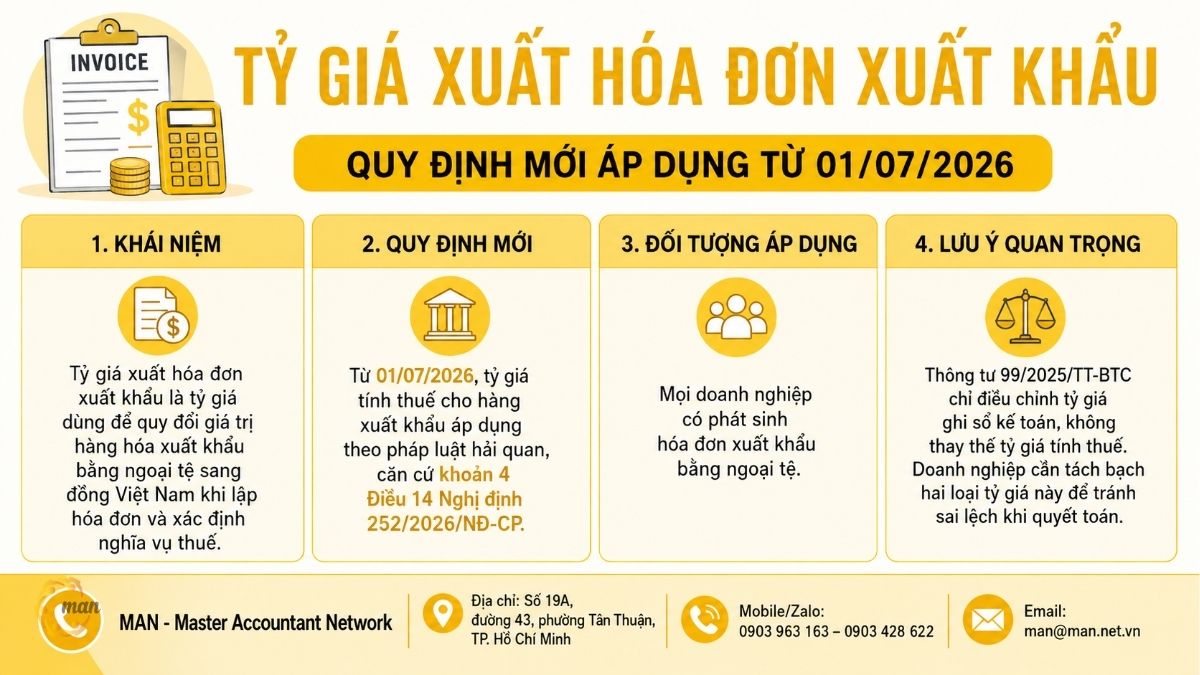
- The export invoice exchange rate is the rate used to convert the value of exported goods in foreign currency into Vietnamese Dong when preparing invoices and determining tax obligations.
- From July 1, 2026, the exchange rate for calculating export taxes will be applied according to customs law, based on Clause 4, Article 14 of Decree 252/2026/ND-CP.
- This applies to all businesses that issue export invoices in foreign currency.
- Circular 99/2025/TT-BTC only adjusts the exchange rate used in accounting records, not the exchange rate used for tax calculation. Businesses need to differentiate between these two exchange rates to avoid discrepancies during tax settlement.
What is the exchange rate for export invoices according to current regulations?
According to the attached Appendix Decree 254/2026/ND-CP, When economic transactions are conducted in foreign currency, the unit price, total amount, and total tax amount on the invoice must be recorded in the foreign currency, and the seller must show the exchange rate to Vietnamese Dong. This exchange rate cannot be chosen by the business itself, but must comply with the provisions of the Law on Tax Administration and its implementing guidelines.
In other words, the exchange rate used on export invoices is the tax rate applied to exported goods, not the commercial bank exchange rate that businesses use daily to account for other foreign currency transactions. This is an important distinction that many accountants are unaware of when preparing invoices.
Why do businesses need to determine the correct exchange rate for export invoices?
Applying the wrong exchange rate leads to two direct consequences: the value-added tax amount recorded on the invoice does not match the customs declaration, and the revenue recorded in the books differs from the actual revenue received. When the tax authorities conduct a review, this discrepancy is often the first reason for requesting an explanation.
Experts at MAN – Master Accountant Network With over 30 years of experience in auditing and tax consulting in Vietnam, we have observed that the majority of export invoice inquiries stem from using the wrong accounting exchange rate for invoice preparation, instead of the tax exchange rate stipulated by customs regulations. Determining the correct exchange rate from the outset helps businesses avoid multiple invoice adjustments and reduces the risk of tax assessments.
Which document governs the exchange rate for export invoices effective from July 1, 2026?
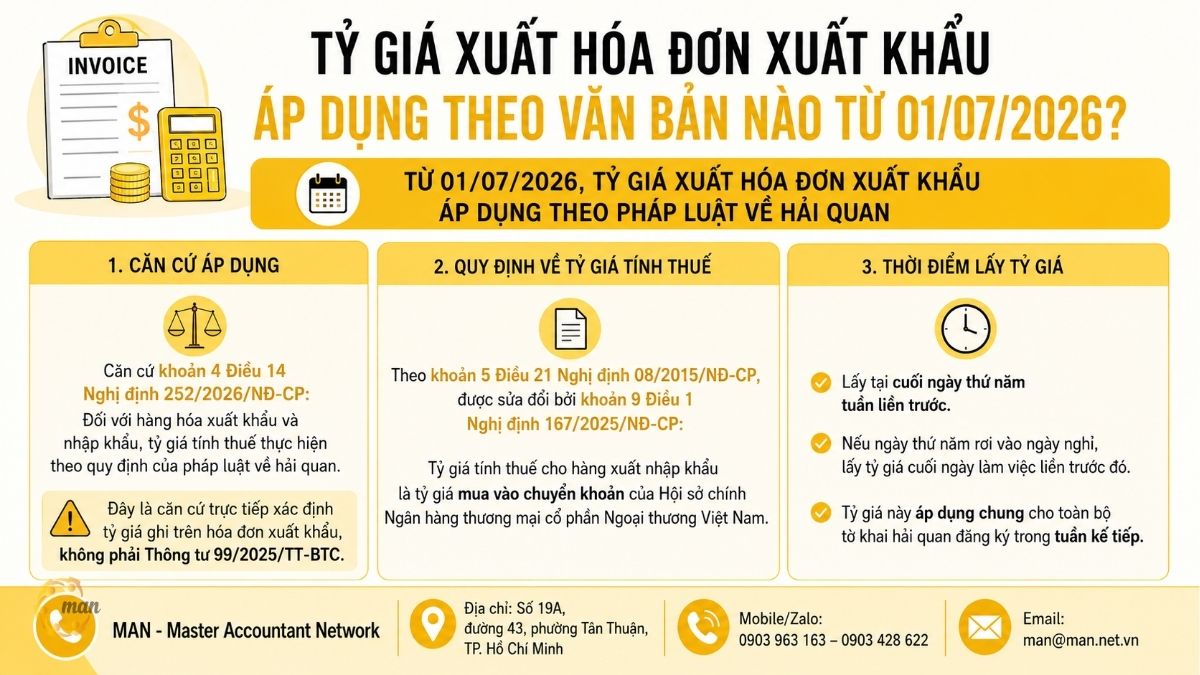
Based on Clause 4, Article 14 Decree 252/2026/ND-CP, For both exported and imported goods, the exchange rate used for tax calculation is determined according to the regulations of customs law. This is the direct basis for determining the exchange rate recorded on the export invoice, not Circular 99/2025/TT-BTC as many people mistakenly believe.
Specifically, according to Clause 5, Article 21 of Decree 08/2015/ND-CP, as amended by Clause 9, Article 1 of Decree 167/2025/ND-CP, the exchange rate for calculating import and export taxes is the buying rate for bank transfers of the head office of the Vietnam Foreign Trade Joint Stock Commercial Bank, taken at the end of the preceding Thursday. If Thursday falls on a holiday, the exchange rate at the end of the preceding working day is used. This exchange rate applies uniformly to all customs declarations registered in the following week.
What happens if Vietcombank doesn't publish exchange rates for a foreign currency?
If the foreign currency involved is not included in Vietcombank's published list, the enterprise shall apply the cross exchange rate between the Vietnamese Dong and that foreign currency as published by the State Bank of Vietnam. If the State Bank of Vietnam has not yet published a cross exchange rate, the Ministry of Finance will request the State Bank of Vietnam to determine and publish a separate exchange rate for that foreign currency.
What role does Circular 99/2025/TT-BTC play in the issuance of export invoices?
Circular 99/2025/TT-BTC stipulates the principle of applying exchange rates for accounting purposes, not for determining the tax exchange rate on invoices. According to this circular, businesses can choose the actual transaction exchange rate, which is the average buying and selling rate of the commercial bank where the business regularly conducts transactions, or an approximate rate with a difference not exceeding plus or minus 1% compared to that average rate.
For export revenue received in advance from the buyer, the portion corresponding to the advance payment will be subject to the actual exchange rate at the time of receipt, not the exchange rate at the time of revenue recognition. The remaining portion of revenue not received in advance will be subject to the actual exchange rate at the time of revenue recognition.
If the bank does not publish the exchange rate for the foreign currency involved, how should the accounting records be made?
In cases where the commercial bank where the business regularly conducts transactions does not publish the exchange rate for the foreign currency involved, the business may choose an intermediate currency for conversion, but must apply it consistently according to Vietnamese accounting standards. The business needs to present the basis for choosing that intermediate currency and the specific conversion method in the Notes to the Financial Statements. This is a detail that is easily overlooked but is often questioned when exporting to markets using less common currencies.
Therefore, businesses need to use two types of exchange rates simultaneously: the exchange rate according to Decree 252/2026/ND-CP for invoicing and determining tax obligations, and the exchange rate according to Circular 99/2025/TT-BTC for recording revenue and accounts payable in the accounting books. These two exchange rates usually do not coincide, and the difference between them is accounted for in the exchange rate difference account.
Which entities are required to apply the new export invoice exchange rate regulations?
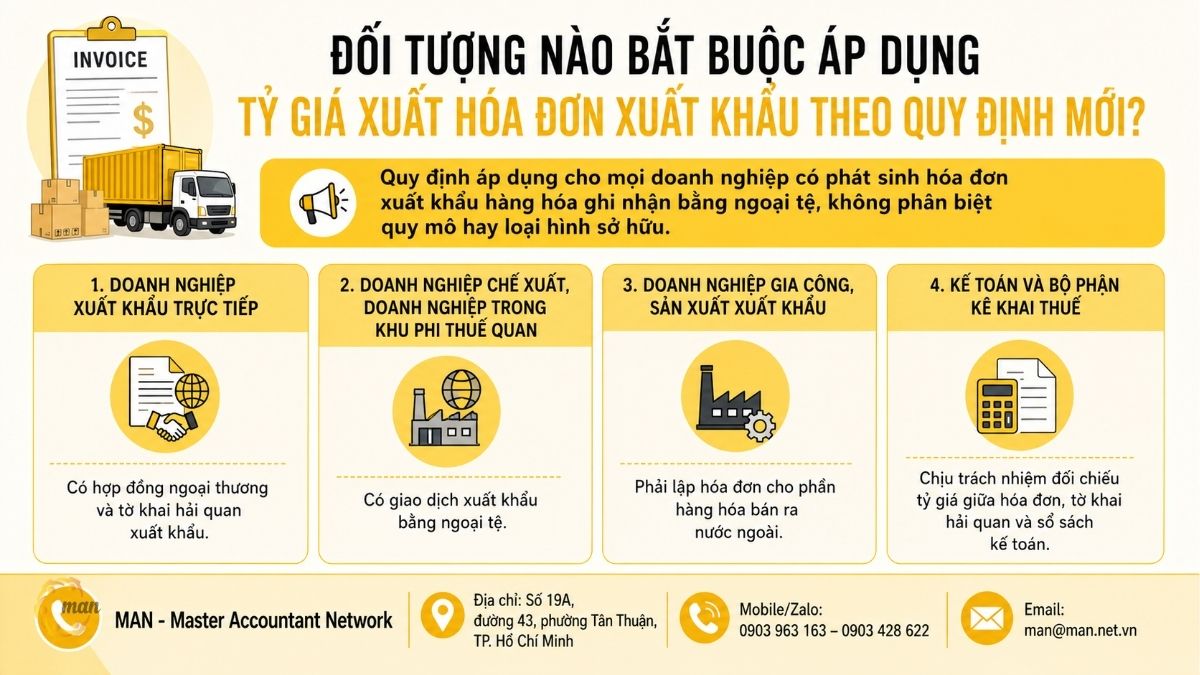
The regulations apply to all businesses that issue export invoices for goods denominated in foreign currency, regardless of size or ownership type. Specifically, they include:
- Businesses that export directly have foreign trade contracts and export customs declarations.
- Export processing enterprises and enterprises in free trade zones that conduct export transactions in foreign currency.
- Businesses engaged in processing and manufacturing for export must issue invoices for the portion of goods sold abroad.
- The accounting and tax filing departments are responsible for reconciling exchange rates between invoices, customs declarations, and accounting records.
Summary of legal documents related to exchange rates for export invoices.
Note: The exchange rate for tax calculation under Decree 252/2026/ND-CP is updated weekly based on the rate published on Thursday, and therefore applies to all tax declarations registered in the following week, not the rate on the exact day the transaction occurred.
| Document | Number and date of issuance | Related content |
| Decree 254/2026/ND-CP | Government, 2026 | Regulations on invoice content require the inclusion of exchange rates when conducting transactions in foreign currencies. |
| Decree 252/2026/ND-CP | The government will issue guidelines for the Law on Tax Administration in 2026. | Clause 4 of Article 14 stipulates the exchange rate for calculating import and export taxes according to customs law. |
| Decree 08/2015/ND-CP | January 21, 2015 | Original regulations on exchange rates for calculating taxes on imported and exported goods. |
| Decree 167/2025/ND-CP | In 2025, amendments and supplements will be made to Decree 08/2015/ND-CP. | Amend Clause 5 of Article 21, stipulating that Vietcombank's transfer buying rate shall be used as the basis for calculating tax. |
| Circular 99/2025/TT-BTC | Ministry of Finance, 2025 | The exchange rate used for accounting purposes is regulated, but the exchange rate used for tax calculation is not adjusted. |
Case study: How do export businesses in Dong Nai handle exchange rates on invoices?
Background
Company Y, a limited liability company specializing in exporting processed agricultural products to the Japanese market, generates an average of 40 export invoices in USD per month. Previously, the company's accountant used the selling exchange rate of the bank where the account was held to prepare invoices, resulting in small but consistent discrepancies compared to the exchange rate used for tax calculation on customs declarations.
How to handle the situation after the review with MAN.
According to advice from MAN – Master Accountant Network, The company implemented three adjustments: separating the exchange rate collection process for export invoices, using the correct Vietcombank buying rate for transfers published at the end of the previous Thursday; creating a weekly exchange rate tracking table for the invoicing department to use for consistent lookup; and conducting monthly reconciliation between the exchange rate on invoices, the exchange rate on customs declarations, and the exchange rate recorded in accounting books according to Circular 99/2025/TT-BTC.
Result
After implementing the separation process, the discrepancy between invoices and customs declarations was reduced to almost zero in subsequent reconciliation periods. The time required to process value-added tax settlements for exports was significantly shortened because there was no longer a need to explain exchange rate differences to the tax authorities.
Expert opinion: Common risks when determining exchange rates for export invoices.
Experts at MAN – Master Accountant Network Note the three most common risks faced by Vietnamese businesses:
- Confusion between the tax exchange rate and the accounting exchange rate. Many accountants apply the exchange rate stipulated in Circular 99/2025/TT-BTC to prepare export invoices, while this document is only for accounting purposes. As a result, the tax amount on the invoice does not match the customs declaration.
- Using the wrong exchange rate at the time. The exchange rate for tax purposes is published weekly, based on the preceding Thursday, not the rate on the invoice date. If accountants look up the exchange rate on the day of the transaction instead of the applicable weekly rate, the figures will be inaccurate.
- Lack of a regular reconciliation process. When businesses lack weekly exchange rate tracking and fail to regularly reconcile data from three sources, accumulated discrepancies over several months can become a major issue during year-end tax settlements, requiring lengthy explanations to the tax authorities.
What information is currently required on export invoices?
In addition to the exchange rate, export invoices must contain all the information required by Article 10 of Decree 254/2026/ND-CP. This is the basis for tax and customs authorities to accept the invoice as valid. Businesses need to review all the following items before issuing the invoice:
- Invoice name, invoice symbol, invoice form number symbol.
- Invoice number.
- Name, address, and tax identification number of the seller.
- The buyer's name, address, tax identification number or budget-related unit code, or personal identification number.
- Name, unit of measurement, quantity, unit price of goods and services; total amount excluding value-added tax, tax rate, total tax amount for each tax rate, total tax amount, and total payment amount including value-added tax.
- The signatures of the seller and the buyer are required. However, for electronic invoices, the digital signature of the buyer is not mandatory, unless the two parties have agreed otherwise.
- When issuing invoices, follow the instructions in Article 9 of Decree 254/2026/ND-CP, displaying them in the format of the Gregorian calendar day, month, and year.
- The time of digital signature on the electronic invoice.
- Tax authority code, for electronic invoices that have a tax authority code.
- Fees and charges belonging to the state budget, trade discounts, promotions if any, and other related matters if any.
- The text, numbers, and currency shown on the receipt.
- Other details on the invoice, if any.
Detailed regulations for each of the above items are stated in Clauses 1 and 2 of Article 10 of Decree 254/2026/ND-CP. Some cases where electronic invoices are not required to include all of these contents are specifically listed in the Appendix attached to the decree; businesses should check their specific situation before omitting any items.
Conclude
The exchange rate for export invoices from July 1, 2026, will be determined according to Decree 252/2026/ND-CP and customs laws, not Circular 99/2025/TT-BTC as many businesses mistakenly believe. Clearly distinguishing between the tax exchange rate and the accounting exchange rate, along with a periodic reconciliation process, is crucial for businesses to avoid data discrepancies and reduce the time spent explaining matters to tax authorities.
MAN – Master Accountant Network We partner with export businesses in tax consulting, tax accounting, tax reporting, and tax settlement services, helping to standardize the exchange rate determination process from invoicing to year-end settlement. For specific support tailored to your business, please contact MAN – Master Accountant Network for consultation.
Tax services at MAN – Master Accountant Network
- Tax accounting services
- Tax consulting services
- Tax settlement services
- Tax reporting services
- VAT refund service
Service contact information at MAN – Master Accountant Network
- Address: No. 19A, Street 43, Tan Thuan Ward, Ho Chi Minh City
- Mobile/Zalo: 0903 963 163 – 0903 428 622
- E-mail: man@man.net.vn
- Google Business Profile: View MAN – Master Accountant Network's Google Business Profile
- LinkedIn Founder: View expert Le Hoang Tuyen's LinkedIn profile.
Responsible for production and professional content review by: Mr. Le Hoang Tuyen – Founder & CEO of MAN – Master Accountant Network, CPA Vietnam with over 30 years of experience in accounting, auditing, taxation, and corporate financial consulting.
Frequently Asked Questions about Export Invoice Exchange Rates
Is the exchange rate on export invoices the same as the exchange rate the commercial bank the business is currently using for transactions?
No. The exchange rate used for export invoices must follow the tax exchange rate stipulated in Decree 252/2026/ND-CP, specifically the weekly published buying rate for bank transfers by Vietcombank, not the exchange rate of the bank the business usually transacts with.
If a business receives advance payment from a foreign customer, how is the exchange rate on the invoice calculated?
For the revenue recorded on invoices, the exchange rate remains in accordance with the tax regulations of Decree 252/2026/ND-CP. The application of the exchange rate at the time of receiving advance payments only applies when recording revenue in the accounting books according to Circular 99/2025/TT-BTC; these two processes must be carried out simultaneously and are not interchangeable.
Does the exchange rate used for tax purposes change daily or weekly?
Weekly. The exchange rate is taken at the end of Thursday of the preceding week and applied to customs declarations registered in the following week.
What should businesses do if they export using a scarce currency and there is no published exchange rate?
The cross-exchange rate published by the State Bank of Vietnam will be applied. If no cross-exchange rate is available, the Ministry of Finance will request the State Bank of Vietnam to determine and publish its own exchange rate.
Besides the exchange rate, what other information should be included on an export invoice denominated in foreign currency?
According to Article 10 of Decree 254/2026/ND-CP, invoices must include the full name, invoice symbol, information of the seller and buyer, unit price, total amount, tax rate, total tax amount, signatures of the parties, date of invoice issuance, and exchange rate, ensuring the correct format as specified in the appendix attached to the decree.