


The 2026 contractor tax is one of the key issues that businesses with cross-border transactions should pay particular attention to. With the introduction of... Circular 20/2026/TT-BTC and Circular 69/2025/TT-BTC, Consequently, the legal framework for tax management of foreign organizations and individuals has been tightened and standardized. This forces financial managers to readjust their methods of calculating and negotiating international economic contracts.
The implementation of the new regulations is not simply a change in numbers, but also directly impacts the cash flow of FDI enterprises and large corporations. Understanding the legal nature and operation of these regulations will help businesses proactively optimize tax costs in Vietnam, minimizing the risk of being subjected to severe administrative penalties by regulatory authorities.
Quick information on contractor tax 2026 for managers
- Defining the coreThe 2026 Contractor Tax is a tax applied to foreign organizations and individuals doing business or earning income in Vietnam based on contracts and agreements.
- Applicable objectsForeign contractors provide services, goods accompanied by services, or generate income such as royalties or interest on loans in Vietnam.
- PurposeEnsuring fairness in tax obligations between domestic and foreign businesses, while controlling revenue from the digital economy.
- Time to pay attentionFiling is required no later than the 10th day of each transaction, or monthly filing is required no later than the 20th day of the following month.
What is the contractor tax in 2026 and who is subject to it?
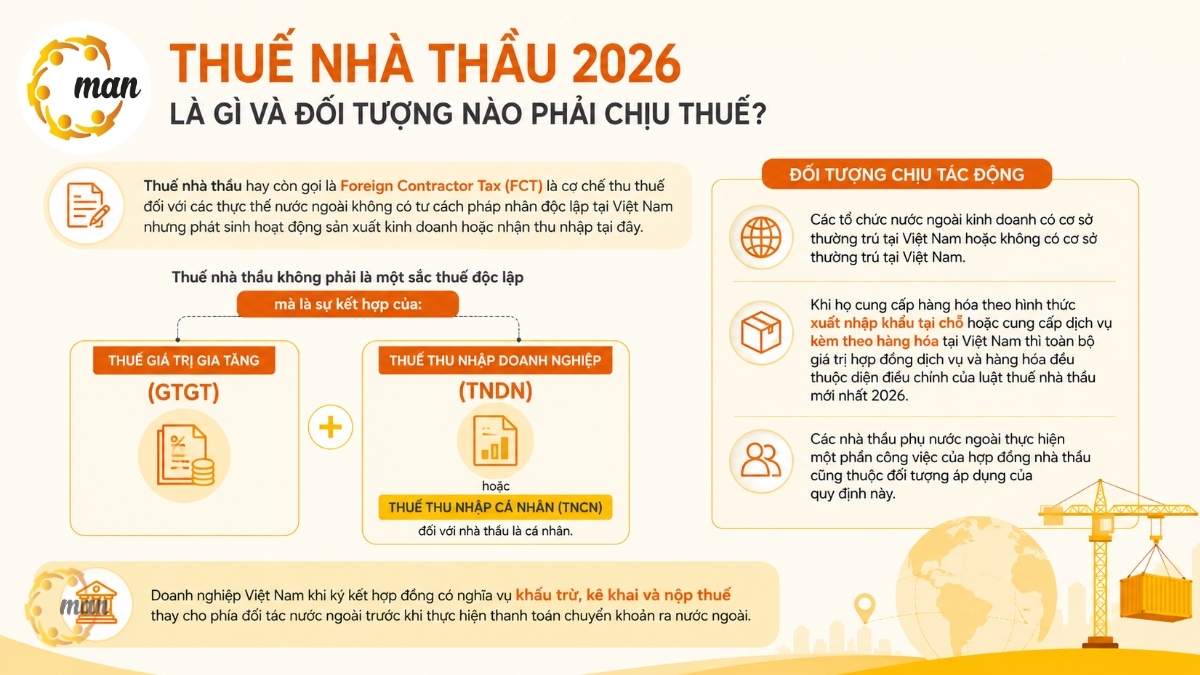
Foreign Contractor Tax (FCT) is a tax mechanism applied to foreign entities that do not have independent legal status in Vietnam but conduct business activities or receive income here. This tax is not a standalone tax but rather a combination of several. Value Added Tax (VAT) and Corporate Income Tax (CIT) or Personal Income Tax For individual contractors.
The entities directly affected include foreign organizations doing business with or without a permanent establishment in Vietnam. When they supply goods through on-site import/export or provide services accompanying goods in Vietnam, the entire value of the service and goods contract is subject to the latest contractor tax law of 2026.
Furthermore, foreign subcontractors performing a portion of the contractor's work are also subject to this regulation. Vietnamese businesses, upon signing a contract, are obligated to deduct, declare, and pay taxes on behalf of their foreign partners before making any international payments.
What does the latest Contractor Tax Law of 2026 stipulate regarding its scope of application?
The scope of application of contractor tax is clearly defined to avoid double taxation or the omission of revenue sources. According to the latest guidelines, services performed and consumed entirely outside Vietnam will not be subject to tax. For example, vehicle repair services abroad and advertising and promotional activities abroad are not subject to foreign contractor tax in Vietnam.
Conversely, services performed outside Vietnam but consumed domestically, such as online marketing services and online training for personnel in Vietnam, are required to declare contractor tax in 2026. This distinction requires the procurement and accounting departments to carefully analyze the terms of the contract to determine the correct tax obligations.
For cross-border e-commerce and digital services, foreign providers without a permanent establishment in Vietnam but conducting business directly with domestic organizations and individuals will register for tax directly or authorize a domestic organization to deduct and pay taxes on their behalf in accordance with current management standards.
See more articles at: Official Document 2495/CT-CS regarding contractor tax policy
Contractor tax schedule 2026 by actual business sector
Depending on the nature of the services or goods provided, the regulatory authority applies different tax percentages to VAT and corporate income tax. Below is the most up-to-date and detailed tax schedule in accordance with the regulations. Decree 320/2025/ND-CP and Decree 181/2025/ND-CP This allows businesses to look up and apply the information to contracts executed during the fiscal year.
| Actual business activities | VAT Rate % (According to Decree 181/2025/ND-CP) | Corporate Income Tax Rate (According to Decree 320/2025/ND-CP) | Total tax rate (Gross price) |
| Standard services (Advertising, legal consulting, technical consulting) | 5% | 5% | 10% |
| Restaurant, hotel, and casino management services. | 5% | 10% | 15% |
| Cross-border digital services (via e-commerce platforms) | 10% | 5% | 15% |
| Rental of machinery, equipment, drilling rigs, and transportation vehicles. | 5% | 5% | 10% |
| Airplane, helicopter, glider, and boat rentals available. | 5% | 2% | 7% |
| Royalties, intellectual property rights | VAT exemption | 10% | 10% |
| Interest on loans from abroad | VAT exemption | 5% | 5% |
| Construction and installation services do not include the supply of materials. | 5% | 2% | 7% |
| Construction and installation including material supply. | 3% | 2% | 5% |
| International transport (Air, sea) | 3% | 2% | 5% |
| Derivative financial services | VAT exemption | 2% | 2% |
| Distribution and supply of goods in Vietnam (Incoterms for domestic delivery) | 1% | 1% | 2% |
| Securities transfer, reinsurance | VAT exemption | 0.1% | 0.1% |
| Transfer of capital into Vietnamese businesses | VAT exemption | 2% | 2% |
The table above is the standard 2026 contractor tax schedule, helping businesses quickly determine their related tax obligations when preparing budget estimates for projects involving the procurement of services or technology from abroad.
Special regulations regarding cases where the contract value cannot be separated.
According to Article 9 of Circular 69/2025/TT-BTC, for contracts encompassing multiple business activities or where a portion of the contract value is not subject to VAT, accountants need to separate the revenue for each activity to apply the corresponding tax rate.
If the value of each business activity cannot be separated, the enterprise must apply the highest percentage rate for VAT calculation on revenue for the entire contract value. Regarding corporate income tax, according to Article 12 of Decree 320/2025/ND-CP, if the provision of services is linked to goods and the value of goods cannot be separated from the value of services, a corporate income tax rate of 21% of the total revenue will be applied.
Current methods of contractor tax payment
Foreign businesses operating in Vietnam can choose one of three tax payment methods depending on the size, accounting system, and duration of their project in Vietnam.
Deduction method (Declaration method)
Foreign contractors pay VAT using the deduction method and corporate income tax based on declared revenue and expenses, just like a Vietnamese enterprise. The conditions for application are that the contractor has a permanent establishment in Vietnam, the contract duration is 183 days or more, and the contractor applies the full Vietnamese accounting system.
Direct method (Rate of revenue method)
This is the most common method, accounting for over 901 transactions currently. The Vietnamese party signing the contract is responsible for directly deducting the VAT and corporate income tax at the prescribed rates from the revenue before making payment to the foreign contractor. The contractor does not need to register and open accounting books in Vietnam.
Mixed method
Foreign contractors pay VAT using the deduction method (requiring the maintenance of accounting records for the VAT portion) but pay corporate income tax using the percentage-based method on taxable revenue. This method is suitable for large-scale construction and installation projects where the contractor wants to manage input VAT invoices for deduction purposes.
How to calculate contractor tax in 2026 for Net and Gross contracts.
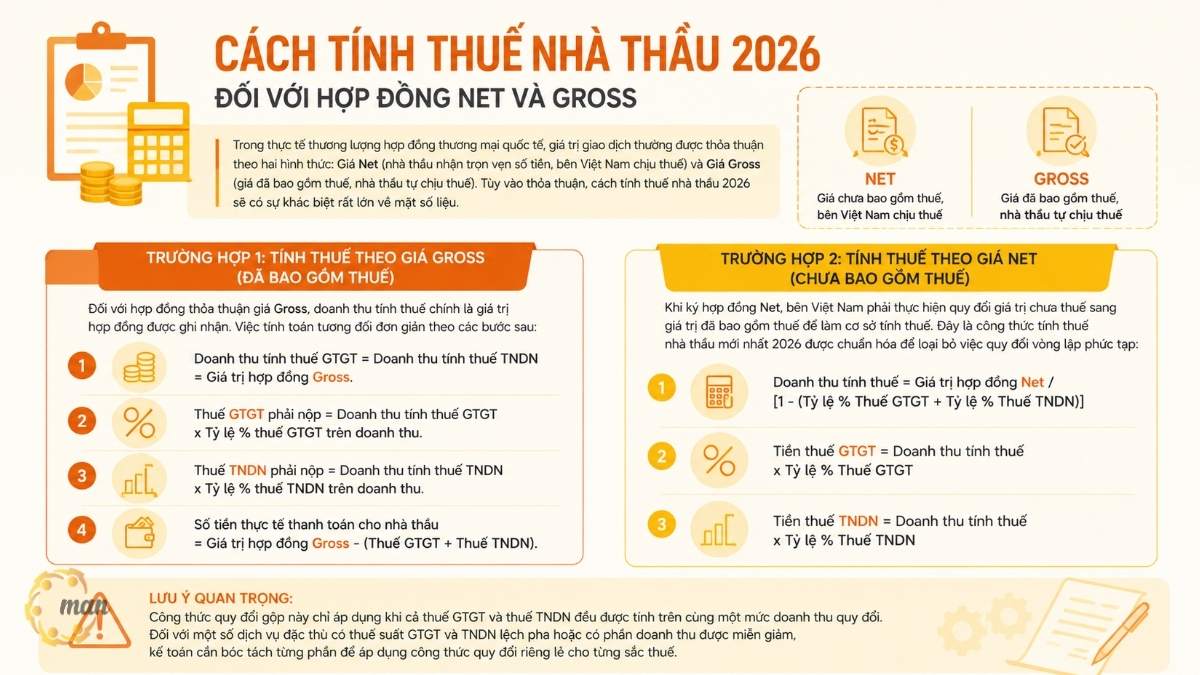
In practice, international commercial contract negotiations usually involve agreeing on two forms of transaction value: Net Price (the contractor receives the full amount, the Vietnamese party pays the tax) and Gross Price (price including tax, the contractor pays the tax themselves). Depending on the agreement, the calculation of contractor tax in 2026 will vary significantly in terms of figures.
Case 1: Calculate tax based on gross price (including tax)
For contracts with a gross price agreement, the taxable revenue is the recorded contract value. The calculation is relatively simple and follows these steps:
- Taxable revenue for VAT = Taxable revenue for corporate income tax = Gross contract value.
- VAT payable = Taxable VAT revenue x VAT rate on revenue.
- Corporate income tax payable = Taxable revenue x Corporate income tax rate on revenue.
- Actual payment amount to the contractor = Gross contract value – (VAT + Corporate Income Tax).
Case 2: Calculate tax based on net price (excluding tax)
In reality, net contracts are not always of the same nature. It's important to identify them. What taxes are not included in the contract price?, From there, choose the appropriate revenue conversion formula.
Typically, net contracts with foreign contractors fall into the following three categories:
Case 2.1: The contract price does not include VAT and corporate income tax for the contractor.
This is a common scenario where the contract stipulates that the foreign contractor receives the full net value, while the Vietnamese party bears and pays all contractor taxes on their behalf.
In that case, taxable revenue must be converted simultaneously for both VAT and corporate income tax at the same revenue level.
Conversion formula:
Taxable revenue = Net contract value / [1 – (VAT rate + Corporate income tax rate)]
After determining taxable revenue:
- VAT = Taxable revenue × VAT rate (1% VAT).
- Corporate income tax = Taxable revenue × Corporate income tax rate (1% tax rate = 3% tax rate).
This is the general conversion formula used when both taxes arise on the same converted revenue level.
Case 2.2: The contract price includes corporate income tax but excludes value-added tax.
Some contracts stipulate that the payment price already includes the contractor's corporate income tax, but the Vietnamese party will pay the additional VAT.
In this case, the taxable revenue for the two taxes is no longer the same, so The combined conversion formula does not apply..
The process for determining taxable revenue is as follows:
- Taxable revenue for corporate income tax = Net contract value (Not to be converted).
- Taxable revenue for VAT = Net contract value / (1 – VAT rate of %).
After determining the revenue subject to VAT:
- VAT = Taxable revenue × VAT rate (1% VAT).
- Corporate Income Tax = Net Contract Value × Corporate Income Tax Rate (%).
Case 2.3: The contract price includes VAT but excludes corporate income tax.
Conversely, if the contract stipulates that the price includes VAT but excludes corporate income tax, then only the corporate income tax portion should be converted.
Then:
- Taxable revenue for VAT purposes = Net contract value.
- Taxable revenue for corporate income tax = Net contract value / (1 – Corporate income tax rate %).
After determining taxable revenue:
- VAT = Net Contract Value × VAT Rate (%).
- Corporate income tax = Taxable revenue × Corporate income tax rate (1% tax rate = 3% tax rate).
Important Note
The choice of conversion formula does not depend on the name. “"Net contract"” good “"Gross contract"”, which depends on clauses dividing tax obligations between the parties in the contract.
- If the contract price This does not include both VAT and corporate income tax., Revenue is calculated using the following formula:
Taxable revenue = Net contract value / [1 – (%GTGT + %TNDN)]
- If the contract only not including a tax, The conversion is only performed for that specific tax; if the tax is already included in the contract price, then the taxable revenue is the contract value.
Furthermore, for certain specific activities where VAT and corporate income tax rates are applied on different tax bases, or where a portion of revenue is exempted or reduced according to regulations, accountants need to separately determine each revenue item to apply the corresponding conversion formula. Circular 20/2026/TT-BTC.
| Contract terms | Revenue subject to VAT | Taxable revenue for corporate income tax | Formula to apply |
|---|---|---|---|
| VAT and CIT (Gross) are included. | Contract price | Contract price | No exchange |
| Excluding VAT, including CIT. | Net / (1 − %GTGT) | Contract price | VAT conversion separately |
| VAT included, CIT excluded. | Contract price | Net / (1 − %TNDN) | Corporate Income Tax Conversion |
| Excluding VAT and CIT. | Net / [1 − (%GTGT + %TNDN)] | Net / [1 − (%GTGT + %TNDN)] | Simultaneous conversion |
See more articles at: Official Document 1918/CT-CS: Corporate Income Tax for Foreign Contractors 2026
Guide to accounting for contractor tax and interest expenses for business accountants.
In large corporations or FDI enterprises, receiving loans from parent companies abroad or international financial institutions is very common. Interest payments made to foreign entities are subject to corporate income tax at a rate of 51% and are exempt from VAT. Accurate accounting of interest payments to avoid being disallowed as a deductible expense during tax settlement requires precision.
When a periodic interest payment obligation arises for a foreign contractor, the accountant makes the following journal entries to record the expense and tax liability:
Journal Entry 1: Accrual for recurring interest expense payable
- Debit Account 635 – Financial Expenses (Total interest expense including tax paid on behalf of borrowers if it is a Net contract).
- Account 335 – Accrued Expenses.
Journal Entry 2: When paying interest on loans and deducting contractor tax.
In the case of a Net contract (where the business pays the tax on behalf of the contractor):
- Debit Account 335 – Accrued Expenses (Net price paid to the contractor).
- Debit Account 635 – Financial Expenses (Part of Corporate Income Tax paid on behalf of contractors).
- Account 112 – Bank Deposits (Net amount transferred abroad).
- Account 33382 exists – Corporate income tax payable to contractors.
In the case of a Gross contract (Contractor pays the tax):
- Debit Account 335 – Accrued Expenses (Gross Value).
- Account 112 – Bank Deposits (Actual amount transferred after deducting 5% tax).
- Account 33382 exists – Corporate income tax payable to contractors.
Journal Entry 3: When paying contractor tax to the State Treasury
- Debit Account 33382 – Corporate Income Tax Payable to Contractors.
- Account 112 – Bank Deposits.
Accountants should ensure they maintain complete records, including: loan agreements registered with the State Bank (if it is a medium or long-term loan), money transfer documents, contractor tax declarations, and payment receipts to the state budget, to serve as evidence during audits.
Real-world case study: Calculating the latest contractor tax for engineering consulting services in 2026.
To help our readers, who are CFOs and Chief Accountants, easily visualize the operational methods in practice, the team of experts at MAN would like to present a real-world case study that was successfully handled for an FDI partner in the electronics component manufacturing sector in Binh Duong.
Situational context
In March 2026, ABC Technology Joint Stock Company (Vietnam) signed a contract to hire an expert engineer from XYZ Group (Singapore) to assist in the installation and calibration of an automated production line. The agreed service contract value was USD 20,000 (Net price, excluding taxes in Vietnam). The actual exchange rate at the time of payment was VND 25,000/USD.
Tax liability analysis
According to Circular 20/2026/TT-BTC and Circular 69/2025/TT-BTC, technical consulting services performed in Vietnam are subject to contractor tax at the following rate:
- VAT rate: 5% (As stipulated in Article 9 of Circular 69/2025/TT-BTC)
- Corporate income tax rate: 5% (As stipulated in Article 7 of Circular 20/2026/TT-BTC)
Practical calculation steps
Step 1: Convert the contract value from USD to VND.
- Net contract value (VND) = 20,000 USD x 25,000 VND/USD = 500,000,000 VND.
Step 2: Determine the contractor's taxable revenue.
- Taxable revenue = 500,000,000 VND / [1 – (5% + 5%)]
- Taxable revenue = 500,000,000 VND / 0.90 = 555,555,556 VND.
Step 3: Calculate the VAT and corporate income tax payable.
- VAT for the contractor = 555,555,556 VND x 5% = 27,777,778 VND.
- Contractor's Corporate Income Tax = 555,555,556 VND x 5% = 27,777,778 VND.
- The total amount of contractor tax that ABC company must pay to the state budget is 55,555,556 VND.
Therefore, the total actual cost incurred by ABC company for this service is VND 555,555,556 (including VND 500,000,000 transferred to the Singaporean partner and VND 55,555,556 paid in state taxes). All of these costs are legitimately recorded as part of the asset's cost or as business management expenses if all required documentation is available.
See more articles at: Contractor tax on foreign loan interest 2025: Draft proposes doubling the corporate income tax rate.
Key changes to the latest 2026 contractor tax law that accountants need to be aware of.
The newly issued regulations are highly consistent and thoroughly address the difficulties encountered in the previous period regarding tax conversion for digital service contracts. Below are the core points businesses need to pay attention to in order to update their internal control systems.
- Standardizing the tax baseThe new guiding circulars stipulate a unified method for calculating VAT and corporate income tax revenue on a single consolidated revenue basis. This regulation completely eliminates the inconsistency among local tax offices in applying the previously separate conversion formulas.
- Tighten tax management for digital services.For technical services and advertising services provided through digital platforms or e-commerce sites from foreign suppliers, the VAT rate is clearly set at 10%. This directly impacts the online advertising budgets (Google, Facebook, TikTok) of businesses selling consumer goods.
- Strict penalties for tax debt collection.According to the new Tax Administration Law, taxpayers (including legal entities paying taxes on behalf of contractors) with tax arrears exceeding 90 days from the deadline will be subject to enforcement of administrative decisions regarding tax management. This requires businesses to closely monitor the progress of tax declaration and payment after completing overseas transfers.
Regulations on administrative penalties and enforcement of tax debt collection from contractors in 2026
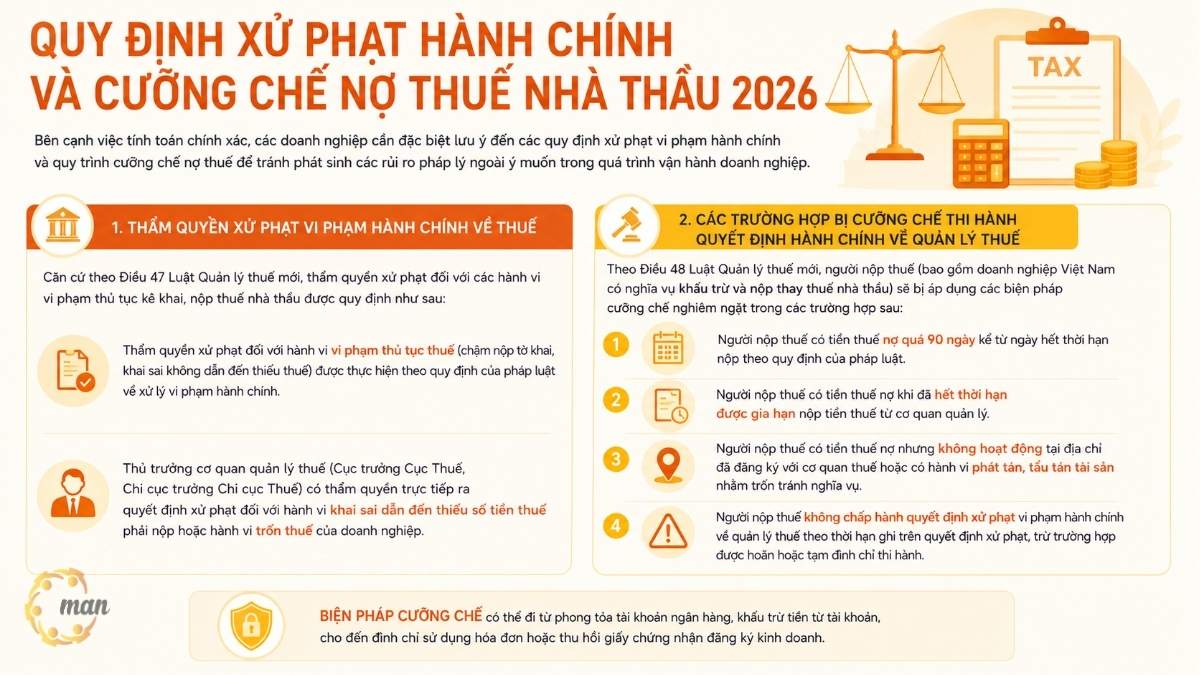
Besides accurate calculations, businesses need to pay special attention to regulations on administrative penalties and tax debt enforcement procedures to avoid unforeseen legal risks during business operations.
Authority to impose administrative penalties for tax violations
According to Article 47 of the new Tax Administration Law, the authority to impose penalties for violations of procedures for declaring and paying contractor taxes is regulated as follows:
- The authority to impose penalties for violations of tax procedures (late filing of tax returns, incorrect declarations that do not result in tax shortfalls) is exercised in accordance with the provisions of the law on handling administrative violations.
- The head of the tax administration agency (Director of the Tax Department, Head of the Tax Sub-Department) has the authority to directly issue penalty decisions for acts of incorrect declaration leading to underpayment of tax or acts of tax evasion by enterprises.
Cases where administrative decisions regarding tax management are enforced.
According to Article 48 of the new Tax Administration Law, taxpayers (including Vietnamese businesses obligated to deduct and pay contractor tax on behalf of others) will be subject to strict enforcement measures in the following cases:
- Taxpayers who have outstanding tax debts exceeding 90 days from the legally prescribed deadline for payment.
- Taxpayers may have outstanding tax debts even after the extended deadline for tax payment granted by the tax authorities has expired.
- Taxpayers who have outstanding tax debts but are not operating at the address registered with the tax authorities, or who engage in the dissipation or concealment of assets to evade their obligations.
- Taxpayers who fail to comply with administrative penalties for tax management violations within the deadline specified in the penalty decision, except in cases where enforcement is postponed or temporarily suspended.
Enforcement measures can range from freezing bank accounts and deducting money from accounts to suspending the use of invoices or revoking business registration certificates.
Expert opinion from MAN on tax risk management for foreign contractors.
With over 30 years of experience in auditing and tax consulting in the Vietnamese market, the team of experts at MAN – Master Accountant Network has found that tax risks associated with foreign contractors often stem from misclassifying the nature of the transaction right from the contract drafting stage.
Many businesses often confuse contracts for the provision of technical services (subject to VAT and corporate income tax) with contracts for the transfer of technology or software licenses (exempt from VAT and subject to corporate income tax). When tax authorities conduct periodic inspections and audits, this misclassification leads to significant tax arrears and late payment penalties, seriously impacting the company's financial plans.
One cost-effective tax solution in Vietnam that MAN often recommends to its large clients is to leverage Double Taxation Avoidance Agreements (DTAA) between Vietnam and the contractor's country. If the foreign contractor meets the criteria of not having a permanent establishment in Vietnam, they may be completely exempt from corporate income tax (5% or 10%). However, to benefit from this incentive, the business must submit a notification of tax exemption under the Agreement to the relevant authority within the specified deadline.
Conclude
Managing and enforcing contractor tax obligations in 2026 requires close coordination among departments within the enterprise, from purchasing and legal to accounting. Understanding the latest updates under Circular 20/2026/TT-BTC not only helps businesses comply with the law and avoid administrative penalties for late payments, but also opens up opportunities to optimize operating costs through favorable contract negotiations.
Service contact information at MAN – Master Accountant Network
- Address: No. 19A, Street 43, Tan Thuan Ward, Ho Chi Minh City
- Mobile/Zalo: 0903 963 163 – 0903 428 622
- Email: man@man.net.vn
Content production by: Mr. Le Hoang Tuyen – Founder & CEO MAN – Master Accountant Network, Vietnamese CPA Auditor with over 30 years of experience in Accounting, Auditing and Financial Consulting.
Frequently Asked Questions about Contractor Tax 2026
Yes. Under DDP (Delivered Duty Paid) terms, the foreign seller bears all risks and costs, including import procedures and tax payments in Vietnam, to deliver the goods to the designated location. Therefore, this activity is considered the distribution of goods in Vietnam and is subject to the 2026 contractor tax with a VAT rate of 11% and corporate income tax rate of 11%.
It is deductible as an expense. However, a mandatory condition is that the service contract signed between the two parties must clearly state the contract value as the net price (excluding tax), and the Vietnamese enterprise is obligated to declare and pay all applicable taxes in accordance with Vietnamese law.
No. When Vietnamese businesses sign contracts with foreign contractors, they must register for tax purposes and be issued a separate 10-digit contractor tax code (or a 13-digit tax code based on the Vietnamese party's tax code) for each foreign contractor to track tax obligations separately for each contract.
According to Article 12 of Decree 320/2025/ND-CP, in cases where a foreign enterprise sells goods that are raw materials, supplies, or components from a bonded warehouse or free trade zone for import into Vietnam to serve the production or processing of export goods under a contract, it is not required to pay corporate income tax. This regulation also applies when a foreign enterprise designates an export processing enterprise to supply components to another export processing enterprise to serve the production of export goods.
For the direct payment method (withholding tax), businesses must submit the tax return and tax payment no later than the 10th day from the date the tax liability arises (the date the money is transferred to the foreign contractor). If the business registers to file taxes monthly, the deadline is no later than the 20th day of the following month. Do businesses that purchase goods from abroad under Incoterms DDP terms have to pay contractor tax?
Are the taxes paid by the contractor on behalf of the foreign party under a Net contract deductible expenses when calculating corporate income tax?
Can a business use a single contractor tax identification number for multiple different foreign contractors?
Under what circumstances are foreign contractors selling raw materials to Vietnam exempt from corporate income tax?
What are the deadlines for filing tax returns and paying contractor taxes?