


Circular 89/2026/TT-BTC Officially effective from July 1, 2026, this marks a major change in tax administration in Vietnam after Law on Tax Administration No. 108/2025/QH15 and Decree 252/2026/ND-CP The document, signed by the Ministry of Finance on June 30, 2026, details a series of core regulations: electronic transactions, tax declaration, tax payment, tax refund, tax exemption and reduction, and tax audit. This is the legal basis that all businesses, households, and individuals paying taxes need to understand to avoid errors when fulfilling their tax obligations during the transitional period.
From the perspective of MAN – Master Accountant Network, a tax, accounting, and auditing consulting firm with over 30 years of practical experience in Vietnam, many businesses are still applying outdated forms and procedures, easily leading to discrepancies in documentation when the tax authorities switch to the new system. This article comprehensively analyzes the scope of adjustment, applicable subjects, key timelines, and risks businesses need to avoid when Circular 89/2026/TT-BTC comes into effect.
Summary of key points in Circular 89/2026/TT-BTC
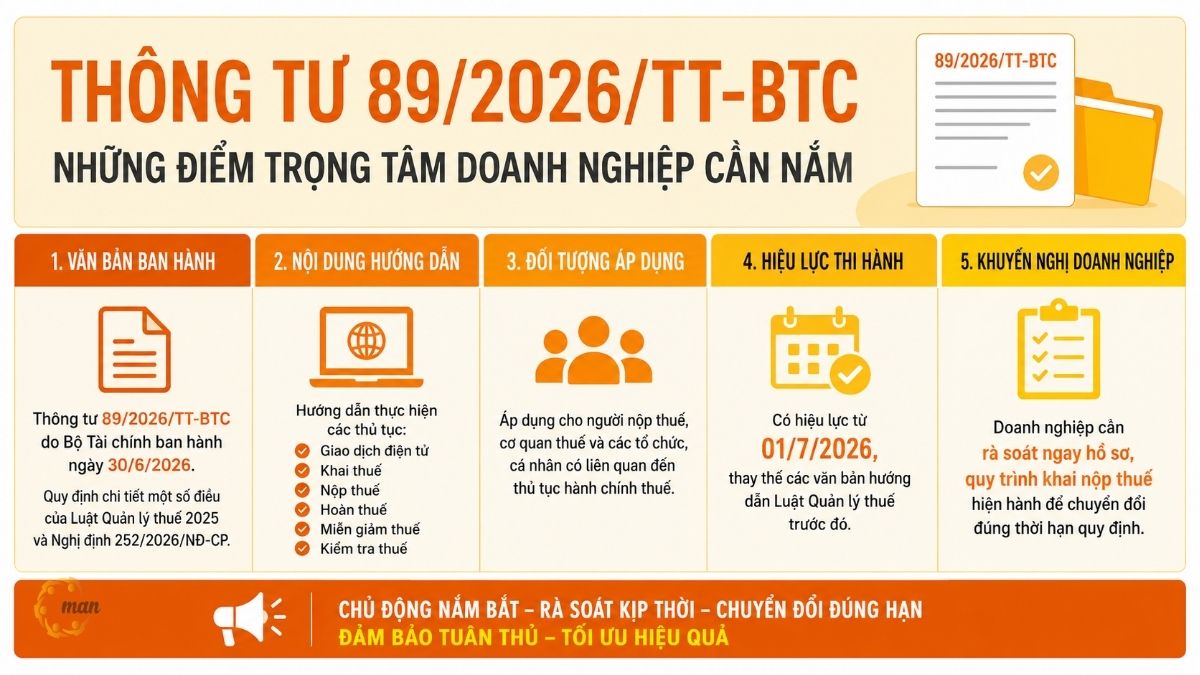
- Circular 89/2026/TT-BTC is a document issued by the Ministry of Finance on June 30, 2026, providing detailed regulations on several articles of the 2025 Law on Tax Administration and Decree 252/2026/ND-CP.
- Used to guide the implementation of procedures such as: electronic transactions, tax declaration, tax payment, tax refund, tax exemption/reduction, and tax audit.
- This applies to taxpayers, tax authorities, and organizations and individuals involved in tax administrative procedures.
- Effective from July 1, 2026, this replaces previous guidelines for the Law on Tax Administration.
- Businesses need to immediately review their current tax filing and payment procedures to make the necessary changes within the stipulated deadline.
What is Circular 89/2026/TT-BTC? Definition and legal basis.
According to Article 1, Circular 89/2026/TT-BTC is a document issued by the Minister of Finance, providing detailed regulations on a number of articles, clauses, and points assigned in the Law on Tax Administration No. 108/2025/QH15 and Decree No. 252/2026/ND-CP of the Government. The document was signed on June 30, 2026, based on Decree 29/2025/ND-CP regulating the functions, tasks, powers and organizational structure of the Ministry of Finance, as amended by Decree 166/2025/ND-CP, at the request of the Director of the Tax Department.
In short, Circular 89/2026/TT-BTC transforms the framework regulations of the Law on Tax Administration and Decree 252 into specific operational guidelines for taxpayers and tax authorities. Its scope covers three major areas, ranging from detailed regulations on legal provisions and decree provisions to specific operational guidelines.
What are the scope of regulations covered by Circular 89/2026/TT-BTC?
- Group 1: This document details the provisions assigned in the Law on Tax Administration 108/2025/QH15, including Clause 3 of Article 3, Clause 9 of Article 12, Clause 9 of Article 14, Clause 5 of Article 15, and many other provisions related to tax declaration, tax payment, and handling of violations.
- Group 2: This document specifies the details of the provisions assigned in Decree 252/2026/ND-CP, including the sample notification documents for tax management and tax administrative procedures.
- Group 3: The guidelines cover seven specific operational groups, including electronic transactions in tax administration; tax declaration and calculation, and other revenue collection; tax payment, tax payment extensions, late payment penalties, and fines; tax refund procedures; tax exemptions, tax reductions, debt restructuring, and debt write-offs; tax audits; and information exchange between tax authorities and other government agencies.
The role of Circular 89/2026/TT-BTC in corporate tax administration and auditing.
Prior to the issuance of Circular 89/2026/TT-BTC, many tax administrative procedures still operated using old forms and templates, which were not synchronized with the recently effective 2025 Tax Administration Law. This caused confusion for corporate accountants when determining the directly managing tax authority, how to allocate tax obligations, or the electronic transaction process.
Experts at MAN – Master Accountant Network With over 30 years of experience in auditing and tax consulting in Vietnam, it is believed that Circular 89/2026/TT-BTC helps standardize the process of tax declaration, payment, refund, and exemption nationwide, while also creating a clear legal basis for businesses to rebuild their internal tax control systems and minimize the risk of being subject to retroactive tax collection during final settlement.
Which entities are subject to Circular 89/2026/TT-BTC?
According to Article 2, Circular 89/2026/TT-BTC applies to taxpayers and tax authorities as stipulated in the Law on Tax Administration and Decree 252/2026/ND-CP, as well as other state agencies, organizations, and individuals involved in receiving and processing tax administrative procedures. This scope includes domestic enterprises, FDI enterprises, business households, individual businesses, and individuals with tax obligations.
Notably, Article 4 of Circular 89/2026/TT-BTC stipulates that tax authorities must categorize taxpayers into four compliance levels: good compliance and low risk, medium compliance, low compliance or high risk, and non-compliance. Businesses in the low compliance and high risk group will be subject to enhanced monitoring and inspection measures, while those in the good compliance group will enjoy preferential treatment in tax management.
What are the responsibilities of tax authorities according to Circular 89/2026/TT-BTC?
Article 5 of Circular 89/2026/TT-BTC clearly defines the responsibilities of three types of tax authorities in cases where taxpayers have business operations or subsidiaries in multiple provinces. Understanding these three roles helps businesses determine the correct place to submit their documents, avoiding submitting to the wrong authority and preventing processing delays.
- The tax authority directly responsible for management: The agency receives tax declarations, calculates and adjusts late payment penalties, urges tax payments, enforces tax debt collection, handles applications for tax extensions, refunds, exemptions and reductions, and conducts tax audits. If the taxpayer is subject to tax liability allocation, this agency also takes the lead in guiding the allocation and calculation of late payment penalties for the entire tax liability and compiles reports on budget revenue in the area.
- The tax authority responsible for the area receiving the allocation: Monitoring and supervising tax declarations and payments in the area where revenue is allocated, coordinating tax debt collection, and resolving applications for tax extensions and refunds of overpaid taxes as requested by the directly managing tax authority.
- The tax authorities manage the collection of state budget revenue: Perform all tax management duties for the assigned revenue collection in the area, from receiving tax declarations and calculating late payment penalties to processing tax refunds, tax exemptions and reductions, and conducting tax audits for that revenue.
When does Circular 89/2026/TT-BTC take effect? What are the transitional provisions?
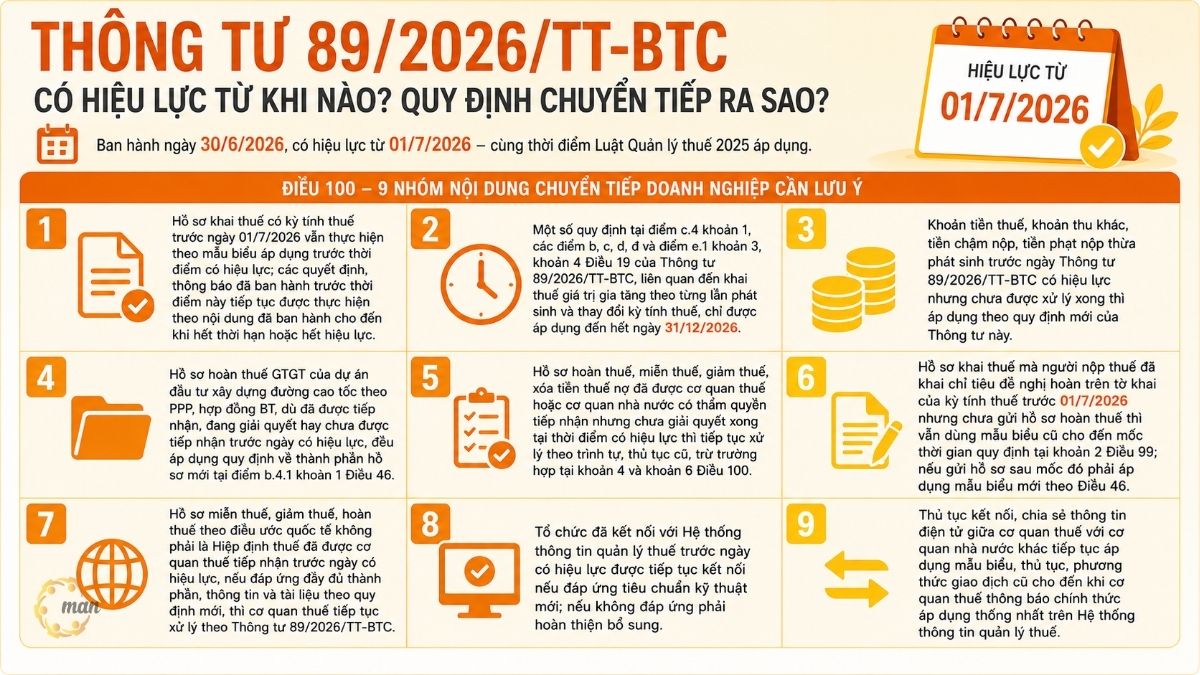
Circular 89/2026/TT-BTC was issued by the Ministry of Finance on June 30, 2026, and will take effect from July 1, 2026, coinciding with the official implementation of the 2025 Tax Administration Law. This is a crucial deadline that businesses need to pay special attention to, as it directly relates to tax declaration forms, tax refund applications, and ongoing tax exemption and reduction procedures.
Article 100 of Circular 89/2026/TT-BTC stipulates nine groups of transitional content that enterprise accountants need to fully review before applying the new forms:
- Tax returns for tax periods prior to July 1, 2026, will continue to be filed using the forms applicable before the effective date; decisions and notices issued before this date will continue to be implemented according to their content until their expiration or invalidation.
- Some provisions in point c.4, clause 1, points b, c, d, e and point e.1, clause 3, clause 4 of Article 19 of Circular 89/2026/TT-BTC, related to value-added tax declaration on a transaction-by-transaction basis and changes in the tax period, are only applicable until December 31, 2026.
- Taxes, other charges, late payment penalties, and overpaid fines incurred before the effective date of Circular 89/2026/TT-BTC but not yet processed shall be governed by the new provisions of this Circular.
- The value-added tax refund application for highway construction investment projects under the public-private partnership method, in the form of build-operate-transfer contracts, whether already received, being processed, or not yet received before the effective date, shall be subject to the new application requirements specified in point b.4.1, clause 1, Article 46.
- Tax refund, tax exemption, tax reduction, and tax debt cancellation applications that have been received by the tax authority or competent state agency but have not yet been processed at the time of effective date shall continue to be processed according to the old procedures, except for the cases specified in Clauses 4 and 6 of Article 100.
- For tax returns where taxpayers have declared the refund request on the tax return for the tax period prior to July 1, 2026, but have not yet submitted the refund application, the old form will continue to be used until the deadline specified in Clause 2, Article 99; if the application is submitted after that deadline, the new form as per Article 46 must be applied.
- Tax exemption, reduction, and refund applications under international treaties other than tax agreements that were received by the tax authorities before the effective date, if they fully meet the requirements regarding components, information, and documents as stipulated in the new regulations, will continue to be processed by the tax authorities in accordance with Circular 89/2026/TT-BTC.
- Organizations that were connected to the Tax Management Information System before the effective date may continue to connect if they meet the new technical standards; otherwise, they must make additional improvements.
- The procedures for connecting and sharing electronic information between tax authorities and other state agencies will continue to apply the old forms, procedures, and transaction methods until the tax authorities officially announce the unified application on the Tax Management Information System.
Compilation of legal documents related to Circular 89/2026/TT-BTC
To properly apply Circular 89/2026/TT-BTC, businesses need to simultaneously compare it with the following original documents and related guidance documents:
| Legal documents | Number / Date of Issue | Related content |
| Tax Administration Law 2025 | No. 108/2025/QH15 | The original legal basis for Circular 89/2026/TT-BTC to provide detailed regulations. |
| Decree 252/2026/ND-CP | Government, 2026 | Detailed regulations and organizational measures for the implementation of the Law on Tax Administration. |
| Decree 29/2025/ND-CP | Government, 2025 | Functions, duties, powers, and organizational structure of the Ministry of Finance |
| Decree 166/2025/ND-CP | Government, 2025 | Amendments and additions to Decree 29/2025/ND-CP concerning the Ministry of Finance. |
| Circular 18/2026/TT-BTC | Ministry of Finance, 2026 | Tax management procedures and documentation for household businesses and individual business owners. |
| Circular 50/2026/TT-BTC | Ministry of Finance, 2026 | Amendments and additions to tax management regulations for household businesses. |
| Decree 118/2025/ND-CP | Government, 2025 | Administrative procedures under the one-stop shop and integrated one-stop shop mechanisms. |
| Decree 347/2025/ND-CP | Government, 2025 | Administrative procedures in the field of State Treasury |
Which documents and forms does Circular 89/2026/TT-BTC repeal and replace?
According to Clause 1, Article 99, from July 1, 2026, Circular 89/2026/TT-BTC repeals all 10 circulars on the tax field that have been issued over several periods, and also repeals some articles, clauses, points and phrases in other documents as per Clause 4, Article 99.
| STT | The text has been repealed. | Previous content adjusted |
| 1 | Circular 179/2013/TT-BTC | Write off uncollectible tax and penalty debts incurred before July 1, 2007. |
| 2 | Circular 103/2014/TT-BTC | Tax obligations for foreign organizations and individuals doing business in Vietnam. |
| 3 | Circular 92/2015/TT-BTC | Personal income tax for resident individuals engaged in business activities. |
| 4 | Circular 96/2016/TT-BTC | Documents and procedures for exemption from personal income tax for foreign experts implementing non-governmental aid projects. |
| 5 | Circular 97/2016/TT-BTC | Documents and procedures for exemption from personal income tax for Vietnamese citizens working at United Nations representative offices. |
| 6 | Circular 84/2016/TT-BTC | Procedures for collecting and remitting state budget revenue, including taxes and domestic revenues. |
| 7 | Circular 19/2021/TT-BTC | Electronic transactions in the tax field |
| 8 | Circular 80/2021/TT-BTC | Guidelines for the implementation of the Law on Tax Administration and Decree 126/2020/ND-CP |
| 9 | Circular 94/2025/TT-BTC | Amendments and additions to Circular 80/2021/TT-BTC |
| 10 | Circular 21/2026/TT-BTC | Amendments to Circular 80/2021/TT-BTC and Decree 126/2020/ND-CP |
Six tax declaration forms for household businesses have been replaced:
According to Clause 5, Article 99, the Ministry of Finance is replacing six forms currently in use under Circular 50/2026/TT-BTC and Circular 18/2026/TT-BTC with new forms bearing the same symbols as in Appendix I issued with Circular 89/2026/TT-BTC, including forms 01/TKN-CNKD, 02/CNKD-TNCN-QTT, 01/XSBHĐC, 01/BK-XSBHĐC, 01/TCKT, and 01/BK-KTHTKD. The basic form names and codes remain unchanged, but taxpayers and tax filing organizations must use the new versions from the effective date. However, tax declarations for tax periods before July 1, 2026, will continue to use the old forms as stipulated in Clause 1, Article 100.
How are electronic transactions in tax administration implemented according to Circular 89/2026/TT-BTC?
Chapter II of Circular 89/2026/TT-BTC is dedicated to electronic transactions, clearly defining three groups of transactions: between taxpayers and tax authorities, between tax authorities and other state management agencies under the integrated one-stop mechanism, and transactions through T-VAN service providers. Taxpayers can conduct transactions 24 hours a day, seven days a week, including holidays and Tet (Lunar New Year).
To conduct valid electronic tax transactions according to Circular 89/2026/TT-BTC, taxpayers need an electronic tax transaction account (either an electronically identified account or an account issued by the Tax Management Information System), internet access, and a valid electronic signature. The electronic information systems serving these transactions include the National Public Service Portal, the Tax Management Information System, and the connected T-VAN service provider's system.
An important principle in Article 6 is that taxpayers are not required to resubmit documents that are already available in the Tax Management Information System or have been retrieved by the tax authorities from the national database. If the data is sufficient to calculate the tax, the system will automatically generate a tax return to assist the taxpayer; however, this assistance does not replace the responsibility of the business to declare taxes and determine the amount of tax payable.
Conditions for becoming a T-VAN service provider organization according to Circular 89/2026/TT-BTC
Not all businesses are eligible to provide T-VAN services. According to Article 15, organizations must simultaneously meet the following conditions:
- The system has equipment and technical solutions that provide stable connectivity to the Tax Management Information System, operating continuously 24/7, with backup, recovery, and data restoration plans.
- Implement comprehensive measures to protect cybersecurity, information security, and control transactions between relevant parties.
- Minimum of 3 years of experience in information technology and building electronic data exchange solutions.
- We commit to having sufficient financial capacity to invest in and operate the system, and to compensate for any damages arising during the provision of services (if any).
- We have a team of technical personnel dedicated to system administration, data security, and taxpayer support.
Table of processing deadlines for electronic documents according to Circular 89/2026/TT-BTC
To help taxpayers and businesses easily track the progress of electronic document processing, Circular 89/2026/TT-BTC clearly stipulates the processing deadlines for each type of procedure. Understanding these deadlines allows for proactive monitoring of results, timely supplementation of documents when needed, and minimizing the impact on tax obligations. The table below summarizes the important processing deadlines according to current regulations.
| Type of procedure | Processing time | Base |
| Notification regarding acceptance of regular electronic tax filings. | No later than 1 business day | Article 11 |
| Announcement regarding the acceptance of tax refund and tax exemption applications. | No later than 3 working days | Article 11 |
| First-time registration for electronic tax transactions. | 15 minutes at the latest. | Article 13 |
| Register for direct connection to the Tax Management Information System. | 5 working days | Article 14 |
| Notification of acceptance of tax return explanation | No more than 5 working days | Article 17 |
| Notification of the results of the extension for filing tax returns. | 3 working days | Article 18 |
Regarding VAT declaration according to Circular 89/2026/TT-BTC: should the tax period be monthly or quarterly?
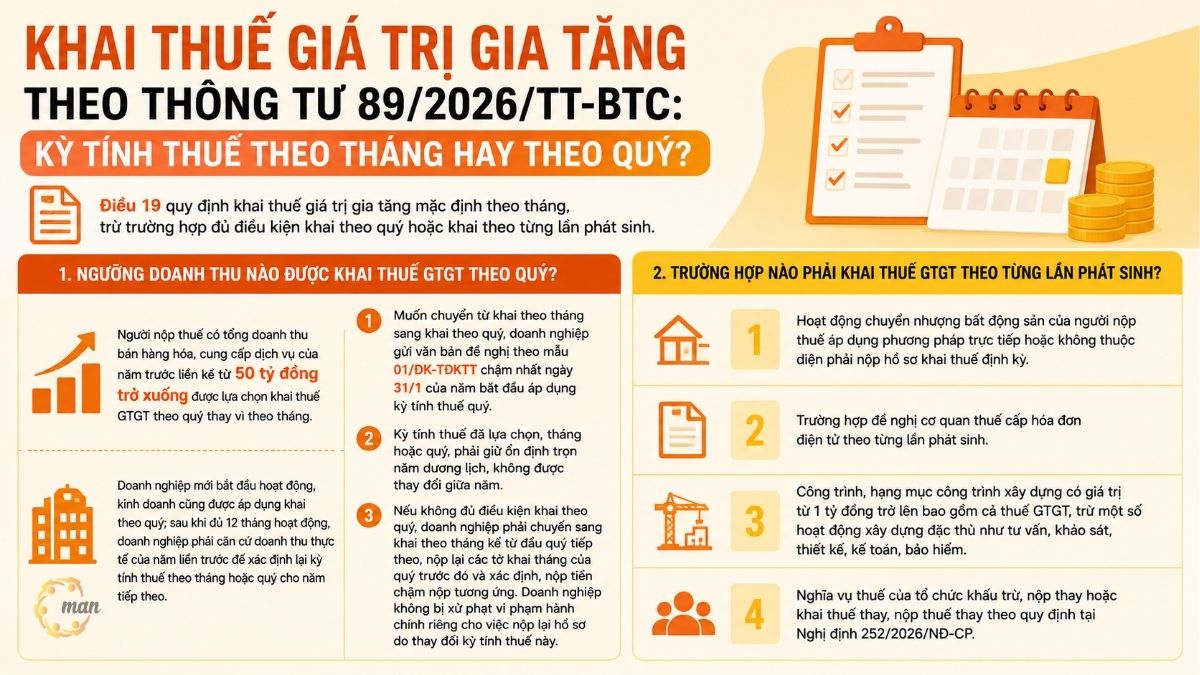
Article 19 stipulates that value-added tax declarations are automatically filed monthly, except in cases where quarterly or per-transaction declarations are permitted. This is a point that small and medium-sized enterprises (SMEs) need to pay special attention to when applying Circular 89/2026/TT-BTC to their periodic declarations.
What revenue threshold allows for quarterly value-added tax (VAT) declarations?
Taxpayers with total revenue from the sale of goods and services in the preceding year of 50 billion VND or less may choose to file value-added tax returns quarterly instead of monthly. Newly established businesses may also file quarterly; after 12 months of operation, the business must determine the tax period for the following year based on the actual revenue of the preceding year, either monthly or quarterly.
- To switch from monthly to quarterly tax filing, businesses must submit a written request using form 01/ĐK-TĐKTT no later than January 31st of the year in which the quarterly tax period begins.
- The chosen tax period, whether monthly or quarterly, must remain stable throughout the calendar year and cannot be changed during the year.
- If a business discovers, either on its own initiative or by the tax authorities, that it does not meet the requirements for quarterly filing, it must switch to monthly filing from the beginning of the following quarter, resubmit the monthly tax returns for the previous quarter, and determine and pay the corresponding late payment penalty. The business will not be subject to separate administrative penalties for resubmitting the documents due to this change in the tax period.
In which cases is value-added tax (VAT) required to be declared each time a transaction occurs?
- Real estate transfer activities of taxpayers applying the direct method or not subject to periodic tax filing requirements.
- This applies to cases where the tax authorities are requested to issue electronic invoices on a transaction-by-transaction basis.
- Construction projects and project components with a value of VND 1 billion or more, including value-added tax, excluding certain specific construction activities such as consulting, surveying, design, accounting, and insurance.
- The tax obligations of organizations that deduct, pay, or declare taxes on behalf of others are regulated by Decree 252/2026/ND-CP.
Quarterly personal income tax filing for salaries and wages: a new point in Circular 89/2026/TT-BTC.
One of the most significant changes in Circular 89/2026/TT-BTC lies in Article 22. According to point a.1, clause 1, Article 22, organizations and individuals paying income from salaries and wages must declare the amount of personal income tax withheld from the income recipients quarterly, instead of monthly as before.
- Organizations and individuals paying income from salaries and wages must declare the amount of personal income tax withheld quarterly, applying it uniformly to all payers.
- At the same time, organizations and individuals paying income must still carry out annual tax settlements and settle taxes on behalf of authorized individuals, regardless of whether tax deductions occurred during the year (point a.2, clause 1, Article 22).
- Compared to the old regulation in Clause 1, Article 9 of Decree 126/2020/ND-CP (amended by Decree 373/2025/ND-CP), taxpayers who previously filed monthly tax returns could only choose to file quarterly if they met the conditions for quarterly VAT filing. From July 1, 2026, quarterly personal income tax filing will be applied uniformly, no longer dependent on the conditions for quarterly VAT filing.
This is a change that the company's human resources and payroll departments need to immediately update in their internal tax filing schedule, as the previous monthly filing deadlines and deduction figures no longer apply to income from salaries and wages.
Case Study: How do businesses in Ho Chi Minh City apply Circular 89/2026/TT-BTC?
Real-world context
Company Y, operating in the field of trade and logistics services in Ho Chi Minh City, has three branches in Binh Duong, Dong Nai, and Long An. Prior to July 1, 2026, the company filed value-added tax returns centrally at its head office using the old form, without allocating tax obligations according to the geographical areas where allocations were received.
The procedure is as stipulated in Circular 89/2026/TT-BTC.
According to advice from MAN – Master Accountant Network, The company takes three steps: (1) reviewing all subsidiaries and business locations to determine cases subject to tax liability allocation as stipulated in Decree 252/2026/ND-CP and Circular 89/2026/TT-BTC; (2) re-registering electronic tax transaction accounts and updating electronic signatures in accordance with the new tax management information system; (3) rebuilding internal procedures to submit the Tax Payable Allocation Table with tax declaration documents on time.
The measured results
- The tax return was confirmed as received by the tax authorities within one business day, with no further requests for information.
- The company avoided the risk of late payment penalties due to filing taxes in the wrong tax-allocated area, saving an estimated 45 to 60 million VND in potential fines each quarter.
- The time required for data reconciliation during annual tax settlement has been reduced to approximately 3 working days thanks to electronic records and documents being stored synchronously on the system.
Expert opinion: Common business risks when applying Circular 89/2026/TT-BTC
Experts at MAN – Master Accountant Network With over 30 years of experience in tax consulting and auditing in Vietnam, we note four main risks that businesses often face when transitioning to Circular 89/2026/TT-BTC:
- Risk 1: Continuing to use the old form after the effective date: Many accountants have not updated their tax declaration forms and notification forms issued with Circular 89/2026/TT-BTC, leading to tax authorities rejecting or requiring resubmission of documents, causing delays and potentially incurring late payment penalties.
- Risk 2: Incorrect identification of the directly managing tax authority or allocated area: For businesses with multiple branches and subsidiaries, incorrectly identifying the tax authority responsible for direct management or omitting tax allocation obligations for the allocated area according to new regulations can easily lead to tax arrears and late payment penalties during tax audits.
- Risk 3: Internal accounting systems are not yet compatible with new electronic transactions: Some domestic accounting software has not yet updated its data fields and forms in accordance with Circular 89/2026/TT-BTC, causing errors in transmitting and receiving documents through the Tax Management Information System or via T-VAN, affecting the deadline for submitting documents.
- Risk 4: Missing the deadline for processing forwarded applications: For tax refund and exemption applications filed before July 1, 2026, that have not yet been processed, businesses need to carefully monitor the transitional provisions in Article 100 to avoid incorrectly applying forms or missing deadlines for supplementing documents as requested by the tax authorities.
Conclude
Circular 89/2026/TT-BTC is an important guiding document that concretizes the 2025 Tax Administration Law and Decree 252/2026/ND-CP into procedures for tax declaration, payment, refund, exemption, and electronic transactions, applicable uniformly nationwide from July 1, 2026. Businesses that correctly understand the scope of regulation, applicable subjects, and transitional provisions will significantly reduce the risk of being subject to tax arrears and penalties during the transitional period between the old and new regulations.
Tax services at MAN – Master Accountant Network
- Tax accounting services
- Tax consulting services
- Tax settlement services
- Tax reporting services
- VAT refund service
Service contact information at MAN – Master Accountant Network
- Address: No. 19A, Street 43, Tan Thuan Ward, Ho Chi Minh City
- Mobile/Zalo: 0903 963 163 – 0903 428 622
- E-mail: man@man.net.vn
- Google Business Profile: View MAN – Master Accountant Network's Google Business Profile
- LinkedIn Founder: View expert Le Hoang Tuyen's LinkedIn profile.
Responsible for production and professional content review by: Mr. Le Hoang Tuyen – Founder & CEO of MAN – Master Accountant Network, CPA Vietnam with over 30 years of experience in accounting, auditing, taxation, and corporate financial consulting.
Frequently Asked Questions about Circular 89/2026/TT-BTC
Circular 89/2026/TT-BTC was issued on June 30, 2026, and came into effect on July 1, 2026, coinciding with the official implementation of the 2025 Tax Administration Law and Decree 252/2026/ND-CP.
This applies to taxpayers, tax authorities in accordance with the Law on Tax Administration and Decree 252/2026/ND-CP, and other state agencies, organizations, and individuals involved in tax administrative procedures.
No. According to Article 100, tax returns for tax periods before July 1, 2026, will continue to be filed using the forms applicable before Circular 89/2026/TT-BTC comes into effect.
Businesses that have already registered for electronic transactions through the National Public Service Portal can continue to use it without re-registering. In case of a change in the transaction system, for example, switching from T-VAN to the Tax Management Information System, the procedure for registering the change as stipulated in Articles 8 and 13 must be followed.
According to Article 12, the Tax Department must promptly notify taxpayers of the time of the incident and the time when the system is back online. Taxpayers may submit their documents on the next working day, and documents submitted during this period will still be considered timely.
Businesses with total revenue from the sale of goods and services in the preceding year of VND 50 billion or less may choose to file value-added tax returns quarterly, as stipulated in Article 19 of Circular 89/2026/TT-BTC. Newly established businesses may also file quarterly returns until they have been operating for 12 months, at which point the tax period can be recalculated.
No. According to point a.1, clause 1, Article 22 of Circular 89/2026/TT-BTC, organizations and individuals paying income from salaries and wages must declare the amount of personal income tax withheld quarterly, applying a uniform method and no longer dependent on the conditions for quarterly value-added tax declaration as in the old regulations. Businesses must still perform annual personal income tax settlement as usual. When does Circular 89/2026/TT-BTC take effect?
Which entities are covered by Circular 89/2026/TT-BTC?
Do tax returns for tax periods prior to July 1, 2026 need to be resubmitted using the new form?
Is it mandatory for businesses to re-register their electronic tax transaction account?
What happens if the tax management information system malfunctions on the last day of the filing deadline?
What revenue level does a business need to have to file value-added tax returns quarterly?
From July 1st, 2026, will businesses still be required to file personal income tax returns for monthly salaries and wages?