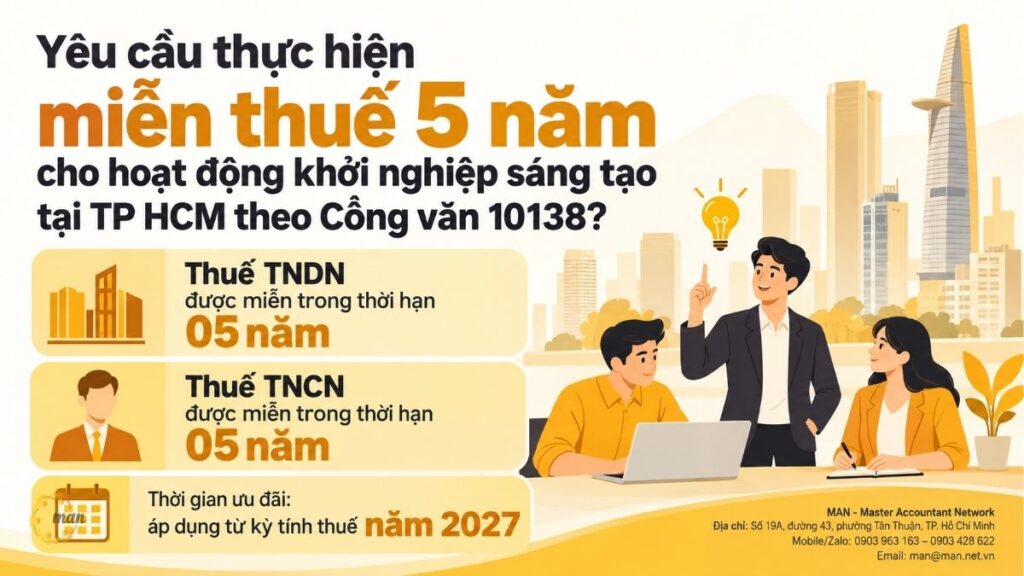


Decree No. 141/2026/ND-CP Issued in the context of the government's efforts to reform the tax system to provide maximum support for the private sector and small businesses, this document, with its groundbreaking changes to the taxable revenue threshold, is not just an administrative regulation but also a crucial financial leverage for millions of business households in Vietnam.
Mastering the core content of Decree No. 141/2026/ND-CP This helps business owners and accountants proactively plan their finances for 2026. In over 30 years of tax consulting experience, MAN recognizes this as the largest-scale adjustment since the 2019 Tax Administration Law came into effect, particularly the synchronization between personal income tax and corporate income tax policies, creating a more level playing field and greater transparency than ever before.
In particular, the promulgation of Decree No. 141/2026/ND-CP dated April 29, 2026, has concretized the tax exemption and reduction roadmaps, providing businesses and business households with a solid legal foundation to thrive in the new economic era.
Summary of key points of Decree No. 141/2026/ND-CP
- Main content: Decree No. 141/2026/ND-CP amends and supplements several articles of Decree 68/2026/ND-CP (on household businesses) and Decree 320/2025/ND-CP (on corporate income tax). It amends the revenue threshold from "VND 500 million" to "VND 1 billion" in a number of provisions of Decree No. 68/2026/ND-CP.
- Purpose: Raise the threshold for VAT/personal income tax exemption and the mandatory revenue threshold for using electronic invoices to VND 1 billion/year; exempt micro-enterprises from corporate income tax.
- Applicable objects: Household businesses, individual business owners (HKD, CNKD), and enterprises with annual revenue ≤ 1 billion VND.
- Effective date: Officially effective from [date] January 1, 2026.
What are the key changes stipulated in Decree No. 141/2026/ND-CP?
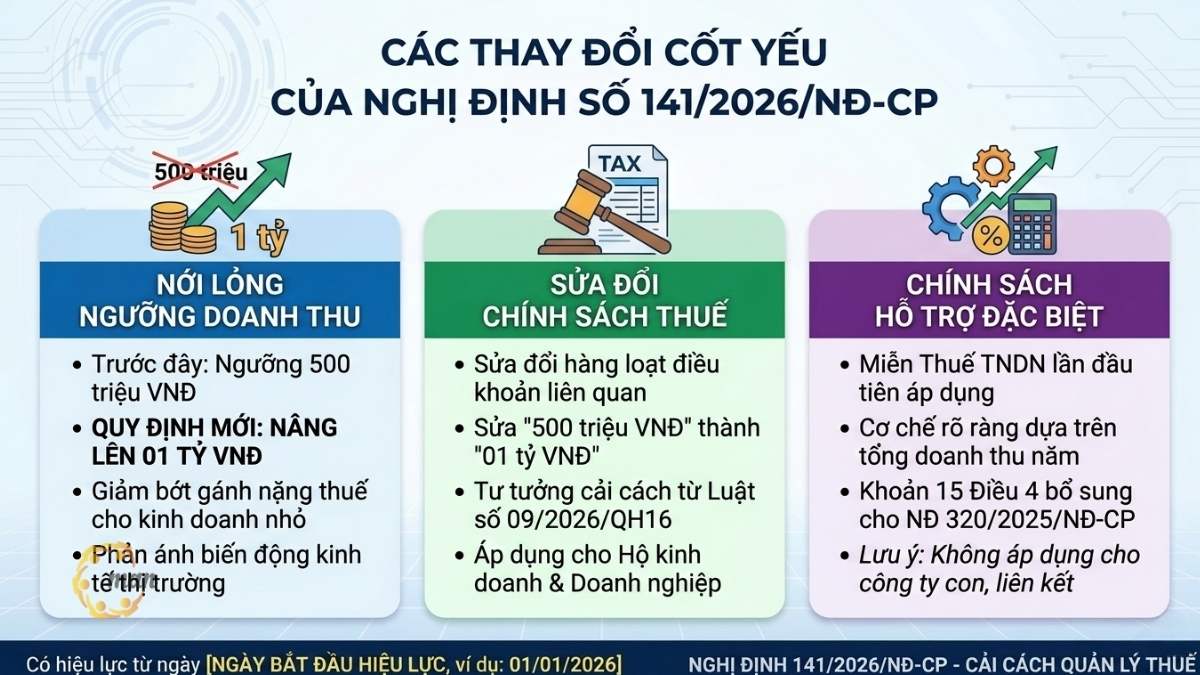
Decree No. 141/2026/ND-CP focuses on relaxing revenue thresholds to reduce the tax burden on small-scale businesses. Previously, a revenue threshold of VND 500 million was a crucial benchmark for determining various tax obligations. However, under the new regulations, this figure has been raised to VND 1 billion, reflecting the volatility of the market economy and the depreciation of the currency.
In legal terms, Decree No. 141/2026/ND-CP is a consolidated document incorporating reform ideas from Law No. 09/2026/QH16 amending and supplementing the Law. This amendment directly applies to important provisions regarding tax management policies, tax calculation methods, and regulations on documents and invoices for both individuals and legal entities. The most noteworthy point is the amendment of the phrase "500 million VND" to "1 billion VND" in a series of provisions. Decree 68/2026/ND-CP, This creates absolute unity within the textual system.
For household businesses, this change means that many individual business owners with average revenue will directly benefit from this threshold change. For enterprises, this is the first time we've seen an exemption mechanism. corporate income tax (CIT) Based on total annual revenue in such a clear and decisive manner, especially with the addition of Clause 15 of Article 4. Decree 320/2025/ND-CP.
Why is Decree No. 141/2026/ND-CP important for corporate financial management?

In financial management, correctly identifying revenue thresholds helps businesses optimize cash flow and reduce compliance costs. Decree No. 141/2026/ND-CP acts as a filter, classifying small businesses to apply specific preferential policies. This reduces complex declaration procedures and costs associated with operating cumbersome accounting systems for micro-sized businesses.
The value of the Decree lies in increasing transparency in the use of electronic invoices. By raising the mandatory threshold to 1 billion VND, the policy shifts from imposition to voluntary encouragement, giving small businesses time to prepare technologically and skillfully. At the same time, the regulation requiring the clear recording of business location codes on invoices for businesses with multiple stores supports more effective management of revenue and cash flow at each location.
From an auditing perspective, Decree No. 141/2026/ND-CP provides a clear legal basis for tax consulting firms to identify the risk of errors in tax declarations. The uniformity of tax thresholds for household businesses and micro-enterprises helps prevent "policy exploitation" by changing business forms solely to avoid taxes. This allows businesses to confidently expand their scale without excessive worry about crossing the boundary between household businesses and corporate legal entities.
Which groups are directly affected by Decree No. 141/2026/ND-CP?
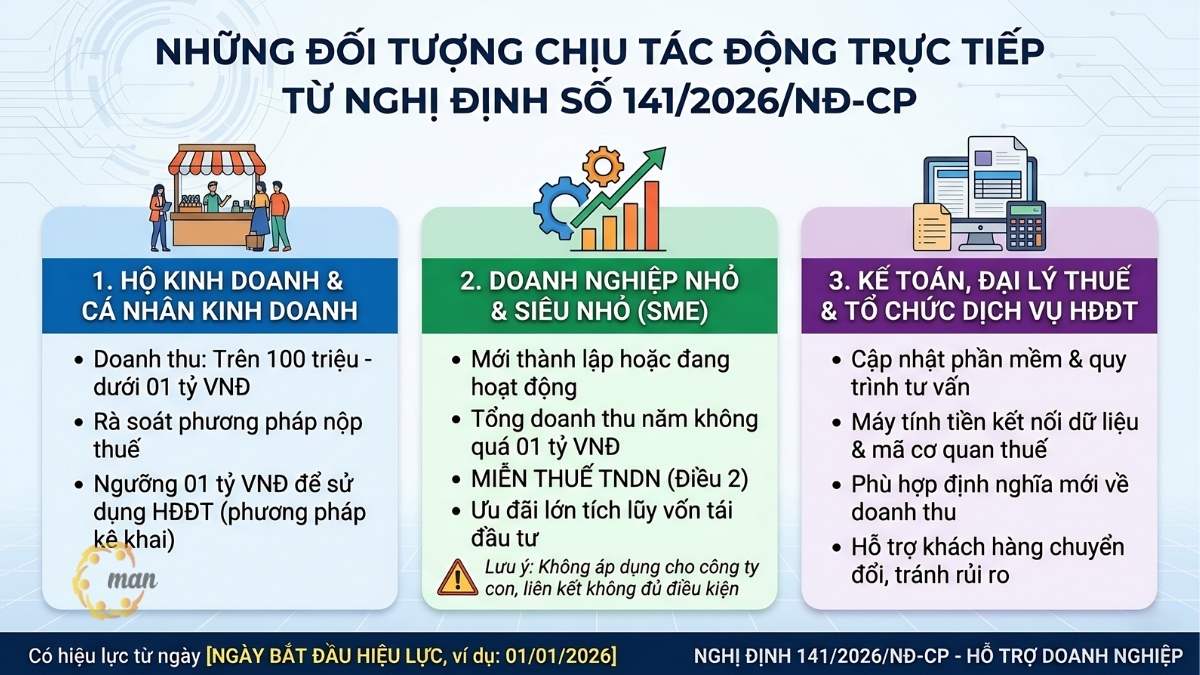
The first group to consider includes business households and individual businesses operating in Vietnam. According to Article 1 of the decree, any individual or business household with revenue ranging from over 100 million to under 1 billion VND must review their tax payment method. In particular, those currently paying taxes using the declaration method should note the 1 billion VND threshold to determine their obligation to use electronic invoices.
The second group of beneficiaries consists of small and micro-enterprises (SMEs). Specifically, newly established or existing businesses with total annual revenue not exceeding VND 1 billion are eligible for corporate income tax exemption under Article 2 of Decree No. 141/2026/ND-CP. This is a significant incentive that helps startups and family businesses accumulate capital for reinvestment. However, it should be noted that subsidiaries or affiliated companies will not be eligible for this incentive if the affiliated party does not meet the conditions.
Finally, there are the accounting teams, tax agents, and organizations providing electronic invoicing services. Changes in regulations regarding data-connected cash registers and tax authority codes require these entities to update their software and consulting processes to comply with the new definition of revenue and invoice registration deadlines. For professionals like us, this is a critical period for guiding clients through the transition without legal risks.
See more articles at: Remove the tax-free revenue threshold of 500 million VND/year for household businesses.
What are the key timelines and practical conditions to consider?
The most important date everyone needs to remember is January 1, 2026. This is the date when Decree No. 141/2026/ND-CP comes into effect. All transactions and tax periods starting from this date will apply a threshold of 1 billion VND, replacing the old regulations.
One noteworthy practical condition is the method of determining revenue for businesses that have been operating for less than 12 months. The decree clearly stipulates that revenue will be converted proportionally based on the number of months to ensure fairness. The specific formula is: (Actual revenue / Actual number of months of operation) x 12 months. If this figure exceeds 1 billion VND, the business will not be exempt from corporate income tax. This is a point that businesses established at the end of the year often misunderstand.
Regarding electronic invoices, if a business household generates cumulative revenue exceeding 1 billion VND during the tax year, they have 30 days from the last day of that tax period to register for the use of electronic invoices with codes or generate them from a cash register. This 30-day period is a very specific new regulation, giving business households time to prepare the necessary equipment and digital signatures.
Summary of taxes for household businesses according to Decree 141/2026/ND-CP
Based on Chapter 2 of Decree 68/2026/ND-CP, as amended by Decree 141/2026/ND-CP, the tax structure for business households is stipulated in detail as follows:
Value Added Tax (VAT)
Raising the revenue threshold to VND 1 billion under Decree 141/2026/ND-CP has changed the way obligations are determined. VAT For household businesses and individual business owners, tax obligations are no longer applied uniformly but are classified according to actual annual revenue, as shown in the table below:
| Annual revenue | Value Added Tax Policy |
| From 1 billion VND or less | Not subject to value added tax. |
| Over 1 billion VND | Calculate using the direct method:
Tax amount = Rate % x Revenue |
Note: The % rate is applied according to the provisions of the 2024 Value Added Tax Law and its guiding documents.
Personal income tax (PIT)
Below is a summary table of personal income tax rates applicable to household businesses according to the latest regulations in Decree 141/2026/ND-CP (amended from Decree 68/2026/ND-CP):
| Household business | Personal income tax |
| Annual revenue of 1 billion VND or less. | No personal income tax payable. |
| Annual revenue ranges from 1 billion VND to 3 billion VND. | Taxable income (x) tax rate
Tax rate 15% Or – Distribution and supply of goods: tax rate 0.5%; – Services and construction without material procurement: tax rate 2%. However, for property leasing, insurance agency, lottery agency, and multi-level marketing agency activities: tax rate 5%; – Production, transportation, services related to goods, and construction with material procurement included: tax rate 1.5%; – Activities providing digital information content products and services related to entertainment, video games, digital films, digital photos, digital music, and digital advertising: tax rate 5%; – Other business activities: tax rate 1%. |
| Annual revenue ranges from 1 billion VND to 3 billion VND. | Tax rate (17%) (x) taxable revenue |
| Actual annual revenue exceeded 3 billion VND. | Taxable income (x) tax rate
– Annual revenue from over 3 billion VND to 50 billion VND: tax rate 17%; – Annual revenue exceeding 50 billion VND: tax rate 20%. |
Revenue and expenses are determined according to the provisions of Articles 5 and 6 of Decree 68/2026/ND-CP.
Regulations on corporate income tax exemption for micro-enterprises according to Decree 141/2026/ND-CP
Decree 141/2026/ND-CP supplements Decree 320/2025/ND-CP with an extremely preferential tax exemption mechanism for businesses:
- Threshold: Businesses with total annual revenue from 1 billion VND or less They are completely exempt from corporate income tax.
- How to determine revenue: This includes total revenue from sales and services + financial revenue + other income.
- In cases where the business has not been operating for 12 months: Revenue is converted to an equivalent of 12 months to determine eligibility.
- Special case: Newly established businesses that project revenue of ≤ 1 billion VND are not required to make quarterly provisional corporate income tax payments.
Important Note: This tax-free offer Not applicable This applies to businesses that are subsidiaries or affiliated with other businesses (not eligible for preferential treatment) to prevent abuse of the policy.
Compilation of legal documents related to Decree No. 141/2026/ND-CP
To gain a thorough understanding of Decree No. 141/2026/ND-CP, we need to place it within the context of a comprehensive legal framework. Below is a summary of the most important legal grounds:
| Document number | Date of issuance | Related content summary |
| Law No. 09/2026/QH16 | Early 2026 | Amend tax laws regarding revenue thresholds and exemption policies. |
| Decree 68/2026/ND-CP | 05/03/2026 | Original regulations on tax management for household businesses. |
| Decree 320/2025/ND-CP | 15/12/2025 | Guidelines for the implementation of the Corporate Income Tax Law. |
| Law on Organization of the Government 63/2025/QH15 | 2025 | Basis for issuing decrees governing the economy. |
| Personal Income Tax Law 109/2025/QH15 | 2025 | Regulations regarding the tax obligations of individual business owners. |
Consulting these documents helps businesses gain a multifaceted view of their obligations, avoiding a rote understanding of a single decree while neglecting the supporting regulations in accompanying circulars.
Case Study 1: Converting from a Sole Proprietorship to a Company
Consider the case of Mr. Hung, the owner of a woodworking factory. In 2025, his revenue will be 900 million VND. According to the old regulations, he was a large-scale business household and had to use electronic invoices.
In 2026, according to Decree No. 141/2026/ND-CP, Mr. Hung decided to establish Hung Anh Wood Furniture Co., Ltd. Because his revenue in 2025 was less than 1 billion VND, his new company was exempt from corporate income tax in 2026. He didn't need to make quarterly tax payments, giving him an additional approximately 20 million VND per quarter to purchase raw materials. This is a prime example of how tax policy promotes the formalization of the economy.
Case Study 2: Businesses established in the middle of the year and how revenue is calculated.
Alpha Company was established in September 2025, with its first tax period ending on December 31, 2025 (4 months of operation). Actual revenue reached VND 350 million. How to determine tax exemption for 2026:
- Revenue converted over 12 months: (350 million / 4 months) x 12 months = 1.05 billion VND. Conclusion: Because the converted revenue exceeds 1 billion VND, Alpha is not exempt from corporate income tax in 2026, even though the actual revenue in 2025 was only 350 million VND. This requires Alpha's accountant to prepare for provisional tax payments starting from Q1/2026.
Rights and responsibilities of household businesses (Article 13 of Decree 68)
According to the latest regulations, household businesses and individual business owners need to be aware of the following rights and obligations:
- Interest: They receive guidance, answers to their questions, and support with tax procedures from the tax authorities; and they have all the rights of a taxpayer as stipulated by law.
- Self-declaration and responsibility: Revenue generated must be accurately and completely declared, and the individual is legally responsible for the content of the declaration.
- Make your account public: Electronically notify the tax authorities of all bank account numbers and e-wallet accounts related to business operations.
- Bookkeeping and Invoices: Use accounting records as prescribed by the Ministry of Finance; be responsible for providing invoices and sales management software when requested by tax authorities for inspection.
- Doing business on digital platforms: Household businesses operating on e-commerce platforms must declare and pay all specific taxes (special consumption tax, environmental protection tax, resource tax, etc.) and provide identification information (Tax ID, Citizen Identification Card/Passport) to the e-commerce platform's owner.
Instructions for handling transitional payments and overpaid taxes (Article 4)
Article 4 of Decree No. 141/2026/ND-CP provides very detailed regulations on transitional situations, and this is the part that businesses often find most confusing:
- For household businesses: If a business household determines its revenue to be below 1 billion VND but has already declared and paid taxes according to the old threshold, the overpaid tax amount will be offset or refunded in accordance with Article 12 of Decree 68.
- For businesses: If a business has already made provisional corporate income tax payments for the first quarter of 2026 but subsequently determines it is eligible for tax exemption under Decree 141, it is not required to make provisional payments for subsequent quarters. The overpaid amount from the first quarter will be offset against other tax obligations or refunded.
- Overdraft tax period (2025-2026): This is the latest update. If a company's 2025 tax year ends after January 1, 2026 (for example, a fiscal year from April 1, 2025 to March 31, 2026), the company will be exempt from tax for the months in 2026. The tax exemption formula is: (Total annual corporate income tax / 12 months) x Number of months in the 2026 tax year. Example: Annual tax is 120 million VND, tax year ends in March 2026 (there are 3 months in 2026). The amount of tax exempted = (120/12) x 3 = 30 million VND.
Comparison table of old and new regulations according to Decree No. 141/2026/ND-CP
The most significant differences lie in the quantitative revenue metrics. The table below illustrates the key changes:
| Comparison criteria | Old rules | New regulations (Decree 141) |
| Mandatory threshold for e-invoices | Over 500 million VND/year | Over 1 billion VND/year |
| Corporate income tax exemption | Tax must be paid at the standard rate. | Completely exempt for revenue ≤ 1 billion. |
| Provisional payment of corporate income tax. | Quarterly provisional payments are mandatory. | No advance payment is required if the projected amount is ≤ 1 billion VND. |
| Late payment penalties for taxes | Calculate immediately if there is a shortfall in payment. | Excluding cases where actual results exceed projected levels. |
| Record the location code on the contract. | Not mandatory. | This must be clearly stated for each store. |
Expert opinions on the risks and experiences in implementing Decree No. 141/2026/ND-CP regarding tax matters.
With over three decades of experience in the industry, MAN recognizes that the biggest risk lies in misidentifying “total revenue.” Many accountants only calculate sales revenue, neglecting financial revenue or other income. Decree No. 141/2026/ND-CP clearly stipulates in Article 2 that “total revenue” includes all three sources. If a business has sales revenue of 990 million VND but interest income from deposits of 15 million VND, totaling 1,005,000,000 VND, the business immediately loses its corporate income tax exemption.
Another issue concerns newly established businesses. Don't celebrate prematurely if you see low actual revenue. Always use the 12-month conversion formula to verify. Otherwise, at the time of year-end settlement, the amount of tax payable along with penalties (unless late payment penalties are excluded) will be a significant burden.
MAN's experience in handling businesses with multiple locations: Ensure your invoicing software system is capable of separating business location codes right from the invoice issuance stage. This not only helps comply with Article 1 of Decree 141 but also helps you effectively manage the business of each branch. Transparent invoicing is the best way to build credibility with the tax authorities.
Conclude
Decree No. 141/2026/ND-CP represents a significant step forward in simplifying Vietnam's tax system. By raising the revenue threshold to VND 1 billion and introducing a groundbreaking corporate income tax exemption policy, the government has created a more favorable legal framework, helping individual businesses and small enterprises reduce financial pressure. However, this comes with requirements for honesty and a thorough understanding of transitional regulations, especially the method of calculating taxes for the tax periods spanning between 2025 and 2026.
Proper application of the regulations in Decree No. 141/2026/ND-CP requires close coordination between business owners and professionals. MAN – Master Accountant Network is always ready to support you in implementing these regulations. tax settlement services Professional, handling procedures for refunding overpaid taxes and tax consulting Optimize your tax obligations according to the latest regulations. Let us help you turn policy changes into a competitive advantage for your business.
Service contact information at MAN – Master Accountant Network
- Address: No. 19A, Street 43, Tan Thuan Ward, Ho Chi Minh City
- Mobile/Zalo: 0903 963 163 – 0903 428 622
- Email: man@man.net.vn
Content production by: Mr. Le Hoang Tuyen – Founder & CEO MAN – Master Accountant Network, Vietnamese CPA Auditor with over 30 years of experience in Accounting, Auditing and Financial Consulting.
Frequently Asked Questions about Decree No. 141/2026/ND-CP
You can absolutely continue using it voluntarily. If you want to stop, you need to notify the tax authorities. However, I recommend keeping it to maintain a professional image.
You must pay corporate income tax on all profits when settling the annual tax return. A special feature of Decree No. 141/2026/ND-CP is that you will not be charged late payment penalties for unpaid taxes from previous quarters.
No, unless the parent company or its affiliated parties are eligible for tax exemption. This is stipulated in point d, clause 15, Article 2 of Decree 141, aimed at preventing the fragmentation of businesses.
You can use the same business tax code for all your stores, but you must clearly state the corresponding business location code on the invoice for each store.
You must register to use electronic invoices with codes within 30 days from the last day of the tax period with cumulative revenue exceeding 1 billion VND. My business is currently using electronic invoices. If my revenue is below 1 billion VND, can I discontinue using them?
I'm starting my business in 2026, with projected revenue of 800 million VND, so I won't be paying any provisional taxes. But what if I reach 1.2 billion VND by the end of the year?
Does the corporate income tax exemption apply to subsidiaries?
How is the tax identification number used for a business with multiple locations?
If my revenue last year was 400 million, but by June 2026 the cumulative revenue has reached 1.1 billion, when should I register for e-invoices?