


Deadline for submitting personal income tax returns for Q2 2026 This is one of the most important deadlines that accounting departments, HR Payroll, and business owners in Vietnam need to pay special attention to when entering the mid-year reporting period. Adhering to the deadline not only helps businesses maintain a clean tax compliance record but also completely eliminates legal risks arising from increasingly stringent administrative penalties under the latest amended decrees.
With tax policies constantly being adjusted and updated until 2026, small and medium-sized enterprises (SMEs) often face considerable confusion when determining their personal income tax declaration obligations. This article, compiled by leading tax consultants, aims to provide a comprehensive legal basis, guidance on calculating quarterly tax declaration deadlines, updated tax schedules for household businesses, and valuable practical tips to optimize tax risk management processes for businesses.
Quick information about the deadline for filing personal income tax returns for Q2 2026.
The deadline for filing the Q2 2026 personal income tax return is July 31, 2026 (Friday). This is a mandatory deadline for all businesses and organizations paying income to file quarterly personal income tax returns. Late filing after this deadline will result in severe administrative penalties depending on the number of days overdue, as per current regulations.
What is the deadline for submitting the personal income tax return for the second quarter of 2026?

The deadline for filing tax returns for quarterly taxes is clearly stipulated in the Vietnamese tax legal system. Specifically, according to point a, clause 3, Article 55 of the 2019 Tax Administration Law, the deadline for filing tax returns for quarterly taxes is no later than the last day of the first month of the following quarter.
Quarter 2 includes April, May, and June. Therefore, the first month of the next quarter is July. According to the 2026 calendar, the last day of July 2026 falls on July 31st, 2026, which is a Friday. This is a normal working day and does not coincide with a weekend or public holiday.
Therefore, the deadline for submitting the Q2 2026 personal income tax return is exactly July 31, 2026. Businesses need to proactively complete their income data, deduct taxes, and make payments. Declaration form 05/KK-TNCN Update your tax system to the electronic tax system before this time to avoid unnecessary penalties.
The latest regulations regarding the deadline for filing quarterly tax returns in 2026.
The quarterly tax return filing deadline method in Vietnam is currently applied uniformly to many different types of taxes, including: personal income tax, VAT and corporate income tax This is an estimate. Businesses need to clearly understand the principles of calculating time margins in order to proactively develop appropriate financial plans.
As stipulated in Article 86 Circular 80/2021/TT-BTC, In cases where the last day of the tax filing deadline coincides with a weekend (Saturday, Sunday) or a public holiday as stipulated by the Labor Law, the tax filing deadline will be shifted to the next working day after that holiday. This regulation ensures maximum benefits for taxpayers when conducting transactions directly or indirectly with the tax authorities.
Although the eTax system operates 24/7 and allows taxpayers to submit documents at any time, including holidays, the regulation on shifting deadlines is consistently applied to calculate administrative penalties. Therefore, mastering the Gregorian calendar and comparing it with the regulations on shifting dates is a mandatory skill for professional accounting personnel.
See more articles at: Latest tax reporting deadlines for 2026
Which individuals or entities are required to file quarterly personal income tax returns?
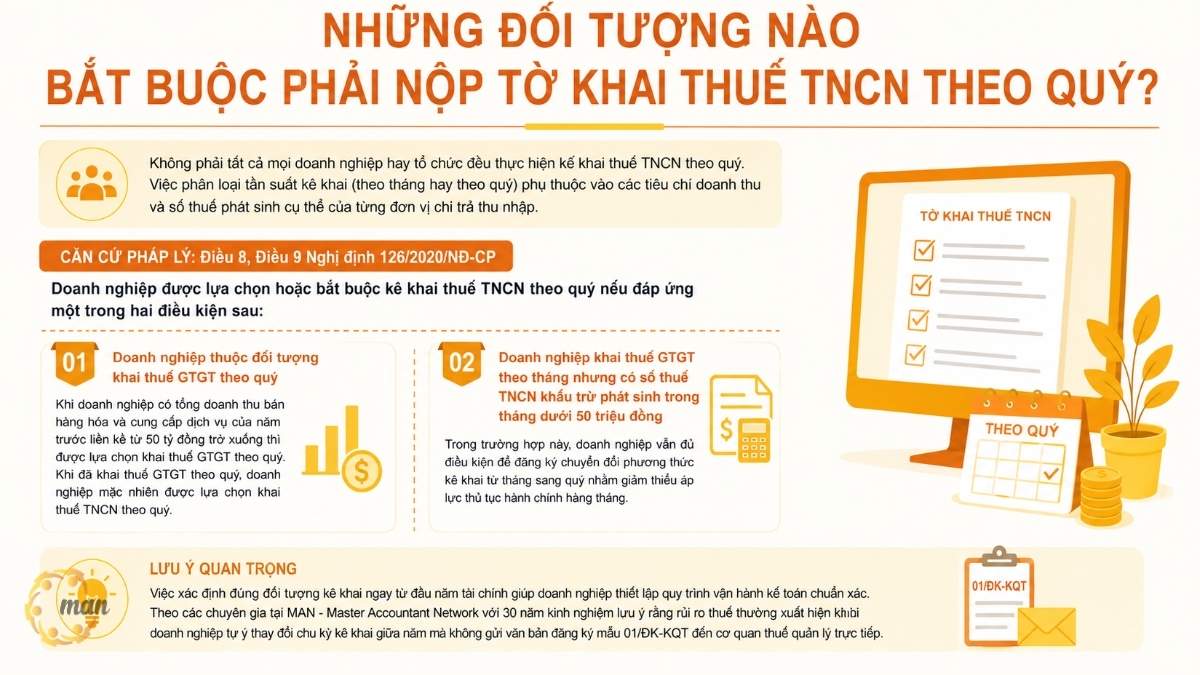
Not all businesses or organizations file personal income tax returns quarterly. The frequency of filing (monthly or quarterly) depends on the specific revenue and tax liability of each income-paying entity.
Based on Articles 8 and 9 Decree 126/2020/ND-CP, Businesses may choose or be required to file personal income tax returns quarterly if they meet one of the following two conditions:
- Firstly, businesses are subject to filing Value Added Tax (VAT) quarterly. Businesses with total sales revenue from goods and services in the preceding year of 50 billion VND or less are eligible to choose to file VAT quarterly. Once VAT is filed quarterly, the business is automatically eligible to file Personal Income Tax (PIT) quarterly as well.
- Secondly, businesses that file VAT returns monthly but have personal income tax withheld in the month below 50 million VND are still eligible to register to switch their filing method from monthly to quarterly to reduce monthly administrative burden.
Identifying the correct tax filing entities at the beginning of the fiscal year helps businesses establish accurate accounting procedures. Experts at MAN – Master Accountant Network, with 30 years of experience, note that tax risks often arise when businesses arbitrarily change their filing cycle mid-year without submitting a registration document. Form 01/DK-KQT Go to the tax authority that directly manages your case.
See more articles at: Business legal calendar for June 2026
Compilation of the latest legal documents on tax administration in 2026
To perform tax accounting accurately, businesses need to systematize the currently effective legal documents. Below is a summary table of fundamental legal documents that directly regulate tax declaration deadlines and payment obligations:
| Document number | Date of issuance | Summary of content |
| Tax Administration Law No. 38/2019/QH14 | 13/06/2019 | The framework law stipulates the principles for tax declaration, deadlines for filing tax returns, and tax payments in Vietnam. |
| Decree 126/2020/ND-CP | 19/10/2020 | Detailed guidance on the implementation of certain provisions of the Law on Tax Administration, stipulating the classification of tax declarations by month/quarter. |
| Circular 80/2021/TT-BTC | 29/09/2021 | Guidelines for implementing the Law on Tax Administration regarding handling deadlines when they coincide with holidays and weekends. |
| Decree 125/2020/ND-CP | 19/10/2020 | Regulations detailing penalties for administrative violations related to taxes and invoices. |
| Decree 310/2025/ND-CP | 15/11/2025 | Amendments and additions to certain articles of Decree 125/2020/ND-CP on penalties for late submission of tax documents. |
| Decree 141/2026/ND-CP | 29/04/2026 | New regulations amending tax management, accounting records, invoices, and personal income tax rates for household businesses. |
Mastering these documents provides accountants with a solid legal basis when working with tax authorities. Continuously updating on new decrees such as Decree 141/2026/ND-CP demonstrates the proactive and professional approach of businesses in managing tax risks.
Updated formula for calculating personal income tax for household businesses according to Decree 141/2026/ND-CP
Besides monitoring the deadline for filing personal income tax returns for the second quarter of 2026, business households are also strongly affected by new tax policies issued in 2026. On April 29, 2026, the Government issued... Decree 141/2026/ND-CP Amend and supplement certain articles of Decree 68/2026/ND-CP.
Below is a detailed summary table of the personal income tax calculation formula, accounting records, invoices, and declaration periods applicable to each group of business households:
| Group of household businesses | Tax rates and calculation methods | Accounting system | Use invoices | Tax filing frequency |
| Group 1Revenue of 1 billion VND/year or less (Small-scale business) | – VAT: Exempt
– Personal Income Tax: Exempt |
– Simple note-taking
– S1a-HKD book |
Not mandatory | – Once a year (Deadline for submission is January 31st of the following year)
– Twice a year (If you are a newly established business, the deadlines are July 31st and January 31st) |
| Group 2Revenue of 1 billion to 3 billion VND/year (Medium size) | – VAT: Calculated based on 1 TP3T revenue
– Personal Income Tax: Calculated based on 1% of revenue or actual profit. Method 1: (Revenue – tax threshold) x corresponding personal income tax rate. Method 2: (Revenue – Expenses) x Tax Rate 15% |
– Apply the average
– S2a-HKD book – If registering to pay taxes based on actual profits: Use forms S2b, S2c, S2d, S2e, S3a |
The use of electronic invoices is mandatory. | Quarterly declaration |
| Group 3Revenue ranging from 3 billion to 50 billion VND per year (Medium-large scale) | – VAT: Calculated based on 1 TP3T revenue
– Personal Income Tax: Calculated based on actual profit using the formula: (Revenue – Expenses) – Applicable personal income tax rate: 17% |
– Use a systematic accounting system including: S2b, S2c, S2d, S2e, S3a | The use of electronic invoices is mandatory. | Quarterly declaration |
| Group 4Revenue exceeding 50 billion VND/year (Medium-large scale) | – VAT: Declared based on actual revenue
– Personal Income Tax: Calculated based on actual profit using the formula: (Revenue – Expenses) – Applicable personal income tax rate: 20% – Management method: Applied in the same way as a formal business. |
– Apply it like a real business:
+ Diary + General Ledger + Detailed ledger + Trial balance + Complete financial report |
The use of electronic invoices is mandatory. | Monthly declaration |
Key takeaways from the data table above:
- For household businesses with annual revenue of 1 billion VND or less: They are completely exempt from Value Added Tax (VAT) and Personal Income Tax (PIT).
- For household businesses with annual revenue between 1 billion and 3 billion VND: It is mandatory to file tax returns and use electronic invoices in their business operations.
- For business households with annual revenue ranging from 3 billion VND to 50 billion VND: Professional accounting management is required to closely monitor the complex accounting system.
- For large-scale household businesses with annual revenue exceeding 50 billion VND: The business owner should seriously consider converting their operating model into a formal enterprise to optimize management and operational processes.
Latest penalties for late filing of tax returns in 2026.
Businesses need to pay special attention to the deadline for submitting personal income tax returns for the second quarter of 2026 to avoid administrative penalties. Below is a detailed penalty framework updated in accordance with the regulations in Article 13 of Decree 125/2020/ND-CP, amended and supplemented by Clause 10, Article 1 of Decree 310/2025/ND-CP:
Table detailing penalties for late filing of tax returns in 2026
| STT | Violation of the submission deadline | Forms and levels of administrative penalties | Mandatory remedial measures |
| 1 | Filing tax returns late by 1 to 5 days and having mitigating circumstances | Warning | The full amount of overdue taxes must be paid into the state budget. |
| 2 | Filing tax returns more than 1 to 30 days after the deadline (excluding cases subject to a warning penalty as mentioned in clause 1 above) | A fine of 2,000,000 to 5,000,000 VND will be imposed. | The full amount of overdue taxes must be paid into the state budget. |
| 3 | Filing tax returns more than 31 to 60 days after the deadline. | A fine of 5,000,000 to 8,000,000 VND will be imposed. | The full amount of overdue taxes must be paid into the state budget. |
| 4 | Falling into one of the following specific behaviors:
(i) Filing tax returns more than 61 to 90 days after the prescribed deadline; (ii) Filing tax returns more than 91 days after the prescribed deadline but without incurring any tax liability to the state budget; (iii) Failure to file a tax return but no tax liability arises; (iv) Failure to submit the required appendices on tax management for enterprises with related-party transactions along with the corporate income tax return. |
A fine of between 8,000,000 VND and 15,000,000 VND will be imposed. | – The full amount of late payment penalties as stated in the tax return must be paid into the state budget.
– Mandatory submission of tax returns and accompanying appendices for the acts specified in points (iii) and (iv). |
| 5 | Filing tax returns more than 90 days after the prescribed deadline, with tax payable incurred, and the taxpayer has paid the full amount of tax and late payment penalties to the state budget before the tax authorities announce a tax audit or inspection decision, or before an administrative violation report is drawn up regarding the late filing of tax returns. | A fine ranging from 15,000,000 VND to 25,000,000 VND will be imposed. | The full amount of overdue tax must be paid into the state budget in accordance with regulations. |
In addition to being fined according to the administrative framework mentioned above, businesses that are late in submitting tax returns with tax obligations will also be subject to late payment penalties calculated at a rate of 0.031 TP3T per day on the total amount of tax overdue. Prolonged delays not only cause direct financial losses but also reduce the business's tax compliance reputation score on the General Department of Taxation's risk management system.
Real-world Case Study: Managing the Risk of Late Filing of Personal Income Tax Returns in Service Businesses
To illustrate the importance of adhering to filing deadlines, let's analyze a real-life situation that occurred at An Binh Tourism Services Co., Ltd. (company name changed) during a previous reporting period.
Due to a sudden change in the chief accountant in July, An Binh Company overlooked submitting its Q2 personal income tax return. On September 15th, during a system review, the accountant discovered that the Q2 form 05/KK-TNCN was still unsubmitted, even though the personal income tax payable for that quarter was 35,000,000 VND. This tax had actually been paid to the state budget on time on July 30th, but the return was simply forgotten.
Analysis of violations and applicable penalties
The number of days overdue for filing the tax return, calculated from August 1st to September 15th, is 46 days. Therefore, this violation falls within the penalty range of VND 5,000,000 to VND 8,000,000 as stipulated in the Decree on administrative penalties for tax violations. The directly managing tax authority subsequently issued an administrative penalty decision against An Binh Company at the average level of the penalty range, VND 6,500,000.
How to fix it
- Step 1: The accountant immediately uploads the missing Q2 personal income tax return to the electronic tax portal system.
- Step 2: The business proactively contacts the tax officer directly in charge to explain the objective reason, such as the handover of accounting personnel, and presents documentation showing that taxes were paid on time previously, in order to request the application of the minimum penalty within the range or consideration of mitigating circumstances.
- Step 3: After receiving the penalty decision from the tax authority, the company proceeds to pay the fine into the state budget account within the deadline specified in the decision.
The case of An Binh Company illustrates that even if a business pays its taxes in full and on time, late filing of tax returns (tax declaration documents) can still result in severe administrative penalties. Establishing an automated reminder system and implementing cross-checking is absolutely essential.
MAN Expert Perspective: Common Tax Risks and How to Optimize Costs
With over 30 years of experience in providing auditing, tax accounting, and tax consulting services in the Vietnamese market, the team of experts at MAN – Master Accountant Network has accumulated many profound practical lessons on tax risk management for businesses.
One of the most common mistakes made by SMEs is the complacency regarding blank tax returns (returns that do not generate any tax liability). Many accountants mistakenly believe that if the business does not deduct any personal income tax for any employees during the quarter, then there is no need to file a personal income tax return for that quarter.
However, according to regulations, only businesses that do not make any taxable income payments to employees during the quarter are exempt from filing tax returns. If a business does pay salaries (even if the salary is below the tax threshold and no tax is withheld), it is still required to file a quarterly tax return. This misunderstanding often leads to accumulated fines over multiple filing periods, causing significant financial losses when the tax authorities conduct final audits.
To optimize tax costs in Vietnam and minimize legal risks, MAN recommends that businesses implement the following three core solutions:
- Firstly, develop a detailed compliance control schedule for each fiscal year, clearly specifying the deadline for completing internal data at least 3 to 5 working days before the state deadline to allow time for handling technical issues with internet connectivity or tax system congestion.
- Secondly, we regularly organize internal training sessions to update staff on new decrees and circulars, such as Decree 141/2026/ND-CP, so that accounting and HR Payroll personnel are always up-to-date on policy changes.
- Thirdly, consider using professional tax reporting services from reputable organizations. Solutions from MAN – Master Accountant Network help businesses free up resources to focus on core business activities, while ensuring absolute legal security thanks to a team of experts with in-depth knowledge of tax risk management practices in Vietnam.
Conclude
Strictly adhering to the deadline for filing the Q2 2026 personal income tax return on July 31, 2026, is a mandatory legal obligation and a measure of professionalism in the operational management of each business. Proactively reviewing, declaring, and filing the tax return on time helps businesses avoid unnecessary financial losses from the latest administrative penalties.
MAN – Master Accountant Network is a trusted partner of many businesses in Vietnam, specializing in providing tax settlement services., tax accounting services, tax reporting services and in-depth tax consulting. With a team of experts boasting over 30 years of experience, MAN is committed to helping businesses optimize costs, minimize legal risks, and confidently manage their financial and accounting operations.
Service contact information at MAN – Master Accountant Network
- Address: No. 19A, Street 43, Tan Thuan Ward, Ho Chi Minh City
- Mobile/Zalo: 0903 963 163 – 0903 428 622
- Email: man@man.net.vn
Content production by: Mr. Le Hoang Tuyen – Founder & CEO MAN – Master Accountant Network, Vietnamese CPA Auditor with over 30 years of experience in Accounting, Auditing and Financial Consulting.
Frequently Asked Questions about Quarterly Tax Filing Deadlines 2 years 2026
According to Article 86 of Circular 80/2021/TT-BTC, if the last day of the filing deadline falls on a weekend, the deadline will be automatically shifted to the next working day of the following week. However, the deadline for filing the Q2 2026 personal income tax return is July 31, 2026, which falls on a Friday, so businesses are not eligible to apply this shift.
If a business makes salary or wage payments to employees in the second quarter of 2026 (even if no employees reach the threshold for personal income tax withholding), it is still required to prepare and submit a quarterly personal income tax return. A business is only exempt from filing a tax return if it makes absolutely no payments of any income throughout the entire quarter.
Currently, most tax authorities in Vietnam use electronic tax filing. Businesses prepare tax returns using the Tax Declaration Support Software (HTKK), export the XML file, and digitally sign it before submitting it online through the e-Tax portal (Thuedientu.gdt.gov.vn) or through T-VAN tax data transmission service providers.
The period for calculating late payment penalties for taxes is continuous, starting from the day immediately following the tax payment deadline until the day the taxpayer pays the full amount of tax into the state budget. The late payment penalty is calculated using the formula: Amount of tax overdue x 0.03% x Number of days of delay.
The monetary penalties for late filing of tax returns applicable in 2026 are detailed in Article 13 of Decree 125/2020/ND-CP and amended and supplemented by Decree 310/2025/ND-CP of the Government. If the deadline for filing the Q2 2026 personal income tax return falls on a Sunday, to what date can businesses extend the filing deadline?
If a business does not have any personal income tax deductions in the second quarter of 2026, is it still required to file a tax return?
What methods can businesses use to submit their Q2 2026 personal income tax returns?
How long after filing a tax return will a late payment penalty be charged?
Which document specifies the penalties for late filing of tax returns applicable for the year 2026?




