

Official Document 6810/CT-QLNT Issued by the Tax Department on September 14, 2026, these guidelines provide key operational instructions on determining foreign exchange rates when issuing electronic invoices. Implementation Decree 254/2026/ND-CP June 30, 2026, specifies certain provisions and measures for organizing and guiding implementation. Tax Administration Law 2025 Regarding electronic invoices and electronic documents, the Tax Department has clarified the method of applying exchange rates for each category in order to ensure consistency in law enforcement.
Incorrect exchange rates on foreign currency invoices pose significant risks to value-added tax (VAT) and corporate income tax obligations. Businesses not only risk having expenses disallowed and taxable revenue recalculated, but may also face penalties for invoice violations or tax evasion as stipulated in the 2025 Tax Administration Law. This article from MAN experts will provide a comprehensive, detailed, and accurate analysis of the relevant legal regulations.
Summary of key points in Official Letter 6810/CT-QLNT
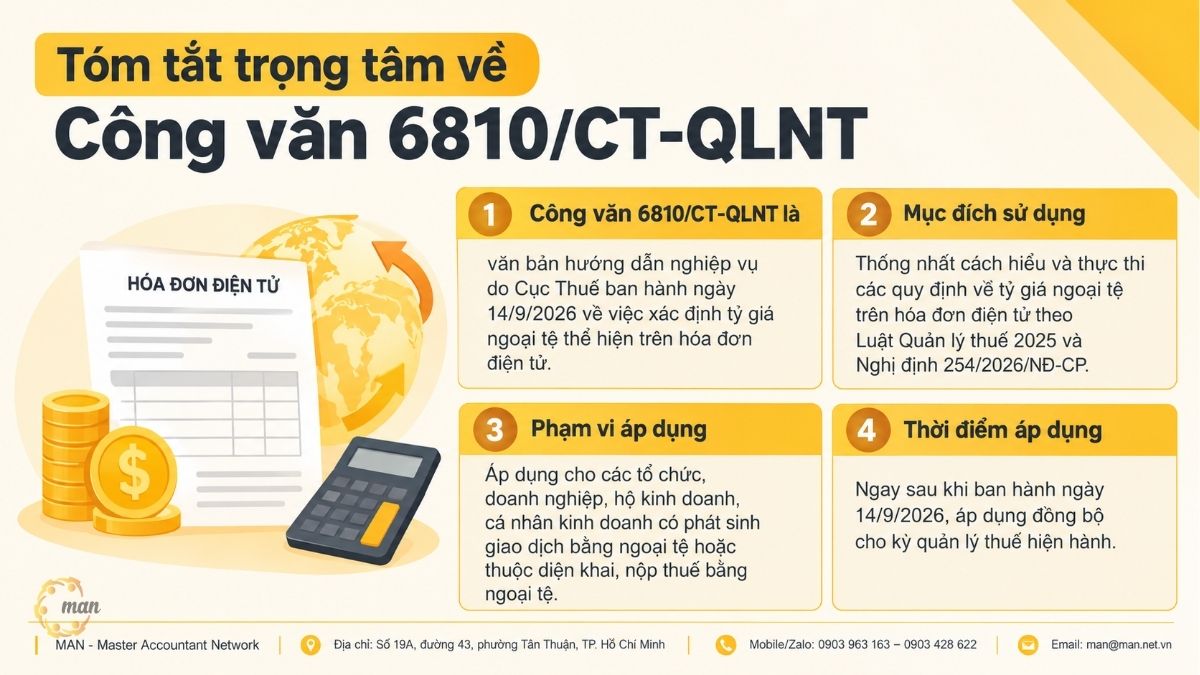
- Official document 6810/CT-QLNT is The professional guidance document issued by the Tax Department on September 14, 2026, concerns the determination of foreign exchange rates shown on electronic invoices.
- Purpose of use: To standardize the understanding and implementation of regulations on foreign exchange rates on electronic invoices according to the 2025 Tax Administration Law and Decree 254/2026/ND-CP.
- Scope of application: This applies to organizations, businesses, household businesses, and individual business owners who conduct transactions in foreign currency or are required to declare and pay taxes in foreign currency.
- Effective date: Immediately upon issuance on September 14, 2026, it will be applied uniformly to the current tax administration period.
What are the guidelines from the Tax Department regarding exchange rates for invoice issuance, as outlined in Official Document 6810/CT-QLNT?
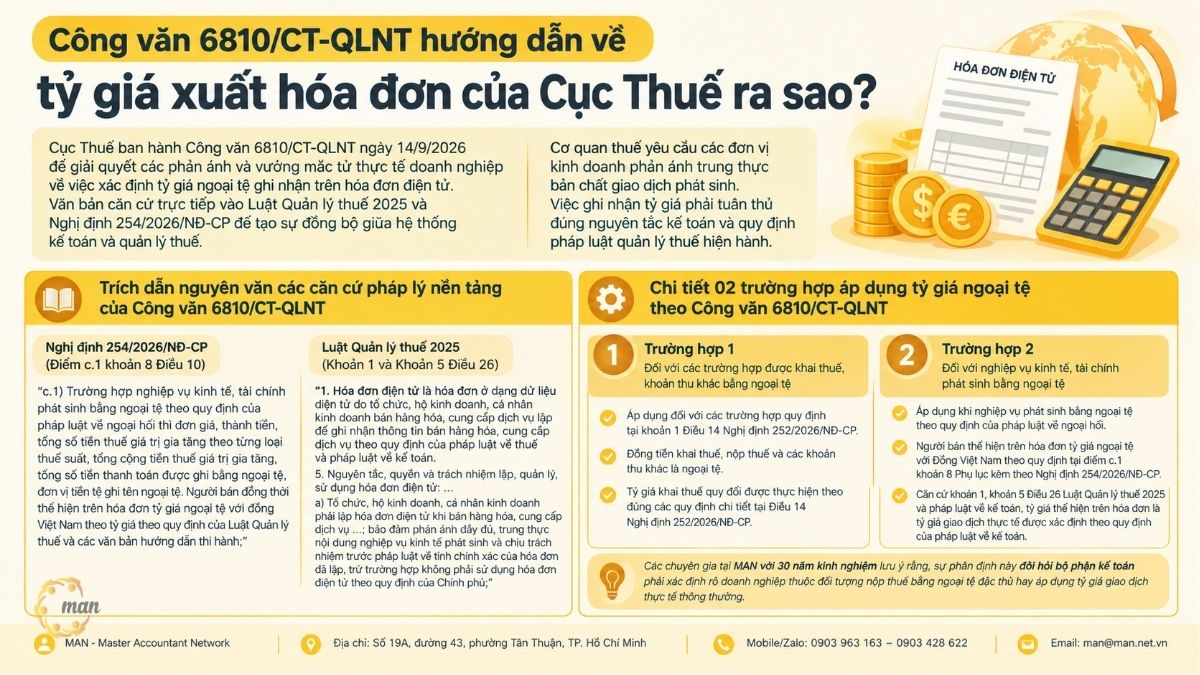
The Tax Department issued Official Letter 6810/CT-QLNT dated September 14, 2026, to address feedback and practical difficulties from businesses regarding the determination of foreign exchange rates recorded on electronic invoices. This document is directly based on the 2025 Tax Administration Law and Decree 254/2026/ND-CP to ensure consistency between accounting and tax administration systems.
The tax authorities require businesses to accurately reflect the nature of transactions. Exchange rate recording must comply with accounting principles and current tax regulations.
Quoting verbatim the fundamental legal grounds of Official Letter 6810/CT-QLNT
To provide a solid legal basis for its guidance, the Tax Department directly cited verbatim provisions from Decree 254/2026/ND-CP and the 2025 Law on Tax Administration.
- The following is a direct quote from Point c.1, Clause 8, Article 10 of Decree 254/2026/ND-CP:
- “c.1) In cases where economic and financial transactions arise in foreign currency as stipulated by the law on foreign exchange, the unit price, total amount, total value-added tax amount for each tax rate, total value-added tax, and total payment amount shall be recorded in foreign currency, with the foreign currency unit indicated by its name. The seller shall also show on the invoice the exchange rate between the foreign currency and the Vietnamese Dong according to the exchange rate stipulated by the Law on Tax Administration and its implementing regulations;”
- The following is a direct quotation from Clauses 1 and 5 of Article 26 of the 2025 Law on Tax Administration:
- “1. An electronic invoice is an invoice in the form of electronic data created by organizations, business households, and individuals engaged in the business of selling goods or providing services to record information on the sale of goods or provision of services in accordance with the provisions of tax law and accounting law.
- 5. Principles, rights, and responsibilities for creating, managing, and using electronic invoices:
- a) Organizations, business households, and individual businesses must issue electronic invoices when selling goods or providing services to buyers in a standard data format and must include all the required information as stipulated by tax and accounting laws, ensuring that the invoices fully and truthfully reflect the economic transactions that have occurred and are legally responsible for the accuracy of the issued invoices, except in cases where the use of electronic invoices is not required according to government regulations;”
Details of 02 cases applying foreign exchange rates according to Official Letter 6810/CT-QLNT
Based on the above regulations, the Tax Department provides specific guidance on determining the exchange rate for invoice issuance, divided into two cases as follows:
Case 1: For cases where tax returns are filed, other income is paid in foreign currency.
- This applies to the cases stipulated in Clause 1, Article 14 of Decree 252/2026/ND-CP.
- The currency used for tax declarations, tax payments, and other revenue collection is a foreign currency.
- The exchange rate used for tax declaration is determined in accordance with the detailed regulations in Article 14. Decree 252/2026/ND-CP.
Case 2: For economic and financial transactions arising in foreign currency.
- This applies when transactions are conducted in foreign currency in accordance with the law on foreign exchange.
- The seller shall show on the invoice the exchange rate between the foreign currency and the Vietnamese Dong as stipulated in point c.1, clause 8 of the Appendix attached to Decree 254/2026/ND-CP.
- Based on Clause 1 and Clause 5 of Article 26 of the 2025 Tax Administration Law and accounting laws, the exchange rate shown on the invoice is actual exchange rate Determined according to the provisions of accounting law.
Experts at MAN, with 30 years of experience, note that this distinction requires the accounting department to clearly determine whether the business is subject to tax payment in a specific foreign currency or to the application of the usual exchange rate.
What is the legally mandated exchange rate for transactions according to accounting regulations?
During the implementation of Circular 6810/CT-QLNT, the biggest question from businesses was how to accurately determine the actual exchange rate for transactions. Vietnamese accounting law has stipulated the principles for applying exchange rates to each specific type of transaction.
The actual exchange rate is the rate recorded at the commercial bank where the business has an account and conducts transactions. Businesses are not allowed to arbitrarily choose the average exchange rate or the free market exchange rate.
Distinguishing between the exchange rate announced by the State Bank of Vietnam and the actual transaction exchange rate.
Businesses often confuse these two types of exchange rates when creating electronic invoices:
- Central exchange rate (announced by the State Bank of Vietnam): This is a macroeconomic indicator for the currency market. This exchange rate should not be used to record the conversion rate on invoices for goods and services.
- Actual exchange rate (Commercial Bank): This is the actual buying or selling rate at the commercial bank where the business designates to conduct transactions at the time the invoice is issued. Circular 6810/CT-QLNT mandates that businesses use this rate.
Principles for determining exchange rates at commercial banks
According to current accounting regulations, the actual exchange rate is determined according to the following principles:
- Revenue recognition (Sales of goods, provision of services): Use the buying rate of the commercial bank where the business designates the customer to transfer payment at the time of invoicing.
- Receive advance payments from customers: In cases where advance payments have been received in foreign currency, the revenue corresponding to the advance payment amount is recorded at the actual exchange rate at the time the advance payment was received.
- Record expenses and purchases: Use the selling exchange rate of the commercial bank where the business plans to make the payment.
From MAN's perspective, businesses should issue internal financial regulations clearly specifying the name of a fixed commercial bank for referencing exchange rates. This ensures consistency when explaining matters to auditors and tax inspectors.
Regulations regarding the timing of invoice issuance for the sale and export of goods.
The timing of invoice issuance directly determines the timing of determining the actual exchange rate. If the invoice is issued at the wrong time, the exchange rate recorded on the invoice will also be considered illegal.
Decree 254/2026/ND-CP specifies the timing for issuing invoices for domestic and export sales of goods.
Timing of invoicing for domestic sales of goods
Based on Clause 1, Article 9 of Decree 254/2026/ND-CP, the time of issuing invoices for the sale of goods (including the sale and transfer of public assets and the sale of national reserves) is stipulated as follows:
- It is the time transfer of ownership or right of use Goods for the buyer.
- Apply this principle. without discrimination Have you received the money or not?.
- The foreign exchange rate recorded on the invoice must be based on the buying rate of the commercial bank on the exact date of transfer of ownership/use.
The timing of invoicing for goods exports.
Regarding the export of goods (including processing for export), Clause 1, Article 9 of Decree 254/2026/ND-CP stipulates:
- The time of issuing an electronic commercial invoice, electronic value-added tax invoice, or electronic sales invoice is determined by the seller. self-determining.
- Invoice time no later than the next business day. from the date the goods are cleared through customs in accordance with customs laws and regulations.
- Businesses apply the actual exchange rate of the invoice date to convert the foreign currency value into Vietnamese Dong.
Detailed quotation of regulations on tax evasion under Article 45 of the 2025 Tax Administration Law.
Using invoices with incorrect exchange rates or violating invoice management regulations can lead to prosecution for tax evasion. Businesses need to understand the legal basis to avoid violations.
Details of acts considered as tax evasion are specified in Article 45 of the 2025 Tax Administration Law.
Based on Clause 4, Article 45 of the 2025 Tax Administration Law, the following acts of tax evasion are fully and comprehensively defined:
- a) Failure to file tax registration documents; failure to file tax returns; filing tax returns more than 90 days after the deadline for filing tax returns or the extended deadline for filing tax returns as prescribed by this Law, resulting in a shortfall in the amount of tax payable or an increase in the amount of tax exempted, reduced, or refunded;
- b) Failure to record or document in the accounting books any income related to determining the amount of tax payable;
- c) Failure to issue invoices and declare taxes when selling goods or services as required by law, or recording a value on sales invoices lower than the actual payment value of the goods or services sold in order to declare taxes;
- d) Using illegal invoices or documents, or illegally using invoices or documents to account for purchased goods and services in activities that generate tax obligations, thereby reducing the amount of tax payable or increasing the amount of tax exempted, reduced, deductible, refunded, or not payable;
- D) Using documents or records that do not accurately reflect the nature or actual value of the transaction to incorrectly determine the amount of tax payable, the amount of tax exempted, the amount of tax reduced, the amount of tax refunded, or the amount of tax not payable;
- e) If individuals or organizations make false declarations regarding exported or imported goods and fail to voluntarily remedy the situation by paying the full amount of taxes due as required by law;
- g) Deliberately failing to declare or making false declarations regarding taxes on exported and imported goods;
- h) Colluding with shippers to import goods for the purpose of tax evasion;
- i) Using goods that are exempt from tax, tax-exempt, or eligible for tax relief for purposes other than those specified, without declaring the change in purpose of use to the tax authorities;
- k) Taxpayers who continue business operations during periods of business suspension or temporary cessation but fail to notify the tax authorities;
- l) Taxpayers are not penalized for tax evasion but for violations of tax procedures in the following cases: failure to submit tax registration documents; failure to submit tax declaration documents; submitting tax declaration documents more than 90 days after the deadline for submitting tax declaration documents or the extended deadline for submitting tax declaration documents, but without any tax payable; submitting tax declaration documents more than 90 days after the deadline for submitting tax declaration documents or the extended deadline for submitting tax declaration documents, with a tax payable amount and the taxpayer has paid the full amount of tax and late payment penalties to the state budget before the tax authority announces the tax audit decision or before the tax authority draws up a report on the late submission of tax declaration documents.
Legal conclusion: Using illegal invoices and fraudulent invoices may be considered tax evasion under point d, clause 4, Article 45 of the 2025 Tax Administration Law if such acts are carried out to account for purchased goods and services in activities that generate tax obligations, thereby reducing the amount of tax payable or increasing the amount of tax exempted, reduced, deductible, refunded, or not payable.
07 actions considered as using illegal invoices and documents.
Based on Clause 7, Article 3 of Decree 254/2026/ND-CP, the following seven acts are considered illegal use of invoices and documents:
- Using forged invoices and documents.
- Using invoices or documents that are not valid or have expired.
- Using invoices that have been suspended during the period of enforcement of invoice suspension measures, except in cases where their use is permitted as notified by the tax authorities.
- Using electronic invoices without registering with the tax authorities.
- Use electronic invoices without a tax authority code in cases where electronic invoices with a tax authority code are required.
- Use invoices for goods and services with an issue date from the date the tax authorities determine that the seller is not operating at the business address registered with the competent state authority.
- Using invoices or purchase documents for goods and services with an issue date before the date the issuer is determined to be no longer operating at the registered business address, or before the tax authority has notified the issuer that the issuer is no longer operating at the registered business address, but the tax authority, police, or other relevant agencies have concluded that the invoice or document is illegal.
Practical Case Study: Analyzing and Managing Exchange Rate Risks on Export Invoices
To illustrate the specific application of Circular 6810/CT-QLNT, let's consider a real-world case handled by consultants at MAN.
Context of the transaction and the resulting errors
Vina Industrial Equipment Co., Ltd. (name changed) signed a contract to export components to the Japanese market worth USD 200,000.
- October 5, 2026: The shipment has completed customs clearance procedures. The buying exchange rate at the commercial bank where the company has an account is 25,100 VND/USD.
- October 12, 2026: The accountant recently issued an electronic export invoice. Due to the exchange rate increasing to 25,500 VND/USD on October 12th, the accountant recorded the exchange rate of 25,500 VND/USD on the invoice.
Analysis of violations and proposed solutions from MAN
Solutions from MAN – Master Accountant Network have helped businesses correct errors and work effectively with tax authorities.
Analysis of violations
- Late invoicing: According to Clause 1, Article 9 of Decree 254/2026/ND-CP, export invoices must be issued no later than the next working day after customs clearance (i.e., October 6, 2026). Issuing the invoice on October 12, 2026 is 6 days late.
- Incorrect exchange rate applied: Using the exchange rate of October 12, 2026 (25,500 VND/USD) increases the difference in converted revenue compared to the standard customs clearance rate (25,100 VND/USD), causing discrepancies in the automatic reconciliation data between the Customs and Tax authorities.
The solution was implemented by MAN.
- Prepare adjustment/replacement invoices in accordance with the standard format of Decree 254/2026/ND-CP.
- Adjust the exchange rate shown on the invoice to the actual exchange rate of the next business day following customs clearance.
- Submit supplementary VAT and corporate income tax returns before the tax authorities issue an audit decision.
- Thanks to MAN's transparent processing procedures, Vina Company only received an administrative penalty for issuing invoices at the wrong time, completely eliminating the risk of being found guilty of fraud or tax evasion.
Summary table comparing exchange rate regulations and invoice issuance timing.
The table below helps managers and accountants quickly compare the core regulations according to Circular 6810/CT-QLNT and Decree 254/2026/ND-CP.
| Comparison criteria | Filing and paying taxes in foreign currency. | Transactions conducted in foreign currency. |
| Legal basis | Article 14 of Decree 252/2026/ND-CP | Official Document 6810/CT-QLNT & Decree 254/2026/ND-CP |
| The currency shown on the receipt | Foreign currency is permitted to be declared. | Foreign currency and its conversion to Vietnamese Dong. |
| Applicable exchange rate | The exchange rate is stipulated in Article 14 of Decree 252/2026/ND-CP. | The actual exchange rate as per accounting regulations. |
| Reference Bank | According to specific tax management regulations | Commercial bank where the business conducts transactions. |
| Time of issuing sales invoices | Date of transfer of ownership/use | Date of transfer of ownership/use |
| Time of issuing export invoices | No later than the next working day after customs clearance. | No later than the next working day after customs clearance. |
MAN expert analysis: Exchange rate risk management and electronic invoicing.
Official document 6810/CT-QLNT affirms the trend of digitalization and automatic data connection between Customs, Banks, and Tax Departments. Any discrepancies in exchange rate data will be immediately detected by the risk warning system.
With over 30 years of experience, the team of experts at MAN has observed that many Vietnamese businesses still have the habit of consolidating invoices at the end of the period. This habit, when faced with fluctuations in foreign exchange rates, can lead to discrepancies in accounting revenue and tax obligations.
To optimally manage tax risks in Vietnam, businesses need to:
- Standardize the information exchange process between the Import/Export, Purchasing, and Accounting departments.
- Get instant updates on the buying/selling exchange rates of commercial banks at the time the invoice issuance obligation arises.
- Regularly check the operational status of your business partners on the tax authority's portal to avoid the risk of receiving invoices from businesses that have abandoned their business address.
- Utilize independent tax advisory services to conduct a thorough review of your accounting records and invoicing system on a regular basis.
Conclude
Official Document 6810/CT-QLNT is an important operational guidance document that helps businesses standardize the process of determining foreign exchange rates on electronic invoices. Accurately adhering to the principle of using the actual transaction exchange rate and the time of invoice issuance helps businesses optimize risk management, avoid administrative penalties, or the risk of being prosecuted for tax evasion under the 2025 Tax Administration Law.
Tax services at MAN – Master Accountant Network
- Tax accounting services
- Tax consulting services
- Tax settlement services
- Tax reporting services
- VAT refund service
Service contact information at MAN – Master Accountant Network
- Address: No. 19A, Street 43, Tan Thuan Ward, Ho Chi Minh City
- Mobile/Zalo: 0903 963 163 – 0903 428 622
- E-mail: man@man.net.vn
- Google Business Profile: View MAN – Master Accountant Network's Google Business Profile
- LinkedIn Founder: View expert Le Hoang Tuyen's LinkedIn profile.
Responsible for production and professional content review by: Mr. Le Hoang Tuyen – Founder & CEO of MAN – Master Accountant Network, CPA Vietnam with over 30 years of experience in accounting, auditing, taxation, and corporate financial consulting.
Frequently Asked Questions (FAQ) regarding Official Document 6810/CT-QLNT
Which entities are covered by Official Document 6810/CT-QLNT?
Official document 6810/CT-QLNT applies to all organizations, businesses, household businesses, and individual businesses that conduct economic transactions in foreign currency or are required to declare taxes in foreign currency.
Is the exchange rate shown on a sales invoice in foreign currency the buying or selling rate?
When issuing invoices to record revenue from the sale of goods and services in foreign currency, the exchange rate recorded on the invoice is the foreign currency buying rate of the commercial bank where the business designates the customer to make payment at the time the invoice is issued.
Will there be a penalty for issuing an export invoice more than one working day after the date of customs clearance?
Yes. Issuing invoices after the next working day following customs clearance violates the regulations on the timing of invoice issuance as stipulated in Clause 1, Article 9 of Decree 254/2026/ND-CP and will be subject to administrative penalties for invoice violations.
How should the use of invoices by businesses that have abandoned their business address be handled?
If a business uses that invoice to account for expenses or deduct taxes, thereby reducing the amount of tax payable, this act is considered tax evasion under point d, clause 4, Article 45 of the 2025 Tax Administration Law and is subject to a penalty of 1 to 3 times the amount of tax evaded.
Can businesses use the central exchange rate set by the State Bank of Vietnam to issue invoices?
No. Official document 6810/CT-QLNT stipulates that the exchange rate recorded on the invoice must be the actual transaction rate at the commercial bank where the business conducts transactions, and not the central exchange rate of the State Bank of Vietnam.