

Official Document 5061/CT-CS This is a document issued by the Tax Department on July 22, 2026, introducing the following: New points of Decree 252/2026/ND-CP This document provides guidance on the implementation of the 2025 Tax Administration Law. It is an important reference document for corporate accountants, finance departments, and individual taxpayers in updating their tax registration, tax filing, and tax compliance procedures under the new legal framework effective from July 1, 2026.
From this perspective MAN – Master Accountant Network, As a tax, accounting, and auditing consulting firm with over 30 years of practical experience in Vietnam, our timely understanding of Circular 5061/CT-CS helps businesses avoid errors when applying new regulations, especially in the context of the 2025 Tax Administration Law and its guiding decrees being continuously updated in the 2026-2027 period.
Summary of key points in Official Letter 5061/CT-CS
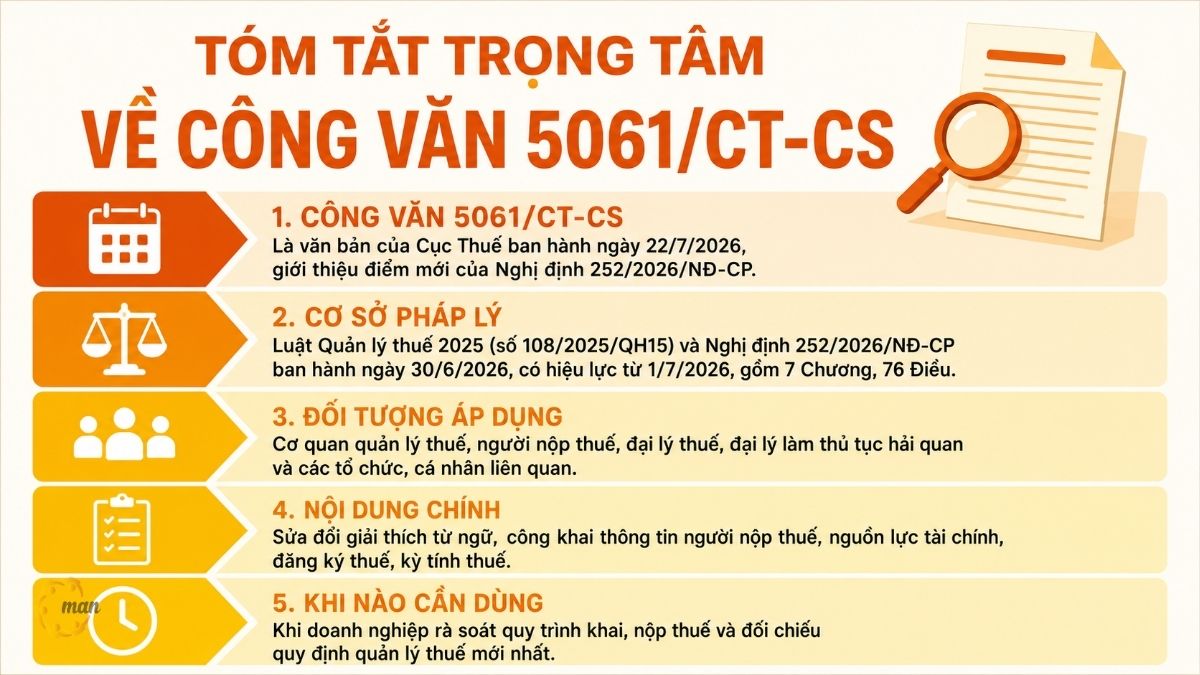
- Official document 5061/CT-CS is a document issued by the Tax Department on July 22, 2026, introducing the new points of Decree 252/2026/ND-CP.
- Legal basis: Law on Tax Administration 2025 (No. 108/2025/QH15) and Decree 252/2026/ND-CP issued on June 30, 2026, effective from July 1, 2026, comprising 7 Chapters and 76 Articles.
- Applicable entities: Tax authorities, taxpayers, tax agents, customs clearance agents, and related organizations and individuals.
- Main content: Amendments to the definition of terms, disclosure of taxpayer information, financial resources, tax registration, and tax period.
- When to use: When businesses review their tax filing and payment processes and compare them with the latest tax regulations.
What is Official Document 5061/CT-CS? Definition and purpose of issuance.
Official document 5061/CT-CS of 2026 issued by the Tax Department aims to disseminate and explain the amendments and additions to the following: Decree 252/2026/ND-CP compared to Decree 126/2020/ND-CP Previously, this document did not create new legal regulations but served as a means of communication and professional guidance for tax authorities at all levels and taxpayers to correctly understand and uniformly apply Decree 252.
In other words, this is the official channel that helps businesses and individuals understand the changing logic of the tax management legal framework, instead of having to read all 76 Articles of the Decree themselves. For internal accounting staff who are already busy with daily bookkeeping, Circular 5061/CT-CS is a concise and highly directional document.
What are the provisions of Decree 252/2026/ND-CP?
Decree 252/2026/ND-CP, issued by the Government on June 30, 2026, and effective from July 1, 2026, provides detailed regulations and organizational measures for the implementation of the Law on Tax Administration. The document consists of 7 chapters and 76 articles, covering general provisions, tax administration functions, and tax declaration and payment for business activities on e-commerce platforms.
The Decree is structured into 7 chapters:
- Chapter I: General Provisions, 5 Articles.
- Chapter II: Functions of Tax Administration, 6 Sections, 34 Articles.
- Chapter III: Declaration and payment of taxes for business activities on e-commerce platforms and digital platforms, 2 Sections, 7 Articles.
- Chapter IV: International cooperation on taxation, preferential tax regimes, technology application and digital transformation, 10 Articles.
- Chapter V: Rights, obligations, duties, and powers of the parties involved, 8 Articles.
- Chapter VI: Enforcement of administrative decisions on tax management, 9 Articles.
- Chapter VII: Enforcement Provisions, 3 Articles.
This structure shows that the focus of the Decree lies in Chapter II, which concentrates most of the operational regulations that business accountants need to apply on a daily basis.
What amendments does Official Document 5061/CT-CS list compared to the old regulations?
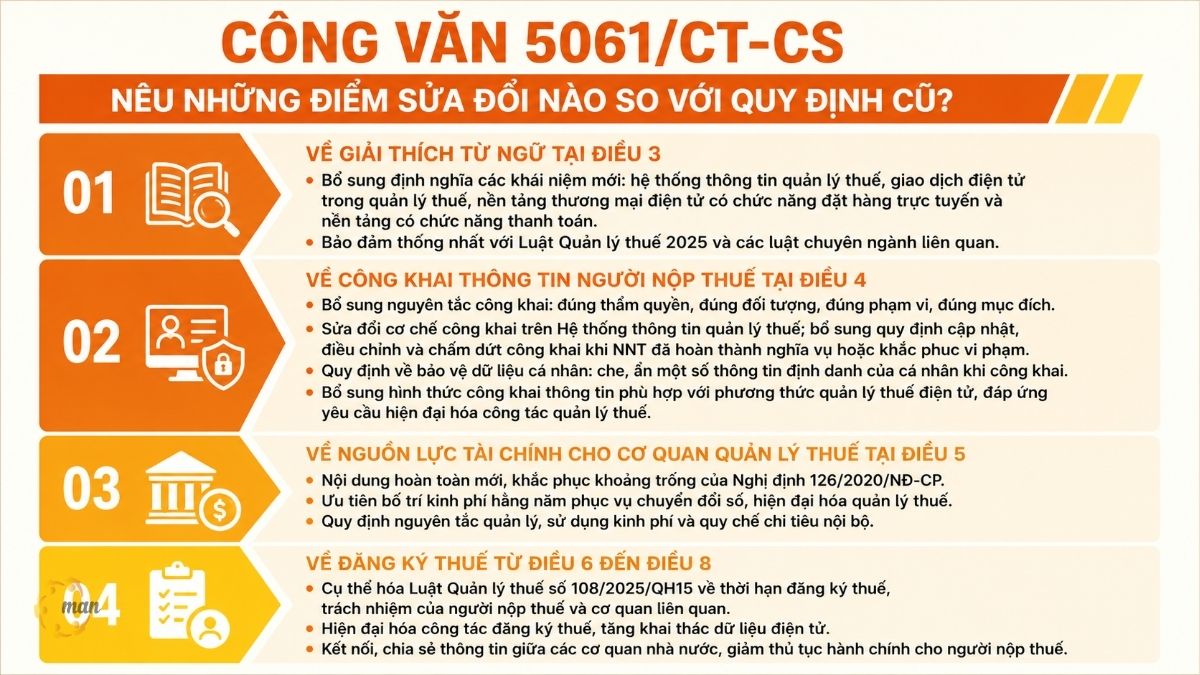
According to the content presented in Official Letter 5061/CT-CS, Decree 252/2026/ND-CP amends and supplements many groups of regulations compared to Decree 126/2020/ND-CP. Four prominent groups of content include definitions of terms, public disclosure of taxpayer information, financial resources for tax authorities, and tax registration.
Regarding the definition of terms in Article 3
The decree adds definitions for new concepts such as tax management information systems, electronic transactions in tax management, e-commerce platforms with online ordering functions, and platforms with payment functions. The addition of these terms aims to ensure consistency with the 2025 Tax Administration Law and other specialized laws related to e-commerce.
Regarding the disclosure of taxpayer information in Article 4.
The decree supplements the principle of public disclosure by the correct authority, to the correct subjects, within the correct scope, and for the correct purpose as prescribed by law. It also amends the mechanism for public disclosure on the Tax Management Information System, adding regulations for updating, adjusting, and terminating public disclosure when taxpayers have fulfilled their obligations or rectified violations. A noteworthy point is the regulation concerning... personal data protection, requiring the concealment or hiding of certain identifying information of individuals when making it public in accordance with the law.
Furthermore, the Decree also adds forms of information disclosure that are consistent with electronic tax management methods, meeting the requirements of modernizing tax administration. It can be seen that the five groups of amendments in Article 4 all aim at a common goal: to both increase transparency and ensure the privacy of taxpayers in a digital environment.
Regarding financial resources for tax administration agencies in Article 5
This is entirely new content, addressing the gap in the previous Decree 126/2020/ND-CP, which lacked regulations on financial resources for tax authorities. Decree 252 stipulates prioritizing the allocation of annual funds for digital transformation and modernization of tax administration, along with principles for managing and using funds and internal spending regulations.
Regarding tax registration, from Article 6 to Article 8
This set of regulations specifies the Tax Administration Law No. 108/2025/QH15 regarding the deadline for tax registration, the responsibilities of taxpayers and relevant agencies in using tax identification numbers. Compared to the old regulations, Decree 252 aims to modernize tax registration, increase the use of electronic data, connect and share information between state agencies, thereby reducing administrative procedures for taxpayers.
Legal documents related to Official Letter 5061/CT-CS
Important Note: Official Letter 5061/CT-CS is only for introducing and disseminating the content; it does not replace the legal effect of Decree 252/2026/ND-CP and the 2025 Tax Administration Law. When applying it in practice, businesses and accountants need to directly compare it with the original documents.
| Legal documents | Number / Date of Issue | Related content |
| Tax Administration Law 2025 | No. 108/2025/QH15 | The original law provides the framework for tax administration, which serves as the basis for Decree 252/2026/ND-CP to provide detailed guidance. |
| Decree 252/2026/ND-CP | Government Decree, issued on June 30, 2026, effective July 1, 2026 | The regulations detailing certain provisions and implementation measures of the 2025 Law on Tax Administration consist of 7 chapters and 76 articles. |
| Official Document 5061/CT-CS | Tax Department, issued July 22, 2026 | Introducing the new points of Decree 252/2026/ND-CP compared to the old regulations. |
| Decree 126/2020/ND-CP | Government, issued 2020 | The guiding document for the previous Law on Tax Administration, amended and supplemented by Decree 252/2026/ND-CP. |
| Official document 6012/CTH-QLDN4 | Tax Department | Instructions for issuing invoices for expenses paid on behalf of others according to Decree 254/2026/ND-CP |
| Official Document 2370/DLA-NVDTPC | Local tax authority | Introducing the new points of Decree 254 and Circular 91 on electronic invoices and electronic documents. |
Which entities are affected by Official Letter 5061/CT-CS and Decree 252/2026/ND-CP?
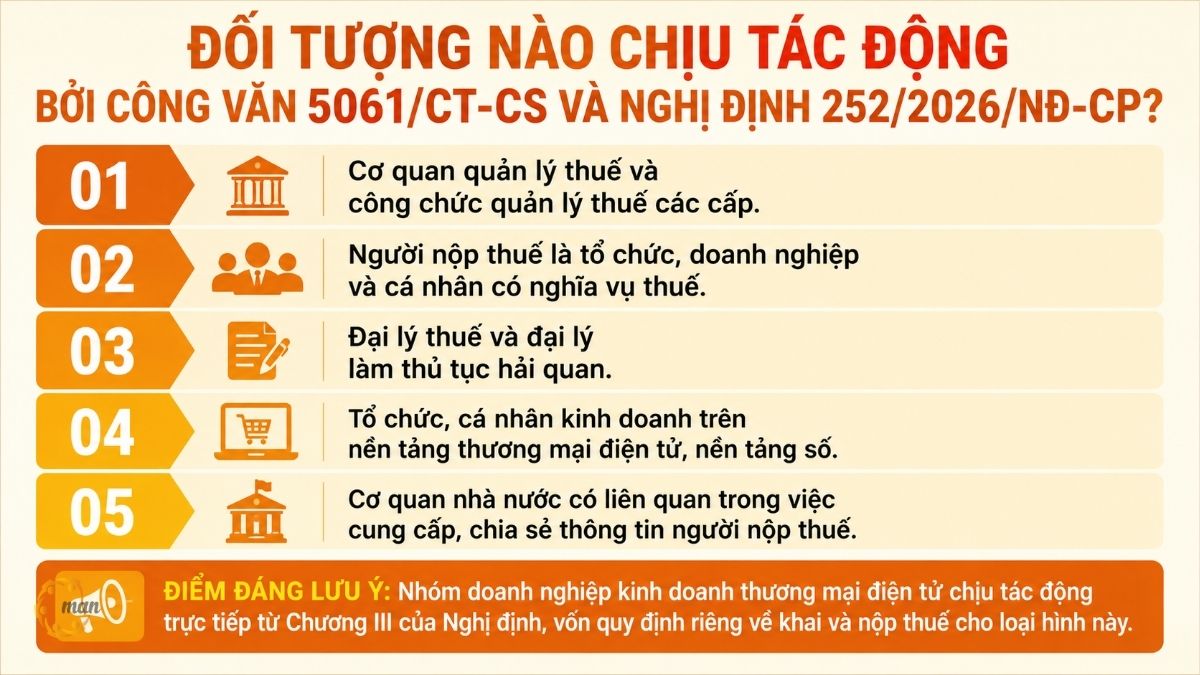
The scope of application of Decree 252/2026/ND-CP is quite broad, covering almost all entities involved in tax management relations in Vietnam. Specifically, it includes:
- Tax authorities and tax officials at all levels.
- Taxpayers are organizations, businesses, and individuals who have tax obligations.
- Tax agents and customs clearance agents.
- Organizations and individuals conducting business on e-commerce platforms and digital platforms.
- Relevant government agencies are involved in providing and sharing taxpayer information.
It is noteworthy that e-commerce businesses are directly affected by Chapter III of the Decree, which specifically regulates the declaration and payment of taxes for this type of business.
Regulations on the confidentiality and disclosure of taxpayer information are stipulated in Article 7 of the 2025 Tax Administration Law.
Based on Article 7 of the 2025 Tax Administration Law, tax authorities, tax officials (including former tax officials), tax agents, and customs clearance agents must maintain the confidentiality of taxpayer information. This principle is only waived in cases where the provision or disclosure of information is permitted by law.
Cases where taxpayer information is provided
The tax authorities provide information to investigative agencies, the Procuratorate, the Courts, inspection agencies, and the State Audit Office upon written request for the purpose of litigation, inspection, and examination. In addition, they may provide information to other competent state agencies upon written request, or to foreign tax authorities in accordance with international treaties to which Vietnam is a signatory.
Cases where taxpayer information is made public.
Tax authorities are authorized to disclose information in three cases: taxpayers evading or delinquent in paying taxes, late payment penalties, or fines; violations of tax laws affecting the rights of other organizations or individuals; or failure to comply with requests from tax authorities as prescribed. This mechanism aims to increase transparency and deterrence, while also requiring agencies and organizations receiving the information to use it for the intended purpose and maintain confidentiality as required.
The responsibilities of the information recipient and the regulations stipulate that the Government shall provide guidance.
Agencies, organizations, and individuals receiving information from tax authorities, as well as relevant domestic and foreign state agencies and organizations when performing tasks related to sharing and exchanging taxpayer information under Articles 38, 39, and 40 of the 2025 Tax Administration Law, must use the information for the intended purpose and maintain confidentiality in accordance with regulations. The 2025 Tax Administration Law also assigns the Government the task of specifying points c, clause 2, and clause 3 of Article 10, as a basis for Decree 252/2026/ND-CP to concretize the cases of providing and disclosing the aforementioned information.
How is the tax period determined according to Article 9 of Decree 252/2026/ND-CP?
This is a matter of great interest to many accountants as it directly affects the schedule for filing and paying taxes monthly, quarterly, and annually. Article 9 of Decree 252/2026/ND-CP stipulates that the tax period includes the period for each transaction, monthly, quarterly, annually, or the tax settlement period, based on Clause 8, Article 4 of the 2025 Law on Tax Administration.
| Tax period type | How to determine |
| Each occurrence | The date on which the taxpayer incurs a tax liability. |
| Monthly period | From the first day to the last day of the Gregorian calendar month. |
| Rare | From the first day of the quarter to the last day of the calendar quarter or fiscal year. |
| Fifth term | According to the calendar year or fiscal year |
| Tax settlement period | According to the accounting year, personal income tax is determined separately based on the calendar year. |
It should be noted that the regulation on tax settlement based on the annual accounting period applies generally, except for the specific case mentioned in point d.2, clause 2, Article 9 of Decree 252/2026/ND-CP. This exception relates to individuals present in Vietnam for less than 183 days in a calendar year but for 183 or more days in 12 consecutive months from the first day of arrival.
In that case, the first year's personal income tax settlement period is determined as those 12 consecutive months, not the regular calendar year. Businesses employing foreign workers need to pay special attention to this point when calculating the personal income tax settlement period for the first year an employee is present in Vietnam.
Case Study: E-commerce businesses applying Decree 252/2026/ND-CP
Background
Company Y operates an e-commerce platform with online ordering and payment functions, generating an average monthly revenue of 15 billion VND. Prior to July 1, 2026, the company applied the tax declaration process according to Decree 126/2020/ND-CP, and did not have a separate process for its digital platform operations.
Actions taken after Decree 252/2026/ND-CP comes into effect.
Following advice from MAN – Master Accountant Network, the company reviewed Chapter III of the Decree to determine its obligations regarding tax declaration and payment, as well as other revenues arising from activities on the platform. The company also updated its electronic transaction data storage system to comply with the new definition in Article 3, avoiding any lack of basis when tax authorities cross-reference electronic transaction data.
The measured results
- The time required for data reconciliation with tax authorities has been shortened from several weeks to just 3-5 working days thanks to clearly categorized electronic transaction records.
- Reduce the risk of tax arrears by correctly defining the scope of tax obligations for digital platform activities from the outset.
- Proactively update internal regulations on the confidentiality and disclosure of taxpayer information in accordance with Articles 4 and 7.
Expert opinion: Common business risks when applying Decree 252/2026/ND-CP
Experts at MAN – Master Accountant Network With over 30 years of experience in auditing and tax consulting in Vietnam, we note some common risks when businesses implement the new regulations of Decree 252/2026/ND-CP and the content introduced in Official Letter 5061/CT-CS.
- Risk 1: Confusion between guidance documents and original legal regulations: Many accountants consider Circular 5061/CT-CS as an independent legal document, while it is merely an introductory document disseminating the content of Decree 252/2026/ND-CP. In practice, businesses must still rely directly on the Decree and the 2025 Tax Administration Law to avoid errors regarding legal validity.
- Risk 2: The registration and use procedures for tax identification numbers have not been updated. With the new regulations on tax registration in Articles 6 to 8, businesses whose registration information changes but are not updated in a timely manner may encounter difficulties when tax authorities cross-reference electronic data between government agencies.
- Risk 3: Lack of internal regulations regarding the confidentiality of taxpayer information: With the new regulations on the disclosure and protection of personal data in Article 4, businesses acting as tax agents or having internal tax information processing departments need to establish clear confidentiality regulations to avoid violating the obligation to protect taxpayer information as stipulated in Article 7 of the 2025 Tax Administration Law.
- Risk 4: Applying the wrong tax period to foreign individuals: In cases where individuals are present in Vietnam for less than 183 days in a calendar year but meet the criteria for calculating income tax based on 12 consecutive months, many businesses still mechanically apply the calendar year, leading to incorrect determination of the personal income tax settlement period for foreign workers.
Conclude
Official Document 5061/CT-CS acts as a bridge, helping businesses and individuals pay taxes quickly and accurately access the core new points of Decree 252/2026/ND-CP, from explaining terminology, disclosing information and financial resources to tax authorities, to registration procedures and tax periods. Mastering this content helps accounting and finance departments proactively adjust internal processes, minimizing the risk of errors when the legal framework for tax management officially changes from July 1, 2026.
Tax services at MAN – Master Accountant Network
- Tax accounting services
- Tax consulting services
- Tax settlement services
- Tax reporting services
- VAT refund service
Service contact information at MAN – Master Accountant Network
- Address: No. 19A, Street 43, Tan Thuan Ward, Ho Chi Minh City
- Mobile/Zalo: 0903 963 163 – 0903 428 622
- E-mail: man@man.net.vn
- Google Business Profile: View MAN – Master Accountant Network's Google Business Profile
- LinkedIn Founder: View expert Le Hoang Tuyen's LinkedIn profile.
Responsible for production and professional content review by: Mr. Le Hoang Tuyen – Founder & CEO of MAN – Master Accountant Network, CPA Vietnam with over 30 years of experience in accounting, auditing, taxation, and corporate financial consulting.
Frequently Asked Questions about Official Document 5061/CT-CS
Official document 5061/CT-CS, issued by the Tax Department on July 22, 2026, introduces the new points of Decree 252/2026/ND-CP guiding the Law on Tax Administration.
The Decree takes effect from July 1, 2026, and was issued by the Government on June 30, 2026.
Decree 252/2026/ND-CP inherits and amends many contents compared to Decree 126/2020/ND-CP, especially the sections related to tax registration, information disclosure, and financial resources for tax authorities.
Yes. Chapter III of the Decree specifically regulates the declaration and payment of taxes and other fees for business activities on e-commerce and digital platforms.
No. Disclosure is only applicable in legally defined cases such as tax evasion, delinquent tax payments, or violations of tax laws, and must ensure that personal identifying information is concealed or hidden in accordance with the principles of personal data protection. When was Official Document 5061/CT-CS issued?
When does Decree 252/2026/ND-CP take effect?
Which document does Decree 252/2026/ND-CP replace?
Will e-commerce businesses be affected by Decree 252/2026/ND-CP?
Will taxpayer information be disclosed arbitrarily under the new regulations?




