

Official Document 2370/DLA-NVDTPC This is an important guidance document issued by the Dak Lak Provincial Tax Department on July 21, 2026, to update the latest regulations on electronic invoices and electronic documents. Read the article now to understand the legal details.
Official document 2370/DLA-NVDTPC clarifies the pivotal changes from Decree 254/2026/ND-CP and Circular 91/2026/TT-BTC, effective from July 1, 2026. Businesses and household businesses face stricter requirements regarding tax risk management and electronic data standardization. Timely understanding of these regulations helps businesses avoid heavy penalties and optimize internal accounting processes. Below is a detailed analysis from an expert's perspective to help businesses adapt safely.
Summary of key points in Official Letter 2370/DLA-NVDTPC
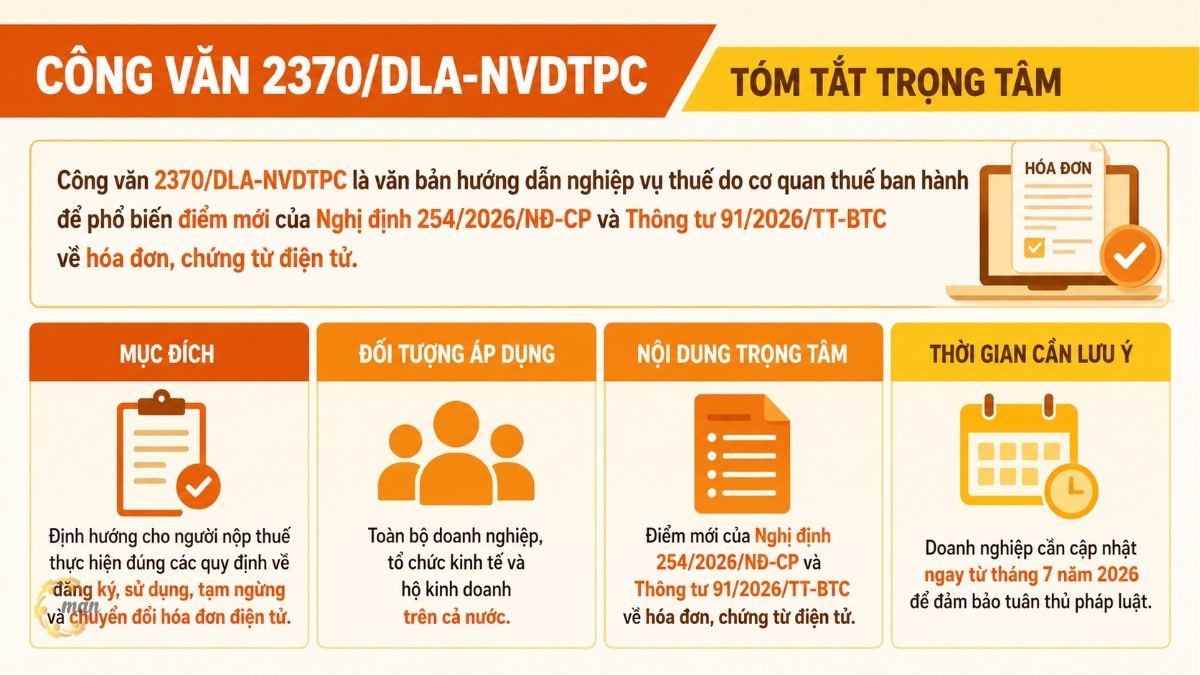
- Official document 2370/DLA-NVDTPC is a tax guidance document issued by the tax authority to disseminate the new points of Decree 254/2026/ND-CP and Circular 91/2026/TT-BTC on electronic invoices and documents.
- This document is intended to guide taxpayers in complying with regulations regarding the registration, use, suspension, and conversion of electronic invoices.
- This regulation applies to all businesses, economic organizations, and household businesses nationwide. Businesses need to update their regulations starting in July 2026 to ensure compliance with the law.
What is Official Document 2370/DLA-NVDTPC and what is its role in tax administration?
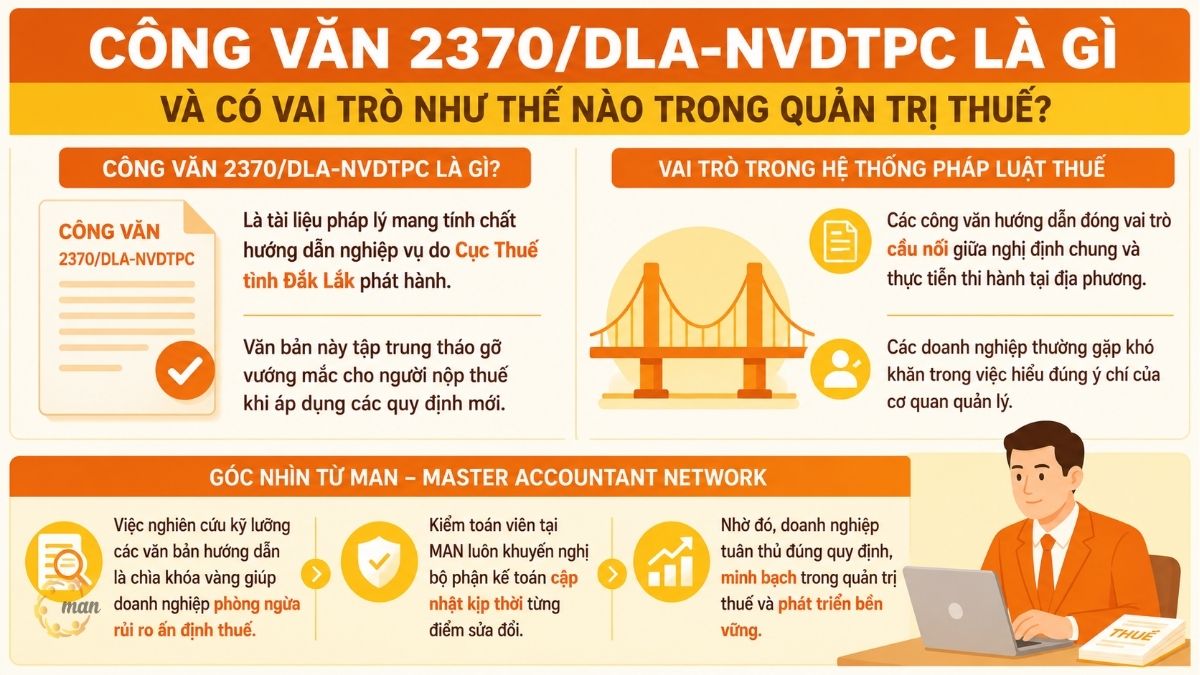
Official Document 2370/DLA-NVDTPC is a legal document providing guidance on professional practices issued by the Dak Lak Provincial Tax Department. This document focuses on resolving difficulties for taxpayers when applying new regulations.
In Vietnam's tax legal system, guiding documents serve as a bridge between general decrees and local implementation practices. Businesses often face difficulties in correctly understanding the intentions of the regulatory authorities.
From the perspective of MAN – Master Accountant Network, thorough research of these guidance documents is key to helping businesses prevent tax assessment risks. Auditors here always recommend that accounting departments promptly update any amendments to avoid errors.
What are the core new points in Decree 254/2026/ND-CP on electronic invoices?
Decree 254/2026/ND-CP introduces many systemic changes aimed at tightening state management of commercial transactions. This is clearly reflected in the adjustment of core legal concepts.
Clauses 5 and 7 of Article 3 of Decree 254 have more clearly defined legal invoices and the act of using illegal invoices. Cases of creating fictitious invoices or misrepresenting actual values are subject to strict penalties.
Solutions from MAN – Master Accountant Network show that many small and medium-sized businesses often neglect to verify the legality of their input invoices. Tightening these regulations requires internal control systems to operate with absolute accuracy.
Which groups are directly affected and are required to comply with the new regulations?
The scope of businesses subject to electronic invoices under Decree 254 has expanded significantly compared to before. Specific business sectors are now subject to stricter management.
Businesses operating in the banking, securities, cryptocurrency, and carbon trading sectors must now use electronic invoices without tax authority codes. This regulation aims to increase transparency regarding large-scale financial flows in the financial market.
Household businesses and individual entrepreneurs with annual revenue exceeding one billion VND are required to use electronic invoices with codes or invoices generated from cash registers. Experts at MAN, with 30 years of experience, note that household businesses need to quickly improve their technological infrastructure to meet this standard.
In which cases is it not necessary to use electronic invoices according to the new regulations?
Tax laws also clearly stipulate exceptions that do not require the use of electronic invoices in order to reduce administrative procedures for certain specific activities. These cases are listed in detail in Article 7 of Decree 254.
Household businesses selling goods that are required to prepare purchase lists under corporate income tax law are not obligated to use electronic invoices unless they register separately. Activities such as real estate leasing or providing digital content services abroad are also among the exceptions.
Internal transactions such as transferring assets between the parent company and its subsidiaries or lending machinery for processing do not require electronic invoices. Businesses need to clearly distinguish between these items to avoid wasting resources on unnecessary documentation.
What are the key new points in Circular 91/2026/TT-BTC that businesses need to know?
Circular 91/2026/TT-BTC This comes with many new points regarding tax administrative procedures and risk criteria for taxpayers. The process of changing information for invoice registration now requires a higher level of authenticity.
The tax authorities are applying biometric authentication when businesses or household businesses make changes to their registration information for using electronic invoices. The deadline for taxpayers to provide explanations as requested in the notification has also been extended from two to three working days.
The criteria for identifying high-risk businesses also include cases where businesses register their headquarters in apartment buildings that are not suitable for their intended business function. This makes it very difficult for many shell companies or fictitious businesses to issue invoices.
What are the regulations regarding the conversion of electronic invoices into paper documents?
Clause 4, Article 5 of Decree 254 specifies the conditions for converting electronic invoices into paper invoices. The exact matching of content between the electronic and paper versions is a mandatory requirement.
Electronic invoices may only be converted to paper form upon request from inspection, auditing, or investigation agencies in accordance with legal regulations. Conversion for internal accounting purposes must also strictly adhere to technical standards.
Please note that converted invoices used for accounting purposes are not valid for transactions or payments, except in cases where the invoice is generated from a cash register with a data connection to the tax authorities.
Real-world case study: Handling input invoice risks at a logistics company.
A logistics company in Ho Chi Minh City recently faced a hefty fine for accepting invoices from a business listed as high-risk by the tax authorities. The company failed to thoroughly verify the supplier's registered head office information according to the new criteria.
When the tax authorities issued a notice suspending the use of the seller's invoices, all of the logistics company's input invoices were frozen in the system. Value-added tax expenses could not be deducted, causing hundreds of millions of dong in losses to quarterly profits.
The team of experts from MAN – Master Accountant Network intervened promptly by reviewing the entire supply chain, collecting non-cash payment documents, and providing reasonable explanations to the tax authorities. As a result, the business successfully protected a large portion of its legitimate expenses. Over 500 clients returned for a second time last year thanks to the dedicated support from MAN's tax settlement services.
Quick comparison table of old and new regulations on electronic invoices
Decree 254/2026/ND-CP and Circular 91/2026/TT-BTC The mechanism for managing electronic invoices has significantly changed, from its scope of application and mandatory users to the registration process and tax risk control. Compared to previous regulations, many procedures have been tightened to increase transparency and prevent fraud. The table below summarizes the prominent differences between the old and new regulations to help businesses and household businesses easily track and apply them.
| Management criteria | Previous regulations | New points according to Decree 254 and Circular 91 |
| Subjects to whom invoices apply | This includes regulations on printing and self-printing invoices. | Completely eliminate the requirement for entities to print and self-print invoices, only regulating electronic invoices. |
| Household businesses must use invoices. | Apply according to the distributed documents. | It is mandatory for households with revenue exceeding 1 billion VND or those selling assets to register ownership rights. |
| Change registration information | Standard procedures via the tax information network. | Adding biometric requirements for more cases of information changes. |
| Headquarters risk | There are still no strict regulations regarding location within apartment buildings. | Exclude apartments that are not used for commercial purposes from the safety criteria. |
Conclude
Updating to Circular 2370/DLA-NVDTPC and the new regulations from Decree 254 and Circular 91 is a vital requirement for all businesses. This change demands extreme caution in document management to avoid any potential legal risks.
Tax services at MAN – Master Accountant Network
- Tax accounting services
- Tax consulting services
- Tax settlement services
- Tax reporting services
- VAT refund service
Service contact information at MAN – Master Accountant Network
- Address: No. 19A, Street 43, Tan Thuan Ward, Ho Chi Minh City
- Mobile/Zalo: 0903 963 163 – 0903 428 622
- E-mail: man@man.net.vn
- Google Business Profile: View MAN – Master Accountant Network's Google Business Profile
- LinkedIn Founder: View expert Le Hoang Tuyen's LinkedIn profile.
Responsible for production and professional content review by: Mr. Le Hoang Tuyen – Founder & CEO of MAN – Master Accountant Network, CPA Vietnam with over 30 years of experience in accounting, auditing, taxation, and corporate financial consulting.
Frequently Asked Questions (FAQ) regarding Official Letter 2370/DLA-NVDTPC
Are businesses with revenue under 1 billion VND required to use electronic invoices?
It is not mandatory unless the business needs to use it or the sale of assets requires registration of ownership rights according to the law.
When will the tax authorities implement measures to temporarily suspend the use of electronic invoices?
When the tax registration information of the business representative does not match the national population database, or the taxpayer fails to explain the risks as notified.
Can businesses use invoices converted from electronic to paper for payment?
No, converted invoices are only for internal accounting purposes, except for invoices generated from cash registers with valid data connections.
What is the deadline for providing an explanation after receiving a notice requesting additional information?
Taxpayers have three working days from the date of receiving the notice to provide explanations and supplementary documents as requested.
Which of MAN's services helps businesses review electronic invoices?
MAN provides comprehensive tax reporting, tax accounting, and tax consulting services to help businesses manage invoice risks effectively.