

Decree 291/2026/ND-CP Officially effective from July 21, 2026, this amendment and supplement to Decree 125/2020/ND-CP on administrative penalties in the field of taxation and invoices adds specific sanctions for violations of the obligation to provide information for the purpose of exchanging tax information under Vietnamese law as well as international treaties and agreements to which Vietnam is a member or signatory. This is an important adjustment in the context of Vietnam's efforts to strengthen international cooperation on tax transparency.
Prior to the promulgation of Decree 291/2026/ND-CP, the legal framework for penalties for violations related to the provision of international tax information was not stipulated as a separate provision. Decree 125/2020/ND-CP, even though this obligation already exists under Vietnam's international commitments. From this perspective... MAN – Master Accountant Network, According to [Name], a tax consulting firm with over 30 years of experience in Vietnam, the lack of specific regulations has caused many foreign-owned businesses to be confused when asked to provide documents. The new decree has addressed this gap.
Summary of key points of Decree 291/2026/ND-CP
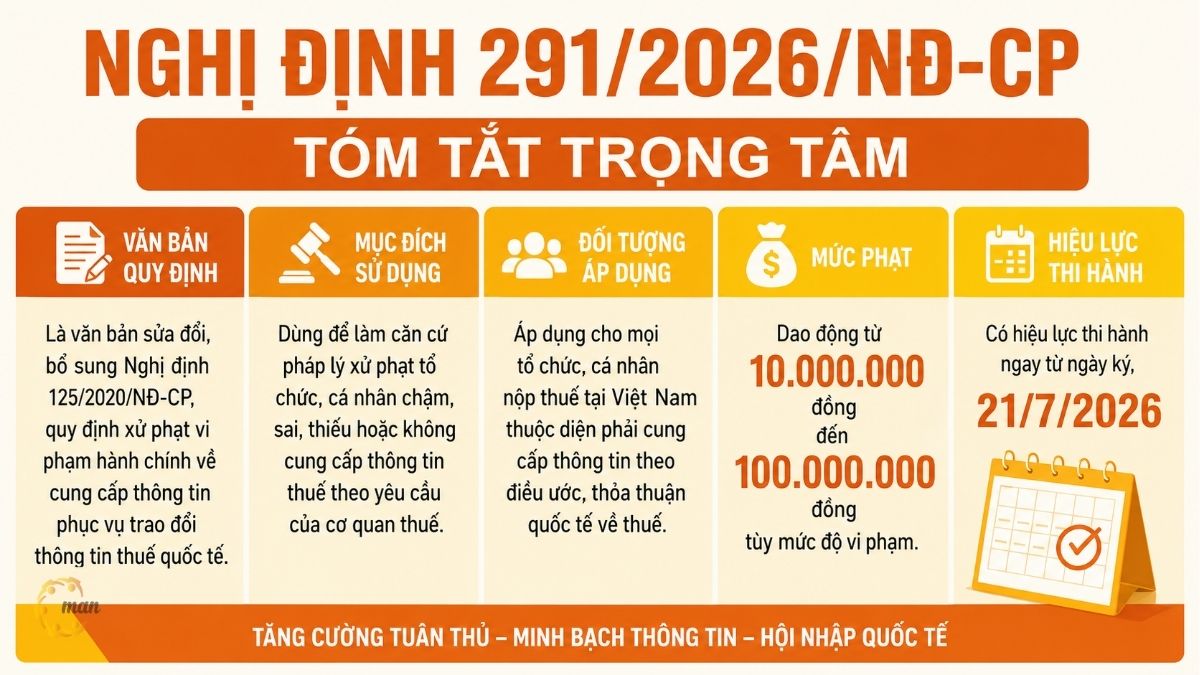
- Decree 291/2026/ND-CP is a document amending and supplementing Decree 125/2020/ND-CP, stipulating administrative penalties for violations related to providing information for international tax information exchange.
- This serves as the legal basis for imposing penalties on organizations and individuals who are late, incorrect, incomplete, or fail to provide tax information as requested by the tax authorities.
- This applies to all organizations and individuals paying taxes in Vietnam who are required to provide information under international tax treaties and agreements.
- Fines range from 10,000,000 VND to 100,000,000 VND depending on the severity of the violation.
- Effective immediately from the date of signing, July 21, 2026.
What is Decree 291/2026/ND-CP? Definition and scope of application.
Decree 291/2026/ND-CP is a document issued by the Government on July 21, 2026, amending and supplementing several articles of Decree 125/2020/ND-CP regulating administrative penalties for tax and invoice violations (this document had previously been amended by Decree 102/2021/ND-CP and Decree 310/2025/ND-CP). The core content of Decree 291/2026/ND-CP is the addition of... Section 3 and Article 19a This follows Section 2, Chapter II of Decree 125/2020/ND-CP.
The scope of the new clause focuses on violations related to: Provide information as requested by the tax authorities., This serves the purpose of exchanging information in accordance with Vietnamese law, international treaties, and international agreements on taxation to which Vietnam is a signatory or member. In other words, this is a specific regulation for cross-border tax information cooperation obligations and does not apply to violations of ordinary domestic tax declarations and payments.
Why is Decree 291/2026/ND-CP important for businesses?
With Vietnam's increasing participation in multilateral tax information exchange mechanisms, the obligation to provide records and data to tax authorities upon request has become more common, especially for businesses with cross-border transactions or those with shareholders or parent companies abroad. Previously, the lack of specific regulations led many entities to be complacent in preparing for and responding to these requests.
According to experts at MAN – Master Accountant Network, The legalization of specific penalties creates clearer compliance pressure, forcing corporate accounting and legal departments to develop systematic and time-controlled procedures for responding to tax information requests. This also signals that Vietnamese tax authorities are tightening their oversight of transactions involving foreign elements.
Which entities are affected by Decree 291/2026/ND-CP?
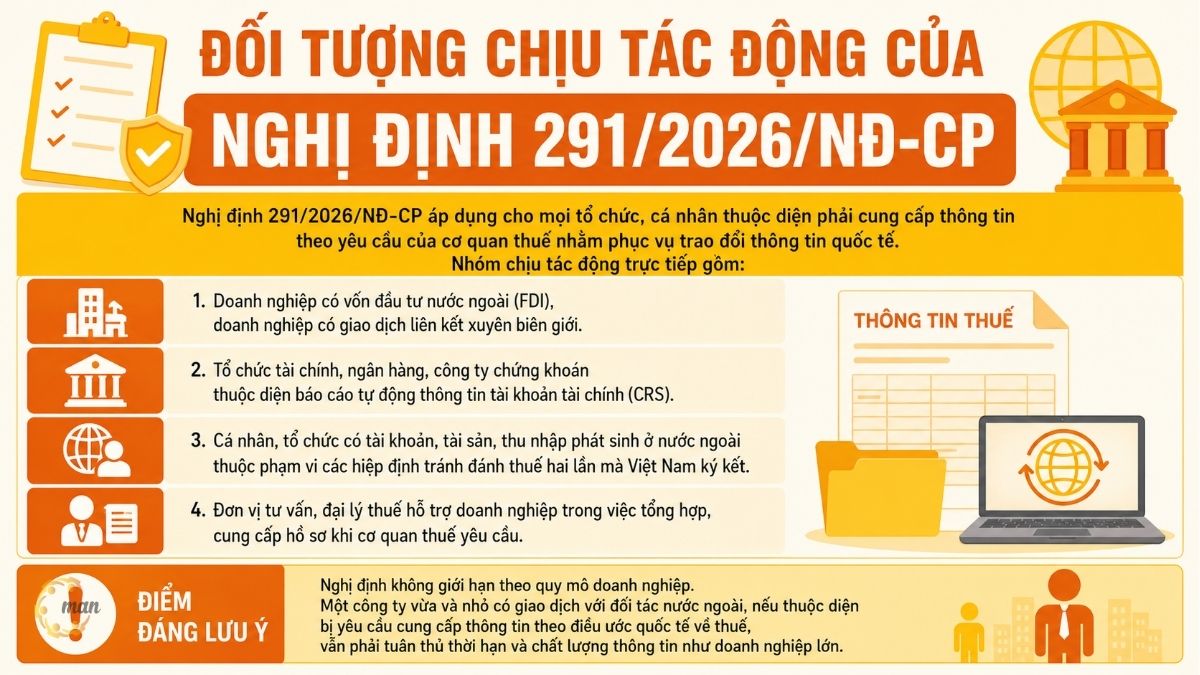
Decree 291/2026/ND-CP applies to all organizations and individuals required to provide information at the request of tax authorities for the purpose of international information exchange. The groups directly affected include:
- Foreign-invested enterprises (FDI), and enterprises with cross-border related-party transactions.
- Financial institutions, banks, and securities companies are subject to automatic reporting of financial account information (CRS).
- Individuals and organizations with accounts, assets, or income generated abroad that fall within the scope of double taxation avoidance agreements signed by Vietnam.
- Tax consulting firms and agents assist businesses in compiling and providing documents when requested by the tax authorities.
The point is that... The decree does not impose any size restrictions on businesses.. A small or medium-sized enterprise that conducts transactions with foreign partners, if subject to requirements for providing information under international tax treaties, must still comply with the same deadlines and information quality standards as large enterprises.
What are the specific penalties under Decree 291/2026/ND-CP?
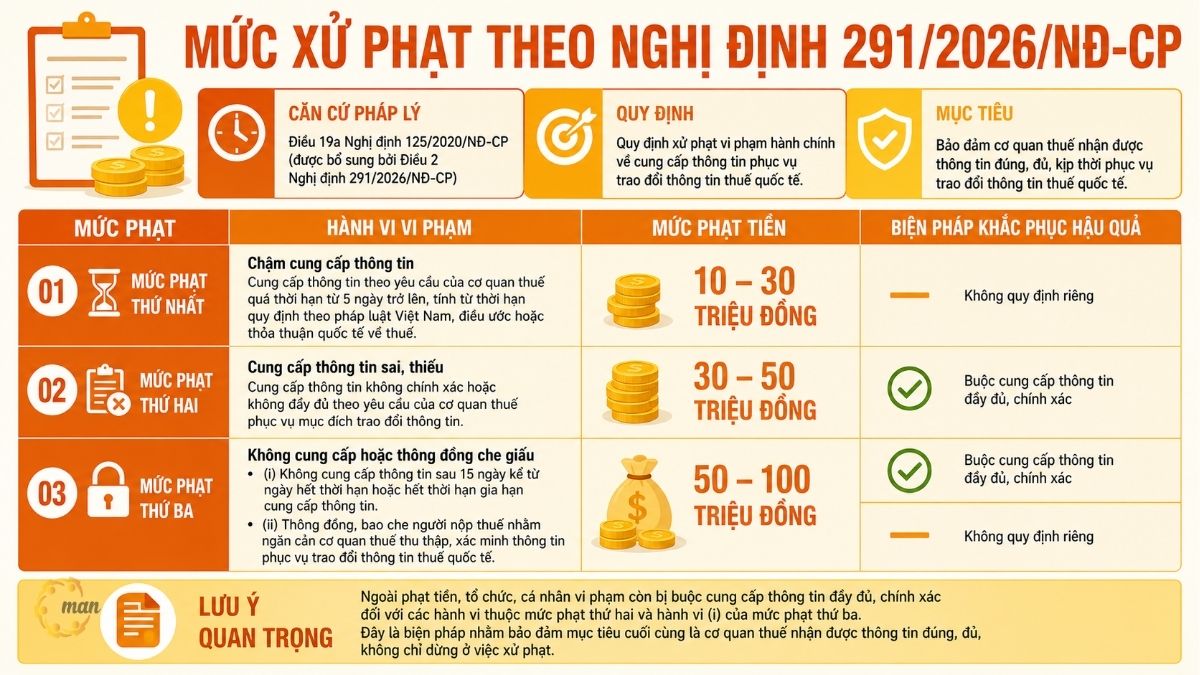
This is the content that businesses and accountants are most interested in. Article 19a of Decree 125/2020/ND-CP (supplemented by Article 2 of Decree 291/2026/ND-CP) stipulates three penalty frameworks corresponding to three levels of violations, along with accompanying remedial measures.
- First penalty: delay in providing information: A fine of VND 10,000,000 to VND 30,000,000 shall be imposed for providing information requested by the tax authorities more than 5 days after the deadline stipulated by Vietnamese law, international treaties or agreements on taxation.
- Second penalty: providing false or incomplete information: A fine of VND 30,000,000 to VND 50,000,000 shall be imposed for providing inaccurate or incomplete information as requested by the tax authorities for the purpose of information exchange.
- Third penalty: failure to provide or complicity in concealing information: Fines ranging from VND 50,000,000 to VND 100,000,000 will be applied to two groups of serious offenses: (i) failure to provide information within 15 days of the deadline or the extended deadline for providing information; (ii) colluding with or concealing taxpayers to prevent tax authorities from collecting and verifying information for the purpose of international tax information exchange.
- Remedial measures: In addition to fines, violating organizations and individuals are also required to provide complete and accurate information regarding the acts falling under the second penalty level and act (i) of the third penalty level. This measure aims to ensure that the ultimate goal is for the tax authorities to receive correct and complete information, not just stop at imposing penalties.
| Violation | Fine amount | Remedial measures |
| Providing information more than 5 days late. | 10 – 30 million VND | No specific regulations |
| Providing inaccurate or incomplete information. | 30 – 50 million VND | Mandatory provision of complete and accurate information. |
| No information provided after 15 days from expiration/renewal date. | 50 – 100 million VND | Mandatory provision of complete and accurate information. |
| Collusion and cover-up by taxpayers to obstruct verification of information. | 50 – 100 million VND | No specific regulations |
When does Decree 291/2026/ND-CP take effect?
Decree 291/2026/ND-CP takes effect from July 21, 2026, the same date of its issuance. This means that violations regarding the provision of international tax information arising from this date onwards will be handled according to the new penalty framework in Article 19a. Businesses need to immediately review any current or upcoming requests for information to avoid being subject to sanctions.
Legal documents related to Decree 291/2026/ND-CP
Important Note: Experts at MAN recommend that businesses, especially FDI companies and financial institutions, should monitor any further implementing guidance that may be issued later, in order to update their internal processes to comply with Article 19a.
| Legal documents | Number / Date of Issue | Related content |
| Decree 291/2026/ND-CP | Government, issued and effective July 21, 2026 | Add Section 3, Article 19a concerning penalties for violations in providing international tax information. |
| Decree 125/2020/ND-CP | The government regulates administrative penalties for violations related to taxes and invoices. | The original text was amended and supplemented by Decree 291/2026/ND-CP. |
| Decree 102/2021/ND-CP | Government | This text previously amended and supplemented Decree 125/2020/ND-CP. |
| Decree 310/2025/ND-CP | Government | Amend Clause 3, Article 5 of Decree 125/2020/ND-CP on the principles of sanctioning multiple violations. |
| Commitment of the Global Forum on Transparency and Information Exchange for Tax Purposes (GF) | International organization | The basis for recommending that Vietnam institutionalize sanctions is outlined in Decree 291/2026/ND-CP. |
What are the principles for imposing penalties when multiple violations occur simultaneously?
Besides the new content in Article 19a, Clause 3 of Article 5 of Decree 125/2020/ND-CP (amended by Article 1 of Decree 310/2025/ND-CP) still maintains the general principle: multiple violations will be penalized for each violation individually. However, the regulation also lists a series of exceptions, preventing the cumulative penalty of individual violations. Businesses need to be fully aware of this to avoid disputes when being penalized for multiple violations during a single tax audit.
Specifically, the following cases are exempt from penalties for individual acts:
- Incorrectly declaring multiple tax information on multiple tax returns on the same day.If the act of misdeclaration falls under the category of procedural tax penalties, the taxpayer will only be penalized for the one act of misdeclaration with the highest fine among the acts committed.
- Late submission of multiple tax returns for the same tax type on the same day.Only one instance of late filing of tax returns will be penalized for the highest penalty. However, if any of the late filings involve tax evasion, that particular case will be penalized separately for tax evasion and not combined with the other.
- Late submission of multiple similar notices and reports regarding invoices on the same day.: only penalized for one offense of late submission of notification/reporting of invoices with the highest penalty bracket.
- Using illegal invoices or using invoices illegally.If the act is already subject to penalties under Article 16 or Article 17 of Decree 125/2020/ND-CP, it should not be subject to additional penalties under Article 28 of this Decree to avoid double penalties for the same nature of the act.
- Issuing multiple invoices at the wrong time.If the acts are still within the statute of limitations for penalties and are processed in the same administrative violation case, only one act of issuing invoices at the wrong time will be penalized, with the fine corresponding to the number of invoices issued at the wrong time, as stipulated in Clause 2, Article 24 of Decree 125/2020/ND-CP.
- Do not issue multiple invoices.Similarly, if the acts are still within the statute of limitations for penalties and are processed in the same case, only one act of not issuing invoices will be penalized, with the fine corresponding to the number of invoices involved, as stipulated in Clause 3, Article 24 of Decree 125/2020/ND-CP.
- Multiple incorrect entries were made on a single tax return. (Unlike the case of multiple files mentioned above): if subject to penalties for tax procedures, only the highest penalty will be imposed for the single act of incorrect declaration of taxable items among the acts committed.
- Incorrectly declaring multiple items on a tax return is subject to both procedural tax penalties and penalties under Article 16 or Article 17.In this case, the taxpayer will only be penalized for one offense under Article 16 or Article 17 of Decree 125/2020/ND-CP, not simultaneously under both sets of regulations.
According to experts at MAN – Master Accountant Network, Understanding these exclusions helps businesses argue based on the correct legal grounds when working with tax authorities, avoiding the misapplication of the cumulative penalty principle for errors of the same nature or occurring on the same day, in the same file, or in the same violation case.
Case Study: How do FDI enterprises handle requests for tax information?
Background
A foreign direct investment (FDI) company in the component manufacturing sector, with its parent company in Europe, received a document from the tax authorities requesting related-party transaction records and account information for information exchange under the Double Taxation Avoidance Agreement. The response deadline was 10 working days, but the internal accounting department was unfamiliar with the process of consolidating data across multiple departments and the parent company overseas.
Risks if processing is delayed.
According to advice from MAN – Master Accountant Network, If a business is more than 5 days late compared to the deadline, the minimum fine applied is already 10 million VND, which can increase to 30 million VND. If the delay extends beyond 15 days from the deadline, the fine can jump to 50 to 100 million VND, and the business must still complete the provision of information as a remedial measure.
Practical solution
The company in this situation collaborated with a consulting firm to develop a three-step process: (1) designating a single point of contact to receive and classify international tax information requests; (2) establishing a fast communication channel with the parent company to shorten the time for cross-border data aggregation; (3) reviewing the accuracy of data before submission, avoiding penalties for providing incorrect or incomplete information. As a result, the company responded on time and did not incur any penalties.
Expert opinion: Common business risks and how to avoid them.
Experts at MAN – Master Accountant Network With over 30 years of experience in auditing and tax consulting in Vietnam, we note three main risks that businesses need to avoid before Decree 291/2026/ND-CP.
- Risk number one: The issue is subjective regarding response deadlines. Many businesses treat requests for international tax information like a regular administrative document, failing to prioritize processing them, leading to penalties even for delays of just a few days.
- Second risk: This relates to data quality. Businesses with complex ownership structures and multiple affiliated companies are more likely to provide incomplete information due to a lack of internal coordination, thus falling under the penalty range of 30 to 50 million VND.
- Third risk: This is due to a lack of a process for storing evidence of timely information provision. When disputes arise regarding the submission time, businesses without supporting records will be at a disadvantage. The solution comes from... MAN – Master Accountant Network This involves establishing a systematic tax risk management process, including a log of receiving and responding to documents from tax authorities, helping businesses to be proactive and have a basis for verification when needed.
Conclude
Decree 291/2026/ND-CP marks a step towards completing the legal framework for penalizing violations related to the provision of international tax information in Vietnam, directly linked to Vietnam's commitments in global tax cooperation. Businesses with cross-border transactions, financial institutions, and individuals with income and assets abroad need to proactively review their internal processes to ensure timely and high-quality information is provided when requested by tax authorities.
Tax services at MAN – Master Accountant Network
- Tax accounting services
- Tax consulting services
- Tax settlement services
- Tax reporting services
- VAT refund service
Service contact information at MAN – Master Accountant Network
- Address: No. 19A, Street 43, Tan Thuan Ward, Ho Chi Minh City
- Mobile/Zalo: 0903 963 163 – 0903 428 622
- E-mail: man@man.net.vn
- Google Business Profile: View MAN – Master Accountant Network's Google Business Profile
- LinkedIn Founder: View expert Le Hoang Tuyen's LinkedIn profile.
Responsible for production and professional content review by: Mr. Le Hoang Tuyen – Founder & CEO of MAN – Master Accountant Network, CPA Vietnam with over 30 years of experience in accounting, auditing, taxation, and corporate financial consulting.
Frequently Asked Questions about Decree 291/2026/ND-CP
From what date does Decree 291/2026/ND-CP come into effect?
Effective from July 21, 2026, the same day the Decree is issued.
Which document does Decree 291/2026/ND-CP amend?
Decree 291/2026/ND-CP amends and supplements Decree 125/2020/ND-CP, specifically by adding Section 3 and Article 19a on penalties for violations in providing international tax information.
What is the maximum fine under Decree 291/2026/ND-CP?
The highest penalty ranges from VND 50,000,000 to VND 100,000,000, applicable to the act of failing to provide information after 15 days from the deadline, or the act of colluding with or covering up for taxpayers.
Are small businesses subject to Decree 291/2026/ND-CP?
Yes, the Decree is not limited by business size. Any organization or individual required to provide information for international tax information exchange is subject to its regulations.
Besides fines, what else can businesses do?
For certain violations, businesses may also be required to take remedial measures, such as providing complete and accurate information as originally requested by the tax authorities.