
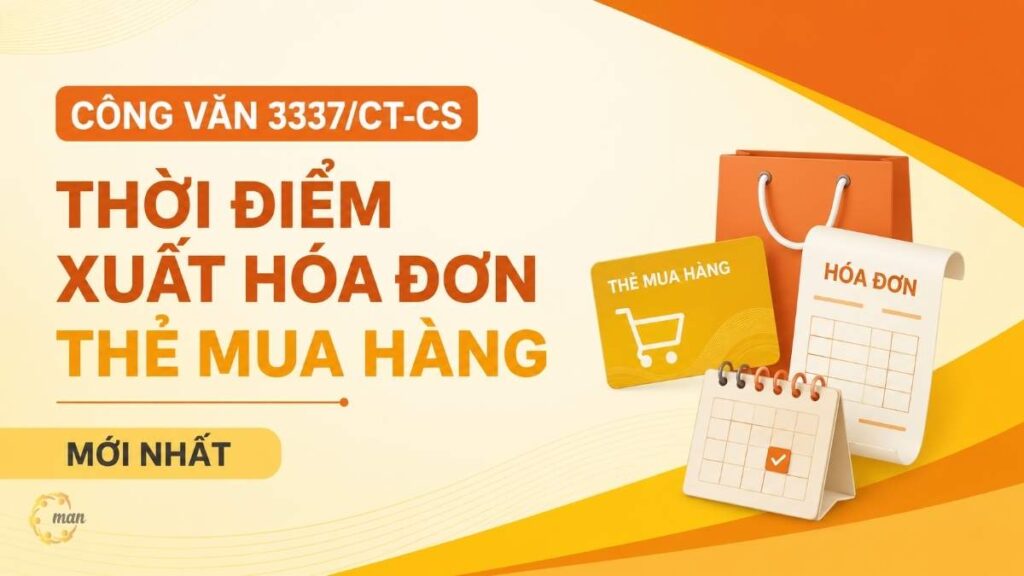
Circular 3337/CT-CS, recently issued, has thoroughly resolved the difficulties faced by many Vietnamese businesses regarding the timing of issuing electronic invoices when issuing and selling shopping cards and vouchers to partners. This comes amidst increasingly stringent tax management regulations. Decree 70/2025/ND-CP and Decree 310/2025/ND-CP, Incorrectly determining the timing of invoice issuance not only leads to the risk of tax arrears but also exposes businesses to very heavy administrative penalties. Many accountants are still confused about distinguishing between receiving advance payments via credit cards and the actual delivery of goods.
To help businesses and accounting staff proactively control tax risks, this article will comprehensively analyze the guidance in Official Letter 3337/CT-CS. At the same time, we will also update the latest regulations on mandatory content for electronic invoices and new penalties for failing to issue invoices when selling goods and services. Practical insights from leading experts will serve as a useful legal guide for your company's upcoming tax settlement activities.
Quick information about Official Letter 3337/CT-CS for managers
Official Document 3337/CT-CS This is a professional guidance document from the tax authority regarding the timing of issuing electronic invoices for the sale of gift cards to customers for payment at partner companies. This document clarifies that the time of invoice issuance is not the time of sale of the gift card, but the time when the customer actually uses the gift card to purchase goods or services.
This guideline applies directly to businesses issuing shopping cards, intermediary entities, and businesses involved in cross-payment schemes using vouchers in the Vietnamese market.
What does Official Document 3337/CT-CS stipulate regarding the timing of issuing invoices for purchase cards?
To fully understand the tax authorities' approach, we first need to grasp the fundamental principles regarding the timing of invoice issuance and the adjustments made in the latest legal regulations. Applying the correct invoice issuance timing is a core principle that helps businesses avoid late payment penalties. value added tax (VAT) It's not worth it.
What are the principles for issuing invoices as stipulated in Decree 70/2025/ND-CP?
Based on Clause 1, Article 4 of Decree 123/2020/ND-CP, as amended by Point a, Clause 3, Article 1 Decree 70/2025/ND-CP The regulations regarding the principles for creating, managing, and using invoices and documents are as follows:
“1. When selling goods or providing services, the seller must issue an invoice to the buyer (including cases where goods and services are used for promotions, advertising, samples; goods and services used for giving, gifting, exchanging, paying as wages to employees and internal consumption (except for goods circulated internally to continue the production process); exporting goods in the form of loans, borrowing or returning goods) and cases where invoices are issued as prescribed in Article 19 of this Decree.
Invoices must contain all the information as prescribed in Article 10 of this Decree. If electronic invoices are used, they must conform to the standard data format of the tax authority as prescribed in Article 12 of this Decree.”
Therefore, regardless of whether the transaction generates revenue or involves non-commercial activities such as gifts or internal consumption, invoicing remains a mandatory obligation for all organizations and individuals doing business in Vietnam.
When is the time of invoicing for the sale of goods determined?
The confusion among accountants stems from the provision in Clause 1, Article 9 of Decree 123/2020/ND-CP (amended by point a, Clause 6, Article 1 of Decree 70/2025/ND-CP), which clearly states the time of invoice issuance for the sale of goods as follows:
“1. The time of issuing an invoice for the sale of goods (including the sale and transfer of public assets and the sale of national reserves) is the time of transferring ownership or the right to use the goods to the buyer, regardless of whether payment has been received or not.
For goods exports (including processing for export), the time of issuing the electronic commercial invoice, electronic value-added tax invoice, or electronic sales invoice is determined by the seller, but no later than the next working day from the date the goods are cleared through customs as stipulated by customs law.”
When selling a physical or electronic card, a business receives payment and delivers the card to the customer. Accountants often worry that not issuing an invoice at this time would violate the principle of issuing an invoice before payment is received for services. However, the purchase card is merely a means to purchase goods later, and its true nature needs to be clarified as outlined below.
Detailed instructions from Official Letter 3337/CT-CS regarding the timing of issuing invoices for purchase cards.
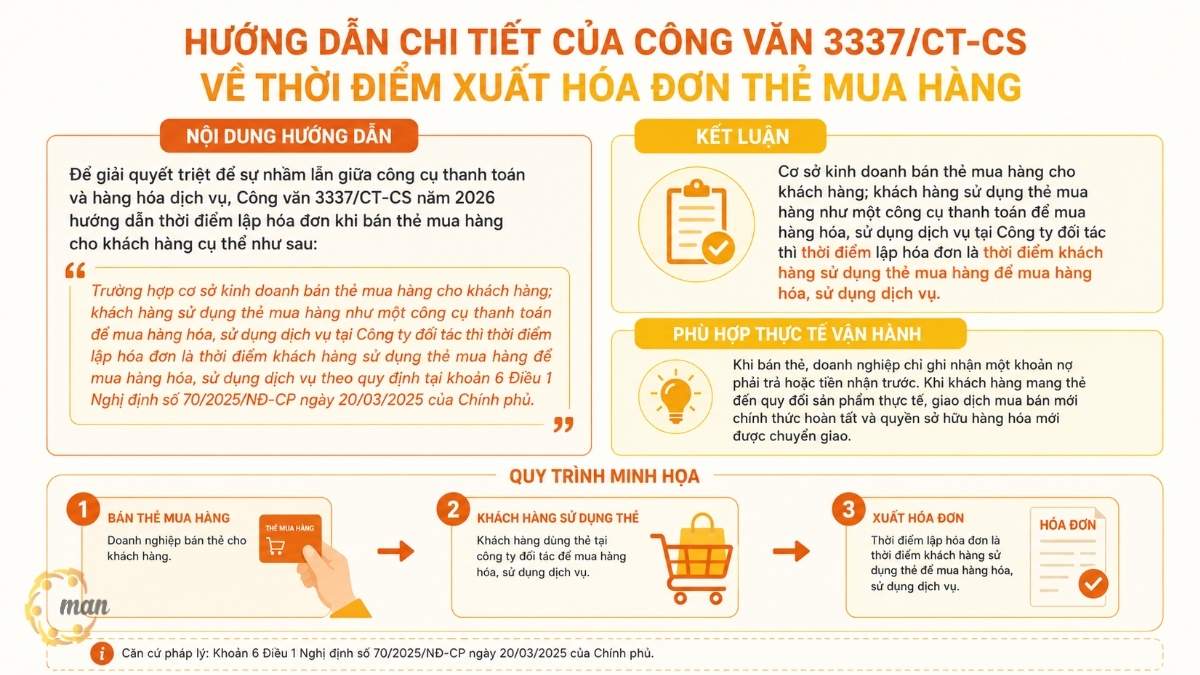
To thoroughly resolve the confusion between payment instruments and goods and services, Circular 3337/CT-CS of 2026 provides guidance on the timing of invoice issuance when selling gift cards to customers as follows:
“"In cases where a business sells gift cards to customers, and the customer uses the gift card as a payment instrument to purchase goods or services at a partner company, the time of invoice issuance is the time the customer uses the gift card to purchase goods or services, as stipulated in Clause 6, Article 1 of Government Decree No. 70/2025/ND-CP dated March 20, 2025."”
Therefore, if a business sells gift cards to customers, and customers use the gift cards as a payment tool to purchase goods or services at a partner company, then the invoice date is the date the customer uses the gift card to purchase goods or services.
This regulation is perfectly aligned with the practical operation of the digital economy. When selling cards, businesses only record a liability or an upfront payment. The transaction is only officially completed and ownership of the goods is transferred when the customer redeems the card for a physical product.
What information is required on electronic invoices according to the latest regulations?
Besides determining the correct timeframe, the complete and accurate presentation of all criteria on electronic invoices is a mandatory condition for those invoices to be considered valid and legal. Businesses need to continuously update changes in forms to avoid technical errors when submitting data to the tax authorities.
List of 14 mandatory items that must be included on invoices according to Decree 123/2020/ND-CP
According to Article 10 of Decree 123/2020/ND-CP, a standard electronic invoice issued to a customer must display the following information in full:
- Invoice name, invoice symbol, invoice form number symbol.
- Invoice name.
- Invoice number.
- Name, address, and tax identification number of the seller.
- Name, address, and tax identification number of the buyer.
- Name, unit of measurement, quantity, unit price of goods/services, total amount excluding VAT, VAT rate, total VAT amount for each tax rate, total VAT amount, total payment including VAT.
- Seller's signature, buyer's signature.
- Invoice date.
- The time of digital signature on the electronic invoice.
- The tax authority code for electronic invoices includes a tax authority code.
- Fees and charges belonging to the state budget, trade discounts, promotions (if any), and other related matters (if any).
- Name and tax identification number of the organization that prints invoices for invoices printed by the tax authority.
- The text, numbers, and currency shown on the receipt.
- Other information on the invoice.
The absence of any of the above mandatory items may result in the invoice being classified as invalid by the tax authorities, directly affecting the input VAT deduction for the card buyer.
Exceptions do not necessarily require the full invoice content as per Official Letter 3337/CT-CS.
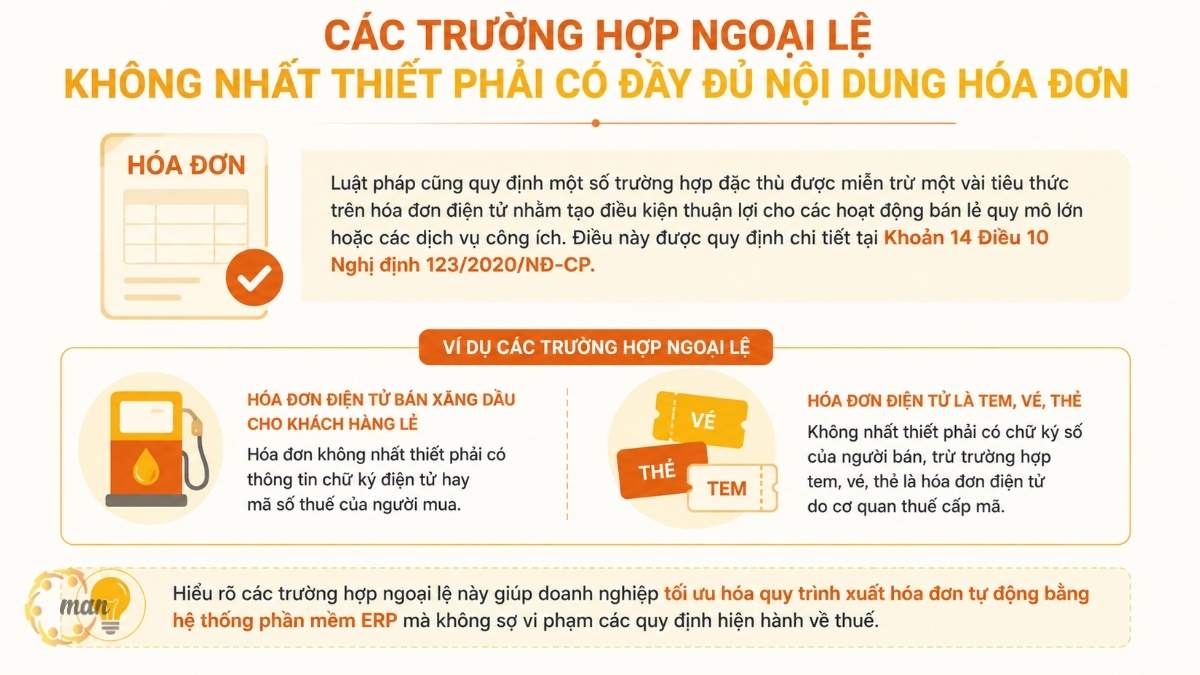
The law also stipulates certain specific cases where some criteria on electronic invoices are exempted to facilitate large-scale retail activities or public services. This is detailed in Clause 14, Article 10 of Decree 123/2020/ND-CP.
For example, for electronic invoices for the sale of gasoline to retail customers, the invoice does not necessarily need to include the electronic signature or tax identification number of the buyer. For electronic invoices in the form of stamps, tickets, or cards, the digital signature of the seller is not required, except in cases where the stamps, tickets, or cards are electronic invoices issued by the tax authority.
Understanding these exceptions helps businesses optimize their automated invoicing processes using ERP software systems without fear of violating current tax regulations.
What are the administrative penalties for not issuing invoices when selling goods or services?
The act of selling goods or providing services without issuing invoices is one of the serious offenses closely monitored by tax authorities. The penalties for this act have been adjusted to be stricter in order to deter cases of deliberate tax evasion or delay in fulfilling tax obligations.
Details of administrative penalties under Decree 310/2025/ND-CP
Based on Clause 2, Article 24 of Decree 125/2020/ND-CP, as amended by Point b, Clause 14, Article 1 of Decree 310/2025/ND-CP, the penalties for failing to issue detailed invoices are as follows:
1. Warning penalty
A warning penalty is applied to the following violations: failure to issue invoices for goods and services used for promotions, advertising, samples; goods and services used for giving, gifting, exchanging, paying as wages to employees, and internal consumption (except for goods circulated internally to continue the production process); and exporting goods in the form of loans, borrowings, or returns with a single invoice number.
2. A fine of between 1,000,000 and 2,000,000 VND will be imposed.
This penalty framework applies in cases where invoices are not issued for goods and services used for promotions, advertising, samples; goods and services used for giving, gifting, exchanging, paying as wages to employees, and internal consumption (except for goods circulated internally to continue the production process); goods exported in the form of loans, borrowings, or returns of goods from 2 to less than 10 invoices; and cases where invoices are not issued when selling goods or providing services as required with a scale of 1 invoice.
3. Fines ranging from 2,000,000 to 10,000,000 VND.
This applies to cases where invoices are not issued for goods and services used for promotions, advertising, samples; goods and services used for giving, gifting, exchanging, paying as wages to employees, and internal consumption (except for goods circulated internally to continue the production process); goods exported in the form of loans, borrowings, or returns from 10 to less than 50 invoices; and cases where invoices are not issued when selling goods or providing services as prescribed from 2 to less than 10 invoices.
4. A fine of between 10,000,000 and 30,000,000 VND will be imposed.
Penalties apply to cases of failure to issue invoices for goods and services used for promotions, advertising, samples, gifts, exchanges, payment in lieu of salary, internal consumption (except internal circulation for production), loans, borrowing, or return of goods when the violation involves 50 to less than 100 invoices. The same applies to cases of failure to issue invoices when selling goods or providing services as required, when the violation involves 10 to less than 20 invoices.
5. A fine of between 30,000,000 and 50,000,000 VND will be imposed.
This monetary penalty applies in cases where invoices are not issued for goods and services used for promotions, advertising, samples; goods and services used for giving, gifting, exchanging, paying as wages to employees, and internal consumption (except for goods circulated internally to continue the production process); goods exported in the form of loans, borrowings, or returns of goods from 100 invoices or more; and cases where invoices are not issued when selling goods or providing services as required from 20 invoices to less than 50 invoices.
6. A fine of between 60,000,000 and 80,000,000 VND will be imposed.
This is the maximum fine, applied directly in cases where invoices are not issued for the sale of goods or provision of services as required by regulations, for 50 or more invoices.
Important notes regarding penalties for individuals and sole proprietorships.
A crucial point that private business owners and household businesses need to be aware of is the principle for determining the amount of fines for violations. All the fines mentioned above are the prescribed fines applicable to organizations.
- The above-mentioned penalties apply to organizations; if an individual violates the above regulations, the fine will be half the amount imposed on organizations (according to Article 7 of Decree 125/2020/ND-CP).
- For taxpayers who are households or business households, the same penalty rates as for individuals apply (according to Article 7 of Decree 125/2020/ND-CP).
This division aims to ensure fairness and alignment with the financial capacity and scale of operations of individual business households in Vietnam.
Real-world case study: Handling invoices when issuing gift cards to business partners.
To help readers better understand the operating mechanism of cash flow and invoice flow in accordance with the spirit of Circular 3337/CT-CS, we would like to present a real-life situation commonly encountered in Vietnamese businesses today.
A real-world scenario at a retail business in Vietnam.
Minh Anh Trading Joint Stock Company specializes in operating a chain of convenience stores. In May 2026, Minh Anh Company signed a commercial cooperation agreement with Hoang Gia Technology Investment Joint Stock Company (the owner of the reward points application).
According to the agreement, Minh Anh Company issued and sold 5,000 physical shopping vouchers to Hoang Gia Company, each with a face value of 500,000 VND, for a total contract value of 2.5 billion VND. Hoang Gia Company paid the entire 2.5 billion VND to Minh Anh Company and distributed these vouchers to users of their application as gifts for their customer loyalty program. Consumers would then take these vouchers to Minh Anh Company's supermarkets to exchange them for consumer goods.
Tax risk mitigation plan based on the latest legal guidance.
Based on the guidance of Official Letter 3337/CT-CS and supporting regulations, MAN's team of experts advised Minh Anh Company to implement the tax control process as follows:
Phase 1: When Minh Anh Company receives the money and hands over the cards to Hoang Gia Company.
At this time, Minh Anh Company has not yet transferred ownership of the goods to the end consumer. Therefore, Minh Anh Company does not issue a value-added tax invoice to Hoang Gia Company for the amount of 2.5 billion VND. The accountant of Minh Anh Company only prepares a receipt and tracks this advance payment in the accounts payable account (Account 131 – Accounts receivable from customers or Account 3387 – Unearned revenue, depending on the accounting policy applied).
Phase 2: When consumers bring their shopping cards to the supermarket to exchange them for goods.
When a customer brings a 500,000 VND shopping card to Minh Anh supermarket to buy milk and confectionery, this marks the moment of transfer of ownership of the goods. At this point, Minh Anh Company is obligated to issue an electronic invoice to the customer for the actual value of the goods purchased (500,000 VND)., VAT rate This applies to milk and confectionery items (e.g., 8% or 10%). The amount paid on the invoice will be deducted from the value of the shopping card presented by the customer.
This accurate advice from experts at MAN helps businesses avoid double-declaring revenue, optimize cash flow for VAT payments, and fully comply with future tax audit regulations.
Summary table comparing cases of invoicing with credit cards and regular goods.
To help our customers easily track and compare the differences in invoice processing across various transactions, we have compiled detailed information in the table below:
| Comparison criteria | Selling gift cards (According to Official Letter 3337/CT-CS) | Selling ordinary goods | Receive advance payment for services |
| Time of receiving money | Receive payment before the customer selects and receives the goods. | Receive payment before, during, or after delivery. | Receive payment before the service is completed. |
| Invoice issuance time | This is the moment when the customer uses the card to make a physical purchase. | It is the point at which ownership/the right to use goods is transferred. | This refers to the time when payment is received in advance or the time when the service is completed. |
| Value on the invoice | Calculated based on the actual value of the goods chosen by the customer. | Calculated based on the agreed selling price of the delivered shipment. | Calculated based on the actual amount collected in advance or the value of the completed service. |
| Common tax risks | Invoices were issued at the wrong time, right when the gift cards were sold. | Delay in issuing invoices after the goods have been physically delivered. | No invoices will be issued upon receipt of service deposits/advance payments. |
MAN expert opinion on tax risk management when using gift cards, as per Official Letter 3337/CT-CS.
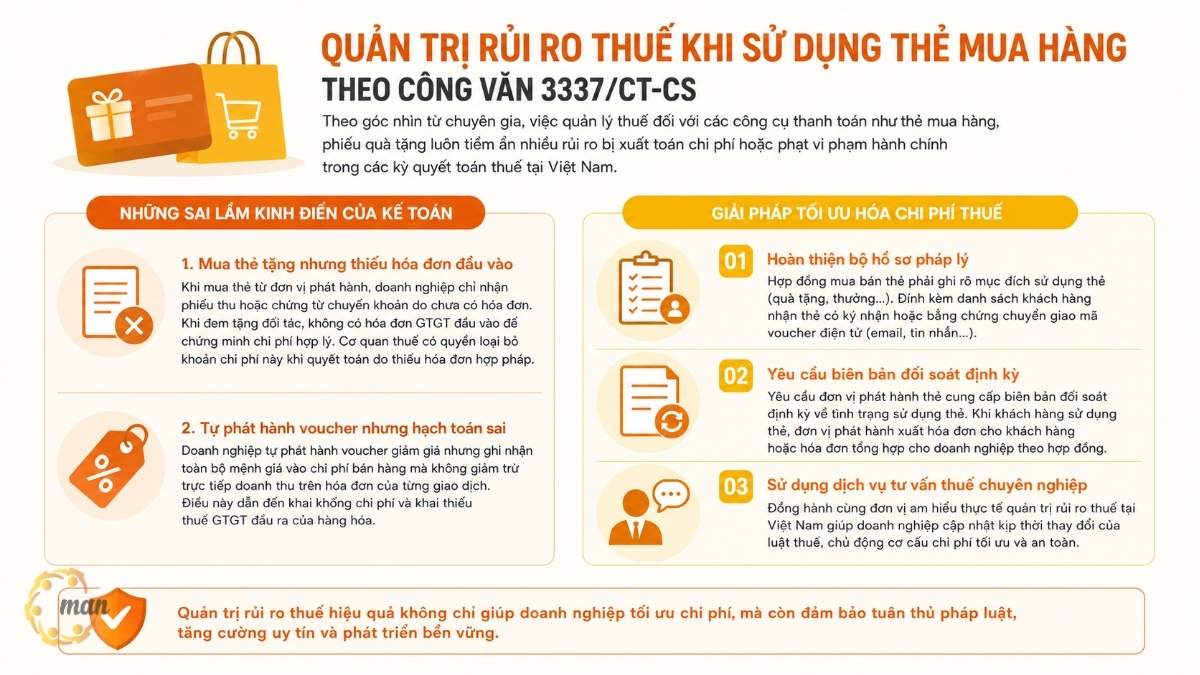
From the perspective of MAN – Master Accountant Network, tax management for payment instruments such as gift cards and vouchers is always a high-risk area for potential expense disallowance or administrative penalties during tax settlements in Vietnam.
Classic accounting mistakes when handling gift cards and electronic vouchers.
Many businesses often make a serious mistake when accounting for the cost of purchasing gift cards to give to customers or employees. When purchasing gift cards from issuers, because the issuer does not immediately issue an invoice (as per Circular 3337/CT-CS), the purchasing business only receives a payment receipt or transfer document.
When giving this card as a gift to business partners, the company does not have... VAT invoice This is input to demonstrate the reasonableness of the expense. At the time of final settlement, the tax authorities have the full right to exclude this expense from deductible expenses. corporate income tax due to the lack of legally valid invoices as required by the Tax Law.
Another mistake is when businesses issue discount vouchers but record the entire face value of the voucher as a selling expense without directly deducting it from the revenue on the invoice for each actual transaction. This leads to inflated expenses and underreporting of output VAT on goods.
Tax cost optimization solutions in Vietnam from Master Accountant Network
Experts at MAN, with 30 years of experience, note that to thoroughly address the tax risks associated with gift cards, businesses need to establish a robust three-step internal control process:
- Complete the legal documentation.The sales contract for the gift cards must clearly state the purpose of use (e.g., as gifts for customer conferences, year-end bonuses for employees). Additionally, a list of customers who received the cards with full signatures or proof of electronic voucher code delivery via email or SMS must be attached.
- Request for periodic reconciliation reportBusinesses purchasing cards must require the card issuer to provide periodic reconciliation statements regarding customer card usage. When a customer uses the card to redeem goods, the issuer must issue an invoice to the customer, or a consolidated invoice to the card-purchasing business, depending on the structure of the signed contract.
- Utilize professional tax consulting services.Partnering with a firm like MAN, which has a deep understanding of tax risk management practices in Vietnam, will help businesses stay one step ahead in updating tax laws, thereby proactively restructuring expenses in the most optimal and secure way.
Conclude
Understanding the guidelines in Official Letter 3337/CT-CS helps service businesses, retail businesses, and intermediary payment instrument issuers clearly define their invoice circulation process. Issuing invoices at the right time not only helps businesses strictly comply with tax laws and avoid heavy administrative penalties from Decree 310/2025/ND-CP, but also ensures the transparency and accuracy of accounting data when explaining to tax audit teams.
To ensure the absolute safety of the financial system and optimize tax costs in Vietnam, businesses need support from professional consulting organizations. MAN is proud to be a leading partner with a team of experts with over 30 years of experience, always ready to accompany your business through high-quality service packages such as: tax settlement services, tax accounting services, tax reporting services and tax consulting services Comprehensive. Contact us today to receive the most professional support for your business's sustainable development journey.
Service contact information at MAN – Master Accountant Network
- Address: No. 19A, Street 43, Tan Thuan Ward, Ho Chi Minh City
- Mobile/Zalo: 0903 963 163 – 0903 428 622
- Email: man@man.net.vn
Content production by: Mr. Le Hoang Tuyen – Founder & CEO MAN – Master Accountant Network, Vietnamese CPA Auditor with over 30 years of experience in Accounting, Auditing and Financial Consulting.
Frequently Asked Questions about Official Letter 3337/CT-CS and the timing of invoice issuance
This should not be done. According to Official Letter 3337/CT-CS, the sale of gift cards does not constitute a transfer of ownership of the goods and therefore does not qualify for the issuance of a sales invoice. If an invoice is issued immediately, the business will violate regulations regarding the timing of invoice issuance and will face difficulties in verifying the actual quantity of goods shipped later, potentially leading to accusations from the tax authorities of issuing invoices at the wrong time.
In this case, the business issues an electronic invoice for the entire actual order value selected by the customer. The payment details will be clearly recorded: a portion will be paid by credit card (offsetting against outstanding debt), and the remaining difference will be paid in cash or via bank transfer from the customer.
When a shopping voucher expires and the customer does not redeem it, the advance payment for the voucher will be converted into other income for the business. The business will reverse this payable amount into other income for corporate income tax purposes as per regulations, and no VAT invoice will be issued because no goods or services have been transferred.
As analyzed, the fine for individuals is half the fine for organizations. For example, the penalty for failing to issue 50 or more invoices for goods and services ranges from 60 million to 80 million VND for organizations, while for individuals or sole proprietorships, this penalty would range from 30 million to 40 million VND.
Businesses need to prepare the following: Card purchase contract, non-cash payment documents (if the value is 20 million VND or more), board of directors' approval decision for the gift-giving program, a signed list of customers receiving gifts, and VAT invoices issued by the card seller when customers actually use the cards, or consolidated invoices for reconciliation as per the contract terms. Can businesses issue invoices immediately upon receiving payment for gift cards if customers request it?
What is the correct way to issue an invoice when a customer uses a credit card but the value of the goods exceeds the card's face value?
If the gift card expires before the customer redeems the item, how is the tax handled?
What is the penalty for individuals who fail to issue invoices when selling goods?
How can businesses include the cost of purchasing gift cards for partners as a legitimate business expense?