


From July 1st, 2026, regulations on tax management for exported and imported goods will officially undergo a significant turning point with the introduction of... Circular 86/2026/TT-BTC This is a significant milestone in streamlining administrative procedures, helping businesses optimize their operations and reduce the burden of customs procedures in the context of increasingly complex international trade.
Understanding tax exemption regulations not only helps businesses comply with the law but also provides a systematic approach to tax risk management. Experts at MAN – Master Accountant Network, with over 30 years of experience, have thoroughly analyzed this topic to provide a practical perspective for the accounting community and business owners operating in the Vietnamese market.
Summary of key points regarding 3 cases where import and export tax declarations are not required.

3 cases where import and export tax declarations are not required. These are specific groups of goods or transactions as stipulated by the Ministry of Finance in Clause 2, Article 3 of Circular 86/2026/TT-BTC. This mechanism eliminates the need for tax declarations on a transaction-by-transaction basis, thereby reducing pressure on businesses and customs authorities.
These regulations apply to businesses importing and exporting specific goods, priority businesses, and other cases as stipulated by law. Businesses need to clearly identify the product group to apply the tax exemption policy accurately.
Details of 3 cases where import and export tax declarations are not required according to the new regulations.
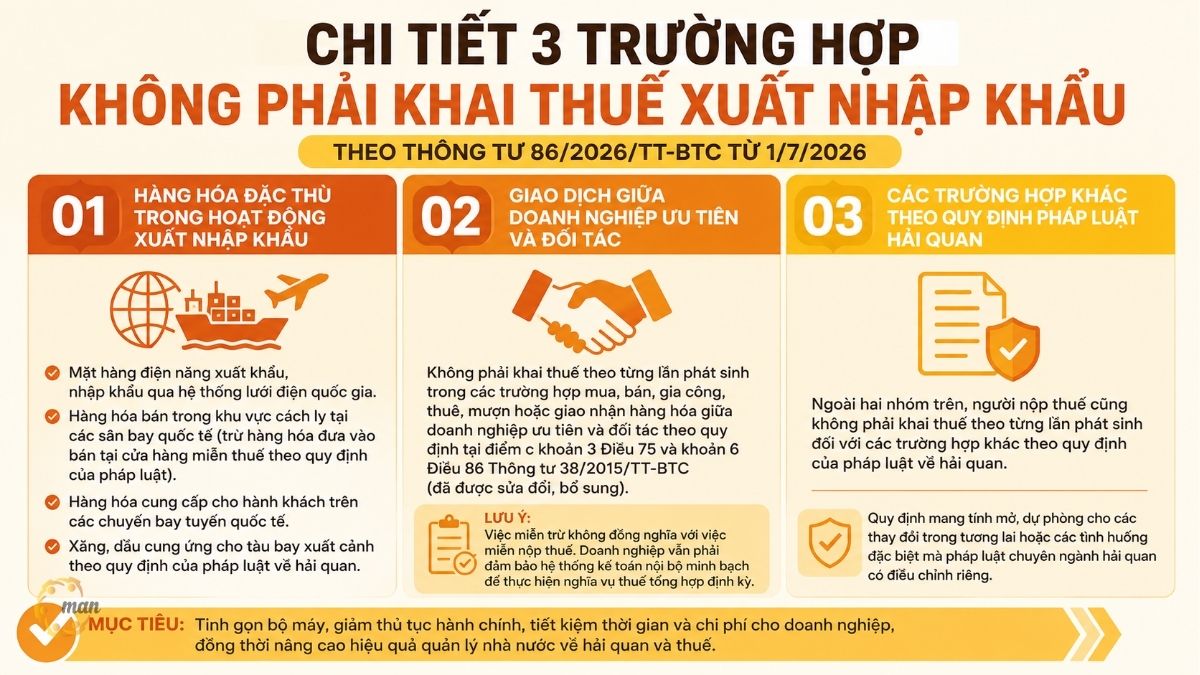
Circular 86/2026/TT-BTC This document was created with the goal of streamlining the administrative apparatus and creating a more favorable environment for commercial activities. Accordingly, Clause 2, Article 3 of this document clearly specifies three groups of cases where taxpayers are not required to file tax returns for each transaction.
Case 1: Specialized goods in import and export activities
For certain types of goods with specific characteristics, taxpayers are not required to file tax returns for each transaction, including:
- Electrical goods export, import via the national power grid system.
- Goods sold within the restricted area at international airports (excluding goods brought in for sale in duty-free shops as stipulated by law).
- Goods provided to passengers on international flights.
- Fuel supplied to aircraft departing the country is subject to customs regulations.
For this category of goods, the continuous nature and physical characteristics make declaration on a transaction-by-transaction basis impractical and wasteful of resources for both regulatory agencies and businesses.
Case 2: Transactions between the preferred enterprise and its counterparty.
Priority businesses are entitled to many favorable conditions in customs procedures. Circular 86/2026/TT-BTC further strengthens this right.
Specifically, there is no requirement to file tax returns for each transaction in cases of purchase, sale, processing, leasing, borrowing, or delivery of goods between priority enterprises and partners as stipulated in point c, clause 3, Article 75 and clause 6, Article 86 of Circular 38/2015/TT-BTC (as amended and supplemented). From the perspective of MAN – Master Accountant Network, this exemption does not mean that businesses are exempt from tax liability. Businesses must still ensure a transparent internal accounting system to fulfill their periodic consolidated tax obligations.
Case 3: Other cases as prescribed by customs law.
In addition to the two groups mentioned above, taxpayers are also exempt from filing tax returns on a transaction-by-transaction basis for other cases as stipulated by customs law. This group of regulations is open-ended, providing for future changes or special situations that require separate adjustments under specialized customs law. This flexibility allows the Vietnamese tax legal system to better adapt to the fluctuations of global trade.
The role of regulations in corporate tax risk management.
Why is this classification important for financial management? The answer lies in process optimization. By clearly understanding which cases do not require reporting, the accounting department can reduce a significant amount of administrative work.
According to experts at MAN – Master Accountant Network, many Vietnamese businesses often encounter problems due to over-declaration or declaration at the wrong time. Understanding these exemptions helps avoid unnecessary administrative penalties. In the context of increasingly stringent tax audits, proving that a business has complied with tax exemption regulations is a significant advantage when tax authorities conduct post-audits.
Expert perspective from MAN on implementation.
With over 30 years of experience, we at MAN – Master Accountant Network recognize that changing regulations always present a significant challenge for accounting departments. Below are some key considerations when implementing new regulations:
- Synchronization between accounting and customs data: The most common mistake is the lack of synchronization between customs declarations and accounting records. When taxes are not filed individually, businesses easily neglect to keep a log of goods. MAN's solution is to establish a robust electronic document storage system.
- Risk management for specialized product groups: For electricity or petroleum products, monitoring losses and discrepancies between actual imports and exports is a sensitive issue. Businesses should establish rigorous internal control procedures, conduct periodic inventory checks, and reconcile data between business and tax accounting departments.
- Leveraging Priority Business Status: Businesses holding Priority certification need to review their delivery processes. Not having to file taxes on a per-transaction basis comes with greater responsibility for supply chain transparency. MAN recommends conducting a compliance audit every six months.
Case study: Handling specialized goods in logistics
Situation: A company that previously supplied fuel to aircraft departing the country had to file tax returns for each shipment. This process consumed hundreds of hours of work for the accounting department and frequently resulted in delays in customs clearance.
The solution from MAN: Following the effective date of Circular 86/2026/TT-BTC, our experts assisted businesses in reviewing their processes and transitioning to a new management method: instead of submitting declarations on a per-transaction basis, they built consolidated monthly reports based on ERP data.
Result: The company saved 30% in accounting personnel costs for administrative procedures. Tax reporting data became more accurate and consistent. During the year-end tax settlement period, transparent records helped the company completely avoid penalties for late tax filing.
Comparison table of tax filing methods
Below is a detailed comparison table of the core changes in tax filing methods before and after the implementation of Circular 86/2026, helping businesses optimize accounting processes and minimize administrative risks.
| Criteria | Before Circular 86/2026 | After the implementation of Circular 86/2026 |
| Method | Declare on a case-by-case basis. | Exempt from filing tax returns on a case-by-case basis (for 3 product groups) |
| Processing time | Expensive, prone to delays. | Economical and flexible |
| Archived records | Individual, scattered declaration forms | Consolidated, centralized records |
| Administrative risks | High (due to minor errors) | Low (if reporting is well controlled) |
| Accounting responsibilities | Manual data entry | Inspection, verification, and explanation |
Conclude
Understanding the three cases exempt from import and export tax declarations under Circular 86/2026/TT-BTC is a crucial step for businesses to streamline their operations and improve tax management efficiency. This change not only reduces administrative procedures but also opens up opportunities for businesses to focus resources on sustainable business development.
Tax services at MAN – Master Accountant Network
- Tax accounting services
- Tax consulting services
- Tax settlement services
- Tax reporting services
- VAT refund service
Service contact information at MAN – Master Accountant Network
- Address: No. 19A, Street 43, Tan Thuan Ward, Ho Chi Minh City
- Mobile/Zalo: 0903 963 163 – 0903 428 622
- E-mail: man@man.net.vn
- Google Business Profile: View MAN – Master Accountant Network's Google Business Profile
- LinkedIn Founder: View expert Le Hoang Tuyen's LinkedIn profile.
Responsible for production and professional content review by: Mr. Le Hoang Tuyen – Founder & CEO of MAN – Master Accountant Network, CPA Vietnam with over 30 years of experience in accounting, auditing, taxation, and corporate financial consulting.
Frequently Asked Questions about 3 Cases Where Import and Export Tax Declarations Are Not Required
Yes, you are required to keep complete records of invoices, documents, contracts, and goods delivery receipts for future inspections, audits, and tax settlements.
You need to base your decision on cooperation agreements, commercial contracts, and confirmation from your partner that they are a priority enterprise according to the conditions in Circular 38/2015/TT-BTC.
You will file tax reports and settle taxes periodically (monthly, quarterly, or annually) depending on the type of goods and the specific regulations of the customs authority.
No, this regulation applies to transactions occurring from July 1, 2026 onwards. Transactions prior to this date will be governed by the laws in force at the time they occurred.
Yes, MAN - Master Accountant Network specializes in providing solutions for building tax accounting processes, supporting tax review and risk management for businesses. If the goods fall under the category of goods exempt from tax declaration, is it still necessary to retain documentation?
How can I tell if my business is a preferred partner of a priority business group?
If I don't file a tax return every time, when do I need to file it?
Does this regulation apply retroactively to transactions conducted before July 1, 2026?
Does MAN assist businesses in developing new tax administration processes in accordance with this circular?




