


Circular 86/2026/TT-BTC Officially effective from July 1, 2026, replacing Circular 06/2021/TT-BTC and creating a new legal framework for all tax management activities for exported and imported goods in Vietnam. The document consists of 3 chapters and 43 articles, designed to specify the assigned tasks. Tax Administration Law 2025 and Decree 252/2026/ND-CP. This is one of the most significant technical changes for the import-export business community in 2026, directly affecting tax declaration procedures, tax payment deadlines, and extension mechanisms in case of force majeure.
From this perspective MAN – Master Accountant Network, As a tax, accounting, and auditing consulting firm with over 30 years of practical experience in Vietnam, we have observed that most import-export businesses are still confused when distinguishing the new regulations from Circular 38/2015/TT-BTC and previous amendments. This article provides a detailed analysis of Circular 86/2026/TT-BTC, its scope of application, mandatory deadlines, and the practical risks businesses need to avoid during implementation.
Summary of key points in Circular 86/2026/TT-BTC
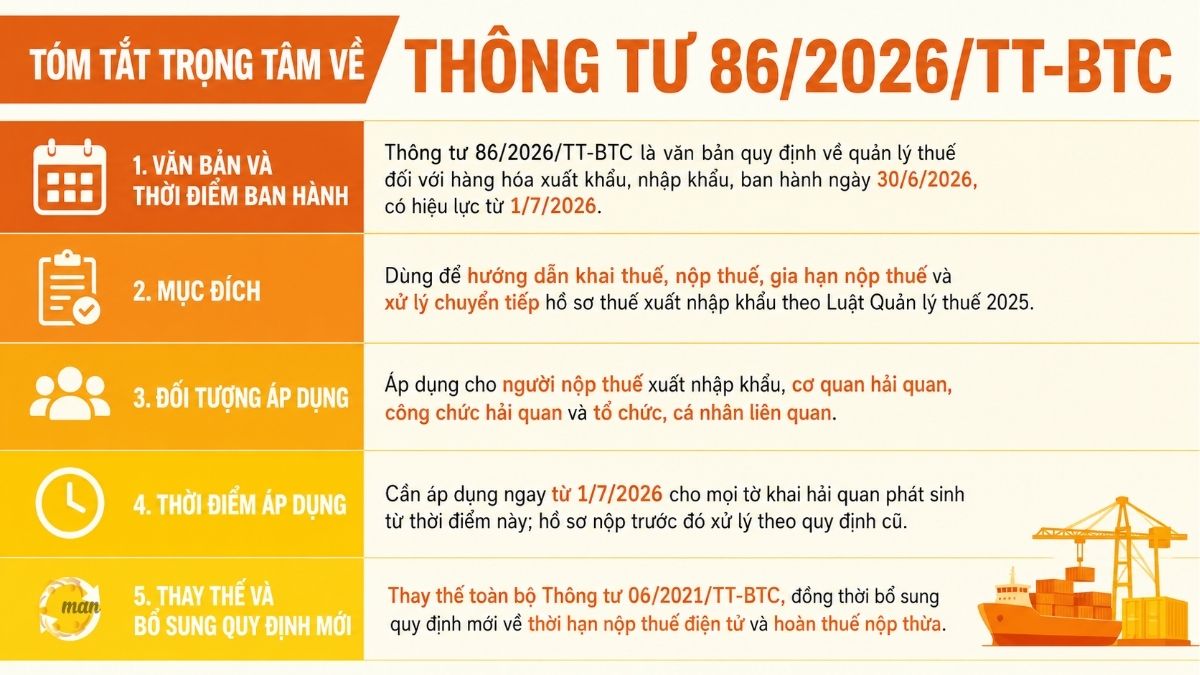
- Circular 86/2026/TT-BTC is a document regulating tax management for exported and imported goods, issued on June 30, 2026, and effective from July 1, 2026.
- This document is used to guide tax declaration, tax payment, tax payment extension, and the handling of transitional import and export tax records according to the 2025 Tax Administration Law.
- This applies to import and export taxpayers, customs authorities, customs officers, and related organizations and individuals.
- These regulations must be applied immediately from July 1, 2026, to all customs declarations submitted from that date; documents submitted before that date will be processed according to the old regulations.
- This replaces Circular 06/2021/TT-BTC entirely, and also adds new regulations on the deadline for electronic tax payment and refund of overpaid taxes.
What is Circular 86/2026/TT-BTC? Definition and scope of application.
Circular 86/2026/TT-BTC, issued by the Minister of Finance on June 30, 2026, regulates tax management for exported and imported goods according to the contents assigned in the 2025 Tax Administration Law and Decree 252/2026/ND-CP. This document clarifies the provisions in Clause 9, Article 12; Point c, Clause 1 and Clause 9, Article 14; Clause 5, Article 15; Clause 7, Article 16; Clause 7, Article 18; Clause 6, Article 19; Clause 6, Article 20; Clause 5, Article 21; Clause 7, Article 22; Clause 3, Article 35; Clause 3, Article 37; and Point b, Clause 2, Article 38 of the 2025 Law on Tax Administration.
In parallel, the Circular also clarifies many provisions in Decree 252/2026/ND-CP (Clause 5, Article 25; Point b, Clause 3, Article 27; Clauses 4, Articles 30, 31, 33; Clause 7, Articles 34, 35, 39; Point b, Clause 2, Articles 58, 65), the document detailing the implementation of the 2025 Law on Tax Administration. The parallel reference to both the law and the original decree shows that this is a technical link that concretizes the entire legal framework for import and export tax management, not an independent document.
In short, this is an implementing guideline document that completely replaces the previous methods of tax declaration, tax payment, and transitional handling for import and export goods, which were scattered across Circular 06/2021/TT-BTC and part of Circular 38/2015/TT-BTC. According to Article 43, Circular 86/2026/TT-BTC takes effect from July 1, 2026, and simultaneously replaces Circular 06/2021/TT-BTC, which guided the implementation of several articles of the 2025 Law on Tax Administration regarding tax management for import and export goods.
The five core contents of Circular 86/2026/TT-BTC
According to expert analysis, Circular 86/2026/TT-BTC revolves around five main pillars: regulating the obligation to declare taxes on a transaction-by-transaction basis, standardizing electronic declaration methods, specifying deadlines for supplementary tax payments, establishing a mechanism for extensions in case of force majeure, and providing transitional provisions for dossiers submitted before July 1, 2026. This is a comprehensive approach to digitizing and transparentizing the import and export tax management process.
The role of Circular 86/2026/TT-BTC in corporate tax administration and auditing.
For accounting and finance departments in import-export businesses, Circular 86/2026/TT-BTC is the direct legal basis for establishing procedures for tax declaration, payment, and customs record keeping. Thorough understanding of this document helps businesses avoid errors in determining tax payment deadlines, thereby minimizing the risk of late payment penalties or administrative sanctions.
From a tax risk management perspective, Circular 86/2026/TT-BTC also sets higher requirements for the accuracy of electronic tax declarations. Experts at MAN – Master Accountant Network With over 30 years of experience in auditing and tax consulting in Vietnam, we believe that businesses with well-structured declaration and data reconciliation systems will significantly reduce processing time during post-audits by customs authorities, while minimizing the amount of back taxes incurred due to incorrect declarations.
Which entities are affected by Circular 86/2026/TT-BTC?
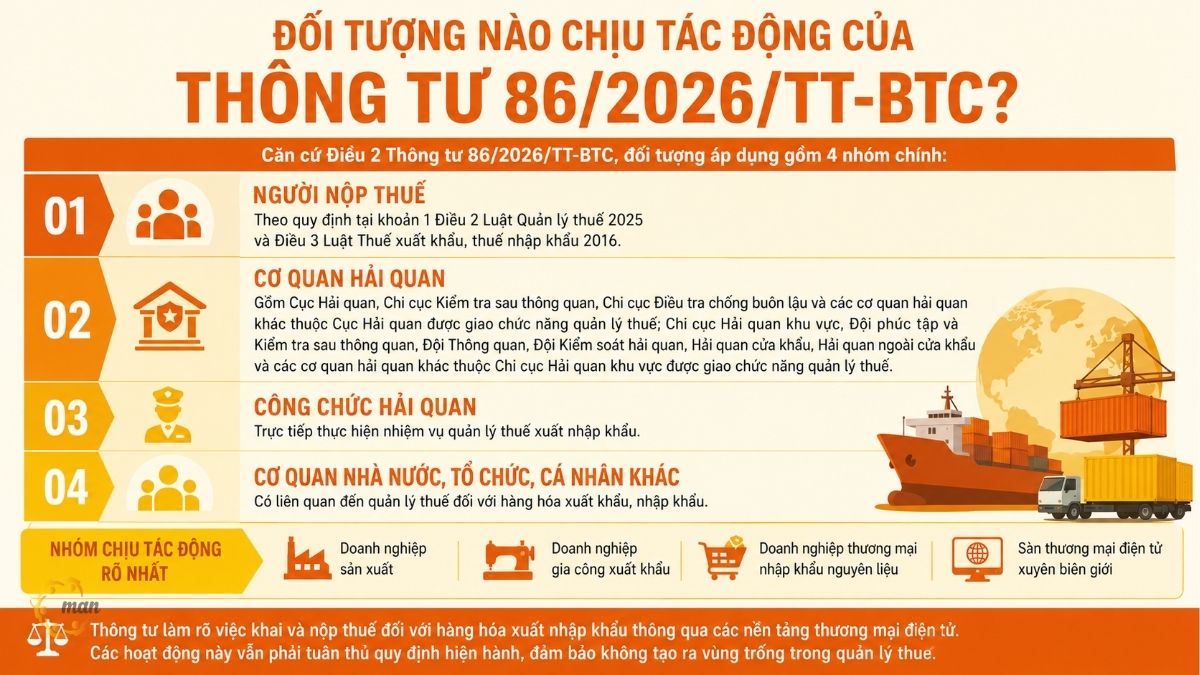
Based on Article 2 of Circular 86/2026/TT-BTC, the scope of application includes four main groups:
- Taxpayers as defined in Clause 1, Article 2 of the 2025 Law on Tax Administration and Article 3 of the 2016 Law on Export and Import Taxes.
- Customs agencies, including the Customs Department, the Post-Clearance Inspection Sub-Department, the Anti-Smuggling Investigation Sub-Department, and other customs agencies under the Customs Department assigned tax management functions; along with regional customs sub-departments, the Post-Clearance Review and Inspection Team, the Customs Clearance Team, the Customs Control Team, border customs, non-border customs, and other customs agencies under the regional customs sub-departments assigned tax management functions.
- Customs officials are directly responsible for managing import and export taxes.
- State agencies, organizations, and other individuals involved in the management of taxes on exported and imported goods.
In fact, the groups most significantly affected are manufacturing and processing businesses for export, businesses importing raw materials, and more recently, cross-border e-commerce platforms. The circular also clarifies the declaration and payment of taxes on imported and exported goods through e-commerce platforms, ensuring that these activities must still comply with current regulations and that no loopholes are created in tax management.
When should Circular 86/2026/TT-BTC be applied? Key dates to note.
Circular 86/2026/TT-BTC takes effect from the date 01/7/2026 The regulations clearly define timelines for application, transition of documents, tax declaration, tax payment, and extension of tax obligations in cases of force majeure. Understanding these timelines correctly will help businesses carry out customs procedures in accordance with regulations and minimize risks arising during the transition period.
Effective Dates and Transition Principles
Circular 86/2026/TT-BTC applies to all customs declarations arising from July 1, 2026. Regarding tax exemption, reduction, and refund applications submitted before this date, Clause 1 of Article 44 stipulates that if the application was submitted by the taxpayer before July 1, 2026, the provisions of the legal documents in effect at the time of submission shall continue to apply. Businesses are not required to resubmit these applications.
Regarding tax audits, if an audit plan has been established but not yet implemented, Circular 86/2026/TT-BTC will apply; if an audit is underway, the regulations in effect at the time the audit decision was issued will continue. This is a point businesses need to carefully consider when working with customs audit teams during the transition period.
Tax filing deadlines vary depending on the transaction.
According to Article 3, tax declarations for exported and imported goods on a transaction-by-transaction basis include export tax, import tax, safeguard tax, anti-dumping tax, countervailing tax, special consumption tax, environmental protection tax, and value-added tax. Tax declarations, supplementary declarations, deadlines for submitting documents, and information requirements shall comply with the provisions of customs law.
The circular also clarifies three groups of cases where tax declarations are not required on a transaction-by-transaction basis: imported and exported electricity and goods sold within the quarantine area of international airports (except duty-free goods); purchase, sale, processing, leasing, and borrowing transactions between priority enterprises and partners as stipulated in Circular 38/2015/TT-BTC, amended by Circular 121/2025/TT-BTC; and other cases as prescribed by customs law.
In essence, Clause 3 of Article 3 defines the tax declaration dossier for exported and imported goods as the customs dossier as stipulated in the 2014 Customs Law and its implementing regulations, not a separate tax declaration dossier. This dossier is submitted to the customs authority where the enterprise registers its customs declaration. This is a point that businesses need to be aware of to avoid preparing duplicate or incomplete dossiers when working with different customs branches.
Deadline for paying tax differences and electronic tax payments.
Article 5 clearly specifies the tax payment date for each method. For electronic tax payment, the tax payment date is the date the transaction is made, deducting money from the taxpayer's or payer's account, and the payment service provider confirms the transaction as successful.
For goods subject to provisional pricing, once the official price is determined, businesses must pay the additional tax difference within 5 working days from the date of issuance of the official invoice. Similarly, adjustments such as royalties and license fees not determined at the time of tax declaration must also be paid within 5 working days from the date the fee is shown on the payment document.
Tax payment deadline extension in case of force majeure.
Article 6 stipulates the documentation, procedures, authority, and conditions for extending tax payment deadlines, late payment penalties, and fines for businesses affected by natural disasters, fires, epidemics, unexpected accidents, or those required to relocate production facilities as decided by competent authorities. During the extension period, taxpayers are exempt from late payment penalties on the extended amount, helping to alleviate cash flow pressure in force majeure situations.
Legal documents related to Circular 86/2026/TT-BTC
Circular 86/2026/TT-BTC is not applied independently but is developed on the basis of Tax Administration Law 2025, Customs Law 2014 and related decrees and guiding circulars. Understanding this system of documents will help businesses correctly identify the legal basis when declaring and paying taxes and carrying out customs procedures for exported and imported goods. The table below summarizes the important documents to refer to when applying Circular 86/2026/TT-BTC.
| Legal documents | Number / Date of Issue | Related content |
| Circular 86/2026/TT-BTC | Ministry of Finance, June 30, 2026, effective July 1, 2026 | Regulations on tax management for exported and imported goods; replacing Circular 06/2021/TT-BTC |
| Tax Administration Law 2025 | No. 108/2025/QH15 | The primary legal basis for the Ministry of Finance to provide guidance on tax declaration, tax payment, and extension of tax payment deadlines for import and export taxes is to issue a document. |
| Decree 252/2026/ND-CP | Government, 2026 | Regulations detailing certain provisions and organizational measures for the implementation of the 2025 Law on Tax Administration. |
| Circular 38/2015/TT-BTC | Ministry of Finance, March 25, 2015 | Regulations on customs procedures, customs inspection and supervision, and import and export taxes; some of which are still referenced in Circular 86/2026/TT-BTC. |
| Circular 121/2025/TT-BTC | Ministry of Finance, 2025 | Amendments and additions to certain provisions of Circular 38/2015/TT-BTC on customs procedures. |
| Customs Law 2014 | No. 54/2014/QH13 | Regulations on the duties of Vietnam Customs and the basis for determining customs documents. |
| Circular 06/2021/TT-BTC | Ministry of Finance, 2021 | The old document on import and export tax management has been replaced as of July 1, 2026. |
Important Note: Some details in Appendix II of Circular 86/2026/TT-BTC regarding electronic declaration information criteria are still in the process of being updated and synchronized by businesses and customs software providers. Experts at MAN Businesses are advised to regularly review VNACCS/VCIS system updates to avoid disruptions during declarations.
How to file taxes and submit documents according to Circular 86/2026/TT-BTC: Practical guide
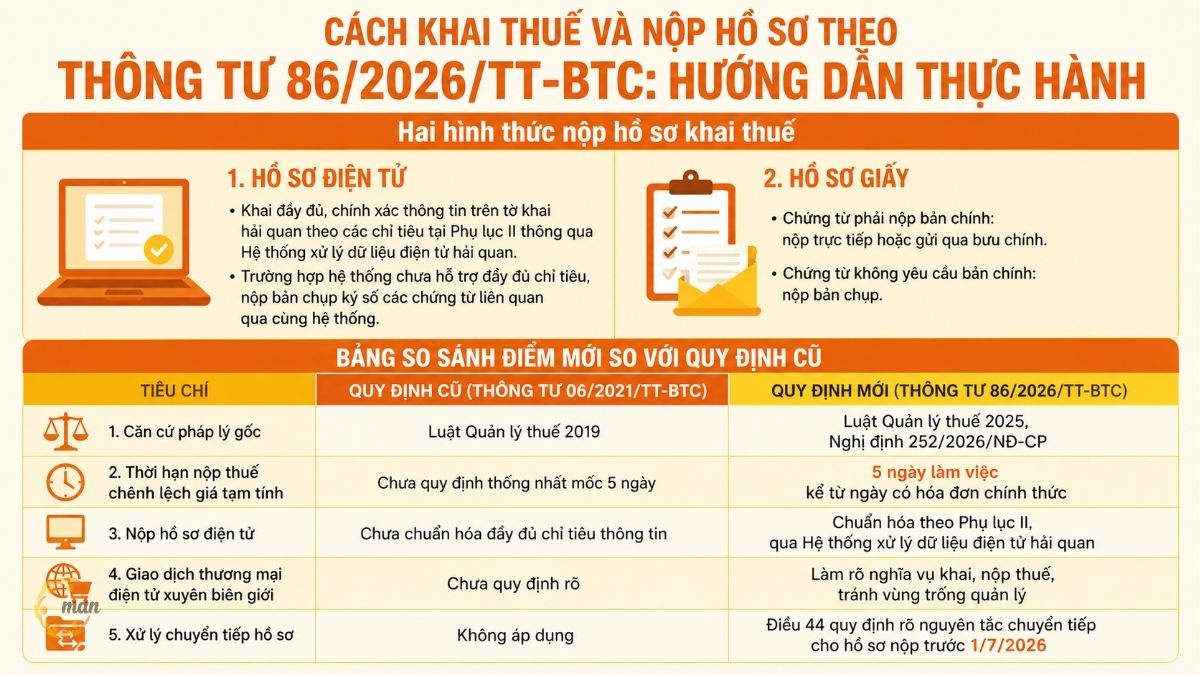
To do it correctly Circular 86/2026/TT-BTC, Businesses need to choose the appropriate filing method and stay updated on new regulations regarding electronic tax filing, tax payment deadlines, cross-border e-commerce transaction management, and document forwarding principles. The following content will guide you on how to file and submit documents and summarize the important changes compared to previous regulations.
Two methods for filing tax returns.
According to Clause 4, Article 3, businesses have two methods for submitting import and export tax declarations. For electronic declarations, taxpayers must fully and accurately declare information on the customs declaration form according to the indicators in Appendix II through the Customs Electronic Data Processing System; if the system does not fully support all indicators, businesses must submit digitally signed copies of relevant documents through the same system. For paper declarations, original documents must be submitted directly or sent by mail; copies of documents that do not require originals may be submitted.
Comparison table of new points versus old regulations
Circular 86/2026/TT-BTC introduces several significant changes compared to Circular 06/2021/TT-BTC, particularly regarding the legal basis, tax payment deadlines, standardization of electronic documents, management of cross-border e-commerce transactions, and transitional provisions. The table below summarizes the key new points to help businesses easily compare and correctly apply the regulations from July 1, 2026.
| Criteria | Old regulations (Circular 06/2021/TT-BTC) | New regulations (Circular 86/2026/TT-BTC) |
| Original legal basis | Tax Administration Law 2019 | Law on Tax Administration 2025, Decree 252/2026/ND-CP |
| Deadline for paying provisional price difference tax | There is no unified regulation specifying the 5-day timeframe. | 5 working days from the date of the official invoice. |
| Submit your application electronically. | Information criteria have not been fully standardized. | Standardization according to Appendix II, via the Customs Electronic Data Processing System. |
| Cross-border e-commerce transactions | Not yet clearly defined | Clarify tax declaration and payment obligations, avoiding management gaps. |
| Processing forwarding of documents | Not applicable | Article 44 clearly stipulates the transitional principles for applications submitted before July 1, 2026. |
Case Study: Export processing enterprises in Bac Ninh applying Circular 86/2026/TT-BTC
Background
Company Y, a limited liability company specializing in the processing of electronic components for export, has a factory located in Bac Ninh. It generates an average of 45 customs declarations per month, of which approximately 30% are goods subject to provisional pricing due to fluctuating input material prices based on contracts with foreign partners. Before July 1, 2026, the company often delayed adjusting the price difference upon receiving official invoices, resulting in late payment penalties in some settlement periods.
Processing after July 1, 2026
According to advice from MAN – Master Accountant Network, the company implemented three steps: (1) Establish an internal process to track the official invoice issuance date of foreign suppliers, attaching automatic alerts 5 working days in advance according to Article 3 of Circular 86/2026/TT-BTC; (2) Review all electronic declaration information indicators according to Appendix II, coordinate with the customs declaration software provider to update synchronously; (3) Build a separate tracking table for additional adjustments such as royalty fees and license fees to avoid missing additional tax payment obligations.
The measured results
- The number of late payment penalties due to missed deadlines for adjusting provisional prices has decreased from an average of 4 times per quarter to almost none.
- The processing time for each post-clearance customs inspection is significantly shortened thanks to complete electronic records meeting all criteria right from the start.
- The tax accounting department reduces the time spent reconciling end-of-period figures thanks to a separate tracking sheet for each type of tax adjustment.
Expert opinion: Common business risks and how to avoid them.
Experts at MAN – Master Accountant Network With over 30 years of experience in auditing and tax consulting in Vietnam, we note four main risks that businesses often encounter when implementing Circular 86/2026/TT-BTC.
- Risk 1: Missing the 5-business-day mark when the official price is announced: Many businesses use provisional prices but lack a proactive tracking process, leading to late payment of tax differences and late payment penalties. A practical solution is to set reminders immediately upon registering tax declarations with provisional prices, instead of waiting until invoices are received to address the issue.
- Risk 2: Failure to declare all required electronic information as per Appendix II: Due to the internal software system not being updated in time, some businesses are still using the old form, leading to rejected documents or requests for additional information, prolonging customs clearance time. Businesses need to work directly with the customs declaration software provider to confirm that the new information has been updated correctly.
- Risk 3: Confusion between records applying the old regulations and the new regulations: For tax exemption, reduction, or refund applications submitted before July 1, 2026, incorrect application of the new regulations by accountants will lead to discrepancies in the amount of tax processed. It is necessary to clearly categorize the application submission date before determining the applicable legal basis.
- Risk 4: Lack of documentation proving cross-border e-commerce transactions: With the trend of importing through e-commerce platforms, businesses need to keep complete records of transactions, invoices, and bills of lading to avoid being considered as concealing tax obligations when customs authorities cross-check the data.
What are the responsibilities of Vietnamese Customs in implementing Circular 86/2026/TT-BTC?
To properly understand the role of Circular 86/2026/TT-BTC, businesses need to grasp the core responsibilities of Vietnam Customs as stipulated in Article 12 of the 2014 Customs Law. Accordingly, Vietnam Customs is responsible for inspecting and supervising goods and means of transport; preventing and combating smuggling and illegal transportation of goods across borders; organizing the implementation of laws on import and export taxes; compiling statistics on import and export goods; and proposing policies and measures for state management of customs and related tax policies.
Thus, Circular 86/2026/TT-BTC is the tool for customs to perform the task of "organizing the implementation of tax laws" mentioned above, specifically detailing the procedures for tax declaration, tax payment, extension, and post-audit that businesses must comply with. From the perspective of MAN – Master Accountant Network, understanding the scope of customs' duties helps businesses be more proactive when coordinating the provision of documents, avoiding confusion between requirements within customs authority and requirements outside the scope of tax management.
Conclude
Circular 86/2026/TT-BTC marks a significant step in perfecting the legal framework for managing import and export taxes, aiming for digitalization, transparency, and stricter accountability for businesses. Understanding the deadlines, declaration criteria, and transitional principles will help businesses be more proactive in their dealings with customs authorities, while minimizing the risk of tax arrears or penalties.
Tax services at MAN – Master Accountant Network
- Tax accounting services
- Tax consulting services
- Tax settlement services
- Tax reporting services
- VAT refund service
Service contact information at MAN – Master Accountant Network
- Address: No. 19A, Street 43, Tan Thuan Ward, Ho Chi Minh City
- Mobile/Zalo: 0903 963 163 – 0903 428 622
- E-mail: man@man.net.vn
- Google Business Profile: View MAN – Master Accountant Network's Google Business Profile
- LinkedIn Founder: View expert Le Hoang Tuyen's LinkedIn profile.
Responsible for production and professional content review by: Mr. Le Hoang Tuyen – Founder & CEO of MAN – Master Accountant Network, CPA Vietnam with over 30 years of experience in accounting, auditing, taxation, and corporate financial consulting.
Frequently Asked Questions about Circular 86/2026/TT-BTC
Effective from July 1, 2026, this Circular replaces Circular 06/2021/TT-BTC.
No. According to Article 44, these files continue to be processed according to the regulations in effect at the time of submission and do not need to be resubmitted.
The circular stipulates two parallel forms of declaration: electronic and paper, but encourages electronic declaration through the Customs Electronic Data Processing System to ensure compliance with the criteria in Appendix II.
The three main groups include electricity imports and exports, goods in international airport quarantine zones (excluding duty-free goods), transactions between priority enterprises and partners as stipulated in Circular 38/2015/TT-BTC (amended), and other cases as prescribed by customs law.
5 working days from the date of issuance of the official invoice by the seller, applicable to both provisional prices and any additional adjustments such as royalties and license fees. When does Circular 86/2026/TT-BTC take effect?
Do businesses that submitted applications for tax exemptions, reductions, or refunds before July 1, 2026, need to resubmit them?
Is electronic tax filing mandatory according to Circular 86/2026/TT-BTC?
In which cases is it not necessary to file a tax return for each transaction?
What is the deadline for paying the price difference after the official price is announced?




