


How to calculate personal income tax deductions (10%) when leaving a job. This is a frequently occurring tax declaration task for businesses when processing income for employees whose contracts have been terminated. Accurately determining the timing of cash flow payments, classifying tax-exempt income, and identifying deduction conditions are crucial for compliance with tax laws. Decree 253/2026/ND-CP Along with guidance documents from local tax authorities, the inspection process for this provisional collection obligation has been tightened to prevent revenue losses and minimize errors in final accounts.
Many organizations currently confuse income paid during the contract period with income paid after the employee's employment contract has ended. This confusion between the application of the progressive tax rate schedule and the fixed deduction rate (10%) leads to the risk of businesses being subject to tax arrears and late payment penalties by the tax authorities. To help accounting departments and management maximize risk control, MAN – Master Accountant Network systematizes all legal basis, formulas, 14 types of tax-exempt income, and practical examples below.
Summary of key points regarding how to calculate the 10% personal income tax deduction when leaving a job.
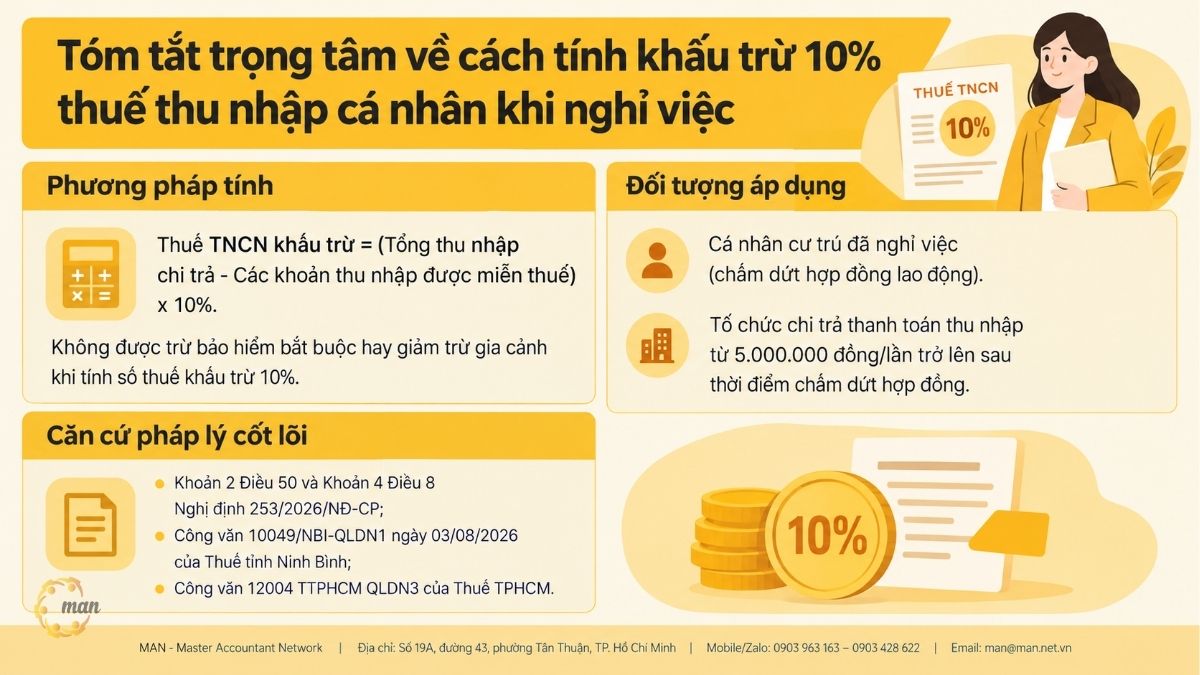
- The method for calculating personal income tax deductions upon termination of employment is a temporary personal income tax deduction method based on a fixed rate of 10% applied to taxable income from salaries and wages of VND 5,000,000 or more per payment, paid to resident individuals after the termination of their employment contract.
- Applicable subjects: Individuals residing in Vietnam who have left their jobs (terminated their employment contracts) and organizations that pay income of VND 5,000,000 or more per payment after the termination of the contract.
- Core legal basis: Clause 2, Article 50 and Clause 4, Article 8 of Decree 253/2026/ND-CP; Official Letter 10049/NBI-QLDN1 dated August 3, 2026 from Ninh Binh Provincial Tax Department; Official Letter 12004 TTPHCM QLDN3 from Ho Chi Minh City Tax Department.
- Calculation principle: Withholding tax = (Total income paid – Tax-exempt income) x 10%. Mandatory insurance or family allowance deductions cannot be deducted when calculating the withholding tax amount (10%).
How to calculate personal income tax deductions (10%) upon leaving employment according to current legal regulations.
The legal nature of deducting 10% after contract termination.
During the term of the employment contract (3 months or more), the employer shall make deductions. personal income tax According to the progressive tax rate schedule. When an employee terminates their employment contract, the employment relationship between the two parties officially ends according to the termination document or resignation decision.
Based on the provisions of Clause 2, Article 50 Decree 253/2026/ND-CP, In cases where a resident individual signs an employment contract for 3 months or more but resigns before the end of the year, and the organization subsequently pays salaries, wages, or other income of a similar nature of 5,000,000 VND or more per payment, the paying organization must deduct tax at the rate of 10% on the taxable income before paying it to the individual.
This 10% tax is essentially a provisional tax collected at source. At the end of the tax year, individuals are responsible for self-assessing their tax liability or authorizing someone else to do so if they meet the conditions to determine their actual tax liability according to the progressive tax rate schedule.
Roles and values in financial management, taxation, and auditing.
The 10% deduction regulation plays a crucial role in an organization's payroll cost management system. Accurate and complete deductions help businesses maintain the validity of deductible expenses when determining costs. corporate income tax.
For tax audits, payments to former employees are always a key focus of inspection by tax authorities. Accurately handling withholding obligations helps organizations avoid unnecessary administrative penalties and late payment fees.
In which cases is it mandatory to apply the 10% method for calculating personal income tax deductions upon leaving a job?

Conditions for determining whether an individual is eligible for tax deduction 10%
Businesses can only apply the tax deduction regulation 10% to payments to former employees when all of the following conditions are met:
- Status of residence: The employee is a resident individual as defined by the Personal Income Tax Law.
- Contract status: Employment contract terminated in accordance with the provisions of the Labor Code.
- Payment timing: The actual cash flow disbursed by the employer occurs after the employment contract expires.
- Payment threshold: The amount paid to an individual in a single payment must reach 5,000,000 VND or more.
If the payment is less than VND 5,000,000 per transaction, the business is not required to deduct personal income tax (PIT), except in cases where the individual resigns and submits a written request for deduction.
Distinguish between payments made during the contract period and payments made after contract termination.
The actual payment date is the sole legal basis for selecting the tax deduction method. Experts at MAN, with 30 years of experience, note that the tax authorities determine the tax calculation date based on the date the money leaves the bank account or the date the cash payment voucher is issued, not based on the payroll period.
- Payment before or on the contract termination date: If the employee resigns on June 30, 2026, the company will pay the June salary on June 30, 2026. This income will be subject to the progressive tax rate schedule, and will be subject to deductions for mandatory insurance contributions and personal allowances.
- Payment after contract termination: The employee resigned on June 30, 2026. The company only paid the June salary on July 10, 2026. Because the payment took place after the termination date, the company is required to deduct tax from income of VND 5,000,000 or more per payment.
Compilation of the latest legal documents and guidance letters on deducting personal income tax (10%).
Businesses need to stay updated on currently effective legal documents and implementing guidelines, including:
- Decree 253/2026/ND-CP: Providing detailed regulations for the implementation of the Law on Personal Income Tax, Clause 2 of Article 50 stipulates the deduction of 10% and Clause 4 of Article 8 stipulates income not included in taxable income.
- Official document No. 10049/NBI-QLDN1 dated August 3, 2026, from Ninh Binh Provincial Tax Department: Detailed guidance on the principle of deducting personal income tax (PIT) for payments of 5 million VND or more per transaction after termination of employment contract.
- Official Letter No. 12004 TTPHCM QLDN3 from the Ho Chi Minh City Tax Department: Guidance on handling personal income tax for payments to employees who have left their jobs according to Decree 253/2026/NĐ-CP.
- Decree 349/2025/ND-CP: Detailing certain specific regimes and policies regarding allowances and support payments.
| Legal documents | Quote the terms and conditions | Practical application content |
| Decree 253/2026/ND-CP | Clause 2, Article 50 | Mandatory deduction of tax 10% applies to income of 5 million VND or more per payment after leaving employment. |
| Decree 253/2026/ND-CP | Clause 4, Article 8 | Details of 14 categories of income that are not in the nature of salaries or wages and are not included in taxable income. |
| Official document 10049/NBI-QLDN1 | Section 1, Section 2, Section 3 | Instructions regarding deductions for insurance and personal allowances; regulations on the conditions for establishing a commitment letter. |
| Official Document 12004 TTPHCM QLDN3 | Instruction content | The appropriate deduction method should be applied based on the timing of cash flow payments. |
Instructions on the formula and method for calculating personal income tax deductions (10%) upon leaving employment.
Formula for determining the amount of personal income tax to be deducted.
Businesses use the following formula to determine the amount of personal income tax to be provisionally withheld when paying employees who have left their jobs:
|
Amount of personal income tax withheld = Taxable income x 10% |
In this context, taxable income is determined as follows:
|
Taxable income = Total income paid – Tax-exempt income |
Businesses first identify and exclude tax-exempt income, and then apply the 10% withholding tax rate to the remaining amount.
List of 14 types of income not included in personal income tax according to Decree 253/2026/ND-CP
According to Clause 4, Article 8 of Decree 253/2026/ND-CP, the following income items that are not considered salaries or wages are not included in taxable personal income:
- Title and Commendation Bonuses: Bonuses accompanying titles awarded by the State; bonuses accompanying emulation titles and forms of commendation as prescribed by law on emulation and commendation; bonuses accompanying national and international awards recognized by the Vietnamese State; bonuses for technical improvements, inventions, and discoveries recognized by competent state agencies; bonuses for detecting and reporting violations of the law to competent state agencies.
- Financial support for the examination and treatment of critical illnesses: This refers to the financial support provided by the employer for the examination and treatment of critical illnesses for the employee and their dependents, including biological children, adopted children, stepchildren, spouse, biological father, biological mother, father-in-law, mother-in-law (or father-in-law, mother-in-law), stepfather, stepmother, adoptive father, and adoptive mother. The amount of support not included in taxable income is the actual amount provided by the employer as shown on invoices and receipts, but not exceeding the total hospital fees paid by the employee and their dependents after deducting any payments from insurance companies (if applicable). The determination of critical illnesses is governed by regulations issued by the Minister of Health.
- Transportation allowance: This allowance per person per year relates to the use of transportation within state agencies, public service units, Party organizations, and mass organizations; and transportation provided to and from work for employees according to the unit's regulations.
- Public housing allowance: The amount of money received under the public housing allowance scheme as prescribed by law.
- Remuneration from official and union activities: This includes amounts received in addition to salary and wages for participating in or serving the activities of the Party, unions, and the National Assembly; or for contributing opinions, evaluating, and reviewing legal documents, resolutions, and political reports; participating in inspection and supervision teams; interacting with constituents and citizens; and for clothing and other work directly related to serving the activities of the National Assembly Office, the National Council and Committees of the National Assembly, the National Assembly Delegations, the Central Office and Committees of the Party, the City Party Committee Office, the Provincial Party Committee Office, and the Committees of the City Party Committee and the Provincial Party Committee Office.
- Airfare for employees on leave: This refers to the cost of airfare paid by the employer for foreign employees and Vietnamese employees working abroad who return home for leave once a year from Vietnam to the country of their citizenship or the country where their family lives, and vice versa; or from the country where the Vietnamese employee works back to Vietnam and vice versa.
- Tuition fees for employees' children: Tuition fees for the children of foreign workers studying in Vietnam, and the children of Vietnamese workers working abroad studying abroad, from preschool to high school, are paid by the employer on behalf of the employee.
- Non-mandatory, non-premium-accumulating insurance: This refers to the amount paid by the employer for non-mandatory insurance products for employees, including health insurance and term life insurance (excluding term life insurance with premium refunds), where the insured does not receive any accumulated premium payments beyond the insurance payout or compensation agreed upon in the insurance contract by the insurance company. In the case of non-mandatory, non-premium-accumulating insurance purchased from insurance companies not established and operating under Vietnamese law but permitted to sell insurance in Vietnam, this amount is also not included in taxable personal income.
- Training and skill development costs: These are expenses paid by the employer on behalf of the employee for training and skill development relevant to the employee's professional work or according to the employer's plan.
- Business trip, reassignment, and rotation expenses: Payments made by the employer to suppliers or to employees for the purpose of reassignment, rotation, or business trips of employees as stipulated in the decision or document assigning the employee to a business trip, financial regulations or internal regulations or employment contract or collective bargaining agreement, and supported by invoices and documents as required.
- Income from funding for literary and artistic creation: This refers to income received by individuals from sponsoring associations and organizations, provided the individual is a member of such association or organization, when participating in the creation of literary and artistic works to fulfill the political tasks of the State or according to the activities program in accordance with the charter of the association or organization, and the funding is sourced from the state budget or managed according to State regulations.
- Funeral and wedding expenses: Amounts received from the employer for funeral and wedding expenses for the employee and their family, in accordance with the financial regulations, internal regulations, employment contract, or collective bargaining agreement of the income-paying entity, and consistent with the deductible amount when determining taxable income for corporate income tax purposes under the law on corporate income tax.
- Income from trade union funds: Money and benefits received from trade union funds that are not considered wages or salaries as defined by the Trade Union Law.
- Nutrition and specific healthcare: A nutritional allowance and specific healthcare regime to ensure women's health and physiology are provided in accordance with Articles 5 and 8 of Decree 349/2025/ND-CP, which regulates the regime and policies for members of sports teams participating in concentrated training and competitions.
In addition to the 14 items mentioned above, overtime pay, night work pay (the portion paid higher than the standard daytime hourly wage), and pay for unused annual leave days as stipulated by labor law are also exempt from tax and can be deducted from taxable income before calculating the deduction 10%.
Items not eligible for deduction when calculating tax deductions 10%
Based on the instructions at Official document 10049/NBI-QLDN1, When calculating tax deductions under form 10% for payments made after termination of employment, businesses are not allowed to make the following deductions:
- Payments for mandatory insurance (social insurance, health insurance, unemployment insurance) cannot be deducted.
- Personal deductions cannot be applied to the dependents.
- The personal allowance for dependents cannot be deducted.
- Donations to charities, humanitarian aid, and educational support programs are not eligible for deduction.
These deductions are only applicable when calculating tax according to the progressive tax rate schedule during the contract's validity period or used as a basis for calculation when the individual performs the transaction. personal income tax settlement end of the year.
Conditions and procedures for preparing a Temporary Commitment Form for Not Withholding Personal Income Tax (10%)
Eligibility requirements for employees to sign a commitment letter.
Individuals who have left their jobs are allowed to create a Temporary Commitment Form for Not Withholding Personal Income Tax (10%) if they simultaneously meet the following two conditions:
- Condition 1: Total income from salaries and wages subject to tax withholding at rate 10% (payment amount of VND 5,000,000 or more per payment).
- Condition 2: Estimated total taxable income for the year after deducting personal allowances is below the threshold for personal income tax liability.
Individuals making this commitment must have registered for tax and been issued a personal tax identification number at the time of making the commitment.
Legal responsibilities of employees and businesses
Upon receiving the Provisional Commitment to Not Deduct Tax, the parties must comply with the legal responsibilities as stipulated:
- Business Responsibilities: Based on the employee's valid commitment, the business will temporarily not deduct personal income tax (10%) when paying income. The business is responsible for compiling a list and income of these individuals to submit to the tax authorities along with the annual personal income tax return.
- Employee's Responsibilities: Individuals are fully responsible before the law for the truthfulness of the commitment. If, during the year, an individual generates additional income that makes their total income subject to tax, the individual is responsible for self-declaring, settling, and paying any outstanding tax and will be subject to administrative penalties if any fraudulent activity is found.
A compilation of illustrative examples on how to calculate the 10% personal income tax deduction when leaving a job.
Example 1: Paying the final month's salary after the termination of an employment contract.
Mr. A resigned and his employment contract officially terminated on June 30, 2026. On July 10, 2026, the company paid Mr. A the remaining salary for June 2026, amounting to 15,000,000 VND.
Analysis and processing:
Payments are made after the employment contract has terminated and are valued at VND 5,000,000 or more. The company must deduct personal income tax (PIT) before making the payment.
Detailed calculation data:
- Taxable income = 15,000,000 VND.
- Personal income tax that the company must withhold = 15,000,000 x 10% = 1,500,000 VND.
- The actual amount Mr. A received = 15,000,000 – 1,500,000 = 13,500,000 VND.
Example 2: Combined payment of salary, overtime pay, unused vacation pay, and insurance.
Ms. B terminated her employment contract on July 31, 2026. On August 15, 2026, the company paid Ms. B a total of 18,000,000 VND in income, including:
- Salary for July 2026: 14,000,000 VND.
- Overtime pay eligible for tax exemption: VND 2,500,000.
- Salary paid for unused vacation days that qualify for tax exemption: VND 1,500,000.
- Ms. B's mandatory social insurance, health insurance, and unemployment insurance contributions for the month are 1,470,000 VND.
- Ms. B has registered for tax deductions for 2 dependents.
Analysis and processing:
- The total amount paid by the company in a lump sum of VND 18,000,000 (from VND 5,000,000 and above) arising after termination of employment is subject to deduction under Article 10%.
- Overtime pay of VND 2,500,000: Excluded from taxable income as it is tax-exempt.
- The amount of VND 1,500,000 in unused vacation pay is excluded from taxable income as it is tax-exempt.
- The mandatory insurance premium of VND 1,470,000 cannot be deducted when performing the temporary deduction 10%.
- Personal deductions and deductions for 2 dependents: Not deductible when calculating the 10% deduction.
Detailed calculation data:
- Income used as the basis for tax deduction 10% = 18,000,000 – 2,500,000 – 1,500,000 = 14,000,000 VND.
- Personal income tax that the company must withhold = 14,000,000 x 10% = 1,400,000 VND.
- The actual amount Ms. B received = 18,000,000 – 1,400,000 = 16,600,000 VND.
Conclusion: The company did not deduct 10% from the total amount of VND 18,000,000, but only deducted 10% from VND 14,000,000 after excluding overtime pay and unused vacation pay that were tax-exempt.
Example 3: Paying severance pay of less than 5,000,000 VND after leaving employment.
Mr. C resigned on July 25, 2026. On August 5, 2026, the company paid Mr. C the remaining outstanding productivity bonus of VND 4,500,000.
Analysis and processing:
The payment amount is less than 5,000,000 VND per transaction. The company does not deduct personal income tax (except in cases where Mr. C requests deduction in writing). Mr. C is entitled to receive the full amount of 4,500,000 VND.
Comparing two methods of deducting personal income tax when paying income.
When paying income to employees, businesses need to determine the correct method of deducting personal income tax based on the contract term, payment time, and income level. Two common methods are deduction according to the progressive tax rate schedule and deduction under Article 10%. The table below helps to clearly distinguish the applicable cases and corresponding calculation methods.
| Comparison criteria | Deductions according to the Progressive Tax Rate Schedule | Fixed rate deduction 10% |
| Applicable objects | Employees who are working under an employment contract of 3 months or more. | Employees whose employment contracts have been terminated or who have signed employment contracts for less than 3 months. |
| Payment time | During the period the employment contract is in effect. | After the employment contract has expired. |
| Income threshold | Applicable to all levels of income earned. | Applicable when the income paid is 5,000,000 VND or more per payment. |
| Excluding mandatory insurance | Mandatory social insurance, health insurance, and unemployment insurance contributions are deductible. | Mandatory insurance contributions cannot be deducted from the total amount. |
| Excluding personal allowances | Personal and dependent deductions are applicable. | Personal deductions are not included. |
| Apply the commitment | Temporary commitments do not apply. | A written commitment can be made if the income is below the taxable threshold. |
Expert opinion from MAN on the tax risks of paying severance pay to former employees.
Common mistakes Vietnamese businesses often make
In practice, tax consulting and auditing for many businesses in Vietnam shows that accounting departments often make the following mistakes related to personal income tax for employees who have left the company:
- Incorrect application of the method due to failure to determine the transfer date: The accountant calculated progressive tax on the last month's salary, citing that the salary was earned during the working period. However, the tax authorities found that the transfer occurred after the contract termination date, so they proceeded to collect back taxes (10%) on the total taxable income and impose late payment penalties.
- Tax deduction on the entire payment amount: Businesses do not separate tax-exempt income such as overtime pay and unused leave pay, but instead apply the 10% rate directly to the total payment amount, directly affecting the rights of employees.
- Accepting an invalid commitment: The accountant accepts a commitment from an individual who has not been issued a personal tax identification number or whose total annual income exceeds the tax threshold. If discovered by a tax audit, the business is responsible for paying the outstanding tax amount.
- Omissions in the tax return: Businesses fail to include payments under VND 5,000,000 made after termination of employment in the detailed income payment statement in the year-end personal income tax return.
Tax risk management solutions from MAN – Master Accountant Network
To ensure compliance with legal regulations and optimize operating costs, MAN recommends that businesses implement internal control solutions:
- Standardize the coordination process between HR and Accounting: Clearly define the final payroll payment schedule. If the progressive tax rate schedule is to be applied, the company must complete the transfer before or on the effective date of the termination decision.
- Break down the income structure on the payment sheet: Classify in detail the fixed salary, overtime pay, and unused vacation pay to accurately determine taxable income as a basis for deduction under Form 10%.
- Review the legal validity of the commitment: Check the status of the individual's tax identification number on the tax authority's system before temporarily suspending tax deductions as per the commitment.
- Utilize professional tax consulting services: Collaborating with an auditing firm helps businesses review all payroll records, promptly identify errors, and proactively make adjustments before tax authorities conduct an audit.
Conclude
Properly calculating the personal income tax deduction (10%) upon termination of employment helps businesses comply with tax laws, minimize administrative penalties, and protect the legitimate rights of employees. Determining the correct timing of cash flow payments, classifying tax-exempt income, and evaluating commitment documents play a crucial role in managing payroll costs within each organization.
Tax services at MAN – Master Accountant Network
- Tax accounting services
- Tax consulting services
- Tax settlement services
- Tax reporting services
- VAT refund service
Service contact information at MAN – Master Accountant Network
- Address: No. 19A, Street 43, Tan Thuan Ward, Ho Chi Minh City
- Mobile/Zalo: 0903 963 163 – 0903 428 622
- E-mail: man@man.net.vn
- Google Business Profile: View MAN – Master Accountant Network's Google Business Profile
- LinkedIn Founder: View expert Le Hoang Tuyen's LinkedIn profile.
Responsible for production and professional content review by: Mr. Le Hoang Tuyen – Founder & CEO of MAN – Master Accountant Network, CPA Vietnam with over 30 years of experience in accounting, auditing, taxation, and corporate financial consulting.
Frequently Asked Questions (FAQ) about deducting personal income tax (10%) upon leaving employment.
What are the conditions for an employee to sign a temporary commitment not to deduct personal income tax (10%)?
Individuals can make a commitment when they have registered for tax and have a personal tax identification number, when they make income payments of VND 5,000,000 or more per payment after leaving their job, and when their estimated total taxable income in the following year, after deducting personal allowances, is below the tax threshold.
If the last monthly salary paid after leaving a job is less than 5 million VND, is it subject to tax deductions (10%)?
No. If the income payment received after leaving employment is less than VND 5,000,000 per payment, the business is not required to deduct personal income tax, unless the individual requests the deduction in writing.
Will excess vacation pay given to employees who take leave be subject to deduction under Article 10%?
No. Wages paid for unused vacation days of employees, within the limits stipulated in the Labor Code, are exempt from personal income tax. This amount is excluded before applying the withholding tax rate 10%.
What should be done if a company fails to deduct tax 10% when paying salaries to employees who have left the company?
Businesses are jointly liable to the tax authorities. They must pay the outstanding tax amount along with late payment penalties, and then proactively recover any overpaid taxes from former employees.
How will the tax amount 10% that was provisionally deducted be handled during the final tax settlement at the end of the year?
At the end of the year, businesses issue Personal Income Tax Withholding Certificates to their employees. Individuals use these certificates to directly settle their taxes with the tax authorities. If the amount of tax provisionally paid is greater than the amount of tax payable according to the final settlement, the individual is entitled to a tax refund or the excess amount will be offset against the next tax period.