


Is table salt subject to VAT?This is a crucial legal question of particular interest to many salt production, processing, import, and trading businesses during the tax declaration period. The 2024 Value Added Tax Law introduces new legal frameworks clearly defining the list of tax-exempt subjects, taxpayers, and the time when tax obligations arise. VAT The aim is to protect domestic industries and stabilize the consumer market.
Incorrectly identifying the taxable entity not only causes financial losses but also leads to the risk of administrative penalties and tax arrears during audits. This article presents a comprehensive analysis from MAN – Master Accountant Network experts, helping businesses understand the legal basis in Articles 4, 5, and 8. VAT Law 2024, tax declaration procedures and tax risk optimization strategies.
Summary of key points regarding whether table salt is subject to VAT.
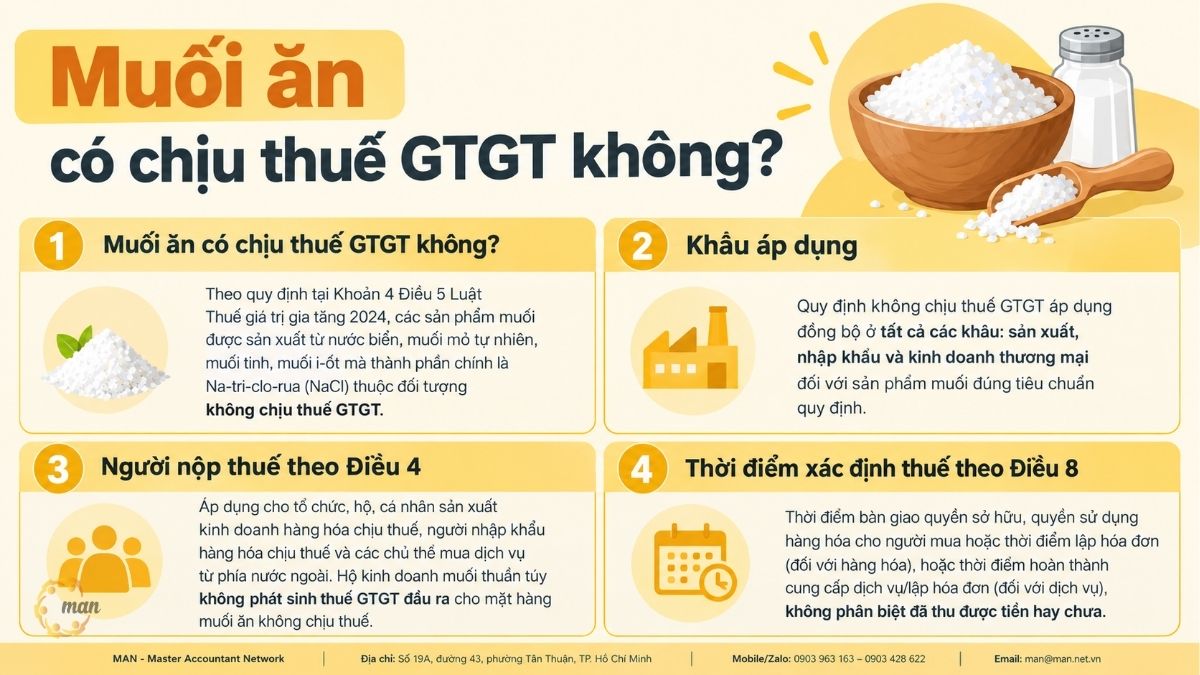
- Is table salt subject to VAT? According to Clause 4, Article 5 of the Value Added Tax Law 2024, salt products produced from seawater, natural rock salt, refined salt, and iodized salt whose main component is sodium chloride (NaCl) are subject to taxation. objects not subject to VAT.
- Application stage: The VAT exemption regulations apply uniformly to all stages: production, import, and commercial trading, for salt products that meet the prescribed standards.
- Taxpayers under Article 4: This applies to organizations, households, and individuals producing and trading taxable goods, importers of taxable goods, and entities purchasing services from foreign countries. Household businesses engaged solely in salt trading do not generate output VAT for their non-taxable table salt products.
- The time of tax determination according to Article 8: The time of transfer of ownership or right to use goods to the buyer, or the time of invoice issuance (for goods), or the time of completion of service provision/invoice issuance (for services), regardless of whether payment has been received or not.
Is table salt subject to VAT? Legal basis according to the VAT Law 2024.

The supreme legal basis governing value-added tax obligations in Vietnam is the Value-Added Tax Law 2024. To accurately answer the question of whether table salt is subject to VAT, businesses need to directly analyze the regulations in Article 5 of this law.
Detailed analysis of Clause 4, Article 5 of the Value Added Tax Law 2024
According to Clause 4, Article 5 of the Value Added Tax Law 2024, the State clearly stipulates the list of items not subject to VAT, including: Salt products produced from seawater, natural rock salt, refined salt, and iodized salt whose main component is sodium chloride (NaCl).
This regulation applies to the entire salt supply chain, from mining and domestic production to import and commercial distribution in the market. Businesses selling these salt products are not required to calculate and pay output VAT.
From MAN's perspective, the purpose of the VAT exemption policy for table salt is to protect an essential commodity, support the livelihoods of salt farmers, and reduce the burden of consumer costs for the people.
Distinguish between types of table salt that are exempt from VAT.
Not all products labeled as salt are automatically exempt from VAT. Tax authorities, during inspections, will base their assessment on the technical characteristics and composition of the product.
The following types of table salt are exempt from VAT:
- Crude salt is produced directly from seawater through natural evaporation.
- Rock salt is extracted directly from natural salt deposits deep underground.
- Processed salt has undergone impurities removal, either mechanically cleaned or refined.
- Iodized salt is refined or coarse salt that has been fortified with iodine according to medical standards for disease prevention.
The key point is that all of these salts must maintain their main constituent component as sodium chloride (NaCl).
In the case where salt products are subject to VAT.
In practice, tax risk management in Vietnam shows that many businesses are subject to tax arrears due to confusion between pure table salt and processed salt products.
If table salt is mixed with other spices and additives to create new products such as shrimp salt, chili salt, pepper salt, dried spiced salt, or salt used in beauty products, those products are no longer exempt from VAT under Clause 4, Article 5.
These mixed processed products will be subject to the standard VAT rate (usually 8% or 10% depending on the tax reduction policy at the time of business). Experts at MAN with 30 years of experience note that incorrect product names and ingredients on invoices are the main cause of this error.
Regulations on taxpayers and tax declaration obligations for households and individuals producing salt.
Besides the goods or services sold, the legal status of the business entity also determines its obligation to declare and pay VAT.
Detailed analysis of Article 4 of the 2024 Value Added Tax Law regarding taxpayers.
Article 4 of the Value Added Tax Law 2024 specifically stipulates the groups of taxpayers liable for VAT, including:
- Clause 1 of Article 4: Organizations, households, and individuals producing and trading goods and services subject to value-added tax (hereinafter referred to as business establishments).
- Clause 2 of Article 4: Organizations and individuals importing goods subject to value-added tax (hereinafter referred to as importers).
- Clause 3 of Article 4: Organizations and individuals producing and trading in Vietnam who purchase services (including services associated with goods) from foreign organizations without a permanent establishment in Vietnam, or from individuals abroad who are non-residents of Vietnam; organizations producing and trading in Vietnam who purchase goods and services to conduct oil and gas exploration, development and exploitation activities from foreign organizations without a permanent establishment in Vietnam, or from individuals abroad who are non-residents of Vietnam.
Thus, any entity participating in economic activity is subject to the Value Added Tax Law. However, the obligation to pay tax to the state budget depends directly on whether the goods or services are subject to tax.
Do businesses that sell table salt have to pay VAT?
Based on the combination of Articles 4 and 5 of the Value Added Tax Law 2024, household businesses and individuals trading in pure table salt (sea salt, rock salt, refined salt, iodized salt) will not be required to pay VAT on the revenue from the sale of this item.
However, if a household business simultaneously sells other taxable items (such as fish sauce, bottled spices, and other consumer goods), the household business is still liable for tax under Clause 1, Article 4, on the revenue generated from those taxable items.
Revenue from salt products, which is not subject to tax, must still be fully recorded in accounting books and reported periodically as required by law.
Tax-free revenue threshold and invoicing responsibility
Tax regulations stipulate that individuals and household businesses with annual revenue below the prescribed tax threshold will not incur any obligation to pay VAT and personal income tax.
For businesses selling table salt, even though table salt is exempt from VAT, they are still required to issue electronic invoices when selling goods. On the electronic invoice, the VAT rate field must correctly select "KCT" (Not subject to VAT).
The solution from MAN – Master Accountant Network helps businesses set up an accurate electronic invoicing system, preventing the selection of incorrect tax codes that could lead to the risk of data extraction by tax authorities.
The time of determining VAT for salt products and goods for which payment has not yet been collected is according to current regulations.
Determining the correct timing for recording tax obligations is a core principle in tax accounting. This avoids the risk of late payment penalties or violations of invoicing regulations.
The regulations regarding the timing of VAT determination are detailed in Article 8 of the 2024 VAT Law.
Based on Article 8 of the Value Added Tax Law 2024, the time of determining VAT is specifically defined as follows:
- According to Clause 1 of Article 8:
- Point a (For goods): This refers to the time when ownership or the right to use the goods is transferred to the buyer, or the time when the invoice is issued, regardless of whether payment has been received or not.
- Point b (For services): This refers to the time when the service is completed or the time when the invoice for the service is issued, regardless of whether payment has been received or not.
- According to Clause 2, Article 8 (Specific cases as detailed by the Government): The government specifies the exact timing for determining value-added tax on the following goods and services:
- a) Exported goods, imported goods;
- b) Telecommunications services;
- c) Insurance business services;
- d) Activities related to electricity supply, electricity generation, and clean water supply;
- d) Real estate business activities;
- e) Construction, installation and oil and gas operations.
The provisions in point a, clause 1, Article 8 apply uniformly to both goods subject to VAT and goods not subject to VAT. Therefore, upon delivering salt to customers or issuing invoices, businesses must record the sales transaction in the corresponding tax declaration period.
Handling transactions for the sale of salt that have not yet been paid for and the timing of invoice issuance.
A common mistake among agricultural and salt businesses is waiting until customers pay before issuing invoices. This seriously violates the provisions of Point a, Clause 1, Article 8 of the 2024 Value Added Tax Law.
Even if payment hasn't been received, businesses are still required to issue invoices immediately upon completion of goods delivery. Recording invoices at the right time helps the accounting system accurately reflect revenue and comply with financial reporting standards.
When issuing invoices for table salt, which is not subject to VAT, businesses record the non-taxable revenue in the list of goods and services sold during the period.
Notes regarding the import and export of salt products
For imported table salt, the time of determining VAT at the import stage follows the regulations in Clause 2, Article 8, as detailed by the Government (usually the time of customs declaration registration). Since table salt is exempt from VAT according to Clause 4, Article 5, importing enterprises are not required to pay VAT at the import stage at the customs authority.
For salt exported abroad, businesses need to be aware of export tax regulations. Exported goods are typically subject to a tax rate of 0%. Switching from a tax-exempt status to one subject to the 0% rate during export allows businesses to claim a refund of input VAT on expenses related to export activities.
The system of legal documents, circulars, and guiding documents related to VAT on salt products.
To effectively manage tax risks, businesses need to stay fully updated on all currently effective legal documents.
| Document number | Date of issuance | Issuing authority | Summary of content related to VAT on salt |
| VAT Law 2024 | 26/11/2024 | National Assembly | Regulations regarding taxpayers (Article 4), the exemption of salt products from tax as stipulated in Clause 4 of Article 5, and the time of tax determination as stated in Article 8. |
| Decree 123/2020/ND-CP | 19/10/2020 | Government | Regulations on invoices and supporting documents; guidance on displaying non-taxable items on electronic invoices. |
| Circular 219/2013/TT-BTC | 31/12/2013 | Ministry of Finance | Detailed guidance on the implementation of the Value Added Tax Law (provisions on the allocation of common input tax). |
| Official Document 4312/TCT-CS | 12/10/2021 | General Department of Taxation | Guide to distinguishing between refined salt, iodized salt (exempt from VAT), and seasoned salt (subject to VAT). |
| Official Document 1895/TCT-CS | 18/05/2023 | General Department of Taxation | Clarifying issues regarding input VAT deduction for businesses with goods not subject to VAT. |
The above regulations consistently affirm the view that original table salt products are not subject to VAT, but related input costs must be accounted for according to separate principles.
The role of correctly determining the VAT on table salt in financial management and corporate auditing.
Accurately classifying the tax obligations of goods is not only about complying with the law but also directly impacts a business's cash flow and profits.
The impact of VAT exemption policies on input costs and tax deductions.
An important principle in VAT law: Input VAT on goods and services used for the production and business of goods and services. not subject to VAT then Not deductible.
This means that input costs such as electricity, packaging, transportation, and outsourced services used in the production and sale of table salt will not be deductible for VAT purposes. This input VAT will have to be included in production and business costs or the original cost of fixed assets.
Therefore, trading in goods not subject to VAT increases the cost of capital for businesses because they are not eligible for input tax refunds or deductions.
Risk of allocating VAT equally between taxable and non-taxable goods.
Many businesses engage in mixed trading, selling both table salt (not subject to VAT) and seasoned salt or canned goods (subject to VAT under tariff code 8% or 10%).
In this case, the input VAT on shared expenses (such as office rent, management fees, and utilities at the headquarters) must be allocated as a percentage (%) of taxable sales revenue relative to total revenue.
If a business fails to maintain separate accounting records or allocates the VAT incorrectly, a tax audit will result in a re-accounting process, recovery of incorrectly deducted input VAT, and late payment penalties.
The importance of periodic tax audits for food industry businesses.
Businesses in the food and agricultural sectors frequently face complexities in HS code classification and VAT rates. Regular tax audits help to promptly detect loopholes in invoice records.
Through a review of the tax declaration process, a professional tax consulting firm will assist businesses in separating costs and developing the most optimal input tax allocation plan.
Practical Case Study: Managing the Risk of Value Added Tax (VAT) Collection at a Salt and Spice Processing Enterprise in Vietnam
To better illustrate the legal risks, let's analyze a real-life situation that MAN successfully advised on and handled.
Business context and tax-related issues
X Food Joint Stock Company (Ba Ria - Vung Tau province) specializes in purchasing granulated salt from salt farmers, then drying and packaging it into two product lines at its factory:
- Dried refined salt, packaged in 500g bags.
- Vietnamese-flavored dried salt (refined salt mixed with 2% chili powder and 1% garlic).
During the period 2022-2025, the company's accountants will declare all revenue from both product lines that fall under the scope of accounting. not subject to VAT. At the same time, the accountant deducted the entire input VAT for the factory, dryer, and packaging.
When the tax authorities conducted a tax audit, the audit team concluded that Company X had seriously violated tax laws.
Analyzing the causes of errors in product classification.
The tax authorities determined:
- Dried refined salt in 500g bags with the composition 99% NaCl: This is indeed an item not subject to VAT. However, the input VAT corresponding to this product line is not deductible.
- Dried salt with Vietnamese flavor, mixed with chili and garlic: This is a mixed processed food product, falling under the category of... Subject to VAT at tax rate 10% (or 8% according to the tax reduction policy applied from time to time).
The company both underdeclared output VAT for its seasoned salt product line and incorrectly deducted input VAT for its refined salt product line. The total amount of back taxes and late payment penalties amounts to over 1.8 billion VND.
Solutions and results achieved from the solution provided by MAN – Master Accountant Network
Upon receiving a request for assistance, MAN's team of experts, with 30 years of experience, directly reviewed all technical documents, production standards, and invoices of Company X.
MAN has implemented the following steps:
- Revenue breakdown: Clearly separate the revenue from tax-exempt refined salt and tax-exempt seasoned salt based on delivery notes and invoices.
- Determine the input tax allocation ratio: Re-establish the criteria for allocating input VAT used for machinery and factory buildings in accordance with the actual revenue ratio.
- Working with the inspection team: Present a technical explanation table demonstrating that the dried refined salt meets the NaCl content standard as stipulated in Clause 4, Article 5 of the Value Added Tax Law.
As a result, MAN helped Company X reduce the amount of back taxes and administrative penalties by 65% compared to the tax authority's initial estimate, while also restructuring its tax accounting system to meet standards for subsequent periods.
Detailed comparison table of VAT classification for salt products.
To help businesses quickly find information, MAN has compiled the following table classifying VAT policies for salt-based product groups:
| Product group | Specifications / Ingredients | VAT policy | Input VAT deduction |
| Coarse sea salt / Rock salt | Naturally extracted, not yet deeply refined, main component is NaCl. | Not subject to VAT | Not deductible |
| Refined salt / Iodized salt | It has been cleaned, dried, and iodized; its main component is NaCl. | Not subject to VAT | Not deductible |
| Seasoning salt (Chili salt, shrimp salt) | Add the seasoning, shrimp, chili peppers, garlic, sugar, and MSG. | Subject to VAT (8% or 10%) | Deductible according to regulations. |
| Industrial salt used in chemicals. | Used as a raw material in the production of caustic soda, chlorine, and water treatment. | Subject to VAT (10%) | Deductible according to regulations. |
| Foot soak salts / Spa salts | Mix in essential oils and herbs for health care purposes. | Subject to VAT (10%) | Deductible according to regulations. |
Expert analysis from MAN: Common tax risks and optimal solutions.
Based on practical experience supporting hundreds of manufacturing and trading businesses in Vietnam, tax consultants at MAN point out key risk hotspots that regulators need to be aware of.
Three common mistakes businesses make when declaring invoices for table salt.
- Issuing invoices with incorrect tax rates: When issuing invoices for refined salt, instead of selecting the tax rate code "KCT" (Not subject to tax), the tax liability is incorrectly declared.
- Deduct all input tax: Businesses that only produce refined salt are exempt from tax but still claim full VAT deductions on the costs of purchasing machinery, trucks, and electricity for production.
- No records of quality declarations were kept: During a tax audit, the business failed to produce a product composition declaration proving that sodium chloride (NaCl) was the main ingredient, leading to the tax authorities rejecting the tax exemption policy.
Experience in handling the allocation of shared input VAT
To optimize tax costs and ensure legality, businesses trading in mixed salt products should apply the following principles:
Proactively maintain separate accounting records right from the purchasing stage. Any costs used specifically for the production of seasoned salt (subject to tax) should be accounted for separately to qualify for input tax deduction. Any costs used specifically for refined salt (not subject to tax) should be directly included in operating expenses.
Allocation should only be performed for truly inseparable general administrative expenses. Establishing a Cost Center coding system in accounting software is the optimal technical solution.
Recommendations from the MAN team of experts with 30 years of experience.
Tax risk management in Vietnam requires keen insight and a deep understanding of the practical application of the law by each local tax authority.
Experts at MAN, with 30 years of experience, recommend that business owners conduct a thorough review of their entire salt product portfolio, comparing it against technical composition standards and checking their input VAT declaration history.
Proactively identifying errors and submitting supplementary declarations before an inspection decision is made will help businesses avoid heavy administrative penalties.
Conclude
Whether table salt is subject to VAT is consistently regulated by law in Clause 4, Article 5 of the 2024 Value Added Tax Law. Accordingly, sea salt, rock salt, refined salt, and iodized salt, with the main component being sodium chloride (NaCl), are completely exempt from VAT. In addition, businesses need to pay attention to the regulations on taxpayers in Article 4 and the time of tax determination in Article 8 to comply with the law and avoid the risk of administrative penalties.
Tax services at MAN – Master Accountant Network
- Tax accounting services
- Tax consulting services
- Tax settlement services
- Tax reporting services
- VAT refund service
Service contact information at MAN – Master Accountant Network
- Address: No. 19A, Street 43, Tan Thuan Ward, Ho Chi Minh City
- Mobile/Zalo: 0903 963 163 – 0903 428 622
- E-mail: man@man.net.vn
- Google Business Profile: View MAN – Master Accountant Network's Google Business Profile
- LinkedIn Founder: View expert Le Hoang Tuyen's LinkedIn profile.
Responsible for production and professional content review by: Mr. Le Hoang Tuyen – Founder & CEO of MAN – Master Accountant Network, CPA Vietnam with over 30 years of experience in accounting, auditing, taxation, and corporate financial consulting.
Frequently Asked Questions about whether table salt is subject to VAT (FAQ)
Is imported table salt subject to VAT at customs?
No. According to Clause 4, Article 5 of the Value Added Tax Law 2024, refined salt and sea salt products whose main component is sodium chloride (NaCl) are exempt from VAT at the import stage.
Is iodized salt sold in supermarkets subject to VAT?
No. Iodized salt for consumer use is not subject to VAT. Retail businesses or supermarkets should select the VAT-exempt code (KCT) when issuing invoices for this item.
If a business buys table salt and repackages it, is the input VAT on packaging deductible?
Not deductible. Because the packaging purchased is directly used for packaging table salt (a product not subject to VAT), the VAT amount recorded on the packaging purchase invoice will be included in the production and business expenses and cannot be declared as a deduction.
Are Tây Ninh shrimp salt or dried chili salt exempt from VAT?
No. Seasoning salts such as shrimp salt and chili salt, which have been mixed with many other ingredients and no longer contain only NaCl as the main component, are subject to VAT at the prescribed rate (usually 8% or 10%).
What VAT rate applies to a company exporting refined salt abroad?
When exporting refined salt products abroad, the VAT rate 0% is applied (if all conditions regarding contracts, customs declarations, and non-cash payment documents as stipulated in Article 8 are met), and not the tax-exempt status as in the domestic market.