


Latest exchange rate for personal income tax calculation This is a matter of great concern to many corporate accountants and individuals with foreign currency income, especially after... Decree 253/2026/ND-CP It officially takes effect and replaces previous regulations on personal income tax management.
In the context of an increasing number of Vietnamese workers receiving salaries through foreign currency accounts, working for foreign organizations not present in Vietnam, or generating income from capital investments in USD, determining the correct exchange rate becomes a crucial factor in ensuring the accuracy of tax payments.
This article is compiled from a professional perspective by MAN – Master Accountant Network, With over 30 years of practical experience in the Vietnamese market, our tax, accounting, and auditing consulting firm will provide a detailed analysis of the legal basis and application of exchange rates in specific situations, while also highlighting the risks that businesses often face when accounting for and filing taxes related to foreign currencies.
Summary of key points regarding the latest personal income tax exchange rates.
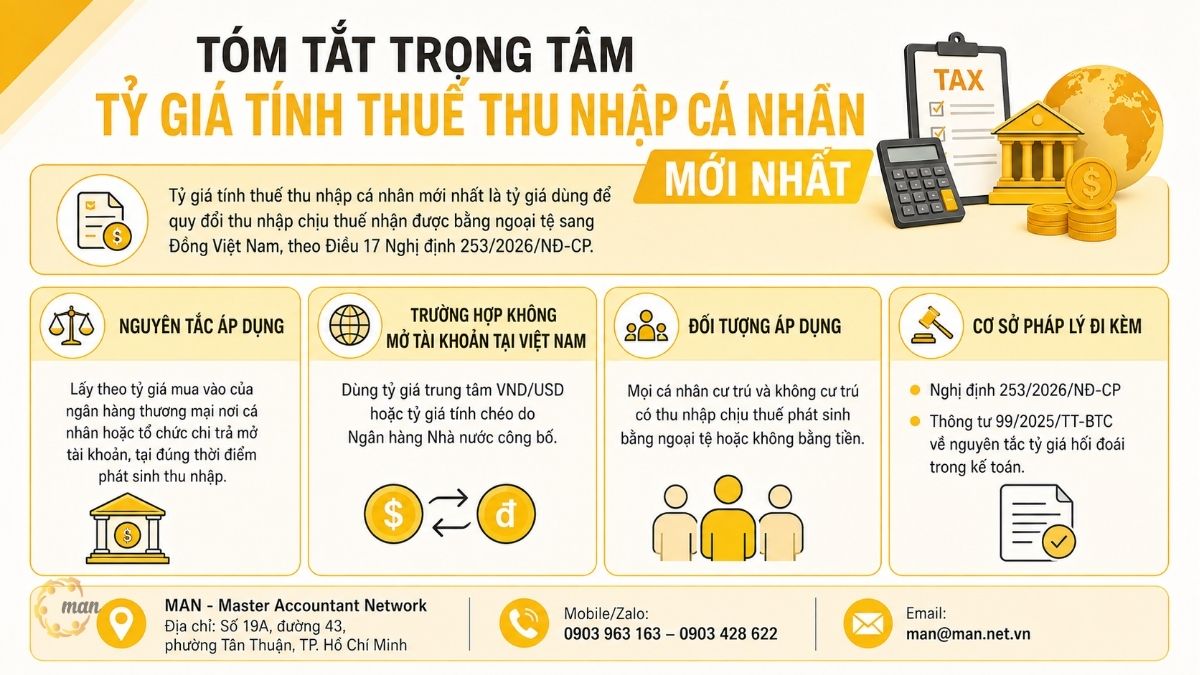
- The latest personal income tax exchange rate is the rate used to convert taxable income received in foreign currency into Vietnamese Dong, according to Article 17 of Decree 253/2026/ND-CP.
- Principle of application: Use the buying exchange rate of the commercial bank where the individual or organization making the payment has an account, at the exact time the income is generated.
- If you do not have an account in Vietnam: use the central VND/USD exchange rate or the cross exchange rate published by the State Bank of Vietnam.
- Applicable to: all resident and non-resident individuals with taxable income arising in foreign currency or other forms of payment.
- Legal basis: Decree 253/2026/ND-CP and Circular 99/2025/TT-BTC on exchange rate principles in accounting.
What is the latest exchange rate for calculating personal income tax? Definition according to Decree 253.

According to Clause 1, Article 17 of Decree 253/2026/ND-CP, taxable personal income received in foreign currency must be converted into Vietnamese Dong. This conversion is based on the buying exchange rate of the commercial bank where the individual has a transaction account, or where the organization or individual paying the income has an account for payment, at the exact time the income is generated.
In short, this is the mandatory exchange rate that tax authorities, businesses, and individuals must use consistently when determining personal income tax obligations for income not generated in Vietnamese Dong. This regulation replaces all previous guidelines on personal income tax exchange rates issued before this date. Decree 253/2026/ND-CP effective.
Two situations where exchange rates are applied according to Article 17:
- Organizations and individuals paying income who have accounts at Vietnamese commercial banks: the buying exchange rate of that bank at the time the income is generated shall apply.
- For organizations and individuals not opening accounts in Vietnam: the central exchange rate of the Vietnamese Dong against the US Dollar, or the cross exchange rate between the Vietnamese Dong and other foreign currencies, as officially announced on the electronic portal of the State Bank of Vietnam, shall apply.
- Taxable income received in non-monetary form, such as goods or services, must be converted to the normal market transaction value of similar or equivalent products or services at the time the income is generated.
Why is it important to determine the correct exchange rate for calculating personal income tax?
Choosing the wrong exchange rate, or using the wrong exchange rate at the right time, leads to two direct consequences: under-declaring taxes payable or overpaying taxes without timely refunds. Both situations pose risks for businesses during annual tax settlement, especially for FDI companies that pay foreign experts in USD or EUR.
From this perspective MAN – Master Accountant Network, Based on practical experience advising numerous foreign-invested enterprises in Ho Chi Minh City and Hanoi, even a small exchange rate discrepancy of just a few tens of dong per dollar can cause a foreign expert's total personal income tax to be off by tens of millions of dong annually. This is a common error when accountants use the selling exchange rate instead of the buying exchange rate, or use the exchange rate on the payday instead of the actual income date.
Which groups will be affected by the application of the latest personal income tax exchange rate?

The regulations on exchange rates in Article 17 of Decree 253/2026/ND-CP apply to all individuals with taxable income in foreign currency, regardless of whether they are residents or non-residents. The groups most significantly affected include:
- Foreign experts and workers in Vietnam receive their salaries in USD, EUR, or other foreign currencies through bank accounts.
- Vietnamese individuals who earn income from employment contracts with foreign organizations that do not have a commercial presence in Vietnam.
- Individuals who earn income from capital investments, securities transfers, and dividends in foreign currency on international exchanges.
- Businesses that pay income and are responsible for withholding personal income tax must determine the correct exchange rate before calculating the amount of tax to be withheld at source.
Points to note: The responsibility for determining the correct exchange rate rests with both the income payer and the income recipient in cases where they self-settle their taxes directly with the tax authorities.
Timeline and conditions for applying the new exchange rate regulations.
Decree 253/2026/ND-CP stipulates that the exchange rate is applied at the time income is generated, not at the time of tax declaration or settlement. This is a crucial difference that many corporate accountants easily misunderstand when performing monthly deductions.
How to determine when income is generated.
The time of income generation is typically determined as the date on which the paying organization or individual makes the payment or records the obligation to pay income to the individual, in accordance with the employment contract, service contract, or bonus payment decision. For periodic income payments such as monthly salaries, this time usually coincides with the actual payday recorded on the payroll.
Mandatory conditions when accounting
Businesses must retain documentation proving the applicable exchange rate, including the exchange rate listing from commercial banks on the exact date the income was generated, or a printed copy of the central exchange rate from the State Bank of Vietnam's electronic portal. Lack of this documentation is a common reason why businesses have their tax assessments recalculated during audits.
Compilation of legal documents related to exchange rates for calculating personal income tax.
Important Note: Businesses need to clearly distinguish between the exchange rate used for tax declaration and payment as stipulated in Decree 253/2026/ND-CP and the exchange rate used for accounting purposes as stipulated in Circular 99/2025/TT-BTC, because the two purposes may lead to two different conversion results in the same transaction.
| Legal documents | Number / Date of Issue | Related content |
| Decree 253/2026/ND-CP | Government issued, 2026 | Article 17 stipulates the conversion of taxable income in foreign currency and non-monetary forms. |
| Decree 253/2026/ND-CP | Article 51 | Regulations on annual personal income tax settlement, cases of exemption from settlement, and authorization for settlement. |
| Decree 253/2026/ND-CP | Article 66 | The tax period for resident individuals is regulated as either a calendar year or 12 consecutive months. |
| Circular 99/2025/TT-BTC | Section 1.2, Clause 1, Account 413 | Principles for applying exchange rates and exchange rate differences in corporate accounting. |
| Previous guidance document | It has been replaced. | Regulations on personal income tax exchange rates issued before the effective date of Decree 253/2026/ND-CP |
How are regulations regarding personal income tax settlement related to exchange rates?
The correct exchange rate conversion is required. personal income tax The latest figures are only truly meaningful when they are included in the correct tax settlement period. According to Article 51 of Decree 253/2026/ND-CP, organizations and individuals paying income and resident individuals with income from salaries and wages are responsible for annual tax settlement, except in certain specific cases.
Cases where tax settlement is not required
- Individuals whose tax liability is less than the tax paid during the tax period and who do not request a refund or tax offset in the next period.
- Individuals who have additional income from other sources, provided that this income averages no more than 15 million VND per month during the year and has been subject to tax withholding at a rate of 10% on income as stipulated in Clause 2, Article 50 of the Decree.
In cases where individuals choose to settle their taxes directly with the tax authorities, the tax management information system will assist in aggregating all income from salaries and wages earned during the year and deducting the amount of tax already withheld.
Cases where settlement is authorized on behalf of another party.
According to Clause 2, Article 51, taxpayers may authorize the income-paying organization to settle their tax obligations on their behalf, even if they have not worked for a full 12 months in the year, if they fall into one of the following two cases:
- Only one source of income is required, derived from salary or wages under an employment contract of 3 months or more with an organization, and the individual must be actually working there at the time of tax settlement, even if transferred due to the merger, consolidation, division, separation, or conversion of the business type of the former organization.
- There is only one source of income as mentioned above, and there is an additional source of income that has been subject to tax deductions as stipulated in point b, clause 1, Article 51.
Cases where self-assessment is mandatory.
According to Clause 3, Article 51, individuals must self-declare their taxes if they request tax reductions due to natural disasters, epidemics, fires, accidents, or serious illnesses as stipulated in Article 40, or if they have deductions as stipulated in Article 49 that they wish to deduct from their income before calculating tax. The procedures and documentation for tax settlement and authorization for tax settlement shall comply with the provisions of the law on tax administration, as specified in Clause 4 of the same article.
From this perspective MAN – Master Accountant Network, This is a point that businesses need to pay special attention to, especially regarding foreign experts receiving income in foreign currency from multiple sources, because incorrect exchange rate conversion in any income source directly affects the year-end settlement results, whether the individual settles the tax themselves or authorizes the paying organization to do so.
How is the personal income tax period for a resident individual determined?
In addition to correctly determining the latest personal income tax exchange rate, businesses and individuals also need to correctly determine the tax period, because the exchange rate applied at each time income is generated must be aggregated according to the tax period stipulated in Article 66 of Decree 253/2026/ND-CP.
Tax period according to calendar year
This applies to income from business activities and income from salaries and wages of individuals. If, within a calendar year, an individual meets the conditions of being a resident individual, the tax period is determined according to that calendar year.
The tax period applies to individuals present in Vietnam for less than 183 days in a calendar year.
In the case of an individual present in Vietnam for less than 183 days in a calendar year, but whose total presence in Vietnam over 12 consecutive months from the first day of arrival reaches 183 days or more, the first tax period is determined as the 12 consecutive months from the first day of arrival. From the second year onwards, the tax period is based on the calendar year if the individual continues to meet the residency requirements. The remaining tax payable for the second tax year is determined according to the following formula:
The remaining tax payable for the second tax year = Tax payable for the second tax year minus the amount of double tax that can be deducted.
In this calculation, the tax payable for the second tax year is equal to the taxable income of the second tax year multiplied by the personal income tax rate, while the double tax deduction is calculated by dividing the tax payable in the first tax year by 12 and then multiplying by the number of months of double tax.
Tax period based on each instance of income generation.
This applies to non-recurring income, including income from capital investments, income from capital transfers (including securities transfers), income from real estate transfers, lottery winnings, royalties, franchise fees, inheritances, gifts, and other income. For this group of income, the latest personal income tax rate according to Article 17 must be determined separately for each transaction, not grouped together monthly or annually.
How to calculate taxable income when converting exchange rates – A practical example.
This is where many accountants are most confused when first encountering the new regulations. The core principle is to use the correct buying rate of the bank where the payment account is opened, on the exact day the income is generated, not the monthly average rate or the selling rate.
Example of a specific calculation
A foreign expert working at a foreign-invested enterprise in Binh Duong receives a salary of $3,000 USD per month, paid through an account opened at a Vietnamese commercial bank. On payday, the bank's buying exchange rate is listed at 25,400 VND per USD. Taxable income is determined by multiplying 3,000 by 25,400, equivalent to 76,200,000 VND. The entire amount of personal income tax to be withheld will be calculated based on this converted amount, not on the exchange rate published from other sources.
In cases where the business paying the income does not have an account in Vietnam, for example, the parent company abroad transfers money directly to the expert, the accountant must look up the central VND/USD exchange rate published by the State Bank of Vietnam on the exact day the income is received to convert the funds, instead of using any commercial bank exchange rate.
| Income generation | Type of exchange rate applied | Sources for determining exchange rates | Time of application |
| Payment will be made through an account opened in Vietnam. | Buying rate | Commercial bank where the account is opened | Date income is generated |
| Payments made without opening an account in Vietnam. | Central exchange rate or cross exchange rate | State Bank of Vietnam's electronic portal | Date income is generated |
| Income in kind or services | Typical market transaction value | Market price of similar or equivalent products | Time of income generation |
| Business accounting records | Actual exchange rate or book exchange rate | According to Circular 99/2025/TT-BTC | According to the details of the economic transaction that occurred. |
Case Study: How do FDI enterprises handle exchange rates for personal income tax purposes?
Background
Company Y, a Japanese-invested electronics component manufacturer in Dong Nai, pays salaries to 15 foreign experts in Japanese Yen, transferred directly from its parent company in Japan, bypassing bank accounts in Vietnam.
Problem arises
Before seeking advice, the company's accountant applied the selling exchange rate of a domestic commercial bank to convert taxable income, resulting in a higher withholding tax amount than required for several consecutive months.
Solutions from MAN – Master Accountant Network
The team of experts at MAN After reviewing all payment records, it was determined that the parent company in Japan did not have an account in Vietnam. Therefore, the cross-exchange rate between the Vietnamese Dong and the Japanese Yen, as announced by the State Bank of Vietnam, had to be applied instead of the commercial bank's exchange rate. MAN assisted the company in rebuilding the payroll calculation sheet, storing exchange rate documents for each payroll period, and adjusting tax deduction records for the months that were incorrectly calculated.
The measured results
- The amount of over-withheld personal income tax for the 15 experts has been accurately recalculated, serving as the basis for tax refunds during the annual tax settlement.
- Standardized exchange rate records help ensure that the company's next tax audit does not result in any outstanding tax liabilities related to exchange rates.
- Businesses save time reconciling data during annual tax settlements because all exchange rate documents are fully stored for each period.
Expert opinion: Common business risks and how to avoid them.
Experts at MAN – Master Accountant Network With over 30 years of experience in auditing and tax consulting in Vietnam, we note three main risks related to exchange rates used in calculating personal income tax that businesses often face.
- Risk 1: Confusion between the buying and selling exchange rates: Many accountants are accustomed to using the selling exchange rate when accounting for expenses, leading to the incorrect application of this rate when converting taxable income. This increases the error in deductible taxes, creating a risk of disputes with employees when they compare year-end tax settlement figures.
- Risk 2: Failure to retain exchange rate documents at the time income is generated: During tax audits, tax authorities often require businesses to present a price list showing the exchange rate on the exact date the income was paid. If a business only records the average monthly exchange rate without keeping a copy of the specific date of the transaction, the difference may be reassessed in an unfavorable manner.
- Risk 3: Applying the wrong exchange rate to income from foreign organizations that do not have accounts in Vietnam: This is a common mistake in businesses where the parent company transfers salaries directly from overseas. Accountants need to accurately determine whether the paying organization has an account in Vietnam before selecting the applicable exchange rate, avoiding the default application of domestic commercial bank exchange rates in all cases.
Conclude
Understanding the latest personal income tax exchange rates is crucial not only for businesses to comply with Decree 253/2026/ND-CP but also to minimize the risk of back taxes or penalties when tax authorities audit payroll records involving foreign currency. This seemingly simple matter is actually prone to errors in practice, requiring accountants to constantly update their knowledge and maintain complete documentation.
Tax services at MAN – Master Accountant Network
- Tax accounting services
- Tax consulting services
- Tax settlement services
- Tax reporting services
- VAT refund service
Service contact information at MAN – Master Accountant Network
- Address: No. 19A, Street 43, Tan Thuan Ward, Ho Chi Minh City
- Mobile/Zalo: 0903 963 163 – 0903 428 622
- E-mail: man@man.net.vn
- Google Business Profile: View MAN – Master Accountant Network's Google Business Profile
- LinkedIn Founder: View expert Le Hoang Tuyen's LinkedIn profile.
Responsible for production and professional content review by: Mr. Le Hoang Tuyen – Founder & CEO of MAN – Master Accountant Network, CPA Vietnam with over 30 years of experience in accounting, auditing, taxation, and corporate financial consulting.
Frequently Asked Questions about the Latest Exchange Rate for Personal Income Tax
Which document governs the latest exchange rate used for calculating personal income tax?
According to Article 17 of Decree 253/2026/ND-CP, which regulates the conversion of taxable income in foreign currency to Vietnamese Dong, previous guidelines on personal income tax exchange rates replace these provisions.
Should businesses use the buying or selling exchange rate to calculate taxes?
Businesses are required to use the buying rate of the commercial bank where they open their income payment account, not the selling rate.
If the parent company is overseas and transfers salaries directly, without going through an account in Vietnam, how is the exchange rate calculated?
The central exchange rate of the Vietnamese Dong against the US Dollar, or the cross exchange rate with other foreign currencies announced by the State Bank of Vietnam at the time the income is generated, shall be applied.
Does income received in kind need to be converted to the exchange rate?
Instead of applying foreign exchange rates, the income is converted using the usual market transaction value of similar or equivalent products or services at the time the income is generated.
Are the exchange rates used for tax calculation and accounting records the same?
They are not exactly the same. The exchange rate used for calculating personal income tax follows Article 17 of Decree 253/2026/ND-CP, while the exchange rate used for accounting records follows the principles in Circular 99/2025/TT-BTC. Businesses need to compare both to avoid discrepancies between financial statements and tax returns.
Who is required to file an annual personal income tax return?
According to Article 51 of Decree 253/2026/ND-CP, organizations and individuals paying income and resident individuals with income from salaries and wages must settle taxes annually, except in cases where the tax payable is lower than the amount paid without requesting a refund or offsetting, or where other income averaging only VND 15 million has been subject to withholding tax.
How is the personal income tax period for a resident individual determined?
According to Article 66 of Decree 253/2026/ND-CP, the tax period for income from business, salaries, and wages is calculated according to the calendar year if the individual meets the residency requirements in that year. If an individual is present in Vietnam for less than 183 days in a calendar year but for 183 days in 12 consecutive months, the first tax period is 12 consecutive months from the first day of their presence in Vietnam.




