
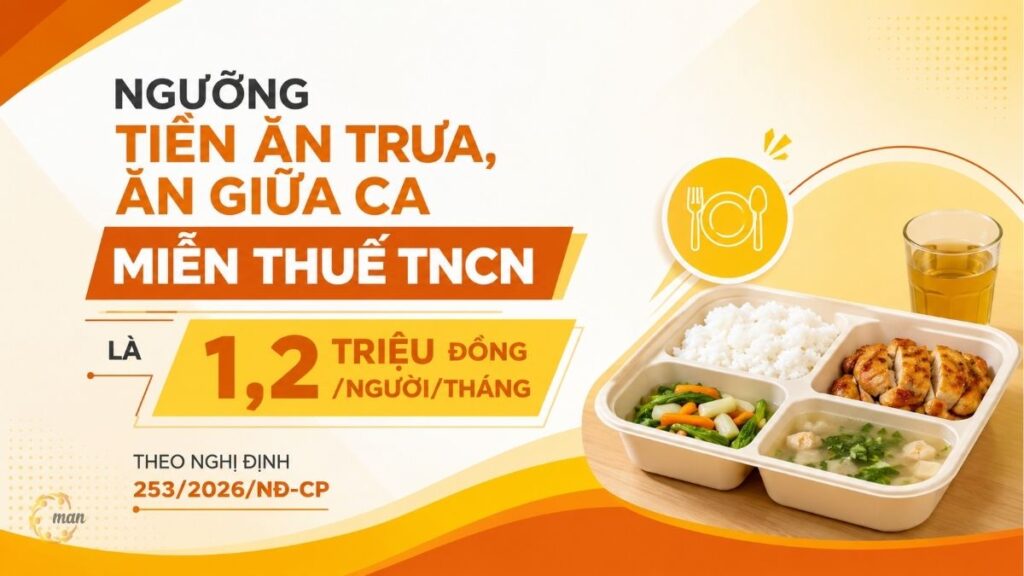
The official threshold for tax-exempt lunch and mid-shift meal allowances has been raised to 1.2 million VND per person per month., This will be applied from July 1, 2026, according to Decree 253/2026/ND-CP. This is the ceiling set by the Government on June 30, 2026, detailing the implementation of the 2025 Personal Income Tax Law, and simultaneously closing the legal gap that has persisted since mid-2025 when the old ceiling of VND 730,000 was abolished without a replacement document. For millions of workers and payroll accountants, this figure is crucial for accurately calculating monthly tax obligations.
Prior to this, many businesses had to estimate their reasonable expenses themselves, risking retroactive tax collection during the annual tax settlement. This article, compiled from the perspective of MAN – Master Accountant Network, a tax, accounting, and auditing consulting firm with over 30 years of practical experience in Vietnam, comprehensively analyzes the legal basis, methods for determining tax exemptions, applicable entities, and risks businesses should avoid when applying the new regulations.
| – The tax-exempt threshold for lunch and mid-shift meal allowances is 1.2 million VND/person/month, applicable to cash payments made by employers to employees. |
| – Legal basis: Point g, Clause 2, Article 8 of Decree 253/2026/ND-CP, effective from July 1, 2026. |
| – Applicable to: all individuals with income from salaries and wages, regardless of the type of business or profession. |
| – Any expenditure exceeding 1.2 million VND/month is included in taxable income; however, if the business directly provides meals (cooking, purchasing meals, issuing meal vouchers), it is completely exempt from this limit. |
What is the tax-exempt threshold for lunch and mid-shift meal allowances?
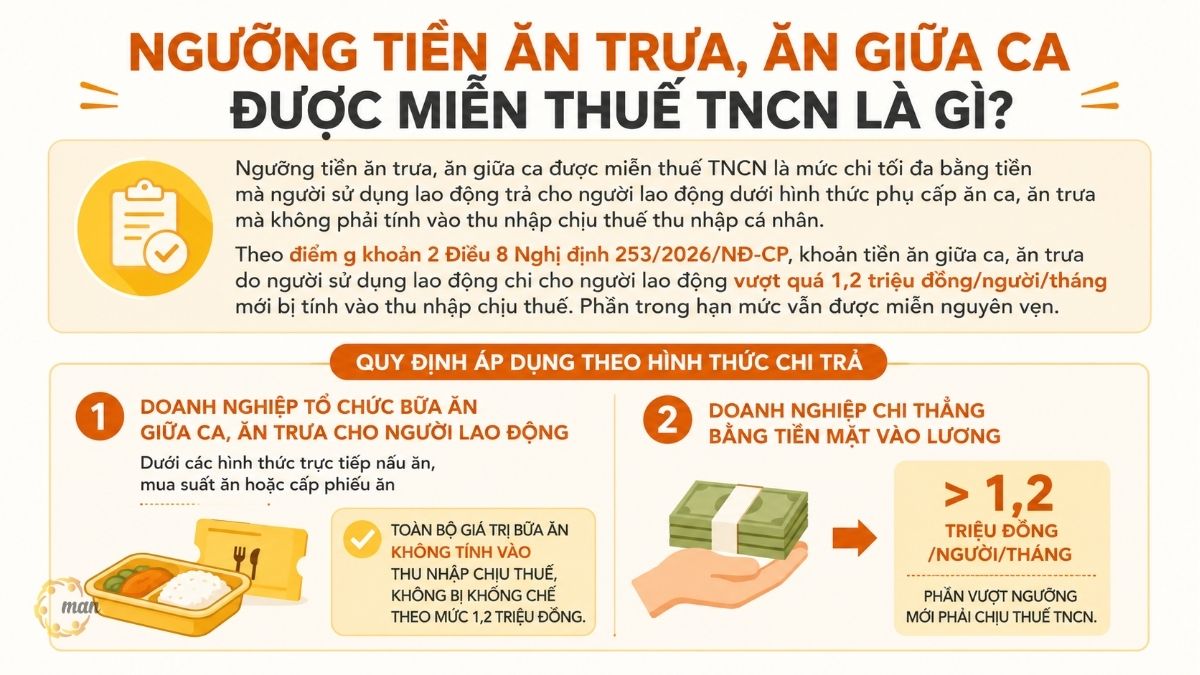
The tax-exempt threshold for lunch and mid-shift meal allowances is the maximum amount paid by employers to employees in the form of meal and lunch allowances that is not included in taxable personal income. (According to point g, clause 2, Article 8) Decree 253/2026/ND-CP, Only meal allowances paid by employers to employees exceeding 1.2 million VND/person/month are considered taxable income. The portion within the limit remains completely tax-exempt.
This regulation needs to be understood separately in terms of two forms of payment. Firstly, if the business organizes mid-shift meals or lunch for employees through direct cooking, purchasing meals, or providing meal vouchers, the entire value of the meal is not included in taxable income and is not subject to the 1.2 million VND limit. Secondly, if the business pays directly in cash as part of the salary, only the amount exceeding the 1.2 million VND threshold is subject to personal income tax.
Why is the tax-free threshold for lunch and mid-shift meal allowances important for businesses?
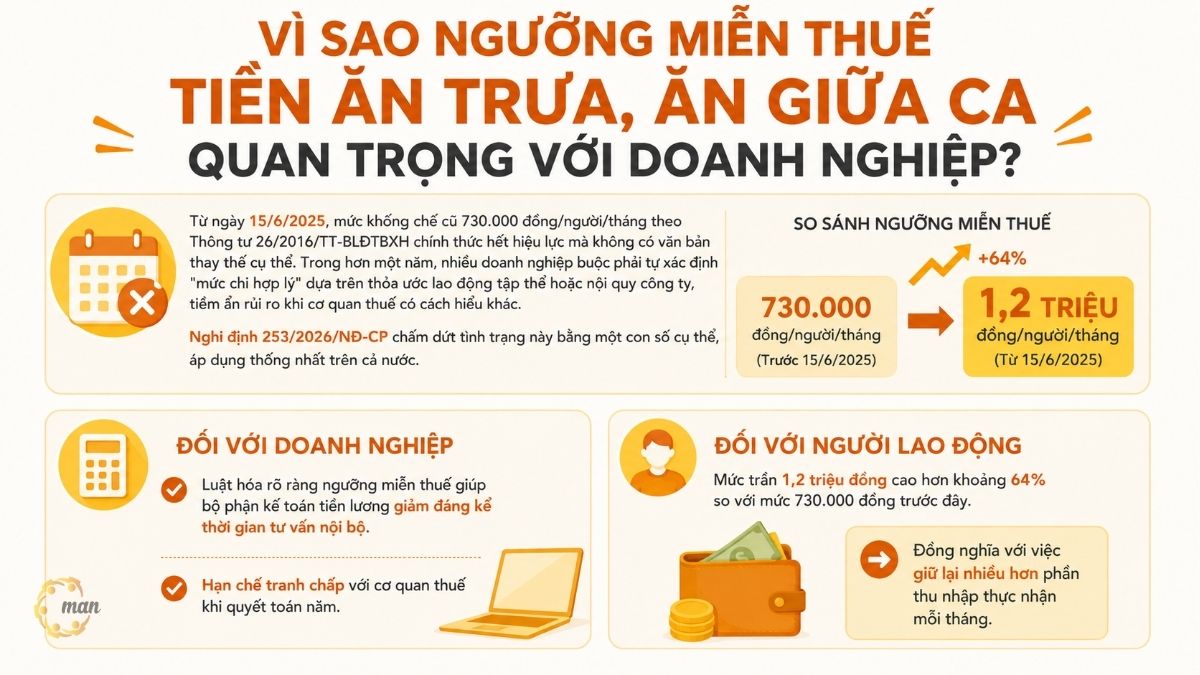
From June 15, 2025, the old limit of 730,000 VND/person/month will be applied. Circular 26/2016/TT-BLDTBXH The regulation officially expired without a specific replacement. For over a year, many businesses were forced to determine "reasonable expenses" based on collective bargaining agreements or company regulations, posing a risk if the tax authorities interpreted it differently. Decree 253/2026/ND-CP puts an end to this situation by establishing a specific figure, applied uniformly nationwide.
From this perspective MAN – Master Accountant Network, Clearly defining the tax-exempt threshold in law significantly reduces the time spent on internal consultations by payroll accounting departments, while also minimizing disputes with tax authorities during annual tax settlements. For employees, the 1.2 million VND ceiling is approximately 64% higher than the previous 730,000 VND, meaning they can retain a larger portion of their actual monthly income.
Which groups are eligible for the tax-free lunch and mid-shift meal allowance?
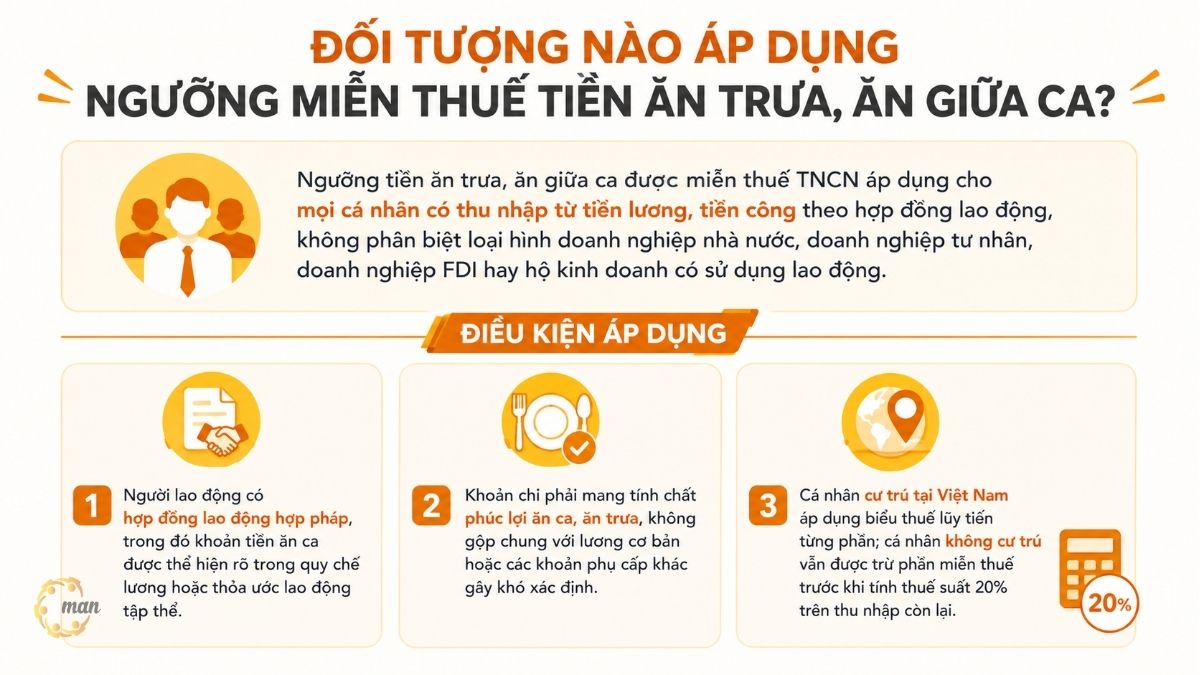
The threshold for waived lunch and mid-shift meal allowances. personal income tax This applies to all individuals with income from salaries and wages under labor contracts, regardless of the type of enterprise (state-owned, private, FDI, or household business employing workers). Conditions for application include:
- Employees must have a legally valid employment contract in which the meal allowance is clearly stated in the wage regulations or collective bargaining agreement.
- The expenditure must be for welfare purposes such as meal allowances and lunch breaks, and should not be combined with basic salary or other allowances that make it difficult to determine its value.
- Individuals residing in Vietnam are subject to a progressive tax rate; non-resident individuals are still allowed to deduct the tax-exempt portion before calculating the remaining tax rate (20%) on their income.
When does the tax-free threshold for meal allowances apply?
According to point b, clause 1, Article 69 of Decree 253/2026/ND-CP, the regulations on mid-shift meal allowances and lunch allowances in point g, clause 2, Article 8 will officially apply from July 1, 2026. This is the mandatory deadline for payroll accountants to update the payroll system and tax calculation software.
Notably, Article 70 of the Decree stipulates transitional provisions for the preceding period, comprising two groups of content:
- The deadlines for registering dependents and submitting supporting documents for tax periods up to 2025 remain in effect according to the personal income tax laws in force before the effective date of Decree 253/2026/ND-CP, and are not retroactively applied under the new regulations.
- For businesses that have already declared and paid taxes on income from salaries and wages for the tax period of 2026 between January 1, 2026 and before the effective date of the Decree, they do not need to resubmit monthly or quarterly tax declarations but can make direct adjustments to their 2026 annual tax settlement documents.
This is a point many accountants easily overlook when preparing year-end tax returns, especially for businesses that paid salaries and deducted taxes using the old calculation method in the first half of 2026.
What is the penalty for businesses that are late in submitting their 2026 personal income tax return?
Alongside updating the tax exemption threshold for meal allowances, businesses need to be aware of the penalties for late filing of personal income tax returns to avoid incurring unnecessary additional costs. According to Article 13 of Decree 125/2020/ND-CP, amended by Clause 10, Article 1 of Decree 310/2025/ND-CP, the penalties for late filing of personal income tax returns in 2026 are stipulated as follows:
| Late filing of tax returns | Penalty level |
| From 1 to 5 days, with mitigating circumstances. | Warning |
| From 1 to 30 days | 2,000,000 – 5,000,000 VND |
| From 31 to 60 days | 5,000,000 – 8,000,000 VND |
| From 61 to 90 days; or over 91 days but without tax liability arising; or failure to file tax returns but without tax liability arising; or failure to submit the related party transaction appendix with the corporate income tax return. | 8,000,000 – 15,000,000 VND |
| Over 90 days have passed, there is a tax liability arising, and the tax and late payment penalties have been fully paid before the tax authorities announce the inspection or audit decision. | 15,000,000 – 25,000,000 VND (the maximum penalty shall not exceed the amount of tax payable as stated in the tax return) |
In addition to fines, businesses are also subject to remedial measures: they are required to pay the full amount of overdue taxes to the state budget, and are required to submit tax declarations along with any missing appendices. According to experts at... MAN – Master Accountant Network, Therefore, combining the correct updating of the tax exemption threshold for meal allowances with strict adherence to filing deadlines are two key factors that will help businesses control tax risks and optimize compliance costs in 2026.
Compilation of legal documents related to the tax-free threshold for lunch and mid-shift meal allowances.
Regulations regarding tax exemptions for lunch and mid-shift meal allowances have undergone several changes recently. Businesses need to stay updated on current legal documents to apply the appropriate tax exemption levels and minimize risks during tax settlement. The table below summarizes important legal documents and key content related to the tax exemption threshold for lunch and mid-shift meal allowances.
| Legal documents | Number / Date of Issue | Related content |
| Personal Income Tax Law 2025 | National Assembly, effective July 1, 2026 | The regulations outline 21 tax-exempt income categories, serving as the basis for issuing the guiding decree. |
| Decree 253/2026/ND-CP | Government Decree, issued on June 30, 2026, effective July 1, 2026 | The regulations specify a tax-free ceiling of 1.2 million VND per person per month for meal allowances during work shifts and lunch breaks. |
| Circular 26/2016/TT-BLDTBXH | Ministry of Labour, Invalids and Social Affairs, issued on September 1, 2016, expires on June 15, 2025. | The old ceiling of 730,000 VND/person/month for state-owned enterprises is applied as a general reference. |
| Circular 003/2025/TT-BNV | Ministry of Interior, issued April 28, 2025 | Repealing Circular 26/2016/TT-BLDTBXH and not specifying a replacement ceiling creates a legal loophole. |
| Circular 111/2013/TT-BTC (amended by Circular 92/2015/TT-BTC) | Ministry of Finance | Regulations stipulate the principle of tax exemption for meal allowances provided directly by the organization and cash payments based on guidelines. |
Important Note: To date, Decree 253/2026/ND-CP is the highest-ranking legal document directly stipulating a ceiling of 1.2 million VND. Experts at MAN Businesses are advised to immediately update their internal salary regulations to comply with the new document, avoiding the mistaken application of the outdated reference rate of 730,000 VND.
What types of income from salaries and wages are subject to personal income tax?
To correctly determine the exempted portion, accountants need to understand the overall picture of taxable income. According to Article 3 of the Personal Income Tax Law 2025, income from salaries and wages subject to personal income tax includes:
- Wages, salaries, and other payments of a similar nature that employees receive from their employers, in any form, whether monetary or non-monetary.
- Remuneration and other monetary or non-monetary benefits received by individuals from organizations or individuals, including meal allowances for breaks and lunches exceeding the tax-free threshold.
- Allowances, subsidies, and other income, apart from The group of preferential and specific support allowances listed separately includes: allowances for meritorious individuals, national defense and security allowances, hazardous and dangerous work allowances, attraction and regional allowances, occupational accident and disease allowances, maternity and adoption allowances, severance pay and unemployment benefits, and other social welfare allowances as prescribed by the Government.
The key point for payroll accounting: meal allowances during work shifts and lunch breaks fall under the category of "remuneration and benefits" mentioned above. Therefore, when the amount exceeds 1.2 million VND/person/month, the excess must be added to the taxable income of this group to calculate personal income tax according to the progressive tax rate schedule, and cannot be kept separate outside the taxable payroll.
Besides meal allowances, what other types of income are exempt from personal income tax from 2026?
Besides the lunch and mid-shift meal allowances within the permitted limits, Article 4 of the 2025 Personal Income Tax Law stipulates a total of 21 income groups that are exempt from personal income tax, a significant expansion compared to the previous law. Understanding this complete list helps businesses and employees avoid missing out on their legal rights when settling taxes.
Summary table of income items exempt from personal income tax from 2026.
| STT | Income groups exempt from personal income tax (summarized in Article 4 of the Personal Income Tax Law 2025) |
| 1 |
Income from the transfer, inheritance, or gift of real estate between direct family members (spouses, parents and children, grandparents and grandchildren, siblings). |
| 2 | Income from the transfer of a person's sole residential house or land in Vietnam. |
| 3 | Income from the value of land use rights granted by the State. |
| 4 | Income of households and individuals directly engaged in the production of agricultural, forestry, and aquatic products that have not undergone deep processing or only basic processing; salt production; profits from agricultural cooperatives and "Large-Scale Farming" contracts.“ |
| 5 | Income from the conversion of agricultural land allocated by the State. |
| 6 | Interest on government bonds, local government bonds, interest on deposits at credit institutions, interest on life insurance contracts. |
| 7 | Income from remittances |
| 8 | Night shift pay, overtime pay; wages and salaries paid for days not taken as leave. |
| 9 | Pensions paid by the Social Insurance Fund; income from supplementary pension funds, voluntary pension funds. |
| 10 | Scholarships are awarded through state budgets or domestic and international organizations under scholarship programs. |
| 11 | Compensation for life insurance, non-life insurance, workers' compensation, state compensation, and other compensation as prescribed by law. |
| 12 | Income from organizations and charitable funds recognized by state agencies and operating on a non-profit basis. |
| 13 | Income from foreign aid for charitable and humanitarian purposes is subject to approval by the competent authority. |
| 14 | Salaries and wages of Vietnamese seafarers working for foreign shipping companies or Vietnamese shipping companies engaged in international transport. |
| 15 | Income of ship owners, those with the right to use the ship, and those working on the ship from providing goods and services for offshore fishing and aquaculture. |
| 16 | Income from the initial transfer of carbon credits, resulting from greenhouse gas emission reductions; interest and initial transfer of green bonds. |
| 17 | Salaries and wages earned from performing scientific, technological, and innovative tasks. |
| 18 | Income from royalties on scientific and technological projects when the results are commercialized. |
| 19 | Income of individual investors, professionals, and founders from innovative startup projects or capital contributions to venture capital funds. |
| 20 | Salaries and wages of foreign experts working on non-refundable ODA projects, foreign non-governmental projects; Vietnamese citizens working at United Nations representative offices; and those participating in United Nations peacekeeping forces. |
| 21 | Net income after corporate income tax of the owner of a private enterprise or the owner of a single-member limited liability company. |
In the above list, item 8 is night shift pay, overtime pay, Furthermore, the tax exemption for mid-shift meals and lunch within the limit of 1.2 million VND is specified in detail in Decree 253/2026/ND-CP guiding the implementation of Article 4 mentioned above. From this perspective... MAN – Master Accountant Network, Therefore, businesses should review all 21 of these items simultaneously when developing their salary regulations, instead of focusing on each item individually, in order to optimize tax costs in Vietnam comprehensively and legally.
Case Study: How do businesses handle the tax exemption threshold for meal allowances?
Background
Company Y, a mechanical processing company, has 850 employees in the Song Than Industrial Park, Binh Duong. Before July 1, 2026, the company paid 900,000 VND/person/month for meal allowances via bank transfer along with salary payments, based on the old reference rate of 730,000 VND. Therefore, the 170,000 VND difference each month is still subject to personal income tax for each employee.
Processing after July 1, 2026
Following advice from MAN – Master Accountant Network, the company reviewed its payroll regulations, compared them with Decree 253/2026/ND-CP, and confirmed that the current monthly expenditure of 900,000 VND falls within the tax-free threshold of 1.2 million VND. The accounting department updated the tax calculation formula in the software and added a meal allowance clause to the collective labor agreement to provide supporting evidence for tax settlement.
The measured results
- Each worker is now exempt from taxes on the entire 900,000 VND/month meal allowance, instead of only 730,000 VND as before.
- With a total of 850 employees, the company helps each worker retain an additional approximately 170,000 VND per month, equivalent to nearly 145 million VND in tax-free income across the entire company each month.
- The personal income tax return for 2026 was prepared separately starting in the third quarter, helping the company avoid having to make last-minute adjustments when submitting the return in March 2027.
How do the old and new meal allowance caps compare in terms of changes?
The tax-free allowance for meal allowances has changed significantly over time due to adjustments in legal regulations. Understanding the applicable ceiling and corresponding legal basis will help businesses develop appropriate welfare policies and minimize risks when filing and settling taxes. The table below summarizes the changes in the meal allowance ceiling over different periods.
| Implementation period | Tax-free ceiling | Legal basis |
| Before June 15, 2025 | 730,000 VND/person/month | Circular 26/2016/TT-BLDTBXH |
| From June 15, 2025 to before July 1, 2026 | There is no fixed limit; it is determined by the labor agreement or company regulations. | Legal vacuum following Circular 003/2025/TT-BNV's repeal of Circular 26 |
| From July 1, 2026 | 1,200,000 VND/person/month | Decree 253/2026/ND-CP |
The new ceiling can be seen as increasing by approximately 64% compared to the old one, accurately reflecting the fluctuations in the actual cost of living and meal prices in industrial zones and major cities during the period from 2016 to 2026.
Expert opinion: Common business risks when applying tax-free thresholds for meal allowances.
Experts at MAN – Master Accountant Network With over 30 years of experience in auditing and tax consulting in Vietnam, we note some common risks businesses face when applying the new tax exemption threshold.
Risk 1: Applying an expired ceiling by mistake.
Many businesses are still accustomed to using the old 730,000 VND limit or arbitrarily setting their own deduction levels during the transition period, leading to underestimation or incorrect exemptions when the new ceiling has increased to 1.2 million VND. This results in employees having more tax deducted than they should be paying, causing unnecessary internal complaints.
Risk 2: Including meal allowances in basic salary.
When meal allowances are not separately itemized in the employment contract or salary regulations, the tax authorities may not accept the tax exemption and may include the entire amount in taxable income during audits and inspections.
Risk 3: Lack of supporting documentation when organizing in-person meals.
In cases where businesses organize cooking, purchase meals, or issue meal vouchers to qualify for unlimited tax exemptions, they must retain complete invoices, meal supply contracts, and records of the actual number of meals served. Without this documentation, the tax authorities may classify it as a cash payment and impose a limit of 1.2 million VND.
Risk 4: Delayed updates to payroll accounting software.
Some domestic accounting software has not yet updated to the new tax ceiling effective from July 1, 2026, leading to discrepancies between actual payrolls and monthly tax returns. Businesses need to review and recheck the tax calculation formulas in their systems before the first payroll period under the new regulations.
Conclude
The increase to 1.2 million VND per person per month for tax-exempt lunch and mid-shift meal allowances marks a necessary adjustment after more than a year of businesses having to navigate legal loopholes on their own. The new regulation helps employees retain more of their legitimate income while creating a clear framework for businesses to properly account for and deduct taxes according to the law, starting from the July 2026 payroll period.
MAN – Master Accountant Network MAN is a tax, accounting, and auditing consulting firm with a team of experts boasting over 30 years of practical experience and a deep understanding of tax risk management in Vietnam. MAN provides a full range of services. tax consulting services, tax accounting services, tax reporting services and tax settlement services This applies to FDI businesses, domestic businesses, and individuals. For a specific review of salary regulations and tax exemptions for meal allowances to suit your business situation, please contact MAN – Master Accountant Network for consultation.
Service contact information at MAN – Master Accountant Network
- Address: No. 19A, Street 43, Tan Thuan Ward, Ho Chi Minh City
- Mobile/Zalo: 0903 963 163 – 0903 428 622
- E-mail: man@man.net.vn
- Google Business Profile: View MAN – Master Accountant Network's Google Business Profile
- LinkedIn Founder: View expert Le Hoang Tuyen's LinkedIn profile.
Responsible for production and professional content review by: Mr. Le Hoang Tuyen – Founder & CEO of MAN – Master Accountant Network, CPA Vietnam with over 30 years of experience in accounting, auditing, taxation, and corporate financial consulting.
Frequently Asked Questions about the tax-exempt threshold for lunch and mid-shift meal allowances for personal income tax purposes.
The fee is 1.2 million VND per person per month, effective from July 1, 2026, according to Decree 253/2026/ND-CP.
The amount exceeding the threshold, 300,000 VND, will be added to the employee's taxable income for that month.
No. If a business provides meals directly through cooking, purchasing meal sets, or issuing meal vouchers, the entire value of the meal is tax-exempt and this ceiling does not apply.
No. The 730,000 VND rate under Circular 26/2016/TT-BLDTBXH expired on June 15, 2025, and was officially replaced by the 1.2 million VND rate from July 1, 2026.
Yes. According to Article 70 of Decree 253/2026/ND-CP, businesses do not need to resubmit monthly or quarterly tax returns, but must adjust the difference in their 2026 personal income tax final settlement documents. What is the current tax-exempt threshold for lunch and mid-shift meal allowances?
If a company spends 1.5 million VND per month on employee meals, which portion is subject to tax?
Is there a limit of 1.2 million VND for businesses that organize group meals?
Is the old ceiling of 730,000 VND still in effect?
Do businesses that paid taxes at the old rate during the first half of 2026 need to make adjustments?