


Resolution 66.22/2026/NQ-CP Officially effective from August 15, 2026, this marks a significant turning point in the national digital transformation process as the Government for the first time issues a comprehensive policy framework on the development of digital citizens. This document not only impacts the public administration sector but also directly relates to tax obligations, compliance costs, and internal governance processes of millions of individuals, households, and businesses nationwide.
According to the Resolution, citizens who complete the integration of 5 essential documents on the VNeID application will be exempt from or receive reductions in a range of key fees and charges such as land and house registration fees, car and motorbike registration fees, driver's license renewal fees, passport fees, and criminal record check fees.
Summary of key points of Resolution 66.22/2026/NQ-CP
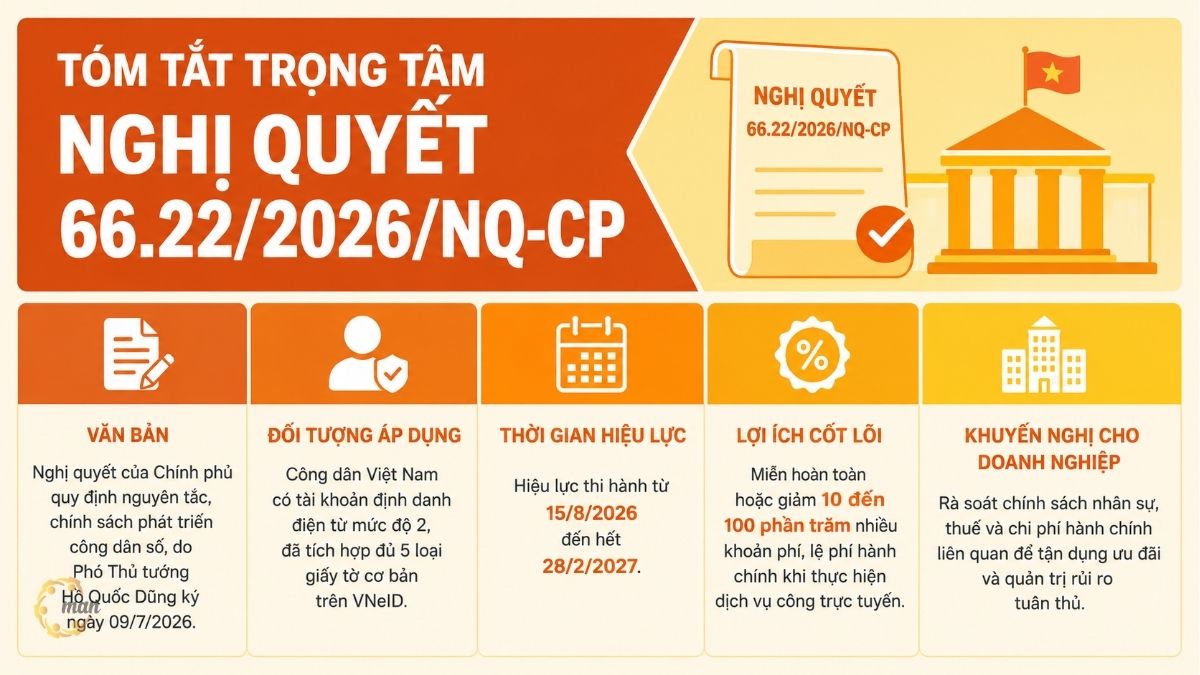
- Resolution 66.22/2026/NQ-CP is a government document stipulating the principles and policies for the development of digital citizens, signed by Deputy Prime Minister Ho Quoc Dung on July 9, 2026.
- This applies to Vietnamese citizens with a level 2 electronic identity verification account that has integrated all 5 basic types of documents into VNeID.
- Effective from August 15, 2026 to February 28, 2027.
- The core benefit: complete exemption or a 10 to 100 percent reduction in many administrative fees and charges when using online public services.
- Businesses need to review their human resources policies, tax policies, and related administrative costs to take advantage of incentives and manage compliance risks.
What is Resolution 66.22/2026/NQ-CP? Definition and legal basis.
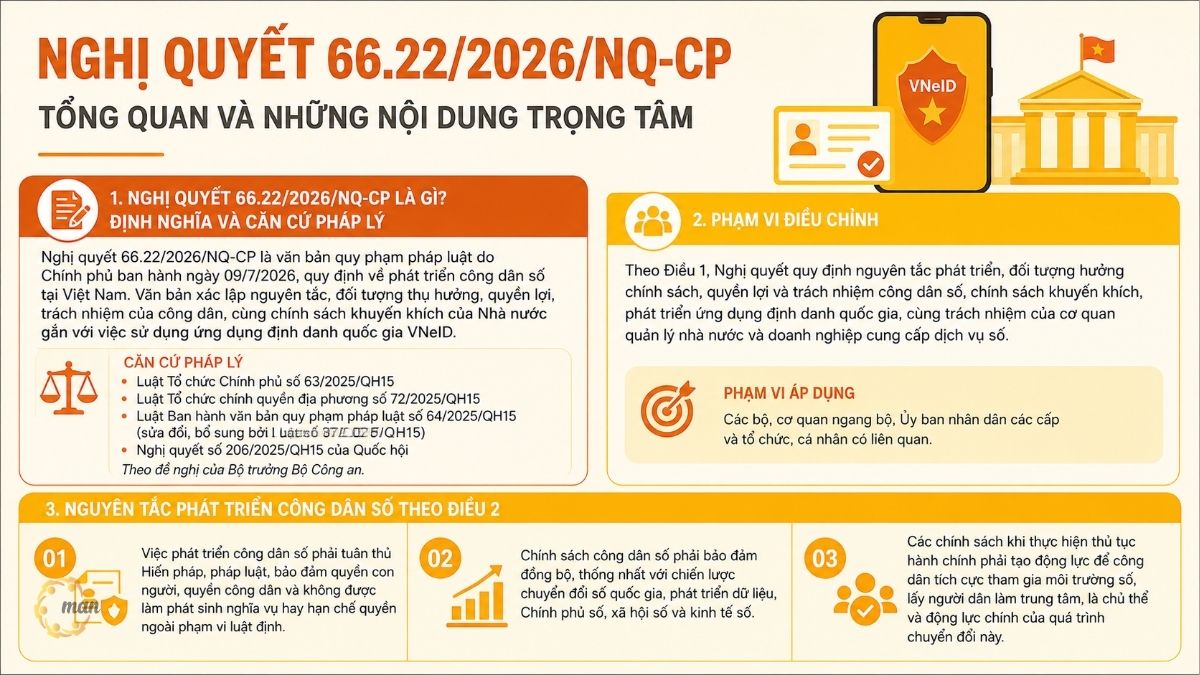
Resolution 66.22/2026/NQ-CP This is a legal document issued by the Government on July 9, 2026, regulating the development of digital citizens in Vietnam. The document establishes the principles, beneficiaries, rights, responsibilities of citizens, and the State's incentive policies associated with the use of the national identification application VNeID.
The legal basis for this Resolution includes Law No. 63/2025/QH15 on Government Organization, Law No. 72/2025/QH15 on Local Government Organization, Law No. 64/2025/QH15 on the Promulgation of Legal Normative Documents (amended and supplemented by Law No. 87/2025/QH15), and Resolution No. 206/2025/QH15 of the National Assembly, as proposed by the Minister of Public Security.
Scope of application of Resolution 66.22/2026/NQ-CP
According to Article 1, the Resolution stipulates the principles of development, beneficiaries of policies, rights and responsibilities of digital citizens, policies to encourage and develop national identification applications, and the responsibilities of state management agencies and businesses providing digital services. The scope of application includes ministries, ministerial-level agencies, People's Committees at all levels, and relevant organizations and individuals.
Principles for developing digital citizenship according to Article 2
The resolution sets out three overarching principles for policy implementation. Firstly, the development of digital citizenship must comply with the Constitution and laws, ensure human rights and civil rights, and must not create obligations or restrict rights beyond the scope of the law.
Secondly, digital citizenship policies must ensure consistency and alignment with the national digital transformation strategy, data development, digital government, digital society, and digital economy. Thirdly, policies implemented in administrative procedures must create incentives for citizens to actively participate in the digital environment, placing citizens at the center, as the main subject and driving force of this transformation process.
The role of Resolution 66.22/2026/NQ-CP in corporate tax, finance, and auditing management.
Many incentives in the Resolution are directly linked to the financial obligations that businesses must handle periodically, such as registration fees when purchasing assets, fire safety assessment fees when investing in projects, or the integration of individual tax identification numbers on VNeID. From the perspective of MAN – Master Accountant Network, this is an opportunity for businesses to optimize tax costs in Vietnam if the accounting department proactively reviews and guides employees and partners to correctly implement the document integration process.
Conversely, failure to update in a timely manner can cause businesses to miss out on legitimate savings or misapply incentives, leading to risks when tax authorities and auditors review records. Experts at MAN, with over 30 years of experience, note that tax risk management during the digital transformation phase requires businesses to synchronize their human resources and accounting data with electronic identification systems from the outset.
Which groups are affected by or benefit from the policies under Resolution 66.22/2026/NQ-CP?
The policies outlined in Resolution 66.22/2026/NQ-CP target various groups of stakeholders, from individuals and households to organizations and businesses. Specifically:
- Individuals who are Vietnamese citizens have a level 2 electronic identification account (Article 3).
- The elderly, people with disabilities, and ethnic minorities are entitled to the highest preferential rates when they meet the eligibility criteria (Article 5, Clause 2).
- Businesses providing digital products and services must comply with regulations on personal data protection and integrate their platforms with VNeID (Article 6).
- Ministries, sectors, and provincial People's Committees are responsible for restructuring administrative procedures and implementing the collection of fees and charges at the new preferential rates.
- Businesses whose employees and partners regularly handle administrative procedures related to land, vehicles, civil registration, and taxes are indirectly affected by the increase in operating costs.
Timeline and conditions for applying Resolution 66.22/2026/NQ-CP
The Resolution shall be effective from August 15, 2026 to February 28, 2027 (Article 10). During its effective period, if the provisions of the Resolution differ from relevant legal documents, the provisions of the Resolution shall take precedence, except in cases where a newly enacted Law or National Assembly Resolution provides otherwise.
A prerequisite for citizens to receive the benefits is the completion of integrating five basic documents and information into VNeID as per Appendix I, including birth certificate, bank card or e-wallet information, social security account information, mobile phone number, and electronic health record. Subsequently, depending on the specific procedure, citizens may integrate additional specialized documents such as driver's license, land use right certificate, or personal tax identification number.
According to Article 5, Clause 4, the application of incentive policies does not restrict the legitimate rights and interests of citizens in choosing methods of accessing and carrying out administrative procedures and public services. In other words, citizens who have not yet integrated all their documents into VNeID still have the right to submit applications through traditional methods, they just will not be entitled to preferential fees.
List of 12 types of documents and information integrated into VNeID as per Appendix I.
Appendix I specifies all the essential documents and information that citizens need to integrate and update on the national identification application, including 5 basic types of information and 7 types of specialized documents applicable to each group of administrative procedures in Appendices II and III:
| STT | Ministry/Department of Management | Field | Document name, information | Note |
| 1 | Ministry of Justice | Civil Registry | Birth certificate | Basic |
| 2 | State Bank of Vietnam | Bank | Bank card / payment account / e-wallet / mobile money account | Basic |
| 3 | Ministry of Public Security | Social security | Social Security account information | Basic |
| 4 | Ministry of Science and Technology | Telecommunications, technology | Mobile phone number information | Basic |
| 5 | Ministry of Health | Medical examination and treatment | Electronic health record | Basic |
| 6 | Ministry of Public Security | Road traffic | Driving license | Integration according to administrative procedures in Appendix II, III |
| 7 | Ministry of Public Security | Road traffic | Vehicle registration certificate | Integration according to administrative procedures in Appendix II, III |
| 8 | Ministry of Education and Training | Education and Training | Diplomas and certificates of the national education system | Integration according to administrative procedures in Appendix II |
| 9 | Ministry of Agriculture and Environment | Land | Certificate of land use rights and ownership of assets attached to the land. | Integration according to administrative procedures in Appendix II, III |
| 10 | Ministry of Justice | Criminal record | Criminal record information | Integration according to administrative procedures in Appendix II |
| 11 | Ministry of Finance | Tax | Personal Tax Identification Number | Integration according to administrative procedures in Appendix III |
| 12 | Ministry of Justice | Civil Registry | Marriage certificate | Integration according to administrative procedures in Appendix II |
Of these, the first five types of information are mandatory requirements, applicable to all procedures for receiving preferential treatment. The remaining seven types of documents only need to be integrated when citizens follow the corresponding administrative procedures, for example, integrating a driver's license when renewing a license, or integrating a personal tax identification number when declaring vehicle registration fees.
Rights and responsibilities of citizens according to Resolution 66.22/2026/NQ-CP
According to Article 4, citizens have the right to manage the exploitation and use of their personal data, access digital services, and are protected by law against acts that infringe upon their legitimate rights and interests in the digital environment. At the same time, citizens are entitled to exemptions and reductions in fees and charges when using online public services as prescribed.
Along with the benefits comes the responsibility to proactively cooperate in providing, updating, and integrating accurate personal information into electronic identification accounts and national and specialized databases. This is a prerequisite for citizens, and businesses supporting workers, to fully enjoy the benefits stipulated in Resolution 66.22/2026/NQ-CP.
According to Article 5, Clause 3, the level of eligibility for state incentives must be publicly disclosed, transparent, and directly displayed on the national identification application linked to each individual's account. The electronic identification and authentication system is also responsible for sharing this data with the National Public Service Portal and other administrative procedure information systems, serving as a basis for implementing incentives without requiring citizens to present additional supporting documents.
What additional features does the VNeID national identity card application offer?
According to Article 7, VNeID was developed to provide key functions including access to citizens' digital data, electronic identification and authentication, free provision of public digital signature certification services for individuals, support for online submission of administrative procedures, linking payment accounts, e-wallets, and bank cards for payment of public services and social security benefits.
The Department of Administrative Management of Social Order under the Ministry of Public Security is the governing body operating the electronic identification and authentication system. For businesses, the free integration of public digital signatures into VNeID opens up the possibility of more convenient digital signing of contracts and electronic tax declarations, reducing the cost of purchasing individual digital certificates for each person.
Specific responsibilities of ministries, departments, localities, and digital service businesses are outlined in Article 6.
Article 6 clearly defines the responsibilities of the public and private sectors in implementing the Resolution. For ministries, ministerial-level agencies, and provincial and city People's Committees, the responsibilities include:
- Design and restructure the process of delivering digital services and online public services to directly apply preferential policies, ensuring equality, convenience, and a people-centered approach.
- Ensure conditions for citizens to access and use digital services, and have specific support policies for vulnerable groups.
- Issue a list of integrated digital services and utilities to be implemented on VNeID.
- Integrating public digital signature authentication services on VNeID into online public service processes and administrative procedures.
- Organize the dissemination of information and guidance to citizens regarding preferential policies and how to implement them.
- Update and configure the administrative procedure information system to ensure that fees and charges are collected at the correct rates as stipulated in the Resolution.
For organizations and businesses providing digital products and services, Article 6, Clause 2 requires compliance with data laws, ensuring cybersecurity and protecting personal data; integrating service platforms with VNeID as needed; and ensuring the stable and efficient operation of digital systems, products, and services. This is a point that technology and fintech companies need to include in their contracts and internal security policies when integrating with the national identification infrastructure.
Notably, Article 6, Clause 3 stipulates that the State encourages and facilitates businesses to implement additional preferential programs such as discounted tickets, discounted services, or other forms of promotion for eligible citizens. This provides room for businesses to develop customer strategies aligned with digital citizenship policies, while also adhering to Clause 4 regarding the proper use of information identifying eligible recipients of preferential treatment, prohibiting discrimination or restrictions on the legitimate rights and interests of citizens.
Compilation of legal documents related to Resolution 66.22/2026/NQ-CP
To ensure accurate application, businesses and accountants need to compare the Resolution with the following guiding Circulars on fees and charges:
| Legal documents | Number / Date of Issue | Related content |
| Resolution 66.22/2026/NQ-CP | Government Decree, issued on July 9, 2026, effective from August 15, 2026 to February 28, 2027 | Regulations outlining principles and policies for developing digital citizenship, and fee exemptions and reductions through VNeID. |
| Circular 67/2025/TT-BTC (amending Circular 13/2022/TT-BTC) | Ministry of Finance | Regarding regulations on vehicle registration fees, the proposal suggests a reduction of 10 to 100 percent for digital citizens. |
| Circular 155/2025/TT-BTC | Ministry of Finance | Vehicle registration and license plate fees: Proposal to add a fee waiver. |
| Circular 154/2025/TT-BTC | Ministry of Finance | Driver's license issuance fee: Proposal to waive it for citizens with a certain number of licenses. |
| Circular 73/2024/TT-BTC and Circular 64/2025/TT-BTC | Ministry of Finance | Fees for issuing or replacing identity cards. |
| Circular 16/2025/TT-BTC | Ministry of Finance | Fees for providing criminal record information. |
| Circular 10/2026/TT-BGDĐT | Ministry of Education and Training | Based on the integration of diploma and certificate information on VNeID |
The full list of exempted fees and charges is in Appendix II of Resolution 66.22/2026/NQ-CP.
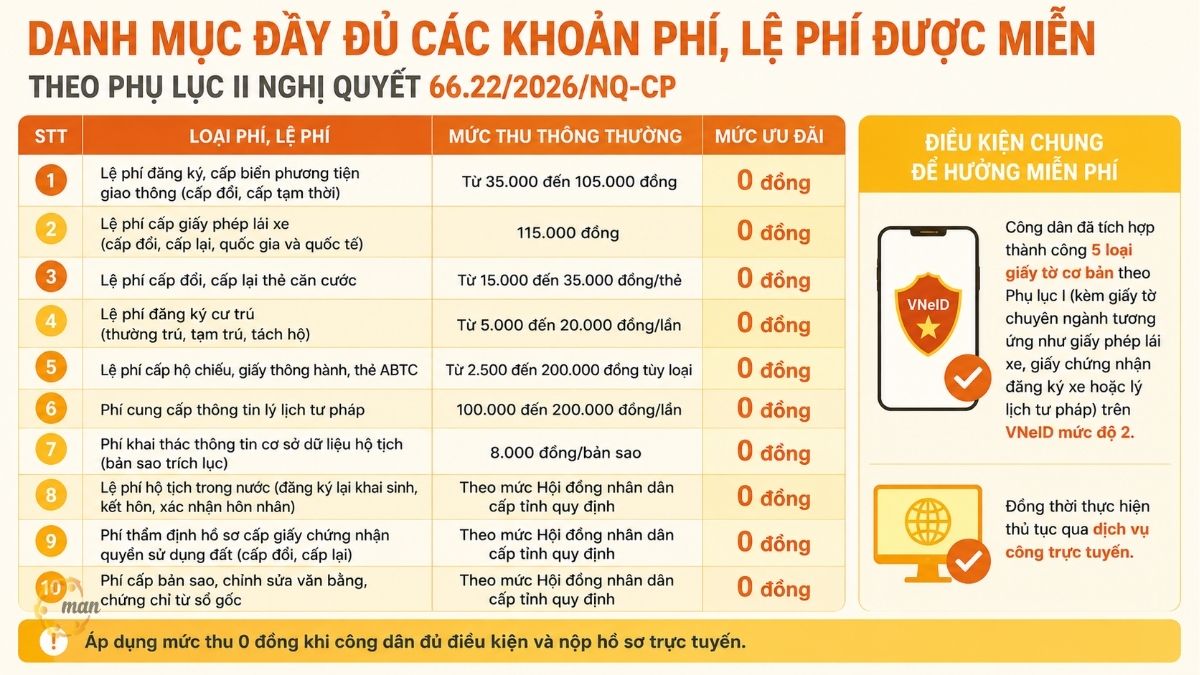
Appendix II lists 10 groups of fees and charges with high transaction frequency that will be charged at 0 VND when citizens are eligible to integrate VNeID and submit applications online:
| Types of fees and charges | Regular revenue | Discount level |
| Registration and license plate issuance fees for vehicles (renewal, temporary issuance) | From 35,000 to 105,000 VND | 0 dong |
| Fees for issuing driver's licenses (renewal, re-issuance, national and international licenses) | 115,000 VND | 0 dong |
| Fees for issuing or replacing identity cards. | From 15,000 to 35,000 VND per card | 0 dong |
| Registration fees for residence (permanent residence, temporary residence, household separation) | From 5,000 to 20,000 VND per visit | 0 dong |
| Fees for issuing passports, travel documents, and ABTC cards. | Prices range from 2,500 to 200,000 VND depending on the type. | 0 dong |
| Fees for providing criminal record information. | 100,000 to 200,000 VND per visit | 0 dong |
| Fees for accessing civil registry database information (copy of extract) | 8,000 VND per copy | 0 dong |
| Domestic civil registration fees (re-registration of birth, marriage, confirmation of marriage) | According to the regulations of the Provincial People's Council. | 0 dong |
| Fees for reviewing applications for land use right certificates (renewal, re-issuance) | According to the regulations of the Provincial People's Council. | 0 dong |
| Fees for issuing copies and correcting diplomas and certificates from the original register. | According to the regulations of the Provincial People's Council. | 0 dong |
The general conditions for enjoying the above free services are that citizens have successfully integrated the 5 basic types of documents according to Appendix I (along with corresponding specialized documents such as driver's license, vehicle registration certificate, or criminal record certificate) on VNeID level 2, and simultaneously completed the procedure through online public services.
Fees and charges are reduced according to Appendix III of Resolution 66.22/2026/NQ-CP.
Unlike Appendix II, which applies a 100% exemption, Appendix III specifies a reduction for three common, high-value transaction groups, specifically:
| Types of fees and charges | Regular revenue | Reduction rate as per Resolution | Terms and Conditions |
| Land and house registration fees | 0.5% is the value used for calculating registration fees. | Reduce 10%, maximum 5 times the base salary, once a year. | Integrates personal tax identification number, land use rights information, and 5 basic documents. |
| Vehicle registration tax (from the second time onwards) | 2% vehicle value | Reduced by 50%, up to 5 times the base salary, once a year. | Integrates personal tax identification number, vehicle registration information, and 5 basic documents. |
| Motorcycle registration fee (from the second time onwards) | 1% vehicle value | Reduce 100%, once a year. | Integrates personal tax identification number, vehicle registration information, and 5 basic documents. |
| Fees for reviewing and approving fire protection design. | Minimum 500,000, maximum 150,000,000 VND per project. | Discount 50% (minimum 250,000, maximum 75,000,000 VND) | Integrates information on land, assets attached to the land or structures, and 5 basic documents. |
| Registration fees for secured transactions (initial registration, changes, cancellation of registration) | From 20,000 to 80,000 VND per application | Reduced fee for 50% (from 10,000 to 40,000 VND/application) | Integrates information on vehicles or land, assets attached to the land, and 5 basic documents. |
Where will the funding for implementing Resolution 66.22/2026/NQ-CP come from?
According to Article 8, funding for the tasks outlined in the Resolution will be allocated from the state budget according to the decentralization of authority and other legally mobilized sources as prescribed by law. Specifically, for funding for science and technology, innovation, and digital transformation tasks, ministries, central agencies, and local authorities must submit proposals to the relevant sectoral management agencies for overall consolidation.
The preparation, management, use, and settlement of state budget funds are carried out in accordance with the laws on budget, public investment, science and technology, innovation, digital transformation, and other relevant legal regulations. This is a point that businesses providing technology services and solutions to the public sector need to consider when participating in digital transformation projects related to digital citizens.
Which agency is responsible for organizing the implementation of Resolution 66.22/2026/NQ-CP?
Article 9 assigns specific responsibilities to various ministries, agencies, and socio-political organizations to ensure the Resolution is implemented synchronously throughout the country.
Notably, Clause 3 of Article 9 stipulates that heads of agencies and units, as well as officials and public employees participating in the drafting and promulgation of the Resolution, may be considered for exclusion, exemption, or reduction of responsibility under a special mechanism as stipulated in Clause 7 of Article 6 of Resolution No. 206/2025/QH15, if risks arise during the pilot implementation of the new policy. This mechanism protects officials who dare to think and act when implementing unprecedented digital transformation initiatives.
The main implementation responsibilities include:
- Ministry of Public Security: The agency is responsible for monitoring, urging, and compiling the results of the Resolution's implementation, ensuring the smooth operation of the electronic identification and authentication system, and assigning dedicated digital citizen officers from the central to local levels.
- Ministry of Science and Technology: In coordination with the Ministry of Public Security and the Government Cipher Committee, they will assess and issue digital signature certificates to the managing agency of the VNeID system.
- Ministry of Finance: The presiding body shall coordinate with ministries and agencies to implement the policy of fee and charge exemption and reduction in accordance with the Resolution.
- Ministry of Health: Instructions for healthcare facilities to connect and share data to deploy digital healthcare services on VNeID.
- State Bank of Vietnam: Technical standards guidelines for electronic payment services based on electronic identification and authentication.
- Ministry of Education and Training: Instructions on connecting and sharing data to integrate diploma and certificate information on VNeID.
- Ministry of Culture, Sports and Tourism, Vietnam Fatherland Front, Youth Union, Vietnam Women's Union: To promote and encourage people to participate in developing digital citizenship and improving digital skills and cybersecurity.
- People's Committees of provinces and cities: Issue action plans, allocate resources, direct community digital technology teams to support citizens, and review administrative procedures under their management authority.
Which legal texts will be amended or supplemented according to Appendix IV?
To ensure consistency and uniformity, the Resolution proposes amending and supplementing 11 Circulars of the Ministry of Finance and related Ministries to codify the fee and charge exemption and reduction levels mentioned in Appendices II and III:
| Circular proposing amendments | Amendments and additions |
| Circular 155/2025/TT-BTC | Adding a provision to exempt citizens from vehicle registration and license plate fees. |
| Circular 154/2025/TT-BTC | Additional regulations waiving fees for issuing, exchanging, and reissuing driver's licenses for citizens. |
| Circular 73/2024/TT-BTC | Additional regulations have been added waiving fees for the issuance and re-issuance of national identity cards for citizens. |
| Circular 75/2022/TT-BTC | Adding regulations to exempt citizens from registration fees for permanent residence, temporary residence, and household separation. |
| Circular 28/2026/TT-BTC | Adding regulations to waive fees for issuing passports, travel documents, and AB stamps for digital citizens. |
| Circular 16/2025/TT-BTC | Adding a provision to provide free access to criminal record information for citizens. |
| Circular 281/2016/TT-BTC | Adding regulations to provide free access to civil registry database information for digital citizens. |
| Circular 106/2021/TT-BTC (amending Circular 85/2019/TT-BTC) | The Provincial People's Council shall stipulate the exemption of civil registration fees and the reduction of land appraisal fees for citizens. |
| Circular 13/2022/TT-BTC (amended by Circular 67/2025/TT-BTC) | Adding preferential rates for registration fees for houses, land, cars, and motorcycles for digital citizens. |
| Circular 70/2025/TT-BTC | Supplementing regulations to reduce the 50% fee for fire prevention and fighting design review and approval for citizens. |
| Circular 61/2023/TT-BTC | Adding a regulation to reduce the registration fee for secured transactions for digital citizens. |
Conclude
Resolution 66.22/2026/NQ-CP creates a clear policy framework to encourage citizens' participation in the digital environment, while also providing practical financial benefits through the exemption and reduction of numerous administrative fees and charges. For businesses, this is not just a public administrative policy but also a cost optimization challenge, requiring close coordination between human resources, accounting, and legal departments to avoid missing out on legitimate rights.
Tax services at MAN – Master Accountant Network
- Tax accounting services
- Tax consulting services
- Tax settlement services
- Tax reporting services
- VAT refund service
Service contact information at MAN – Master Accountant Network
- Address: No. 19A, Street 43, Tan Thuan Ward, Ho Chi Minh City
- Mobile/Zalo: 0903 963 163 – 0903 428 622
- E-mail: man@man.net.vn
- Google Business Profile: View MAN – Master Accountant Network's Google Business Profile
- LinkedIn Founder: View expert Le Hoang Tuyen's LinkedIn profile.
Responsible for production and professional content review by: Mr. Le Hoang Tuyen – Founder & CEO of MAN – Master Accountant Network, CPA Vietnam with over 30 years of experience in accounting, auditing, taxation, and corporate financial consulting.
Frequently Asked Questions about Resolution 66.22/2026/NQ-CP
From August 15, 2026 to February 28, 2027, as per Article 10 of the Resolution.
Vietnamese citizens with a level 2 electronic identification account, who have integrated all 5 basic types of documents into VNeID as per Appendix I, and who complete procedures through online public services.
Organizations and businesses providing digital products and services are encouraged to integrate their platforms with VNeID as needed, while complying with regulations on personal data protection and cybersecurity as stipulated in Article 6.
According to Appendix III, the preferential rate for registration fees for houses, land, cars, and motorcycles applies only once a year for each individual, with a maximum reduction of no more than 5 times the basic salary at the time of declaration.
According to Article 9, October 15th of each year is designated as Vietnam's Digital Citizen Day. When does Resolution 66.22/2026/NQ-CP take effect?
Who is eligible for fee exemptions and reductions under Resolution 66.22/2026/NQ-CP?
Is it mandatory for businesses to integrate their systems with VNeID?
How many times a year is the vehicle registration fee reduction applied?
When is Vietnam's Digital Citizen Day officially designated?




