

Resolution 43/2026/QH16 Recently approved by the 16th National Assembly at its first extraordinary session, a large-scale fiscal support package has been officially established for the business community and individual entrepreneurs. The issuance of this preferential policy comes at a time when the economy needs direct cash flow support, helping the private sector and small businesses increase their accumulated resources to expand production.
Based on the regulations at Law on Corporate Income Tax No. 67/2025/QH15 and Law on Personal Income Tax No. 109/2025/QH15, This new tax reduction policy directly impacts the financial obligations of hundreds of thousands of businesses over two consecutive tax periods, 2026 and 2027. To help business owners, CFOs, and accounting teams understand the applicable conditions and prevent the risk of retroactive tax collection due to accounting errors, the experts at MAN – Master Accountant Network provide a detailed analysis of the legal content and accompanying risk management strategies.
Summary of key points of Resolution 43/2026/QH16
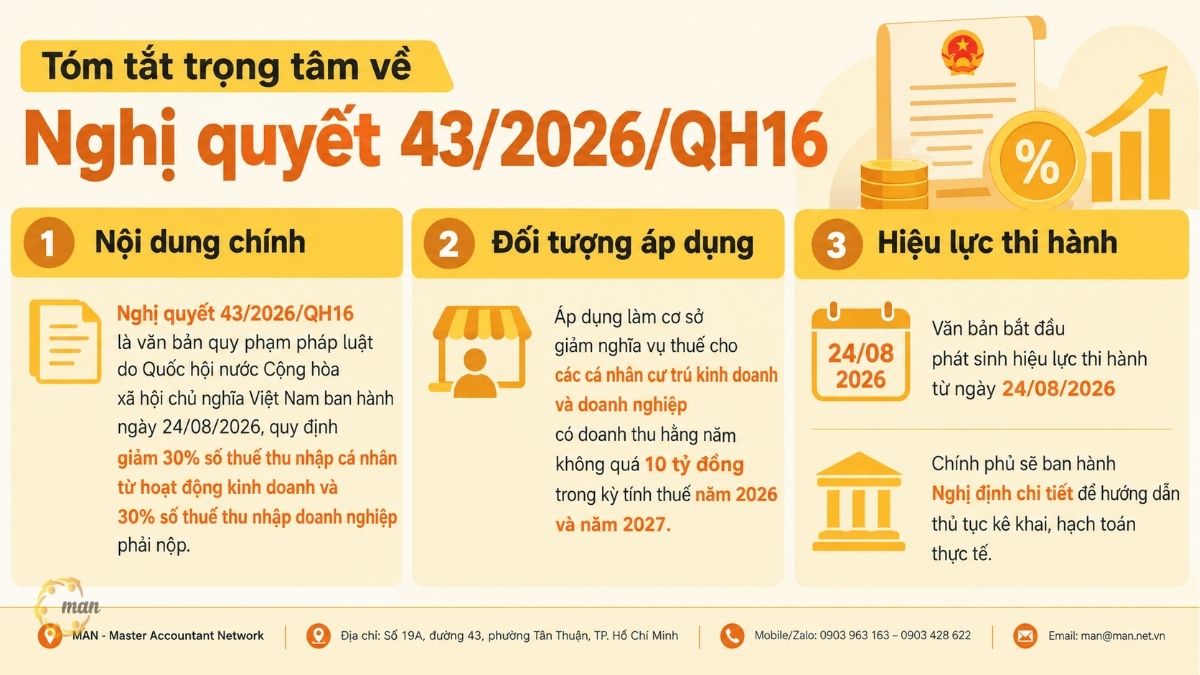
- Resolution 43/2026/QH16 is a legal document issued by the National Assembly of the Socialist Republic of Vietnam on August 24, 2026, stipulating a reduction of 30% in personal income tax from business activities and 30% in corporate income tax payable.
- This document is applied as the basis for reducing tax obligations for resident business individuals and enterprises with annual revenue not exceeding VND 10 billion in the tax periods of 2026 and 2027.
- The document will come into effect on August 24, 2026, and the Government will issue a detailed Decree to guide the procedures for declaration and actual accounting.
What is Resolution 43/2026/QH16 and what are its core provisions?

Resolution 43/2026/QH16 is a legal document passed by the 16th National Assembly on August 24, 2026, at its First Extraordinary Session. The document stipulates a mechanism for temporary tax exemptions and reductions aimed at alleviating financial difficulties for small and medium-sized enterprises (SMEs) in Vietnam.
The legal nature and validity period of Resolution 43/2026/QH16
From a legislative standpoint, this is an additional tax exemption policy that provides fiscal support for a fixed period. The text applies to two consecutive fiscal years, encompassing the tax periods of 2026 and 2027.
The official document takes effect from August 24, 2026. All income tax obligations arising in the tax periods of 2026 and 2027 that meet the revenue requirements are eligible for the reduction as stipulated.
Detailed structure of the resolution clauses and content.
The document's structure consists of two fundamental articles that comprehensively cover the principles of tax administration:
- Article 1 specifies the scope of tax reductions, the reduction rate (30%), the revenue ceiling condition of VND 10 billion/year, exclusion clauses for cases of business splits after the effective date, and the calculation principles for businesses currently enjoying preferential packages. corporate income tax other.
- Article 2 stipulates the effective date of implementation as August 24, 2026, the period of application for the tax years 2026 and 2027, and assigns responsibility to the Government to issue a Decree providing detailed regulations.
From MAN's perspective, this streamlined structure makes it more accessible to taxpayers; however, the exclusions in Article 1 require careful consideration when determining quarterly provisional tax payments.
The impact of Resolution 43/2026/QH16 on corporate financial governance, taxation, and auditing.

Tax exemption policies are not simply about adjusting figures on year-end tax returns. From a management perspective, these policies have a profound impact on cash flow structure and financial reporting.
Optimizing cash flow and short-term cost of capital.
Retaining the corporate and personal income tax payable (30%) creates an immediate source of internal working capital for the business. This capital does not incur capital costs or bank interest, allowing the business to proactively reinvest in inventory, machinery, or expand its distribution channels.
In the context of volatile input costs, reducing direct tax obligations helps improve operating cash flow, increasing net profit margins for small businesses.
Requirements for allocating income and expenses in financial reporting.
For auditing and accounting purposes, regulations require businesses to clearly separate income from business operations eligible for preferential treatment from other income (such as real estate transfers, capital transfers, and income from asset liquidation).
If a business operates in multiple sectors or has multiple sources of income, failing to keep separate accounting records can lead to the risk of the tax authorities rejecting the tax reduction for income not eligible for preferential treatment.
Increased risk of revenue scrutiny from tax authorities.
Due to the revenue ceiling of 10 billion VND per year, tax authorities will intensify their efforts to extract data from the electronic invoice system to verify the integrity of revenue. Acts of delaying revenue recognition or concealing revenue to maintain a level below 10 billion VND will be quickly detected by the tax authorities' risk management algorithms.
The consulting team at MAN – Master Accountant Network notes that revenue verification is typically performed by reconciling cash flow through bank accounts and outgoing invoice data; therefore, businesses need to ensure consistency across their entire accounting system.
Which entities are eligible for tax incentives under Resolution 43/2026/QH16?
Accurately identifying the beneficiaries is a prerequisite for determining whether a business or individual is eligible for tax reduction. The document divides beneficiaries into two main groups.
Individuals residing in Vietnam who earn income from business activities.
Individuals residing in Vietnam who are engaged in the production and business of goods and services in all sectors and fields as prescribed by law are directly affected by this regulation.
The conditions for application are that the individual must have total revenue from production and business activities in 2026 not exceeding 10 billion VND and in 2027 not exceeding 10 billion VND. The applicable reduction rate is 30% number. personal income tax Taxes payable arising from that business activity.
Group of businesses and economic organizations with revenue under 10 billion VND.
The entities eligible for corporate income tax reduction include businesses and organizations legally established and operating under Vietnamese law (such as Limited Liability Companies, Joint Stock Companies, Private Enterprises, Cooperatives, and Cooperative Unions).
Businesses must have total annual revenue for the 2026 tax year not exceeding VND 10 billion and for the 2027 tax year not exceeding VND 10 billion. This regulation applies uniformly, regardless of the tax payment method or industry, except in cases where splitting is restricted.
Conditions for application and exclusions according to Resolution 43/2026/QH16
Legislators designed technical regulations to ensure that policies reach the intended recipients while preventing loopholes used for personal gain.
Principles for determining the revenue ceiling of 10 billion VND/year
Annual revenue used as the basis for considering tax reduction eligibility is the total revenue from the sale of goods, processing fees, and service provision fees, including subsidies, surcharges, and additional fees received by the business or individual during the fiscal year.
For newly established businesses or those operating for less than 12 months in 2026 or 2027, the method for converting revenue to meet the 10 billion VND requirement will be specified in detail in the Government's guiding decree.
Regulations restricting the splitting or separation of businesses after August 24, 2026.
To prevent large businesses from splitting into smaller units to reduce the revenue of each unit to below 10 billion VND, the regulation stipulates very strict exclusion clauses.
Accordingly, the 30% corporate income tax reduction will not apply to businesses formed from the division or separation of enterprises after the effective date of the Resolution (August 24, 2026), if the total annual revenue of all enterprises after the division or separation in 2026 or 2027 exceeds VND 10 billion.
How to combine calculations when a business is already enjoying other corporate income tax incentives.
One point that businesses currently enjoying corporate income tax incentives (such as preferential tax rates, tax exemptions, or tax reductions based on investment location or preferred industry) need to pay special attention to is the formula for determining the additional tax reduction amount.
In cases where a business is enjoying tax incentives under the Corporate Income Tax Law or other Laws and Resolutions, the amount of corporate income tax reduced will be calculated on the remaining corporate income tax payable after deducting the portion of corporate income tax currently enjoying incentives as stipulated.
The specific formula is as follows:
|
Corporate income tax reduction amount = (Corporate income tax payable at the current tax rate – Corporate income tax currently under preferential treatment) x 30% |
The system of legal documents serving as the basis and guiding the implementation related to Resolution 43/2026/QH16.
The correct application of the regulations requires consistent reference to existing legal documents within the Vietnamese tax legal system.
List of Laws and Resolutions serving as the basis for promulgation
The resolution was adopted by the National Assembly based on the latest revised and updated legal grounds:
- Constitution of the Socialist Republic of Vietnam (as amended and supplemented by Resolution No. 203/2025/QH15).
- Law on the Organization of the National Assembly No. 57/2014/QH13 (amended and supplemented by Law No. 65/2020/QH14 and Law No. 62/2025/QH15).
- Law on Personal Income Tax No. 109/2025/QH15 (amended and supplemented by Law No. 09/2026/QH16).
- Law on Corporate Income Tax No. 67/2025/QH15 (amended and supplemented by Laws No. 116/2025/QH15, No. 127/2025/QH15, No. 133/2025/QH15, No. 141/2025/QH15, No. 143/2025/QH15 and No. 09/2026/QH16).
- Law on the Promulgation of Legal Normative Documents No. 64/2025/QH15 (amended and supplemented by Law No. 87/2025/QH15).
Key issues awaiting guidance in the Government Decree.
According to Clause 2, Article 2, the Government will issue a Decree providing detailed regulations. This Decree will clarify technical issues including:
- Methods for determining revenue for businesses that operate for less than 12 months in a fiscal year.
- The Appendix form for declaring the tax reduction amount is attached to the Corporate Income Tax and Personal Income Tax Final Settlement Declaration.
- Procedures for handling corporate income tax and personal income tax that have been provisionally paid for the quarters prior to the issuance and effective date of the Resolution.
The solution from MAN – Master Accountant Network recommends that accounting departments prepare detailed monthly revenue data in advance so that it can be applied immediately when the Decree is officially issued.
Practical Case Study: Tax Calculation Method According to Resolution 43/2026/QH16 for Two Business Models
To help managers clearly visualize the process for determining the amount of tax reduction, MAN has developed two practical calculation scenarios applicable to the 2026 tax year.
Situation 1: The manufacturing enterprise is enjoying preferential treatment for being located in a disadvantaged area.
Precision B Mechanical Co., Ltd. was established and operates in an area with difficult socio-economic conditions. In 2026, the company's financial figures were as follows:
- Total revenue in 2026: VND 8.8 billion (Eligible for revenue under VND 10 billion).
- Corporate income tax: 1.2 billion VND.
- The preferential tax rate currently in effect is: 15%.
The company is currently in the process of receiving a reduction in corporate income tax payable under the investment incentives for the locality.
The process for calculating corporate income tax payable in 2026:
- Step 1: Calculate the corporate income tax amount at the preferential tax rate: 1,200,000,000 x 15% = 180,000,000 VND.
- Step 2: Calculate the amount of corporate income tax reduced according to the local preferential rate (50%): 180,000,000 x 50% = 90,000,000 VND.
- Step 3: Determine the remaining corporate income tax payable after the local tax incentive: 180,000,000 – 90,000,000 = 90,000,000 VND.
- Step 4: Calculate the amount of corporate income tax reduced under the new regulations: 90,000,000 x 30% = 27,000,000 VND.
- Step 5: The actual corporate income tax that Precision B Company must pay in 2026: 90,000,000 – 27,000,000 = 63,000,000 VND.
Situation 2: A household business paying taxes using the declaration method has revenue of 6.5 billion VND.
Business owner Tran Van C is engaged in the distribution of electronic equipment. In 2026, the business declared the following figures:
- Total sales revenue in 2026: VND 6.5 billion (Eligible for revenue under VND 10 billion).
- Personal income tax rate based on revenue for the goods distribution industry: 0.5%.
The process for calculating the personal income tax payable in 2026:
- Step 1: Calculate the personal income tax payable according to standard regulations: 6,500,000,000 x 0.5% = 32,500,000 VND.
- Step 2: Calculate the amount of personal income tax reduced under the new regulations: 32,500,000 x 30% = 9,750,000 VND.
- Step 3: The actual personal income tax Mr. C has to pay in 2026: 32,500,000 – 9,750,000 = 22,750,000 VND.
The two examples above clearly illustrate the principle of sequentially deducting incentives, ensuring accurate adherence to the spirit of the legal document.
A comprehensive comparison table of regulations on corporate income tax and personal income tax reductions according to Resolution 43/2026/QH16.
The table below summarizes the core legal criteria to help taxpayers easily compare the two groups eligible for tax reductions:
| Comparison criteria | Corporate Income Tax (CIT) | Personal Income Tax |
| Applicable objects | Businesses and organizations established under Vietnamese law. | Individuals residing in Vietnam who have income from production and business activities. |
| Tax reduction | Reduce the corporate income tax payable by 30%. | Reduce the amount of personal income tax payable from business activities by 30%. |
| Revenue threshold | Total annual revenue shall not exceed 10 billion VND. | Total annual revenue shall not exceed 10 billion VND. |
| Applicable tax period | Tax periods 2026 and 2027. | Tax periods 2026 and 2027. |
| Exclusion conditions for splitting | Excluding businesses split after August 24, 2026, where the total revenue of all companies exceeds VND 10 billion. | The provisions for splitting a household business do not apply. |
| Principle of coordinated incentives | Calculate 30% on the remaining tax amount after deducting other corporate income tax incentives. | Calculate 30% directly on the personal income tax generated from business activities. |
| Based on the terms | Clause 2, Article 1 of Resolution 43/2026/QH16. | Clause 1, Article 1 of Resolution 43/2026/QH16. |
MAN experts identify the four biggest tax risks when businesses self-declare under Resolution 43/2026/QH16.
Despite the policy's clear financial benefits, audits at many entities reveal that businesses are highly susceptible to serious legal errors. Experts at MAN, with 30 years of experience, highlight the following four key risks:
Risk of miscalculating the timing of revenue recognition to lower revenue below 10 billion.
Many businesses are deliberately shifting the revenue recognition date from 2026 to 2028 or pushing it back to 2025 in order to lower their total revenue for 2026 to below 10 billion VND.
During a tax audit, if the tax authorities use electronic invoice data and handover records to reassess the revenue recognition date, the total revenue for 2026 will be adjusted to exceed 10 billion VND. The business will have all the reduced tax amount (30%) disallowed, be subject to back taxes, late payment penalties, and administrative fines for incorrect declarations.
Risk of being subject to retroactive tax collection due to business splits without justifiable economic reasons.
Businesses undergoing splits or separations after August 24, 2026, need to prepare documentation demonstrating legitimate commercial reasons. The tax authorities are currently using artificial intelligence tools to link businesses with the same owner, the same business location, or shared human resources.
If it is discovered that the split was solely for the purpose of dividing revenue to benefit from tax reductions, the authorities will consolidate the revenue of the member units. When the total revenue exceeds 10 billion VND, all units formed after the split will be required to pay back the tax amount that was declared as reduced.
Errors in the order of applying overlapping corporate income tax incentives.
A common mistake made by accounting departments in businesses receiving tax reductions based on location or industry is miscalculating the order of payments. Accountants often multiply the total tax payable by the 30% amount before subtracting the local tax discount.
The correct procedure requires deducting the preferential tax amount under the Corporate Income Tax Law first, and only then applying the 30% reduction rate to the remaining tax amount. Calculating in the wrong order will unjustifiably increase the tax reduction amount and lead to the risk of penalties during tax settlement.
Accounting risks and late filing while awaiting guiding decrees.
While awaiting the Government's issuance of a detailed decree, many businesses are confused about making quarterly provisional corporate income tax payments for 2026. If a business makes a provisional payment that is significantly less than the actual tax payable (even after deducting the expected reduction), it may still be charged late payment penalties according to the provisions of the Tax Administration Law.
Understanding the realities of tax risk management in Vietnam, MAN recommends that businesses conduct regular tax health checks to closely monitor revenue thresholds and calculation methods before finalizing their year-end accounts.
Conclude
Resolution 43/2026/QH16 is a practical fiscal policy, providing direct financial support solutions for small businesses and individual entrepreneurs in 2026 and 2027. Proactively updating regulations, accurately controlling revenue milestones, and correctly accounting for preferential treatment will help taxpayers optimize tax costs safely and legally.
Tax services at MAN – Master Accountant Network
- Tax accounting services
- Tax consulting services
- Tax settlement services
- Tax reporting services
- VAT refund service
Service contact information at MAN – Master Accountant Network
- Address: No. 19A, Street 43, Tan Thuan Ward, Ho Chi Minh City
- Mobile/Zalo: 0903 963 163 – 0903 428 622
- E-mail: man@man.net.vn
- Google Business Profile: View MAN – Master Accountant Network's Google Business Profile
- LinkedIn Founder: View expert Le Hoang Tuyen's LinkedIn profile.
Responsible for production and professional content review by: Mr. Le Hoang Tuyen – Founder & CEO of MAN – Master Accountant Network, CPA Vietnam with over 30 years of experience in accounting, auditing, taxation, and corporate financial consulting.
Frequently Asked Questions about Resolution 43/2026/QH16 (FAQ)
Will businesses established in 2026 be eligible for tax reductions?
Yes. Newly established businesses in 2026 with actual revenue generated in 2026 not exceeding VND 10 billion are still eligible for the reduction of Corporate Income Tax (CIT) under Article 30%. The rules for determining revenue for operating months will follow the Government's guiding Decree.
Are household businesses paying taxes using the lump-sum method eligible for personal income tax reduction?
Yes. Individuals residing in Vietnam who pay taxes using the lump-sum method and have annual revenue not exceeding VND 10 billion are eligible for a reduction in personal income tax payable from business activities in 2026 and 2027.
Does this resolution apply to the reduction of Value Added Tax (VAT)?
No. This document only stipulates a reduction in personal income tax from business and corporate income tax; it does not stipulate a reduction in VAT or other taxes.
How should a business be calculated if its revenue in 2026 is 9.5 billion VND but in 2027 it is 11 billion VND?
The company was granted a reduction of 30% corporate income tax for the tax period of 2026. However, in the tax period of 2027, because its revenue exceeded 10 billion VND, the company was no longer eligible for the tax reduction.
Do businesses need to submit an application for tax reduction to the tax authorities?
No. Under the self-declaration and self-payment mechanism, businesses determine their own eligibility, calculate the amount of tax reduction, and declare it in the Tax Reduction Appendix attached to the Corporate Income Tax Return when submitting it to the tax authorities.




