


Are individuals and household businesses acting as agents eligible for a reduction in personal income tax under Decree 30% as stipulated in Resolution 43? This is a top legal concern for tens of thousands of insurance agents, lottery agents, multi-level marketing agents, and other commercial agents nationwide during the tax periods of 2026 and 2027. Entering the 2026-2027 period, Vietnam's tax legal system will undergo significant changes with the introduction of the Personal Income Tax Law 2025, the Tax Administration Law 2025, and a series of implementing decrees. These changes require business owners to thoroughly understand the legal basis to ensure their rights to tax incentives, optimize operating costs, and avoid the risk of tax arrears or administrative penalties.
In order to support the recovery and economic development of the individual business sector, the National Assembly has issued... Resolution 43/2026/QH16 This policy offers practical tax exemptions and reductions. However, due to the unique nature of agency activities, which often fall between salary, wages, brokerage, and business income, many agencies are still confused about whether they qualify. The team of expert consultants at MAN – Master Accountant Network, with over 30 years of practical experience in accounting, auditing, and tax consulting in Vietnam, will provide a comprehensive and detailed analysis of the legal basis, application conditions, and the most accurate tax declaration process for taxpayers.
In summary, the main question is whether individuals and household businesses acting as agents are eligible for personal income tax reduction under Resolution 43 (specifically, tax code 30%).
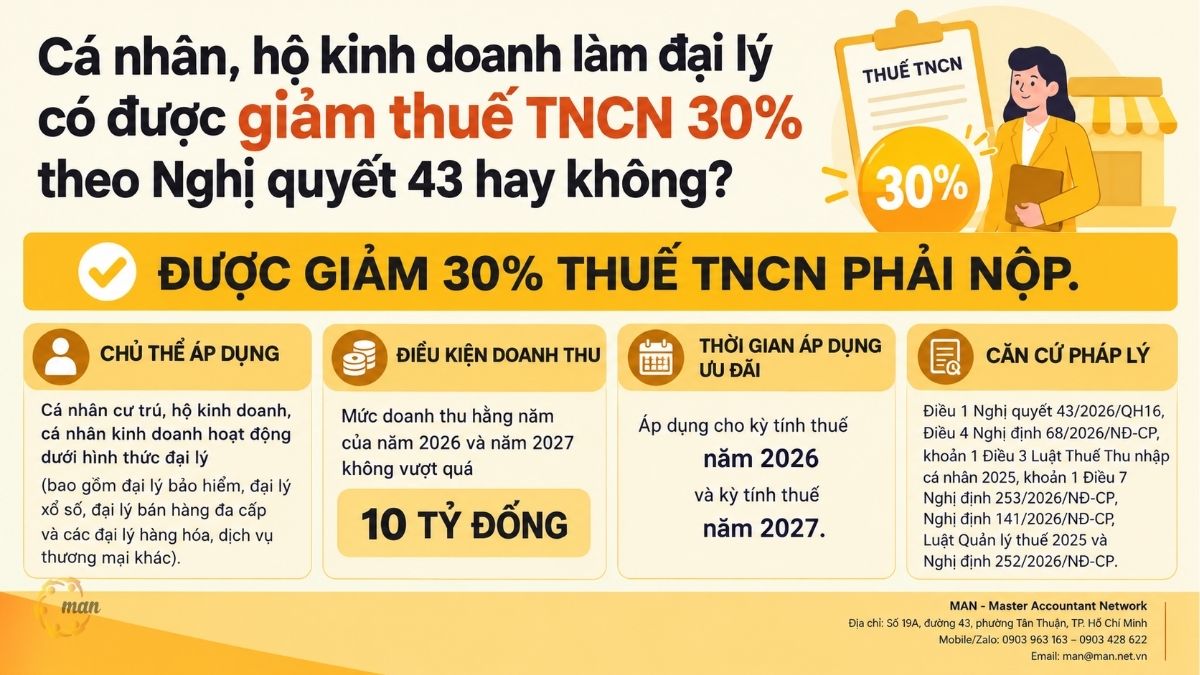
The question of whether individuals and household businesses acting as agents are eligible for a reduction in personal income tax (30%) under Resolution 43 has been answered with the affirmative: YES, THEY ARE ELIGIBLE FOR A REDUCTION IN PERSONAL INCOME TAX (30%) PAID.
- Applicable entities: Individuals residing in Vietnam, household businesses, and individuals operating as agents (including insurance agents, lottery agents, multi-level marketing agents, and other agents for commercial goods and services).
- Revenue requirements: Annual revenue for 2026 and 2027 shall not exceed 10 billion VND.
- Offer valid for the following period: Applicable to the tax periods of 2026 and 2027.
- Legal basis: Article 1 of Resolution 43/2026/QH16, Article 4 of Decree 68/2026/ND-CP, Clause 1, Article 3 of the Personal Income Tax Law 2025, Clause 1, Article 7 of Decree 253/2026/ND-CP, Decree 141/2026/ND-CP, the Tax Administration Law 2025, and Decree 252/2026/ND-CP.
Are individuals and household businesses acting as agents eligible for a reduction in personal income tax under Decree 30% as stipulated in Resolution 43?

Answer the question directly. Are individuals and household businesses acting as agents eligible for a reduction in personal income tax under Decree 30% as stipulated in Resolution 43?Individuals and household businesses operating as agents 30% IS COMPLETELY REDUCED The amount of personal income tax payable for the tax periods of 2026 and 2027, provided that annual revenue does not exceed 10 billion VND.
This legal conclusion is based on the synchronized alignment between the National Assembly Resolution, the relevant tax laws, and the Government Decrees issued for the period 2026-2027.
Based on Article 1 of Resolution 43/2026/QH16, the regulations on personal income tax reduction are as follows:
“Article 1. Reduction of personal income tax, reduction of corporate income tax
- Reduce the personal income tax payable for the tax periods of 2026 and 2027 for income from business activities of resident individuals with annual revenue in 2026 and 2027 not exceeding VND 10 billion.”
Based on Article 4 of Decree 68/2026/ND-CP, individuals residing in Vietnam who engage in production and business activities, including individuals registering to establish a household business or individuals authorized by household members to act as representatives of the household business, are considered business individuals.
Simultaneously, Clause 1, Article 3 of the Personal Income Tax Law 2025 and the content of Clause 1, Article 7 Decree 253/2026/ND-CP The regulations stipulate that taxable income from business activities includes six specific groups:
- Income from the production and business of goods and services as prescribed by law. Specifically, for income from the activities of households and individuals directly producing agricultural products, planted forests, livestock, aquaculture, and fishing products that have not been processed into other products or have only undergone basic processing, and salt production, this tax exemption only applies in cases where the conditions for tax exemption stipulated in Article 21 of Decree 253/2026/ND-CP are not met.
- Income derived from the independent professional activities of individuals holding a license or professional certificate and registered business in accordance with the law.
- Income from agency activities, including insurance agents, lottery agents, and multi-level marketing agents.
- Income from brokerage activities as regulated by law.
- Income derived from business cooperation activities with organizations and enterprises.
- Income from e-commerce business activities and business based on digital platforms.
According to the detailed regulations above, individuals and business households with income from agency activities, including insurance agents, lottery agents, and multi-level marketing agents, are considered to have income from business activities.
Therefore, individuals and household businesses acting as agents with annual revenue in 2026 and 2027 not exceeding 10 billion VND will be eligible for a reduction of 30% number. personal income tax payable for the corresponding tax period according to Resolution 43/2026/QH16.
In-depth analysis of the legal basis and conditions for receiving agency tax incentives.
To correctly apply the 30% tax reduction policy, taxpayers need to clearly understand each link in the chain of legal regulations governing income from agency.
The legal nature of agency income in the Personal Income Tax Law 2025
Previously, many individual agents often wondered whether the commission income received from the agency was considered salary or business income. The introduction of the Personal Income Tax Law 2025 and... Decree 253/2026/ND-CP This concept has been completely standardized.
Clause 1, Article 7 of Decree 253/2026/ND-CP includes all agency activities (insurance, lottery, multi-level marketing, goods and services agency) in the category of income from business activities. This classification is of fundamental importance. When agency income is determined to be income from business activities, the entity generating the income immediately satisfies the conditions regarding the income group stated in Article 1 of Resolution 43/2026/QH16.
Mechanism for controlling annual revenue of 10 billion VND.
The policy of reducing personal income tax under Resolution 43/2026/QH16 applies a mechanism to cap annual revenue in order to focus support on the right individuals and small and medium-sized business households.
- How to determine taxable revenue: Taxable agency revenue is the total amount of commissions, discounts, sales bonuses, service fees, and other surcharges received by the agency during the tax period (2026 or 2027).
- The principles for calculating revenue include: The calculation is based on all of an individual's business income sources for the year, not separating each agency contract individually if the individual acts as an agent for multiple different entities.
- What to do when exceeding the 10 billion VND limit: If the total revenue from business activities in the year exceeds 10 billion VND by even just 1 VND, the individual business owner will not be eligible for the personal income tax reduction (30%) for the entire tax amount incurred during that tax period.
What are the requirements for business households to file quarterly tax returns for VAT and personal income tax in 2026?
The changes in the tax declaration process in 2026 bring many advantages to business households acting as agents, but also require precise adherence to the declared revenue threshold.
Based on Article 10 of Decree 68/2026/ND-CP, as amended by Clause 1, Article 1 of Decree 141/2026/ND-CP, the following is stipulated:
“Article 10. Tax declaration and payment of value-added tax and personal income tax for business households and individual businesses with annual revenue exceeding 1 billion VND.
- Filing tax returns and paying value-added tax.
- a) In cases where annual revenue is 50 billion VND or less, value-added tax declarations and payments shall be made quarterly;
- b) In cases where annual revenue exceeds 50 billion VND, value-added tax (VAT) declarations and payments shall be made monthly.
- Filing and paying personal income tax.
- a) Household businesses and individual businesses that choose to pay personal income tax using the tax rate multiplied by (x) taxable revenue shall declare and pay personal income tax quarterly, at the same time as declaring and paying value-added tax;
- b) Household businesses and individual businesses subject to personal income tax under the method of taxable income multiplied by the tax rate shall declare and pay provisional personal income tax monthly or quarterly on the same value-added tax return. The amount of provisional personal income tax paid shall be equal to the tax rate multiplied by the taxable revenue of the month or quarter, and the final personal income tax return shall be filed annually. If the amount of provisional personal income tax paid is less than the amount declared provisionally paid, or if the provisional tax paid is less than the amount payable upon final settlement, the household business or individual business shall make the additional payment and shall not be charged late payment penalties. If the amount of provisional personal income tax paid is more than the amount payable upon final settlement, the procedure for handling the overpaid tax shall be carried out in accordance with the provisions of Article 12 of this Decree.”
Therefore, the conditions for a household business to be registered are as follows... VAT For the quarter of 2026, the target is annual revenue of 50 billion VND or less. Regarding personal income tax, the declaration and payment deadline will be the same as for value-added tax.
What is the penalty for late tax payments for household businesses from July 1, 2026?
Tax administration will be tightened from mid-2026 with the application of the 2025 Tax Administration Law. Business owners and agents need to understand the regulations on penalties for late payment to avoid unnecessary financial burdens.
Based on Clause 2, Article 16 of the 2025 Tax Administration Law (effective from July 1, 2026), the following is stipulated:
“Article 16. Handling of late payment of taxes and other fees
- The rates and periods for calculating late payment penalties are stipulated as follows:
- a) The late payment penalty is calculated at 0.031 TP3T/day on the amount of tax and other charges overdue for collection by the tax authority, and 0.031 TP3T/day on the amount of tax overdue for collection by the customs authority;
- b) The period for calculating late payment penalties shall be in accordance with the regulations of the Government.”
From July 1st, 2026, businesses that are late in paying taxes will be subject to a late payment penalty of 0.031 TP3T/day calculated on the amount of tax overdue. This penalty will be applied based on the actual number of days of delay.
The formula for calculating late payment penalties as applied in practice:
|
Late payment penalty = Amount of tax overdue x 0.03% x Actual number of days overdue |
The period for calculating late payment penalties is according to Decree 252/2026/ND-CP.
According to Clause 1, Article 26 of Decree 252/2026/ND-CP, the time for calculating late payment penalties is specified in the following two cases:
Case 1: Late payment of taxes as per tax obligations.
The period for calculating late payment penalties is continuous from the day immediately following the last day of the deadline for paying taxes, other revenues, or any extended payment deadline, or the deadline stated in the notice, tax assessment decision, tax authority's handling decision, or decision or document of a competent state agency, until the day immediately preceding the date on which the amount of tax debt, other revenue debt, additional tax, additional other revenue, assessed tax, assessed other revenue, delayed tax transfer, or delayed other revenue is paid into the state budget.
Case 2: Revoking tax refunds or tax exemptions/reductions
The period for calculating late payment penalties is continuous from the date the State Treasury disburses the tax refund or the date the State Treasury accounts for the offsetting of the tax refund against state budget revenue according to the decision on tax refund recovery by the tax authority, or from the date of the decision on tax exemption, tax reduction or notification of tax exemption, tax reduction until the day immediately preceding the date the recovered tax refund, tax exemption, or tax reduction amount is paid into the state budget.
Summary of legal documents regulating agency tax for the years 2026-2027
The legal framework directly regulating tax obligations and preferential policies for household business agents is summarized in detail in the table below:
| Legal documents | Issuing authority / Validity | The core content applies to sole proprietorships and individual business agents. |
| Resolution 43/2026/QH16 | National Assembly (Applicable to tax period 2026 – 2027) | Regulation 30% reduces personal income tax for individual business owners with annual revenue not exceeding 10 billion VND. |
| Personal Income Tax Law 2025 | National Assembly (Effective from 2026) | Income from agency activities (insurance, lottery, multi-level marketing, commerce) falls under the category of business income. |
| Tax Administration Law 2025 | National Assembly (Effective from July 1, 2026) | The regulation stipulates a penalty for late tax payments of 0.031 TP3T/day on the actual amount of tax owed. |
| Decree 68/2026/ND-CP | Government (Effective from 2026) | Regulations governing tax management for household businesses, individual businesses, and individual business status. |
| Decree 141/2026/ND-CP | Government (Amendment to Decree 68/2026) | Amend Article 10 regarding the conditions for quarterly VAT and personal income tax declarations for revenue of VND 50 billion or less. |
| Decree 253/2026/ND-CP | Government (Effective from 2026) | The guidelines for the Personal Income Tax Law stipulate six groups of taxable income from business activities. |
| Decree 252/2026/ND-CP | Government (Effective from 2026) | The regulations detail the time period for calculating late payment penalties for taxes and the handling of recovery of tax exemptions and reductions. |
Comparing two methods of personal income tax declaration applied to agency business households.
Understanding the differences between the two methods of calculating personal income tax helps business owners choose the accounting model that best suits their specific circumstances.
| Comparison criteria | Method of % Ratio on Revenue | Method: Taxable Income x Tax Rate |
| Basis for calculating personal income tax. | Actual revenue x % ratio as stipulated | (Revenue – Eligible Expenses) x Tax Rate |
| Filing deadline | File and pay quarterly (if revenue is under 50 billion VND) | Monthly/quarterly provisional tax payments; Annual personal income tax final settlement. |
| How to apply the 30% personal income tax reduction. | Subtract 30% directly from the tax amount calculated at a rate of %. | Reduce 30% on the total personal income tax payable for the year. |
| Request for accounting records and documents | Track sales invoices and commission revenue. | Maintain complete accounting records and valid receipts and disbursements. |
| Nature of penalties for late payment | Late submission of quarterly tax returns will result in a late filing penalty. | No late payment penalty will be applied for provisional payments that fall short of the final settlement amount. |
| Suitable for all target groups | Small dealers, input costs are difficult to verify. | Large-scale dealerships with clearly defined operating costs. |
Real-world case study: Analysis of tax obligations and reductions for insurance agents in 2026
To help our readers better understand the tax calculation process and the application of incentives under Resolution 43/2026/QH16, let's analyze a real-life case study handled by the MAN consulting team.
Real life situation
Ms. Nguyen Thi C registered as an individual business owner acting as an insurance agent in Hanoi. In 2026, Ms. C's agency activities generated the following financial figures:
- Total insurance commission revenue received in 2026: 4.5 billion VND.
- Tax declaration and payment methods: The method of applying a ratio of % to taxable revenue.
- Tax rate as stipulated: VAT (5%) and Personal Income Tax (2%) apply to insurance agency services.
- Filing period: Because her revenue was 4.5 billion VND (less than 50 billion VND), Ms. C chose to file VAT and personal income tax returns quarterly.
Detailed steps for calculating tax obligations.
Step 1: Check eligibility for tax reduction under Resolution 43/2026/QH16
- Revenue in 2026 is 4.5 billion VND, which is less than the 10 billion VND threshold.
- Income from insurance agency services is considered business income as defined in Clause 1, Article 7 of Decree 253/2026/ND-CP.
- Conclude: Ms. C's business is eligible for a reduction of 30% personal income tax payable in 2026.
Step 2: Determine the VAT payable for 2026
VAT payable = 4,500,000,000 x 5% = 225,000,000 VND
Each of the three ladies, Ms. C, declared and paid 56,250,000 VND in VAT.
Step 3: Determine personal income tax and the reduction rate for taxable income as stipulated in Resolution 43/2026/QH16.
- Personal income tax incurred before the tax reduction:
- Personal income tax before reduction = 4,500,000,000 x 2% = 90,000,000 VND
- The amount of personal income tax reduced by 30% according to Resolution 43/2026/QH16:
- The amount of personal income tax reduced = 90,000,000 x 30% = 27,000,000 VND
- Actual personal income tax payable in 2026:
- Personal income tax actually paid = 90,000,000 – 27,000,000 = 63,000,000 VND
Step 4: Evaluate the effectiveness of tax administration.
Ms. C directly saved 27 million VND in personal income tax expenses in 2026. At the same time, filing quarterly helped Ms. C optimize her operating cash flow instead of having to file monthly returns.
Expert analysis from MAN on common tax risks and management solutions.
In reality, consulting with thousands of household businesses and agency enterprises in Vietnam shows that many business owners still face significant problems with tax authorities due to a lack of understanding of legal regulations. Experts at MAN, with 30 years of experience, point out the following key risks.
Common mistakes made by agency businesses
- Confusion between sales revenue and commission revenue: Many commercial agents sell goods at the fixed price but declare the entire sales revenue as the income of their household business. This causes their revenue to unreasonably exceed 10 billion VND, resulting in the loss of the preferential tax reduction under Article 30% for personal income tax and creating serious VAT risks.
- Missing sales bonuses and incentives: According to Decree 253/2026/ND-CP, all bonuses for achieving targets, expense support payments, and trade discounts paid by the principal are considered taxable revenue. Omitting these amounts will result in tax assessment and a penalty of 0.031 TP3T/day as per the 2025 Tax Administration Law.
- Disagreement on the tax deduction method with the principal: For individual agents who are not registered as household businesses, the principal usually deducts personal income tax at source. However, if the individual is registered as a household business and self-declares their income, a lack of coordination between the two parties can lead to double tax deductions or omissions in tax settlements.
- Lack of tools to control quarterly revenue reporting thresholds: Many businesses experienced rapid growth during the year but did not closely monitor the 50 billion VND mark. If revenue exceeds 50 billion VND but they continue to file quarterly instead of monthly, they will be subject to administrative penalties for tax procedural violations.
MAN's solution for optimizing tax costs in Vietnam.
To eliminate the aforementioned risks, the solution from MAN – Master Accountant Network provides comprehensive support for agency businesses:
- Review the agency contract structure: Verify the exact nature of the contract—whether it's an insurance agency, lottery, multi-level marketing scheme, or commercial transaction—to correctly determine the taxable revenue category.
- Standardize accounting records and declarations: Establish a process for recording commission revenue and eligible expenses, ensuring accurate quarterly reporting in accordance with Decree 141/2026/ND-CP.
- Partnering with you for tax settlement and cost optimization in Vietnam: This guide explains how to properly prepare the application for a reduction in personal income tax (30%) according to Resolution 43/2026/QH16, ensuring compliance with legal standards and preventing risks of tax arrears or late payment penalties.
Conclude
The question of whether individuals and household businesses acting as agents are eligible for the personal income tax reduction under Resolution 43 (30%) has been clarified legally. Agency income is considered business income, and agents with annual revenue not exceeding 10 billion VND are eligible for the personal income tax reduction under Resolution 43 (30%) in 2026 and 2027. Proactively updating regulations on quarterly tax declarations is also crucial. Decree 141/2026/ND-CP The same late payment penalty of 0.031 TP3T/day from July 1, 2026, will help agents protect their cash flow and comply with the law.
Tax services at MAN – Master Accountant Network
- Tax accounting services
- Tax consulting services
- Tax settlement services
- Tax reporting services
- VAT refund service
Service contact information at MAN – Master Accountant Network
- Address: No. 19A, Street 43, Tan Thuan Ward, Ho Chi Minh City
- Mobile/Zalo: 0903 963 163 – 0903 428 622
- E-mail: man@man.net.vn
- Google Business Profile: View MAN – Master Accountant Network's Google Business Profile
- LinkedIn Founder: View expert Le Hoang Tuyen's LinkedIn profile.
Responsible for production and professional content review by: Mr. Le Hoang Tuyen – Founder & CEO of MAN – Master Accountant Network, CPA Vietnam with over 30 years of experience in accounting, auditing, taxation, and corporate financial consulting.
Frequently Asked Questions (FAQ) regarding whether agents are eligible for a reduction in personal income tax under Resolution 43 (30%).
Are multi-level marketing agents eligible for a reduction in personal income tax (PIT) under Resolution 43?
Yes. Income from multi-level marketing sales is defined as business income according to Clause 1, Article 7 of Decree 253/2026/ND-CP. Therefore, if the revenue in 2026 or 2027 does not exceed 10 billion VND, the multi-level marketing agent is fully entitled to a reduction in personal income tax.
If a business acting as an agent has a revenue of 12 billion VND in 2026, will it be eligible for a personal income tax reduction?
No. Resolution 43/2026/QH16 stipulates an annual revenue ceiling of no more than 10 billion VND. When revenue reaches 12 billion VND, the entire personal income tax for that year is not eligible for the 30% reduction.
What is the deadline for filing quarterly VAT and personal income tax returns for 2026?
Based on Article 10 of Decree 68/2026/ND-CP (amended by Decree 141/2026/ND-CP), the deadline for submitting quarterly tax returns is no later than the last day of the first month of the following quarter.
If I make provisional personal income tax payments during the year that are less than the amount due upon final tax settlement, will I be penalized?
According to point b, clause 2, Article 10 of Decree 68/2026/ND-CP, if the amount of provisional personal income tax paid is less than the amount payable upon final settlement, the business household shall pay the difference and shall not be charged late payment penalties for this shortfall.
How will penalties for late tax payments be calculated from July 1, 2026?
According to Clause 2, Article 16 of the 2025 Tax Administration Law, the late payment penalty is calculated at 0.031 TP3T/day on the actual amount of tax overdue. The calculation period is from the day immediately following the deadline to the day immediately preceding the date of payment into the State budget.




