Official Document 9940/TPHCM-QLDN3 The Ho Chi Minh City Tax Department, in a document issued on July 24, 2026, requests taxpayers to submit tax declarations electronically instead of in person on paper. This document was issued in the context of... Tax Administration Law 2025 and Circular 89/2026/TT-BTC This new law has just come into effect, establishing a new legal framework for all electronic tax transactions in Vietnam.
This is a concrete step in implementing the policy of digitizing tax management in Ho Chi Minh City, directly impacting hundreds of thousands of businesses and individuals with tax declaration obligations in the area. From this perspective... MAN – Master Accountant Network, As a tax consulting firm with over 30 years of practical experience in Vietnam, understanding the content of this document correctly helps businesses avoid delays in filing documents and minimize risks when the tax authorities cross-check data.
Summary of the key points in Official Document 9940
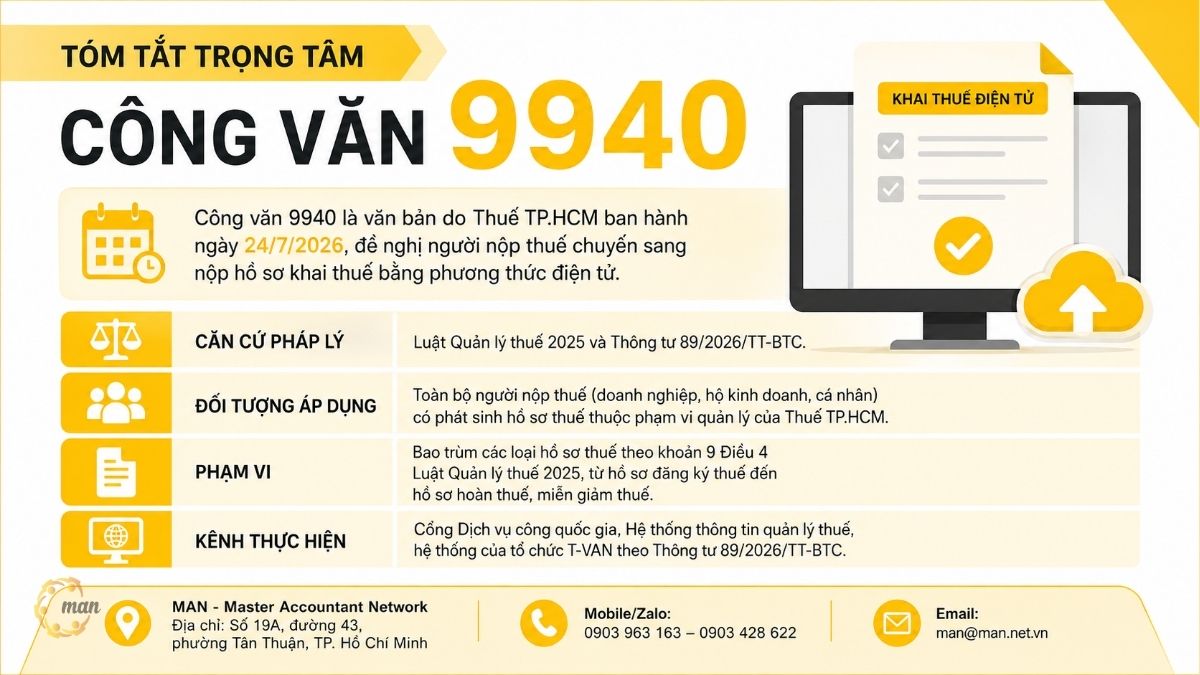
- Official document 9940, issued by the Ho Chi Minh City Tax Department on July 24, 2026, requests taxpayers to switch to submitting tax returns electronically.
- Legal basis: Law on Tax Administration 2025 and Circular 89/2026/TT-BTC.
- Applicable subjects: All taxpayers (businesses, household businesses, individuals) with tax records under the management of Ho Chi Minh City Tax Department.
- Scope: Covers all types of tax documents as stipulated in Clause 9, Article 4 of the 2025 Tax Administration Law, from tax registration documents to tax refund and tax exemption/reduction documents.
- Implementation channels: National Public Service Portal, Tax Management Information System, T-VAN organization systems as per Circular 89/2026/TT-BTC.
What is Official Document 9940? Definition and legal context.
Official Document 9940 is an administrative document issued by the Ho Chi Minh City Tax Department requesting and guiding taxpayers in the area to switch to submitting tax returns electronically. The document, numbered 9940/TPHCM-QLDN3 and issued on July 24, 2026, belongs to the category of operational guidance documents and is not a new legal regulation.
The content of the official document is based on two main legal foundations: the 2025 Tax Administration Law and Circular 89/2026/TT-BTC. This is an important point that many accountants need to note, because the official document itself does not create new regulations but merely reiterates and encourages the fulfillment of obligations already stipulated by law and circulars.
Specific legal basis of Official Letter 9940
The official document refers to Clause 9, Article 4 and Point a, Clause 2, Article 5 of the 2025 Tax Administration Law to determine the scope of tax documents, and also cites Point a, Clause 1, Article 7 and Point a, Clause 1, Article 9 of Circular 89/2026/TT-BTC to clarify the obligation for electronic transactions. Clause 9, Article 4 lists all types of tax documents, from tax registration documents, tax declaration documents, tax refund documents, tax exemption/reduction documents to customs documents.
The full scope of tax documentation is defined in Clause 9, Article 4 of the 2025 Law on Tax Administration.
This is a point many accountants overlook when reading Circular 9940, as they often only understand "tax records" as periodic tax declaration records. In reality, Clause 9, Article 4 of the 2025 Tax Administration Law stipulates that this concept encompasses many types of records, specifically including:
- Tax registration documents, tax return documents, documents for declaring other income.
- Tax filing documents, other payment documents.
- Application for extension of tax return filing deadline, application for extension of other income tax return filing deadline.
- Tax refund application, other refund application.
- Tax exemption application, other fee exemption application, tax reduction application, other fee reduction application.
- Tax-exempt records, records not subject to tax.
- Documents for writing off tax debts, documents for writing off tax debts.
- Applications for exemption from late payment penalties, applications for exemption from fines, and applications for exemption from late payment fees.
- Application for extension of tax payment deadline, application for extension of other payment deadline, application for extension of tax debt payment deadline.
- Documents for installment payment of outstanding tax debts and customs documents.
Therefore, when Official Letter 9940 requests the submission of tax returns electronically, the scope of application actually covers the entire group of documents mentioned above, not just monthly or quarterly tax returns.
How does the content of tax administration under Article 5 of the 2025 Tax Administration Law relate to Official Letter 9940?
Point a, Clause 2, Article 5 of the 2025 Tax Administration Law, as directly cited in Official Letter 9940, identifies the tax administration contents for which taxpayers carry out administrative procedures with the tax authorities. This group of contents includes: tax registration; tax declaration, tax calculation, tax deduction; tax payment, late payment penalties, fines; tax assessment; tax refund; handling of overpaid taxes, late payment penalties, and fines.
In addition, there are: tax exemptions, reductions, non-payment, and non-collection of taxes; tax debt write-offs and cancellations; waivers of late payment penalties and fines; extensions of tax payment deadlines and tax return filing deadlines; installment payments of tax debts; and enforcement of administrative decisions on tax management.
Each of the above contents is associated with a corresponding type of tax record. According to Article 7 of Circular 89/2026/TT-BTC, all administrative procedures belonging to this group of contents fall within the scope of electronic tax transactions that Official Letter 9940 proposes to apply.
Why is Circular 9940 important for businesses and taxpayers?
Prior to this official directive, many small and medium-sized enterprises in Ho Chi Minh City maintained the habit of submitting certain tax documents in paper form, especially tax exemption or tax payment extension applications. This practice carried the risk of lost documents, delays in processing, and difficulty in retrieving documents for verification when needed.
According to experts at MAN – Master Accountant Network, Furthermore, the complete shift to electronic methods helps businesses have a clear record of transactions, making it easier to prove the time of filing when disputes arise with tax authorities. This also serves as a basis for minimizing tax risks arising from administrative errors, one of the common causes of unfair penalties for businesses.
Who is affected by Official Document 9940?
Circular 9940 applies to all taxpayers under the management of Ho Chi Minh City Tax Department, regardless of business type or scale of operation. Specifically, this includes:
- Domestic businesses and foreign-invested enterprises (FDI) are filing tax returns in Ho Chi Minh City.
- Household businesses and individual business owners have an obligation to file tax returns as prescribed by law.
- Organizations and individuals may generate other types of tax documents such as tax refund applications, tax exemption applications, and tax payment extension applications.
- The entity is using the services of a T-VAN service provider to fulfill its tax obligations.
Points to note: The official document is not limited to a specific tax type. It applies to all tax declaration forms. value added tax, corporate income tax, personal income tax Or the initial tax registration records, all of which fall within the scope of the proposed electronic conversion.
From what date and under what conditions does Circular 9940 apply?
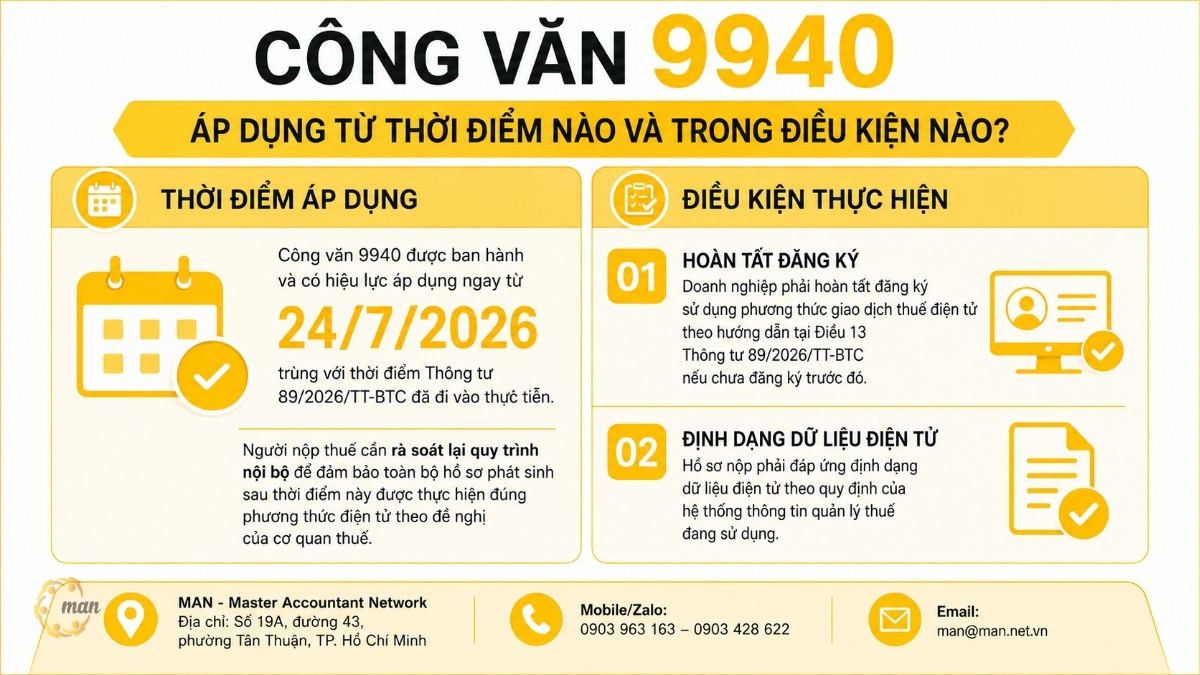
Official document 9940 was issued and came into effect on July 24, 2026, coinciding with the date Circular 89/2026/TT-BTC came into force. Therefore, taxpayers need to review their internal procedures to ensure that all documents generated after this date are processed electronically as requested by the tax authorities.
The implementation requirements consist of two parts: firstly, businesses must complete the registration for using electronic tax transaction methods as guided in Article 13 of Circular 89/2026/TT-BTC if they have not registered previously; secondly, the submitted documents must meet the electronic data format requirements of the tax management information system currently in use.
Legal documents related to Official Letter 9940
Important note: Circular 9940 is only valid for urging and guiding implementation within Ho Chi Minh City. Experts at MAN recommend that businesses in other provinces and cities should proactively contact their directly managing tax authorities to confirm the corresponding guidance document, avoiding confusion regarding the scope of application.
| Legal documents | Number / Date of Issue | Related content |
| Official Document 9940 | 9940/TPHCM-QLDN3, dated July 24, 2026 | Taxpayers are requested to submit their tax returns electronically. |
| Tax Administration Law 2025 | National Assembly issued | Clause 9 of Article 4 defines tax records; point a of clause 2 of Article 5 stipulates the content of tax management. |
| Circular 89/2026/TT-BTC | Ministry of Finance, 2026 | Guidelines for the implementation of the Law on Tax Administration, detailing regulations on electronic tax transactions in Articles 7, 8, 9, and 13. |
| Article 7 of Circular 89/2026/TT-BTC | Reference | Regulations governing the content of electronic transactions between taxpayers and tax authorities. |
| Articles 8 and 9 of Circular 89/2026/TT-BTC | Reference | Regulations on electronic information systems, electronic records and documents. |
Which system is used to conduct electronic tax transactions according to Official Letter 9940?
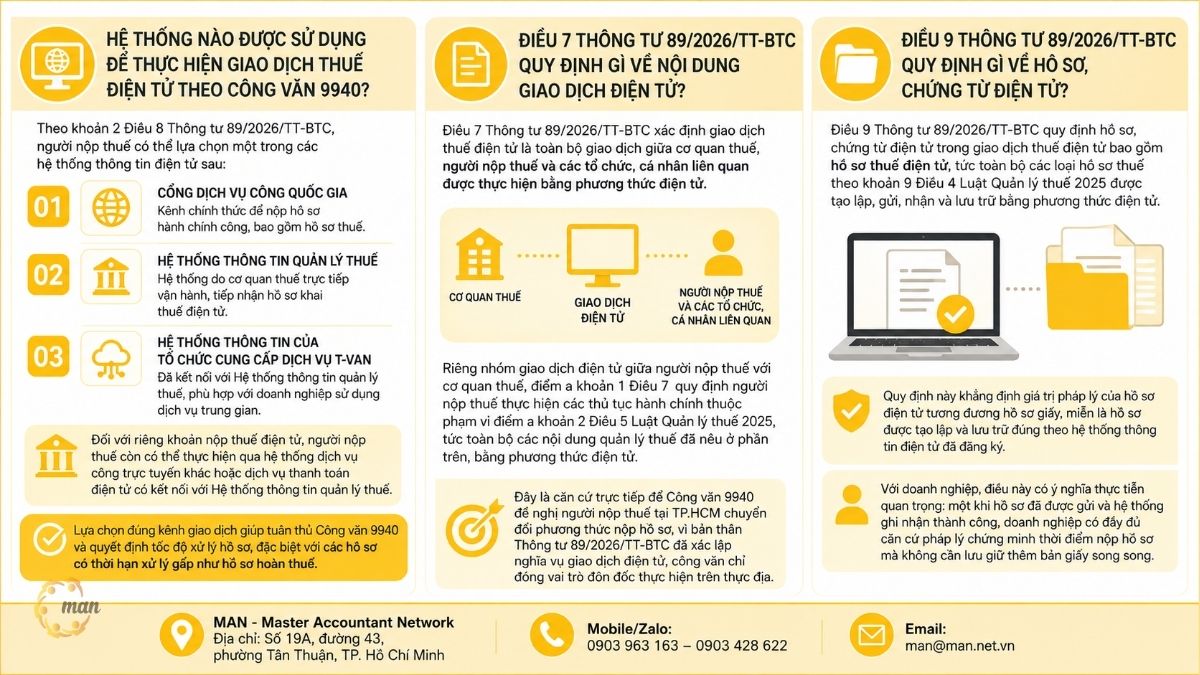
According to Clause 2, Article 8 of Circular 89/2026/TT-BTC, taxpayers may choose one of the following electronic information systems to conduct electronic tax transactions:
- National Public Service Portal: The official channel for submitting public administrative documents, including tax documents.
- Tax management information system: A system directly operated by the tax authority, receiving electronic tax returns.
- Information system of the T-VAN service provider It has been connected to the Tax Management Information System, suitable for businesses using intermediary services.
- For electronic tax payments specifically, taxpayers can also make payments through other online public service systems or electronic payment services connected to the Tax Management Information System.
Choosing the right transaction channel not only helps comply with Circular 9940 but also determines the speed of processing applications, especially for applications with urgent deadlines such as tax refund applications.
What does Article 7 of Circular 89/2026/TT-BTC stipulate regarding the content of electronic transactions?
Article 7 of Circular 89/2026/TT-BTC defines electronic tax transactions as all transactions between tax authorities, taxpayers, and related organizations and individuals conducted electronically. Specifically, regarding electronic transactions between taxpayers and tax authorities, Point a, Clause 1, Article 7 stipulates that taxpayers perform administrative procedures within the scope of Point a, Clause 2, Article 5 of the 2025 Tax Administration Law, i.e., all tax administration matters mentioned above, electronically.
This is the direct basis for Official Letter 9940 requesting taxpayers in Ho Chi Minh City to switch to electronic filing methods, because Circular 89/2026/TT-BTC itself has established the obligation for electronic transactions, and the official letter only serves to encourage implementation on the ground.
What does Article 9 of Circular 89/2026/TT-BTC stipulate regarding electronic documents and records?
Article 9 of Circular 89/2026/TT-BTC stipulates that electronic documents and records in electronic tax transactions include electronic tax records, i.e., all types of tax records as defined in Clause 9, Article 4 of the 2025 Tax Administration Law that are created, sent, received, and stored electronically. This regulation affirms that the legal value of electronic records is equivalent to paper records, provided that the records are created and stored correctly according to the registered electronic information system.
For businesses, this has significant practical implications: once the application has been submitted and successfully recorded by the system, the business has full legal proof of the submission date without needing to keep a parallel paper copy.
The process for registering for electronic tax transactions follows the relevant guidelines.
According to Clause 3, Article 8 of Circular 89/2026/TT-BTC, the registration process is divided according to the type of system. Taxpayers who choose to transact through the National Public Service Portal or electronic payment service channel will register according to the specific instructions of the system's managing unit, not the general procedure of the tax sector.
Conversely, if taxpayers choose the Tax Management Information System or a T-VAN system, they must register in accordance with the regulations in Article 13 of Circular 89/2026/TT-BTC. Businesses need to prepare a valid digital signature, an electronic transaction account, and verify the initial tax registration information to avoid data discrepancies when the system verifies the application.
Case Study: How are businesses in Ho Chi Minh City implementing Circular 9940?
Background
Company Y, a trading and service company located in District 1, Ho Chi Minh City, previously submitted both paper and electronic documents for certain types of tax exemptions. Upon receiving Official Letter 9940, the company's accounting department was initially confused as it was unclear whether the entire set of documents needed to be converted immediately.
Practical handling
After consultation from MAN – Master Accountant Network, The company takes three steps: reviewing the entire catalog of periodically generated tax documents to classify them according to Clause 9, Article 4 of the 2025 Tax Administration Law; rechecking whether the previously registered electronic transaction account and digital signature are still valid; and creating a schedule for submitting electronic documents linked to each declaration deadline to avoid duplication or omissions.
The measured results
- The processing time for tax exemption applications has been reduced from an average of 5 working days to 2 working days.
- There are no longer any cases of lost paper documents when reconciling with the tax authorities at the end of the year.
- The accounting department saves time on travel and filing documents in person, allowing them to focus resources on internal tax risk control.
| Criteria | Before adopting electronic methods | After implementing Circular 9940 |
| Processing time for tax exemption/reduction applications | 5 working days | 2 working days |
| Risk of losing records | There is a problem. | No issues arose. |
| Ability to retrieve records | Manual, time-consuming | Instant online lookup |
| Administrative operating costs | Higher due to transportation and printing. | Significant reduction |
Expert opinion: Common business risks when implementing Circular 9940
Experts at MAN – Master Accountant Network With over 30 years of experience in auditing and tax consulting in Vietnam, we note four main risks that businesses often encounter when implementing the guidelines in Circular 9940.
- Risk 1: Confusion between mandatory and recommended scope: Many businesses mistakenly believe that the official document mandates the immediate submission of all types of documents electronically, when in reality it is a request based on existing regulations in the 2025 Tax Administration Law. Businesses need to compare each specific type of document with the original regulations to determine their obligations correctly.
- Risk 2: Digital signatures and electronic trading accounts have not been updated: Many businesses have electronic tax transaction accounts, but their digital signatures have expired or are not properly linked to the current tax management information system. When submitting documents, the system rejects them, leading to delays in filing and potential administrative penalties.
- Risk 3: Choosing the wrong electronic trading channel: Choosing the wrong system, for example, submitting a tax refund application through a channel that does not comply with the regulations in Article 8 of Circular 89/2026/TT-BTC, can result in the application being returned or not being recorded at the correct time of submission. This is a technical error, but it has significant legal consequences.
- Risk 4: Lack of internal electronic document archiving procedures: Businesses are switching to electronic methods but are not establishing a systematic process for storing and backing up electronic documents, causing difficulties when tax authorities request the resubmission of records during subsequent tax audits and inspections.
Conclude
Official Document 9940 is a concrete step taken by the Ho Chi Minh City Tax Department to implement the obligation of electronic tax transactions under the 2025 Tax Administration Law and Circular 89/2026/TT-BTC. Businesses that understand the scope, subjects, and procedures will significantly reduce the risk of delayed filings and optimize administrative operating costs in the long term.
Tax services at MAN – Master Accountant Network
- Tax accounting services
- Tax consulting services
- Tax settlement services
- Tax reporting services
- VAT refund service
Service contact information at MAN – Master Accountant Network
- Address: No. 19A, Street 43, Tan Thuan Ward, Ho Chi Minh City
- Mobile/Zalo: 0903 963 163 – 0903 428 622
- E-mail: man@man.net.vn
- Google Business Profile: View MAN – Master Accountant Network's Google Business Profile
- LinkedIn Founder: View expert Le Hoang Tuyen's LinkedIn profile.
Responsible for production and professional content review by: Mr. Le Hoang Tuyen – Founder & CEO of MAN – Master Accountant Network, CPA Vietnam with over 30 years of experience in accounting, auditing, taxation, and corporate financial consulting.
Frequently Asked Questions about Official Document 9940
Which agency issued Official Document 9940 and when did it take effect?
Official document 9940/TPHCM-QLDN3 issued by Ho Chi Minh City Tax Department on July 24, 2026, is effective from the date of issuance.
Does Circular 9940 mandate that all businesses must submit documents electronically?
The request is based on the obligations stipulated in the 2025 Tax Administration Law and Circular 89/2026/TT-BTC; businesses need to compare each specific type of document to determine the level of mandatory compliance.
Are businesses outside of Ho Chi Minh City affected by Official Letter 9940?
This is not a direct reference, as the official document is only valid within the jurisdiction of the Ho Chi Minh City Tax Department. Businesses in other localities should refer to the corresponding guidance documents from their respective tax authorities.
What types of documents are recommended to be submitted electronically?
All types of tax documents are listed in Clause 9, Article 4 of the 2025 Tax Administration Law, from tax registration documents and tax declaration documents to tax refund documents, tax exemption/reduction documents, and tax payment extension documents.
What preparations do businesses need to make to comply with Circular 9940?
A valid electronic tax transaction account, a valid digital signature, and the correct electronic information system selection as stipulated in Article 8 of Circular 89/2026/TT-BTC are required.