


Official Letter No. 5628/BHXH-QLT This document, issued by the Ho Chi Minh City Social Insurance Agency on July 20, 2026, provides specific guidance on the collection of mandatory social insurance contributions from business owners in the area. It has drawn the attention of many accountants, business owners, and human resources departments at local social insurance offices, as it clarifies how to identify individuals required to participate in mandatory social insurance based on their declared revenue and specifies how to handle cases where individuals previously paid mandatory social insurance but no longer meet the eligibility requirements.
In this context Social Insurance Law 2024 and Decree 141/2026/ND-CP Although the scope of mandatory social insurance coverage has officially been expanded to include business owners, many localities are still struggling with the practical implementation. The article below, written from the professional perspective of MAN – Master Accountant Network, a tax and accounting consulting firm with over 30 years of practical experience in Vietnam, will help businesses and sole proprietors correctly understand and apply the provisions of this circular.
Key Points Summary of Official Letter No. 5628/BHXH-QLT
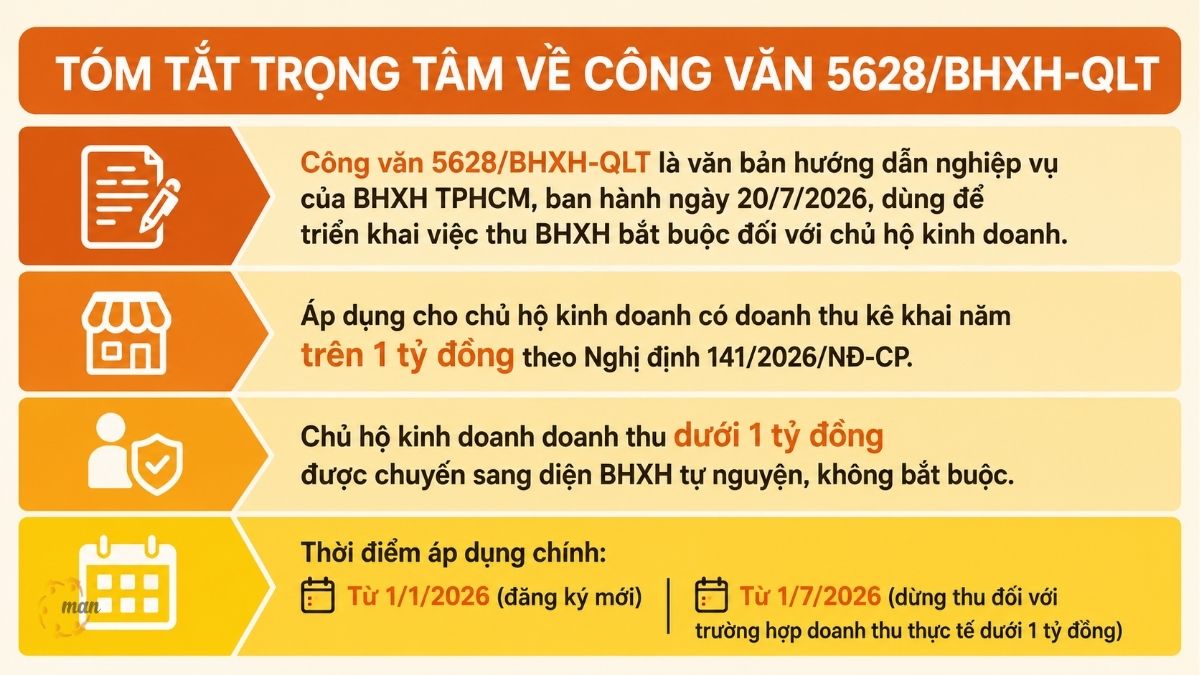
- Circular No. 5628/BHXH-QLT is an operational guideline issued by the Ho Chi Minh City Social Insurance Agency on July 20, 2026, for the implementation of mandatory social insurance contributions for business owners.
- Applies to business owners with annual reported revenue exceeding 1 billion VND, in accordance with Decree 141/2026/NĐ-CP.
- Business owners with annual revenue of less than 1 billion VND will be transferred to the voluntary social insurance program, which is not mandatory.
- Effective dates: January 1, 2026 (for new registrations) and July 1, 2026 (collection will cease for cases where actual revenue is less than 1 billion VND).
What is Official Letter No. 5628/BHXH-QLT? Definition and Scope of Application
Official Letter No. 5628/BHXH-QLT is an administrative document issued by the Ho Chi Minh City Social Insurance Agency, serving as internal guidance for the sector to standardize procedures for reviewing, collecting, and suspending the collection of mandatory social insurance contributions from business owners in the city. The document does not establish new legal provisions but rather clarifies existing provisions in the 2024 Social Insurance Law and Decree No. 141/2026/NĐ-CP.
Essentially, this circular serves as a bridge between legal regulations and their implementation at grassroots-level social insurance agencies. As a result, the districts, counties, and cities under the jurisdiction of Ho Chi Minh City have a unified basis for determining which individuals are required to make contributions, which are exempt from contributions, and which are encouraged to switch to voluntary participation.
Why is Circular No. 5628/BHXH-QLT important for business owners and accountants?
Before specific guidelines were issued, many business owners and accounting departments faced difficulties in determining whether they were subject to mandatory social insurance contributions, especially when actual revenue fluctuated from year to year. The lack of consistent guidance can easily lead to incorrect coverage, delays in reporting reductions, or failure to fulfill registration obligations.
According to reports from MAN – Master Accountant Network While advising medium-sized businesses in Ho Chi Minh City, we have encountered numerous cases where annual revenue exceeded 1 billion VND one year but fell below that threshold the following year, yet the business owners did not proactively report the change, resulting in unnecessary continued deductions for mandatory social insurance contributions. Circular No. 5628/BHXH-QLT directly addresses this issue through a clear mechanism for review and suspension of collections.
Who is affected by Circular No. 5628/BHXH-QLT?
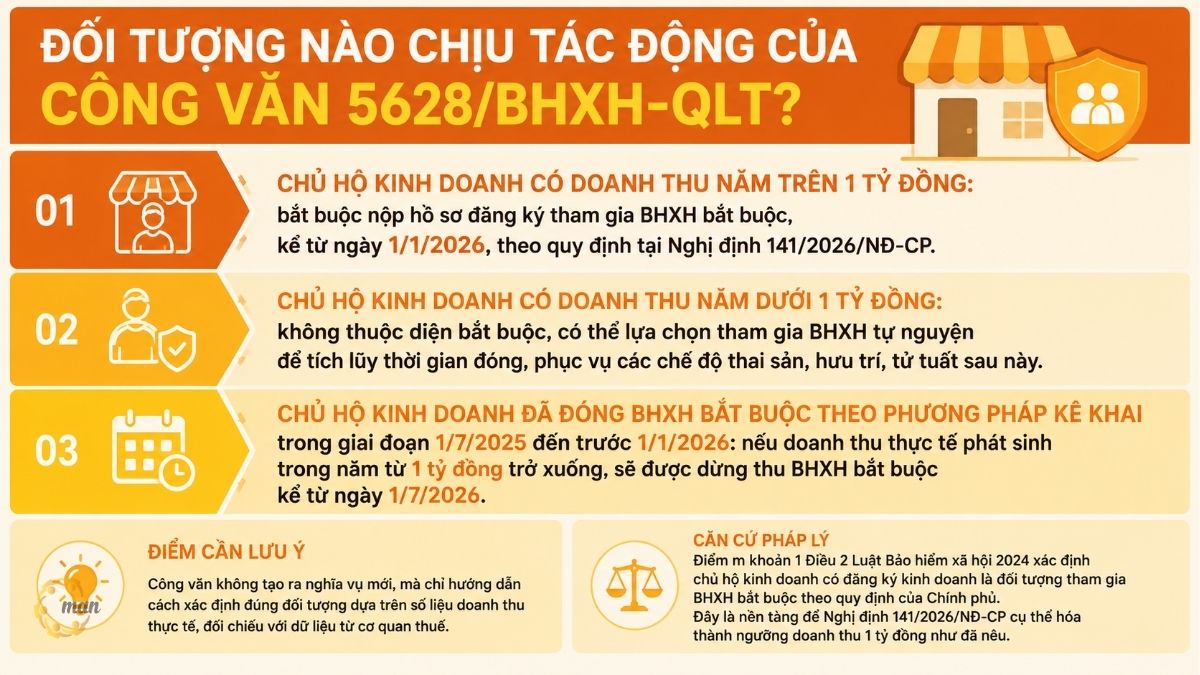
The scope of the circular focuses on two main groups, which are categorized based on their annual reported revenue.
- Business owners with annual revenue exceeding 1 billion VND: It is mandatory to submit an application for enrollment in the mandatory social insurance program, effective January 1, 2026, in accordance with the provisions of Decree No. 141/2026/NĐ-CP.
- Business owners with annual revenue of less than 1 billion dong: Although not mandatory, you may choose to enroll in voluntary social insurance to accumulate contribution periods, which will be used to qualify for maternity, retirement, and survivor benefits in the future.
- Business owners who paid mandatory social insurance premiums using the self-reporting method during the period from July 1, 2025, to before January 1, 2026: If actual revenue for the year is 1 billion VND or less, mandatory social insurance contributions will be suspended effective July 1, 2026.
It is important to note that the circular does not create any new obligations; rather, it provides guidance on how to correctly identify eligible entities based on actual revenue figures, cross-referenced with data from the tax authorities.
Regarding the legal basis, Point m of Paragraph 1 of Article 2 of the 2024 Social Insurance Law stipulates that heads of business households with a business registration are subject to mandatory social insurance participation in accordance with government regulations. This serves as the basis for Decree No. 141/2026/NĐ-CP to specify a revenue threshold of 1 billion VND, as stated above.
The following deadlines and applicable conditions should be noted.
Staying on top of deadlines is crucial for business owners and accountants to avoid mistakes when fulfilling their social insurance obligations.
- From 1/1/2026: The mandatory social insurance registration requirement will take effect for business owners with reported revenue exceeding 1 billion VND.
- Stage January 1, 2026, through June 30, 2026: The City Social Insurance Agency will continue to review the matter and submit a written report to the Vietnam Social Insurance Agency; it will not immediately suspend collections during this transition period.
- From 1/7/2026: Mandatory social insurance contributions have been officially suspended for business owners whose actual annual revenue is 1 billion VND or less.
- No later than January 31 of the following year: Business owners must submit a report on their actual revenue to the tax authorities, which will serve as the basis for reconciliation with the Social Insurance Agency.
In addition to the timeframe, a prerequisite for correctly determining eligibility is that the revenue figures must match between tax return records and the data received by the Social Insurance Agency. This is why the official letter calls for close coordination among the Social Insurance Agency, the tax authorities, and ward and commune People’s Committees.
Which agencies does Official Letter No. 5628/BHXH-QLT require to coordinate with?
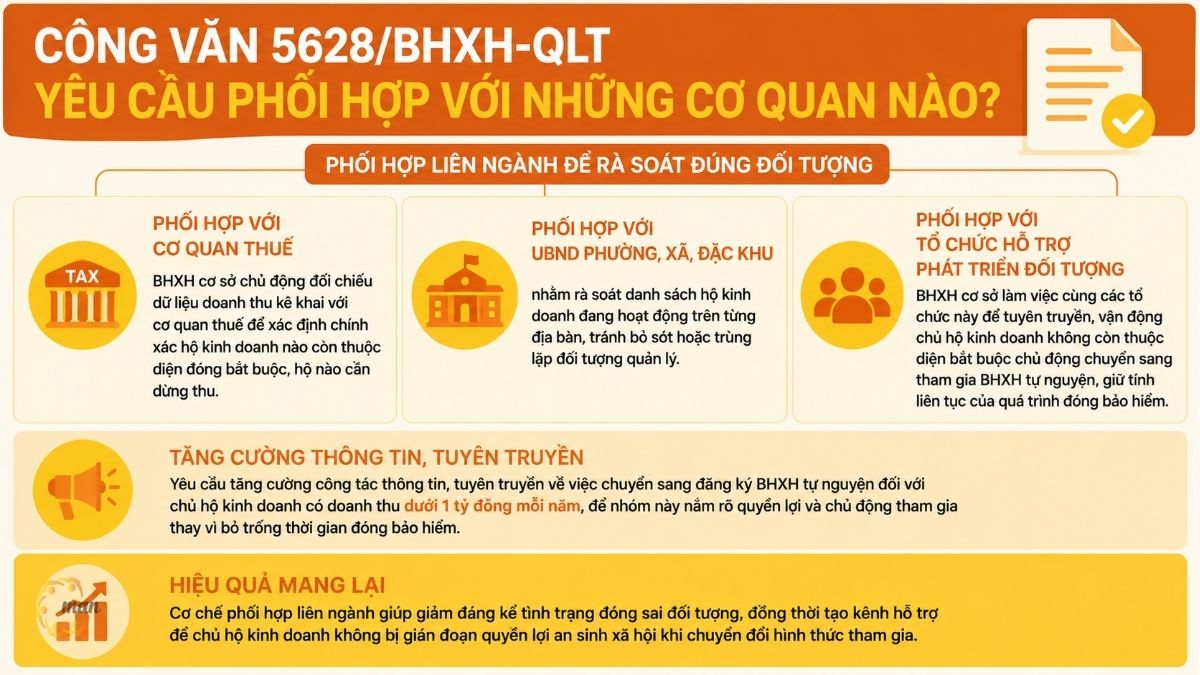
One notable point that many analyses often overlook is the interagency coordination mechanism, which is outlined in considerable detail in the official document. This is precisely what determines the feasibility of properly targeting the review.
- Coordinate with the tax authorities: Local social insurance offices proactively cross-check the reported revenue data with tax authorities to accurately determine which business households are still subject to mandatory contributions and which should no longer be required to pay.
- In coordination with the People’s Committees of wards, communes, and special zones: to review the list of active business households in each area, ensuring that no entities are omitted or duplicated.
- Collaborate with the Organization to Support the Target Population: Local social insurance offices are working with these organizations to raise awareness and encourage business owners who are no longer subject to mandatory coverage to voluntarily switch to the voluntary social insurance program, thereby maintaining the continuity of their insurance contributions.
In addition to coordinating the review, the official letter also calls for strengthening information and outreach efforts regarding the transition to voluntary social insurance enrollment for business owners with annual revenue of less than 1 billion VND, so that this group can fully understand their benefits and proactively enroll rather than leaving gaps in their insurance coverage.
According to word analysis MAN – Master Accountant Network, this interagency coordination mechanism helps significantly reduce cases of incorrect enrollment and, at the same time, provides a support channel to ensure that business owners do not experience any disruption in their social security benefits when switching their enrollment status.
How does a business registration number relate to mandatory social insurance contributions?
An important technical element for data reconciliation is the business household code, as stipulated in Article 91 of Decree 168/2025/NĐ-CP. This number also serves as a tax ID number; it is issued by the Tax Registration Application System and transmitted to the Business Household Registration Information System, and is recorded on the Business Household Registration Certificate.
The process of issuing a business registration number involves interconnected steps between the two systems. When a business registration application meets the eligibility requirements, the Business Registration Information System transmits the data to the Tax Registration Application System to verify compliance with tax registration regulations. If the information is compliant, the tax system returns the business household identification number along with information on the directly managing tax authority; if it is not compliant, the system reports an error so that the commune-level business registration authority can notify the business household to make corrections.
Since the business registration number also serves as the tax identification number, it is the key that allows the Social Insurance Agency to accurately cross-reference reported revenue data with insurance enrollment records, which directly supports the identification of mandatory coverage recipients in accordance with Official Letter No. 5628/BHXH-QLT. Government agencies have now agreed to use this code consistently in the management and exchange of information regarding business households.
Compilation of Legal Documents Related to Official Letter No. 5628/BHXH-QLT
Important Note: As of now, detailed guidelines on how to proceed for the period from January 1, 2026, to June 30, 2026, are still pending official instructions from the Vietnam Social Insurance Agency. Experts at MAN We recommend that business owners and accountants closely monitor any supplementary documents to stay up to date.
| Legal documents | Number / Date of Issue | Related content |
| Official Letter No. 5628/BHXH-QLT | Ho Chi Minh City Social Insurance Agency, July 20, 2026 | Guidelines for the Collection of Mandatory Social Insurance Contributions from Business Owners |
| Social Insurance Law 2024 | National Assembly | Regulations on the basis for contributions, contribution rates, and eligible participants in mandatory social insurance |
| Decree No. 158/2025/NĐ-CP | The Government, June 25, 2025 | Detailed Regulations and Guidelines for the Implementation of Certain Provisions of the Social Insurance Law Regarding Mandatory Social Insurance |
| Official Letter No. 2525/BHXH-QLT | Vietnam Social Insurance, July 13, 2026 | In response to citizens’ letters regarding social insurance and health insurance policies, the Ho Chi Minh City Social Insurance Agency issued Official Letter No. 5628/BHXH-QLT. |
| Decree 141/2026/ND-CP | Government | Regulations setting a revenue threshold of 1 billion VND as the basis for determining which business owners are subject to mandatory social insurance contributions |
| Decree No. 161/2026/ND-CP | May 15, 2026; effective July 1, 2026 | The base salary is set at 2,530,000 VND per month and serves as the reference rate for calculating social insurance contributions. |
| Decree 168/2025/ND-CP | Article 91 | Regulations on business registration numbers, which also serve as tax identification numbers |
| Decree 68/2026/ND-CP | Article 6 | Regulations on Deductible and Non-Deductible Expenses When Calculating Personal Income Tax for Self-Employed Individuals |
How are mandatory social insurance contributions for business owners calculated?
Pursuant to Point d, Paragraph 1, Article 31 of the 2024 Social Insurance Law, the individuals specified in Points g, h, m, and n of Paragraph 1 of Article 2 of this Law—including business owners—may select the wage level to serve as the basis for mandatory social insurance contributions, with the minimum level equal to the reference rate and the maximum level equal to 20 times the reference rate at the time of contribution. Only after at least 12 months of contributions at the selected level may the participant select a new salary level as the basis for contributions.
Regarding contribution rates, subparagraph a of paragraph 4 of Article 33 of the 2024 Social Insurance Law stipulates that the monthly contribution rate is 25% of the wage used as the basis for contributions, consisting of 3% to the sickness and maternity fund, and 22% to the pension and survivor benefits fund.
Specifically regarding the determination of the reference rate, Clause 13 of Article 141 of the 2024 Social Insurance Law stipulates that, during the period when the base wage has not yet been abolished, the reference rate shall be equal to the base wage; once the base wage is abolished, the reference rate shall not be lower than the base wage in effect at that time. Since the current base wage, pursuant to Decree No. 161/2026/ND-CP issued on May 15, 2026, is 2,530,000 VND per month, the actual contribution rate effective July 1, 2026, is determined as follows.
| Contribution Rate | Wage used as the basis for contributions (VND/month) | Amount of mandatory social insurance contributions (VND/month) |
| Highest | 20 × 2,530,000 = 50,600,000 | 25% × 50,600,000 = 12,650,000 |
| Lowest | 2.530.000 | 25% × 2,530,000 = 632,500 |
This is a fairly wide range, allowing business owners to actively choose a contribution level that suits their financial capacity, provided it falls within the limits permitted by law and complies with the requirement of a minimum period of 12 months before the selected contribution level can be adjusted.
Regarding the method of payment, Point b of Clause 4 of Article 33 of the 2024 Social Insurance Law allows business household heads to pay directly to the social insurance agency or to pay indirectly through the business household, enterprise, cooperative, or cooperative union that manages them. The payment cycle may be selected on a monthly, quarterly, or semiannual basis, with the deadline for payment being no later than the last day of the month immediately following the selected payment cycle.
Are social insurance contributions made by business owners deductible when calculating personal income tax?
This is a question that many accountants are concerned about now that business owners are officially subject to mandatory social insurance contributions. Pursuant to Point c, Clause 2, Article 6 of Decree 68/2026/NĐ-CP, salaries, wages, and other payments of a salary-like nature received by individual business owners, groups of individual business owners, and members of business households, in principle, shall not be included as deductible expenses when determining personal income tax, except for mandatory insurance contributions.
In other words, the mandatory social insurance contributions made by business owners in accordance with Official Letter No. 5628/BHXH-QLT are eligible for deduction when determining taxable income. personal income tax. This is a benefit that helps reduce the tax burden on business owners to some extent, thereby partially offsetting the costs arising from the new social insurance obligations. According to a note from MAN – Master Accountant Network, business owners must keep all documentation regarding Social Insurance contributions—whether paid monthly or according to the selected cycle—to serve as the basis for accounting for deductible expenses when personal income tax settlement At the end of the year, avoid having expenses disallowed during a tax audit.
Case Study: How Did a Business in Bình Thạnh District Handle Changes to Its Social Insurance Coverage?
Background
Business Y, a food and beverage service provider in Bình Thạnh District, reported revenue of 1.3 billion VND in 2025 and is subject to mandatory social insurance participation under the self-reporting method starting in July 2025. In 2026, due to a change in its business model, its actual revenue decreased to approximately 850 million VND, falling below the 1 billion VND threshold specified in Decree 141/2026/ND-CP.
Proceed in accordance with the instructions in Official Letter No. 5628/BHXH-QLT
According to advice from MAN – Master Accountant Network, business owners must follow three steps: First, submit a report on actual revenue for 2026 to the tax authority by January 31, 2027; second, prepare tax return documents as a basis for verification and submit them to the Social Insurance Agency to request a reduction; third, proactively explore options for switching to voluntary social insurance to maintain continuous contribution periods and avoid future interruptions in pension benefits.
The measured results
- As of July 1, 2026, Business Household Y will be exempt from mandatory social insurance contributions as of that date, with no back payments or disputes with the Social Insurance Agency.
- By switching to voluntary social insurance immediately after mandatory coverage ended, business owner Y avoided any interruption in his insurance coverage and maintained his accumulation plan toward retirement benefits.
- A well-organized revenue reconciliation file ensures that the process of working with the Social Insurance Agency can be completed in a single session, without the need for repeated requests for additional documents.
Expert Analysis: Common Risks in Implementing Circular 5628/BHXH-QLT
With over 30 years of experience in tax and accounting consulting, the team of experts at MAN – Master Accountant Network highlights three common risks that business owners and accountants are prone to encountering.
- Risk number one is the delay in reporting actual revenue when revenue falls below the 1 billion dong threshold. If the business owner does not proactively submit the required documents by the January 31 deadline, mandatory social insurance contributions will continue to be deducted even though the business is no longer subject to mandatory coverage, resulting in unnecessary cash flow waste.
- Second risk This relates to the incorrect selection of the wage level used as the basis for contributions. Some business owners choose a contribution level that is too low to reduce immediate costs, but this directly affects their future pension benefits. Since regulations require a minimum of 12 months before adjustments can be made, the initial selection should be carefully considered with the assistance of professionals specializing in tax and insurance risk management.
- Third risk is a lack of data synchronization between tax return records and social insurance enrollment records. When the revenue figures from the two sources do not match, the reconciliation process between the tax authority and the social insurance agency may be prolonged, affecting the timeline for reporting a reduction in enrollment or registering new enrollees.
Conclude
Circular No. 5628/BHXH-QLT helps standardize the method for determining the eligible groups, timing, and conditions for collecting mandatory social insurance contributions from business owners in Ho Chi Minh City, while also establishing a clear mechanism to suspend collections in a timely manner when revenue no longer meets the specified threshold. A thorough understanding of the key timelines, documentation requirements, and contribution rates will help business owners better manage their cash flow and secure their long-term insurance benefits.
Tax services at MAN – Master Accountant Network
- Tax accounting services
- Tax consulting services
- Tax settlement services
- Tax reporting services
- VAT refund service
Service contact information at MAN – Master Accountant Network
- Address: No. 19A, Street 43, Tan Thuan Ward, Ho Chi Minh City
- Mobile/Zalo: 0903 963 163 – 0903 428 622
- E-mail: man@man.net.vn
- Google Business Profile: View MAN – Master Accountant Network's Google Business Profile
- LinkedIn Founder: View expert Le Hoang Tuyen's LinkedIn profile.
Responsible for production and professional content review by: Mr. Le Hoang Tuyen – Founder & CEO of MAN – Master Accountant Network, CPA Vietnam with over 30 years of experience in accounting, auditing, taxation, and corporate financial consulting.
Frequently Asked Questions About Circular No. 5628/BHXH-QLT
Issued by the Ho Chi Minh City Social Insurance Agency on July 20, 2026, these guidelines outline the collection of mandatory social insurance contributions from business owners in the city.
No. This group is not required to participate; they may only enroll in voluntary social insurance to accrue eligibility periods for social security benefits.
Effective July 1, 2026, this applies to cases where actual revenue generated during the year is 1 billion VND or less, following a reconciliation of figures with the tax authorities.
From 632,500 VND to 12,650,000 VND per month, depending on the salary level used as the basis for contributions that the business owner selects within the range permitted by law.
You must provide tax return documents showing the actual revenue for the year, along with a revenue notification submitted to the tax authority, as the basis for filing with the Social Insurance Agency to process the reduction request.
Yes. According to Decree No. 68/2026/ND-CP, mandatory insurance contributions are an exception that is included in deductible expenses when determining the personal income tax base for business owners. Which agency issued Official Letter No. 5628/BHXH-QLT, and when was it issued?
Are business owners with annual revenue of less than 1 billion dong required to enroll in social insurance?
When can a business owner stop making mandatory social insurance contributions?
What is the current range of mandatory social insurance contribution rates for business owners?
What documents do I need to prepare to apply for a reduction in mandatory social insurance contributions?
Are mandatory social insurance contributions paid by business owners deductible when calculating personal income tax?




