

Official Document 4831/CT-CS This is a document issued by the Tax Department on July 15, 2026, introducing new points at Decree 254/2026/ND-CP and Circular 91/2026/TT-BTC Regarding electronic invoices and electronic documents, this document serves as a bridge between newly enacted legal regulations and practical implementation at each local tax office. It helps tax officials and taxpayers promptly grasp changes that will directly affect the process of creating, managing, and using electronic invoices in business operations.
From the target users of electronic invoices and criteria for identifying high-risk taxpayers to the responsibilities of organizations providing electronic invoice services with tax authority codes, each change mentioned in Circular 4831/CT-CS necessitates adjustments to accounting processes, invoicing software, and tax compliance documentation. This article, compiled from the professional perspective of MAN – Master Accountant Network, analyzes each point in detail, includes real-world case studies, and offers recommendations for risk mitigation for businesses.
Summary of key points in Official Letter 4831/CT-CS
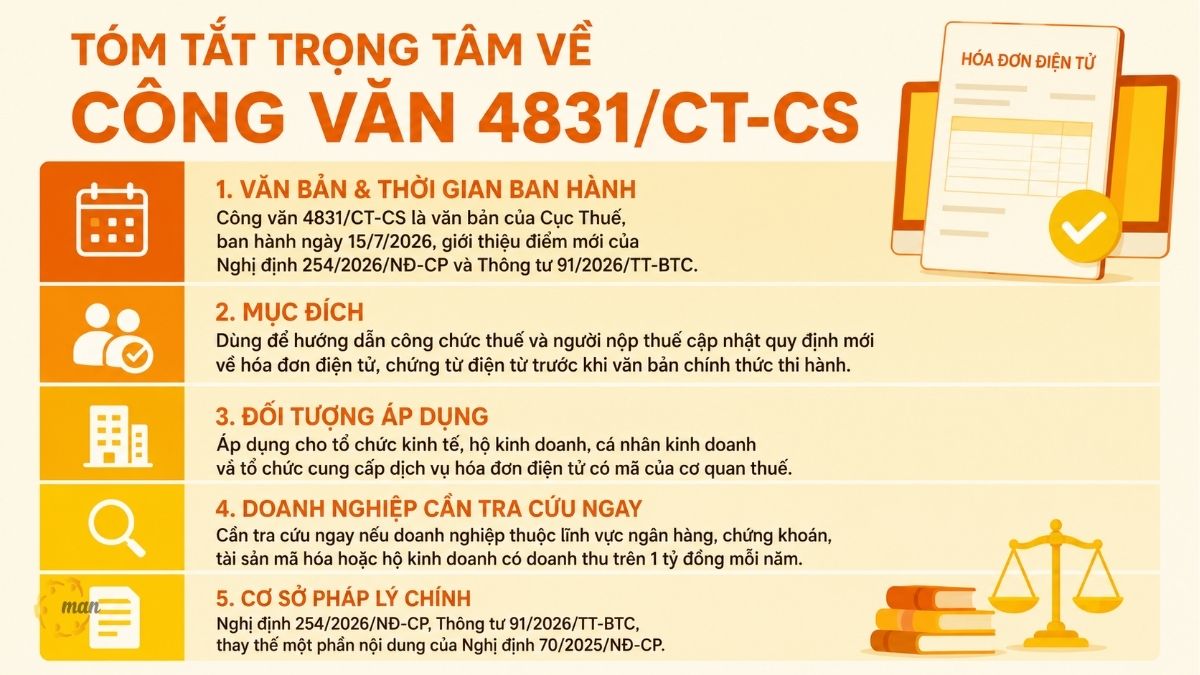
- Official document 4831/CT-CS, issued by the Tax Department on July 15, 2026, introduces the new points of Decree 254/2026/ND-CP and Circular 91/2026/TT-BTC.
- This is to guide tax officials and taxpayers in updating their knowledge of new regulations on electronic invoices and electronic documents before the official regulations come into effect.
- This applies to economic organizations, business households, individual businesses, and organizations providing electronic invoice services with tax authority codes.
- It is necessary to check immediately if the business is in the banking, securities, or crypto asset sectors, or if it is a sole proprietorship with annual revenue exceeding 1 billion VND.
- Main legal basis: Decree 254/2026/ND-CP, Circular 91/2026/TT-BTC, partially replacing the content of Decree 70/2025/ND-CP.
What is Official Document 4831/CT-CS? Definition and legal basis.
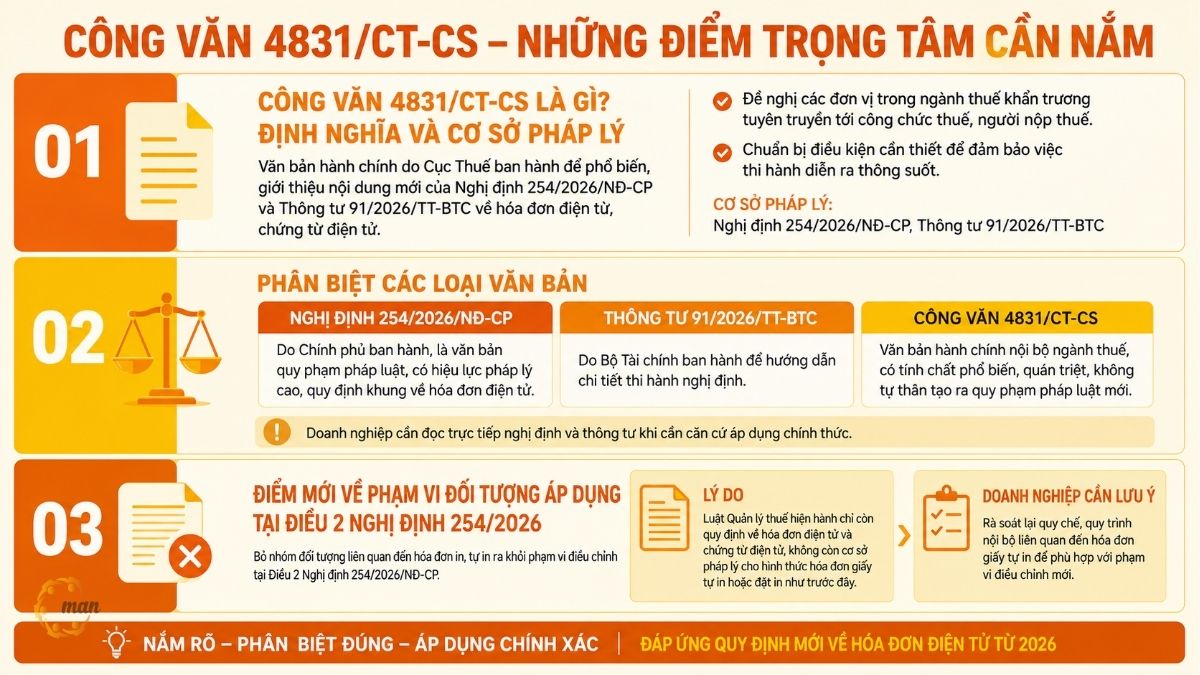
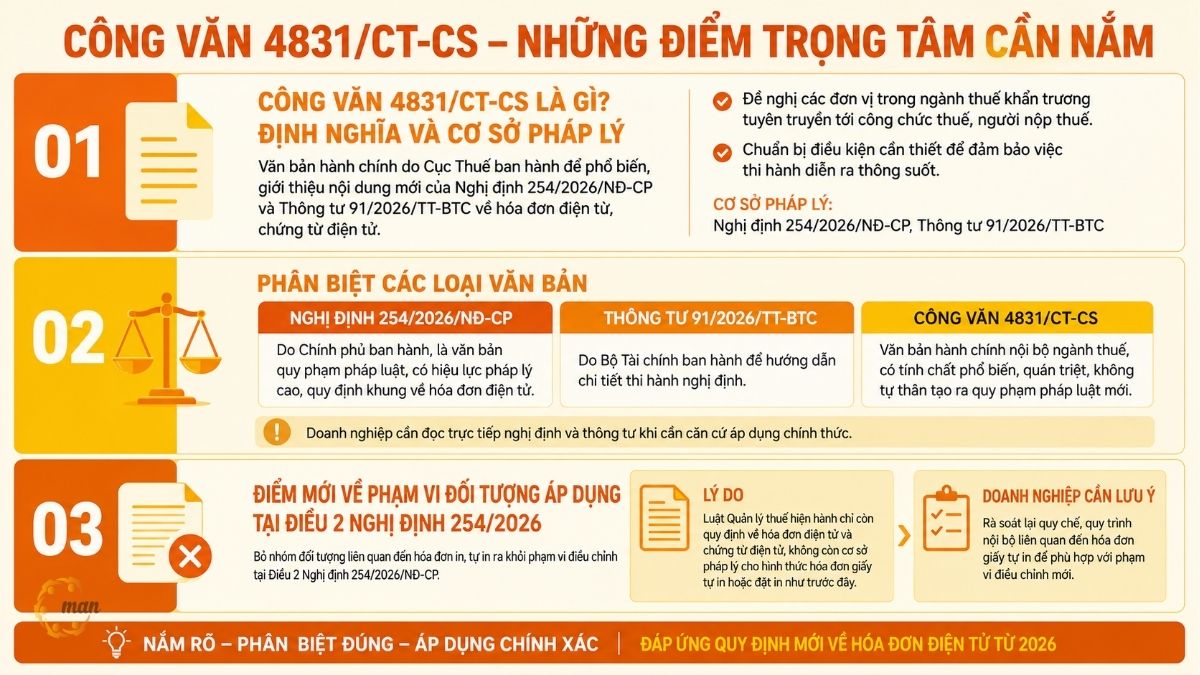
Official Document 4831/CT-CS is an administrative document issued by the Tax Department to disseminate and introduce new content. Decree 254/2026/ND-CP and Circular 91/2026/TT-BTC Regarding electronic invoices and electronic documents, the document requests that units within the tax sector urgently disseminate information to tax officials and taxpayers, and prepare the necessary conditions to ensure smooth implementation.
Regarding the original legal content, Decree 254/2026/ND-CP amends the key concept in Article 3. Accordingly, a legally valid invoice or document is defined as "an invoice or document that ensures correct form and content as prescribed," while illegal use includes erasing, improperly correcting, creating fictitious invoices, or misrepresenting the actual value of the transaction.
Distinguishing between Official Letter 4831/CT-CS and Decree 254/2026 and Circular 91/2026
It is necessary to clearly distinguish between three types of documents to avoid confusion when searching for and applying them. Decree 254/2026/ND-CP, issued by the Government, is a legally binding document that provides a framework for electronic invoices. Circular 91/2026/TT-BTC, issued by the Ministry of Finance, provides detailed guidance on the implementation of the decree. Circular 4831/CT-CS, however, is merely an internal administrative document within the tax sector, intended for dissemination and implementation, and does not create new legal regulations. Businesses should directly read the decree and circular when they need a basis for official application.
New points regarding the scope of application in Article 2 of Decree 254/2026.
Another notable change introduced in Official Document 4831/CT-CS is that Remove the group of subjects related to printed and self-printed invoices. This falls outside the scope of regulation under Article 2 of Decree 254/2026/ND-CP. The reason is that the current Tax Administration Law only regulates electronic invoices and electronic documents, and no longer provides a legal basis for self-printed or pre-printed paper invoices as before. Businesses that still store or reference processes related to self-printed paper invoices need to review their internal regulations to conform with the new scope of regulation.
See more articles at: 6 new points in Decree 254/2026/ND-CP on electronic invoices that you need to know.
The role of Official Letter 4831/CT-CS in tax administration, accounting, and auditing.
For accounting and internal audit departments, Circular 4831/CT-CS serves as a quick summary, shortening the time spent studying the two original documents, which are quite lengthy. This allows businesses to proactively review their invoicing software, registration process, and supporting documents before the new regulations officially impact their daily invoice issuance operations.
From this perspective MAN – Master Accountant Network, These seemingly technical changes regarding the target users of electronic invoices or high-risk criteria actually directly affect the likelihood of being penalized. Stop using invoices If businesses fail to update their information in time, experts at MAN, with over 30 years of practical experience in tax risk management in Vietnam, recommend that businesses periodically review their tax registration information, especially their registered address, immediately after Circular 4831/CT-CS is issued.
Which entities are affected by the new points in Official Letter 4831/CT-CS?
The scope of impact of Official Letter 4831/CT-CS is quite broad because it is linked to Article 6 of Decree 254/2026/ND-CP on the subjects using electronic invoices. Specifically, the following groups need to pay special attention:
- Banking, securities, and cryptocurrency businesses: They have been added to the group of entities using electronic invoices without a tax authority code, along with service providers supporting transactions on carbon trading platforms.
- Organizations and business households that sell goods directly to consumers: If you have already registered for electronic invoices with or without codes, you are not required to register for electronic invoices generated from cash registers.
- Household businesses and individual businesses with annual revenue exceeding 1 billion VND: Or, if the sale of assets requires registration of ownership or usage rights, it is mandatory to use electronic invoices with codes or electronic invoices generated from cash registers connected to the tax authority's data system.
- Non-business organization: However, transactions involving the sale of goods or provision of services subject to value-added tax, corporate income tax, or other taxes are eligible for the issuance of electronic invoices with codes for each transaction.
- Export consignment agent and parties to a business cooperation contract (BCC): Electronic invoices must be issued to collect commission fees or to share revenue and expenses according to the agreed-upon representative roles.
Timeline and practical conditions that need to be prepared
Official Letter 4831/CT-CS was issued on July 15, 2026, immediately after Decree 254/2026/ND-CP and Circular 91/2026/TT-BTC were approved. The Tax Department requested its subordinate units to urgently disseminate the content to tax officials and taxpayers, and to prepare the necessary technical and personnel conditions to ensure timely implementation.
One point businesses need to note regarding the procedure: the deadline for providing explanations, supplementary information, and documents when requested by the tax authorities has been set. Extended from 2 days to 3 business days According to Circular 91/2026/TT-BTC, this creates additional processing time for business accountants. Furthermore, when there are changes to the registration information for using electronic invoices, organizations, business households, and individual businesses must use Form No. 01/ĐKTĐ-HĐĐT through the Tax Management Information System or through an electronic invoice service provider.
Notably, Circular 91/2026/TT-BTC adds the following requirement. perform biometrics When changing registration information for using electronic invoices, except in cases of discontinuation or temporary suspension of use, this is an additional verification step compared to Decree 70/2025/ND-CP, which previously only required a separate procedure when changing the legal representative, business representative, or owner. Businesses should prepare a biometric verification plan for their representatives to avoid disruption when updating registration information.
Compilation of legal documents related to Official Letter 4831/CT-CS
For accurate reference, businesses should familiarize themselves with the relevant documents directly related to Official Letter 4831/CT-CS in the following order of legal validity:
| Document | Issue number / date | Related content |
| Official Document 4831/CT-CS | Tax Department, July 15, 2026 | Introducing the new points of Decree 254/2026 and Circular 91/2026 on electronic invoices and electronic documents. |
| Decree 254/2026/ND-CP | Government, 2026 | Regulations on electronic invoices and electronic documents, scope of application, and responsibilities of relevant parties. |
| Circular 91/2026/TT-BTC | Ministry of Finance, 2026 | Guidelines for implementing Decree 254/2026, stipulating forms, deadlines for explanations, and high-risk criteria. |
| Decree 70/2025/ND-CP | Government, 2025 | Regulations on electronic invoices that were in effect before Decree 254/2026 came into force have been partially replaced. |
| Official Document 2231/DLA-NVDTPC | Tax authorities | Instructions for tax registration and use of electronic invoices for household businesses and individual business owners. |
Case Study: How do retail businesses handle the new points from Circular 4831/CT-CS?
Background
Y Retail Co., Ltd., which operates a chain of 45 convenience stores in Ho Chi Minh City, registered to use electronic invoices with tax authority codes since 2023. When Circular 4831/CT-CS was issued, the accounting department was concerned about having to register additional electronic invoices generated from cash registers for all 45 outlets, leading to increased investment costs for a new system.
How to handle it
After joint review MAN – Master Accountant Network, The company determined that it falls under the exclusion clause (ii) of Article 6 of Decree 254/2026/ND-CP: organizations selling directly to consumers that have registered for electronic invoices with or without codes are not required to register for additional electronic invoices generated from cash registers. The company only needs to review its franchised business households with revenue exceeding 1 billion VND to guide this group to convert within the deadline.
Result
- This saves approximately 350 million VND in investment costs for a point-of-sale system that would otherwise require data connectivity for 45 sales points.
- It was determined that 6 out of 12 franchised businesses were required to convert due to exceeding the annual revenue threshold of 1 billion VND.
- Complete the registration information update using Form No. 01/ĐKTĐ-HĐĐT within 10 working days, with no further explanation required from the tax authorities.
Comparison of electronic invoice regulations before and after Decree 254/2026
Decree 254/2026/ND-CP has amended many important regulations on electronic invoices to simplify procedures, expand the scope of application, and standardize management. These changes directly impact businesses, household businesses, financial institutions, and other entities using electronic invoices. The table below summarizes the prominent differences between the regulations before and after Decree 254/2026 came into effect, helping accountants and managers easily compare and apply the regulations correctly.
| Content | Prior to Decree 254/2026 | Following Decree 254/2026 |
| Banking, securities, and cryptocurrency assets | There are no specific regulations regarding the use of electronic invoices without codes. | Clearly added to the group using electronic invoices without a tax authority code. |
| Invoices are generated from the cash register. | In many cases, registration must be done in parallel with existing electronic invoices. | No further registration is required if you have already registered for electronic invoices with or without a code. |
| Business households, individual businesses | The revenue criteria are not yet standardized. | This is mandatory when annual revenue exceeds 1 billion VND or when selling assets requiring registration of ownership. |
| Deadline for submitting additional documents. | 2 working days | 3 working days |
| Issuing invoices on a transaction-by-transaction basis to dissolved businesses. | The applicable regulations remain. | Repeal this regulation. |
The responsibilities of organizations providing electronic invoice services with codes are as stipulated in Article 15.
Besides outlining the scope of application, Circular 4831/CT-CS also clearly defines the responsibilities of organizations providing electronic invoice services with tax authority codes, as stipulated in Article 15 of Decree 254/2026/ND-CP. This is an important basis for businesses to assess the capabilities of invoice software providers before signing long-term service contracts.
- Manage the usernames and passwords of accounts issued by the tax authorities, ensuring that authentication information is not leaked or compromised outside the system.
- Creating electronic invoices to submit to the tax authorities for code issuance, and being legally responsible for the legality and accuracy of the created electronic invoices.
- Send the electronic invoice with the tax authority code to the buyer immediately after receiving the code from the tax authority; there should be no delay that could affect the rights of the buyer.
- At the end of the day, electronic invoice data generated from the cash register must be sent to the tax authority, except in cases where the service provided falls under a specific category, in which case the method and timing of data transfer will be carried out according to separate regulations of the Ministry of Finance.
From this perspective MAN – Master Accountant Network, Therefore, businesses should include the timelines in Article 15 in the service quality commitment clause when signing contracts with electronic invoice software providers, in order to have a clear basis for holding them accountable if there is a delay in sending data or issuing invoices to customers.
Conditions for electronic invoices to be assigned a code by the tax authority are specified in Article 12.
Another often overlooked aspect is the conditions for an electronic invoice to be assigned a code by the tax authorities, as stipulated in Clause 2, Article 12 of Decree 254/2026/ND-CP. Understanding the four conditions below helps accountants proactively review invoices before submission, minimizing the risk of being rejected for a code due to technical errors or incorrect registration information.
- Full content: The invoice must fully display all the mandatory contents of an electronic invoice as stipulated in Article 10 of Decree 254/2026/ND-CP.
- Correct formatting: Invoices must comply with the standard electronic invoice format prescribed by the Minister of Finance, and be compatible with the data standards for connection with the tax authorities.
- The registration information is correct: The information on the invoice must match the information of the organization or individual that has registered to use electronic invoices with the tax authorities.
- Not subject to discontinuation of use: The seller is not currently subject to a suspension of the use of electronic invoices with tax authority codes as stipulated by the Minister of Finance.
When an invoice meets all four of the above conditions, the Tax Department's invoice code issuance system will automatically issue the code and send the result back to the sender without manual intervention, significantly shortening processing time compared to the previous paper invoice issuance process.
Expert opinion: Common business risks when implementing Circular 4831/CT-CS
Experts at MAN – Master Accountant Network With over 30 years of experience in auditing and tax consulting in Vietnam, we note four main risks that businesses often encounter when implementing the contents of Circular 4831/CT-CS:
Risk 1: Confusion between administrative documents and legal regulations.
Many accountants directly cite Circular 4831/CT-CS as the legal basis when preparing documents, even though this document is only for introductory and dissemination purposes. The official basis for application should still be Decree 254/2026/ND-CP and Circular 91/2026/TT-BTC; citing the wrong source can make the explanatory documents submitted to the tax authorities unconvincing.
Risk 2: Delay in updating high-risk criteria regarding registered office address.
Circular 91/2026/TT-BTC amends the criteria for identifying high-risk taxpayers related to their registered office address not being specific to administrative boundaries or located in apartment buildings. Businesses that have not reviewed their registered address may be placed under stricter supervision, affecting the speed of issuing electronic invoice codes daily.
Risk 3: Household businesses have not yet reached the revenue threshold required for conversion.
Many business households and individual business owners have not closely monitored their cumulative annual revenue, leading to the discovery of exceeding the 1 billion VND threshold when the deadline for registering for coded electronic invoices or electronic invoices generated from cash registers has passed, potentially resulting in administrative penalties for invoice violations.
Risk 4: The electronic invoicing service provider has not fully fulfilled its responsibilities.
According to Article 15 of Decree 254/2026/ND-CP, organizations providing electronic invoice services with codes must manage accounts, send invoices to buyers immediately after receiving the code, and send invoice data generated from the cash register at the end of the day. Businesses using the service of a provider that do not fully comply with these deadlines risk being considered late in sending invoice data, even if the fault does not originate from the business itself.
Conclude
Official Document 4831/CT-CS plays a crucial guiding role in helping businesses, household businesses, and individual business owners grasp the changes regarding electronic invoices and electronic documents before Decree 254/2026/ND-CP and Circular 91/2026/TT-BTC officially come into effect. Proper and complete preparation of documents and procedures from this stage will help businesses avoid risks such as administrative violations, suspension of invoice usage, or retroactive tax collection during tax audits and inspections.
Tax services at MAN – Master Accountant Network
- Tax accounting services
- Tax consulting services
- Tax settlement services
- Tax reporting services
- VAT refund service
Service contact information at MAN – Master Accountant Network
- Address: No. 19A, Street 43, Tan Thuan Ward, Ho Chi Minh City
- Mobile/Zalo: 0903 963 163 – 0903 428 622
- E-mail: man@man.net.vn
- Google Business Profile: View MAN – Master Accountant Network's Google Business Profile
- LinkedIn Founder: View expert Le Hoang Tuyen's LinkedIn profile.
Responsible for production and professional content review by: Mr. Le Hoang Tuyen – Founder & CEO of MAN – Master Accountant Network, CPA Vietnam with over 30 years of experience in accounting, auditing, taxation, and corporate financial consulting.
Frequently Asked Questions about Official Document 4831/CT-CS
Official document 4831/CT-CS, issued by the Tax Department on July 15, 2026, introduces the new points of Decree 254/2026/ND-CP and Circular 91/2026/TT-BTC regarding electronic invoices and electronic documents.
No. This is a general administrative document, an internal guideline for the tax sector. The official legal basis for application remains Decree 254/2026/ND-CP and Circular 91/2026/TT-BTC.
Not mandatory. This industry group is added to the list of entities using electronic invoices without a tax authority code according to Article 6 of Decree 254/2026/ND-CP.
Unless required, business households can still register to use electronic invoices with codes or electronic invoices generated from cash registers as needed, even if their revenue has not exceeded 1 billion VND.
According to Article 15 of Decree 254/2026/ND-CP, service providers must manage the assigned account, create and send invoices to the tax authority for code issuance, then transfer the coded invoices to the buyer and send invoice data from the cash register at the end of the day. Which agency issued Official Document 4831/CT-CS and on what date?
Is Official Letter 4831/CT-CS a legal normative document?
Are banking and securities businesses required to use electronic invoices with codes?
Do household businesses with revenue under 1 billion VND need to use electronic invoices?
What are the main responsibilities of a provider of electronic invoicing services with codes?




