

Official Document 12004/TTPHCM-QLDN3 Issued by the Ho Chi Minh City Tax Department on August 26, 2026, this is an important guidance document on the policy of deducting personal income tax on payments made to employees after the termination of their employment contracts. This is in the context of significant adjustments to the tax legal system from 2025 and 2026 with the Personal Income Tax Law 2025., Decree 253/2026/ND-CP and Circular 89/2026/TT-BTC, Understanding these regulations helps businesses comply with the law and minimize the risk of being subject to tax arrears.
In practice, tax audits at businesses reveal that payments made upon termination of employment contracts are always a key focus of tax authority inspections. The introduction of this regulation requires close cooperation between accounting and human resources departments to determine the correct timing of payments, the nature of each income item, and the appropriate tax deduction rate. This article from MAN – Master Accountant Network will comprehensively analyze the legal and practical aspects of this regulation.
Summary of key points in Official Letter 12004/TTPHCM-QLDN3
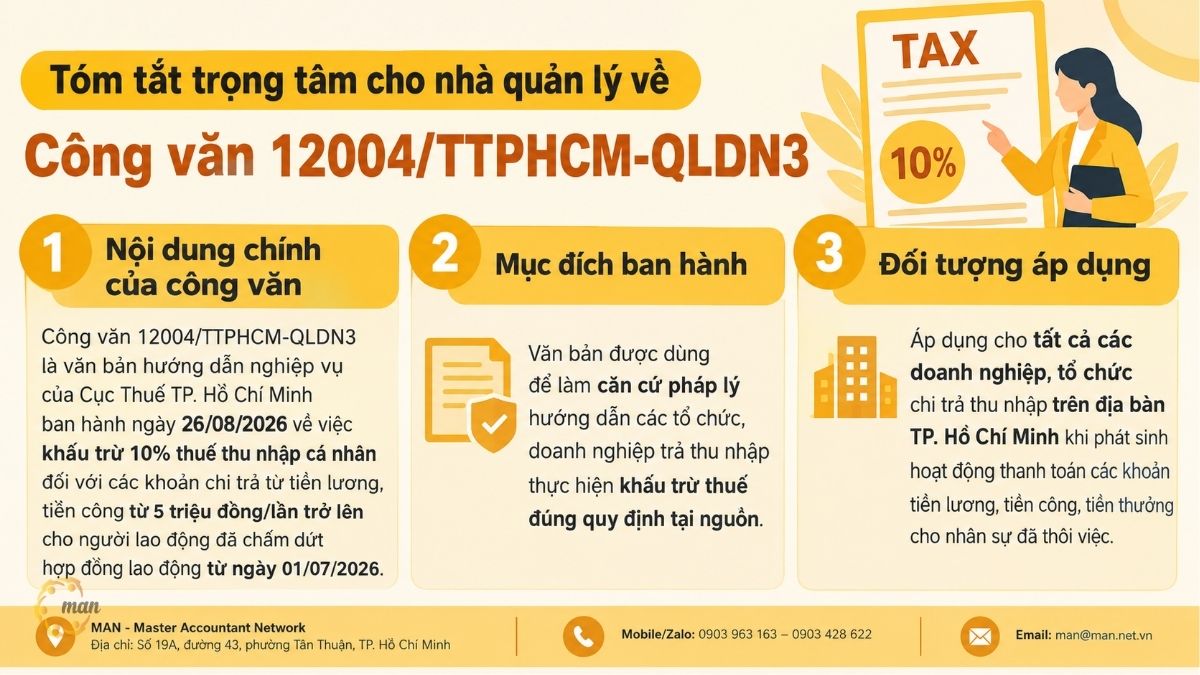
- Official document 12004/TTPHCM-QLDN3 is a professional guidance document issued by the Ho Chi Minh City Tax Department on August 26, 2026, regarding the deduction of personal income tax on salary and wage payments of 5 million VND or more per payment to employees whose employment contracts were terminated from July 1, 2026.
- This document serves as a legal basis to guide organizations and businesses paying income in properly withholding tax at source.
- This regulation applies to all businesses and organizations in Ho Chi Minh City that pay income when settling salaries, wages, and bonuses for employees who have left their jobs.
What does Official Document 12004/TTPHCM-QLDN3 stipulate regarding personal income tax deduction upon termination of employment?

Based on the guidance in Official Letter 12004/TTPHCM-QLDN3, the Ho Chi Minh City Tax Department has clarified the principle of deducting personal income tax on payments from salaries and wages to employees whose employment contracts have been terminated. This guidance is based on the coordinated implementation of several current legal documents.
Businesses need to understand the fundamental legal grounds applied by the tax authorities, including:
- Based on the Personal Income Tax Law 2025.
- Based on Clause 3, Article 113 of the 2019 Labor Code.
- Based on Government Decree 253/2026/ND-CP.
- Based on Article 22 of Circular 89/2026/TT-BTC of the Ministry of Finance.
Based on the above regulations, the principle of tax deduction for employees who leave their jobs is determined as follows: If a business makes payments of income from salaries and wages of 5 million VND or more per payment to employees after the termination of their employment contract from July 1, 2026, the business is responsible for deducting personal income tax from the employee at the rate of 10% on the total taxable income from salaries and wages as stipulated in Clause 2, Article 50. Decree 253/2026/ND-CP.
In addition, the document clearly defines tax-exempt expenses. Payments for unused vacation days for employees, if these payments meet the regulations in Clause 3, Article 113 of the 2019 Labor Code, and severance pay and unemployment benefits as prescribed by law, are exempt from personal income tax according to Clause 8, Article 4 of the 2025 Personal Income Tax Law and Article 26 of Decree 253/2026/ND-CP.
The key point lies in the timing of payment and the individual's contractual status. If the funds are disbursed after the decision to terminate the employment contract takes effect, the business is required to deduct tax at source on the portion of taxable income of VND 5 million or more per payment.
The role of Official Letter 12004/TTPHCM-QLDN3 in corporate tax risk management.
For financial management and internal auditing, the correct application of Circular 12004/TTPHCM-QLDN3 plays a crucial role in controlling personal income tax risks. When employees leave their jobs, businesses often pay various amounts such as last month's salary, performance bonuses, severance pay, and unused annual leave. Failure to clearly define the legal nature of each payment leads to the risk of applying the wrong tax deduction rate.
Experts at MAN, with 30 years of experience, note that the biggest risk for businesses is under-deducting tax deductions. personal income tax This applies to employees. When the tax authorities conduct an audit, the business will be legally responsible for tax arrears collection and administrative penalties for tax violations, along with late payment fees. Because the employees have left the company and ceased contact, recovering the unpaid taxes is almost impossible, resulting in direct losses to business expenses.
Furthermore, adhering to the withholding tax regulations helps businesses standardize their monthly, quarterly, and annual personal income tax returns. This creates a solid foundation for financial statement audits and enhances the business's compliance credibility score in the eyes of tax authorities.
Which entities are affected by Official Letter 12004/TTPHCM-QLDN3?
The guidelines issued by the Ho Chi Minh City Tax Department directly impact two main groups of stakeholders in labor relations and tax administration. Clearly defining these stakeholders helps all parties fulfill their legal obligations correctly.
Organizations and businesses that pay income
All businesses of all economic sectors, branches, cooperatives, agencies, or organizations that generate salary and wage payments operating within Ho Chi Minh City are eligible. These businesses act as tax withholding agents, obligated to correctly identify the taxpaying entities, accurately calculate the amount of tax to be withheld, and pay it into the state budget within the specified timeframe.
The employee terminates their employment contract.
Individuals residing in Vietnam who have worked at a business and have completed the procedures for terminating their employment contract in accordance with the Labor Code are eligible to receive payments from salaries and wages arising after the contract expires, with a total taxable payment of VND 5,000,000 or more per payment.
Timelines and practical conditions for applying Official Letter 12004/TTPHCM-QLDN3
To accurately apply the deduction regulation 10% as per Official Letter 12004/TTPHCM-QLDN3, the accounting department needs to fully verify the following conditions and actual timelines:
- Effective date: Payments will be made from July 1, 2026 onwards.
- Legal conditions of the contract: The employment contract between the company and the employee has officially terminated (a termination notice or contract liquidation document has been issued).
- Actual payment date: The money is transferred or paid in cash to the individual after the termination date of the employment contract stated in the decision.
- Income thresholds apply: The payment amount for each installment must be 5,000,000 VND or more (calculated based on the total taxable income in that payment).
In the event that the payment takes place before On the day the employment contract is terminated (while the contract is still valid), the business continues to deduct personal income tax according to the progressive tax rate schedule, just like paying regular monthly salaries.
Summary of legal documents related to Official Letter 12004/TTPHCM-QLDN3
Below is a summary table of legal documents used in the tax authority's guidelines to help accountants easily refer to them.
| Document number | Document Type & Date of Issue | Issuing authority | Summary of applicable content |
| Official Document 12004/TTPHCM-QLDN3 | Official document (August 26, 2026) | Ho Chi Minh City Tax Department | Instructions for deducting personal income tax (10%) on payments to employees who have left their jobs from July 1, 2026. |
| Personal Income Tax Law 2025 | Law | National Assembly | General regulations on taxable income, tax-exempt income, and personal deductions. |
| Decree 253/2026/ND-CP | Decree | Government | Regulations detailing the implementation of the Personal Income Tax Law; Clause 2, Article 50 stipulates the withholding of tax at source. |
| Labor Code 2019 | Law (November 14, 2019) | National Assembly | Clause 3 of Article 113 stipulates the payment of wages for unused annual leave days. |
| Circular 89/2026/TT-BTC | Circular | Ministry of Finance | Article 22 provides guidance on the management, declaration, and payment of personal income tax by income-paying organizations. |
What does taxable and tax-exempt income include according to Official Letter 12004/TTPHCM-QLDN3?

One of the most common mistakes in practice is that accountants lump together all contract termination expenses to calculate tax under Article 10%. According to the guidance in Circular 12004/TTPHCM-QLDN3, businesses must accurately classify which expenses are taxable and which are tax-exempt.
Detailed classification of income subject to personal income tax.
Based on Article 3 of the Personal Income Tax Law 2025, taxable personal income from salaries and wages includes:
- Salaries, wages, and other payments of a similar nature.
- Remuneration, monetary or non-monetary benefits in any form received by the employee.
- Allowances, subsidies, and other income.
Allowances and subsidies that are not subject to tax include:
- Allowances and subsidies as prescribed by law regarding preferential treatment for meritorious individuals.
- Defense and security allowance.
- Hazardous and dangerous work allowance for occupations or jobs performed in workplaces with hazardous or dangerous elements.
- Attraction allowance and regional allowance are provided in accordance with the law.
- Allowances, subsidies, and living expenses are paid by Vietnamese agencies abroad.
- Emergency hardship allowance, work accident allowance, occupational disease allowance.
- A one-time allowance for childbirth or adoption.
- Disability allowance, lump-sum retirement allowance, monthly survivor's allowance, and other allowances as prescribed by social insurance law.
- Severance pay, unemployment benefits.
- Social welfare benefits and other allowances, subsidies, and income that are not considered wages or salaries are regulated by the Government.
Details of income exempt from personal income tax upon leaving employment.
Official document 12004/TTPHCM-QLDN3, based on Clause 8, Article 4 of the Personal Income Tax Law 2025 and Article 26 of Decree 253/2026/ND-CP, identifies two types of income that are subject to taxation. Personal income tax exemption When terminating a contract:
- Payment for unused annual leave days: This amount is paid by the employer for the days the employee has not taken their annual leave or has not used all of their annual leave days, as stipulated in Clause 3, Article 113 of the 2019 Labor Code.
- Severance pay, unemployment benefits: The subsidies are paid by businesses to the correct recipients and at the correct rates as stipulated in the Labor Code and the Social Insurance Law.
These expenses are not included in the total taxable income for the purpose of determining the 5 million VND threshold and are absolutely not subject to personal income tax deductions.
Current personal allowance rates for calculating personal income tax.
The current personal allowance for calculating personal income tax is stipulated in Article 10 of the Personal Income Tax Law 2025:
- Personal deductions are amounts deducted from taxable income before calculating tax on salary and wage income of resident individual taxpayers. Personal deductions include:
- The tax deduction for taxpayers is 15.5 million VND/month (186 million VND/year).
- The deduction amount for each dependent is 6.2 million VND/month.
- Based on fluctuations in prices and income, the Government submits to the Standing Committee of the National Assembly regulations on the appropriate level of personal allowance deductions in accordance with the socio-economic situation in each period.
- Determining the personal allowance for dependents follows the principle that each dependent can only be claimed as a deduction once by one taxpayer.
- A dependent is a person whom the taxpayer is responsible for supporting, including:
- The child is a minor; the child is incapacitated, disabled, or unable to work.
- Individuals with no income or whose income does not exceed the level prescribed by the Minister of Finance include adult children attending university, college, vocational school, or apprenticeship; spouses who are unable to work; parents who are past working age or unable to work; and other dependents whom the taxpayer directly supports.
Business note: At the time a business pays severance pay after the termination of an employment contract, the business Are not Personal deductions are applied to individuals. Taxes are directly deducted from taxable income (10%). Individuals will compile their income and recalculate the personal deductions when directly settling their taxes with the tax authorities at the end of the year.
Real-world case study: Optimizing tax obligations when terminating employment contracts in Vietnam.
To clearly illustrate the process, the consulting team at MAN would like to share a real-world case study that was successfully handled for a client company in August 2026.
Real life situation
Ms. Tran Thi B terminated her employment contract with Company Y on July 10, 2026. On August 15, 2026, Company Y made the final financial payment to Ms. B, including:
- Salary owed for the last month of work: 9,000,000 VND.
- Project completion bonus: 11,000,000 VND.
- Payment for 4 unused annual leave days: 3,500,000 VND (in accordance with Clause 3, Article 113 of the 2019 Labor Code).
- Severance pay according to the Labor Code: 18,000,000 VND.
How to handle common business mistakes
The accountant at Company Y calculated the total amount paid as: 9 + 11 + 3.5 + 18 = 41,500,000 VND. Noticing that the total amount exceeded 5 million VND and was paid after the employee left the company, the accountant deducted 10% personal income tax on the entire amount: 41,500,000 x 10% = 4,150,000 VND.
Consequence: Workers filed a complaint alleging incorrect tax deductions for severance pay and tax-exempt annual leave.
The correct procedure is as instructed by MAN.
According to MAN – Master Accountant Network, accountants must separate income before calculating the amount of tax to be withheld:
Step 1: Identify tax-exempt income.
- Unused annual leave pay: VND 3,500,000 (Exempt from tax according to Clause 8, Article 4 of the Personal Income Tax Law 2025).
- Properly calculated severance pay: VND 18,000,000 (Tax-exempt according to Clause 8, Article 4 of the Personal Income Tax Law 2025).
- Total tax-exempt income = 21,500,000 VND.
Step 2: Determine the total taxable income from salaries and wages.
- Last month's salary: 9,000,000 VND.
- Project bonus: 11,000,000 VND.
- Total taxable income = 9,000,000 + 11,000,000 = 20,000,000 VND.
Step 3: Compare the 5 million threshold and calculate the deductible tax amount (10%).
- The taxable income threshold is VND 20,000,000, reaching a minimum of VND 5,000,000 per transaction.
- The payment will be made after the date of termination of the employment contract (August 15, 2026 > July 10, 2026).
- The amount of personal income tax that Company Y must withhold is: 20,000,000 x 10% = 2,000,000 VND.
Result: Company Y actually paid Ms. B 39,500,000 VND (41,500,000 – 2,000,000). This method complies with legal regulations, protects the legitimate interests of employees, and eliminates auditing risks.
Comparison table of personal income tax deduction regulations before and after July 1, 2026
The changes to personal income tax policy for employees leaving their jobs from July 1, 2026, are summarized as follows:
| Comparison criteria | Regulations effective before July 1, 2026 | Regulations as per Official Letter 12004/TTPHCM-QLDN3 (Effective from July 1, 2026) |
| The minimum payment threshold requires a 10% deduction. | From 2,000,000 VND per transaction onwards. | From 5,000,000 VND per transaction onwards. |
| The core legal basis for personal income tax. | Personal Income Tax Law 2007 (amended) & Circular 111/2013/TT-BTC. | Personal Income Tax Law 2025 & Decree 253/2026/ND-CP. |
| Personal deduction amount | 11 million VND/month. | 15.5 million VND/month. |
| Deduction amount for dependents | 4.4 million VND/month. | 6.2 million VND/month. |
| Apply for the Low Income Commitment Form | Allows the submission of Commitment Form 08/CK-TNCN if the conditions are met for temporary deferment of tax deduction 10%. | Under no circumstances should commitments be made regarding payments made after the termination of an employment contract. |
MAN experts' assessment of common risks and management solutions.
Experts at MAN, with 30 years of experience, note that the biggest risk in payroll and personal income tax cost management arises from a lack of operational standards between the Human Resources and Accounting departments. When terminating employment contracts, if the process is unclear, businesses are very likely to make the following three serious mistakes:
The final salary payment coincided with the decision to resign, but the tax was calculated incorrectly.
Many accountants habitually include the last month's salary in the company's overall payroll and calculate tax according to the progressive tax rate schedule. However, if the payment is made after the effective date of the termination notice, and the taxable amount is 5 million VND or more, calculating tax according to the progressive tax rate schedule is against regulations.
No personal income tax deduction certificates will be issued to employees.
When deducting personal income tax (PIT) from the income of employees who have left their jobs, businesses are obligated to issue an electronic PIT deduction certificate to that individual. The lack of this certificate prevents employees from independently settling their taxes with the tax authorities at the end of the year, leading to unnecessary legal disputes between employees and businesses.
Solutions from MAN – Master Accountant Network
To completely mitigate these risks, MAN – Master Accountant Network proposes a 4-step process for managing tax risks when terminating employment contracts:
- Reviewing the contract and deciding on termination: Verify the exact effective date of the decision to terminate the employment contract.
- Separate the payment cash flows: The contract termination agreement clearly categorizes payments into three groups: Tax-exempt amounts (severance pay, annual leave), Fixed taxable amounts (Payments of 5 million VND or more after termination), and Progressive amounts (Payments made before termination).
- Issuing electronic tax documents: Automate the issuance of tax deduction certificates immediately upon completion of payment transactions.
- Audit record keeping: Synchronized storage of Termination Decisions, Payroll/Benefit Calculation Sheets, Money Transfer Documents, and Tax Deduction Documents is essential for easy presentation during tax settlement.
Conclude
Circular 12004/TTPHCM-QLDN3 has provided a clear legal framework for businesses in handling personal income tax obligations for employees whose employment contracts are terminated from July 1, 2026. Applying the correct deduction rate (10%) to taxable payments of VND 5 million or more per transaction, combined with accurately separating tax-exempt items such as severance pay and unused annual leave, is key to helping businesses comply with the law and optimize operating costs.
Tax services at MAN – Master Accountant Network
- Tax accounting services
- Tax consulting services
- Tax settlement services
- Tax reporting services
- VAT refund service
Service contact information at MAN – Master Accountant Network
- Address: No. 19A, Street 43, Tan Thuan Ward, Ho Chi Minh City
- Mobile/Zalo: 0903 963 163 – 0903 428 622
- E-mail: man@man.net.vn
- Google Business Profile: View MAN – Master Accountant Network's Google Business Profile
- LinkedIn Founder: View expert Le Hoang Tuyen's LinkedIn profile.
Responsible for production and professional content review by: Mr. Le Hoang Tuyen – Founder & CEO of MAN – Master Accountant Network, CPA Vietnam with over 30 years of experience in accounting, auditing, taxation, and corporate financial consulting.
Frequently Asked Questions about Official Document 12004/TTPHCM-QLDN3 (FAQ)
Are expenses under 5 million VND deductible for tax purposes after an employee leaves their job?
According to Clause 2, Article 50 of Decree 253/2026/ND-CP, the deduction of 10% only applies to expenses of VND 5,000,000 or more per transaction. For expenses under VND 5,000,000 per transaction, businesses are not required to deduct 10% at the time of payment, but must still record it in the income payment list for tax finalization at the end of the year.
Can former employees sign a commitment form to avoid having their 10% tax deducted?
No. The regulation requiring a low-income commitment form only applies to individuals with employment contracts of less than 3 months or those without employment contracts at the time of payment. For individuals whose employment contracts have been terminated, payments of 5 million VND or more per payment are subject to mandatory withholding tax (10%) at source and are not eligible for the commitment form.
Are unused annual leave payments subject to tax (10%)?
No. Payments for unused annual leave days, as stipulated in Clause 3, Article 113 of the 2019 Labor Code, are exempt from personal income tax according to Clause 8, Article 4 of the 2025 Personal Income Tax Law. Therefore, this amount is not included in taxable income for deduction purposes.
Does the business have to issue a tax deduction certificate to employees whose tax is deducted under form 10%?
Yes. Businesses are responsible for issuing electronic personal income tax deduction certificates to employees after deducting the tax, except in cases where the employee authorizes tax settlement or does not need to receive the certificate.
What should a business do if it accidentally calculates post-employment tax using the progressive tax rate?
Businesses need to file adjusted and supplementary tax returns for the month/quarter in which errors occurred. Simultaneously, they must recalculate the deductible tax amount according to the 10% rate, and pay the difference in tax and late payment penalties (if any) to the state budget before the tax authorities announce an audit decision.




