


Do individuals who change their identity cards need to update their tax information? This is a question of great concern to millions of taxpayers and income-paying organizations. The transition from the old National Identity Card or Citizen Identity Card to the new Citizen Identity Card under the Citizen Identity Card Law changes core identifying information, leading to the risk of data discrepancies between the Tax authorities and the national population database if not synchronized in a timely manner.
According to Decree 252/2026/ND-CP and Decree 125/2020/ND-CP (Amended by Decree 310/2025/ND-CP), regulations on tax registration have been strongly integrated with the national population data. However, the actual implementation of administrative procedures still depends on specific groups of subjects and the status of data connectivity between state management systems. Understanding the legal basis helps individuals and businesses optimize procedures and minimize the risk of unnecessary administrative penalties.
Summary of key points regarding whether individuals changing their identity card need to update their tax information:
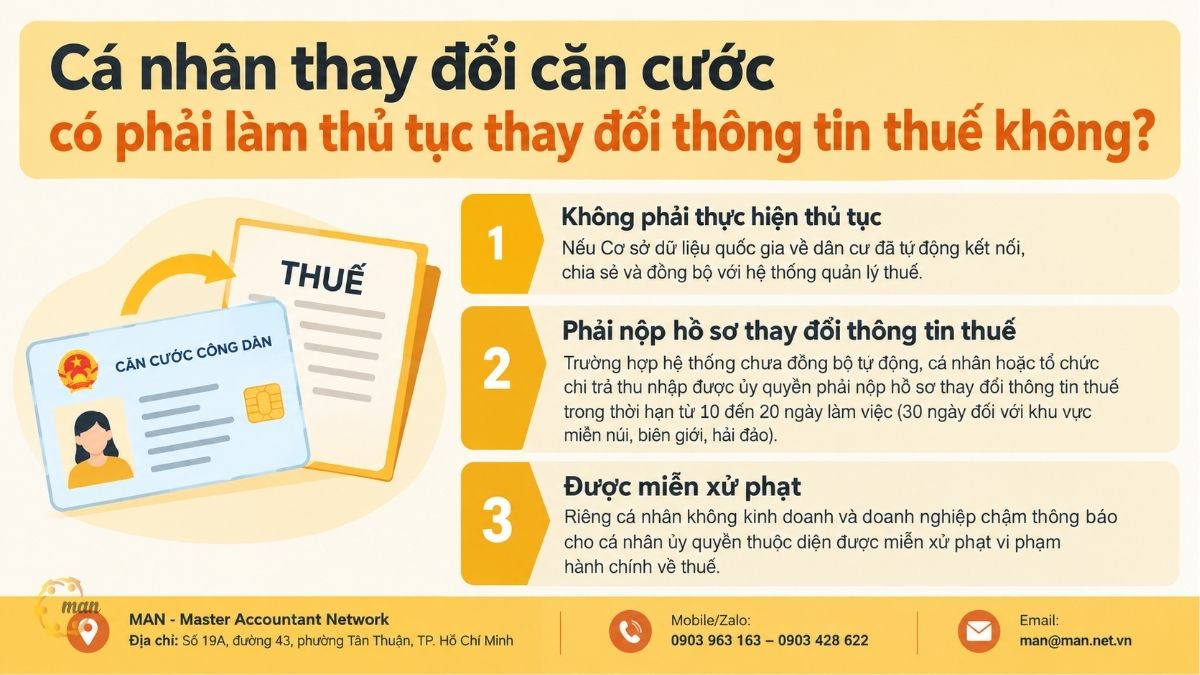
- Whether individuals who change their identity card need to update their tax information is a legal question regarding the obligation to update tax registration information when personal identification changes.
- According to current regulations, individuals No procedure required If the National Population Database has automatically connected, shared, and synchronized with the tax management system.
- In cases where the system has not automatically synchronized, the individual or organization authorized to pay income must submit the tax information change application within 10 to 20 working days (30 days for mountainous, border, and island areas).
- Individuals not engaged in business and businesses that are slow to notify authorized individuals are subject to this regulation. exempted from penalties Administrative violations related to taxation.
According to the latest legal regulations, do individuals who change their identity cards need to update their tax information?

The question of whether individuals who change their identity card need to update their tax information is specifically answered in point e, clause 3, Article 6 of Decree 252/2026/ND-CP, which regulates the deadline for tax registration.
Based on Clause 3, Article 6 Decree 252/2026/ND-CP, For taxpayers who are subject to direct tax registration with the tax authority as stipulated in Clause 3, Article 10 of the Law on Tax Administration, the deadline for changing tax registration information is specified as follows:
- General provisions (point e.1): Taxpayers who register directly with the tax authority must notify the directly managing tax authority within the specified timeframe if there are any changes to their tax registration information. 10 working days from the date the information change occurred.
- For individuals (point e.2): For individual taxpayers, when changing information regarding their full name, personal identification number, date of birth (for Vietnamese citizens), or passport (for foreigners), the deadline for updating tax registration information is... 20 working days (especially mountainous, highland, border, and island communes) 30 days) from the date of change in the National Population Database, the date recorded on the passport.
- Authorization cases: In cases where an individual authorizes the organization or individual paying the income to register changes to their tax registration information and that of their dependents, the organization or individual paying the income must be notified no later than... 10 working days From the date the information changes, the organization or individual paying the income is responsible for notifying the tax authorities no later than... 10 working days from the date of receiving authorization from the individual.
- Automatic exemption mechanism (point e.3): Taxpayers falling under the category specified in point e.2 There is no need to go through the procedure of changing information with the tax authorities. In cases where the National Population Database is connected and shares data with the tax authority's database, and automatically synchronizes when an individual's information changes, the tax management information system will automatically send notifications to taxpayers informing them of the updated information.
Thus, the process of determining the obligation to perform the procedure is clearly divided into two practical cases:
Case 1: The population database is connected and automatically synchronized with the Tax authority.
- Individuals: No need to go through the procedure of changing information with the tax authorities.
- Tax System: Automatically updates and sends confirmation notifications to taxpayers.
Case 2: The population database has not automatically synchronized.
- Individuals/Businesses paying income: Must submit tax registration information update documents within the legally mandated deadline (10 to 20 or 30 working days).
Which objects are required to be updated and which are automatically synchronized?
Not all taxpayers are subject to the same mechanism when changing their National Identity Card. The law clearly defines responsibilities based on the nature of the activities of each group of taxpayers.
Individuals not engaged in business
For salaried individuals, dependents, or individuals who only have infrequent personal income tax obligations:
- These entities are among the priority groups eligible for the automatic data synchronization mechanism between the Ministry of Public Security and the General Department of Taxation, as stipulated in point e.3, clause 3, Article 6 of Decree 252/2026/ND-CP.
- If the system is not automatically synchronized, individuals can manually update their information through the public service portal, the eTax Mobile application, or authorize the income-paying organization (the company where they work) to do so on their behalf.
Individual businesses and household businesses
For individuals who are business owners or independent commercial operators:
- It is mandatory to declare changes to tax registration information with the directly managing tax authority to ensure the accuracy of the tax identification number associated with business operations and electronic invoice issuance.
- The implementation period is 20 working days (or 30 days for mountainous, border, and island areas) from the date of the change in the National Population Database.
Income-paying organization (Enterprise)
Businesses that receive authorization from employees are responsible for compiling the necessary documents and carrying out the centralized tax registration information update procedure with the tax authority directly managing the business within 10 working days from the date of receiving the authorization.
| Target group | Responsibility for carrying out the procedure | Update method |
| Individuals not engaged in business | No further procedures are required if data has been automatically synchronized. | Automatic via the population database / eTax Mobile / Tax settlement |
| Business households, individual businesses | Proactive notification of changes to information is mandatory. | Submit your application in person or through the Electronic Tax Portal. |
| Income paying businesses | On behalf of authorized workers | Consolidated tax declaration via HTKK software / Electronic Tax Portal |
What is the timeframe for updating tax registration information when changing your ID card?
In cases where the tax management system and the population database are not automatically synchronized, taxpayers must strictly adhere to the deadlines stipulated in point e, clause 3, Article 6 of Decree 252/2026/ND-CP.
- In the case of a taxpayer who registered directly for tax purposes and experienced a change in information: The deadline for notifying the directly managing tax authority is 10 working days from the date the information change occurred.
- In cases where individuals handle the procedures themselves due to changing their ID card: The deadline is 20 working days from the date the updated information is recorded in the National Population Database or the date stated on the passport. For individuals residing in mountainous, highland, border, or island communes, this period is extended. 30 working days.
- In cases where an individual authorizes a business to pay their income:
- Individuals notify businesses: Individuals must send a notification along with copies of their new documents to the business within the following timeframe: 10 working days from the date the information change occurred.
- Businesses submit the following to the Tax Authority: Businesses are responsible for compiling and notifying the tax authorities directly in charge within a maximum period of... 10 working days from the date of receiving authorization from the individual.
Timeline for processing procedures through business authorization:
- Milestone T0: The new ID card information has been successfully updated in the National Population Database.
- Milestone T1 (Latest T0 + 10 working days): Individuals submit a notification of information change and a letter of authorization to the income-paying enterprise.
- T2 milestone (No later than T1 + 10 working days): Businesses compile the necessary documents, prepare the declaration form, and send the change notification to the tax authority directly responsible for their management.
Penalties for violating tax information update deadlines and cases where penalties are waived.

Many individuals and businesses are concerned about the risk of administrative penalties if they are late in updating their National Identity Card information. The fines and exemptions are specifically stipulated in Article 11 of Decree 125/2020/ND-CP (amended and supplemented by Clause 9, Article 1 of Decree 310/2025/ND-CP).
The amount of the fine applied for violating the notification deadline.
Based on Clauses 4 and 5 of Article 11 of Decree 125/2020/ND-CP (amended by Decree 310/2025/ND-CP):
The fine ranges from 3,000,000 VND to 5,000,000 VND:
This applies to one of the following actions:
- Notification of changes to tax registration information submitted after the prescribed deadline. 91 days or more but without changing the Tax Registration Certificate or Tax Identification Number Notification (point a, clause 4).
- Notification of changes to tax registration information submitted after the prescribed deadline. 31 to 90 days to amend the Tax Registration Certificate or Tax Identification Number Notification (point b, clause 4).
The fine ranges from 5,000,000 VND to 7,000,000 VND:
This applies to one of the following actions:
- Notification of changes to tax registration information submitted after the prescribed deadline. 91 days or more to amend the Tax Registration Certificate or Tax Identification Number Notification (point a, clause 5).
- Failure to notify changes to information in tax registration records (point b, clause 5).
Remedial measures (Clause 7): Mandatory submission of an application to amend tax registration information for the act of failing to notify changes in tax registration information as stipulated in point b, clause 5, Article 11.
Principles for applying penalties to individuals: The fines stipulated in Article 11 are the fines applicable to organizations. According to Clause 4, Article 7 of Decree 125/2020/ND-CP, for individual taxpayers, the fine is equal to... Half the penalty for organizations (ranging from 1,500,000 VND to 3,500,000 VND depending on the offense).
Exceptional cases are EXEMPTED FROM FINES.
Based on Clause 6, Article 11 of Decree 125/2020/ND-CP (amended by Clause 9, Article 1 of Decree 310/2025/ND-CP), the following cases apply: NO PENALTIES APPLY Administrative violations regarding the deadline for notifying changes in information:
- Non-business individuals who have been issued a personal income tax code are late in updating their information according to the Citizen Identity Card or Electronic Identity Card (point a, clause 6).
- Income-paying agencies are slow to notify changes in information when individual taxpayers who have authorized tax settlement services have changes in information according to their Citizen Identity Card or Electronic Identity Card (point b, clause 6).
- Failure to notify or notify changes to taxpayer address information on tax registration records within the prescribed time limit due to changes in administrative boundaries according to Resolutions of the Standing Committee of the National Assembly or Resolutions of the National Assembly (point c, clause 6).
| Content of the violation | Penalty for Organizations | Individual Penalty Amount (1/2) | Notes / Measures for KPHQ |
| Delayed notification of 31-90 days (This includes changing the Business Registration Certificate / Tax Identification Number Notification) | 3,000,000 – 5,000,000 VND | 1,500,000 – 2,500,000 VND | Applying point b, clause 4, Article 11 |
| Delay in notification of 91 days or more (Do not amend the Business Registration Certificate / Tax Identification Number Notification) | 3,000,000 – 5,000,000 VND | 1,500,000 – 2,500,000 VND | Applying point a, clause 4, Article 11 |
| Delay in notification of 91 days or more (This includes changing the Business Registration Certificate / Tax Identification Number Notification) | 5,000,000 – 7,000,000 VND | 2,500,000 – 3,500,000 VND | Applying point a, clause 5, Article 11 |
| No notification of information changes. in tax registration records | 5,000,000 – 7,000,000 VND | 2,500,000 – 3,500,000 VND | Mandatory submission of amendment documents (Clause 7) |
| Individuals not engaged in business Slow to update to the new ID card. | EXEMPTION FROM PENALTY | EXEMPTION FROM PENALTY | Point a, Clause 6, Article 11 |
| The company pays Delay in notifying the AUTHORIZED individual | EXEMPTION FROM PENALTY | Not applicable | Point b, Clause 6, Article 11 |
| Delay in notifying the address due to changes in administrative boundaries | EXEMPTION FROM PENALTY | EXEMPTION FROM PENALTY | Point c, Clause 6, Article 11 |
Assessing and classifying four levels of tax law compliance according to Circular 94/2026/TT-BTC.
Updating ID card data accurately not only streamlines administrative procedures but also directly impacts taxpayer compliance rankings within the tax administration system.
Based on Article 10 Circular 94/2026/TT-BTC, Taxpayers are assessed and classified by the tax authorities into... 4 levels of tax compliance:
- Level 1: Good compliance (point a, clause 1): Taxpayers who strictly comply with all regulations regarding registration, declaration, tax payment, and information updating will receive priority processing of tax refund applications, reduced inspection frequency, and maximum support with administrative procedures.
- Level 2: Average compliance (point b, clause 1): Apply standard tax administration measures.
- Level 3: Low compliance (point c, clause 1): Place them under monitoring, apply regular reminders, and improve compliance.
- Level 4: Non-compliance (point d, clause 1): Implement in-depth management measures as prescribed in Article 9 and implement compliance enhancement measures as prescribed in Article 11 of Circular 94/2026/TT-BTC.
Mechanism for evaluating and processing results (Clause 2, Clause 3, Article 10 of Circular 94/2026/TT-BTC):
- The level of compliance is classified based on a system of criteria specified in Appendix I Issued together with Circular 94/2026/TT-BTC.
- For taxpayers belonging to Level 4 (Non-compliance), The tax authorities implement in-depth management measures according to Article 9 and apply measures to improve compliance according to Article 11 of Circular 94/2026/TT-BTC.
- For taxpayers belonging to the following categories: Level 1, Level 2, and Level 3, The tax authorities apply measures to improve compliance as stipulated in Article 11 of Circular 94/2026/TT-BTC.
If an individual or business experiences prolonged data synchronization issues related to Identity Cards, the system may record inaccurate identification information, negatively impacting the compliance assessment score as per Appendix I of Circular 94/2026/TT-BTC.
Summary of current legal regulations regarding tax registration and information updates.
To help taxpayers and corporate accountants easily find the relevant information, here is a summary table of all current legal documents:
| Legal documents | Date of issuance / Effective date | Related content summary |
| Law on Tax Administration 38/2019/QH14 | 13/06/2019 | The framework regulations regarding tax registration obligations and notification of changes to tax registration information are stipulated in Articles 36 and 10. |
| Decree 252/2026/ND-CP | Latest regulations | Article 6 specifies the deadlines for tax registration, including 10-20-30 day periods, and the mechanism for automatically synchronizing the population database. |
| Decree 125/2020/ND-CP | 19/10/2020 | Regulations on administrative penalties for tax and invoice violations, the penalty framework in Article 11, and the individual penalty levels in Article 7. |
| Decree 310/2025/ND-CP | Amendments to the regulations | Amend Article 11 of Decree 125/2020/ND-CP, adding a provision to EXEMPTION FROM FINES for non-business individuals and organizations making payments. |
| Circular 94/2026/TT-BTC | Latest regulations | Article 10 stipulates the criteria in Appendix I and classifies taxpayers' compliance with tax laws into four levels. |
The 3-step process for updating tax information when changing your physical identity card.
If the system has not automatically synchronized the National Identity Card data with the tax identification number, taxpayers can follow the standardized procedure below:
Step 1: Check the data synchronization status.
- Individuals using the application eTax Mobile Alternatively, access the General Department of Taxation's electronic portal using a level 2 VNeID account.
- Verify the "Tax Registration Account Information" section to ensure the new ID card number and issuance date match the actual ID card.
Step 2: Choose the update declaration method.
- Form 1 (Online self-declaration): Select the "Change tax registration information" function on eTax Mobile/VNeID. The system will automatically retrieve data from the population database; the individual will check and send confirmation.
- Option 2 (Authorization by a Business): Employees submit a copy of their new ID card along with a letter of authorization to the Accounting department. Businesses use the HTKK software to create the form. 05-DK-TH-TCT Sent via the e-commerce portal.
- Option 3 (Submit in person): Individuals submit the Declaration Form. 08-MST Please provide a copy of your ID card at the Tax Office in your place of residence.
Step 3: Receive notification of results
- Within 1 to 3 business days, the Tax Authority will provide the results via electronic notification on the eTax Mobile application or to the registered email address.
Real-world Case Study: Optimizing Personal Income Tax Data Risks for a Manufacturing Group with 1,200 Employees in Binh Duong
To illustrate the practical application of the latest legal regulations in governance, the following is a real-world case study handled by our team of consultants.
Situational context
X Production Joint Stock Company (New Industrial Park, Binh Duong) manages 1,200 employees. During a review in preparation for personal income tax finalization, the Accounting Department discovered that 450 workers had switched to the new Citizen Identity Cards, but their information stored in the tax system still showed their old 9-digit ID card numbers or Citizen Identity Card numbers.
Risk of occurrence
- The tax administration system refused to issue a tax identification number to the dependent due to discrepancies in the taxpayer's identification data.
- File personal income tax settlement The backlog affecting 450 employees risks delaying the company's tax return filing deadline.
- The management is concerned that the company may face administrative penalties for failing to notify the authorities of changes in information in a timely manner, as stipulated in Article 11 of Decree 125/2020/ND-CP.
Solutions from MAN – Master Accountant Network
Experts at MAN, with 30 years of experience, were directly involved in providing support and offering comprehensive solutions:
- Legal basis for protecting businesses: Quoting precisely Clause 6, Article 11 of Decree 125/2020/ND-CP (amended by Decree 310/2025/ND-CP), it is proven that the enterprise and the employee who authorize the act fall under the following categories. exempted from monetary penalties, This helps relieve psychological pressure on the Board of Directors.
- Review and filter the data: Using an automated reconciliation tool between the personnel list and VNeID data, 320 cases were found to have been automatically synchronized by the tax system according to point e.3, clause 3, Article 6 of Decree 252/2026/ND-CP, leaving only 130 cases requiring updated declaration.
- Online centralized declaration: Prepare form 05-ĐK-TH-TCT and submit it via the e-tax portal for the remaining 130 employees, completing the update within 3 working days.
Results achieved
| Evaluation index | Before consultation | After processing by MAN |
| Number of workers with incorrect ID card data. | 450 people | 0 people |
| Number of documents that need to be filed manually | 450 applications (Estimated) | 130 records (Automatic synchronization excluded) |
| Risk of administrative fines | Fear of being heavily fined. | 0 VND (Applying the penalty waiver amount) |
| Time to complete the settlement | Risk of delays | Completed 15 days ahead of schedule. |
Compare cases where procedures must be done manually and cases where updates are automatic.
The comparison table below clearly distinguishes between the automatic synchronization mechanism and the manual self-declaration mechanism:
| Comparison criteria | Automatic synchronization mechanism | Self-declaration/Submission mechanism |
| Legal basis | Point e.3, Clause 3, Article 6 of Decree 252/2026/ND-CP | Points e.1 and e.2 of Clause 3, Article 6 of Decree 252/2026/ND-CP |
| Terms and Conditions | The population database and the tax database are now seamlessly connected. | The system is not connected or the data is misaligned. |
| Individual responsibility | No procedures are required. | Declare via eTax Mobile/VNeID or submit Form 08-MST. |
| Corporate Responsibilities | No need to create a new file for synchronized employees. | Prepare Form 05-ĐK-TH-TCT for authorized employees. |
| Processing results | The system sends automatic notifications to taxpayers. | The Tax Authority provides electronic results within 1-3 days. |
| Sanctions | No issues arose. | Exempt from fines under Decree 310/2025/ND-CP |
Expert insights from MAN: Perspectives on tax risk management and optimizing business operations.
From the perspective of MAN – Master Accountant Network, although Decree 310/2025/ND-CP has provided a legal framework to exempt individuals and businesses from fines for non-business activities and for businesses that are late in notifying changes to their ID cards, business managers should not be complacent.
Experts at MAN, with 30 years of experience, note that the biggest tax risk today is not the penalty for late filing of information changes, but rather... Data chain disruptions during tax settlement and their impact on business compliance ratings.. When the ID number in the tax system does not match the actual population data:
- The business's application for tax deductions for dependents was rejected.
- Individuals are facing delays in processing personal income tax refunds or tax exemptions.
- Businesses risk having their compliance rating downgraded under Circular 94/2026/TT-BTC if a large proportion of their human resources data is not standardized.
Management advice from MAN:
- Proactively review the list of ID cards for all personnel at least 60 days before the tax settlement period.
- Accurately categorize the list of automatically synchronized personnel and those requiring manual data entry.
- Make the most of the VNeID and eTax Mobile applications to reduce costs and time spent on procedures.
Conclude
The question of whether individuals changing their identity cards need to update their tax information has been clearly answered by law. The data connection between the national population database and the tax management system, as stipulated in Decree 252/2026/ND-CP, allows most non-business individuals to automatically synchronize their information without needing to go through any procedures. Furthermore, the exemption from penalties under Decree 310/2025/ND-CP provides reassurance to taxpayers and businesses during the process of standardizing identification data.
Tax services at MAN – Master Accountant Network
- Tax accounting services
- Tax consulting services
- Tax settlement services
- Tax reporting services
- VAT refund service
Service contact information at MAN – Master Accountant Network
- Address: No. 19A, Street 43, Tan Thuan Ward, Ho Chi Minh City
- Mobile/Zalo: 0903 963 163 – 0903 428 622
- E-mail: man@man.net.vn
- Google Business Profile: View MAN – Master Accountant Network's Google Business Profile
- LinkedIn Founder: View expert Le Hoang Tuyen's LinkedIn profile.
Responsible for production and professional content review by: Mr. Le Hoang Tuyen – Founder & CEO of MAN – Master Accountant Network, CPA Vietnam with over 30 years of experience in accounting, auditing, taxation, and corporate financial consulting.
Frequently Asked Questions (FAQ) regarding whether individuals who change their identity card need to update their tax information.
Is it mandatory to update tax information when switching from the 9-digit ID card to the new Citizen Identification Card?
Yes. The change from the 9-digit ID card to the new Citizen Identification Card changes core identification information. You need to update your information so that the tax management system can convert your tax identification number to the new identification number. If the population database and the tax database have been automatically synchronized, you don't need to do any paper procedures.
If an employee fails to provide their new ID card to the company, will the business be fined?
No. Based on point b, clause 6, Article 11 of Decree 125/2020/ND-CP (amended by Decree 310/2025/ND-CP), organizations that fail to notify authorized individuals of changes in information on time are exempt from administrative penalties.
Is it possible to update my National Identity Card information myself through the eTax Mobile app?
Okay. Log in to eTax Mobile using your level 2 VNeID account, access the "Change tax registration information" section, check the information returned by the population database, and submit an online update request.
Does changing my ID card affect my previously issued personal tax identification number?
No. The personal tax identification number is unique and stays with the individual for life. Updating the ID card only changes the identification document information associated with that tax identification number; it does not change the tax identification number sequence.
If a household business changes the ID card of the head of the household, what is the deadline for registering the update?
The deadline is 20 working days (30 working days for mountainous, border, and island areas) from the date of updating in the population database. Business households must proactively make adjustments to avoid affecting the issuance of electronic invoices.