


Latest exchange rate for contractor tax calculation in 2026 This is a top concern for businesses that account for transactions in foreign currency, especially those that sign contracts with foreign contractors or suppliers on digital platforms. From July 1, 2026, when the 2025 Tax Administration Law comes into effect, the old regulations on converting taxable income according to the accounting exchange rate will be lifted.Circular 99/2025The current exchange rate is no longer applicable, causing confusion for many accountants and business owners when determining the correct exchange rate for declaring contractor tax and corporate income tax.
In response to this guidance gap, the Tax Department has issued an official response, specifically citing current legal grounds for consistent application by businesses. This article, compiled from the professional perspective of MAN – Master Accountant Network, a tax, accounting, and auditing consulting firm with over 30 years of practical experience in Vietnam, will analyze in detail the new regulations, their scope of application, relevant legal documents, and the risks businesses need to be aware of when determining the exchange rate for contractor tax purposes.
Summary of key points regarding the latest contractor tax exchange rates in 2026.
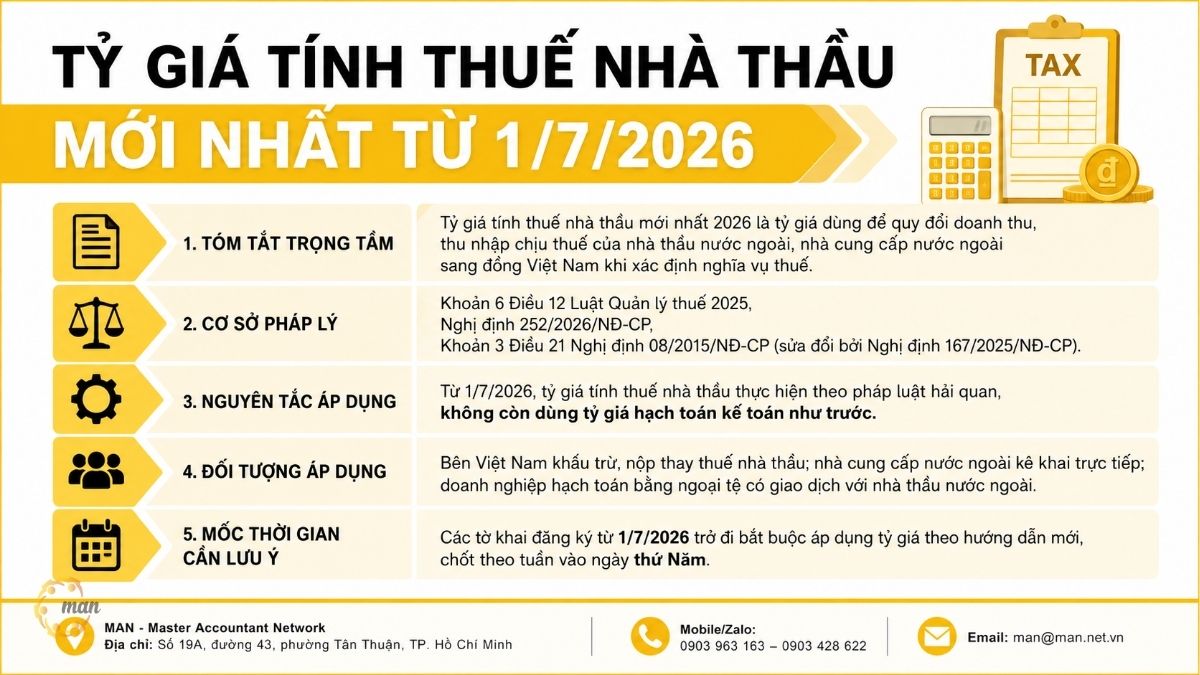
- The latest exchange rate for contractor tax calculation in 2026 is the rate used to convert the revenue and taxable income of foreign contractors and foreign suppliers into Vietnamese Dong when determining tax obligations.
- Legal basis: Clause 6, Article 12 of the 2025 Law on Tax Administration, Decree 252/2026/ND-CP, Clause 3, Article 21 of Decree 08/2015/ND-CP (amended by Decree 167/2025/ND-CP).
- Applicable principle: From July 1, 2026, the exchange rate for calculating contractor tax will be in accordance with customs law, and will no longer use the accounting exchange rate as before.
- Applicable entities: Vietnamese parties deducting and paying contractor tax on behalf of foreign suppliers; foreign suppliers declaring tax directly; and businesses accounting in foreign currency that have transactions with foreign contractors.
- Important timeframe: Registration forms submitted from July 1, 2026 onwards are required to apply the exchange rate as per the new guidelines, finalized weekly on Thursdays.
How is the latest exchange rate for contractor tax calculation in 2026 defined according to the law?
According to Clause 6, Article 12 of the 2025 Law on Tax Administration, the exchange rate for calculating taxes on imported and exported goods is determined by customs law. This is the basis cited by the Tax Department when guiding businesses on the exchange rate for calculating contractor taxes. Accordingly, from 2026, the exchange rate for calculating contractor taxes will be based on the customs exchange rate, replacing the accounting exchange rate as stipulated in Circular 99/2025.
Specifically, Article 1 Decree 252/2026/ND-CP Regulations governing the declaration, calculation of taxes, and exchange rates for import and export goods are implemented in accordance with customs law. According to Clause 3, Article 21 of Decree 08/2015/ND-CP, amended by Decree 167/2025/ND-CP, the exchange rate for tax calculation is the Vietcombank transfer buying rate, published at the end of Thursday of the preceding week.
Legal basis for determining the exchange rate for contractor tax calculation.
- Clause 6, Article 12 of the 2025 Tax Administration Law: The exchange rate for calculating taxes on exported and imported goods shall be applied according to customs law.
- Article 1 of Decree 252/2026/ND-CP: provides detailed regulations for the implementation of Clause 6, Article 12 of the 2025 Law on Tax Administration.
- Clause 3, Article 21 of Decree 08/2015/ND-CP (amended by Decree 167/2025/ND-CP), under Article 21 on customs valuation inspection and determination: the exchange rate is the buying rate for bank transfers of Vietcombank Head Office, announced at the end of Thursday of the preceding week, applicable to declarations registered in the following week.
- In cases where Vietcombank does not publish the foreign exchange rate: the cross exchange rate published by the State Bank of Vietnam shall apply; if no cross exchange rate is available, the State Bank of Vietnam shall determine it based on a proposal from the Ministry of Finance.
Notably, this guidance was officially confirmed by the Tax Department at the online Q&A program on Tax and Customs Policies for Korean businesses, held on July 23, 2026. Responding to a question from a business accounting in USD, the Tax Department confirmed that from July 1, 2026, businesses will use the exchange rate stipulated by customs law to calculate contractor tax, instead of the accounting exchange rate as before. This practical basis helps businesses confidently apply the regulations consistently, without needing to wait for further separate guidance documents.
Scope of application of Article 12 of the 2025 Law on Tax Administration and Decree 252/2026/ND-CP
In addition to the provisions on exchange rates for contractor tax calculation in Clause 6, Article 12 of the 2025 Tax Administration Law, many other provisions related to tax declaration and tax calculation are also stipulated, which are detailed in Decree 252/2026/ND-CP. Businesses should understand the overall scope of this law to apply it consistently, avoiding simply consulting Clause 6 alone and overlooking related provisions.
- Clause 1 of Article 12 stipulates the cases in which the calculation of taxes, other revenues, tax notices, and other revenues are carried out by the tax administration agency.
- Clause 2, Article 12: Foreign organizations and individuals conducting business on e-commerce platforms, other digital platforms, and other services shall declare and pay taxes and other fees in Vietnam directly or through authorization.
- Clause 3 of Article 12: stipulates regulations on tax deduction, declaration on behalf of others, and payment on behalf of others for tax obligations.
- Point b, Clause 4, Article 12: Cases where the deadline for submitting tax returns and other revenue declarations must be extended.
- Clause 5, Article 12: In cases where taxpayers discover errors or omissions in their submitted tax returns, they may file supplementary returns within 5 years from the date the deadline for submitting tax returns for other income in the tax period containing the errors or omissions has expired.
- Clause 6 of Article 12: tax declaration, supplementary declaration, deadline for submitting tax declaration documents, customs authority receiving tax declaration documents and exchange rate for tax calculation for exported and imported goods; this is the basis for applying the exchange rate for contractor tax calculation.
- Clause 7 of Article 12: Cases where taxes can be declared and calculated in foreign currency.
Why is the latest 2026 exchange rate for contractor tax calculation important for businesses?
Determining the correct exchange rate is crucial. Latest contractor tax rates 2026 This directly affects the amount of value-added tax and corporate income tax that the Vietnamese party must deduct, declare, and pay on behalf of the foreign contractor. Applying the wrong exchange rate, even with a small difference, can lead to discrepancies between the declared tax amount and the figures verified by the tax authorities, resulting in the risk of back taxes and late payment penalties during final settlement.
From the perspective of MAN – Master Accountant Network, after many years of advising FDI enterprises with contracts with foreign contractors in Vietnam on tax matters, establishing a single reference exchange rate, namely the customs exchange rate, significantly reduces the time spent reconciling data between accounting, tax, and banking departments. This is also a crucial basis for internal and independent auditors to verify the accuracy of financial statements related to contractor tax obligations.
Which entities will be affected by the latest 2026 exchange rate for contractor tax calculation?
The latest regulations on exchange rates for contractor tax calculation in 2026 not only affect businesses directly signing contracts with foreign contractors, but also involve many different groups of entities in the tax declaration and payment chain.
- The Vietnamese party signs the contract, deducts, and pays taxes on behalf of the foreign contractor or foreign subcontractor using the direct, deduction, or mixed methods.
- Foreign suppliers engaged in e-commerce and digital platform businesses must register, declare, and pay taxes directly in Vietnam.
- Businesses that use foreign currency for accounting, usually US dollars, may have payment transactions with foreign contractors.
- Foreign airlines, foreign carriers, and foreign reinsurance organizations that generate income in Vietnam must declare it using separate forms.
Timeline and conditions for applying the latest 2026 contractor tax exchange rate.
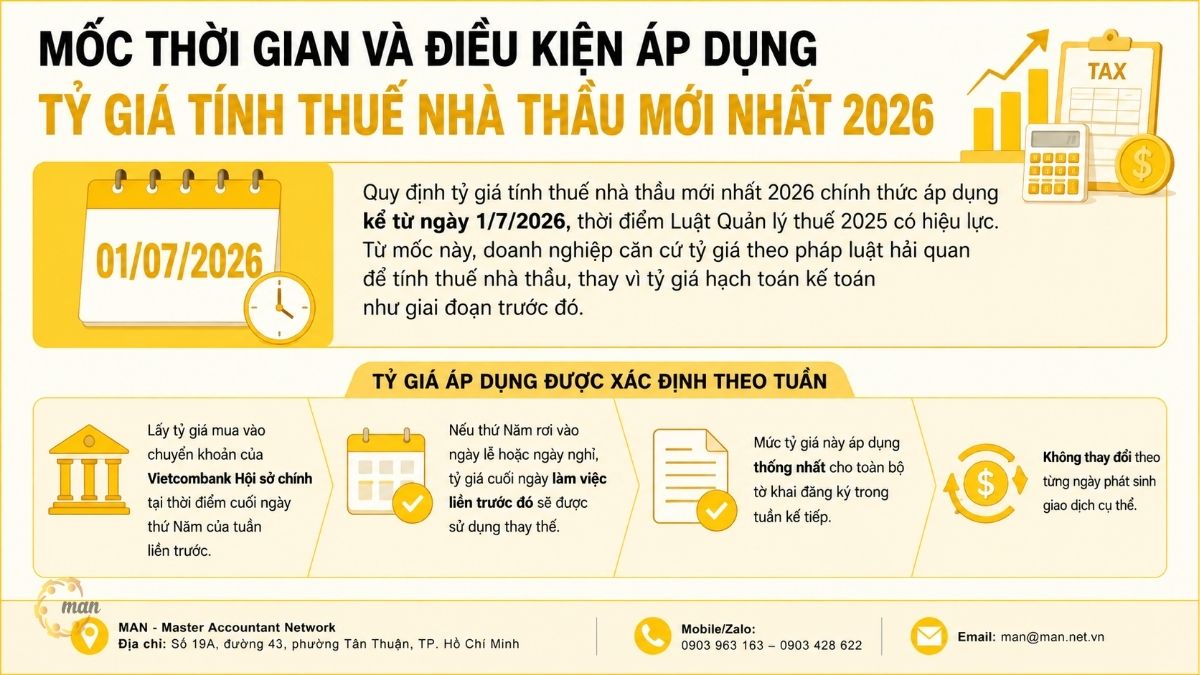
The latest regulations on exchange rates for contractor tax calculation in 2026 will officially apply from July 1, 2026, the date the 2025 Tax Administration Law comes into effect. From this date, businesses will base their contractor tax calculations on the exchange rate stipulated by customs law, instead of the accounting exchange rate used previously.
The applicable exchange rate is determined weekly: the Vietcombank Head Office's transfer buying rate at the end of Thursday of the preceding week is used. If Thursday falls on a public holiday or day off, the rate at the end of the previous business day will be used instead. This rate applies uniformly to all registration forms in the following week and does not change on specific transaction days.
Compilation of legal documents related to exchange rates for contractor tax calculation in 2026
To correctly apply the latest 2026 contractor tax exchange rate, businesses need to understand the following legal documents, arranged in order of validity and level of detail of guidance.
| Legal documents | Number / Date of Issue | Related content |
| Tax Administration Law 2025 | Promulgated by the National Assembly, effective July 1, 2026 | Clause 6, Article 12: Exchange rates for calculating export and import taxes according to customs law. |
| Decree 252/2026/ND-CP | Regulations detailing the implementation of the Law on Management and Supervision 2025 | Article 1: Detailed guidance on Clause 6 of Article 12, scope of adjustment of exchange rate for tax calculation. |
| Decree 08/2015/ND-CP (amended by Decree 167/2025/ND-CP) | Clause 3, Article 21 | Determining the exchange rate for customs valuation: Vietcombank's weekly published exchange rate. |
| Circular 89/2026/TT-BTC | Ministry of Finance | Instructions on tax filing and tax return documents for foreign contractors and foreign suppliers. |
| Circular 99/2025 | Old rules | The actual accounting exchange rate will no longer be used as the basis for calculating contractor tax from July 1, 2026. |
How to determine the latest exchange rate for contractor tax calculation in 2026 with illustrative examples.
Suppose a business in Ho Chi Minh City signs a technical service contract with a foreign contractor for $50,000 USD. The contractor tax return is registered on any Tuesday of the week. According to the new regulations, the business must use the buying exchange rate for transfers published by Vietcombank's head office at the end of the preceding Thursday, not the exchange rate on the exact day the tax return is registered or the payment date.
Assuming the published exchange rate at that time was 25,000 VND per US dollar, the taxable revenue would be 50,000 multiplied by 25,000, equivalent to 1,250,000,000 VND. This would serve as the basis for determining the value-added tax and corporate income tax that the Vietnamese party must deduct and pay on behalf of the Vietnamese party. This is an illustrative example; the actual exchange rate changes weekly, so businesses need to check the official exchange rate published by Vietcombank at the time of application.
Comparison table of exchange rate regulations for contractor tax calculation before and after July 1, 2026
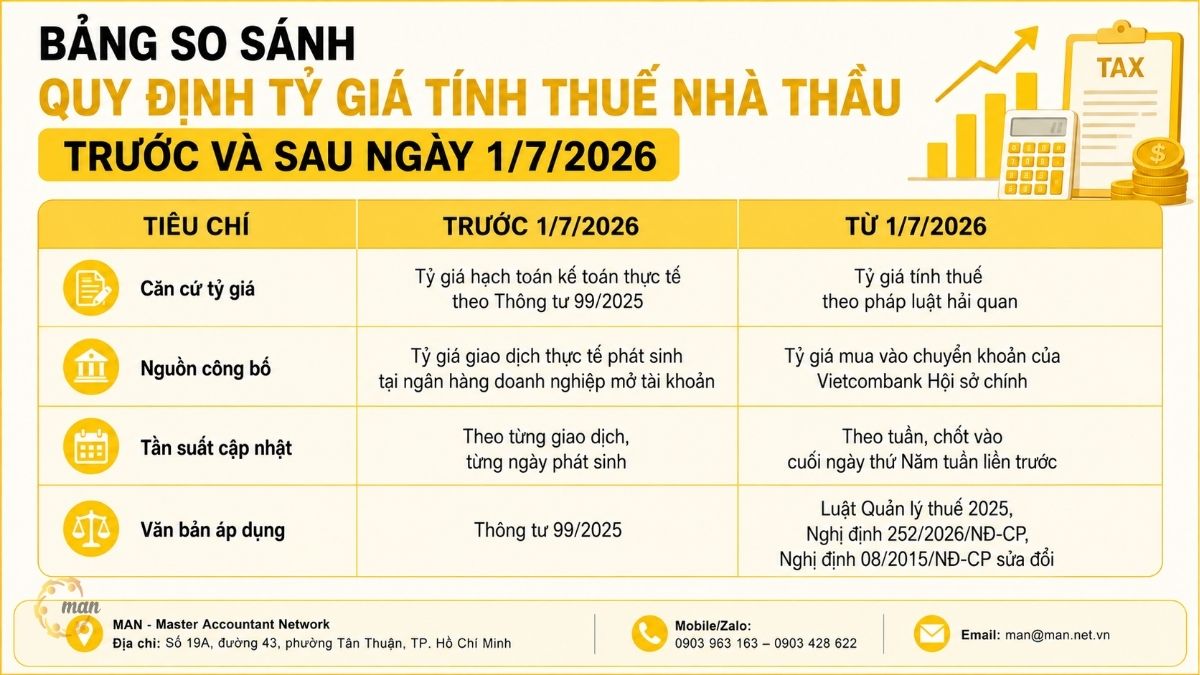
From July 1st, 2026, regulations regarding exchange rates for tax calculation will undergo significant changes, particularly for transactions involving foreign contractors. The table below summarizes the key differences between the regulations before and after this date, helping businesses easily identify the basis and source of exchange rates to apply when filing taxes.
| Criteria | Before July 1, 2026 | From July 1, 2026 |
| Based on the exchange rate | The actual accounting exchange rate is based on Circular 99/2025. | Exchange rate for tax calculation according to customs law. |
| Source of publication | The actual exchange rate is determined at the bank where the business has its account. | Vietcombank Head Office's buying rate for bank transfers. |
| Update frequency | Each transaction is based on the day it occurs. | Weekly, closing at the end of Thursday of the preceding week. |
| Applicable document | Circular 99/2025 | Law on Tax Administration 2025, Decree 252/2026/ND-CP, and Decree 08/2015/ND-CP amending the law. |
Case Study: How do FDI enterprises handle exchange rates for contractor tax purposes?
Background
Company Y, a foreign-invested enterprise operating in the information technology sector in Hanoi, uses USD for its accounting and frequently contracts with foreign consultants and purchases software licenses from foreign suppliers. Prior to July 1, 2026, the company applied the actual accounting exchange rate on the payment date to calculate contractor tax, resulting in constantly changing figures and difficulties in reconciliation between tax declaration periods.
How to handle it
Following advice from MAN – Master Accountant Network, the company adjusted its process in three steps: building a weekly updated exchange rate tracking table for contractor tax calculations based on the Vietcombank exchange rate published every Thursday; retraining the tax accounting department on the principle of applying the weekly exchange rate instead of the daily rate; and reviewing all ongoing foreign contractor contracts to determine the correct time to apply the new exchange rate, avoiding confusion between declarations before and after July 1, 2026.
The measured results
Standardizing the process helped the company reduce the time spent reconciling exchange rates between tax returns from an average of three days to just half a day per filing period. When the tax authorities reviewed the contractor's tax returns for the third quarter of 2026, all exchange rate data was confirmed to match the rates published by Vietcombank, with no discrepancies requiring explanation.
Distinguish between the exchange rate used for calculating contractor tax and other specific exchange rates.
In addition to the exchange rate used for calculating contractor tax, the 2025 Tax Administration Law and its guiding decrees also stipulate specific exchange rates applicable to certain special cases. Businesses need to clearly distinguish these to avoid misapplying the principle.
- Global minimum tax: There are separate exchange rate guidelines in accordance with global minimum tax regulations; the customs exchange rate principle mentioned above does not apply.
- Oil and gas activities: The exchange rate for calculating taxes on oil and gas activities is guided separately due to the specifics of the production cycle and payment in foreign currency under oil and gas contracts.
- For exported and imported goods: the customs exchange rate as analyzed above is applied, which is also the principle that the Tax Department has instructed to apply similarly to the calculation of contractor tax.
- Cases where taxes are declared and calculated in foreign currency: these are implemented according to Clause 7, Article 12 of the 2025 Tax Administration Law, as detailed in Decree 252/2026/ND-CP.
Because multiple parallel exchange rate principles exist, businesses that simultaneously engage in various types of transactions, such as importing goods, hiring foreign contractors, and paying global minimum tax rates, need to clearly categorize each item to apply the correct corresponding exchange rate, avoiding the use of a single exchange rate for all tax obligations arising during the period.
Tax declaration and direct payment by foreign suppliers according to Circular 89/2026/TT-BTC
Besides the mechanism of deduction and payment on behalf of others in Vietnam, Circular 89/2026/TT-BTC Furthermore, the regulations stipulate a mechanism for foreign suppliers to self-declare and pay taxes directly in Vietnam, commonly applied to e-commerce platforms and cross-border digital platforms. According to Clause 1, Article 31 of Circular 89/2026/TT-BTC, the direct tax declaration and payment by foreign suppliers shall be carried out according to the following principles.
- Foreign suppliers declare directly to the tax authorities or through an authorized agent; tax declaration documents shall be prepared in accordance with the provisions of point 16, Appendix I issued with Circular 89/2026/TT-BTC.
- In the event that errors or omissions are discovered after the tax declaration and payment procedures are completed, the foreign supplier shall make an adjustment to the tax payable arising in Vietnam in accordance with the provisions of point 16 of Appendix I mentioned above.
- Foreign suppliers pay taxes in freely convertible foreign currency into the state budget revenue account as notified on the Tax Management Information System, ensuring that the correct tax payment identification code sent by the directly managing tax authority is entered.
- In cases where there is an overpayment of taxes, other charges, late payment penalties, or fines, the foreign supplier may offset this amount against the taxes, other charges, late payment penalties, fines payable, and outstanding tax debts as stipulated in Clauses 1, 2, 4, 5, and 6 of Article 42. Circular 89/2026/TT-BTC.
- The tax authorities, in coordination with relevant agencies, will identify and publish the names and website addresses of foreign suppliers who have not registered, declared, or paid taxes but have transactions occurring in Vietnam; and will also coordinate with foreign tax authorities to urge them to declare and pay taxes, collect back taxes, and handle cases according to regulations when inaccurate declarations are discovered.
Thus, the latest exchange rate for calculating contractor tax in 2026 applies to two tax declaration mechanisms: the Vietnamese party deducts and pays on behalf of the foreign contractor, and the foreign supplier self-declares and pays directly. Regardless of the mechanism, the principle of determining the exchange rate according to customs law remains consistent when converting taxable income and revenue into Vietnamese Dong.
What documents are required for foreign contractor tax declarations according to Circular 89/2026/TT-BTC?
In addition to regulations on exchange rates, businesses need to understand... foreign contractor tax return According to Appendix 1 issued with Circular 89/2026/TT-BTC, the latest exchange rate for contractor tax calculation in 2026 is only meaningful when applied correctly to the correct type of declaration and at the correct time of declaration.
- In cases where VAT is paid using the deduction method and corporate income tax is paid based on declared revenue and expenses to determine taxable income: VAT declaration shall be carried out according to the provisions of point 4 and corporate income tax declaration according to the provisions of point 6 of Appendix I.
- Submission case VAT Calculated directly based on revenue, payable corporate income tax Based on a percentage of taxable revenue (direct method): declarations are filed on a case-by-case basis or monthly if multiple transactions occur, using Form 01/NTNN, NCCNN accompanied by a copy of the contractor contract and subcontractor contract for the first declaration; final settlement declarations upon contract completion use Form 02/NTNN along with Appendix 02-1/NTNN (list of foreign contractors) and 02-2/NTNN (list of subcontractors).
- For cases where VAT is paid using the deduction method and corporate income tax is paid as a percentage of revenue (mixed method): the declaration form should be submitted for each transaction or monthly using Form No. 03/NTNN, accompanied by a copy of the contractor contract or subcontractor contract for the first declaration; the final settlement declaration form upon completion of the contract should use Form No. 04/NTNN along with Appendix 02-2/NTNN.
- Foreign airlines: file quarterly using Form No. 01/HKNN, accompanied by a copy of the contractor contract and subcontractor contract for the first tax filing.
- Foreign shipping companies: file annual tax returns using Form No. 01/VTNN, along with Appendix 01-1/VTNN (statement of international transport income, applicable to ship operating enterprises), 01-2/VTNN (applicable in cases of space swapping and sharing), and 01-3/VTNN (statement of container demurrage revenue).
- Foreign reinsurance organizations: submit quarterly reports using Form No. 01/TBH, along with Appendix 01-1/TBH regarding reinsurance contracts and documents.
Expert opinion: Common business risks when applying exchange rates for contractor tax calculation.
Risk 1: Applying the wrong daily exchange rate instead of the weekly rate.
Many accountants are still accustomed to applying the exchange rate on the exact date of the transaction or payment, while the new regulations require the use of a fixed weekly exchange rate, fixed on the preceding Thursday. This error causes the declared tax amount to differ from the figures verified by the tax authorities; although the exchange rate difference is usually not large, an explanation may still be required.
Risk 2: Failure to update procedures during the transition period between old and new regulations.
For contracts signed before July 1, 2026, but with payments and tax declarations made after this date, many businesses still apply the old accounting exchange rate. This is a common mistake during the transition period between the two regulations, when information has not been widely disseminated within the accounting department.
Risk 3: Lack of evidence for verification during tax audits.
Businesses need to retain documentation proving that the exchange rate used matches the rate published by Vietcombank at the specified time, such as a printed copy or screenshot of the weekly exchange rate announcement. Without this documentation, businesses will have difficulty explaining their position during tax audits and inspections.
Risk 4: Confusion between the exchange rate used for contractor tax calculation and the exchange rate for specific transactions.
The 2025 Tax Administration Law still retains separate guidelines on exchange rates for certain specific cases, such as global minimum tax rates and oil and gas activities. Incorrectly applying the customs exchange rate principle to these transactions, or vice versa, can lead to discrepancies in the amount of tax payable and carries the risk of retroactive tax collection.
Experts at MAN – Master Accountant Network, with over 30 years of experience in tax consulting and auditing in Vietnam, recommend that businesses build a weekly updated exchange rate tracking table for contractor tax purposes, linked to internal tax filing schedules, in order to optimize tax costs and minimize tax risks arising from exchange rate errors.
Conclude
The latest exchange rate for contractor tax calculation in 2026 marks a significant change in how businesses determine their tax obligations to foreign contractors and suppliers. The shift from accounting exchange rates to weekly customs exchange rates requires businesses to update their processes, retrain their tax accounting personnel, and build a robust exchange rate monitoring system to avoid errors in tax declarations and settlements.
Tax services at MAN – Master Accountant Network
- Tax accounting services
- Tax consulting services
- Tax settlement services
- Tax reporting services
- VAT refund service
Service contact information at MAN – Master Accountant Network
- Address: No. 19A, Street 43, Tan Thuan Ward, Ho Chi Minh City
- Mobile/Zalo: 0903 963 163 – 0903 428 622
- E-mail: man@man.net.vn
- Google Business Profile: View MAN – Master Accountant Network's Google Business Profile
- LinkedIn Founder: View expert Le Hoang Tuyen's LinkedIn profile.
Responsible for production and professional content review by: Mr. Le Hoang Tuyen – Founder & CEO of MAN – Master Accountant Network, CPA Vietnam with over 30 years of experience in accounting, auditing, taxation, and corporate financial consulting.
Frequently Asked Questions about the latest contractor tax exchange rates in 2026
When will the latest exchange rate for contractor tax calculation in 2026 be applied?
From July 1, 2026, when the 2025 Tax Administration Law comes into effect, the exchange rate used for calculating contractor taxes will be based on customs law instead of the accounting exchange rate used previously.
Which bank publishes the exchange rate used for calculating contractor tax?
The exchange rate is based on the transfer buying rate of the Head Office of Vietnam Foreign Trade Commercial Bank, as published at the end of Thursday of the preceding week.
If Thursday is a public holiday, which exchange rate should be used?
Businesses use the exchange rate at the end of the business day immediately preceding Thursday to apply to registration forms submitted during the week.
Can businesses that use foreign currency for accounting still use the accounting exchange rate to calculate contractor tax?
No. From July 1, 2026, the accounting exchange rate according to Circular 99/2025 will no longer be the basis for calculating contractor tax; businesses must switch to applying the customs exchange rate according to the new guidelines.
How is the exchange rate calculated for foreign currencies that Vietcombank doesn't publish?
Businesses apply the cross exchange rate between the Vietnamese Dong and the foreign currency as published by the State Bank of Vietnam; if no cross exchange rate is available, the State Bank will determine it based on a proposal from the Ministry of Finance.