
Distinguishing between accounting exchange rates and tax exchange rates. This is a problem that many businesses involved in foreign exchange transactions have been struggling to solve since then. Circular 99/2025/TT-BTC and Decree 252/2026/ND-CP Both systems will take effect from July 1, 2026. These two exchange rate systems serve two different purposes: one is used for bookkeeping and financial reporting, while the other is used for tax declarations and determining obligations to the budget. Any confusion could result not only in discrepancies in internal data but also in the risk of back taxes and penalties when tax authorities review records.
In practice, having advised hundreds of foreign-invested enterprises and import-export businesses in Vietnam, the team MAN – Master Accountant Network It has been observed that most errors do not stem from a lack of legal knowledge, but from applying a single exchange rate to all transactions. This article systematizes the latest legal basis, provides specific calculation examples, and points out the risks businesses need to be aware of now.
Summary of key points regarding the distinction between accounting exchange rates and tax exchange rates.

- Distinguishing between accounting exchange rates and tax exchange rates involves clearly identifying two different types of exchange rates: the accounting exchange rate used for bookkeeping and financial reporting; and the tax exchange rate used for tax and customs declarations.
- Legal basis: Circular 99/2025/TT-BTC (accounting exchange rate) and Decree 252/2026/ND-CP, Decree 08/2015/ND-CP amended by Decree 167/2025/ND-CP (tax exchange rate), effective from July 1, 2026.
- Applicable entities: All businesses that conduct economic transactions in foreign currency, especially import-export businesses, FDI businesses, and oil and gas businesses.
- The core principle: Accounting records cannot be used as a basis for calculating taxes if the exchange rate applied does not comply with tax laws; the two exchange rate systems must be clearly separated in the records.
What are accounting exchange rates and tax exchange rates? Standard legal definitions.
This is a fundamental question that any accountant needs to understand before recording any foreign currency transactions. Although both concepts revolve around converting foreign currency into Vietnamese Dong, their legal nature and purposes are fundamentally different.
How are accounting exchange rates determined?
According to Section 1.2 of Account 413 issued with Circular 99/2025/TT-BTC, enterprises with economic transactions denominated in foreign currency must record accounting entries and prepare financial statements in a single currency unit, either the Vietnamese Dong or the currency used in accounting. The conversion must be based on... actual exchange rate or book exchange rate, depending on the content and nature of each economic transaction, and not applied mechanically to all cases.
For actual transaction exchange rates, businesses may choose the average buying and selling exchange rate on the transaction day of the commercial bank where they regularly conduct transactions, or apply an approximate exchange rate provided that the difference does not exceed plus or minus 1% compared to the average buying and selling exchange rate. Circular 99/2025/TT-BTC further notes that the use of approximate exchange rates must ensure that it does not materially affect the financial situation and business performance in the accounting period of the business.
In cases where the commercial bank where the enterprise regularly conducts transactions does not publish the exchange rate of the foreign currency involved, the enterprise may choose an intermediate currency for conversion, but must apply it consistently according to Vietnamese accounting standards and clearly explain the basis for the choice in the financial statements.
How is the exchange rate used for tax calculation determined?
The tax exchange rate is the rate used specifically for the purpose of tax declaration, customs declaration, and determining the taxable value of imported and exported goods. (Based on Clause 4, Article 14) Decree 252/2026/ND-CP According to Clause 5, Article 21 of Decree 08/2015/ND-CP (amended by Clause 9, Article 1 of Decree 167/2025/ND-CP), this exchange rate is implemented in accordance with customs law. For exported goods, it is the buying rate for bank transfers of Vietcombank's head office as announced by the Customs Department.
Why are businesses required to distinguish between accounting exchange rates and tax exchange rates?
Many business owners believe that a single, unified exchange rate is sufficient for both accounting and tax purposes. This is one of the most common misconceptions. MAN – Master Accountant Network This has been observed through reviews of tax accounting records for FDI clients over the years.
The distinction between the two exchange rates is directly significant in determining the correct tax obligations and the accuracy of financial reporting. Circular 99/2025/TT-BTC clearly states an important principle: when determining tax obligations related to transactions in foreign currency, businesses must comply with tax laws and regulations, and not apply the exchange rate used in accounting.
In other words, accounting records and tax returns may reflect two different exchange rates for the same transaction. This is perfectly legal if the business applies the correct exchange rate for the correct purpose. Conversely, using the accounting exchange rate for tax declarations is not. import and export taxes, Alternatively, using the customs exchange rate to record revenue in the books will result in discrepancies and may lead to requests for explanations from the tax authorities, or even adjustments to the entire relevant accounting period.
Which entities are affected when a distinction is made between accounting exchange rates and tax exchange rates?
This regulation is not exclusive to import and export businesses. Its scope of application is quite broad, including:
- Businesses that conduct economic transactions in foreign currency must record their transactions and prepare financial statements in Vietnamese Dong or the currency used in accounting.
- Businesses exporting and importing goods need to determine the taxable value in accordance with customs law.
- Taxpayers subject to supplemental corporate income tax filing under global tax base erosion regulations, especially when filing in foreign currency but paying taxes in Vietnamese Dong.
- The company operates in the oil and gas sector, including the domestic sale and export of oil and gas.
- Accountants, auditors, and the internal tax department are responsible for reconciling figures between financial statements and tax returns on a regular basis.
Points to note: Even businesses that do not have direct import or export activities but have liabilities, revenues, or expenses in foreign currency must still apply the correct accounting exchange rate principles when recording transactions, and separate them when related tax obligations arise.
What legal documents govern accounting exchange rates and tax exchange rates?
Important Note: These two systems of regulations operate in parallel and independently. Businesses need to monitor both accounting regulations and tax/customs regulations simultaneously, because each amendment to specialized regulations can change the way tax exchange rates are determined without affecting accounting exchange rates, and vice versa.
| Legal documents | Number / Date of Issue | Related content |
| Circular 99/2025/TT-BTC | Ministry of Finance | Regulations on exchange rates in accounting, accounting for Account 413, principles of actual transaction exchange rates and approximate exchange rates. |
| Decree 252/2026/ND-CP | Government, effective July 1, 2026 | Regulations on exchange rates for tax declarations, including supplementary corporate income tax, oil and gas activities, import and export taxes, fees and charges. |
| Decree 08/2015/ND-CP (amended by Decree 167/2025/ND-CP) | Government | Detailed regulations and implementation measures of the Customs Law regarding customs procedures, inspection, and supervision, including regulations on exchange rates for calculating import and export taxes. |
| Decree 236/2025/ND-CP | Government | Basis for determining the exchange rate applicable to the global minimum tax when filing in foreign currency. |
Detailed table differentiating between accounting exchange rates and tax exchange rates.
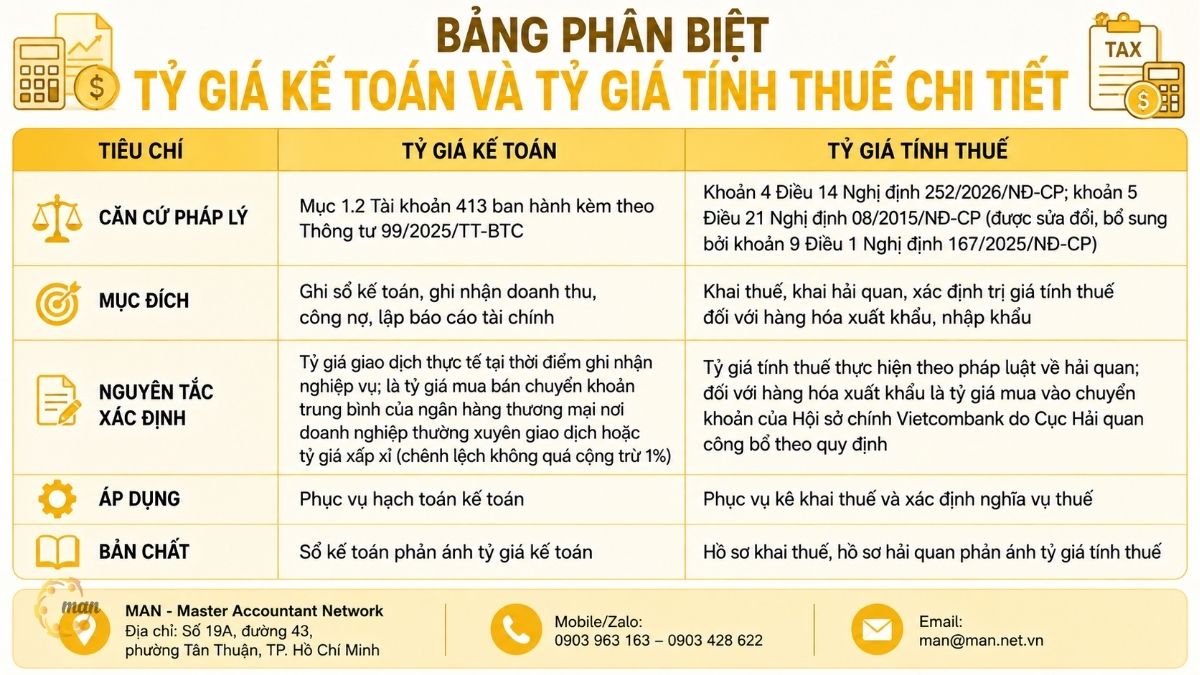
To make it easier to understand, below is a table directly comparing the two types of exchange rates based on the core criteria that accountants need to compare daily.
| Criteria | Accounting exchange rate | Tax exchange rate |
| Legal basis | Section 1.2, Account 413 issued together with Circular 99/2025/TT-BTC | Clause 4, Article 14 of Decree 252/2026/ND-CP; Clause 5, Article 21 of Decree 08/2015/ND-CP (amended and supplemented by Clause 9, Article 1 of Decree 167/2025/ND-CP) |
| Purpose | Record accounting entries, identify revenue and accounts receivable, and prepare financial statements. | Tax declaration, customs declaration, and determination of taxable value for exported and imported goods. |
| Principle of determination | The actual exchange rate at the time of recording the transaction is the average buying and selling rate of the commercial bank where the business regularly conducts transactions, or an approximate rate (the difference should not exceed plus or minus 1%). | The exchange rate for tax calculation is determined according to customs law; for exported goods, it is the buying rate for bank transfers of Vietcombank's head office as announced by the Customs Department in accordance with regulations. |
| Apply | Serving accounting purposes | Serving the purpose of tax declaration and determining tax obligations. |
| Nature | The accounting records reflect the accounting exchange rate. | Tax returns and customs documents reflect the exchange rate used for tax calculation. |
How to calculate accounting exchange rates and tax exchange rates through a practical example.
The theory becomes easier to understand when placed in a specific situation. Suppose company B exports a shipment worth $50,000. The invoice date is the date the revenue transaction occurs, as recorded in the accounting books.
If the commercial bank where company B regularly conducts transactions publishes an average exchange rate of 25,400 VND per USD for buying and selling transfers, the accountant will use this figure, or an approximate rate within the allowed difference, to record revenue of 50,000 USD, equivalent to approximately 1,270,000,000 VND, in the books.
However, when filing export tax returns, Company B did not use the aforementioned figure of 25,400 VND, but instead consulted the Vietcombank exchange rate published by the Customs Department at the time of customs declaration registration. If this exchange rate was 25,350 VND per USD, the taxable value would be approximately 1,267,500,000 VND, a difference of 2,500,000 VND compared to the amount recorded in the accounting books. This difference is reasonable and not an error, provided the company keeps sufficient records for each exchange rate applied.
Article 14 of Decree 252/2026/ND-CP specifies which exchange rates are used for tax declaration.
In addition to the general principles, Article 14 of Decree 252/2026/ND-CP specifically lists each group of transactions with its own method for determining the exchange rate for tax declaration. This is the most easily overlooked part because of its narrow scope of application, but it is crucial for the specific groups of businesses involved.
Exchange rate for supplementary corporate income tax declaration under the global minimum tax mechanism.
In cases where taxpayers declare information in a foreign currency according to the global minimum tax regulations, but choose to declare and pay supplementary corporate income tax in Vietnamese Dong, the exchange rate will be determined according to Decree 236/2025/ND-CP. If no exchange rate is available according to this decree, the enterprise will apply the cross-exchange rate published by the State Bank of Vietnam on the day closest to the tax declaration date.
In the case of supplementary tax returns, businesses must apply the same exchange rate used in the initial tax return accepted by the tax authorities; they are not allowed to change to a new exchange rate. If the action is taken in accordance with the conclusions or decisions following an inspection or audit, the applicable exchange rate will be the rate in the initial tax return that was accepted, or the exchange rate on the last day of the tax return filing deadline if the business has not yet filed the return.
Taxable exchange rate for oil and gas activities and oil and gas sales.
For oil and gas operations and sales, the exchange rate used for tax declarations and other revenue collection is the actual exchange rate used for payment of the oil and gas sales transaction.
Specifically, in the case of the Vietnam National Energy and Industry Corporation, which is allowed to pay taxes and other revenues in Vietnamese Dong as stipulated by the Government, the exchange rate for tax declaration is the average buying and selling rate of the commercial bank where the taxpayer regularly conducts transactions, calculated on the date of filing the tax return. In the case of supplementary declaration, the enterprise shall apply the exchange rate used in the initial tax return that was accepted.
For domestic oil sales, the exchange rate used for calculating value-added tax is the transfer selling rate of the commercial bank where the taxpayer receives payment according to the contract, determined at the time of invoice issuance in accordance with the law on invoices.
Exchange rates for calculating import and export taxes and exchange rates for calculating fees and charges.
For exported and imported goods, the exchange rate for tax calculation is implemented according to the regulations of customs law as presented in the definition section. Regarding fees and charges, Decree 252/2026/ND-CP stipulates that the exchange rate for calculating fees and charges is implemented according to the regulations of specialized laws on fees and charges, and does not apply a single formula with the exchange rate for calculating import and export taxes or the accounting exchange rate.
Case Study: How do export businesses in Ho Chi Minh City handle two different exchange rates?
Background
Company Y, a limited liability company specializing in textile exports, has an average monthly foreign currency revenue of $2 million USD. Previously, the accounting department used a single exchange rate obtained from the bank for both bookkeeping and export tax declarations, leading to small but recurring discrepancies over many periods.
Processed based on advice from MAN – Master Accountant Network.
The team of experts at MAN The review recommended that the company take three steps: firstly, update the accounting software to separate the exchange rate data fields for book value and tax declaration for each shipment; secondly, create a daily exchange rate reconciliation table, attached with source documents from the bank and the Customs Department; and thirdly, retrain the accounting department on the principle of not using the book value exchange rate for tax declaration, in accordance with Circular 99/2025/TT-BTC.
The measured results
- The exchange rate discrepancies between the accounting records and the tax returns have been clearly explained, and no further adjustment requests from the tax authorities arose during the most recent audit.
- The time required for final data reconciliation was reduced from 5 days to 2 days thanks to the system's data separation from the outset.
- The company avoided the risk of being subject to back taxes due to the incorrect application of the tax exchange rate, a common error among businesses with high foreign currency transaction frequency.
Expert opinion: Common business risks and how to avoid them.
With over 30 years of experience providing tax and auditing consulting services to businesses in Vietnam, our team of experts MAN – Master Accountant Network This article points out the four most common risks when businesses fail to clearly distinguish between accounting exchange rates and tax exchange rates.
Risk 1: Using a single exchange rate for all purposes.
This is the most common mistake. Many accountants use the bank exchange rate for accounting purposes and also declare it in customs documents, even though the two rates may differ slightly. In the long run, the accumulated discrepancies will cause financial statements and tax returns to clash when the tax authorities conduct a review.
Risk 2: Lack of source documentation for each exchange rate.
Tax and customs authorities require businesses to retain documentation proving the applicable exchange rate, including exchange rate announcements from commercial banks and tax exchange rate notifications from the Customs Department at the time of the transaction. Lack of this documentation makes it difficult for businesses to explain their actions during inspections and audits.
Risk 3: The accounting software has not yet updated the two separate exchange rate fields.
Many domestic accounting software programs currently only have one exchange rate field per transaction, forcing accountants to process data manually outside the system. This increases the risk of errors and makes it difficult to control when dealing with large volumes of foreign currency transactions.
Risk 4: Confusion when declaring the global minimum tax in foreign currency.
For multinational corporations subject to the global minimum tax rate, determining the exchange rate from the Information Declaration to the Supplementary Corporate Income Tax Return follows a specific procedure as stipulated in Decree 236/2025/ND-CP. Incorrect application of this procedure can lead to multiple supplementary declarations, affecting credibility and tax settlement progress.
Solutions from MAN – Master Accountant Network To address these risks, it is necessary to establish a separate internal control process right from the data entry stage, combined with quarterly reviews to ensure optimal tax cost management in Vietnam while fully complying with legal regulations.
Conclude
Distinguishing between accounting exchange rates and tax exchange rates is not merely a technical accounting issue, but a fundamental aspect for businesses to comply with legal regulations, avoid the risk of tax arrears, and ensure that financial statements accurately reflect their business performance. From July 1, 2026, when Circular 99/2025/TT-BTC and Decree 252/2026/ND-CP come into effect, clearly separating the two exchange rate systems right from the internal process setup stage will significantly save businesses time in reconciliation and minimize disputes with tax authorities.
Tax services at MAN – Master Accountant Network
- Tax accounting services
- Tax consulting services
- Tax settlement services
- Tax reporting services
- VAT refund service
Service contact information at MAN – Master Accountant Network
- Address: No. 19A, Street 43, Tan Thuan Ward, Ho Chi Minh City
- Mobile/Zalo: 0903 963 163 – 0903 428 622
- E-mail: man@man.net.vn
- Google Business Profile: View MAN – Master Accountant Network's Google Business Profile
- LinkedIn Founder: View expert Le Hoang Tuyen's LinkedIn profile.
Responsible for production and professional content review by: Mr. Le Hoang Tuyen – Founder & CEO of MAN – Master Accountant Network, CPA Vietnam with over 30 years of experience in accounting, auditing, taxation, and corporate financial consulting.
Frequently Asked Questions about Differentiating Between Accounting Exchange Rates and Tax Exchange Rates
Is it mandatory for businesses to use the same exchange rate for accounting and tax filing?
No. The two exchange rates serve two different purposes and may have different values at the same time of transaction, as long as each rate is applied correctly according to the relevant legal regulations.
What is the permitted difference between the approximate exchange rate and the rate published by the bank?
According to Circular 99/2025/TT-BTC, the approximate exchange rate must not exceed plus or minus 1% compared to the average buying and selling transfer rate on the transaction day of the commercial bank.
Where does the exchange rate used for calculating export taxes come from?
This is the buying rate for bank transfers at Vietcombank's head office, as published by the Customs Department in accordance with customs law at the time of customs declaration registration.
How do oil and gas companies apply exchange rates for tax purposes?
For oil and gas sales, the exchange rate is the actual rate at which the transaction is settled. If the Vietnam National Energy Industry Corporation pays taxes in Vietnamese Dong, the applicable exchange rate is the average buying and selling rate for transfers on the date of tax return filing.
What happens if the bank doesn't publish the exchange rate for the foreign currency involved?
Businesses may choose an intermediate currency for conversion, but must apply it consistently in accordance with Vietnamese accounting standards and clearly explain the basis for the choice in the financial statements.