


How to handle adjustments when increasing/decreasing VAT amounts. The issue of tax deductions is a source of confusion for many corporate accountants, especially since Circular 89/2026/TT-BTC and Decree 252/2026/ND-CP Officially effective. Errors in supplementary declarations not only distort the figures on the VAT return but also carry the risk of being subject to back taxes and late payment penalties when the tax authorities conduct inspections and audits.
This article systematizes all current legal regulations related to the adjustment of numbers. VAT Furthermore, deductions are also covered, based on legal grounds, arising circumstances, specific declaration methods, and practical risks commonly encountered by Vietnamese businesses. The content is compiled from a professional perspective. MAN – Master Accountant Network, a tax, accounting, and auditing consulting firm with over 30 years of practical experience in the Vietnamese market.
Summary of key points regarding how to handle adjustments when increasing/decreasing the deductible VAT amount.
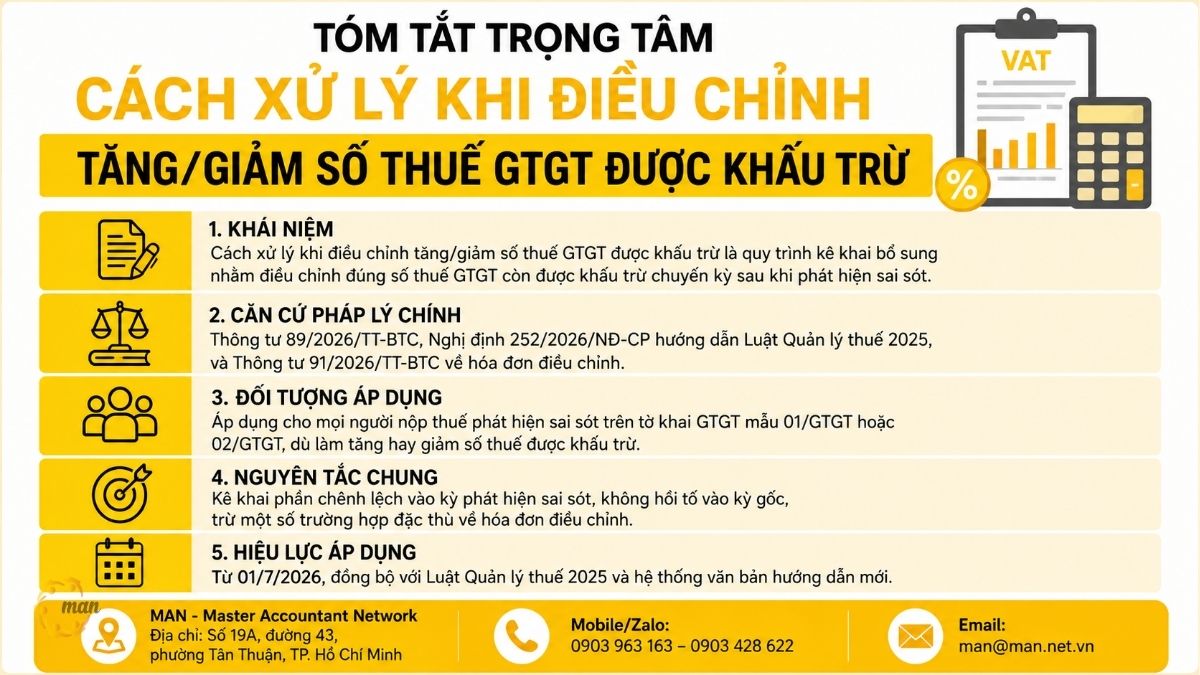
- The procedure for adjusting the amount of deductible VAT upwards or downwards is a supplementary declaration process aimed at correcting the amount of deductible VAT carried over to the next period when an error is discovered.
- Main legal basis: Circular 89/2026/TT-BTC, Decree 252/2026/ND-CP guiding the 2025 Tax Administration Law, and Circular 91/2026/TT-BTC on adjusted invoices.
- This applies to all taxpayers who discover errors on their VAT declaration form 01/GTGT or 02/GTGT, regardless of whether the error increases or decreases the deductible tax amount.
- General principle: declare the difference in the period in which the error is discovered, and do not retroactively apply it to the original period, except in some specific cases regarding adjustment invoices.
- Effective date: from July 1, 2026, in line with the 2025 Tax Administration Law and the new system of guiding documents.
What is the procedure for adjusting the amount of deductible VAT upwards or downwards?
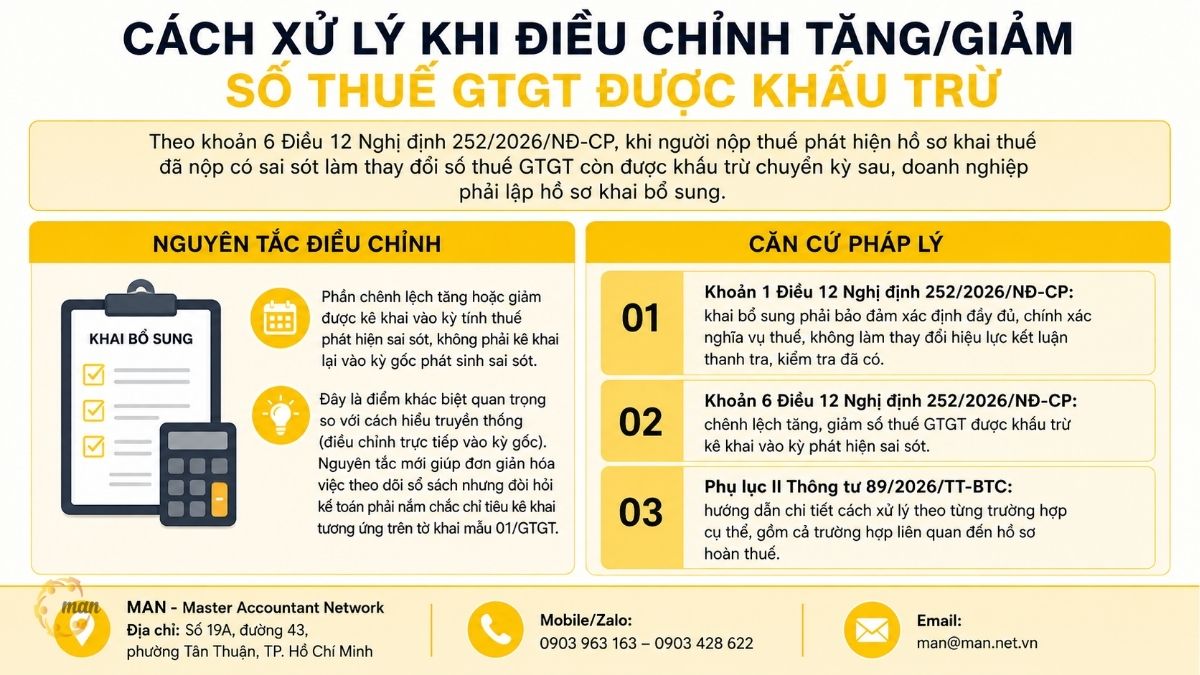
According to Clause 6, Article 12 of Decree 252/2026/ND-CP, when taxpayers discover errors in their submitted tax returns that change the amount of deductible VAT carried forward to the next period, they must prepare a supplementary tax return. The difference (increase or decrease) is declared in the tax period in which the error is discovered, and does not need to be re-declared in the original period in which the error occurred.
This is a significant difference from the traditional understanding of many accountants, who are accustomed to making direct adjustments to the base period. The new principle simplifies bookkeeping but requires accountants to have a firm grasp of the corresponding declaration items on form 01/GTGT.
Legal basis for determining the regulatory principles:
- Clause 1, Article 12 of Decree 252/2026/ND-CP: supplementary declarations must ensure the full and accurate determination of tax obligations and must not alter the validity of existing inspection or audit conclusions.
- Clause 6, Article 12 of Decree 252/2026/ND-CP: the increase or decrease in the amount of deductible VAT declared in the period in which the error is discovered.
- Appendix II of Circular 89/2026/TT-BTC: provides detailed guidance on how to handle each specific case, including cases related to tax refund applications.
Why do businesses need to understand how to handle adjustments when increasing or decreasing the amount of deductible VAT?
Errors in VAT declarations are one of the most common mistakes in small and medium-sized enterprises (SMEs), due to the large volume of invoices and the lack of rigorous reconciliation processes. If adjustment items are incorrectly processed, the figures on the tax return will not match the accounting records, leading to discrepancies that persist over several periods.
From this perspective MAN – Master Accountant Network, In most cases, businesses are required to provide explanations by the tax authorities because they incorrectly declare adjustments (increases or decreases) or omit late payment penalties when the adjustments increase the amount of tax payable. Understanding the correct procedure from the outset helps businesses avoid wasting time on explanations and minimize the risk of being subjected to tax assessments.
Which entities are subject to the regulations on adjusting the amount of deductible VAT upwards/downwards?
This regulation applies to all taxpayers subject to VAT declaration using the deduction method, regardless of size or type of business. Specifically, the following entities should take note:
- The business discovered errors on the VAT declaration form 01/GTGT that had been submitted for the previous tax period.
- Businesses with investment projects are filing separate declarations on form 02/GTGT.
- Businesses that have submitted tax refund applications but have encountered errors that need correction before or after the refund is granted.
- The entity undergoing a change in business type, division, separation, merger, consolidation, or termination of operations of a subsidiary unit that generates deductible VAT tax amounts needs to be transferred.
Points to note: Not every discrepancy requires the submission of a supplementary declaration.. In cases where tax liabilities are inherited due to business restructuring, it is only necessary to declare based on the tax authority's notice of transfer of tax obligations; no supplementary declaration is required.
When is it necessary to make adjustments to increase or decrease the deductible VAT amount?
The time of application is linked to the time the error is discovered, not the time the error initially occurred. Businesses need to make adjustments immediately upon reviewing, comparing, and discovering discrepancies between declared data and actual figures, through the following activities:
- Regularly reconcile input and output invoice lists with the submitted tax returns.
- Review when preparing the application documents. VAT refund.
- Conduct an internal audit before the annual tax settlement period.
- After receiving a request for explanation or conclusion from the tax authority, provided it does not fall within the scope of an existing inspection or audit decision.
For adjustment invoices, the reporting period depends on the type of situation that gives rise to the adjustment invoice, as specifically stipulated in Clause 5, Article 10. Circular 91/2026/TT-BTC.
Legal documents related to adjusting the amount of deductible VAT upwards/downwards.
Important note: From July 1, 2026, Circular 91/2026/TT-BTC no longer stipulates supplementary declarations in the base period for electronic invoices with incorrect tax identification numbers, amounts, tax rates, or product specifications. Instead, the declaration process will follow the principles outlined in the regulations. Decree 252/2026/ND-CP and the Tax Administration Law 2025.
| Legal documents | Number / Date of Issue | Related content |
| Tax Administration Law 2025 | National Assembly | The regulations stipulate the principles for submitting supplementary tax returns in Clause 5, Article 12. |
| Decree 252/2026/ND-CP | Guidelines for the 2025 Tax Administration Law | Detailed regulations on how to file supplementary declarations and the declaration period for discrepancies are specified in Clauses 1 and 6 of Article 12. |
| Circular 89/2026/TT-BTC | Ministry of Finance | Appendix II provides guidance on how to handle specific cases of increases or decreases in the amount of deductible VAT. |
| Circular 91/2026/TT-BTC | Ministry of Finance, effective from July 1, 2026 | Regulations regarding the issuance of adjustment invoices and the declaration period for both the seller and the buyer are specified in Article 10. |
| Decree 254/2026/ND-CP | Government | Regulations on rewarding consumers who report the failure to issue or deliver electronic invoices. |
Specific procedures for handling each case of adjusting the amount of deductible VAT upwards/downwards.
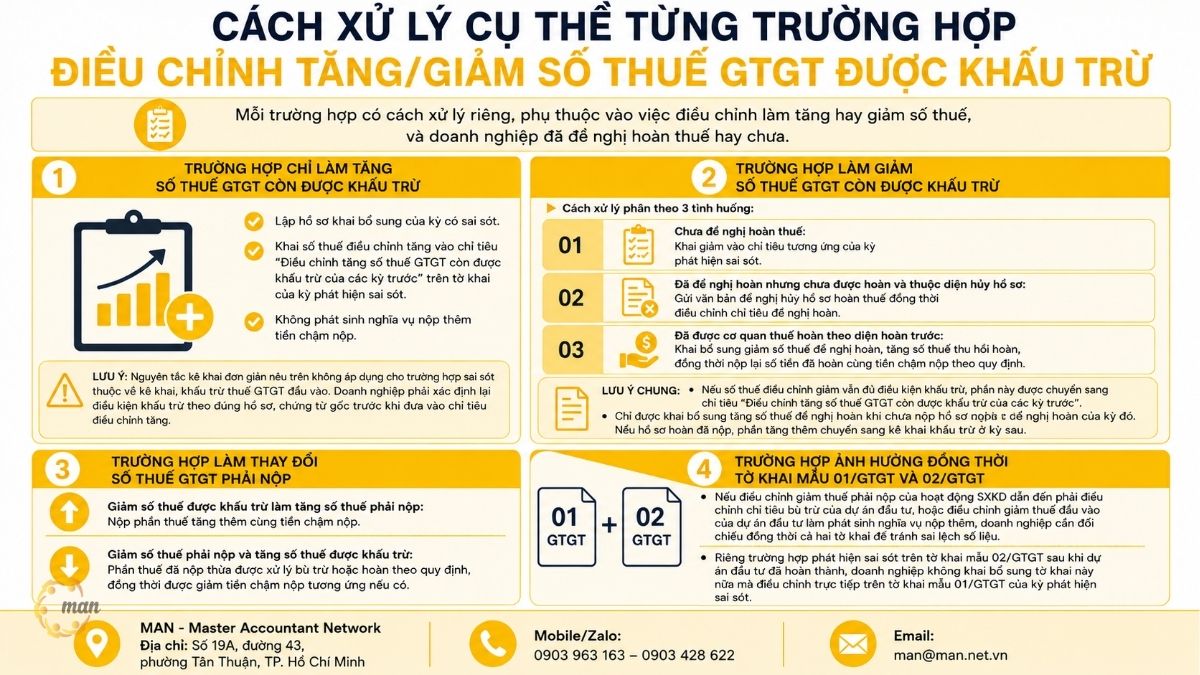
This is a crucial aspect that accountants need to understand to avoid errors in tax declarations. Each case requires a different approach, depending on whether the adjustment increases or decreases the tax amount, and whether the business has already requested a tax refund.
This case only increases the amount of deductible VAT.
If the supplementary declaration only increases the amount of uncredited tax carried forward to the next period, the business prepares a supplementary declaration for the period with the error, then declares the increased tax amount in the "Adjustment increasing the amount of VAT still deductible from previous periods" section on the declaration for the period in which the error was discovered. In this case, no additional late payment penalty is incurred.
It is important to note an exception: the simplified declaration principle mentioned above does not apply to cases where errors are discovered related to the declaration and deduction of input VAT. For this type of error, businesses must re-determine the deduction conditions based on the original documents before including them in the upward adjustment item; they cannot apply the same principle mechanically to every upward difference that arises.
Cases that reduce the amount of deductible VAT
In cases of tax reduction, the handling is divided into three situations. If a tax refund has not yet been requested, the business declares the reduction in the corresponding item for the period in which the error was discovered. If a refund has been requested but not yet received and the application is subject to cancellation, the business must submit a written request to cancel the tax refund application and simultaneously adjust the requested refund item.
In cases where the tax authorities have already refunded the tax under the advance refund scheme, the business is required to file an amended tax return reducing the requested refund amount, increasing the amount of tax to be recovered, and simultaneously repaying the refunded amount along with late payment penalties as stipulated. This is the situation with the highest financial cost among adjustment cases.
Note that in both of the above tax refund situations: if the adjusted tax amount is still eligible for deduction, this portion is transferred to the "Adjustment increasing the amount of deductible VAT from previous periods" item, and the deduction right is not lost. Furthermore, taxpayers are only allowed to declare an increase in the requested refund amount if they have not yet submitted the refund application for that period. If the refund application has already been submitted, the additional amount is transferred to the deduction declaration for the next period and is not added to the pending refund request.
Cases that change the amount of VAT payable
When adjustments result in a reduction of deductible tax while simultaneously increasing payable tax, the business must pay the additional tax along with late payment penalties. Conversely, if adjustments reduce payable tax and increase deductible tax, the overpaid tax will be offset or refunded according to regulations, and any applicable late payment penalties will be reduced accordingly.
Cases where both forms 01/GTGT and 02/GTGT are affected simultaneously.
For businesses with separately declared investment projects, Circular 89/2026/TT-BTC stipulates how to handle each specific situation. If a reduction in the tax payable for production and business activities leads to an adjustment in the offsetting item of the investment project, or a reduction in input tax of the investment project results in additional tax liability, the business needs to compare both declarations simultaneously to avoid discrepancies in data.
In cases where errors are discovered on form 02/GTGT after the investment project has been completed, the enterprise does not need to file a supplementary declaration on this form but should make the correction directly on form 01/GTGT for the period in which the error was discovered.
In which period should adjustment invoices and replacement invoices be declared?
This question arises in parallel with the adjustment of the deductible VAT amount, as most errors on the tax return stem from adjusted or replaced input and output invoices. The general principle in point d, clause 6, Article 10 of Circular 91/2026/TT-BTC stipulates that the seller declares the adjustment in the period in which the adjustment invoice is issued, and the buyer declares it in the period in which the adjustment invoice is received.
However, this current period declaration principle does not apply to all adjustment invoices, but is limited to four specific situations stipulated in Clause 5, Article 10 of Circular 91/2026/TT-BTC.
Four specific cases are declared in the period in which the adjustment invoice is issued.
- Quantity-based trade discounts: the discount amount is calculated and adjusted on the invoice of the last purchase or the next period, or an adjustment invoice is issued along with a list of invoices requiring adjustment.
- Returning goods: If the buyer returns all or part of the goods, including exchanging goods that change their value, the seller will issue an adjusted invoice. If the parties agree that the buyer will issue an invoice upon returning the goods, the buyer will issue an electronic invoice to the seller.
- Insurance and revenue reductions: refunds, reductions, reductions in insurance brokerage commissions, or other expenses resulting in revenue reductions, the seller issues an adjustment invoice clearly stating the amount and reason for the refund or reduction.
- Prepayments, payments, telecommunications, natural gas: This includes invoices for prepayments in real estate and construction projects where the transaction is cancelled or partially terminated; credit institutions or service providers refunding customers by issuing adjustment invoices without including a reference to the original invoice number, form number, symbol, and date; prepaid telecommunications services based on a statement; and cases where natural gas is priced in foreign currency but payment is made in VND, resulting in a conversion difference.
Apart from these four cases, all other situations involving invoice errors, such as incorrect tax identification numbers, incorrect amounts, incorrect tax rates, or goods not properly recorded, will no longer be eligible for supplementary declaration in the base period from July 1, 2026. Businesses must handle these according to the general principles in Decree 252/2026/ND-CP, which means declaring the difference in the period in which the error is discovered, in accordance with the method of adjusting the increase/decrease in deductible VAT as described above.
Summary table of how to handle each case
Adjusting VAT tax returns depends not only on whether the tax amount increases or decreases, but also on the company's tax refund status. Each case will apply different declaration criteria and may result in additional tax payments or refunds of previously refunded taxes. The table below summarizes the corresponding handling procedures for each situation to help businesses easily refer to and comply with regulations.
| Adjustment situation | Tax refund has been requested. | Applicable declaration criteria | Additional obligations arise |
| Increase the amount of tax deductible. | Unrelated | Adjusting upwards the amount of tax that can still be deducted. | Do not have |
| Reduce the amount of tax deductible. | No refund requested yet. | Adjusting the amount of deductible tax downwards. | Do not have |
| Reduce the amount of tax deductible. | Request submitted, not yet completed. | Adjust the requested refund amount, along with a document canceling the application. | This may apply if the deduction conditions are met. |
| Reduce the amount of tax deductible. | Already refunded in advance | Increase the amount of tax refunds recovered. | Repay the refund and late payment penalties. |
| Increase the amount of tax payable. | Unrelated | Adjusting the amount of deductible tax downwards. | Pay additional taxes and late payment penalties. |
Case Study: A manufacturing company in Dong Nai addresses errors in VAT declaration.
Background
Company Y, a limited liability company operating in the mechanical processing sector in Dong Nai, has a factory expansion investment project that is being separately declared on form 02/GTGT. During an internal review before the final settlement period, the accountant discovered that some input invoices for the investment project had incorrect tax rates, leading to an overestimation of the deductible tax for the project compared to the actual amount.
The solution as advised by MAN.
According to instructions from MAN – Master Accountant Network, The company took three steps to address the issue. First, it accurately determined the period in which the error was discovered and prepared a separate supplementary declaration file for the 02/GTGT form of the investment project. Second, because the error reduced the deductible input tax of the project and resulted in additional tax liability, the company calculated the additional tax payable along with late payment penalties in accordance with regulations.
Thirdly, the company cross-checks the impact of the transaction on the VAT declaration form 01/GTGT for its production and business activities to ensure that there are no discrepancies in the offsetting figures between the two declarations.
The measured results
- The adjusted tax amount increased by approximately 180 million VND, along with a corresponding late payment penalty based on the actual number of days of delay.
- The supplementary tax return is fully documented with original supporting documents, allowing for a verification process with the tax authorities within 3 working days.
- Businesses can avoid the risk of being overcharged by proactively detecting and correcting issues before an audit is decided.
Expert opinion: Common business risks when adjusting the amount of deductible VAT upwards/downwards.
Experts at MAN – Master Accountant Network With over 30 years of experience in auditing and tax consulting in Vietnam, we identify four common risks that businesses often face.
Risk 1: Confusion between the base period and the period in which the error is discovered.
Many accountants are accustomed to the old way of doing things, trying to make adjustments directly to the base period instead of the period in which the error is discovered. This leads to discrepancies between the submitted tax return and the supplementary return, making it difficult for tax authorities to reconcile the data.
Risk 2: Missing out on late payment penalties.
When adjustments result in an increase in the amount of tax payable, many businesses only pay the increased tax amount and forget to calculate late payment penalties based on the actual number of days. This is a common mistake that leads to businesses being charged additional taxes when discovered by tax inspectors.
Risk 3: Mishandling cases where tax refunds have already been granted.
With tax refunds processed under the pre-refund scheme, some businesses only adjust their deduction targets downwards without repaying the refunded tax amount. This leads to the tax authorities identifying them as having prolonged late payment and recalculating late payment penalties from the time they received the refund.
Risk 4: Mistake in filing adjustment invoices.
From July 1, 2026, not all adjusted invoices need to be declared in the current period. Only specific cases stipulated in Clause 5, Article 10 of Circular 91/2026/TT-BTC, such as trade discounts, product returns, and insurance premium refunds, will apply this principle. Other cases will still follow the general regulations in Decree 252/2026/ND-CP.
From MAN's perspective, most disputes arising between businesses and tax authorities stem from a lack of clear distinction between special adjustment invoices and ordinary error invoices. Correct classification from the outset helps businesses optimize tax costs and significantly reduce the time spent explaining the issue during audits.
How does the policy of rewarding whistleblowers for reporting violations without issuing invoices relate to the adjustment of VAT?
Another notable regulation effective at the same time is the policy of rewarding consumers who report the failure to issue or deliver electronic invoices, according to Clause 5, Article 41 of Decree 254/2026/ND-CP. From July 1, 2026, consumers who provide information about sales without issuing invoices will be considered for a reward of no more than the amount of administrative fines, with a maximum of VND 10,000,000 per case.
To be considered for a reward, whistleblowers must provide truthful, accurate, and timely information, clearly identifying the time, location, and perpetrator, and the tax authority must have issued a penalty decision based on that information. This regulation indirectly increases the likelihood of tax authorities detecting transactions without invoices, leading to the consequence that businesses must review and adjust their input and output VAT if discrepancies are discovered.
From the perspective of MAN – Master Accountant Network, this is why businesses need to proactively review and adjust their processes before third-party complaints arise, instead of waiting until an audit is conducted before taking action.
Conclude
Mastering the procedures for adjusting the amount of deductible VAT upwards or downwards helps businesses proactively control their tax obligations, avoid errors that persist across multiple tax periods, and minimize the risk of being subject to back taxes or late payment penalties during tax audits. Applying the correct declaration criteria for each specific case, combined with a rigorous internal reconciliation process, forms the foundation for a safe and sustainable tax accounting system.
Tax services at MAN – Master Accountant Network
- Tax accounting services
- Tax consulting services
- Tax settlement services
- Tax reporting services
- VAT refund service
Contact information for services at MAN – Master Accountant Network
- Address: No. 19A, Street 43, Tan Thuan Ward, Ho Chi Minh City
- Mobile/Zalo: 0903 963 163 – 0903 428 622
- E-mail: man@man.net.vn
- Google Business Profile: View MAN – Master Accountant Network's Google Business Profile
- LinkedIn Founder: View expert Le Hoang Tuyen's LinkedIn profile.
Responsible for production and professional content review by: Mr. Le Hoang Tuyen – Founder & CEO of MAN – Master Accountant Network, CPA Vietnam with over 30 years of experience in accounting, auditing, taxation, and corporate financial consulting.
Frequently Asked Questions about how to handle adjustments when increasing/decreasing the deductible VAT amount.
Does adjusting the deductible VAT amount upwards result in a late payment penalty?
No. If the error only increases the amount of tax that can be carried forward to the next period, the business only needs to declare it under the upward adjustment item of the period in which the error is discovered; there is no obligation to pay late payment penalties.
What happens if a tax refund has already been received but an error is discovered?
Businesses must file supplementary declarations reducing the amount of tax requested for refund and increasing the amount of tax recovered on the supplementary declaration form, while simultaneously repaying the refunded amount along with late payment penalties as stipulated in Circular 89/2026/TT-BTC.
Do merged businesses need to file supplementary tax returns to inherit the deductible tax amounts?
No supplementary declaration is required. Businesses should use the tax authority's notice of tax liability transfer to declare the deductible VAT received in the VAT received during the period on form 01/GTGT for the period in which the notice was received.
Adjustment invoices are always declared in the current period, right?
That's not entirely correct. The principle of declaring adjustments in the period in which the invoice is issued only applies to specific cases as stipulated in Clause 5, Article 10 of Circular 91/2026/TT-BTC. Other cases still follow the general regulations on supplementary declarations.
How should errors on form 02/GTGT be handled after an investment project is completed?
Businesses should not submit supplementary declaration form 02/GTGT in this case, but should make adjustments directly on declaration form 01/GTGT of the period in which the error was discovered, in accordance with the guidelines in Circular 89/2026/TT-BTC.




