


Official document 7889/NBI-QLDN3 This is a document issued by the Ninh Binh Provincial Tax Department in 2026, providing specific guidance on how to deduct personal income tax (PIT) from employees after their employment contracts have been terminated. The document was issued in response to a situation where many businesses were confused about paying the final month's salary, severance pay, or remaining income to employees who had left their jobs, unsure whether to apply the progressive tax rate or a fixed deduction rate (10%).
According to Circular 111/2013/TT-BTC, The time for determining taxable income is the time when the business actually pays salaries and wages, regardless of when the work is performed. This is the key basis for the tax authorities to issue guidance in Official Letter 7889/NBI-QLDN3, helping accounting departments apply regulations correctly and minimize errors. personal income tax settlement at the end of the year and to avoid the risk of being subject to retroactive tax collection.
Summary of key points in Official Letter 7889/NBI-QLDN3
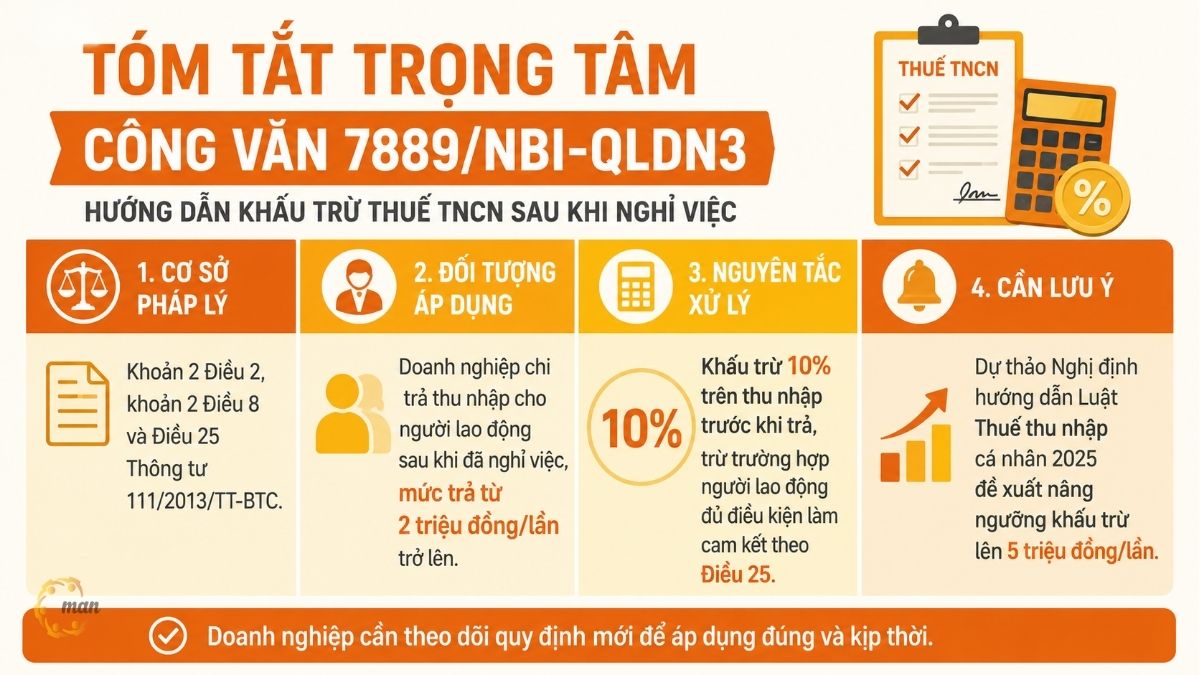
- Official document 7889/NBI-QLDN3 is a guidance document from Ninh Binh Provincial Tax Department regarding the deduction of personal income tax for employees whose employment contracts have been terminated, issued in 2026.
- Legal basis: Clause 2, Article 2; Clause 2, Article 8; and Article 25 of Circular 111/2013/TT-BTC.
- Applicable entities: Businesses paying severance pay to employees after they have left their jobs, with payments of 2 million VND or more per payment.
- Processing principle: deduct 10% from income before payment, except in cases where the employee is eligible to make a commitment as per Article 25.
- It should be noted that the draft Decree guiding the Personal Income Tax Law 2025 proposes raising this deduction threshold to 5 million VND per transaction.
What is Official Document 7889/NBI-QLDN3? Definition and context of issuance.
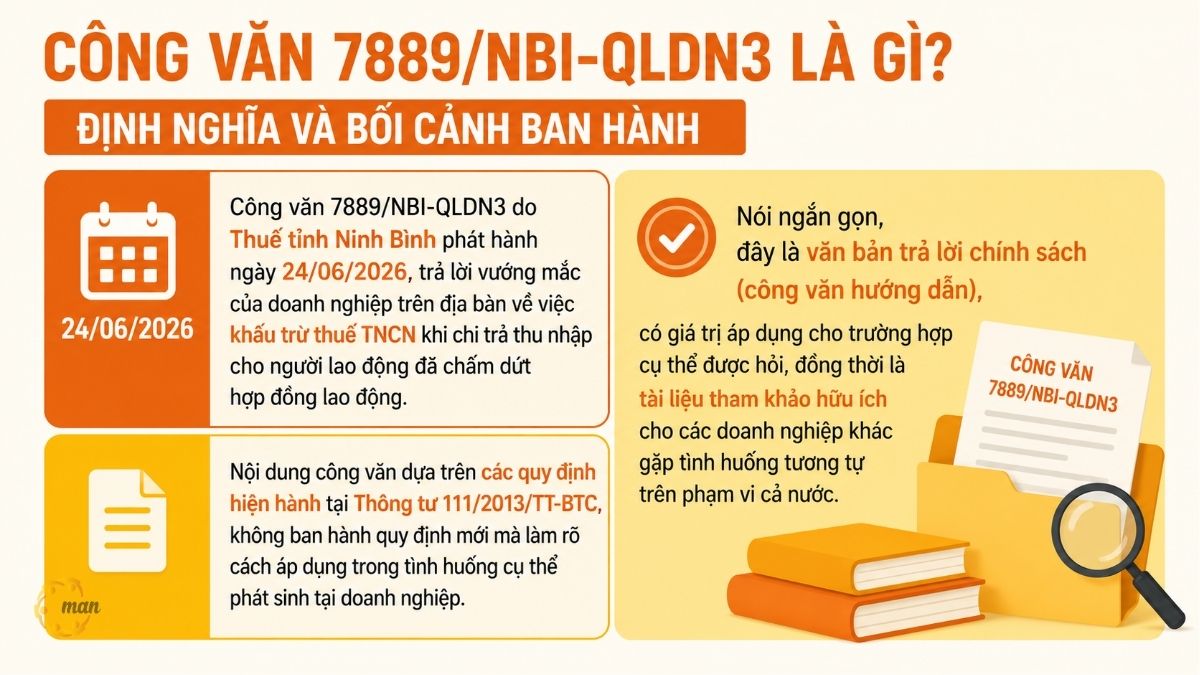
Official document 7889/NBI-QLDN3 issued by Ninh Binh Provincial Tax Department on June 24, 2026, addresses the difficulties faced by businesses in the area regarding tax deductions. personal income tax When paying income to employees whose employment contracts have been terminated, the content of the official letter is based on the current regulations in Circular 111/2013/TT-BTC, not issuing new regulations but clarifying how to apply them in specific situations arising at the enterprise.
In short, this is a policy response (guidance document) that is applicable to the specific case in question and also serves as a useful reference for other businesses facing similar situations nationwide.
What types of income are subject to personal income tax according to Article 2 of Circular 111/2013/TT-BTC?
Before applying the deduction method as per Official Letter 7889/NBI-QLDN3, businesses need to correctly identify which items are taxable income. According to Clause 2, Article 2 of Circular 111/2013/TT-BTC, taxable income from salaries and wages includes:
- Salaries, wages, and other payments of a similar nature, whether paid in cash or in non-cash form.
- Allowances and subsidies, except for certain items that are specifically excluded from taxable income.
- Monetary or non-monetary benefits other than salary paid by the employer to the taxpayer in any form.
- Cash or non-cash bonuses of all forms, including bonuses in the form of securities, except for certain bonuses that are specifically excluded.
Points that businesses need to pay special attention to: according to clause b.6, paragraph 2, Article 2 of Circular 111/2013/TT-BTC, severance pay, unemployment benefits and other allowances as stipulated in the Labor Code and the Social Insurance Law. not subject to personal income tax.. Therefore, when paying the remaining amounts to employees who have left their jobs, accountants need to separate the legally mandated severance pay (which is exempt) from the outstanding salary, wages, and bonuses (subject to tax), and then apply the deduction method mentioned in Official Letter 7889/NBI-QLDN3 to the taxable income.
Regarding the method for determining taxable income, Clause 2, Article 8 of Circular 111/2013/TT-BTC stipulates that taxable income from salaries and wages is determined by the total amount of salaries, wages, fees, and other income of a similar nature received by the taxpayer during the tax period.
Why is Official Document 7889/NBI-QLDN3 important for businesses and accountants?
In reality, many businesses pay salaries, bonuses, and severance pay to employees after their official termination date, sometimes several weeks to several months later. If the accountant applies the wrong tax rate, two situations can occur: under-deduction leading to back taxes and late payment penalties, or over-deduction causing employee losses and resulting in complaints.
Official document 7889/NBI-QLDN3 helps to unify the understanding and clearly define the boundary between two cases: when the labor contract is still valid at the time of payment and when the contract has terminated at the time of payment. This is a crucial point that determines the applicable tax rate.
Which entities are affected by Official Letter 7889/NBI-QLDN3?
Official document 7889/NBI-QLDN3 directly impacts the following groups:
- Businesses must pay employees their last month's salary, unused annual leave, severance pay, and unemployment benefits after they have left their jobs.
- Employees who have signed employment contracts of 3 months or more, and terminate their contracts either before or on schedule.
- The accounting and human resources departments are responsible for deducting, declaring, and settling personal income tax on a monthly and annual basis.
Two specific deduction cases are detailed in Official Letter 7889/NBI-QLDN3.
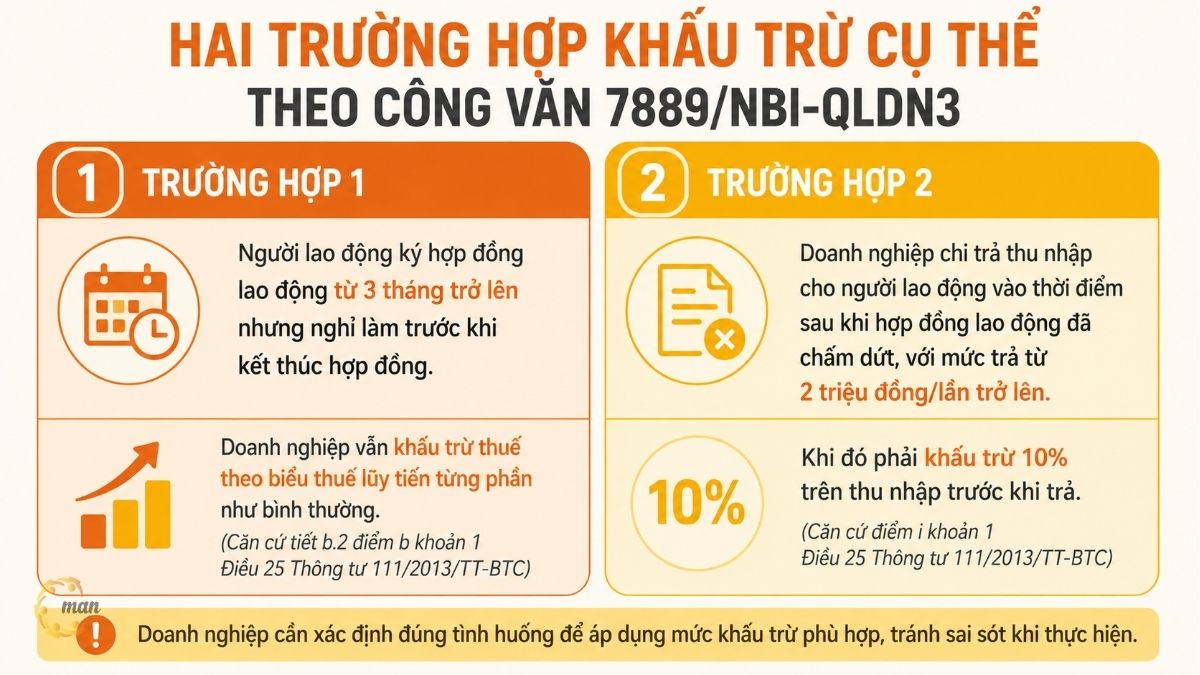
According to the guidelines, businesses need to clearly distinguish between the following two situations when determining how to deduct:
- Case 1: If an employee signs a labor contract for 3 months or more but quits before the contract ends, the business will still deduct tax according to the progressive tax rate schedule as usual (based on clause b.2, point b, paragraph 1, Article 25 of Circular 111/2013/TT-BTC).
- Case 2: Businesses that pay income to employees after the employment contract has ended, with payments of 2 million VND or more per payment, must deduct 10% from the income before payment (based on point i, clause 1, Article 25 of Circular 111/2013/TT-BTC).
When are businesses required to apply the deduction as per Official Letter 7889/NBI-QLDN3?
It's important to remember that the time of determining taxable income is not when the employee works, but when the business actually pays the salary or wages. Therefore, even if the work occurs while the contract is still in effect, if the payment is made after the contract has ended, the business must still apply the deduction method corresponding to the time of payment, not the time the work occurred.
Legal documents related to Official Letter 7889/NBI-QLDN3
To apply correctly, businesses need to be familiar with the legal framework that underpins Circular 7889/NBI-QLDN3, including both current regulations and proposed amendments:
| Legal documents | Number / Date of Issue | Related content |
| Circular 111/2013/TT-BTC | Circular No. 111/2013/TT-BTC, dated August 15, 2013 | Articles 2, 8, and 25 stipulate taxable income, the time of determining taxable income, and the principles of personal income tax withholding. |
| Official document 7889/NBI-QLDN3 | Ninh Binh Provincial Tax Department, June 24, 2026 | Guidelines for deducting personal income tax for employees after termination of employment contract. |
| Personal Income Tax Law 2025 | National Assembly, effective from July 1, 2026 | Article 2: Regulations on the basis for determining whether individuals are resident and liable for personal income tax. |
| Draft Decree guiding the Personal Income Tax Law 2025 | The Ministry of Finance is currently seeking feedback. | Article 50: Proposal to raise the threshold for withholding tax on occasional income from 2 million to 5 million VND per transaction. |
Important Note: The aforementioned draft Decree has not yet come into effect. Businesses should continue to monitor the official document before changing the deduction threshold currently applied under Circular 111/2013/TT-BTC.
Proposal to increase the threshold for withholding tax on occasional income to 5 million VND per transaction.
Besides Official Letter 7889/NBI-QLDN3, businesses also need to monitor Clause 2, Article 50 of the draft Decree guiding the Personal Income Tax Law 2025. According to the proposal, organizations and individuals paying salaries, wages, or fees to resident individuals who do not have a contract or have a labor contract of less than 3 months, including employees whose contracts have been terminated, must deduct, declare, and pay personal income tax (PIT 10%) if the payment is 5 million VND or more per payment. If the payment is less than 5 million VND per payment, the paying entity can still deduct PIT 10% if the individual requests it.
Notably, this threshold has undergone several adjustments during the drafting process. Initially, the Ministry of Finance only proposed raising the threshold from 2 million to 3 million VND per transaction. After incorporating feedback, the latest draft adjusted it directly to 5 million VND per transaction. This is still a proposal, not the final official regulation, so businesses and individuals making payments need to continue applying the 2 million VND per transaction threshold as stipulated in point i, clause 1, Article 25 of Circular 111/2013/TT-BTC until the official Decree is issued.
How to determine and deduct personal income tax according to Official Letter 7889/NBI-QLDN3 – Practical example
This is a common mistake many accountants make in practice. Below is a specific example illustrating the correct application according to the spirit of Circular 7889/NBI-QLDN3.
Employee B signed a 12-month employment contract with company Y and officially resigned on May 1, 2026. On June 15, 2026, company Y paid the outstanding April salary and severance pay, totaling 15,000,000 VND. Because the payment date (June 15, 2026) was after the contract had ended, and the payment amount was 2,000,000 VND or more per payment, the accountant had to deduct 10% equivalent to 1,500,000 VND before payment. Employee B actually received 13,500,000 VND, along with the tax deduction certificate as required.
If B has only this one source of income during the year and the estimated taxable income after personal deductions is below the tax threshold, B can submit a written commitment using the prescribed form to the company to temporarily avoid tax withholding. A mandatory condition is that B must be registered for tax and have a tax identification number at the time of making the commitment.
It should be noted that if the aforementioned VND 15,000,000 includes severance pay disbursed in accordance with the Labor Code, that portion of the severance pay is not taxable income under clause b.6, paragraph 2, Article 2 of Circular 111/2013/TT-BTC. Accountants should only apply the VND 2 million/payment threshold and the withholding rate to the remaining salary/wage, not to the entire amount paid.
| Case | Payment time | Method of deduction | Legal basis |
| Employment contract of 3 months or more, early termination | While the contract is still in effect | Progressive tax schedule | Clause b.2, point b, paragraph 1, Article 25 of Circular 111/2013 |
| Income is paid after the termination of the employment contract, starting from 2 million VND per payment. | After the employment contract has ended | Deduct 10% before payment. | Point i, Clause 1, Article 25 of Circular 111/2013 |
| Eligible employees can make a commitment. | After the employment contract has ended | No deductions will be made for now. | Point i, Clause 1, Article 25 of Circular 111/2013 (commitment section) |
| According to the draft of the new Decree (not yet in effect) | After the employment contract has ended, the proposed payment will be 5 million VND per payment. | Deduct 10% before payment. | Article 50 of the draft Decree guiding the Personal Income Tax Law 2025 |
Case Study: Businesses in Ninh Binh handle tax deductions after employees leave their jobs.
Background
Company Z, a leather shoe manufacturing company, employs approximately 800 workers in Ninh Binh. On average, 15 to 20 employees terminate their contracts each month, but their final salary, unused annual leave, and severance pay are typically paid in the next paycheck, following the official termination date.
The handling method follows the instructions in Official Letter 7889/NBI-QLDN3.
After reviewing the content of Official Letter 7889/NBI-QLDN3, the accounting department of Company Z reviewed the entire list of payments to employees who left the company in the second quarter of 2026, classifying them into two groups: payments made while the contract was still in effect and payments made after the contract had terminated, thereby applying the correct tax rate to each group.
The measured results
- Twelve cases were discovered in Q2/2026 where the progressive tax rate was incorrectly applied instead of the prescribed deduction 10%.
- The amount of tax that needs to be adjusted, refunded to employees, and declared additionally is approximately 18,000,000 VND.
- Businesses should proactively make adjustments before the tax settlement period to avoid being subject to tax arrears and late payment penalties during subsequent audits and inspections.
Expert opinion: Common business risks when deducting taxes after employees leave the company.
Based on our practical experience advising numerous manufacturing and service businesses on tax matters, we have identified four of the most common risks businesses face when applying regulations related to Circular 7889/NBI-QLDN3.
- Risk 1 – Misjudging the timing of income determination: Accountants base their calculations on the time the work occurs instead of the time of payment, leading to the incorrect application of tax rates.
- Risk 2 – Applying the wrong tariff schedule: Using a progressive payment schedule for payments made after the contract has ended, whereas it should correctly deduct 10%.
- Risk 3 – Lack of commitment documentation: Failure to retain the employee's commitment letter when temporary deductions are not being made results in insufficient documentation for tax authorities to verify.
- Risk 4 – New threshold not yet updated: If the draft Decree is approved with a threshold of 5 million VND per transaction, businesses need to promptly adjust their accounting procedures to avoid applying the old threshold which has expired.
From the perspective of MAN – Master Accountant Network, most errors related to Circular 7889/NBI-QLDN3 stem from businesses failing to clearly distinguish between "actual termination dates" and "actual payment dates" in their payroll systems. Experts at MAN, with over 30 years of experience, note that establishing a process for reconciling these two dates from the human resources stage will significantly reduce tax risks and optimize tax costs in Vietnam during year-end tax settlements.
Conclude
Official document 7889/NBI-QLDN3 provides businesses and employees with a clear basis for determining the correct method of deducting personal income tax when paying income after the termination of an employment contract. Accurately distinguishing the payment time, income level, and employment contract status is key to avoiding errors and minimizing the risk of tax arrears and penalties during tax audits and inspections.
Tax services at MAN – Master Accountant Network
- Tax accounting services
- Tax consulting services
- Tax settlement services
- Tax reporting services
- VAT refund service
Service contact information at MAN – Master Accountant Network
- Address: No. 19A, Street 43, Tan Thuan Ward, Ho Chi Minh City
- Mobile/Zalo: 0903 963 163 – 0903 428 622
- E-mail: man@man.net.vn
- Google Business Profile: View MAN – Master Accountant Network's Google Business Profile
- LinkedIn Founder: View expert Le Hoang Tuyen's LinkedIn profile.
Responsible for production and professional content review by: Mr. Le Hoang Tuyen – Founder & CEO of MAN – Master Accountant Network, CPA Vietnam with over 30 years of experience in accounting, auditing, taxation, and corporate financial consulting.
Frequently Asked Questions about Official Letter 7889/NBI-QLDN3
Which agency issued Official Document 7889/NBI-QLDN3?
The Ninh Binh Provincial Tax Department issued Official Letter 7889/NBI-QLDN3 on June 24, 2026, addressing specific concerns of businesses regarding the deduction of personal income tax after employees terminate their employment contracts.
How should businesses deduct taxes when paying salaries to employees who have left the company?
If the payment is 2 million VND or more per payment and the payment is made after the contract has ended, the business will deduct 10% from the income before paying the employee.
Can employees be temporarily exempted from having their 10% tax deducted?
Yes, if the employee's only source of income is estimated to be below the tax threshold after deductions, the employee can submit a commitment to the company, provided they have a tax identification number at the time of making the commitment.
Will the 2 million VND/per transaction threshold change in the future?
It's possible. The draft Decree guiding the Personal Income Tax Law 2025 is proposing to raise this threshold to 5 million VND per transaction, but this is still a proposal, not an official regulation.
What should be done if a business has incorrectly deducted taxes according to Official Letter 7889/NBI-QLDN3?
Businesses need to review and adjust the amount of tax already deducted, refund the difference to employees if there is an overpayment, and file supplementary declarations with the tax authorities to avoid being subject to back taxes and penalties during the annual tax settlement.




