

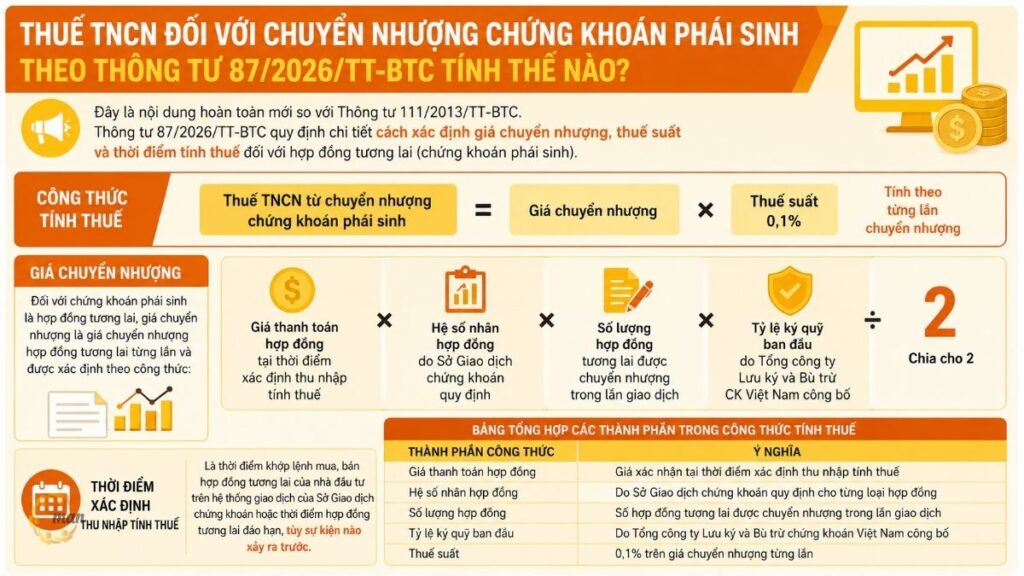
Circular 87/2026/TT-BTC The new regulations, issued by the Ministry of Finance on June 30, 2026, officially take effect from July 1, 2026, replacing previous ones. Circular 111/2013/TT-BTC It has been in effect for over a decade. This document provides detailed instructions. Law on Personal Income Tax No. 109/2025/QH15 and Decree No. 253/2026/ND-CP, focusing on three main areas: income levels for determining dependents, documentation for proving family allowance deductions, and methods for calculating tax on the transfer of derivative securities.
This change directly impacts millions of workers, corporate accountants, and derivatives investors nationwide. Previously, the maximum income required for someone to be considered a dependent was only 1 million VND per month, making it ineligible for tax deductions in many practical situations, such as for retired parents. This article provides a detailed analysis of each point, along with specific calculation examples, from an in-depth perspective. MAN – Master Accountant Network, a tax consulting firm with over 30 years of practical experience in Vietnam.
| Circular 87/2026/TT-BTC is a document issued by the Ministry of Finance on June 30, 2026, providing guidance on the Personal Income Tax Law 2025 and Decree 253/2026/ND-CP. |
| Effective from July 1, 2026, replacing Circular 111/2013/TT-BTC. |
| Raise the income threshold for determining dependents from 1 million to 3 million VND per month. |
| The regulations detail the required documentation for proving dependent status for each category, including resident foreigners. |
| This is the first guide on how to calculate the personal income tax of 0.1% on the transfer of derivative securities. |
What is Circular 87/2026/TT-BTC? Definition and scope of application.
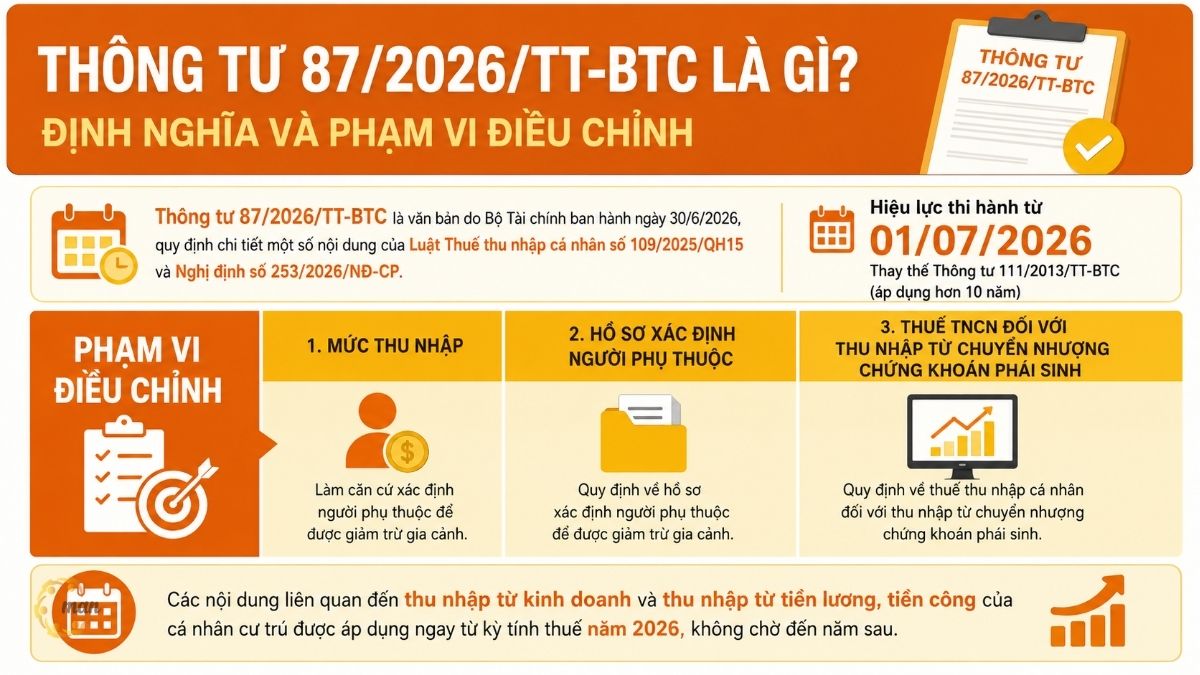
Circular 87/2026/TT-BTC, issued by the Ministry of Finance on June 30, 2026, provides detailed regulations on several aspects of the Personal Income Tax Law No. 109/2025/QH15 and Decree No. 253/2026/ND-CP. The document takes effect from July 1, 2026, and officially replaces Circular 111/2013/TT-BTC, which had been in effect for over a decade to guide the 2007 Personal Income Tax Law.
According to Article 1 of the Circular, the scope of regulation includes three main groups of contents: income levels used as a basis for determining dependents for family allowance deductions; documentation for determining dependents; and personal income tax on income from the transfer of derivative securities. These are all contents that the previous Circular 111/2013/TT-BTC did not fully regulate or regulate at all.
The regulations regarding income from business activities and income from salaries and wages of resident individuals will be applied immediately from the 2026 tax year, without waiting until the following year. This is a point that businesses need to pay special attention to when planning their year-end tax settlements.
Why is Circular 87/2026/TT-BTC important for taxpayers and businesses?
Prior to the issuance of Circular 87/2026/TT-BTC, many practical difficulties arose in the process of tax deduction and declaration. personal income tax There is no clear legal basis for handling this. The income threshold of 1 million VND/month, as stipulated in Circular 111/2013/TT-BTC issued in 2013, is no longer appropriate given current price levels and income, resulting in many dependents, such as retired parents and homeless relatives, being excluded from the tax deduction.
From this perspective MAN – Master Accountant Network, Previously, the transfer of derivative securities lacked specific guidance on transfer prices and tax calculation timing, leading to inconsistent application by investors and tax authorities. Circular 87/2026/TT-BTC fills this gap, creating a clear legal basis for taxpayers, income-paying entities, and regulatory agencies alike.
Which entities are affected by Circular 87/2026/TT-BTC?
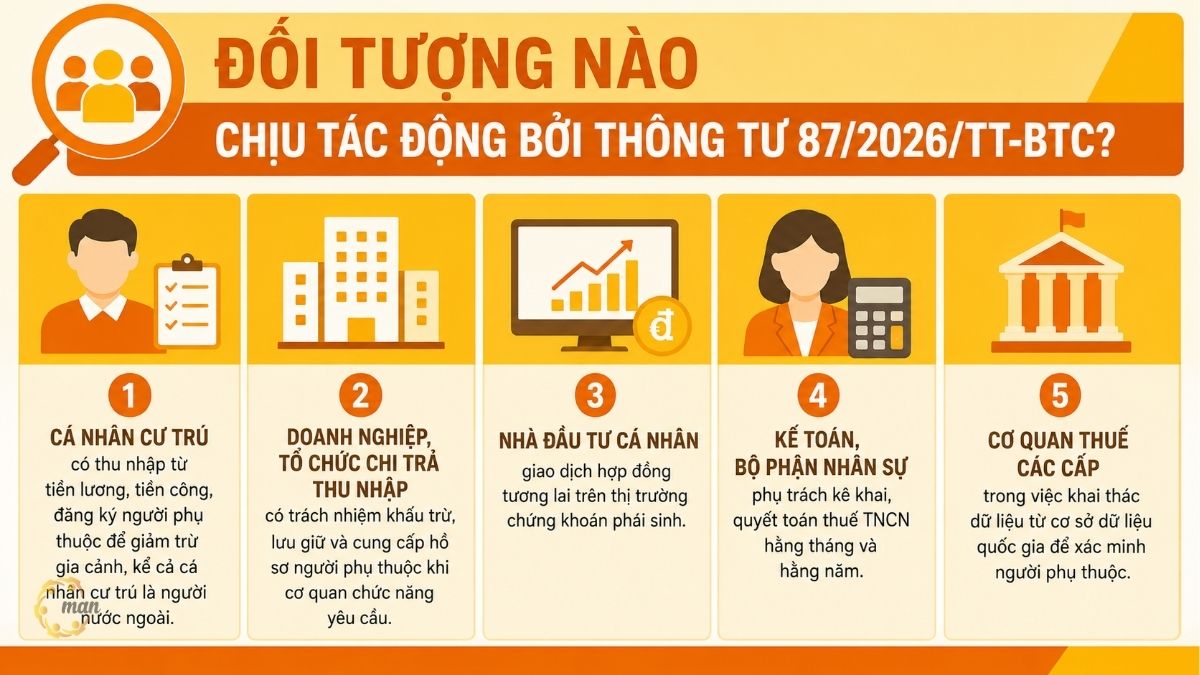
Circular 87/2026/TT-BTC has a fairly broad scope of impact, including:
- Individuals residing in Vietnam who have income from salaries and wages can register dependents for personal deductions, including foreign individuals residing in Vietnam.
- Businesses and organizations that pay income are responsible for deducting, retaining, and providing records of dependents when requested by the authorities.
- Individual investors trade futures contracts in the derivatives market.
- The accounting department and the human resources department are responsible for filing the records., personal income tax settlement monthly and annually.
- Tax authorities at all levels utilize data from the national database to verify dependents.
How has the income threshold for determining dependents changed according to Circular 87/2026/TT-BTC?
This is the most discussed issue. According to Clause 1, Article 3 of Circular 87/2026/TT-BTC, the average monthly income of dependents from all sources of income during the year must not exceed 3 million VND. Compared to the 1 million VND/month threshold in Circular 111/2013/TT-BTC, this threshold has tripled.
This income level serves as the basis for applying for personal deductions for spouses, parents, children over 18 years old, other dependents, or those unable to work.
Clause 2 of Article 3 clearly stipulates that taxpayers are responsible for determining dependents whose average monthly income does not exceed 3 million VND, and for declaring this accurately and truthfully. If the tax authorities discover any false declaration, the taxpayer will be penalized according to the law.
Example of practical calculation
Employee B's mother receives a pension of 2.5 million VND per month. According to the old Circular 111/2013/TT-BTC (threshold of 1 million VND), this case did not qualify her as a dependent. However, according to Circular 87/2026/TT-BTC (threshold of 3 million VND), Employee B's mother fully qualifies for a family allowance deduction. This is a typical example showing how the new regulations significantly expand the benefits of family allowance deductions for taxpayers.
What documents are required to identify dependents according to Circular 87/2026/TT-BTC?
Overall, the documentation for identifying dependents under Circular 87/2026/TT-BTC hasn't changed much from before, but it's now more clearly and specifically categorized for each case. This is the part that businesses and accountants need to understand thoroughly to avoid having deductions disallowed during tax settlement.
Documentation for dependents who are children of the taxpayer.
- Biological children: A copy of the child's birth certificate or a copy of the decision on acknowledging paternity or maternity, or a document from a competent authority confirming the parent-child relationship; along with a copy of the child's identity card if issued.
- Adopted: Copies of the child's birth certificate; a copy of the child's identity card if issued; and a copy of the adoption recognition decision or certificate issued by a competent state authority.
- Wife's child from a previous marriage or husband's child from a previous marriage: Copies of the child's birth certificate; a copy of the child's identity card if issued; and a copy of the taxpayer's marriage certificate or other document issued by a competent authority to prove the relationship with the stepchild of the spouse.
- Children aged 18 and over who are legally incapacitated or disabled: In addition to the aforementioned documents proving the parent-child relationship, a copy of the Certificate of Incapacity to Act or the Certificate of Disability as prescribed by law on persons with disabilities must be submitted.
- Your child is currently attending university, college, vocational high school, or vocational school., For children aged 18 and above who are studying in secondary school (including the waiting period for exam results from June to September of the 12th grade): in addition to documents proving the child relationship, a photocopy of the student ID card or a declaration certified by the school or other documents proving enrollment must be submitted.
Documentation for dependents who are the taxpayer's spouse.
Copies of the Identity Card and Marriage Certificate, or other documents proving the marital relationship issued by a competent authority.
Documentation for dependents who are the taxpayer's parents.
- Biological father, biological mother: Copies of the parents' identity cards; and copies of the taxpayer's birth certificate or copies of the decision on acknowledging paternity or maternity, or documents from competent authorities confirming the parent-child relationship.
- Foster father, foster mother: Copies of the parents' identity cards; and copies of the Decision or Certificate of Adoption issued by a competent state agency.
- Father-in-law, mother-in-law, or husband's father, husband's mother: Copies of the parents' identity cards; copies of the taxpayer's spouse's birth certificates; and copies of the taxpayer's marriage certificate or other documents proving the marital relationship issued by a competent authority.
- Stepfather, stepmother: Copies of the taxpayer's Identity Card; a copy of the taxpayer's Birth Certificate; and a copy of the Marriage Certificate or other document proving the marital relationship between the taxpayer's stepfather and biological mother, or between the taxpayer's stepmother and biological father, issued by a competent authority.
Records for other individuals without means of support whom the taxpayer is directly responsible for.
This includes a copy of the National Identity Card; a declaration form regarding the person to be directly supported, as prescribed by tax management law; documents proving the relationship between the taxpayer and the dependent; and documents proving the taxpayer's obligation to support the dependent according to the law (if any).
Important additional notes
- Persons unable to work: In addition to documents proving the respective relationship, further documentation is required to demonstrate a disability rating of 81% or higher, as stipulated by law.
- Registration responsibilities: Taxpayers are responsible for registering and changing dependents in accordance with tax management laws and are legally liable for the accuracy of the registration, changes, and income declarations for dependents. Any inaccurate declarations will be handled according to tax management laws and related legislation.
- Individuals residing in Vietnam who are foreigners: If the required documentation for each specific case mentioned above is not available, legal documents issued by a competent authority must be provided, ensuring that the dependent meets the eligibility criteria and clearly demonstrating the relationship between the taxpayer and the dependent.
- Responsibilities of the income-paying entity: Organizations and individuals paying income are responsible for maintaining and providing complete documentation proving dependent status to facilitate inspections, audits, and other cases as prescribed by law.
- Electronic data mining: Based on tax registration information, tax authorities can access and utilize data from the National Public Service Portal, the administrative procedure resolution information system, national databases, and specialized databases managed by state agencies, shared in accordance with the law, to determine dependents eligible for family allowance deductions. Only when the tax authorities are unable to access this data will taxpayers be required to provide all relevant documents as prescribed.
How is personal income tax calculated on the transfer of derivative securities according to Circular 87/2026/TT-BTC?
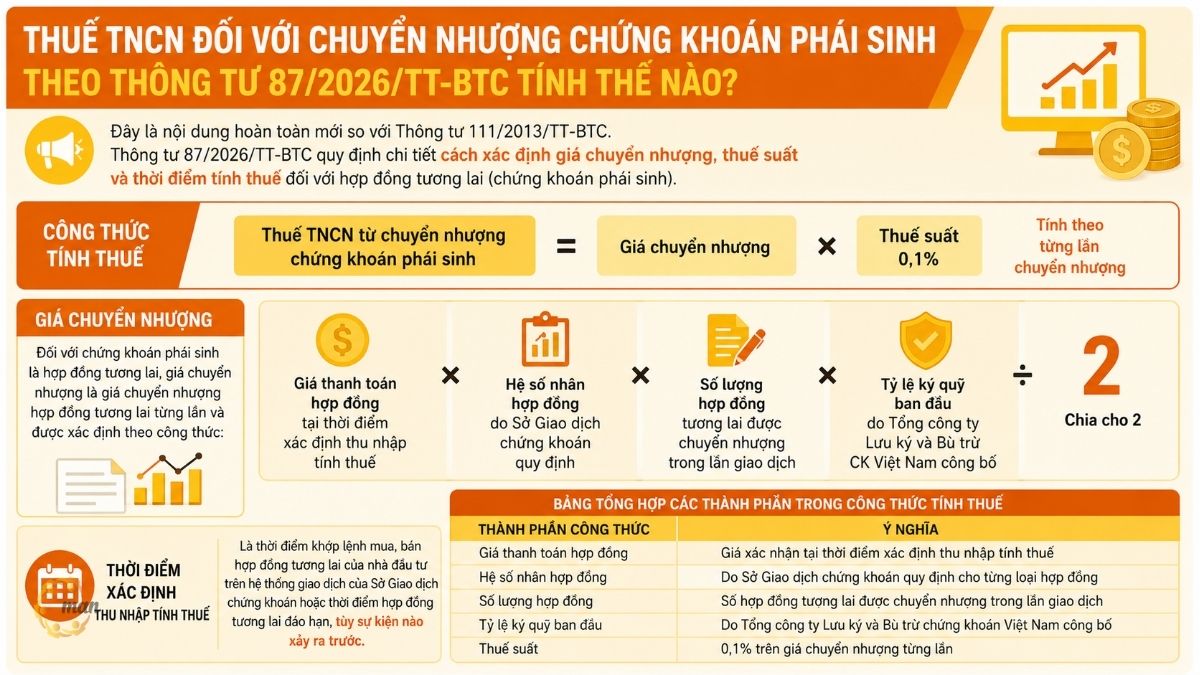
This is entirely new content compared to Circular 111/2013/TT-BTC. Previously, Circular 111 only provided guidance on personal income tax for securities transfer activities in general, and did not have specific regulations for the transfer of derivative securities, nor did it provide guidance on how to determine the transfer price, tax rate, and tax calculation time for futures contracts.
According to Article 5 of Circular 87/2026/TT-BTC, the tax calculation formula is as follows:
|
Personal income tax from the transfer of derivative securities = Transfer price x Tax rate 0.1%, calculated per transfer. |
The transfer price is determined as follows: for derivative securities in the form of futures contracts, the transfer price is the transfer price of each futures contract. Specifically, the transfer price of each futures contract is determined by multiplying the settlement price of the futures contract at the time of determining taxable income by the contract multiplier, by the number of contracts, by the initial margin ratio, and then dividing by 2. The initial margin ratio is published periodically by the Vietnam Securities Depository and Clearing Corporation.
Regarding the timing of taxable income determination: for derivative securities such as futures contracts, this timing is the time when the investor's buy or sell order for the futures contract is matched on the stock exchange's trading system, or the time the futures contract expires, whichever event occurs first.
| Formula ingredients | Meaning |
| Contract payment price | The price confirmed at the time of determining taxable income. |
| Contract multiplier | The regulations of the Stock Exchange apply to each type of contract. |
| Number of contracts | Number of futures contracts transferred in the transaction |
| Initial margin rate | Published by the Vietnam Securities Depository and Clearing Corporation. |
| Tax rate | 0.1% on the transfer price per transaction |
Legal documents related to Circular 87/2026/TT-BTC
To properly apply Circular 87/2026/TT-BTC, businesses and individuals need to refer to relevant legal documents, including the Personal Income Tax Law 2025, guiding decrees, and any documents replacing or amending previous regulations. The table below summarizes important documents to refer to when determining tax obligations and filing declarations according to the new regulations.
| Legal documents | Number / Date of Issue | Related content |
| Personal Income Tax Law 2025 | No. 109/2025/QH15 | The original legal basis for issuing Circular 87/2026/TT-BTC |
| Decree 253/2026/ND-CP | June 30, 2026 | Detailed regulations and implementation measures for the Personal Income Tax Law 2025. |
| Circular 87/2026/TT-BTC | June 30, 2026, effective July 1, 2026 | Income levels, dependent records, and taxes on derivative securities. |
| Circular 111/2013/TT-BTC | August 15, 2013 (replaced) | The guiding document for the Personal Income Tax Law 2007 will cease to be in effect from July 1, 2026. |
| Resolution 110/2025/UBTVQH15 | Effective January 1, 2026 | Adjusted personal allowance: VND 15.5 million/month for the taxpayer, VND 6.2 million/month for each dependent. |
Important Note: Circular 87/2026/TT-BTC also repeals part of the content of Article 1 of Circular 79/2022/TT-BTC. Experts at MAN Businesses are advised to review all relevant documents before implementation to avoid errors when comparing old and new regulations.
Case Study: How do businesses handle dependent registration documents according to Circular 87/2026/TT-BTC?
Background
Company Y (logistics services, 350 employees) in Ho Chi Minh City has approximately 401 employees who register their dependents as retired parents or homeless relatives. Before July 1, 2026, many cases of parents receiving pensions of 1.2 to 2.8 million VND/month were not counted as dependents because they exceeded the 1 million VND threshold, preventing employees from claiming family allowance deductions for this amount.
Processing after July 1, 2026
According to advice from MAN – Master Accountant Network, The company reviewed all previously rejected dependent records, compared them with the new income threshold of 3 million VND, and supplemented the declarations and supporting documents according to the classification in Article 4 of Circular 87/2026/TT-BTC. The HR department also updated the payroll software to synchronize the new dependent data and maintained complete records for inspection and audit purposes when needed.
The measured results
- Approximately 65 previously excluded dependents are now eligible to re-register.
- Each employee receives an additional deduction of VND 6.2 million per month from taxable income for each newly registered dependent, equivalent to a saving of approximately VND 310,000 - VND 650,000 in personal income tax per month, depending on the tax bracket.
- Businesses can avoid the risk of being subject to retroactive tax collection due to the incorrect application of the old threshold after the circular comes into effect.
Expert opinion: Common business risks when applying Circular 87/2026/TT-BTC
Experts at MAN – Master Accountant Network With over 30 years of experience in tax consulting and auditing in Vietnam, we note 4 risks businesses need to avoid:
- Risk 1: The old income threshold of 1 million VND remains in effect: Many accountants have not updated their knowledge of the new regulations and continue to refuse to register dependents with incomes between 1-3 million VND/month, depriving employees of the family allowance deductions they should have been entitled to from the 2026 tax year onwards.
- Risk 2: Lack of properly categorized records: Circular 87/2026/TT-BTC categorizes documents in great detail according to each relationship, such as biological children, adopted children, stepchildren, stepfathers, stepmothers, and resident foreigners. If a business applies a single set of documents to all cases, tax authorities may request additional information during an audit, and the tax deduction may even be disallowed.
- Risk 3: Confusion regarding the formula for calculating derivative securities tax: The transfer price formula involves multiplying four variables: settlement price, contract multiplier, number of contracts, and margin ratio divided by two. Individual investors who self-declare their values are prone to making mistakes if they do not update their initial margin ratio according to the latest announcement from the Vietnam Securities Depository and Clearing Corporation.
- Risk 4: Lack of clear definition of the implementation time: Income from business activities, salaries, and wages earned before and after July 1, 2026, must be clearly separated when settling taxes for 2026, as the new regulations only apply from the 2026 tax year onwards. Accountants need to keep records documenting the time when income was earned to avoid disputes during tax settlement.
Comparison of Circular 111/2013/TT-BTC and Circular 87/2026/TT-BTC
Circular 87/2026/TT-BTC introduces several significant changes compared to Circular 111/2013/TT-BTC, particularly regarding dependent conditions, tax guidance on derivative securities, and the use of electronic data in tax administration. The table below summarizes the most notable differences between the two documents.
| Criteria | Circular 111/2013/TT-BTC | Circular 87/2026/TT-BTC |
| Maximum income limit for dependents | 1 million VND/month | 3 million VND/month |
| Dependent profile | General regulations, few classifications. | Detailed classification by relationship, including foreign residents. |
| Tax on derivative securities | There are no specific guidelines yet. | Specific instructions, tax rate 0.1% |
| Electronic data mining | Not yet regulated | The tax authorities have access to national data. |
| Validity | From August 15, 2013 | From July 1, 2026 |
Conclude
Circular 87/2026/TT-BTC marks a significant step in perfecting the personal income tax legal system, considerably expanding the benefits of family allowance deductions for taxpayers and, for the first time, creating a clear legal framework for derivative securities investment activities. However, to apply it correctly and avoid the risk of retroactive tax collection, businesses need to proactively update their payroll processes, records, and management systems starting from the 2026 tax year.
Over 500 clients have returned for a second time in the past year, a tangible testament to the quality of our consulting services and the peace of mind they feel when entrusting us with their business. For specific support tailored to your business needs, contact MAN – Master Accountant Network for a free consultation.
Tax services at MAN – Master Accountant Network
- Tax accounting services
- Tax consulting services
- Tax settlement services
- Tax reporting services
- VAT refund service
Service contact information at MAN – Master Accountant Network
- Address: No. 19A, Street 43, Tan Thuan Ward, Ho Chi Minh City
- Mobile/Zalo: 0903 963 163 – 0903 428 622
- E-mail: man@man.net.vn
- Google Business Profile: View MAN – Master Accountant Network's Google Business Profile
- LinkedIn Founder: View expert Le Hoang Tuyen's LinkedIn profile.
Responsible for production and professional content review by: Mr. Le Hoang Tuyen – Founder & CEO of MAN – Master Accountant Network, CPA Vietnam with over 30 years of experience in accounting, auditing, taxation, and corporate financial consulting.
Frequently Asked Questions about Circular 87/2026/TT-BTC
From July 1, 2026, according to Clause 1, Article 6 of the Circular, provisions related to income from business, salaries, and wages of resident individuals will be applied immediately from the 2026 tax year.
This applies to all cases of personal deductions: spouse, parents, children over 18 years old, dependents, and persons unable to work.
Yes. Taxpayers can review and re-register from the 2026 tax year, along with supporting documents proving income does not exceed VND 3 million per month as per the new regulations.
Foreign nationals residing in Vietnam who do not have the required documentation for their specific case must provide legal documents issued by competent authorities to prove their eligibility as dependents and clearly demonstrate their relationship with the taxpayer.
Businesses need to review all dependent records, update payroll software, train HR departments on the new record classification system, and maintain complete documentation for tax audits and inspections. When does Circular 87/2026/TT-BTC take effect?
Which dependents are eligible for the 3 million VND income threshold?
Can dependents who were previously rejected due to income of 1-3 million VND be re-registered?
What happens if a foreign resident does not have the required documentation?
What preparations do businesses need to make to comply with Circular 87/2026/TT-BTC?