

Foreigners working in Vietnam are exempt from personal income tax. This has been a matter of concern for many FDI businesses, foreign experts, and human resources departments since Circular 95/2026/TT-BTC The guidelines for the Double Taxation Avoidance and Anti-Tax Evasion Agreement officially come into effect on July 1, 2026. This document provides guidance on the implementation of Double Taxation Avoidance Agreements that Vietnam has signed, opening up a mechanism to exclude personal income tax obligations in Vietnam for certain cases of short-term foreign workers, provided they meet the legally stipulated conditions.
Not all foreign individuals working in Vietnam are exempt from personal income tax. Tax exemption only applies when the employee is a resident of a country that has signed a tax agreement with Vietnam and simultaneously meets all three conditions stipulated in the regulations. With over 30 years of experience in tax consulting, accounting, and auditing, MAN – Master Accountant Network will analyze the legal basis, application conditions, and important considerations to ensure businesses comply with the regulations.
Summary of information regarding personal income tax exemption conditions for foreigners working in Vietnam.
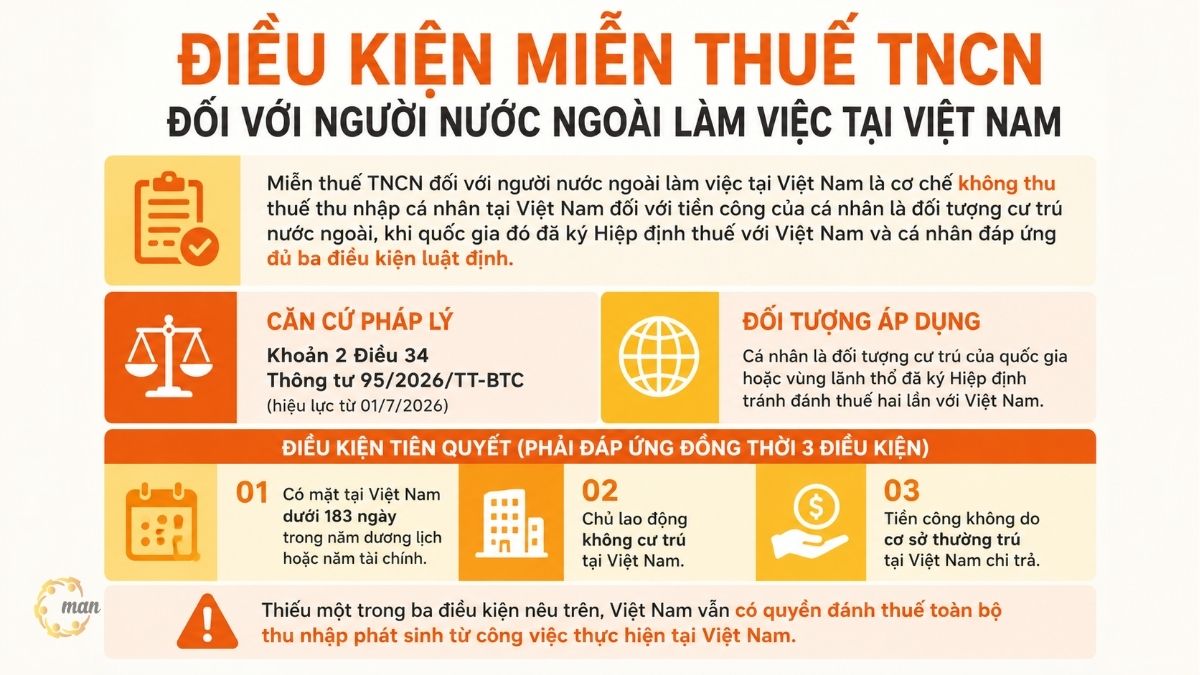
Exemption from personal income tax for foreigners working in Vietnam is a mechanism that does not collect personal income tax in Vietnam on the wages of individuals who are foreign residents, when that country has signed a tax agreement with Vietnam and the individual meets all three legally stipulated conditions.
- Legal basis: Clause 2, Article 34 Circular 95/2026/TT-BTC, effective from July 1, 2026.
- Applicable subjects: individuals who are residents of a country or territory that has signed a Double Taxation Avoidance Agreement with Vietnam.
- Prerequisites: presence in Vietnam for less than 183 days, employer not residing in Vietnam, wages not paid by a permanent establishment in Vietnam.
- Even without one of the three conditions, Vietnam still has the right to tax all income generated from work performed in Vietnam.
What is the personal income tax exemption for foreigners working in Vietnam?
According to Clause 1, Article 34 of Circular 95/2026/TT-BTC, the general principle is that Vietnam has the right to collect personal income tax on income from employment activities arising in Vietnam, even when the employee is a foreign individual. This is a point of confusion for many: simply being present and working in Vietnam does not automatically mean tax exemption.
However, Clause 2 of Article 34 stipulates an important exception. If a foreign individual simultaneously meets all three legally required conditions, wages from work performed in Vietnam are only taxed in the country where that individual is a resident, and are not subject to personal income tax in Vietnam. In other words, exemption. personal income tax For foreigners working in Vietnam, this is a mechanism that excludes Vietnam's right to tax them in cases of short-term work, which is more of a work-related assignment rather than a long-term commercial presence.
Legal basis for establishing tax exemption:
This mechanism originates from a common principle in double taxation avoidance agreements that Vietnam has signed with many countries, often referred to as the rule on income from short-term dependent labor. Circular 95/2026/TT-BTC internalizes this principle so that tax authorities, businesses, and taxpayers in Vietnam have a basis for consistent application from July 1, 2026.
Why is the policy of exempting personal income tax for foreigners working in Vietnam important for FDI businesses?
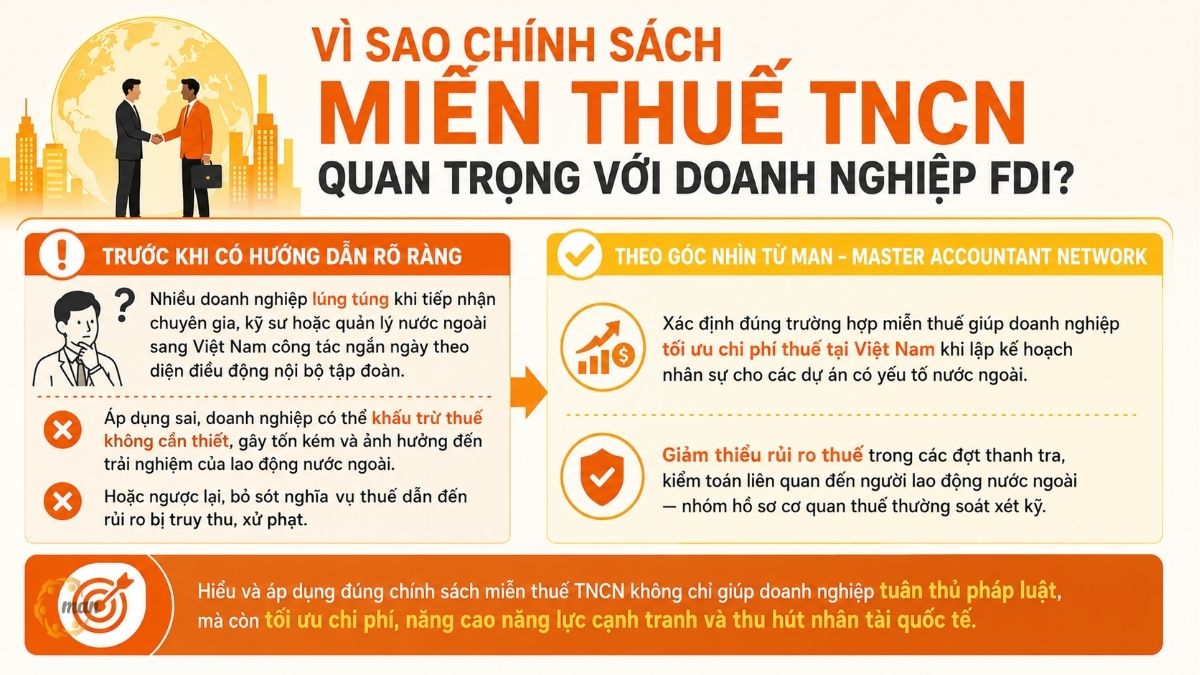
Before clear guidelines were in place, many businesses were confused when receiving foreign experts, engineers, or managers for short-term work in Vietnam under internal corporate transfers. Incorrect application could lead to unnecessary tax deductions, causing unnecessary costs and negatively impacting the experience of foreign workers, or conversely, overlooking tax obligations resulting in the risk of retroactive tax collection.
From the perspective of MAN – Master Accountant Network, correctly identifying tax exemption cases also helps businesses optimize tax costs in Vietnam when planning human resources for projects with foreign elements, while minimizing tax risks during inspections and audits related to foreign workers, which are a group of documents that tax authorities often scrutinize carefully.
See more articles at: Night shift and overtime pay will be tax-exempt from July 1, 2026.
3 conditions for exemption from personal income tax for foreigners working in Vietnam.
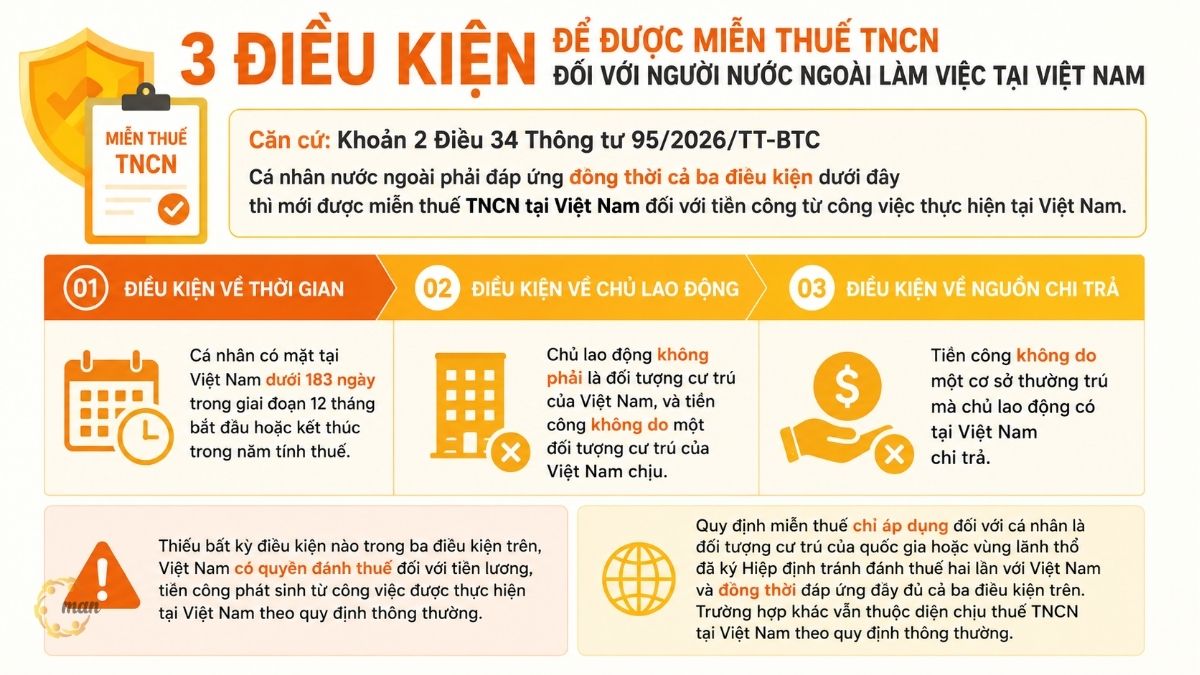
According to Clause 2, Article 34 of Circular 95/2026/TT-BTC, foreign individuals must simultaneously meet all three of the following conditions to be exempt from personal income tax in Vietnam on wages earned from work performed in Vietnam:
- Time requirement: the individual must be present in Vietnam for less than 183 days within a 12-month period beginning or ending in the tax year.
- Employer requirements: the employer must not be a resident of Vietnam, and the wages must not be paid by a resident of Vietnam.
- Payment condition: wages must not be paid by a permanent establishment that the employer has in Vietnam.
If any of the three conditions above are not met, Vietnam has the right to tax salaries and wages arising from work performed in Vietnam according to normal regulations. This is also why businesses need to carefully review labor deployment documents before applying for tax exemption, instead of assuming that all foreign experts on short-term assignments are eligible.
The aforementioned tax exemption does not apply to all foreigners working in Vietnam. The regulation only applies to individuals who are residents of a country or territory that has signed a Double Taxation Avoidance Agreement with Vietnam, and who also meet all three of the stated conditions. Foreigners from countries that have not signed a tax agreement, or who lack any of the three conditions, are still subject to personal income tax in Vietnam under the normal regulations.
See more articles at: The tax-exempt threshold for lunch and mid-shift meal allowances is 1.2 million VND per person per month.
Distinguishing between resident and non-resident individuals.
Determining residency status remains the first step before considering tax exemptions under the Agreement. An individual is considered a resident of Vietnam if they are present in Vietnam for 183 days or more in a calendar year or in 12 consecutive months from the first day of arrival, or have a permanent residence in Vietnam. Individuals who do not meet these conditions are considered non-residents.
Resident individuals pay taxes according to a five-tiered progressive tax system, with the lowest tax rate of 5% and the highest of 35% applied to taxable income exceeding 100 million VND per month. Non-resident individuals are generally subject to a flat tax rate of 20% on income from salaries and wages earned in Vietnam, unless they are exempt under the Agreement as analyzed above.
How to identify the actual employer under the new regulations.
A key technical point is found in Clause 3, Article 34 of Circular 95/2026/TT-BTC: when considering the second condition regarding the employer, the tax authority does not only look at the formal labor contract but also considers who the actual employer is, based on the following factors:
- The entity that has rights to the product or results of the work created by the worker.
- The person who is responsible for and bears the risks associated with that individual's work.
- The entity provides work instructions and supplies the necessary equipment and tools.
- The object of control is the location where the work is performed.
- The entity that pays wages determines the number and quality of workers to be assigned.
This approach is often referred to by professionals as the economic employer principle, aiming to prevent businesses from circumventing the law by signing only formal employment contracts with the parent company abroad, while in reality, the company in Vietnam is the one employing, managing, and benefiting from the individual's labor. If the company in Vietnam is identified as the actual employer, the second condition is considered unmet, and the foreign individual is still required to pay taxes in Vietnam.
Key timelines and practical business conditions to consider.
The Personal Income Tax Law 2025 (Law No. 109/2025/QH15), passed by the National Assembly on December 10, 2025, will take effect from July 1, 2026. However, regulations related to income from salaries and wages for resident individuals will be applied earlier, starting from the 2026 tax year. For non-resident individuals, including a large proportion of short-term foreign workers, the new regulations will be applied uniformly from July 1, 2026, coinciding with the effective date of Circular 95/2026/TT-BTC.
Regarding the actual documentation, to prove eligibility for tax exemption, foreign individuals and receiving businesses need to prepare: a tax residence certificate issued by a foreign tax authority, an employment contract or assignment decision from the parent company abroad, time sheets or work schedules confirming the number of days present in Vietnam, and a document confirming that the source of payment for wages does not originate from a permanent establishment in Vietnam. Missing any of these documents makes the tax exemption application highly likely to be rejected by the tax authorities during inspections.
Compilation of legal documents related to personal income tax exemption for foreigners.
To determine whether foreign workers are exempt from personal income tax under the Double Taxation Avoidance Agreement, businesses need to compare the Personal Income Tax Law and its guiding decrees and circulars. Each document specifies different provisions, from tax exemption conditions and tax registration procedures to the application of the Agreement. The table below summarizes the important legal documents currently in effect for businesses to easily consult.
| Legal documents | Number / Validity | Related content |
| Personal Income Tax Law 2025 | Law No. 109/2025/QH15, effective July 1, 2026 | General legal framework regarding taxpayers, taxable income, and tax exemptions. |
| Circular 95/2026/TT-BTC | Ministry of Finance, effective July 1, 2026 | Guidelines for the Agreement on the Avoidance of Double Taxation and the Prevention of Tax Evasion; stipulating 3 conditions for tax exemption and criteria for determining the actual employer in Article 34. |
| Circular 90/2026/TT-BTC | Ministry of Finance, effective July 1, 2026 | Regulations on tax registration, including the tax registration form for individuals with income from salaries and wages. |
| Decree 253/2026/ND-CP | Government, issued June 30, 2026 | Detailed guidance on the Personal Income Tax Law 2025, effective from July 1, 2026. |
| Circular 111/2013/TT-BTC and its amendments | Ministry of Finance, 2013-2015 | The old document will continue to apply to the sections for which there are no new guidelines until it is completely replaced. |
Note: Detailed guidance documents are still being updated by local tax authorities. Experts at MAN recommend that businesses closely monitor guidance documents from the Tax Department and the General Department of Taxation to ensure accurate application in each specific case.
Comparison table of tax obligations for foreigners working in Vietnam
The personal income tax liability of foreigners in Vietnam depends on their residency status and whether they meet the tax exemption conditions under the Double Taxation Avoidance Agreement. The table below helps businesses and employees easily compare each case to determine their respective tax obligations.
| Case | Do you meet all three conditions for tax exemption? | Tax obligations in Vietnam |
| Individuals residing in Vietnam (for 183 days or more) | Not applicable | Pay taxes according to a five-tiered progressive tax system on global income from salaries and wages. |
| Non-resident individuals, countries with tax agreements, and meeting all three conditions. | Have | Exempt from personal income tax in Vietnam, only tax payable in the country of residence. |
| Non-resident individuals, countries with tax agreements, are missing one condition. | Are not | Pay the full tax rate 20% on income earned in Vietnam. |
| Non-resident individuals, and individuals from countries that have not signed a tax agreement with Vietnam. | Not applicable | Pay the full tax rate 20% on income earned in Vietnam. |
Case Study: Japanese technical expert on short-term assignment at a factory in Bac Ninh.
Background
Company Y, a foreign-invested enterprise manufacturing electronic components in Bac Ninh, hired Mr. K, a Japanese engineer, to assist in the installation of a production line for four months, as per the assignment decision of its parent company in Japan. Mr. K's entire salary will still be paid by the parent company in Japan; the Vietnamese company will only cover his accommodation and travel expenses.
Processed according to advice from MAN.
According to advice from MAN – Master Accountant Network, the company took the following steps: (1) Review the time Mr. K was present in Vietnam in the relevant 12 months, confirming it was less than 183 days; (2) Collect the tax residence certificate issued by the Japanese tax authority; (3) Verify the actual employment relationship according to the criteria of a real employer, confirming that the company in Vietnam does not have direct management or supervision of Mr. K's activities; (4) Store records, assignment contracts and time sheets as a basis for tax settlement.
Result
Because all three legal conditions were met, Mr. K's wages during his employment in Vietnam were exempt from personal income tax in Vietnam, and were only subject to tax in Japan according to the regulations of the host country. Preparing complete documentation from the outset helped the company avoid the risk of being required to provide explanations or face tax arrears during the year-end tax settlement.
Expert opinion: Common business risks when applying personal income tax exemption for foreigners.
Experts at MAN – Master Accountant Network, with over 30 years of auditing and tax consulting experience in Vietnam, point out several common risks in tax risk management for foreign worker profiles:
- Risk 1: Inaccurate tracking of the number of days spent in Vietnam: Many businesses lack a systematic system for recording the entry and exit dates of foreign experts, leading to miscalculations of residency days. If the residency exceeds 183 days within the relevant 12-month period, the first condition is no longer met.
- Risk 2: Confusion between nominal employers and actual employers: This is the most easily overlooked risk. If a company in Vietnam directly assigns work, monitors progress, and evaluates the work performance of a foreign individual, even though the employment contract is still signed with the parent company abroad, the tax authorities may determine that the company in Vietnam is the actual employer and reject the tax exemption.
- Risk 3: Lack of a valid tax residence certificate: In many cases, businesses apply for tax exemptions but lack a tax residence certificate issued by a foreign tax authority, or the certificate has expired at the time the income is generated. During tax audits, files lacking this documentation are often subject to the recovery of the entire previously exempted tax amount, along with late payment penalties.
- Risk 4: Applying tax exemptions indiscriminately to all cases involving foreign elements: Some HR departments assume that all foreign experts working in Vietnam are tax-exempt, while in reality, each case needs to be assessed separately based on all three conditions. This approach carries the risk of large-scale tax arrears if the tax authorities review all foreign personnel records of the enterprise during an inspection.
Conclude
The personal income tax exemption for foreigners working in Vietnam is a highly technical regulation, requiring businesses to simultaneously assess all three conditions: length of stay, employer, and source of payment, rather than applying it based on intuition. Correct application helps reduce legitimate tax costs for foreign workers and avoids conflicts with the tax authorities of the host country; incorrect application can lead to tax arrears, late payments, and damage the business's compliance reputation.
Tax services at MAN – Master Accountant Network
- Tax accounting services
- Tax consulting services
- Tax settlement services
- Tax reporting services
- VAT refund service
Service contact information at MAN – Master Accountant Network
- Address: No. 19A, Street 43, Tan Thuan Ward, Ho Chi Minh City
- Mobile/Zalo: 0903 963 163 – 0903 428 622
- E-mail: man@man.net.vn
- Google Business Profile: View MAN – Master Accountant Network's Google Business Profile
- LinkedIn Founder: View expert Le Hoang Tuyen's LinkedIn profile.
Responsible for production and professional content review by: Mr. Le Hoang Tuyen – Founder & CEO of MAN – Master Accountant Network, CPA Vietnam with over 30 years of experience in accounting, auditing, taxation, and corporate financial consulting.
Frequently Asked Questions about Personal Income Tax Exemption for Foreigners Working in Vietnam
From July 1, 2026, according to Circular 95/2026/TT-BTC guiding the Double Taxation Avoidance Agreement, the regulations apply to income from work performed in Vietnam from this date.
No. The tax exemption mechanism under Article 34 of Circular 95/2026/TT-BTC only applies to individuals who are residents of a country or territory that has signed a Double Taxation Avoidance Agreement with Vietnam.
No. The legal requirement is to be present for less than 183 days. Being present for 183 days or more within the relevant 12-month period means the first condition is not met.
Accommodation and travel allowances do not automatically void tax eligibility, but the nature of the expense and the company's actual role in the labor relationship in Vietnam, based on criteria for determining a true employer, need careful consideration.
Businesses need to retain foreign tax residence certificates, labor assignment decisions or contracts, time sheets or work schedules confirming the number of days present in Vietnam, and documents confirming that the source of payment for wages does not originate from a permanent establishment in Vietnam. When does the regulation exempting foreigners from personal income tax come into effect?
Are foreigners from countries that have not signed a tax agreement with Vietnam exempt from tax?
If a foreign expert is present in Vietnam for exactly 183 days, are they exempt from taxes?
Does a Vietnamese company paying for the accommodation and travel expenses of foreign experts affect their tax exemption eligibility?
What documents need to be kept to prove eligibility for tax exemption during tax settlement?