

6 new points of Decree 252/2026/ND-CP Regarding official tax management regulations, effective from July 1, 2026, many provisions will be replaced and supplemented. Decree 126/2020/ND-CP. This document directly impacts the information disclosure, tax registration, and tax filing obligations of millions of businesses, credit institutions, and individual taxpayers nationwide. Understanding these new points helps accountants and business owners proactively adjust internal processes, avoiding the disclosure of violations or missing opportunities for exemption from tax filing.
From the perspective of MAN – Master Accountant Network, a tax, accounting, and auditing consulting firm with over 30 years of practical experience in Vietnam, the changes in Decree 252/2026/ND-CP This not only reflects administrative technicalities but also the trend of digitizing tax management, connecting national population data with the tax sector's database. The article below analyzes in detail each new point, its application, timeline, and the risks businesses need to be aware of.
Summary of the key points of the 6 new regulations in Decree 252/2026/ND-CP
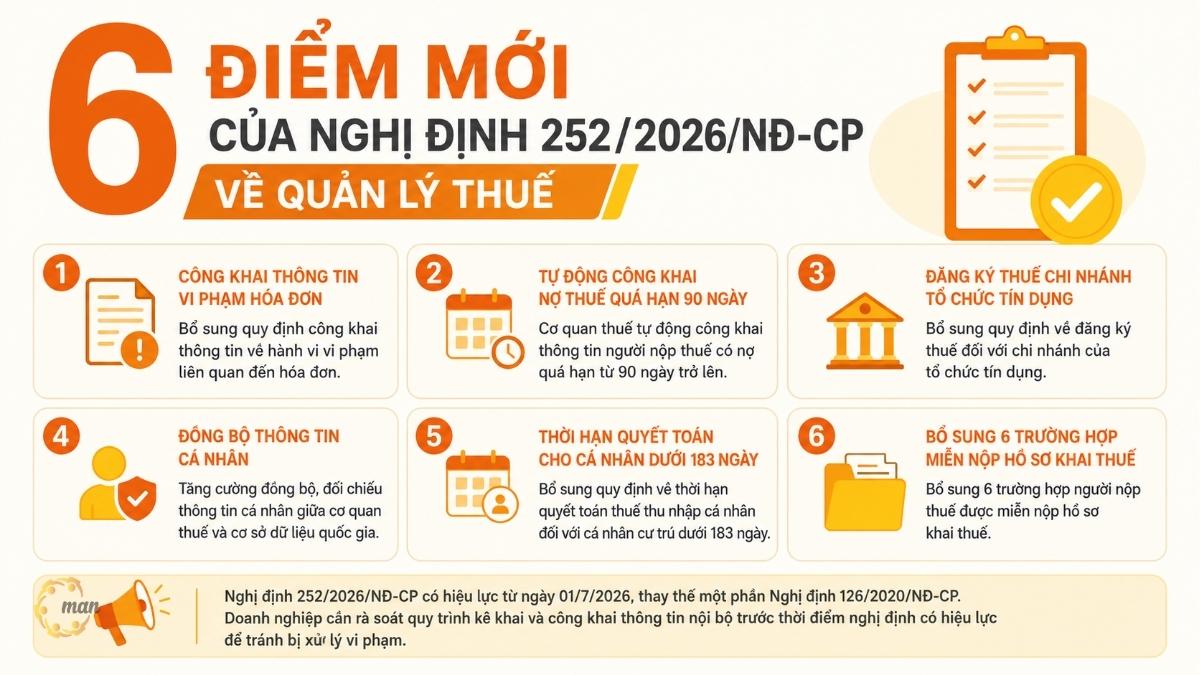
- The six new points of Decree 252/2026/ND-CP are supplementary and amended regulations on tax management, partially replacing Decree 126/2020/ND-CP, effective from July 1, 2026.
- Legal basis: Government Decree 252/2026/ND-CP, effective from July 1, 2026.
- Applicable entities: businesses, credit institutions, individual taxpayers, foreign contractors, and organizations collecting fees and charges in Vietnam.
- Main content: public disclosure of invoice violations, automatic public disclosure of overdue tax debts overdue for more than 90 days, tax registration for branches of credit institutions, synchronization of personal information, tax settlement deadline for individuals under 183 days, addition of 6 cases exempt from filing tax returns.
- Businesses need to review their internal information declaration and disclosure processes before the decree takes effect to avoid penalties for violations.
What is Decree 252/2026/ND-CP? Legal basis and scope of application.
Decree 252/2026/ND-CP is a legal document issued by the Government, detailing certain aspects of tax management, and effective from July 1, 2026. This Decree amends, supplements, and replaces many provisions of Decree 126/2020/ND-CP, which served as the foundational document guiding the Law on Tax Management for nearly six years.
The scope of Decree 252 covers issues such as: public disclosure of information on taxpayers who violate tax regulations, tax registration, deadlines for tax declaration and settlement, and cases where tax declarations are exempted. These regulations are procedural in nature but directly affect the reputation, cash flow, and compliance obligations of taxpayers.
Why do businesses need to understand the 6 new points of Decree 252/2026/ND-CP?
Previously, many businesses were reactive in monitoring risks associated with electronic invoices or late tax payments, leading to information being publicly disclosed without sufficient time for explanation. Decree 252/2026/ND-CP tightens the automatic disclosure mechanism while also facilitating certain procedures such as personal information registration and exemption from tax declaration filing in cases where sufficient data is available.
According to experts at MAN – Master Accountant Network, delays in updating internal procedures according to the six new points of Decree 252/2026/ND-CP can lead to businesses having their violations publicly disclosed on the tax authority's electronic portal, directly affecting their reputation when working with partners, banks, and investors.
Which entities are affected by Decree 252/2026/ND-CP?
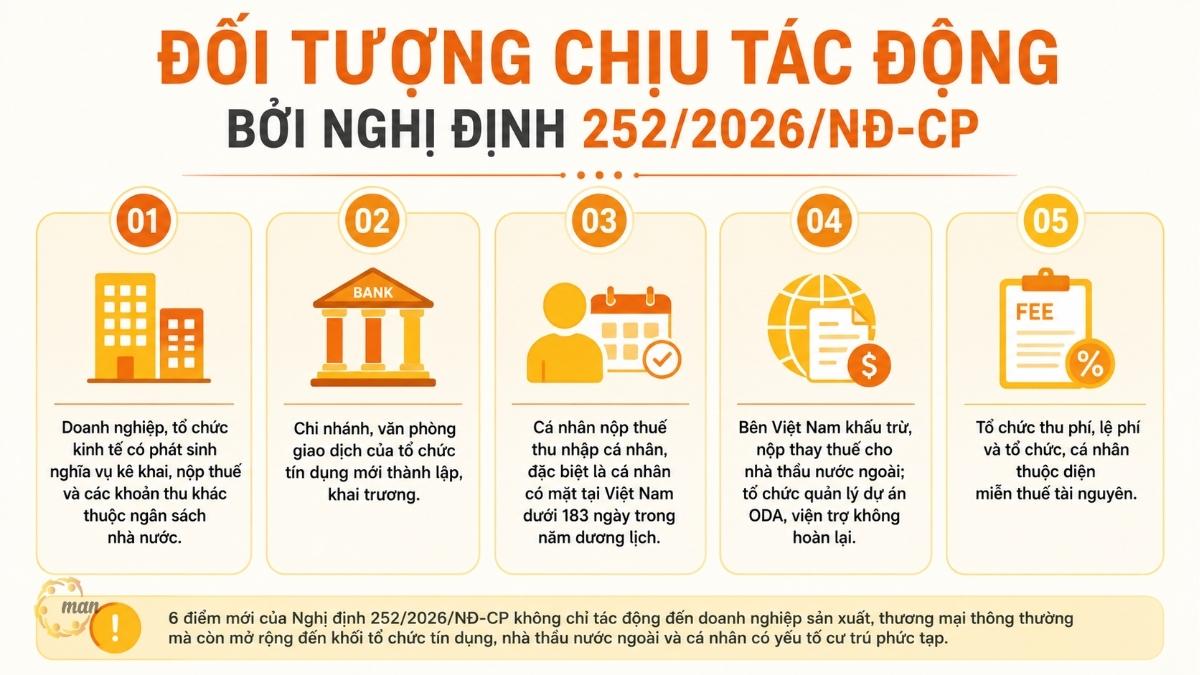
The decree has a fairly broad scope of impact, specifically encompassing the following groups:
- Businesses and economic organizations have the obligation to declare and pay taxes and other revenues belonging to the state budget.
- Newly established or opened branches and transaction offices of credit institutions.
- Individuals who pay personal income tax, especially those present in Vietnam for less than 183 days in a calendar year.
- The Vietnamese side deducts and pays taxes on behalf of foreign contractors; and manages ODA projects and non-refundable aid.
- Organizations collecting fees and charges, and organizations and individuals eligible for exemption from resource tax.
As can be seen, the six new points of Decree 252/2026/ND-CP not only affect ordinary manufacturing and trading businesses but also extend to credit institutions, foreign contractors, and individuals with complex residency issues.
Details of 6 new points in Decree 252/2026/ND-CP on tax management.
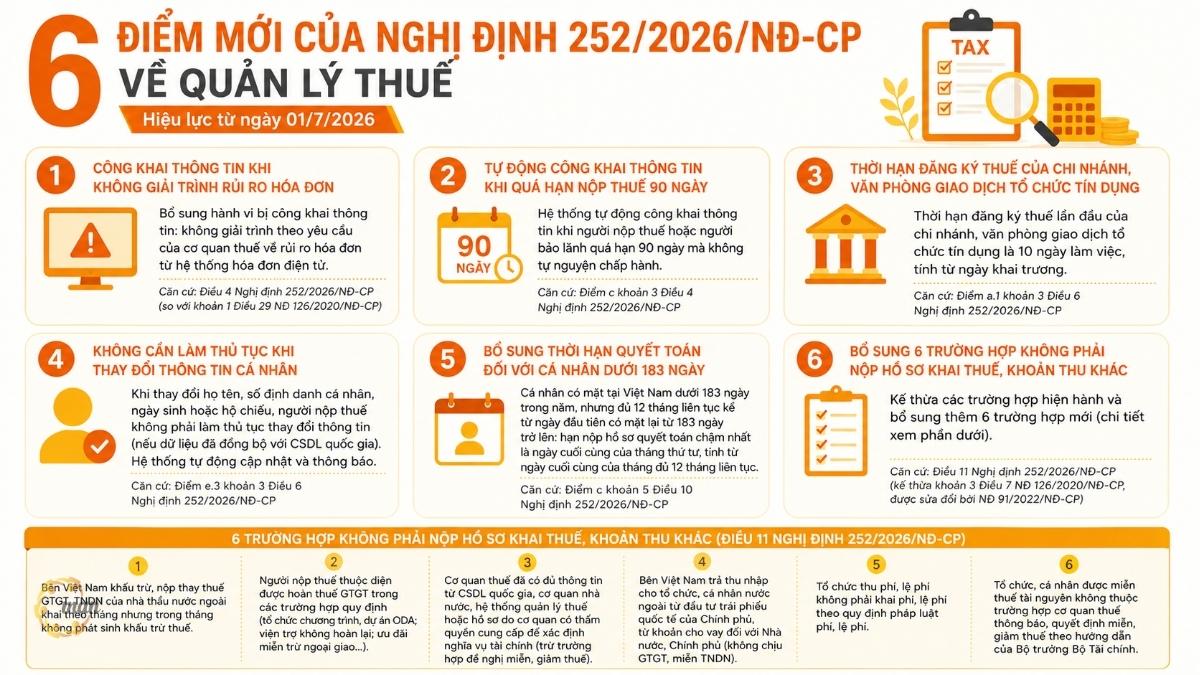
The following section presents each new point in turn, along with specific legal basis, to facilitate easy reference and comparison for businesses and accountants when applying them.
New point 1: Public disclosure of information when invoice risks cannot be explained based on system alerts.
Compared to Clause 1, Article 29 of Decree 126/2020/ND-CP, Article 4 of Decree 252/2026/ND-CP adds a mandatory public disclosure act: taxpayers who fail to provide explanations as requested by the tax authorities regarding invoice risks warned by the electronic invoice system. In addition to mandatory public disclosure on the tax authority's website, the head of the tax authority may also apply other forms such as public disclosure through mass media, posting at headquarters, press conferences, or press releases.
New feature 2: Automatic disclosure of information when tax payment is overdue by 90 days.
Point c, Clause 3, Article 4 of Decree 252 is a completely new regulation. When a taxpayer or guarantor fails to voluntarily comply within 90 days of the deadline for paying taxes, other fees, late payment penalties, fines, or administrative decisions on tax management, the Tax Management Information System will automatically publish the information on a monthly basis, without waiting for a manual decision from the tax authority.
New point 3: Deadline for tax registration of branches and transaction offices of credit institutions.
Point a.1, Clause 3, Article 6 of Decree 252 stipulates that the deadline for initial tax registration of branches and transaction offices of credit institutions is 10 working days from the date of opening. This is a detail that the previous Decree 126/2020/ND-CP did not specifically address, causing confusion for many credit institutions when determining the registration deadline.
New feature 4: No paperwork required when changing personal information.
According to point e.3, clause 3, Article 6 of Decree 252, when an individual changes their full name, personal identification number, date of birth, or passport, the taxpayer is not required to update this information with the tax authorities, provided that the national population database has been automatically connected and synchronized with the tax sector's database. The tax management information system will automatically send an update notification to the taxpayer.
New point 5: Added a settlement deadline for individuals present in Vietnam for less than 183 days.
Clause c, point 5, Article 10 of Decree 252 supplements the regulations for cases where an individual is present in Vietnam for less than 183 days in a calendar year, but the total number of consecutive days from the first day of their presence is 183 or more. In this case, the deadline for submitting the personal income tax return for the first year is no later than the last day of the fourth month, counting from the last day of the month that completes the 12 consecutive months.
New point 6: Added 6 cases where tax returns for other income are not required.
Article 11 of Decree 252/2026/ND-CP inherits the current cases of exemption from tax declaration filing in Clause 3, Article 7 of Decree 126/2020/ND-CP (amended and supplemented by Decree 91/2022/ND-CP), and adds the following six new cases:
Case 1: Vietnamese organizations and individuals are responsible for deducting and paying value-added tax and corporate income tax on behalf of foreign contractors in accordance with tax laws, and for filing monthly tax returns, but no tax deductions occur during that month.
Case 2: Taxpayers eligible for a VAT refund under the Value Added Tax law are not required to file a VAT return in the following cases:
- The program/project owner or main contractor (including the main contractor's operating office in Vietnam), or the organization designated by the foreign donor to manage the program/project using non-refundable Official Development Assistance (ODA) funds (including the donor's operating office or the organization managing and implementing the program/project designated by the donor).
- Organizations in Vietnam use grant funds and humanitarian aid from foreign organizations and individuals to purchase goods and services for grant and humanitarian aid programs and projects in Vietnam.
- Organizations and individuals are entitled to diplomatic privileges and immunities as stipulated by the law on diplomacy when purchasing goods and services in Vietnam.
Case 3: Taxpayers are not required to submit tax returns or other revenue documents when the tax authorities have sufficient information from the national database, state agencies, the Tax Management Information System, or documents provided by competent authorities to determine financial obligations. However, tax exemptions or reductions must still be submitted. The list of applicable documents is publicly available on the Tax Management Information System.
Case 4: In Vietnam, income payments to foreign organizations and individuals arising from investments in international bonds issued by the Vietnamese Government, or from loans to the State and Government of Vietnam, which are exempt from value-added tax and corporate income tax according to tax laws, do not require the submission of tax returns.
Case 5: Organizations that collect fees and charges but are not required to declare them according to the law on fees and charges are not required to submit fee and charge declaration documents.
Case 6: Organizations and individuals exempt from resource tax, except those not subject to tax exemption or reduction notices or decisions issued by the tax authorities as guided by the Minister of Finance, are not required to submit resource tax declarations.
Summary of legal documents related to Decree 252/2026/ND-CP
To properly apply the new tax management regulations under Decree 252/2026/ND-CP, taxpayers and businesses need to simultaneously monitor relevant legal documents. The following documents are important legal bases for determining cases of exemption from tax declaration filing, tax management procedures, and related regulations.
| Legal documents | Issue number / date | Related content |
| Decree 252/2026/ND-CP | Government, effective July 1, 2026 | Supplementing and amending regulations on tax management, partially replacing Decree 126/2020/ND-CP. |
| Decree 126/2020/ND-CP | October 19, 2020 | The regulations detailing the implementation of the Law on Tax Administration, which serve as the foundational document, are amended by Decree 252. |
| Decree 91/2022/ND-CP | October 30, 2022 | Amendments and additions to Decree 126/2020/ND-CP regarding cases exempt from tax declaration filing. |
| Articles 106 and 107 of the 2019 Labor Code | No. 45/2019/QH14 | This document relates to working hours and serves as a basis for verifying personal tax filing obligations. |
Case Study: How are businesses responding to the 6 new points in Decree 252/2026/ND-CP?
Background
Company Y, a limited liability company operating in the export-oriented mechanical processing sector in Dong Nai, frequently receives warnings about electronic invoice risks from the tax authorities but lacks a timely explanation process. Simultaneously, the company incurred tax debt due to cash flow issues in the second quarter of 2026.
Actions taken after Decree 252/2026/ND-CP comes into effect.
Following advice from MAN – Master Accountant Network, the company implemented three steps:
- (1) Assign the accounting department to monitor weekly invoice alerts and provide explanations within 5 working days;
- (2) Build an internal reminder schedule to avoid exceeding the 90-day tax payment deadline, preventing the system from automatically disclosing information;
- (3) Review all tax declaration records to identify items that are exempt from filing under Article 11 of Decree 252, reducing unnecessary declaration workload.
The measured results
- The company avoided having its violations publicly disclosed on the tax authority's electronic portal in the third quarter of 2026.
- The volume of monthly tax returns was reduced by approximately 15% by correctly applying the new exemption cases.
- The processing time for invoice alerts has been shortened from an average of 12 days to just 5 business days.
Comparison table of old and new regulations according to Decree 252/2026/ND-CP
Decree 252/2026/ND-CP adds many new regulations on tax management and amends some provisions of Decree 126/2020/ND-CP to simplify administrative procedures and enhance management using digital data. The table below summarizes the notable changes.
| Content | Regulations stipulated in Decree 126/2020/ND-CP | New regulations in Decree 252/2026/ND-CP |
| Disclosure of invoice risk information | There are no specific regulations regarding the failure to provide explanations for invoice warnings. | Supplementing information is an act that requires mandatory disclosure. |
| Public disclosure of overdue tax debts | The tax authorities will review and decide on a case-by-case basis. | The system automatically publishes the information monthly after 90 days of overdue date. |
| Tax registration for credit institution branches | There are no specific regulations regarding the time limit. | 10 working days from the opening date |
| Change personal information | You need to go through the procedures with the tax authorities. | No further action is required if the data has already been synchronized with the population database. |
Expert opinion: Common business risks when applying Decree 252/2026/ND-CP
Experts at MAN – Master Accountant Network, with over 30 years of experience in auditing and tax consulting in Vietnam, note the following common risks.
- Risk 1: Missing the deadline for explaining invoice warnings: Many businesses lack a department that regularly monitors and alerts about electronic invoices, leading to information being publicly disclosed even when they did not intentionally violate the rules. The solution is to assign specific individuals to be responsible and schedule regular inspections.
- Risk 2: Being complacent about small tax debts, leading to them being overdue by 90 days: Because the disclosure mechanism is now automated and system-driven, businesses no longer have the time to delay as before. Internal alerts should be set up at least 15 to 30 days before the tax filing deadline.
- Risk 3: Misapplication of tax filing exemptions: Not all cases qualify for exemption from filing under Article 11. Businesses need to carefully compare existing records and data before ceasing to file tax returns to avoid retroactive tax collection and penalties for under-filing.
- Risk 4: Confusion regarding settlement deadlines for individuals with foreign elements: Individuals who work less than 183 days in a calendar year but have worked 183 days in 12 consecutive months have a separate method for calculating the settlement deadline, which can easily cause confusion for the human resources and payroll departments of businesses employing foreign workers.
Conclude
The six new points of Decree 252/2026/ND-CP on tax management are two-pronged: they tighten the mechanism for publicly disclosing information on violations while simultaneously facilitating certain tax administrative procedures. Businesses and individuals paying taxes need to proactively review their internal processes, update their declaration systems, and assign personnel to closely monitor the new deadlines to avoid the risk of having their information publicly disclosed or being subject to tax collection.
Tax services at MAN – Master Accountant Network
- Tax accounting services
- Tax consulting services
- Tax settlement services
- Tax reporting services
- VAT refund service
Service contact information at MAN – Master Accountant Network
- Address: No. 19A, Street 43, Tan Thuan Ward, Ho Chi Minh City
- Mobile/Zalo: 0903 963 163 – 0903 428 622
- E-mail: man@man.net.vn
- Google Business Profile: View MAN – Master Accountant Network's Google Business Profile
- LinkedIn Founder: View expert Le Hoang Tuyen's LinkedIn profile.
Responsible for production and professional content review by: Mr. Le Hoang Tuyen – Founder & CEO of MAN – Master Accountant Network, CPA Vietnam with over 30 years of experience in accounting, auditing, taxation, and corporate financial consulting.
Frequently Asked Questions about the 6 New Points of Decree 252/2026/ND-CP
The Decree will take effect from July 1, 2026.
The decree does not specify the details of how to remove it; businesses need to contact the tax authority directly for processing after fulfilling their obligations or providing explanations.
Failure to register within the specified timeframe may result in administrative penalties for tax registration violations under current regulations.
If the national population database is already connected and synchronized with the tax authorities, no further procedures are needed; if it is not yet connected, individuals should proactively notify the tax authorities to avoid discrepancies in their records.
It is necessary to review which months do not have tax deductions in order to correctly apply the exemption from filing tax returns according to Article 11, avoiding the submission of unnecessary documents. When does Decree 252/2026/ND-CP take effect?
Can information about a company that has been publicly disclosed have the information removed after it has been rectified?
Will a branch of a credit institution be penalized for registering for tax purposes 10 days late?
Do foreign individuals need to proactively notify the tax authorities of changes to their passports?
What should businesses with foreign contractors be aware of regarding the 6 new points in Decree 252/2026/ND-CP?