New features Decree 254/2026/ND-CP This is the most discussed topic among the accounting community and business owners in the third quarter of 2026. On June 30, 2026, the Government officially issued this document to guide the implementation of the 2025 Tax Administration Law regarding electronic invoices and documents, completely replacing the old legal framework that had existed since 2020.
With over 30 years of experience in accounting, auditing, and tax consulting in Vietnam, the team of experts at MAN – Master Accountant Network recognizes this as one of the most far-reaching adjustments since the mandatory implementation of electronic invoices. This article summarizes all the new points, applicable entities, and practical risks businesses need to be aware of.
Summary of key new points in Decree 254/2026/ND-CP
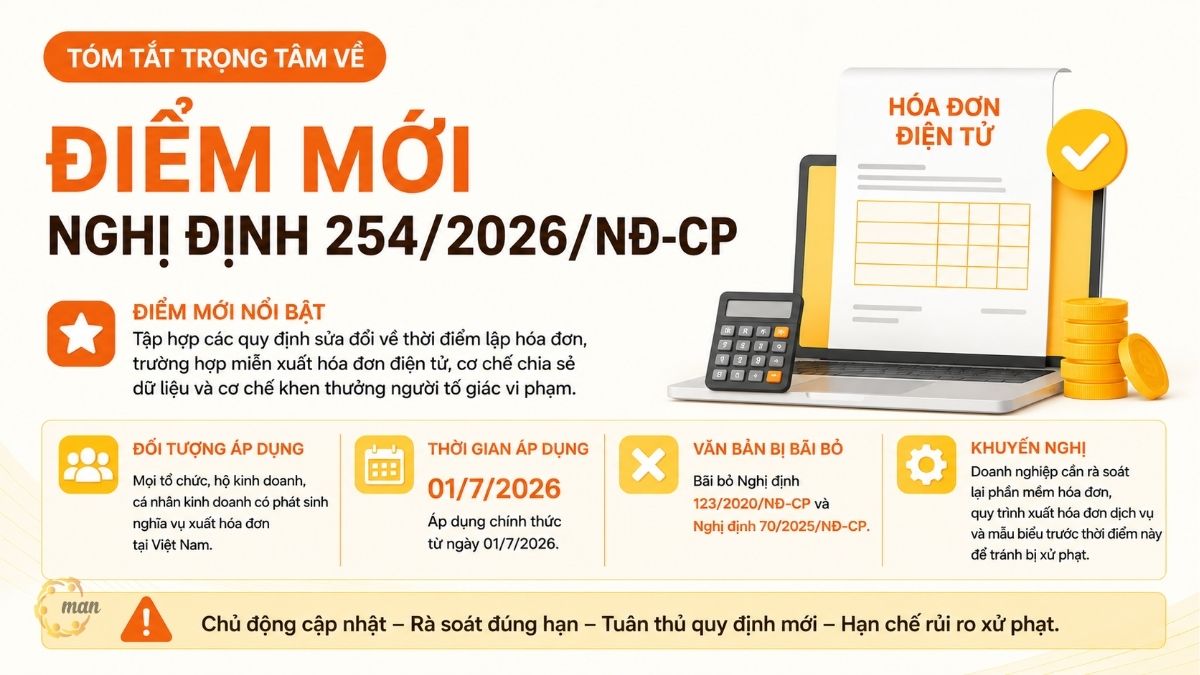
New features Decree 254/2026/ND-CP This is a collection of revised regulations on the timing of invoice issuance, cases exempt from electronic invoice issuance, data sharing mechanisms, and mechanisms for rewarding whistleblowers. The document applies to all organizations, business households, and individual businesses that have an obligation to issue invoices in Vietnam. It will officially apply from July 1, 2026, and simultaneously repeals previous regulations. Decree 123/2020/ND-CP and Decree 70/2025/ND-CP. Businesses need to review their invoicing software, service invoice issuance process, and forms before this time to avoid penalties.
What are the new points in Decree 254/2026/ND-CP according to the law?
According to the official document, Decree 254/2026/ND-CP specifies the details and implementation measures. Tax Administration Law 2025 Regarding electronic invoices and electronic documents, this is not a separate law but rather a guiding document that concretizes the major principles of the law into operational procedures that accountants apply daily.
The biggest differences compared to Decree 123/2020/ND-CP lie in three groups of content: expanding the list of cases where electronic invoices are not required, adjusting the invoice issuance time for specific service groups, and adding a cross-monitoring mechanism between tax authorities and other state management agencies such as land, police, and health. All these changes are detailed in the six new points below.
6 new points in Decree 254/2026/ND-CP on electronic invoices that you need to know.
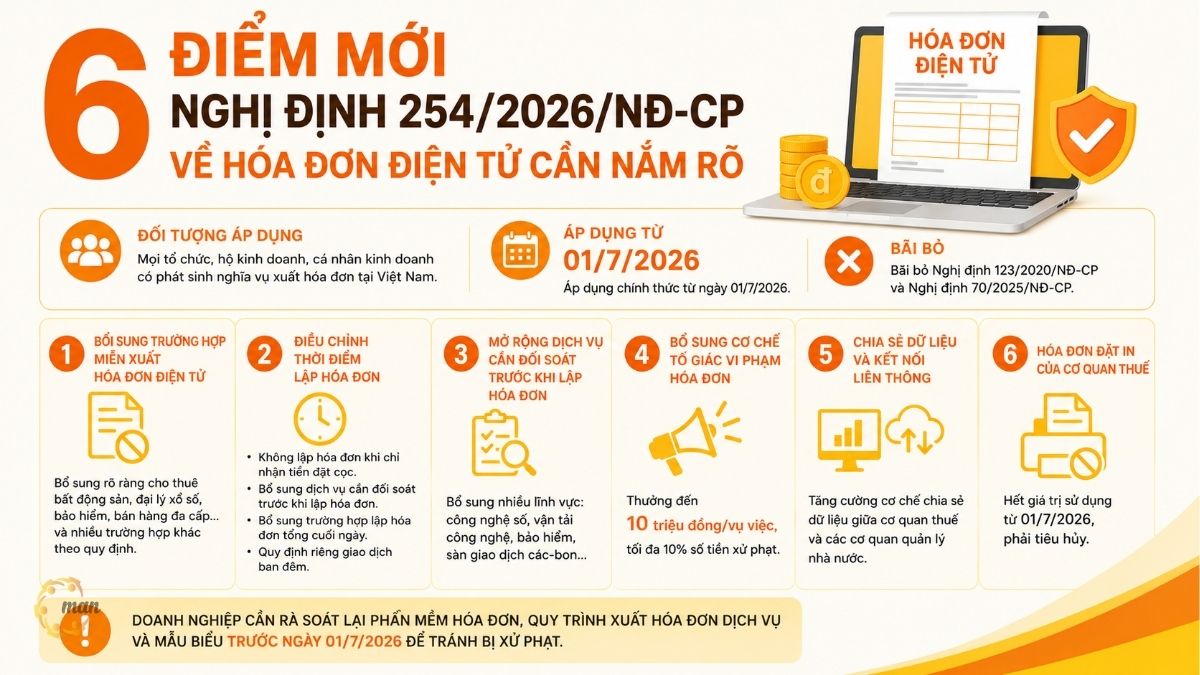
1. Cases where electronic invoices are not required from July 1, 2026.
According to Article 7 of Decree 254/2026/ND-CP, the cases where electronic invoices are not required are specifically stipulated as follows:
Regarding household businesses and individual businesses, this includes: selling goods and services that require the creation of a list of purchased goods and services as stipulated by the law on corporate income tax, unless they have registered to use electronic invoices; income from real estate rental activities; income from providing digital content products and services related to entertainment, video games, digital films, digital photos, digital music, and digital advertising to organizations and individuals abroad; and acting as lottery agents, insurance agents, or multi-level marketing agents where the lottery, insurance, or multi-level marketing companies have already withheld taxes according to the tax management law.
Regarding fees and financial income, this includes: fees and other income arising from reinsurance activities (reinsurance cession, reinsurance cession commissions, and other income from reinsurance cession), deposit taking, financial activities (issuance of certificates of deposit, primary securities, and valuable papers), debt sales, foreign exchange transactions, and derivative products. Specifically for foreign exchange sales transactions, the entity must prepare a detailed summary of transactions occurring during the month, be responsible for the accuracy of the content of each transaction, and provide this summary when requested by the tax authorities or other competent state agencies.
Regarding internal capital contributions and asset transfers, this includes: contributing assets of business organizations and individuals to economic organizations; transferring assets from the parent company to dependent accounting units and vice versa, or between dependent accounting units within the same business entity, including during division, separation, merger, acquisition, or conversion of business type; machinery and equipment that are fixed assets, and tools and implements lent for processing goods, without charge or transfer of ownership.
Regarding value-added tax-related cases under Decree 181/2025/ND-CP, these include: goods and services used to continue the production and business process, such as goods transferred internally, materials and semi-finished products exported for continued production within the same business; goods and services exported or provided by a business to serve its own production and business activities, including self-built or self-produced fixed assets; and income not related to the sale of goods or provision of services, such as monetary compensation (including compensation for land and assets on the land when expropriated), bonuses, third-party claims from insurance activities, amounts collected and disbursed on behalf of others, and fees from state agencies.
Among these, the most notable case for individual business owners is real estate rental. Previously, regulations were unclear, causing many landlords and apartment owners to be confused about whether they needed to register for electronic invoices. Decree 254/2026/ND-CP has definitively confirmed that this is an exempted case.
2. Adjusting regulations regarding the timing of invoice issuance.
Article 9 of Decree 254/2026/ND-CP provides quite detailed regulations on the timing of invoice issuance for four specific groups of situations that accountants often find confusing.
2.1 Receiving a deposit for the performance of a service contract does not require issuing an invoice.
According to Clause 2, Article 9, the time of issuing an invoice for a service is the time the service is completed, regardless of whether payment has been received or not. If payment is received before or during the provision of the service, the time of issuing the invoice is the time of payment. However, this regulation does not include the case of collecting a deposit as stipulated in the 2015 Civil Code to guarantee the performance of a service contract.
The new point lies in the scope of application. According to the old regulation in point a, clause 6, Article 1 of Decree 70/2025/ND-CP amending clause 2, Article 9 of Decree 123/2020/ND-CP, the exemption from issuing invoices when receiving deposits only applied to 5 specific service groups: accounting, auditing, financial and tax consulting; valuation; surveying and technical design; supervision consulting; and preparation of construction investment projects. Therefore, when a business only receives a deposit to ensure the conclusion and performance of a contract, it is not required to issue an invoice at the time of receiving the deposit, and this exemption is no longer limited to specific services as before.
2.2 Additional services require a 7-day reconciliation and invoicing period.
According to point a, clause 4, Article 9, the Government has added services with a large volume and frequent occurrence, requiring time for data reconciliation between businesses and customers/partners, including: maritime pilotage services; advertising services on electronic newspapers; digital technology services and digital platforms; information technology services including payment intermediary services used on telecommunications and information technology platforms; cryptographic asset services; services supporting transactions on carbon exchanges; insurance services; security services; industrial catering services; commodity exchange services; credit information services; and passenger transport business services by taxi, contract vehicles, and two-wheeled motorcycles using software to support transport connectivity in accordance with road transport laws, when providing services to business and organizational customers.
2.3 Addition of cases where end-of-day total invoices are issued.
According to point m, clause 4, Article 9, the Government adds a case where medical examination and treatment facilities are allowed to compile and issue electronic invoices for medical services performed on the same day, applicable when patients receive medical examination and treatment services that require printed receipts, such as X-rays and scans.
The conditions for application include four factors: the medical facility must use medical examination and treatment management software; medical fees must be managed transaction-by-transaction and service-by-service with printed receipts; the system must be stored in the information technology system; and patients must not require an invoice. Conversely, if a customer requests an invoice, the medical facility must still issue an electronic invoice to the customer immediately.
2.4 Adding provisions for transactions occurring during nighttime working hours.
According to Clause 5, Article 9, if the seller does not have automatic invoicing software and a transaction involving the sale of goods or provision of services occurs during nighttime working hours as stipulated in the 2019 Labor Code (from 10 PM to 6 AM the following morning), the invoice must be issued no later than the next working day.
3. Land management agencies, police, and health agencies must share electronic invoice data with the Tax Department.
To align with the current model of local government organization, Clause 4, Article 40 of Decree 254/2026/ND-CP has adjusted the regulations on the responsibility for connecting and sharing relevant information and data in their respective areas of management with the Tax Department to build an electronic invoice database.
Specifically, the data receiving point has been replaced from the former General Department of Taxation to the Tax Department, and the names of some agencies have been updated to reflect the new organizational structure. Agencies responsible for sharing and connecting information include: market management agencies; the Land Management Department; the Vietnam Geological and Mineral Resources Department; the police; the transportation agency; the health agency; and other relevant agencies. This multi-directional connection is the reason why invoice errors are increasingly difficult to conceal, and it also serves as a basis for tax authorities to cross-check when detecting irregularities in declarations.
4. Reporters who expose the failure to issue electronic invoices will be rewarded up to 10 million VND.
This is entirely new content, previously unregulated. According to Clause 1, Article 41 of Decree 254/2026/ND-CP, the conditions for consumers to be considered for commendation for reporting sellers who fail to issue and deliver electronic invoices when selling goods or providing services include three factors: providing truthful, accurate, timely information with a basis for determining the time, place, and person committing the violation; the information accurately reflects the actual situation, providing sufficient basis for the tax authority to determine the nature and extent of the violation and conduct inspections and verifications; and the tax authority has issued a decision to impose administrative penalties for tax and invoice violations based on the information provided.
The reward for reporting the failure to issue and deliver invoices in a single case shall not exceed the administrative penalty amount and a maximum of 10 million VND per case. Consumers can report through one of the following methods: via eTax Mobile; the National Public Service Portal; official email; the tax authority's electronic information reception system; or by submitting a written report directly to the tax authority's headquarters.
5. Cancel unused printed invoices issued by the tax authority.
This regulation is stipulated in Clause 3, Article 44 of Decree 254/2026/ND-CP. Specifically, from July 1, 2026, pre-printed invoices issued by the tax authority will no longer be valid. Tax authorities, economic organizations, business organizations, household businesses, and individual businesses that have not yet used up pre-printed invoices must destroy them according to the procedures prescribed by the Minister of Finance.
This regulation also applies to self-printed and custom-printed paper receipts issued under Decree 123/2020/ND-CP, but the destruction process will only begin on January 1, 2027. Unused self-printed and custom-printed paper receipts may continue to be used until December 31, 2026. Simultaneously, organizations using paper receipts must convert to electronic receipts using the standard data format during this period.
Along with the cancellation of pre-printed invoices, Article 43 of Decree 254/2026/ND-CP stipulates that this decree replaces Decree 123/2020/ND-CP, Decree 70/2025/ND-CP, and Article 1 of Decree 41/2022/ND-CP amending Decree 123/2020/ND-CP. All three documents officially cease to be in effect from July 1, 2026.
6. New regulations regarding invoice content
Based on the appendix on invoice content issued with Decree 254/2026/ND-CP, many new regulations on how to present invoice content have been added, directly affecting whether an invoice is considered valid or not.
Regarding abbreviations, for excessively long buyer names and addresses, sellers are allowed to abbreviate some common terms such as "Ward" to "W", "City" to "C", "Vietnam" to "VN", "Joint Stock" to "CP", "Limited Liability" to "TNHH", "Industrial Park" to "KCN", "Production" to "SX", and "Branch" to "CN". The mandatory condition is that the full house number, street name, ward, commune, special zone, province, and city must still be included to accurately identify the business name and address, consistent with business registration and tax registration.
Regarding the recording of buyer information, according to point b, clause 4 of the Appendix, if the buyer is a consumer who does not provide their name, address, or personal identification number, the seller is not allowed to leave the buyer information blank as before, but must clearly state "Sold to consumer" on the invoice. Conversely, if the buyer provides their name, address, and personal identification number, the invoice must show all this information; for foreign buyers, the passport number, entry/exit documents, and nationality must be shown. Meanwhile, the old regulation in point a, clause 7, Article 1 of Decree 70/2025/ND-CP amending clause 5, Article 10 of Decree 123/2020/ND-CP only stipulated that if the buyer does not have a tax identification number, the buyer's tax identification number should not be shown, and foreign customers could replace the address with their passport number and nationality, but there was no specific guidance for cases where no information is provided.
Regarding invoice content for specific business models, the supplementary appendix stipulates separate regulations for household businesses and individual businesses using a single tax identification number for all their stores: invoices must show the name, code, and address of each specific business location where the transaction occurred. Petroleum businesses must clearly state the code and address of each business location issued by the competent authority for each store on the invoice. For electronic invoices issued under authorization, the invoice content must simultaneously show the name, address, and tax identification number of both the authorizing party and the authorized party. In the case of auctioning assets to enforce a judgment, the invoice must clearly state the name, address, and tax identification number of the agency authorized to auction the assets and of the seller of the assets.
Why should businesses immediately update to the new provisions of Decree 254/2026/ND-CP?
Because of the regulations regarding time of invoicing Even a discrepancy of just one day can lead to administrative penalties. In the context of tax authorities connecting invoice data in real time with many other regulatory agencies, errors are no longer easily corrected internally as before. From MAN's perspective, this is why tax risk management needs to be considered an ongoing task, not just something done at the end of the tax year.
Furthermore, the complete replacement of Decree 123/2020/ND-CP means that many previous guiding documents based on this new document also need to be reviewed. Accountants cannot mechanically apply professional guidelines issued before July 1, 2026, without checking whether their content is still consistent with the new legal framework. This is the most easily overlooked point during the transition period between the two regulatory systems.
The role of new developments in corporate financial and tax management.
The changes in Decree 254/2026/ND-CP are not merely administrative and technical in nature, but directly impact cash flow, revenue recognition methods, and internal reconciliation processes.
For digital services, technology platforms, insurance, and ride-hailing services, being allowed to issue invoices every 7 days instead of per transaction significantly reduces accounting workload while ensuring compliance. Conversely, retail businesses and food service businesses operating at night need to adjust their operational processes to avoid violating the regulation requiring invoices to be issued no later than the next business day.
The solution from MAN – Master Accountant Network for businesses struggling with the transition is to rebuild the transaction classification system by invoice group right from the beginning of the third quarter, instead of waiting until closer to the tax settlement deadline to review it.
Which entities are affected by the new provisions of Decree 254/2026/ND-CP?
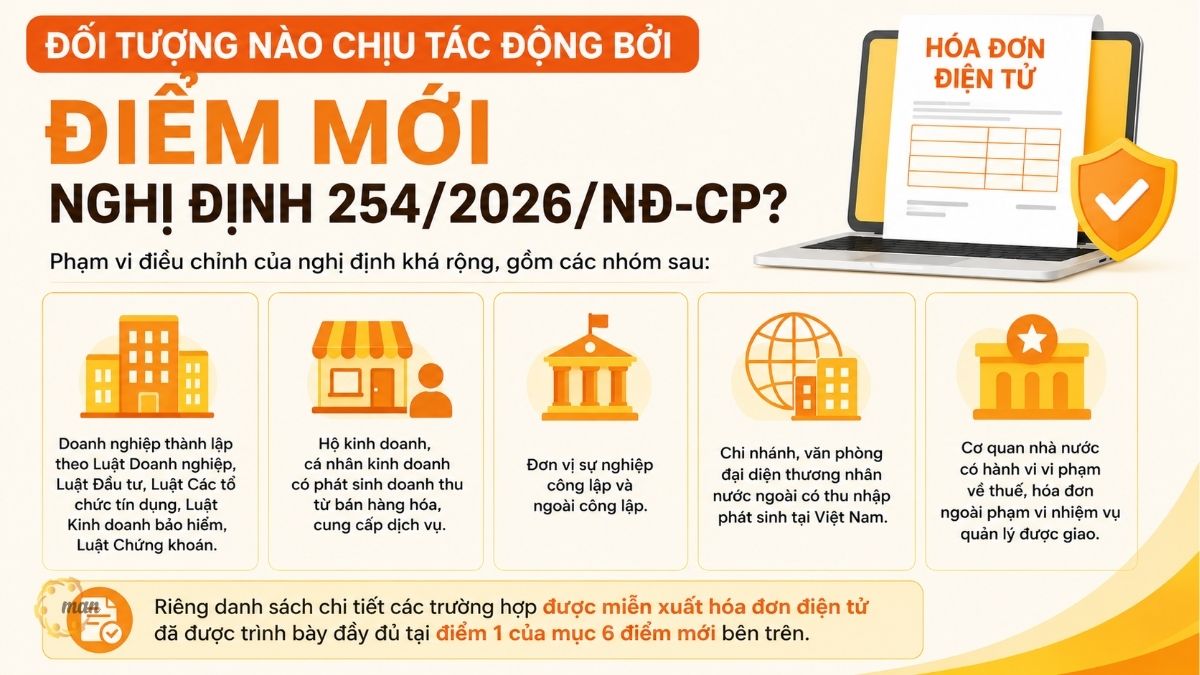
The decree covers a fairly broad range of topics, specifically including the following groups:
- Businesses are established under the Law on Enterprises, the Law on Investment, the Law on Credit Institutions, the Law on Insurance Business, and the Law on Securities.
- Household businesses and individual businesses that generate revenue from selling goods or providing services.
- Public and private non-profit organizations.
- Branches and representative offices of foreign businesses that generate income in Vietnam.
- State agencies commit tax and invoice violations outside the scope of their assigned management duties.
The detailed list of cases exempt from issuing electronic invoices has been fully presented in point 1 of section 6 of the new points above.
The following deadlines and applicable conditions should be noted.
Businesses need to understand the following milestones to avoid being caught off guard during implementation:
- From July 1, 2026: Decree 254/2026/ND-CP officially takes effect, simultaneously repealing Decree 123/2020/ND-CP and Decree 70/2025/ND-CP.
- Printed invoices issued by the tax authority: Once their useful life expires on July 1, 2026, they must be destroyed according to the guidelines of the Ministry of Finance.
- Self-printed or custom-printed paper receipts: They will continue to be used until December 31, 2026, and must be destroyed and converted to electronic receipts from January 1, 2027.
- Nighttime trading without automated software: The latest time for issuing invoices is the next working day, effective immediately upon the decree's entry into force.
Compilation of relevant legal documents
To properly apply Decree 254/2026/ND-CP, businesses need to simultaneously monitor relevant legal documents on electronic invoices and tax management., VAT and administrative penalties for violations. The table below summarizes important documents and their main contents, making it easy for you to look up and identify the legal basis when taking action.
| Document | Date of issuance | Main content |
| Decree 254/2026/ND-CP | 30/6/2026 | Guidance on the 2025 Tax Administration Law regarding electronic invoices and documents, replacing the entire old legal framework. |
| Decree 123/2020/ND-CP | 19/10/2020 | Regulations on invoices and supporting documents (expired on July 1, 2026) |
| Decree 70/2025/ND-CP | 20/3/2025 | Amendments and additions to Decree 123/2020/ND-CP (which expired on July 1, 2026) |
| Decree 125/2020/ND-CP (amended by Decree 310/2025/ND-CP) | – | Regulations on administrative penalties for invoice violations. |
| Decree 181/2025/ND-CP | – | Guidelines for implementing the Value Added Tax Law 2024, serving as a basis for determining cases where invoices are not required. |
| Article 1 of Decree 41/2022/ND-CP | 20/6/2022 | Amendments and supplements to Decree 123/2020/ND-CP are now also expiring along with the replacement. |
| Resolution 107/2023/QH15 | – | Based on the application of global tax base erosion regulations, relating to the reporting responsibilities of constituent entities. |
Real-world case study: How do technology-based transportation companies handle invoices?
A ride-hailing company in Ho Chi Minh City, which collaborates with over 3,000 drivers and serves approximately 40 corporate clients with long-term contracts, faced difficulties in issuing invoices for each trip made each day. On average, more than 25,000 trips were made each month, meaning that many invoices would need to be processed under the old regulations, overwhelming the accounting department and increasing the risk of errors in invoice generation.
According to the new regulations in Decree 254/2026/ND-CP, passenger transport services provided to business and organizational customers are classified as high-volume, frequently occurring services requiring data reconciliation. This allows businesses to consolidate and issue invoices for each customer every 7 days, instead of issuing over 800 individual invoices daily as before. The number of consolidated invoices needed is reduced to approximately 40 per reconciliation period, significantly shortening processing time for the accounting department while still complying with regulations.
Experts at MAN, with 30 years of experience, note that businesses in this group must still retain complete original reconciliation data to present when requested by the tax authorities; consolidating invoices should not be considered as neglecting the obligation to record each transaction.
Comparison table of old and new regulations
Decree 254/2026/ND-CP has changed many important regulations on electronic invoices compared to Decree 123/2020/ND-CP. The table below summarizes the prominent differences, helping businesses and accountants quickly grasp the new regulations to apply them correctly and minimize risks in the process of creating and managing invoices.
| Criteria | Decree 123/2020/ND-CP (old) | Decree 254/2026/ND-CP (new) |
| Cases where invoice issuance is waived | There are no clear regulations for households that rent out real estate. | Clearly add real estate rentals, lottery agencies, insurance, and multi-level marketing schemes. |
| Nighttime billing time | There are no specific regulations yet. | No later than the next business day if there is no automated software. |
| The service requires verification before invoicing. | Restrictions on certain industries | Expand into digital technology, technology-based transportation, insurance, and carbon trading platforms. |
| Mechanism for reporting invoice violations | No specific bonus amount has been announced yet. | Rewards of up to 10 million VND per case, with a maximum fine amount of 10%. |
| Printed invoices issued by the tax authority. | Still valid | Expires from July 1, 2026, must be destroyed. |
What is the penalty for issuing an invoice at the wrong time?
This is the most frequently searched question when businesses are concerned about transitioning processes according to the new provisions of Decree 254/2026/ND-CP. According to Article 24 of Decree 125/2020/ND-CP, amended by Clause 14, Article 1 of Decree 310/2025/ND-CP, the penalty is calculated progressively based on the number of violating invoices in an inspection, rather than a fixed amount for all cases.
It's important to note that the regulations divide the offenses into two groups with different invoice number thresholds. The first group includes invoices issued for goods and services used for promotions, advertising, samples, gifts, exchanges, payment in lieu of salary, internal consumption, or goods issued in the form of loans, borrowings, or returns. The second group includes invoices issued when selling goods or providing services normally, which are subject to a lower number threshold, making it easier to incur higher penalties for the same number of erroneous invoices.
| Penalty level | Invoice number for promotional, gift, and internal group | Sales and service group invoice number |
| Warning (no fine) | a number of invoices | – |
| 500,000 – 1,500,000 VND | From 2 to less than 10 invoices | a number of invoices |
| 2,000,000 – 5,000,000 VND | From 10 to under 50 invoices | From 2 to less than 10 invoices |
| 5,000,000 – 15,000,000 VND | From 50 to under 100 invoices | From 10 to under 20 invoices |
| 15,000,000 – 30,000,000 VND | From 100 invoices or more | From 20 to under 50 invoices |
| 30,000,000 – 50,000,000 VND | – | From 50 to under 100 invoices |
| 50,000,000 – 70,000,000 VND | – | From 100 invoices or more |
It can be seen that, with the same number of incorrectly issued invoices, the group selling regular goods and providing services always faces heavier penalties than the group selling promotional or gift items. This is a point that retail and service businesses need to pay special attention to because the majority of their transactions fall into the second category.
It is important to note that according to Clause 5, Article 5 of Decree 125/2020/ND-CP, the above-mentioned fines apply to organizations and are twice the amount applied to individuals committing the same violation. In other words, individual businesses that violate the regulations will only be subject to half the amount stated in the table above.
Who are the subjects of administrative penalties for invoice-related violations?
According to Article 3 of Decree 125/2020/ND-CP, as amended by Clause 2, Article 1 of Decree 310/2025/ND-CP, the scope of those subject to penalties is much broader than the common belief among accountants that only taxpayers are subject to penalties.
Firstly, taxpayers who violate tax and invoice regulations are subject to direct penalties. However, if a taxpayer authorizes another organization or individual to fulfill their tax obligations according to the law, the authorized party will be solely responsible for the penalty if a violation occurs, and the original taxpayer will not be held liable. Similarly, organizations or individuals who register for tax, declare taxes, and pay taxes on behalf of others according to the law and commit violations will also be subject to direct penalties.
A notable new point is the application of the global tax base erosion regulation under Resolution 107/2023/QH15. A constituent entity assigned by the group to declare and pay additional corporate income tax, if it violates its registration, declaration, and tax payment obligations, will be subject to penalties under Decree 125/2020/ND-CP.
Regarding the groups of organizations subject to penalties, the regulations list quite comprehensively, including: enterprises established under the Enterprise Law, Investment Law, Law on Credit Institutions, Law on Insurance Business, Law on Securities, Law on Oil and Gas, Law on Commerce, and their dependent units and business locations that directly declare and pay taxes; public and private non-profit organizations; organizations under the Law on Cooperatives; foreign organizations and enterprises, branches, representative offices of foreign traders, and executive offices of foreign contractors with income generated in Vietnam; state agencies that violate regulations outside the scope of their assigned management duties; and cooperatives and other organizations established under the law.
From MAN's perspective, expanding the scope of responsible parties shows that the tax authorities are tightening accountability throughout the entire authorization chain, from the original taxpayer to the party hired to provide accounting and tax filing services. Businesses that outsource tax accounting services need to carefully review the responsibilities outlined in their service contracts to avoid disputes when penalties arise.
Expert opinion: Common risks faced by Vietnamese businesses.
Based on our experience advising numerous small and medium-sized enterprises, MAN has identified three recurring risk groups when implementing the new regulations on electronic invoices.
- First, businesses often confuse the following: deposit and advance payment. According to the new regulations, deposits made under the Civil Code to guarantee the performance of service contracts do not yet require invoices. However, if the nature of the revenue is misrepresented, accountants can easily issue invoices at the wrong time or omit the obligation to issue invoices.
- Secondly, many healthcare facilities use end-of-day total billing but do not store sufficient detailed data for each receipt on their information technology systems, making it difficult to explain when subjected to retrospective audits.
- Thirdly, using abbreviations for addresses and business names on invoices that do not conform to the permitted abbreviation list may result in the invoice being considered invalid, directly affecting the buyer's ability to deduct input value-added tax.
- Fourth, many small businesses are complacent about the reporting mechanism from their own customers. According to Clause 1, Article 41, consumers are only considered for commendation when they meet three conditions: providing truthful, accurate, and timely information, clearly identifying the time, place, and person of the violation; the content of the complaint is factual and sufficient for the tax authority to verify; and the tax authority has issued a penalty decision based on that information. Consumers can submit complaints via eTax Mobile, the National Public Service Portal, official email, the tax authority's electronic information receiving system, or directly in writing to the tax authority's headquarters. For businesses that sell directly to consumers, this is a nearly instantaneous monitoring channel that did not exist before.
In these cases, the solution from MAN – Master Accountant Network always begins by reviewing the revenue recognition process right from the contract stage, not waiting until the invoice is issued to process it. This helps businesses proactively optimize tax costs in Vietnam instead of reactively chasing after errors.
Conclude
The new provisions of Decree 254/2026/ND-CP mark a comprehensive change in the management of electronic invoices and documents in Vietnam, from expanding the scope of entities exempt from invoice issuance and adjusting the invoice issuance time for specific service groups, to tightening the mechanism for data sharing between state management agencies. Businesses need to proactively review their internal processes now to avoid the risk of penalties when the regulations officially come into effect.
Tax services at MAN – Master Accountant Network
- Tax accounting services
- Tax consulting services
- Tax settlement services
- Tax reporting services
- VAT refund service
Service contact information at MAN – Master Accountant Network
- Address: No. 19A, Street 43, Tan Thuan Ward, Ho Chi Minh City
- Mobile/Zalo: 0903 963 163 – 0903 428 622
- E-mail: man@man.net.vn
- Google Business Profile: View MAN – Master Accountant Network's Google Business Profile
- LinkedIn Founder: View expert Le Hoang Tuyen's LinkedIn profile.
Responsible for production and professional content review by: Mr. Le Hoang Tuyen – Founder & CEO of MAN – Master Accountant Network, CPA Vietnam with over 30 years of experience in accounting, auditing, taxation, and corporate financial consulting.
Frequently Asked Questions about the New Points in Decree 254/2026/ND-CP
From July 1st, 2026, Decree 123/2020/ND-CP and Decree 70/2025/ND-CP will be simultaneously repealed.
Not mandatory. This is one of the cases exempt from issuing electronic invoices according to Article 7 of this decree.
No later than the next working day, according to Clause 5, Article 9 of the decree.
No. This type of invoice will expire on July 1, 2026, and must be destroyed according to the instructions of the Ministry of Finance.
A reward of up to 10 million VND per case may be considered, not exceeding the administrative fine amount, if truthful and verifiable information is provided.
The corresponding fine ranges from approximately 5,000,000 to 15,000,000 VND, based on the penalty range for 10 to under 20 invoices, applicable to organizations. Individuals committing the same violation will be subject to half the fine. When does Decree 254/2026/ND-CP take effect?
Is it mandatory for businesses that rent out houses to issue electronic invoices?
If selling goods at night without automated software, when can invoices be issued?
Are old, pre-printed invoices from the tax authorities still valid?
What benefit do consumers gain from reporting businesses that fail to issue invoices?
What is the penalty for a business issuing 15 invoices at the wrong time?