

Official Document 4217/CT-NVT The document issued by the Tax Department on June 23, 2026, is receiving significant attention from accountants, just before a series of new tax regulations take effect from July 1, 2026. This document addresses a seemingly minor but very common issue raised by the Quang Ngai Provincial Tax Department: businesses have already declared, allocated, and paid taxes. corporate income tax (CIT) for an area that shouldn't have been allocated.
The story doesn't end with simply "getting the money back." How the Tax Department classifies that amount—whether it's overpaid or mistakenly paid—will determine the processing procedure, which tax authority is responsible for the refund, and how long it takes for the business to recover the funds. For companies with branches and production facilities spread across multiple provinces, this is a very common tax risk.
Summary of key points in Official Letter 4217/CT-NVT
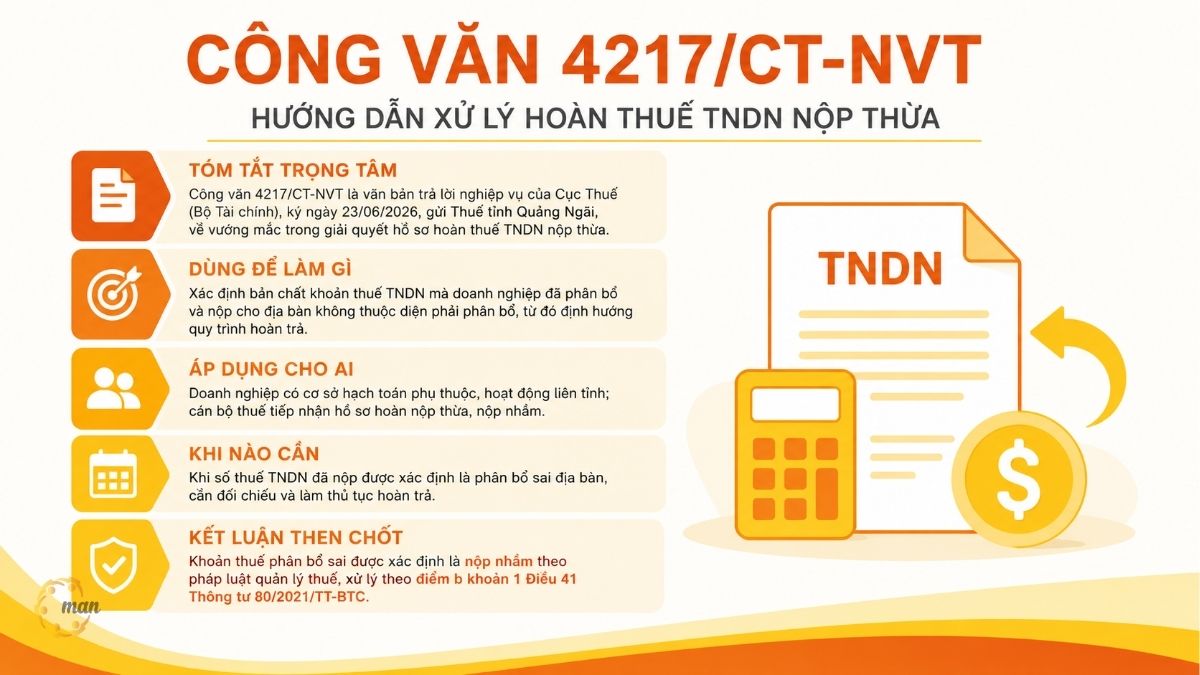
- Official document 4217/CT-NVT is The response from the Tax Department (Ministry of Finance), signed on June 23, 2026, sent to the Quang Ngai Provincial Tax Department, concerns difficulties in resolving overpaid corporate income tax refund applications.
- What is it used for? Determine the nature of the corporate income tax that the enterprise has allocated and paid to areas not subject to allocation, and then guide the refund process.
- Who does this apply to? Businesses with dependent accounting units and inter-provincial operations; tax officials receive applications for refunds of overpaid or mistakenly paid taxes.
- When is it needed? When it is determined that the corporate income tax already paid has been incorrectly allocated to the wrong geographical area, a reconciliation and refund procedure are necessary.
- Key conclusion: The incorrectly allocated tax amount is determined to be an erroneous payment according to tax administration law, and is handled in accordance with point b, clause 1, Article 41 of Circular 80/2021/TT-BTC.
What is Official Document 4217/CT-NVT and who issued it?
This is a professional response letter, not a legal regulation. The Tax Department issued it to guide the Quang Ngai Provincial Tax Department in handling a specific case.
The identifying information includes: document number 4217/CT-NVT, issuing authority Hanoi, date of issuance June 23, 2026, signatory Ms. Nguyen Thi Thu, Head of Tax Operations Department, signing on behalf of the Director. The document originates from... Official document No. 3861/QNG-QLDN1 December 24, 2025, from the Quang Ngai Provincial Tax Department.
Because it is a specific document, its binding effect is limited to the situation in question. However, its reference value is very high for any business facing a similar situation.
The "Recipients" section of the document is also noteworthy. Besides the Quang Ngai Provincial Tax Department, the document was also sent to Deputy Director Mai Son for reporting purposes, the Policy Department, the Legal Department, the Inspection Department, the Large Enterprise Tax Sub-department, and the Da Nang City Tax Department for coordination. More importantly, the document is posted on the Tax Department's website, so businesses can publicly access and refer to it when needed.
What is the core issue addressed in Official Letter 4217/CT-NVT?
The situation described is very specific. Long Viet Joint Stock Company in Da Nang City declared, allocated, and paid corporate income tax for the years 2022 and 2023 to Quang Ngai province. The problem is that the company is not required to allocate corporate income tax to Quang Ngai province. This means the money has flowed into the budget of another locality improperly. The Tax Department's position is quite clear. The corporate income tax paid in this case was determined to be an erroneous payment according to tax management laws, and not simply an overpayment.
Why does Official Letter 4217/CT-NVT differentiate between overpayment and incorrect payment?
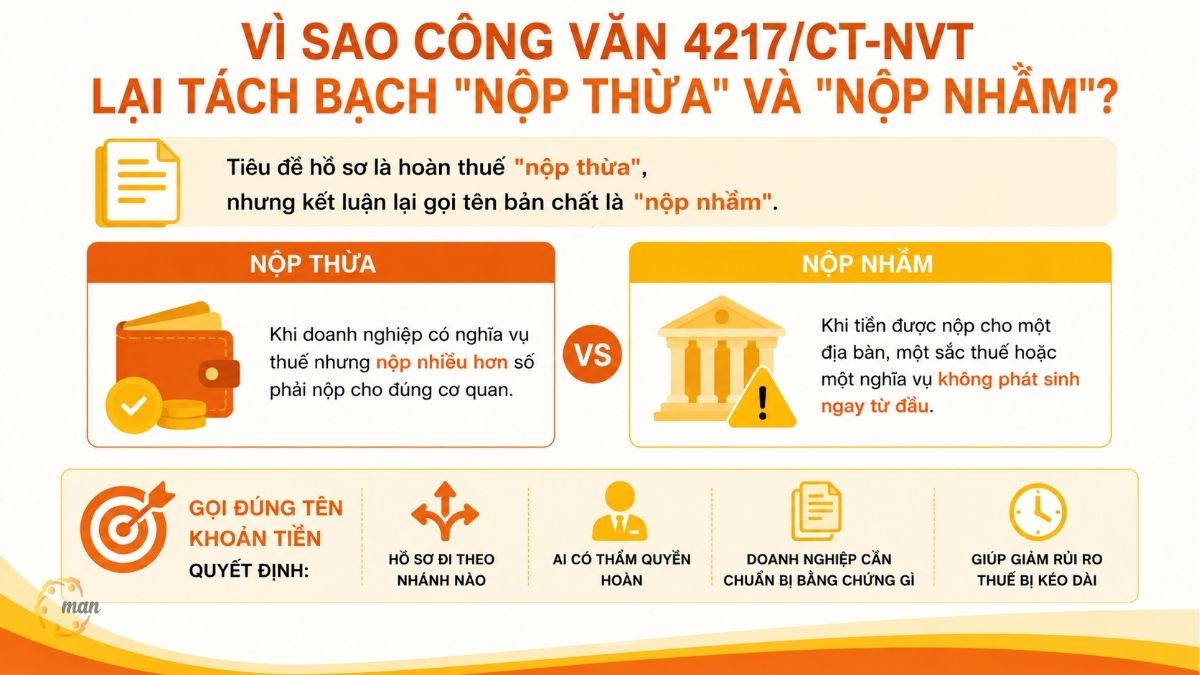
This is the most subtle and also the most easily overlooked detail. The title of the application is "Tax Refund". “"overpaying"”, but the conclusion calls the essence by name. “"submitted by mistake"”.
Overpayment occurs when a business has a tax obligation but pays more than it should to the correct authority. Incorrect payment occurs when money is paid for a location, tax type, or obligation that did not arise in the first place.
From MAN's perspective, correctly naming the amount of money isn't just a matter of wording. It determines which branch the claim goes through, who has the authority to process the refund, and what evidence the business needs to prepare to mitigate the risk of tax delays.
Which groups are directly affected by Official Letter 4217/CT-NVT?
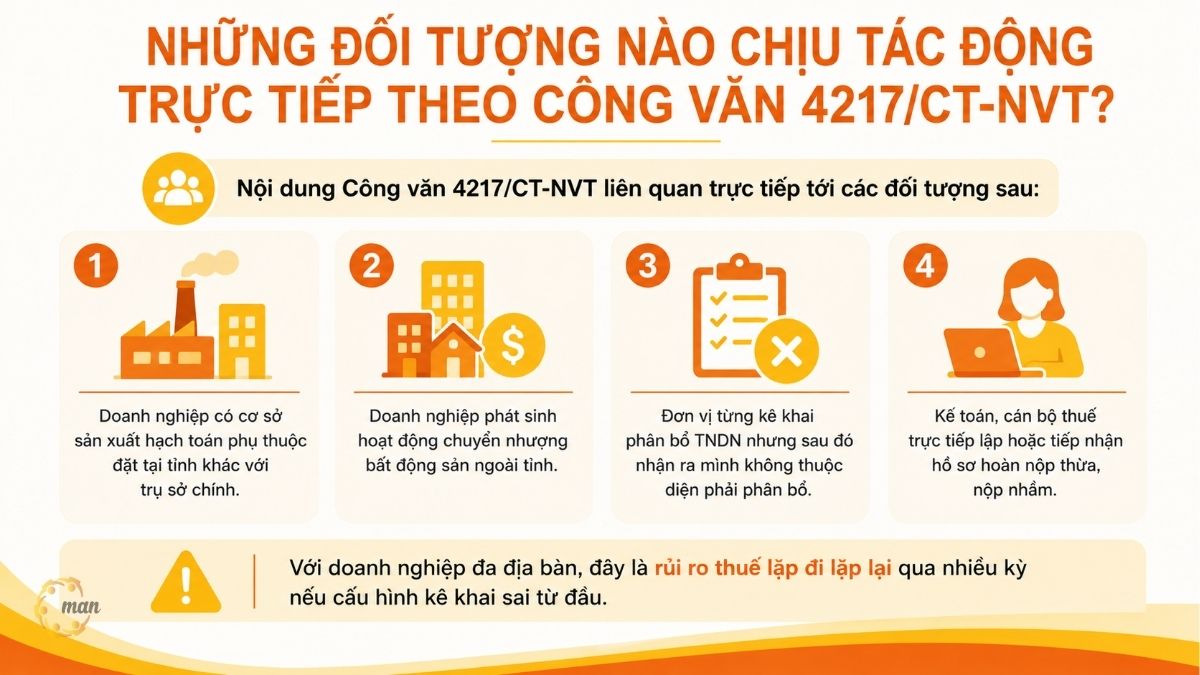
Not all businesses are affected by corporate income tax allocation. However, the group that is impacted is very large in practice. Specifically, the content of Official Letter 4217/CT-NVT directly relates to:
- The business has a production facility located in a province different from its head office.
- The company engages in real estate transfer activities outside the province.
- The entity had previously declared corporate income tax allocation but later realized it was not subject to allocation.
- Accountants and tax officials directly prepare or receive refund applications for overpayments or incorrect payments.
For businesses operating across multiple locations, this is a recurring tax risk that can occur over several periods if the initial tax declaration configuration is incorrect.
What legal basis is cited in Official Letter 4217/CT-NVT?
This document does not create new regulations. It reiterates four existing sets of legal grounds to guide how to handle the situation. This is the section that experts at MAN always ask clients to read carefully, because correctly citing the relevant clause makes the tax refund audit process much smoother.
| Document | Number and date of issuance | The term is cited. | Summary of content |
| Circular of the Ministry of Finance | Circular 78/2014/TT-BTC, June 18, 2014 | Article 12 | Principles for determining and declaring corporate income tax; guidance on Decree 218/2013/ND-CP on the Corporate Income Tax Law. |
| Circular of the Ministry of Finance | Circular 80/2021/TT-BTC, dated September 29, 2021 | Clause 1, Article 17 | Regulations on the allocation of corporate income tax to different localities. |
| Circular of the Ministry of Finance | Circular 80/2021/TT-BTC, dated September 29, 2021 | Point i, k7, Clause 1, Article 5 | The tax management responsibilities lie with the tax authority directly managing and the tax authority managing the allocated area. |
| Circular of the Ministry of Finance | Circular 80/2021/TT-BTC, dated September 29, 2021 | Point b, Clause 1, Article 41 | The tax authority's responsibility in receiving and processing overpayment refund applications. |
The two aforementioned circulars do not stand alone. Circular 78/2014/TT-BTC Guidance on Decree 218/2013/ND-CP dated December 26, 2013 on the Corporate Income Tax Law, and Circular 80/2021/TT-BTC instruct Law on Tax Administration and Decree 126/2020/ND-CP October 19, 2020. When reviewing documents, businesses should read the original decree as well, not just the circular.
Based on those grounds, the Tax Department requests the Quang Ngai Provincial Tax Department to coordinate with the Da Nang City Tax Department to study point b, clause 1, Article 41 of Circular 80/2021/TT-BTC to resolve the matter within their authority.
In the legal context of 2026-2027, where should this document be placed?
The timing of its issuance is noteworthy. The document appears just before the July 1, 2026 deadline, when many tax regulations are scheduled to change.
From mid-2026, the 2025 Corporate Income Tax Law and Decree 320/2025/ND-CP on the implementation of the Corporate Income Tax Law will begin to govern many activities. Four consolidated documents on personal income tax, value-added tax, corporate income tax, and special consumption tax will also be used as the legal basis from July 1, 2026.
This means that the principles for handling incorrect or overpayments remain the same, but businesses must also refer to the new legal framework when reviewing recent tax periods.
When does the period of corporate income tax exemption or reduction begin?
This is a common question that arises when businesses review the corporate income tax obligations of investment projects. Incorrect calculation benchmarks can distort incentives for many years.
According to Clause 4, Article 20 of Decree 320/2025/ND-CP, the period of exemption and reduction of corporate income tax is specified. starting from the first year Businesses that generate taxable income from investment projects. If there is no taxable income in the first three years, the calculation is based on... postponed to the fourth year since the first year. The project generates revenue.
An important note regarding high-tech projects, high-tech agriculture, or science and technology projects: if the certificate or confirmation of incentives is issued after the income is generated, the incentive period is calculated from the year the certificate is issued, following the same principle regarding the year of income generation.
How many years can corporate income tax losses be carried forward continuously?
Loss carryforward is a tool that helps businesses reduce their tax burden in subsequent years, but many miss out because the deadline has passed.
According to Article 16 of the Corporate Income Tax Law 2025, businesses with losses can carry them forward to the following year and deduct them from taxable income. The loss carryforward period is continuous and does not exceed 5 years, starting from the year following the year in which the loss occurred.
This five-year rule also applies to losses from the transfer of projects or rights to explore, exploit, or process minerals, provided they are carried forward to the taxable income of the activity itself. From MAN's perspective, this is a point that auditors always remind clients to closely monitor, because exceeding the five-year deadline results in the loss of the right to legally optimize tax expenses.
Real-world scenario: illustrative case study analysis
To make it easier to understand, let's take the structure of the case and attach illustrative data. Let's assume Long Viet Joint Stock Company has its headquarters in Da Nang and a facility in Quang Ngai.
In 2022 and 2023, the accountants understood that having a branch in another province required the allocation of corporate income tax. They allocated and remitted approximately 850 million VND each year to Quang Ngai, totaling 1.7 billion VND (illustrative figures).
The problem is that the facility in Quang Ngai is not a dependent accounting production facility eligible for allocation. Therefore, the entire amount already paid to Quang Ngai is determined to have been paid by mistake.
Approaches and lessons learned from the case study.
According to the document's guidelines, the file does not follow the logic of "Quang Ngai is holding the money because the business operates there." The funds need to be reviewed for reimbursement in accordance with Article 41 of Circular 80/2021/TT-BTC.
In practice, with nearly 30 years of consulting experience, MAN has found that the most time-consuming step is proving that the facility is "not eligible for allocation." Businesses must re-examine the nature of their operations and compare them with Article 17 of Circular 80/2021/TT-BTC.
The lesson learned is very practical: a single incorrect declaration configuration can lead to repeated errors over many periods, and the cost of correcting the mistake is always higher than the cost of getting it right from the start.
Comparison table: What is the difference between overpayment and incorrect payment?
Many accountants use these two concepts interchangeably. The difference directly affects the records.
| Criteria | Overpaying | Submitted by mistake |
| Nature | They have tax obligations but pay more than they should. | No tax obligations arise in that area or for that particular tax. |
| Typical example | The provisional corporate income tax payment for the whole year is higher than the final tax amount. | Allocate and pay corporate income tax to provinces not subject to allocation. |
| The situation described in Official Letter 4217/CT-NVT | The original name of the file | The nature is determined by the Tax Department. |
| Processing facility | Regulations regarding refunds of overpayments | Point b, Clause 1, Article 41 of Circular 80/2021/TT-BTC |
| Common risks | Slow clearing, stagnant cash flow. | Incorrect budgetary jurisdiction, prolonged coordination between the two tax agencies. |
The common point is that both can be processed through the overpayment refund mechanism. The difference lies in the evidence and the agency responsible for the refund.
Expert opinion: Where does the real risk lie?
After years of auditing tax records for businesses operating across multiple locations, a few recurring risks have become almost a pattern.
- Firstly, there's the risk of "allocation based on subjective feelings." Many accountants assume that any branch located in a different province must automatically be allocated corporate income tax, while Article 17 of Circular 80/2021/TT-BTC only applies to certain specific cases. A mistake in this initial assumption leads to errors throughout the entire chain.
- Secondly, there is the risk of late detection. In the case of Official Letter 4217/CT-NVT, the errors from 2022 were only brought to light at the end of 2025. The longer it is left unaddressed, the more difficult it becomes to prove the errors, and the larger the amount of money tied up.
- Thirdly, there is the risk of inter-agency coordination. Once the money has entered a province's budget, the reimbursement process requires the involvement of two tax authorities. Experts at MAN, with nearly 30 years of experience, note that this is often the stage that causes the reimbursement process to take longer than expected.
The solution from MAN – Master Accountant Network typically starts with reviewing the original tax return configuration, rather than just addressing the symptoms. This approach optimizes tax costs and reduces the recurrence of errors in subsequent periods, especially as the legal framework changes from mid-2026 onwards.
What actions should businesses take right now, according to Official Letter 4217/CT-NVT?
There's no need to wait until the tax authorities ask to conduct a review. Some steps should be taken early.
First, compare all previously allocated corporate income tax periods with Article 17 of Circular 80/2021/TT-BTC to determine if the allocation is correct. Then, separate any suspected mispaid amounts to prepare the necessary documentation.
Once the nature of the transaction is determined, the business should refer to Article 41 of Circular 80/2021/TT-BTC regarding the refund procedure. In cases involving large sums of money or multiple geographical locations, having a consulting and auditing firm involved will significantly reduce tax risks.
Conclude
Official Letter 4217/CT-NVT serves as a practical reminder that in tax management, correctly identifying the nature of an amount of money is just as important as paying it in full. The distinction between overpayment and erroneous payment, the proper citation of Articles 17 and 41 of Circular 80/2021/TT-BTC, and the requirement for inter-agency coordination are all crucial points that businesses operating across multiple locations need to understand. In the context of the changing tax legal framework effective July 1, 2026, proactively reviewing corporate income tax allocation periods becomes even more urgent.
If your business is concerned about tax refund applications, corporate income tax allocation, or similar tax risks, MAN – Master Accountant Network is a partner worth considering. With a team of experts boasting nearly 30 years of experience and a deep understanding of tax risk management practices in Vietnam, MAN provides tax settlement services, tax accounting services, tax reporting services and tax consulting services, We partner with businesses to process documents accurately and optimize tax costs.
Service contact information at MAN – Master Accountant Network
- Address: No. 19A, Street 43, Tan Thuan Ward, Ho Chi Minh City
- Mobile/Zalo: 0903 963 163 – 0903 428 622
- E-mail: man@man.net.vn
- Google Business Profile: View MAN – Master Accountant Network's Google Business Profile
- LinkedIn Founder: View expert Le Hoang Tuyen's LinkedIn profile.
Responsible for production and professional content review by: Mr. Le Hoang Tuyen – Founder & CEO of MAN – Master Accountant Network, CPA Vietnam with over 30 years of experience in accounting, auditing, taxation, and corporate financial consulting.
Frequently Asked Questions about Official Document 4217/CT-NVT
No. This is a professional response to a specific situation, which is of high reference value but does not replace circulars or decrees.
According to the document, if the business is not subject to allocation requirements, the amount already paid will be considered an erroneous payment under tax management laws.
Coordination is required between the tax authority directly managing the tax and the tax authority managing the area where the payment was received, as stipulated in point b, clause 1, Article 41 of Circular 80/2021/TT-BTC.
Not sure. The allocation only applies to certain cases as stipulated in Article 17 of Circular 80/2021/TT-BTC. The nature of the establishment's operations needs to be verified before declaration.
It may be possible to get a refund according to regulations, but the longer it takes, the more complicated it becomes to prepare the supporting documents and coordinate with relevant agencies. Therefore, it's best to review and process it promptly. Is Official Document 4217/CT-NVT a legal normative document?
Is corporate income tax allocated incorrectly to a particular geographical area considered an overpayment or an erroneous payment?
Which agency is responsible for processing the application?
My company has branches outside the province; do I still need to allocate corporate income tax?
If I realize I made a mistake paying money many years ago, can I get it back?




