

From July 1, 2026, millions of Vietnamese workers – from textile workers in Binh Duong to night shift nurses at Cho Ray Hospital – will officially be exempt from personal income tax on night shift and overtime pay, according to Clause 1, Article 4 of the 2025 Personal Income Tax Law (passed on November 27, 2024). This is not simply a technical adjustment: this is the first time since the 2007 Personal Income Tax Law that the National Assembly has officially legalized the exclusion of night shift and overtime pay from taxable income – eliminating a paradox that has lasted for nearly 20 years: the more overtime workers work, the higher the marginal tax.
Practical advice from MAN – Master Accountant Network clearly demonstrates the positive impact: a machine operator at VSIP II industrial park (Binh Duong), working 3 shifts with night allowance 70%, previously had to pay an additional 350,000 to 700,000 VND. personal income tax Each month, the tax reduction comes solely from overtime pay – equivalent to nearly a day's salary. Under the new regulations, the entire difference is exempt. For a manufacturing company with 1,000 night shift workers, the tax reduction amounts to hundreds of millions of dong per month, requiring accountants to master the payroll separation process starting from July 2026.
This article, compiled by a team of CPA experts with over 30 years of practical experience at MAN, provides a comprehensive analysis: standard legal definitions, formulas for calculating the exempted portion, 4 common risks during implementation, and a roadmap for preparing documentation before the Ministry of Finance's guiding circular (expected in Q3/2026) is issued.
What is personal income tax counseling and why is it important?
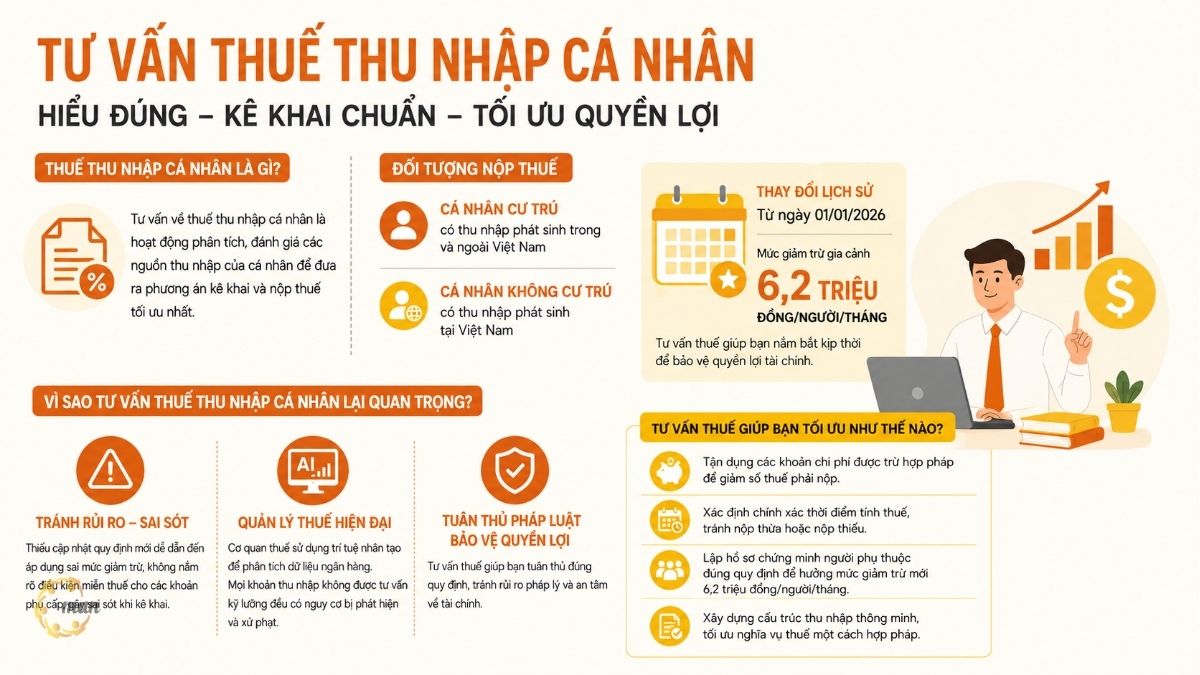
Personal income tax consulting is defined as the activity of analyzing and evaluating an individual's income sources to provide the most optimal tax declaration and payment plan. According to Article 2 of the Personal Income Tax Law, taxpayers include resident individuals with income arising within and outside Vietnam, as well as non-resident individuals with income arising in Vietnam. The historic change in the personal allowance from January 1, 2026, has transformed the process. tax consulting It has become an urgent need to protect financial interests.
A lack of up-to-date information on new regulations often leads to serious errors, such as applying the wrong deductions or not understanding the tax exemption conditions for allowances. In a modern tax administration environment, tax authorities use artificial intelligence to analyze bank data, making any income that is not thoroughly vetted at risk of being detected and penalized.
A tax consultant will help you not only comply with the law but also build a smart income structure. This includes leveraging deductible expenses, accurately determining tax timing, and properly documenting dependents to qualify for the new deduction of VND 6.2 million per person per month.
How can residency status be accurately determined when advising on personal income tax?
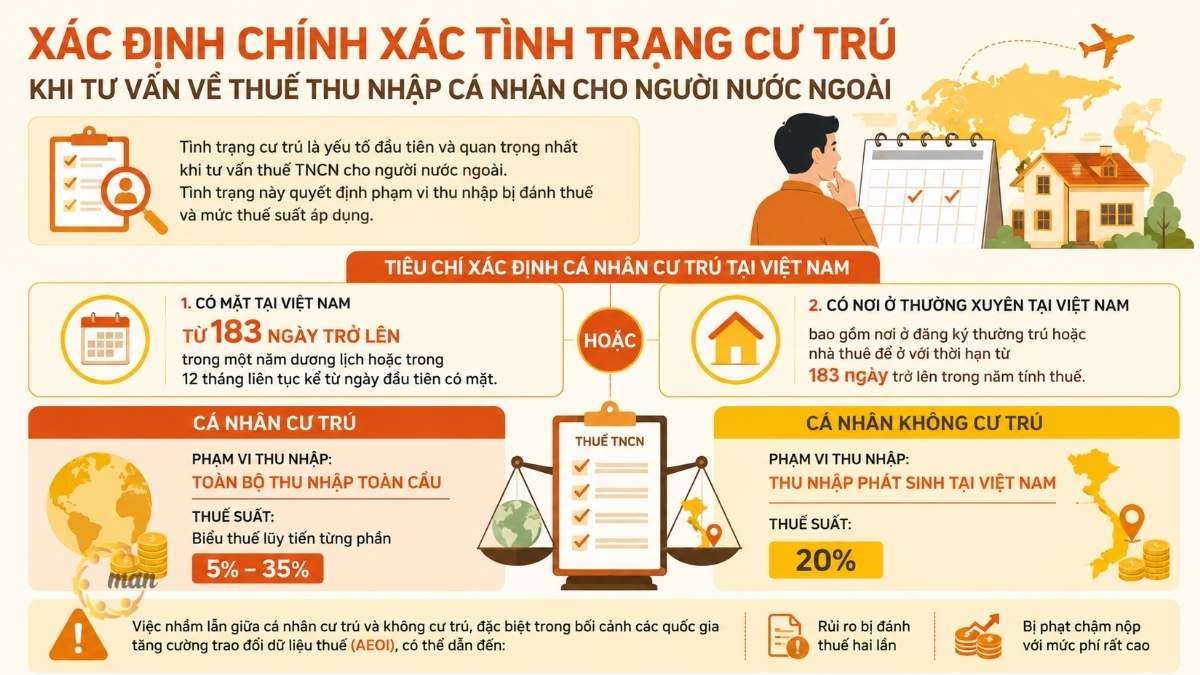
Determining residency status is the first and most important step when carrying out the process. tax advice Personal income for foreigners. This status determines the taxable income range and the applicable tax rate. According to Vietnamese law, an individual is considered a resident if they meet one of the following criteria:
- Being present in Vietnam for 183 days or more in a calendar year or in 12 consecutive months from the first day of arrival.
- Having a permanent residence in Vietnam, including a registered permanent residence or a rented house for a period of 183 days or more in the tax year.
At MAN, we assist clients in reviewing their travel itineraries and rental agreements to determine their correct status. If you are a resident individual, you must settle on global income with a progressive tax rate of up to 35%. Conversely, non-resident individuals only pay 20% on income earned in Vietnam. Confusing these two statuses, especially in the context of increased international exchange of tax information (AEOI), can lead to the risk of double taxation or high late payment penalties.
The process for providing personal income tax consulting services at MAN.
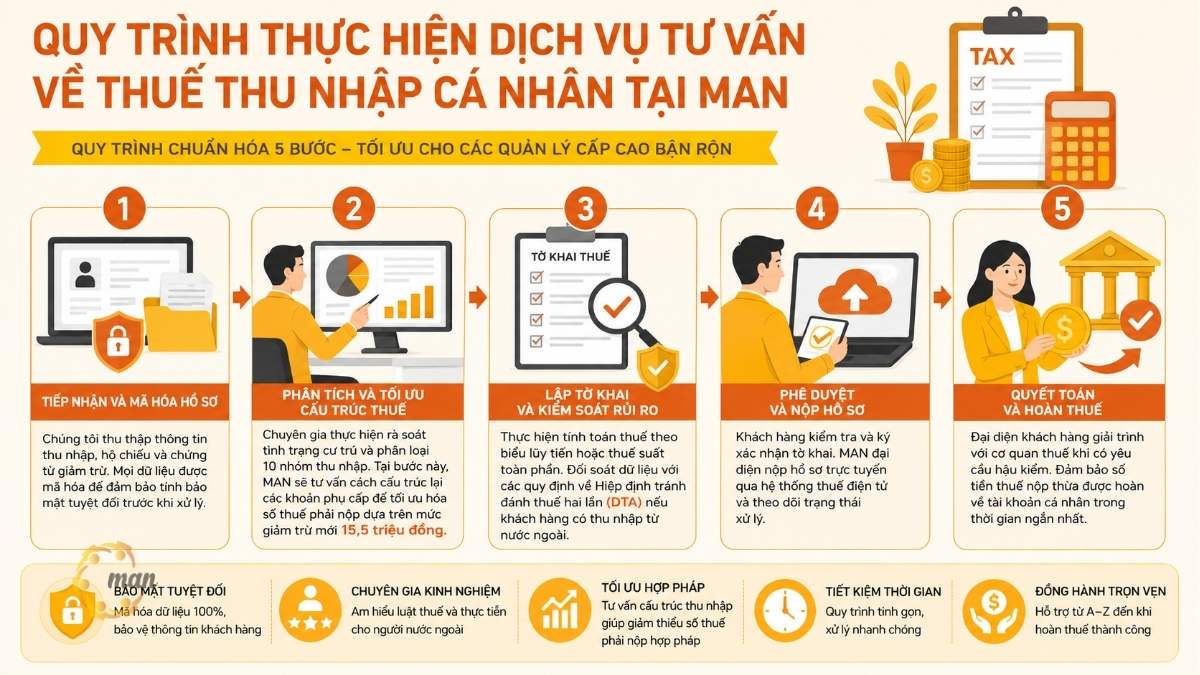
To provide maximum convenience and security for customers, MAN has developed a standardized 5-step process, especially optimized for busy senior managers.
- Step 1: Receiving and coding the documents: We collect income information, passport details, and tax deduction documents. All data is encrypted to ensure absolute confidentiality before processing.
- Step 2: Analyze and optimize the tax structure: Experts conduct a review of residency status and classify income into 10 groups. At this stage, MAN will advise on how to restructure allowances to optimize tax payments based on the new deduction of VND 15.5 million.
- Step 3: Prepare the declaration and control risks: Calculate taxes using either the progressive tax rate or the flat tax rate. Reconcile data against the Double Taxation Avoidance Agreement (DTA) regulations if the client has income from abroad.
- Step 4: Approval and submission of documents: The client checks and signs the declaration form. MAN, on behalf of the client, submits the online application through the electronic tax system and monitors the processing status.
- Step 5: Settlement and tax refund: The client representative will explain the situation to the tax authorities when a post-audit is requested. This ensures that any overpaid taxes are refunded to the individual's account in the shortest possible time.
Reference price list for personal income tax consulting services.
We provide personal income tax consulting services for employees, foreign professionals, and individuals with multiple income sources. Below is a list of services offered. Tax consulting service fee schedule This is a reference for common services such as tax settlement, tax refunds, tax identification number registration, and application of international tax agreements. Fees may vary depending on the specific case and its complexity.
| Type of service | Content details | Reference price (VND) |
| Basic consultation package | Annual tax settlement for individuals (1 source) | From 3,500,000 |
| Expats Intensive Package | Global income, subject to tax agreements. | From 12,000,000 |
| Tax refund service | Prepare a claim for a refund of overpaid taxes. | % on the refund amount |
| Tax Registration & Deductions | Tax identification number, dependents at level 6.2 million. | From 1,500,000 |
List of 10 types of taxable income to be aware of according to the latest legal regulations.
When providing advice on personal income tax, accurately classifying income sources is crucial for applying the correct tax rate. According to the Personal Income Tax Law, there are 10 key income groups that require special attention:
- Income from business: This includes income from the production and sale of goods and services. It should be noted that individuals engaged in business with annual revenue of 100 million VND or less are not subject to this tax.
- Income from salaries and wages: This is the most common income category for senior management. Taxable income includes salaries, wages, fees, and other payments of a salary nature in any form, whether monetary or non-monetary (such as housing and company-provided transportation). However, specific allowances such as hazardous work allowances, dangerous work allowances, and allowances for meritorious individuals are excluded.
- Income from capital investments: This includes interest on loans, dividends, and income from other forms of capital investment. Personal income tax advice will help you separate interest on savings deposits (tax-exempt) from income from business capital investments (5%).
- Income from capital gains: This includes the transfer of capital in economic organizations and the transfer of securities. This is a confusing part because the tax rate for securities is 0.1% on the selling price, while the tax rate for the transfer of capital contributions is 20% on the profit.
- Income from the transfer of real estate: This includes income from the transfer of land use rights and ownership of houses. Knowing the declaration deadline, within 10 days of the contract becoming effective, is extremely important.
- Income from winnings: This applies to lottery winnings, promotions, bets, or casino games exceeding 10 million VND.
- Income from royalties: Income from the transfer of intellectual property or technology exceeding 10 million VND.
- Income from franchising: Income derived from franchise agreements is governed by the Commercial Law.
- Income from inheritance: This includes inheritance of real estate, securities, or assets requiring registration of ownership.
- Income from receiving gifts: Gifts are assets that require registration of ownership or usage rights, similar to inheritance.
Updated personal allowance rates and official tax calculation formulas from 2026.
From January 1, 2026, personal income tax consultants will need to apply the new figures according to the tax reform roadmap. This is a significant change that will help alleviate the financial burden on workers in the face of fluctuating living costs.
The latest personal deductions for 2026.
Based on the new Personal Income Tax Law, deduction levels It is defined as follows:
- Personal tax deduction: VND 15,500,000/month (VND 186,000,000/year).
- Deduction for each dependent: VND 6,200,000/month/person.
- Mandatory insurance contributions include: social insurance, health insurance, unemployment insurance, and professional liability insurance for certain specific occupations.
- Charitable, humanitarian, and educational donations must be supported by valid documentation as required by regulations.
With this deduction, an employee without dependents only has to pay personal income tax when their taxable income (after deducting insurance contributions) exceeds VND 15.5 million per month.
Tax calculation formula for resident individuals with contracts exceeding 3 months.
The amount of tax payable is calculated through the following steps:
|
Personal income tax = Taxable income x Tax rate |
In there:
|
Taxable income = Taxable revenue – Deductions Taxable income = Total income – Exemptions |
Tax rates for other cases
- Contracts for less than 3 months or no contract signedWithholding tax (10%) for each income payment of VND 2,000,000 or more (except in cases where a commitment form 08/CK-TNCN is provided).
- Non-resident individualApplying the flat tax rate 20% to taxable income arising in Vietnam, without considering personal deductions.
|
Personal Income Tax (Non-resident) = Taxable income x 20% |
New progressive tax rate schedule applied in personal income tax consultations (Effective from July 1, 2026)
The new tax brackets have been streamlined from seven to five, while also widening the income range for tax purposes within each bracket:
| Tax rates | Taxable income/month (million VND) | Tax rate (%) |
| 1 | Up to 10 | 5 |
| 2 | Between 10 and 30 | 10 |
| 3 | Between 30 and 60 | 20 |
| 4 | Between 60 and 100 | 30 |
| 5 | Over 100 | 35 |
This change significantly reduces the amount of tax payable by middle and upper-middle income earners because the lower tax brackets (5% and 10%) have a wider range of income categories.
The roadmap for preparing tax exemption applications for businesses: 90 days before the Law takes effect.
The Personal Income Tax Law 2025 will take effect from July 1, 2026, but the guiding circular from the Ministry of Finance is not expected to be issued until the third quarter of 2026. This legal gap raises a practical question: what should businesses prepare now to avoid being caught off guard when settling their taxes?
Based on experience supporting over 50 FDI and domestic businesses in preparing for major tax reforms, the MAN team proposes a specific roadmap in three phases:
Phase 1 (April-May 2026): Review of the current payroll system.
Verify that the accounting software has separate data fields for: base salary, night shift allowance, overtime allowance, and tax-exempt additional pay. Review current salary regulations to ensure that night shift and overtime allowances are not lower than the minimums stipulated in Articles 97-98 of the 2019 Labor Code (150%-300%). Evaluate the labor contract: add an overtime clause if not already in place, ensuring a written agreement in accordance with Clause 2, Article 107 of the 2019 Labor Code.
Phase 2 (June 2026): Establish timekeeping and approval procedures.
Design a time sheet template for shifts (day shift/night shift/overtime) with confirmation from the team leader and HR department – this is the most important document when the tax authorities conduct post-audits. Implement internal procedures for approving overtime with written requests or forms to avoid cases where overtime is not properly recorded. Update the payroll software: separate the line "Tax-exempt portion – night shift/overtime" from the total taxable income when calculating Form 05/QTT-TNCN.
Phase 3 (Starting July 1, 2026): Operation and Risk Control
Implement the first month's personal income tax deduction according to the new regulations; keep supporting documents including time sheets and salary regulations with official stamps. Monitor the Ministry of Finance's guiding circular (expected August-September 2026) to adjust the method of determining the "difference" if there are different instructions. Plan for the 2026 personal income tax final settlement (deadline March 2027): all tax exemptions from July 1, 2026, need to be compiled and clearly presented on the final settlement declaration.
Note from MAN experts: Although the Circular has not yet been issued, businesses should immediately apply the principle of "only exempting the difference, not the entire night shift/overtime income" – this principle is consistent with both Article 4 of the 2025 Personal Income Tax Law and the guiding practices from previous periods.
Tax exemption for night shift and overtime pay: Impact on recruitment and retention strategies.
Night shift and overtime pay are tax-exempt. This is a perspective that most tax documents overlook: tax exemptions are not just an accounting issue – they are a real human resource leverage for manufacturing and service businesses with night shifts.
Real income increased without the company needing to raise gross salaries.
With the gross salary remaining unchanged, the net income of night shift workers will increase significantly after July 1, 2026. For example: worker B has a basic salary of 8 million VND/month, works 8 night shifts/month with an hourly wage allowance of 200% – the difference of 100% is completely tax-exempt, resulting in a real increase in net income without the company needing to adjust the gross payroll.
This creates a specific recruitment advantage: for the same gross salary, companies with night shifts will pay higher net salaries than those with administrative work. This information can be included in the job description and offer letter to attract candidates in the context of increasingly fierce labor competition in industrial zones.
Opportunity to restructure compensation policies.
Businesses can consider converting a portion of voluntary allowances (which are taxable) into legally permissible (tax-exempt) night shift/overtime allowances to optimize employees' net income within regulations. The July 2026 salary policy is also a suitable time for HR to explain to employees that increased net income is due to the new policy – without the need to increase gross salary – helping to control the payroll budget amidst rising operating costs.
Be aware of internal communication risks.
If a company provides inaccurate information – for example, stating that “all night shift earnings are tax-exempt” – employees may have false expectations, leading to complaints upon receiving their actual payslip. The HR and accounting departments need to coordinate to ensure accurate notification: only the difference is tax-exempt; the basic salary remains subject to normal taxation.
In-depth solution: Double taxation avoidance agreement for Expats
An integral part of MAN's personal income tax advisory services is the application of Double Taxation Avoidance Agreements (DTAs). Vietnam has currently signed DTAs with over 80 countries and territories.
For foreign managers, income being taxed in both their country of origin and Vietnam is a significant financial risk. We assist clients with the necessary procedures:
- Issuing a Tax Residence Certificate.
- Notification of tax exemptions and reductions under the Agreement.
- Deduct taxes paid abroad from your tax obligations in Vietnam.
This process requires meticulous preparation of international tax payment documents and consular authentication, something that the MAN team, with over 30 years of experience, always handles accurately.
Why choose MAN for personal income tax advice?
What sets MAN – Master Accountant Network apart is its reputation, experience, and commitment to providing the highest level of client protection.
- Our team of experts has over 30 years of experience: We have a team of CPAs and tax lawyers with in-depth knowledge of risk management practices in Vietnam. MAN doesn't just talk theory; we provide practical solutions based on these insights. Circulars such as 111/2013/TT-BTC and the latest revisions in 2026.
- Confidentiality and legal responsibility commitment: At MAN, data security is a vital priority. We are committed to taking full responsibility for the advice we provide to our clients and for handling any issues with regulatory authorities.
- Extensive and comprehensive service network: We serve customers nationwide with consistent quality standards.
Case Study: Tax Optimization for Senior Management with Multiple Income Sources
SituationMr. Robert, a British professional residing in District 7, Ho Chi Minh City, earns a salary in Vietnam (150 million VND/month) and income from renting real estate in the UK (50 million VND/month). He has never declared his foreign income because he believes he has already paid taxes in the UK.
MAN's solution:
- Robert has been identified as a resident individual and is therefore required to pay taxes on his global income.
- The new personal deduction amount is 15.5 million VND, and the deduction for two dependents is 12.4 million VND.
- Use the Double Taxation Avoidance Agreement between Vietnam and the UK to deduct the tax he paid in the UK from his tax obligations in Vietnam.
- Prepare a detailed explanation of the source of foreign income to submit to the Ho Chi Minh City Tax Department.
ResultRobert only had to pay a small portion of the tax difference in Vietnam, instead of being penalized for back taxes and late payment penalties on all of his foreign income over many years.
Conclude
Personal income tax consulting is a key solution for managing legal risks and optimizing financial benefits in the context of significant changes to the 2026 tax law. Proactively staying updated on the new personal allowances and understanding residency regulations will give you more confidence in your investment and work activities in Vietnam.
MAN – Master Accountant Network is committed to being a reliable partner, providing services such as: Tax accounting, Tax Consulting, We provide tax settlement and tax reporting services with international standards. Let us help you solve complex tax problems so you can fully focus on your career and family.
Service contact information at MAN – Master Accountant Network
- Address: No. 19A, Street 43, Tan Thuan Ward, Ho Chi Minh City
- Mobile/Zalo: 0903 963 163 – 0903 428 622
- Email: man@man.net.vn
Content production by: Mr. Le Hoang Tuyen – Founder & CEO MAN – Master Accountant Network, Vietnamese CPA Auditor with over 30 years of experience in Accounting, Auditing and Financial Consulting.
Frequently Asked Questions about Personal Income Tax Advice
Yes, if a foreigner is determined to be a tax resident in Vietnam, they are fully entitled to the same personal and dependent deductions as Vietnamese citizens.
Income from securities transfers is calculated as 0.1% on the selling price of each transaction, regardless of whether you make a profit or a loss.
You need to submit documents proving the relationship (birth certificate, household registration book, etc.) and documents proving that the dependent has no income or an average monthly income of no more than 1 million VND.
For individuals filing their tax returns directly, the deadline is the last day of the fourth month from the end of the calendar year (usually April 30th annually).
Yes, this is part of our comprehensive tax registration package to ensure you receive the deduction right from your first tax period. Does the VND 15.5 million tax deduction apply to foreigners?
How will my income from securities be taxed in 2026?
How do I register for the 6.2 million VND dependent deduction?
What is the deadline for filing annual tax returns?
Does MAN assist in obtaining tax identification numbers for dependents?