


In what cases are taxpayers subject to partial deductions from their wages? This is a question that many individuals and corporate HR departments ask when they receive enforcement notices from the tax authorities. Tax Administration Law 2025 and Decree 252/2026/ND-CP, This is one of eight coercive measures for enforcing administrative decisions on tax management, applied in a strict procedure rather than arbitrarily.
In reality, many workers are surprised to see their net wages deducted without explanation, while businesses – responsible for paying wages – are also confused about their obligation to cooperate in enforcing the decision. This article, compiled from a professional perspective, presents the following insights. MAN – Master Accountant Network, This will clarify the entire legal basis, application conditions, and appropriate handling procedures in accordance with current regulations.
A summary of key points regarding the circumstances under which taxpayers may have a portion of their wages deducted.
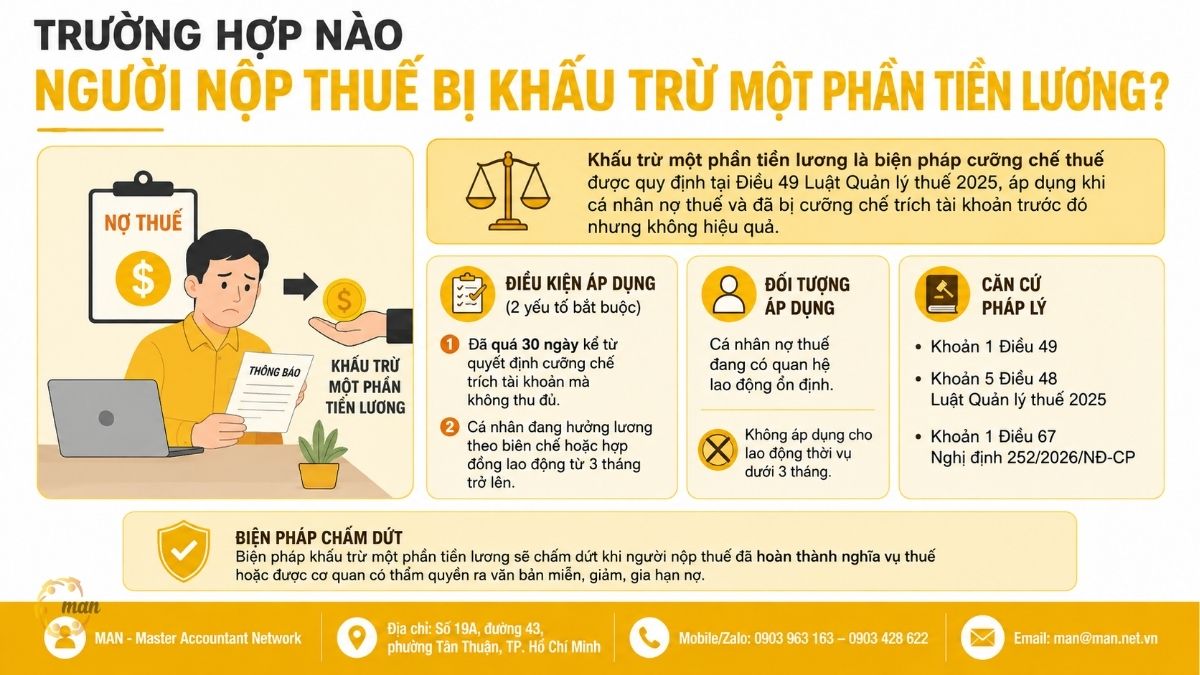
- Partial salary deduction is a tax enforcement measure stipulated in Article 49 of the 2025 Tax Administration Law, applied when an individual owes taxes and has previously been subjected to coercive measures such as deduction from their account without success.
- The conditions for application include two mandatory elements: more than 30 days have passed since the decision to forcibly deduct funds from the account without sufficient collection, and the individual is receiving a salary under a permanent employment contract or a labor contract of 3 months or more.
- Applicable to: Individuals with tax debts who have a stable employment relationship; not applicable to seasonal workers employed for less than 3 months.
- Main legal basis: Clause 1, Article 49, Clause 5, Article 48 of the 2025 Law on Tax Administration and Clause 1, Article 67 of Decree 252/2026/ND-CP.
- The measure terminates when the taxpayer has fulfilled their tax obligations or receives a written notice from the competent authority granting a tax exemption, reduction, or extension.
What is a partial salary deduction?
Before delving into specific measures, it's necessary to understand the underlying concept. Enforcement of administrative decisions regarding tax management is the application of measures stipulated in the 2025 Tax Management Law and other relevant laws to compel taxpayers to fulfill their outstanding tax obligations.
Partial salary deduction is a measure by which the tax authorities require the organization or agency paying the taxpayer's salary to deduct a portion of that income and remit it to the state budget, in order to enforce the fulfillment of outstanding tax obligations. This measure is listed in point b, clause 1, Article 49 of the 2025 Tax Administration Law, ranking second in the list of eight administrative tax enforcement measures.
Unlike the measure of deducting money from a bank account, this measure directly impacts an individual's regular income through the employer. In other words, the business or agency paying the salary becomes the party obligated to cooperate in implementing the enforcement decision, rather than the party being penalized.
Eight enforcement measures under Clause 1, Article 49 of the 2025 Tax Administration Law.
Paragraph 1 of Article 49 lists eight coercive measures in order of priority for application as follows:
- The funds will be deducted from the account of the person subject to enforcement at a credit institution or foreign bank branch, or the account will be frozen.
- Deducting a portion of salary or income.
- Stop processing customs procedures for exported and imported goods.
- Stop using invoices.
- Collect money and other assets belonging to the person subject to enforcement that are currently held by other agencies, organizations, or individuals.
- Seize assets and auction off the seized assets in accordance with the law.
- File a petition to initiate bankruptcy proceedings.
- Revocation of business registration certificates, enterprise registration certificates, cooperative registration certificates, cooperative group registration certificates, household business registration certificates, establishment and operation licenses, professional licenses, branch/representative office registration certificates, business location registration certificates, or e-commerce platform operating licenses.
Of the eight measures, partial wage deduction ranks second, usually applied immediately after account withdrawal fails. This explains why the 30-day waiting period is crucial in the entire enforcement process.
Under what circumstances can a taxpayer have a portion of their salary deducted according to the 2026 regulations?

According to Clause 1, Article 67 Decree 252/2026/ND-CP, The measure of partially deducting wages or income is only applicable when the taxpayer is an individual and simultaneously meets the following two conditions. If either condition is missing, the tax authorities have no basis to issue a coercive decision using this measure.
- Condition 1 Regarding the enforcement process: More than 30 days have passed since the issuance of the enforcement decision using measures such as deducting money from accounts or freezing accounts, and the tax authorities have not collected or have not collected the full amount of tax owed, or lack sufficient information or conditions to implement such measures. This indicates that salary deduction is a secondary measure, only activated after the account deduction method proves ineffective.
- Second condition This relates to the nature of the employment relationship. The individual subject to enforcement is receiving salary or income from an agency or organization under a permanent employment contract or a fixed-term employment contract of 3 months or more. This contract duration requirement aims to ensure a sufficiently stable income source so that the tax authorities can make deductions for multiple consecutive periods.
Why do we need to wait 30 days before applying it?
The 30-day period is intended to allow tax authorities to verify the results of previous enforcement measures, avoiding the overlapping application of multiple measures simultaneously that could be excessively detrimental to taxpayers. (From this perspective) MAN – Master Accountant Network, This is also a time for individuals with tax debts to proactively contact the tax authorities to negotiate installment payment options, avoiding more severe enforcement measures.
Which individuals are subject to salary deductions?
Not all individuals with tax debts are eligible for this measure. The scope of eligible individuals is determined based on the nature of their work and the form of income payment, specifically as follows:
- Individuals who are civil servants or public employees receiving salaries according to the state payroll system.
- Employees who are working under a formal employment contract with a term of 3 months or more at a business or organization.
- Individuals who have incurred tax debts under the jurisdiction of the tax authorities and have experienced unsuccessful attempts at forced account seizure.
Conversely, seasonal workers employed for less than 3 months, individuals without stable employment relationships, or those whose income is not generated regularly at a fixed location are generally ineligible for this measure, as it is difficult for tax authorities to determine a continuous source of deductions.
Procedures and timelines for enforcing wage deductions.
Essentially, this is a multi-step enforcement process, not a single decision. Businesses need to understand the procedure to properly fulfill their legal obligations and avoid liability for failing to comply with tax authority requirements.
- The tax authorities issue a decision to forcibly deduct money from and freeze the accounts of individuals who owe taxes.
- After 30 days, if the tax is not collected or is not fully collected, the tax authorities will verify whether the individual is receiving a salary under a permanent employment contract or a labor contract of 3 months or more.
- If eligible, the tax authority issues a decision to enforce collection by deducting a portion of the salary, and sends it to the salary-paying entity.
- The payroll payer is responsible for making deductions according to the rates and deadlines specified in the decision, and remitting the funds to the state budget.
- The deductions continue until the full amount of tax owed is paid or until a written order is issued by the competent authority terminating the enforcement action.
Legal basis for partial salary deductions
Important note: Detailed guidance documents on maximum deduction rates, enforcement decision forms, and specific responsibilities of payroll payers are regularly updated through circulars from the Ministry of Finance. Experts at MAN recommend that businesses and individuals regularly monitor these implementing guidelines to ensure accurate application and avoid discrepancies between the framework regulations and actual implementation.
| Legal documents | Terms and conditions apply. | Related content |
| Tax Administration Law 2025 | Article 49 | The regulations stipulate eight measures for enforcing administrative decisions on tax management, with the deduction of a portion of wages being the second measure. |
| Tax Administration Law 2025 | Clause 2, Article 49 | Cases where the enforcement decision to deduct wages is terminated. |
| Tax Administration Law 2025 | Clause 5, Article 48 | In cases where the taxpayer has complied with the tax audit decision, this relates to the termination of enforcement measures. |
| Tax Administration Law 2025 | Articles 15 and 18 | Regulations on handling overpaid tax amounts, offsetting, and refunding |
| Decree 252/2026/ND-CP | Clause 1, Article 67 | Conditions for applying coercive measures to deduct a portion of wages or income. |
When does the measure of forced wage deduction cease to be effective?
According to Clause 2, Article 49 of the 2025 Tax Administration Law, the coercive measure of partially deducting wages ceases to be effective from the occurrence of one of the following events:
- The amount of tax arrears that were subject to enforcement has been fully paid into the state budget.
- The tax authorities or competent state agencies issue documents granting exemptions, reductions, non-collection, installment payments, extensions, or waivers of late payment penalties.
- The competent state agency issues a document requesting the termination of the enforcement decision.
- The taxpayer has complied with the tax audit decision in the case stipulated in Clause 5, Article 48 of the 2025 Law on Tax Administration.
This is a point that both employees and HR departments need to pay attention to. As soon as any of the four grounds mentioned above are met, the payroll entity must stop the deductions, avoiding the situation of continuing to deduct wages after the tax obligations have been settled.
Case study: How do businesses handle decisions to enforce wage deductions?
Background
A trading company in Ho Chi Minh City received an enforcement order from the Tax Department, requiring the deduction of a portion of the salary of a sales employee who owes personal income tax from their previous sole proprietorship activities. This employee is currently working under an indefinite employment contract with the company.
The solution is based on advice from MAN – Master Accountant Network.
According to guidance from experts at MAN, To comply, the company needs to take three steps. First, compare the enforcement decision with the labor contract records to confirm that the correct individuals are eligible. Second, calculate the correct deduction rate and timeframe according to the decision, and record it separately on the payroll. Third, keep complete records of the payments made on behalf of the company to use as a basis for verification when needed.
Result
The deductions were made on the correct payroll period, with clear confirmation from all three parties: the company, the employee, and the tax authority. Once the outstanding tax was paid in full, the company received a document terminating the enforcement and stopped the deductions immediately in the next payroll period, without any complaints from employees regarding prolonged and unfounded salary deductions.
Comparison table of related tax enforcement measures
To recover outstanding tax debts, tax authorities can apply various enforcement measures, increasing in severity depending on the taxpayer's compliance status. Each measure has different target groups and implementation conditions, ranging from deducting money from bank accounts and income deductions to halting customs procedures or seizing assets. The table below provides a quick comparison of common tax enforcement measures.
| Coercive measures | Applicable objects | Activation conditions |
| Deduct money from account, freeze account. | Individuals and organizations with accounts at credit institutions. | The first enforcement measure when overdue tax debts arise. |
| Deducting a portion of salary or income | Individuals with a salary based on a permanent position or an employment contract of 3 months or more. | After 30 days, the account deduction method fails to collect the full amount. |
| Stop customs clearance procedures. | Organizations and individuals engaged in import and export activities. | When previous measures proved ineffective and import and export activities occurred... |
| Seize assets and sell them at auction. | Individuals and organizations with legally owned assets | Applicable when less stringent measures fail to recover tax debts. |
Expert opinion: Common business risks
Experts at MAN – Master Accountant Network With over 30 years of practical experience in auditing and tax consulting in Vietnam, we identify three common risks that businesses face when receiving a decision to forcibly deduct employee salaries.
- Risk number one This includes delays in responding to enforcement decisions. Many businesses miss documents due to lax procedures in receiving official correspondence, leading to delays in deductions and potentially being perceived as uncooperative with the tax authorities.
- Second risk This involves incorrectly calculating the deduction rate or timeframe, leading to disputes with employees. The payroll department needs to accurately verify the decision before applying it to the payroll, avoiding excessive deductions or extensions beyond the stipulated timeframe.
- Third risk This involves failing to update promptly when a document terminating the enforcement action is issued, and continuing to deduct wages even though tax obligations have been fulfilled. According to the proposed solution... MAN – Master Accountant Network, Therefore, businesses should establish a process for regular reconciliation with the tax authorities and maintain complete records of tax payments, which helps to ensure transparent tax risk management and minimize internal disputes.
Handling overpaid taxes related to payroll deductions.
In some cases, after deductions from their salaries to pay outstanding taxes, taxpayers discover that the amount paid is greater than the actual tax due. According to Article 15 of the 2025 Tax Administration Law, this overpayment can be offset against other tax obligations or refunded when the taxpayer no longer owes taxes.
The offsetting process is carried out automatically by the Tax Management Information System or at the request of the taxpayer. In the case of a refund request, the taxpayer must follow the procedures stipulated in Article 18 of the 2025 Tax Administration Law. The law also clarifies that any overpaid tax will not be refunded if the taxpayer refuses to accept it, or if more than 10 years have passed since the payment was made to the state budget without a request for offsetting or refund.
A specific situation to note is the overpayment of value-added tax (VAT) on imported goods. If a taxpayer has overpaid VAT on imported goods and has declared and deducted that amount with the tax authorities, the handling of the overpaid and deducted tax will be carried out according to separate regulations issued by the Minister of Finance, and will not follow the general offsetting and refund procedures.
Furthermore, the 2025 Tax Administration Law assigns the Minister of Finance the authority to specify the details regarding the documentation, procedures, and authority for handling overpaid taxes, the timing of determining overpaid taxes, and the distinction between automatic offsetting and offsetting upon request. Businesses should stay updated on these guidelines to ensure proper procedures are followed.
Conclude
The circumstances under which a taxpayer may have a portion of their salary deducted are not arbitrary decisions of the tax authorities, but rather follow strict procedures and conditions stipulated in the 2025 Tax Administration Law and Decree 252/2026/ND-CP. Understanding these two core conditions—the 30-day period following the forced deduction from the account and the nature of the employment contract being 3 months or longer—helps both employees and businesses be more proactive when receiving a forced deduction decision.
Tax services at MAN – Master Accountant Network
- Tax accounting services
- Tax consulting services
- Tax settlement services
- Tax reporting services
- VAT refund service
Service contact information at MAN – Master Accountant Network
- Address: No. 19A, Street 43, Tan Thuan Ward, Ho Chi Minh City
- Mobile/Zalo: 0903 963 163 – 0903 428 622
- E-mail: man@man.net.vn
- Google Business Profile: View MAN – Master Accountant Network's Google Business Profile
- LinkedIn Founder: View expert Le Hoang Tuyen's LinkedIn profile.
Responsible for production and professional content review by: Mr. Le Hoang Tuyen – Founder & CEO of MAN – Master Accountant Network, CPA Vietnam with over 30 years of experience in accounting, auditing, taxation, and corporate financial consulting.
Frequently Asked Questions about Partial Salary Deductions
In what circumstances can a taxpayer have a portion of their salary deducted?
When an individual with tax debt has had their account forcibly debited or frozen for more than 30 days without full collection, and is also receiving a salary under a permanent employment contract or labor contract of 3 months or more at an agency or organization.
Is a business obligated to make deductions upon receiving an enforcement order?
Yes. The entity paying the salary of the individual subject to enforcement action is responsible for cooperating in the deduction process in accordance with the tax authority's decision.
What is the maximum percentage of salary that can be deducted?
The specific deduction rate is stipulated in the enforcement decision and detailed guidance documents. Businesses need to accurately base their decisions on the content received and not apply rates arbitrarily.
When will the salary deductions stop?
When the outstanding tax amount has been fully paid, there is a written exemption or extension from the competent authority, a written request to terminate the enforcement effect, or the taxpayer has complied with the tax audit decision as stipulated in Clause 5, Article 48 of the 2025 Tax Administration Law.
What should be done if an incorrect or excessive deduction is made?
Any overpayments will be offset or refunded in accordance with Articles 15 and 18 of the 2025 Tax Administration Law. Taxpayers should proactively contact the tax authorities or a consulting firm for guidance on the correct procedures for requesting a tax refund.