


Paying wages after termination of employment contract This is a situation that arises almost monthly in every business with personnel turnover, from manufacturing companies to service corporations. As of July 1st, 2026, Decree 253/2026/ND-CP This has fundamentally changed the way personal income tax deduction obligations for these payments are determined, causing considerable confusion among payroll accounting departments when applying the regulations.
Previously, many businesses were accustomed to calculating taxes using a progressive tax rate for delayed salary payments after employees had left their jobs, leading to the risk of retroactive tax collection and penalties during tax audits. This article, compiled from the practical perspective of experts at MAN – Master Accountant Network with over 30 years of experience in tax risk management, will help accountants and business owners understand the regulations, application timelines, and how to handle situations correctly according to the law.
Summary of key points regarding compensation after termination of employment contract
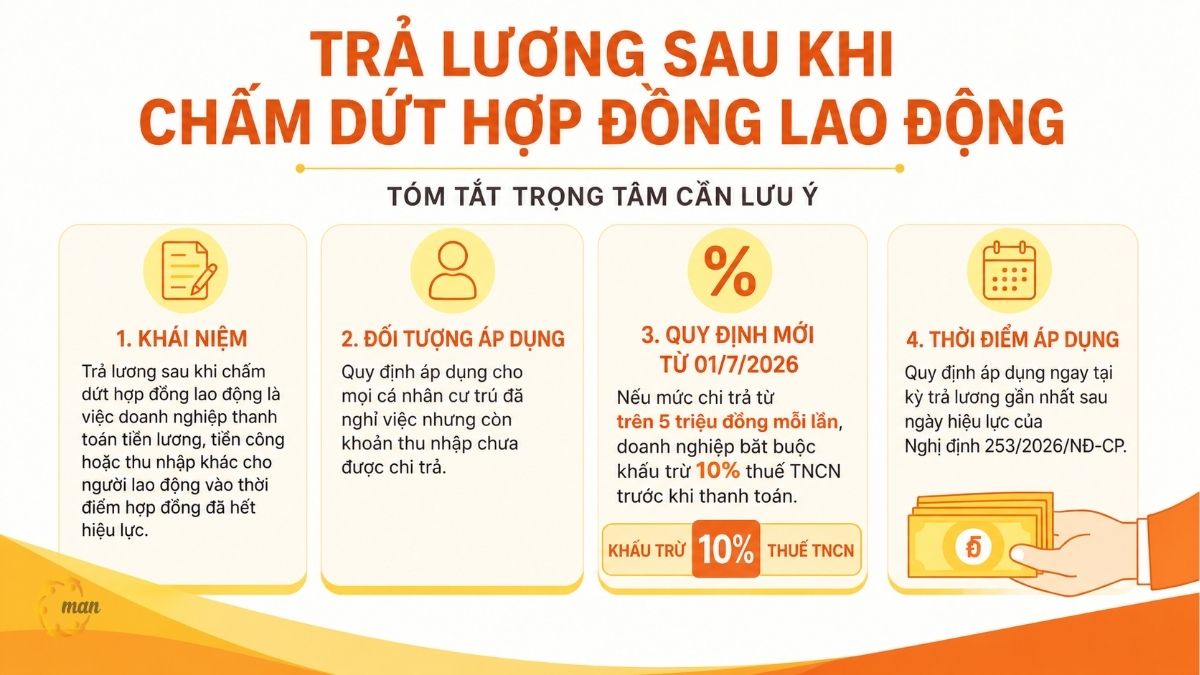
Paying wages after termination of employment is the process by which an employer pays wages, salaries, or other income to an employee at the time the contract has expired. This regulation applies to all resident individuals who have left their jobs but still have unpaid income. From July 1, 2026, if the payment exceeds 5 million VND per payment, the employer is required to deduct personal income tax (PIT) before payment, no longer applying the progressive tax rate as before. This regulation will be applied immediately to the nearest payroll period following the effective date. Decree 253/2026/ND-CP.
What is salary payment after termination of employment contract?
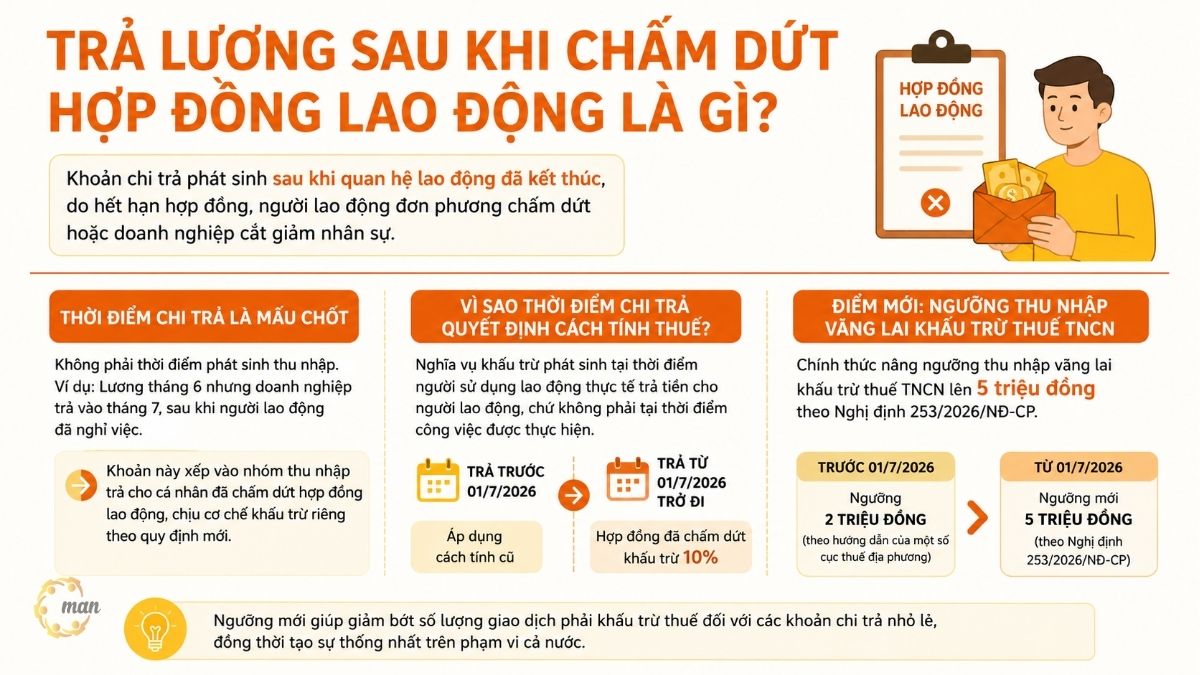
Legally speaking, this is a payment that arises after the employment relationship between the two parties has ended. The termination of the contract may be due to contract expiration, unilateral termination by the employee, or workforce reduction by the company.
The key point lies in payment time, This does not apply to the time the income is earned. For example, if the salary for June is paid by the company in July, after the employee has already left the job, this amount is classified as income paid to an individual whose employment contract has been terminated, and is subject to a separate deduction mechanism according to the new regulations.
Why does the timing of payment determine how taxes are calculated?
According to the principle of determining taxable income from salaries and wages, the withholding obligation arises at the time the employer actually pays the employee, not at the time the work is performed. This principle has been affirmed by many local tax departments in guiding documents before the issuance of Decree 253/2026/ND-CP.
Therefore, for the same June salary, if paid before July 1, 2026, the old calculation method will apply. However, if paid from July 1, 2026 onwards, after the contract has terminated, the enterprise must apply the new deduction mechanism (10%).
See more articles at: 10 new points of Decree 253/2026/ND-CP
New points compared to the previous regulations on the threshold for current income.
One significant change that came with it was the Officially raising the threshold for deductible incidental income for personal income tax to 5 million VND. According to Decree 253/2026/ND-CP, instead of the 2 million VND threshold previously applied by some local tax departments, the new threshold helps reduce the number of transactions subject to tax deduction for small payments, while creating uniformity nationwide instead of each locality providing different guidance as before July 1, 2026.
What role do regulations regarding salary payments after termination of employment contracts play in corporate tax management?
For payroll accounting departments, correctly determining the deduction mechanism not only helps ensure legal compliance but also protects the business from the risk of tax assessment. If the deduction rate or the wrong entity is applied, the business may be subject to retroactive tax collection, plus late payment penalties and administrative fines.
From a cash flow management perspective, withholding tax under form 10% at source helps businesses avoid tracking the tax obligations of former employees, a group that is often difficult to contact again to request additional tax settlement documents. From MAN's perspective, this is essentially a mechanism that simplifies tax declaration for both sides, provided that businesses update it at the appropriate time.
Who is affected by the payment of wages after the termination of an employment contract?
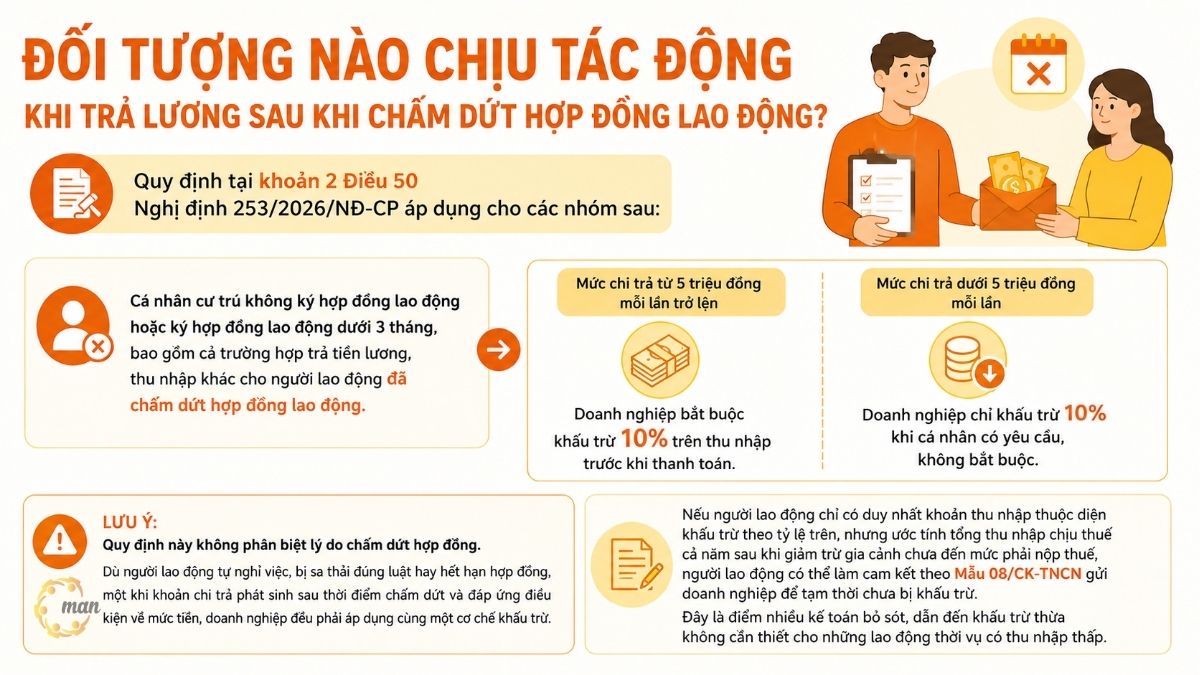
The provisions of Clause 2, Article 50 of Decree 253/2026/ND-CP apply to the following groups:
- Individuals residing in Vietnam who do not sign employment contracts. or signing employment contracts for less than 3 months, including cases where wages or other income are paid to employees whose employment contracts have been terminated.
- Payment amount from 5 million VND or more per transaction.Businesses are required to deduct tax 10% from income before making payments.
- Payment amount is less than 5 million VND per transaction.Businesses only deduct tax (10%) when requested by individuals; it is not mandatory.
It should be noted that this regulation does not differentiate between reasons for contract termination. Whether the employee resigns voluntarily, is legally dismissed, or the contract expires, once the payment is made after the termination date and meets the monetary requirements, the employer must apply the same deduction mechanism.
If an employee has only one source of income subject to the above-mentioned withholding tax rate, but the estimated total taxable income for the year after personal deductions is below the tax threshold, the employee can submit a commitment form (Form 08/CK-TNCN) to the company to temporarily avoid withholding tax. This is a point many accountants overlook, leading to unnecessary over-withholding for low-income seasonal workers.
The effective date for paying wages after the termination of an employment contract is July 1, 2026.
The most important effective date is July 1, 2026, From the date Decree 253/2026/ND-CP officially came into effect, all salaries and other income paid to employees whose contracts have been terminated, with a payment amount exceeding 5 million VND per payment, must be subject to withholding tax. personal income tax, regardless of which previous month that income was generated.
An illustrative example from the guidance document: an employee signs a 12-month employment contract, terminating the contract on July 1, 2026. The June salary, paid in July 2026, will be subject to a personal income tax deduction (10%), not calculated according to the progressive tax rate schedule as in the previous method.
Businesses need to immediately review any outstanding wages owed to employees who left their jobs before July 1, 2026, but are expected to be paid after this date, in order to apply the correct deduction rate and avoid errors when settling personal income tax at the end of the year.
Compilation of legal documents related to wage payment after termination of employment contract.
Below are the core legal documents that the accounting and human resources departments need to understand in order to apply the regulations correctly:
| Document | Date of issuance/effective date | Summary of content |
| Decree 253/2026/ND-CP | Effective from July 1, 2026 | Regulation 10% TNCN stipulates the deduction of personal income tax (TNCN) for income paid to individuals without a contract or with a contract of less than 3 months, including those whose contracts have been terminated, for payments of 5 million VND or more per payment. |
| Decree 252/2026/ND-CP | Issued in 2026 | Guidelines for the implementation of the 2026 Tax Administration Law, serving as a basis for regulations related to tax deductions. |
| Circular 111/2013/TT-BTC | Issued on August 15, 2013 | Clause b2, point b, paragraph 1, Article 25 stipulates the deduction of personal income tax according to the progressive tax rate schedule for employees with contracts of 3 months or more. |
| Circular 80/2021/TT-BTC | Issued in 2021 | Issuance of Form 08/CK-TNCN, commitment form for low-income individuals to not deduct personal income tax. |
| Official document 7889/NBI-QLDN3 | Issued on June 17, 2026, Ninh Binh Provincial Tax Department | Local guidance on deducting 10% TNCN (Personal Income Tax) on payments made after contract termination, prior to the nationwide application of Decree 253/2026/ND-CP. |
It can be seen that, prior to the issuance of Decree 253/2026/ND-CP, some local tax departments, such as Ninh Binh, had proactively guided the application of withholding tax on payments made after contract termination. The new decree has legalized and standardized this interpretation nationwide, while also raising the withholding threshold from 2 million VND to 5 million VND per payment compared to the previous guidance in Circular 111/2013/TT-BTC.
The specific content of Official Letter 7889/NBI-QLDN3 dated June 17, 2026
The official document issued by the Ninh Binh Provincial Tax Department clearly outlines two key points that businesses need to understand.
- Firstly, the time for determining taxable income from salaries and wages is the time when the employer actually pays the money, not the time when the work is performed. Furthermore, this payment is still subject to progressive tax rates as stipulated in clause b2, point b, paragraph 1, Article 25 of Circular 111/2013/TT-BTC.
- Secondly, for employees with contracts of 3 months or more who receive income after the contract has ended, if the total payment is 2 million VND or more at once, tax deductions (10%) must be applied before payment. If the employee's only source of income is this 2 million VND and the estimated annual income is below the tax threshold, the individual can submit a commitment to the company to temporarily avoid deductions. This served as the basis for Decree 253/2026/ND-CP, which later standardized the threshold to 5 million VND and applied it nationwide.
Businesses should note that the content of local regulations only provides guidance at the time of issuance. From July 1, 2026, the regulations in Decree 253/2026/ND-CP will be the official and uniform basis for general application. Businesses should not continue to refer to old regulations when the payment amount is between 2 and 5 million VND.
Real-world case study: Businesses miscalculate taxes when paying salaries after termination of employment contracts.
A typical case at a manufacturing company in the South: Employee A signed a 12-month employment contract and resigned on July 5, 2026. Due to handover issues, the company only finalized and paid the June salary of 18 million VND along with an unpaid allowance of 3 million VND on July 20, 2026, totaling 21 million VND.
The accounting department initially applied the progressive tax rate as per previous practice, calculating the tax payable at approximately 1.2 million VND based on the estimated taxable income after personal deductions for the entire year. However, according to the new regulations effective from July 1, 2026, because this was a payment made after the contract had ended and the 21 million VND payment exceeded the 5 million VND threshold, the company must deduct the correct amount (10%) from the entire sum, equivalent to 2.1 million VND, before paying employee A.
A difference of 900,000 VND, if not adjusted promptly, will become a tax shortfall, and the business will be responsible for paying the additional amount along with late payment penalties when the tax authorities conduct a review. This is a situation that experts at MAN, with 30 years of experience, frequently encounter when assisting businesses in reviewing year-end tax deduction records, especially in companies with high employee turnover rates.
Comparison table of tax calculation methods before and after July 1, 2026
Below is a comparison table highlighting key changes in the method of deducting personal income tax on wages and fees before and after July 1, 2026. This comparison helps businesses and individuals easily identify new points regarding the legal basis, deduction methods, applicable income thresholds, and regulations on exemption commitments, ensuring compliance with current regulations.
| Criteria | Before July 1, 2026 | From July 1, 2026 |
| Legal basis | Circular 111/2013/TT-BTC and local guidelines | Decree 253/2026/ND-CP |
| How to calculate tax | Progressive tax rate (if the contract is for 3 months or more) | Fixed deduction 10% on income |
| Deduction threshold | From 2 million VND/per instance (according to guidelines from some localities) | From 5 million VND/time or more |
| Cases below the threshold | Lack of uniformity among localities | The 10% deduction is only applicable upon individual request. |
| Commitment to waive deductions | Apply using Form 08/CK-TNCN if eligible. | The terms and conditions remain unchanged. |
Expert opinion: Common risks and optimal solutions.
Based on their experience advising hundreds of businesses, experts at MAN have identified three of the most common risks businesses face when handling payroll after the termination of an employment contract.
- Firstly, many accountants still confuse the time when income is generated with the time when it is paid, leading to the application of incorrect tax rates. The solution from MAN – Master Accountant Network is to create a separate tracking table for outstanding salaries owed to employees who have left the company, flagging warnings based on the expected payment date so that the accounting department can proactively change the calculation method when necessary.
- Secondly, businesses often overlook collecting the 08/CK-TNCN commitment form for low-income seasonal workers, leading to over-withholding, causing confusion and wasting time resolving complaints later. Standardizing the process of collecting the commitment form at the time of contract signing, instead of waiting until payment, significantly saves processing time.
- Thirdly, some businesses are concerned that the 10% deduction will cause employee backlash due to perceived reductions in net earnings. The team at MAN recommends that businesses proactively inform employees in writing about the applicable legal basis, along with a detailed payslip clearly showing the deducted tax amount. This helps minimize unnecessary disputes and strengthens the company's reputation in human resource management.
Overall, a thorough understanding of the realities of tax risk management in Vietnam requires businesses not only to stay updated on new regulations but also to standardize corresponding internal processes, avoiding piecemeal application on a case-by-case basis.
How to use the 2026 Commitment Form for Not Withholding Personal Income Tax (Form 08/CK-TNCN)?
The personal income tax commitment form applicable in 2026 is: Form 08/CK-TNCN, This document, issued in conjunction with Circular 80/2021/TT-BTC of the Ministry of Finance, is a form that individuals with income subject to withholding tax (10%) prepare and send to businesses as a basis for temporarily not withholding tax when their estimated annual income is below the taxable threshold.
- Conditions for using form 08/CK-TNCN: Individuals can only make a commitment using this form if they simultaneously meet two conditions: their only source of income is from the paying entity subject to the 10% withholding tax rate, and they have a tax identification number at the time of making the commitment. If the employee has additional sources of income or has not registered for a personal tax identification number, the business will not accept the commitment and must still deduct 10% as per regulations.
- How should businesses store commitments? The commitment form should be kept by the business along with tax records and presented when requested by the tax authorities for inspection or audit. Based on MAN's practical experience, businesses should digitize all commitment forms for each employee code to avoid losing paper records, especially for units with a large number of seasonal workers or short-term contract collaborators.
Conclude
Salary payments after termination of employment contracts, effective from July 1, 2026, have shifted from a progressive tax rate to a fixed deduction (10%) for payments exceeding 5 million VND per transaction, as stipulated in Decree 253/2026/ND-CP. This change directly impacts the salary calculation process, deduction documentation, and obligations. personal income tax settlement At the end of the year, every business experiences frequent staff changes.
Tax services at MAN – Master Accountant Network
- Tax accounting services
- Tax consulting services
- Tax settlement services
- Tax reporting services
- VAT refund service
Service contact information at MAN – Master Accountant Network
- Address: No. 19A, Street 43, Tan Thuan Ward, Ho Chi Minh City
- Mobile/Zalo: 0903 963 163 – 0903 428 622
- E-mail: man@man.net.vn
- Google Business Profile: View MAN – Master Accountant Network's Google Business Profile
- LinkedIn Founder: View expert Le Hoang Tuyen's LinkedIn profile.
Responsible for production and professional content review by: Mr. Le Hoang Tuyen – Founder & CEO of MAN – Master Accountant Network, CPA Vietnam with over 30 years of experience in accounting, auditing, taxation, and corporate financial consulting.
Frequently Asked Questions about Payroll After Termination of Employment
Yes, if the payment exceeds 5 million VND per transaction, the business is required to deduct tax 10% according to Clause 2, Article 50 of Decree 253/2026/ND-CP, effective from July 1, 2026.
It's not mandatory. Businesses only deduct 10% when individuals request it in writing.
It is possible if the employee makes a commitment using Form 08/CK-TNCN confirming that their income is below the taxable threshold and sends it to the company before the payment date.
Yes, if the actual payment date falls on or after July 1, 2026, even if the income was generated before that date, the business will still apply the new calculation method.
Businesses may be subject to retroactive collection of outstanding taxes, late payment penalties, and administrative tax penalties in accordance with the current Tax Administration Law. Is it mandatory to deduct personal income tax (PIT) from salary paid after the termination of an employment contract?
If the payment is less than 5 million VND, is tax deductible?
Are low-income workers exempt from withholding tax?
Do the new regulations apply to salary payments made before July 1, 2026?
What are the penalties for businesses that incorrectly deduct the applicable tax rate?




