

Are union dues subject to personal income tax? This is a recurring question in most tax settlement periods, especially in businesses with active labor unions. A company with 800 employees, whose payroll used as the basis for social insurance contributions is approximately 7 billion VND per month, must allocate 21% of its total workforce to the labor union fund each year, equivalent to nearly 1.7 billion VND. A large portion of this money returns to employees in the form of Tet gifts, sick leave allowances, and assistance in times of hardship. The question for accountants is: should these amounts be included in taxable income?
From July 1st, 2026, Decree 253/2026/ND-CP Issued on June 30, 2026, to replace Decree 65/2013/ND-CP, implementation guidelines Law on Personal Income Tax No. 109/2025/QH15. For the first time, money and benefits from trade union funds were recorded as a separate item within the group of income not subject to tax. Prior to this milestone, accountants primarily relied on fragmented guidance documents from local tax authorities, leading to inconsistent treatment among businesses in the same industry.
Summary of key points regarding whether union fees are subject to personal income tax.
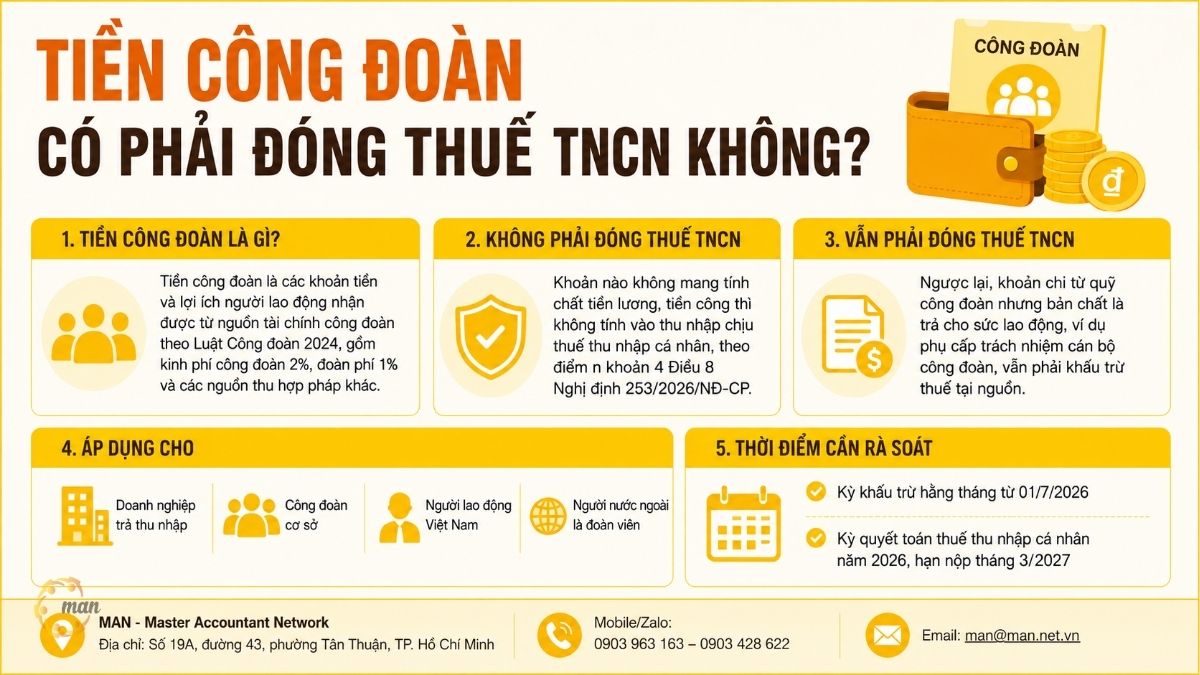
- Union fees are the funds and benefits that workers receive from union finances according to the 2024 Trade Union Law, including union funds (2%), union dues (1%), and other legitimate sources of revenue.
- According to point n, clause 4, Article 8 of Decree 253/2026/ND-CP, any amount that is not considered salary or wages is not included in taxable personal income.
- Conversely, expenditures from union funds that are essentially payments for labor, such as responsibility allowances for union officials, are still subject to withholding tax.
- Applicable to: businesses paying income, grassroots trade unions, Vietnamese workers, and foreign workers who are union members.
- Timeframe for review: monthly withholding periods from July 1, 2026, and the 2026 personal income tax final settlement period, deadline March 2027.
According to the latest regulations, are union dues subject to personal income tax?
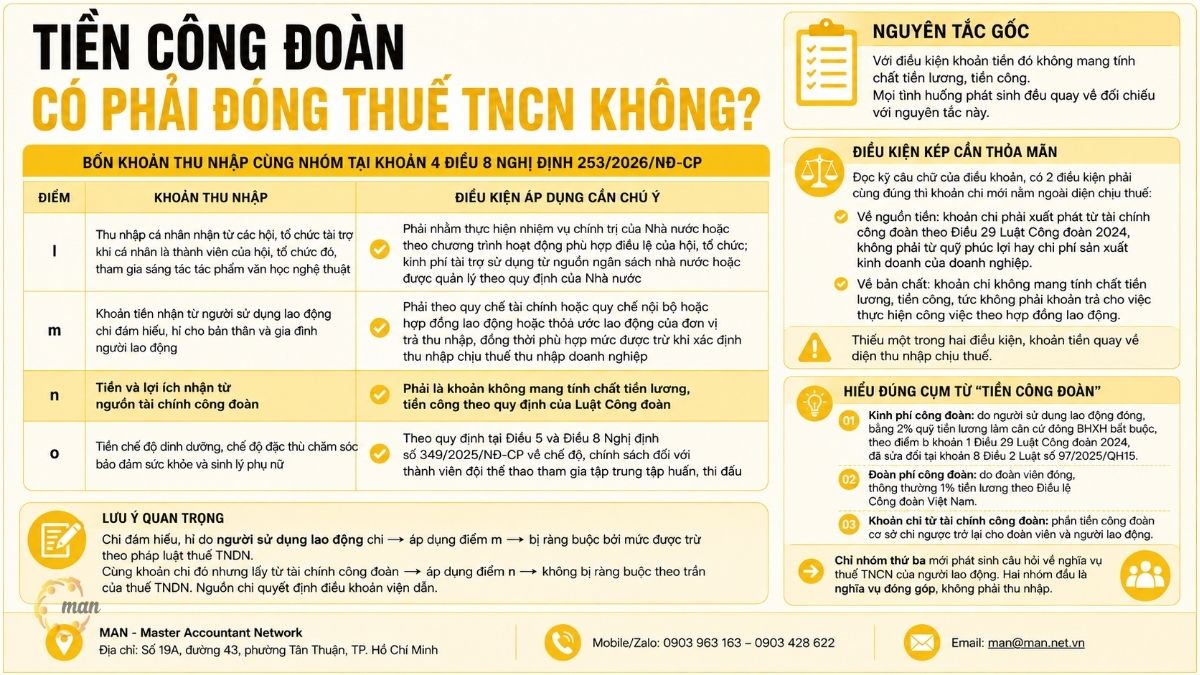
Provided that the payment is not in the nature of salary or wages. This is the fundamental principle; all arising situations should be referenced back to this principle.
At point n, clause 4, Article 8 Decree 253/2026/ND-CP, The government lists money and benefits received from trade union funds that are not considered wages or salaries as stipulated in the Trade Union Law as income not subject to personal income tax. This regulation is placed in Article 8 on income from wages and salaries, guiding Clause 2, Article 3 of the Personal Income Tax Law.
The four types of income belong to the same group as in Clause 4, Article 8.
Point n does not stand alone. Clause 4 of Article 8 of Decree 253/2026/ND-CP lists a group of income items that are not in the nature of salaries or wages, and therefore are not included in taxable income. The last four items of this clause usually appear together on a payroll, so accountants need to understand the entire group.
| Point | Income | Conditions for application should be noted. |
| l | Personal income received from associations and organizations that sponsor the individual when the individual is a member of such association or organization and participates in the creation of literary and artistic works. | Funding must be used to fulfill the political tasks of the State or in accordance with the charter of the association or organization; the funding must come from the state budget or be managed according to State regulations. |
| m | Money received from the employer to cover funeral and wedding expenses for the employee and their family. | Income must comply with the financial regulations, internal regulations, employment contract, or collective bargaining agreement of the income-paying entity, and must also conform to the deductible amount when determining taxable corporate income. |
| n | Money and benefits received from union funds. | It must be an amount that is not considered salary or wages as stipulated in the Trade Union Law. |
| o | A nutritional plan and specific care regimen ensure women's health and physiology. | According to the provisions of Articles 5 and 8 of Decree No. 349/2025/ND-CP on the regime and policies for members of sports teams participating in concentrated training and competition. |
Point m is noteworthy because it is easily confused with point n. Funeral and wedding expenses paid by the employer apply point m and are subject to the deductible limits under corporate income tax law. The same expense, when funded by the trade union, applies point n and is not subject to the corporate income tax ceiling. The source of the expenditure determines the cited clause.
The double condition must be satisfied simultaneously.
Read the clause carefully; two conditions must both be met for the expense to be exempt from tax:
- Regarding funding sources: The expenditure must originate from the trade union's finances, as stipulated in Article 29 of the 2024 Trade Union Law, and not from the welfare fund or the enterprise's production and business expenses.
- In essence: Expenses that are not in the nature of salaries or wages, meaning they are not payments for the performance of work under an employment contract.
If either of the two conditions is missing, the money becomes taxable income. Many accountants only check the first condition and then draw conclusions; this is a common cause of tax arrears after audits.
Understanding the term "union money" correctly.
In reality, these three concepts, often grouped together as "union money," have fundamentally different legal natures:
- Trade union funds: The employer pays the contribution equivalent to 2% of the wage fund used as the basis for mandatory social insurance contributions, according to point b, clause 1, Article 29 of the 2024 Trade Union Law, as amended by clause 8, Article 2 of Law No. 97/2025/QH15.
- Union dues: Contributed by union members, typically 1% is the salary as stipulated in the Vietnam Trade Union Charter.
- Expenditures from union funds: The funds from the grassroots trade union are then distributed back to union members and workers.
Only the third group raises questions about the employee's personal income tax obligations. The first two groups are about contribution obligations, not income.
Why does the "non-wage-related" boundary determine everything?
Vietnamese tax law levies taxes based on the nature of the transaction, not on the name on the document. This principle governs the entire process of handling expenditures from the trade union fund.
A Tet gift of 500,000 VND for union members and a responsibility allowance of 500,000 VND for union group leaders can be disbursed from the same account, on the same day, and with the same approval signature. However, the first is for welfare activities, while the second is payment for additional duties. Therefore, the tax treatment results will differ.
From the perspective of MAN – Master Accountant Network, businesses should build classification criteria directly into their accounting software instead of processing them manually each time. The one-time setup cost is much lower than the cost of explaining when the tax authorities request retrospective separation of three years.
| Expenditures from union funds | Include in taxable personal income. | Reasons for classification |
| Visiting and providing assistance during illness, maternity leave, hardship, and misfortune. | Are not | Welfare activities as stipulated in point c, clause 2, Article 31 of the 2024 Trade Union Law. |
| Tet gifts and holiday gifts for union members from the union fund. | Are not | Not linked to job performance results. |
| Expenses for organizing tours, cultural events, and sports activities. | Are not | Expenditure tasks as stipulated in point g, clause 2, Article 31 of the 2024 Trade Union Law. |
| Rewarding employees who have achieved academic success. | Are not | The beneficiaries are family members, not the workers. |
| Providing support to union members affected by accidents, natural disasters, and epidemics. | Are not | It is supportive in nature, not responsive to the task. |
| Responsibility allowance for part-time trade union officials | Have | Payment for additional duties, essentially a form of compensation. |
| The salaries of full-time trade union officials are paid by the trade union. | Have | Income from employment relationships |
| Performance-based bonuses are paid through the trade union fund. | Have | Directly linked to labor results |
| Payments in lieu of salary or salary compensation are made through the trade union channel. | Have | Essentially, it's about salaries, just a change in the source of funding. |
Which expenditures from union funds are definitely outside of taxable income?
The basis for confirming that an expenditure is for welfare activities lies in Clause 2, Article 31 of the 2024 Trade Union Law. This law fully lists the tasks for which trade union finances can be used, and this serves as the basis for comparison when explaining matters to the tax authorities.
Three principles for managing and utilizing trade union finances.
Clause 1 of Article 31 sets out the framework of principles before addressing the content of expenditures. These three principles are rarely mentioned in articles on taxation, but they are the first things that tax authorities and auditors scrutinize:
- The management and use of trade union finances must ensure the principles of centralization, openness, transparency, economy, efficiency, with assigned responsibilities and decentralization of management, linking the authority and responsibility of trade unions at all levels.
- Trade union organizations at all levels shall carry out accounting, statistics, reporting, and financial settlement of trade union funds in accordance with the provisions of the law on accounting and statistics.
- Trade unions manage and utilize their finances in accordance with the law and the regulations of the Vietnam General Confederation of Labor.
The principle of openness and transparency has direct practical value. An expenditure that is not disclosed at a workers' conference and lacks accompanying union accounting records will find it very difficult to convince the tax authorities that it is a welfare activity and not a payment in lieu of salary.
All thirteen expenditure tasks under Clause 2, Article 31
Union finances are used for the following purposes:
- To represent and protect the legitimate rights and interests of trade union members and workers; to participate in building progressive, harmonious, and stable labor relations.
- To disseminate and educate on the Party's guidelines and policies, and the State's laws and regulations; to improve the professional skills, expertise, and work ethics of trade union members and workers.
- Visiting and providing assistance to union members and workers when they are sick, pregnant, facing difficulties or misfortunes; organizing other welfare activities for union members and workers.
- Developing trade union membership, establishing grassroots trade unions and professional associations, and building a strong trade union.
- Training and developing trade union officials; training and developing outstanding workers to create a pool of cadres for the Party, the State, and the trade union organization.
- Organize emulation movements initiated or led by the Trade Union.
- Organize cultural, sports, sightseeing, and tourism activities for union members and workers.
- Rewarding and encouraging employees and their children who achieve success in their studies and work.
- Investing in the construction of social housing for union members and workers to rent; cultural and sports facilities, and related technical infrastructure serving union members and workers in accordance with the law.
- Activities aimed at ensuring gender equality are consistent with the functions and responsibilities of the trade union organization.
- Scientific research, technology, innovation, and digital transformation within the trade union organization.
- Administrative expenses are used to support the activities of trade union organizations at all levels and the international cooperation activities of trade unions.
When the expenditure matches one of the above tasks and there is a resolution or decision on the expenditure by the grassroots trade union executive committee, the documentation is sufficient to exclude it from taxable income.
Not all expenditure tasks generate personal income.
Two things need to be distinguished. The list of thirteen tasks answers the question of what the union's funds are being spent on, not whether those expenditures constitute the income of a specific individual.
Expenses for propaganda, membership development, administrative management, scientific research, and digital transformation are expenses for the organization's activities. No individuals receive money, so there is no issue of personal income tax. The group requiring review includes expenses directly reaching employees: visits, subsidies, awards, travel, and training.
Regarding the training and development of union officials and outstanding workers, review experience shows that this group is most frequently questioned. If the union pays for tuition for a course that directly relates to the individual's professional work within the enterprise, the line between this and a monetary benefit becomes blurred. The documentation must clearly demonstrate that the training is linked to union activities.
Note regarding the source of payment
The problem arises when a business makes payments on behalf of another party and then accounts for them as administrative expenses. At that point, the source is no longer union funds, and the expenditure must be considered according to the welfare regulations in Decree 253/2026/ND-CP and corporate income tax laws. These two approaches yield completely different tax results; therefore, the source of funds must be clearly documented from the outset.
In what cases is it unavoidable that union fees are subject to personal income tax?

There are four categories of expenses that, based on audit experience, are almost always included in taxable income by the tax authorities.
- The first group consists of responsibility allowances for trade union officials. Chairpersons, vice-chairpersons, and members of the grassroots trade union executive committee who hold concurrent positions usually receive a monthly allowance calculated based on the base salary coefficient. From July 1, 2026, the base salary will be 2,530,000 VND/month according to Decree 161/2026/ND-CP. This is payment for work performed, not welfare.
- The second group consists of salaries for full-time trade union officials. Full-time union employees, whose salaries are paid from union funds, generate income from wages and salaries. The union organization then acts as the income payer, with the obligation to deduct and issue deduction certificates.
- The third group consists of productivity-related expenses. Attendance bonuses, innovation bonuses, and plan completion bonuses, if channeled through the trade union, will retain their original nature as labor-related rewards.
- The fourth group consists of payments in lieu of salary. Some organizations divert a portion of salaries from the union fund to reduce their tax liability. This practice is considered tax evasion, with consequences including back taxes, late payment penalties, and fines.
Experts at MAN – Master Accountant Network, with over 30 years of auditing and tax consulting experience, note that the distinction between the caregiving category and the compensation category lies not in the name of the expense, but in whether that expense is dependent on the volume and quality of work performed.
Are union dues from 1% deductible when calculating personal income tax?
This is the second most common misconception, after the question about taxability. Many payrolls deduct union fees before calculating taxable income, which is incorrect.
Deductions when determining taxable income from salaries and wages include social insurance, health insurance, unemployment insurance, mandatory professional liability insurance, voluntary retirement fund, charitable and humanitarian contributions, educational contributions, and personal allowances. Union dues are not included in this list.
Technically, union dues are payments made by employees after they have earned taxable income. The employer deducts these dues at source and pays them to the higher-level union; this practice does not change the amount of tax payable.
| Item | Closed object | Impact on personal income tax for employees |
| Trade union funds 2% | Employers | No, because it's not the worker's income. |
| Trade union membership fee 1% | Union members | No deductions are allowed when calculating taxable income. |
| Mandatory social insurance, health insurance, and unemployment insurance. | Workers and businesses | The portion contributed by the employee that is deductible. |
| Welfare from the trade union fund | grassroots trade union branch | Not included in taxable income |
Which groups are affected and need immediate review?
The provisions in point n, clause 4, Article 8 of Decree 253/2026/ND-CP affect four groups of entities, each with its own specific responsibilities.
- Businesses that pay income: Review all expenditure codes on the payroll, separating expenditures from the trade union fund from expenditures from the company's welfare fund.
- Local trade union: Complete the resolution, expenditure decision, and signature list; these are the original documents proving the purpose of use.
- Vietnamese workers: Check year-end tax deduction documents and compare the amounts received from the trade union.
- Foreign workers: According to Article 5 of the 2024 Trade Union Law, foreigners working under labor contracts of 12 months or more are eligible to join grassroots trade unions, and therefore also fall within the scope of application if they are resident individuals.
Compilation of legal documents related to whether union fees are subject to personal income tax.
Before making any decisions, accountants should have all six of the following documents on their desks.
| Document | Number and date | Related content |
| Personal Income Tax Law | Law No. 109/2025/QH15, amended by Law No. 09/2026/QH16 | Clause 2 of Article 3 stipulates income from salaries and wages. |
| Decree guiding the Law on Personal Income Tax | Decree No. 253/2026/ND-CP, issued on June 30, 2026, effective July 1, 2026 | Point n, Clause 4, Article 8, regarding money and benefits from trade union finances. |
| Trade Union Law | Resolution No. 50/2024/QH15, adopted on November 27, 2024, effective July 1, 2025 | Article 29 on trade union finances, Article 31 on expenditure responsibilities |
| Law amending four laws | Resolution No. 97/2025/QH15, effective July 1, 2025 | Clause 8 of Article 2 amends the subjects required to pay trade union fees (2%). |
| Decree on trade union finances | Decree No. 105/2026/ND-CP, issued on March 31, 2026, effective May 16, 2026 | Methods and deadlines for payment; exemptions, reductions, and temporary suspensions of trade union fee payments. |
| Decree on the regime for members of sports teams | Decree No. 349/2025/ND-CP | Articles 5 and 8 are referenced in point o, clause 4, Article 8 of Decree 253/2026/ND-CP. |
Decree 253/2026/ND-CP replaces Decree 65/2013/ND-CP, and Decree 105/2026/ND-CP replaces Decree 191/2013/ND-CP. Both of these old documents are no longer in effect, but many company internal regulations still refer to them. This is a detail that needs immediate correction in the financial regulations.
What impact do prohibited behaviors within a trade union have on tax records?
Article 10 of the 2024 Trade Union Law lists prohibited behaviors. Many accountants consider this to be the responsibility of the human resources department, but at least one group of behaviors directly affects whether an expense can be excluded from taxable income.
The following actions are strictly prohibited:
- Obstructing or hindering the exercise of trade union rights.
- Discrimination against workers and union officials based on their establishment, membership, or participation in a union.
- Using economic measures, psychological threats, or other measures detrimental to the trade union organization; interfering with or manipulating the establishment and operation of the trade union; weakening or neutralizing the performance of the trade union's functions, duties, rights, and responsibilities.
- Failure to ensure the conditions for trade union operation and trade union officials as prescribed by law.
- Failure to pay trade union fees; late payment of trade union fees; payment of trade union fees at an incorrect rate; payment of trade union fees for an insufficient number of eligible members; improper management and use of trade union funds.
- Receiving aid, funding, or technical assistance in violation of the law.
- Abusing trade union rights to violate the law, infringe upon the interests of the State, and infringe upon the legitimate rights and interests of agencies, organizations, units, businesses, and individuals.
- False, inflammatory, distorted, and defamatory information about trade union organizations and activities.
Eight manifestations of discriminatory behavior.
The law specifies discriminatory behavior in eight forms:
- Requirements for joining, not joining, or leaving the Vietnam Trade Union in order to be recruited, enter into, or renew a labor contract or employment agreement.
- Dismissal, disciplinary action, unilateral termination of employment contracts or work agreements; failure to continue or renew employment contracts or work agreements; transferring employees to other jobs.
- Discrimination in terms of wages, bonuses, benefits, working hours, and other rights and obligations in the workplace.
- Discrimination based on gender, ethnicity, religion, beliefs, and other forms of discrimination in the workplace.
- False information intended to tarnish the reputation and honor of trade union officials.
- Promising or providing material or non-material benefits to workers or union officials to discourage them from participating in union activities, to resign from their positions as union officials, or to engage in actions against the Union.
- Dominating, obstructing, or creating difficulties related to work in order to weaken the activities of the trade union.
- Other conduct as prescribed by law.
The relationship with tax obligations
Improper management and use of trade union funds is a direct link to taxation. An expenditure made for an improper purpose, contrary to Clause 2 of Article 31, violates both Article 10 and undermines the basis for invoking Point n, Clause 4, Article 8 of Decree 253/2026/ND-CP. The consequence is a double wharf: disciplinary action against trade union violations and the recovery of personal income tax.
More importantly, the practice of promising or providing material benefits to encourage workers to cease their union activities can create a disguised expenditure. This expenditure does not fall under any legitimate spending category and therefore must be fully included in the recipient's taxable income.
From the perspective of MAN – Master Accountant Network, businesses should consider union compliance records and personal income tax records as a single, unified set. Auditors typically begin with employee meeting minutes and union payment resolutions, then cross-reference them with payroll records.
Case study: How do FDI businesses in Dong Nai handle this?
Background
Company B Electronics Co., Ltd., a South Korean-owned company with 850 employees in Dong Nai, has an average monthly payroll of 7.2 billion VND used as the basis for social insurance contributions. The company's trade union contribution is 144 million VND per month, equivalent to 1.728 billion VND for the entire year of 2026. The company's grassroots trade union has 14 part-time officials.
In the last six months of 2026, the grassroots trade union spent money on three groups of expenses: sick leave and hardship allowances totaling 310 million VND; Mid-Autumn Festival gifts and Women's Day gifts totaling 240 million VND for union members; and responsibility allowances for 14 trade union officials totaling 63.7 million VND.
Problems discovered during the review
Payroll accountants exclude all three of these expense categories from the payroll, arguing that the money comes from the union fund and is therefore tax-exempt. This interpretation is correct for the first two categories but incorrect for the third.
The responsibility allowance of 63.7 million VND was allocated to 14 people, averaging 758,000 VND per person per month. With an average marginal tax rate of 10% for this group of officials, the amount of underdeclared tax is approximately 6.37 million VND for six months.
How to handle it
The consulting team followed three steps:
- Separate the expense codes in the payroll software into three groups: welfare from the union fund, union responsibility allowance, and benefits from company expenses.
- Add responsibility allowances to the taxable income of each employee, and file supplementary tax returns for the months related to the inspection before the tax authorities announce the inspection decision.
- Complete the original documentation for the welfare group, including the executive committee's expenditure resolution, a signed receipt list for beneficiaries, and bank transfer documents.
The measured results
- The additional tax declared was 6.37 million VND, and the late payment penalty, calculated at 0.03%/day, was only about 350,000 VND.
- Because the business discovered the error and submitted the supplementary declaration before the inspection decision was made, the unit was not penalized for the false declaration.
- The tax authorities accepted the 550 million VND welfare payment as a deduction from taxable income, meaning 850 workers retained their income without deductions.
- The time required to review payroll records has been reduced from the expected four days to two days thanks to the pre-grouped documentation.
The lesson learned: the difference between correct and incorrect handling in this situation is not large in absolute terms, but if it remains unresolved for three years and is discovered during an audit, the penalty of 20% on the underdeclared tax plus late payment interest will drive the cost up many times over.
Expert opinion: Five common risks and how to avoid them.
Based on its experience reviewing tax records for manufacturing and service businesses in Vietnam, MAN – Master Accountant Network has identified five most frequently recurring risks when businesses handle expenditures from union funds.
Risk 1: Equating the source of expenditure with the nature of the expenditure.
This is the most common error. Accountants assume all expenses from the union account are tax-exempt. The way to avoid this is to create a detailed expense list with columns classifying taxable expenses, which must be jointly approved by the union executive committee and the human resources department at the beginning of the year.
Risk 2: Lack of original documents proving the purpose of the expenditure.
The tax authorities require resolutions or decisions on expenditures, internal spending regulations of the grassroots trade union, a list of recipients, and payment documents. The lack of a list of recipients is the most common problem during collective gift-giving events. The solution: digitize the list of recipients at the time of disbursement.
Risk 3: Mixing union funds with company welfare funds.
Many organizations allocate funds for Tet (Lunar New Year) gifts, partly from the union fund and partly from company expenses, but only create a single payment voucher. When the funds are broken down, it's difficult to determine which part belongs to which source. The solution: create two separate payment vouchers right from the payment request stage.
Risk 4: Omission of responsibility allowance for trade union officials.
This amount is small, paid regularly every month, and easily overlooked for many consecutive years. Accumulated over three years for a company with several dozen union officials, it could result in a significant amount to be recovered. The way to prevent this: include it in the quarterly periodic inspection list.
Risk 5: Failure to update internal regulations according to new regulations.
Many current trade union expenditure regulations still refer to Decree 191/2013/ND-CP and Decree 65/2013/ND-CP. Both have been replaced in 2026. The preventative measure is to review and issue new regulations in the nearest quarter, clearly stating that they are based on Decree 105/2026/ND-CP and Decree 253/2026/ND-CP.
Experience in tax risk management in Vietnam shows that the cost of getting things right from the start is often only a fraction of the cost of correcting problems after an audit. The reason is simple: once a case has been closed for many years, re-collecting the beneficiary's signature is almost impossible, especially for employees who have left their jobs.
Conclude
Answering the question of whether union fees must be paid. personal income tax It's not simply a matter of one principle: consider the nature of the expenditure, not its name or the payment account. Expenditures for caring for, visiting, and supporting union members from union funds are not included in taxable income according to point n, clause 4, Article 8 of Decree 253/2026/ND-CP. Conversely, all payments for labor must be fully deducted. The real value of correct classification lies not only in the amount of legally saved taxes, but also in having a solid record that can withstand inspections.
MAN – Master Accountant Network provides tax consulting, tax accounting, tax reporting, and tax settlement services, with a team of experts boasting over 30 years of practical experience and a deep understanding of tax risk management practices in Vietnam. Over 500 clients have returned for a second time in the past year, the majority being FDI enterprises and large-scale manufacturing businesses. If you need a review of how to handle expenditures from the trade union fund before the 2026 tax settlement period, please contact MAN for a personalized discussion.
Tax services at MAN – Master Accountant Network
- Tax accounting services
- Tax consulting services
- Tax settlement services
- Tax reporting services
- VAT refund service
Service contact information at MAN – Master Accountant Network
- Address: No. 19A, Street 43, Tan Thuan Ward, Ho Chi Minh City
- Mobile/Zalo: 0903 963 163 – 0903 428 622
- E-mail: man@man.net.vn
- Google Business Profile: View MAN – Master Accountant Network's Google Business Profile
- LinkedIn Founder: View expert Le Hoang Tuyen's LinkedIn profile.
Responsible for production and professional content review by: Mr. Le Hoang Tuyen – Founder & CEO of MAN – Master Accountant Network, CPA Vietnam with over 30 years of experience in accounting, auditing, taxation, and corporate financial consulting.
Frequently Asked Questions about whether union fees are subject to personal income tax.
Is union money subject to personal income tax when disbursed to the relatives of employees?
No. The bonus for children of union members with academic achievements, paid from the union fund, falls under the duties specified in point h, clause 2, Article 31 of the 2024 Trade Union Law and is not considered salary or wages.
What happens if a company has not yet established a grassroots trade union?
Businesses are still required to pay trade union fees under Article 2% of the 2024 Trade Union Law. When there is no grassroots trade union, expenses for employees usually come from the company's welfare fund; therefore, the regulations on welfare must apply, and point n, clause 4, Article 8 of Decree 253/2026/ND-CP should not be invoked.
Are foreign workers who receive welfare payments from labor unions subject to taxation?
No, if the expenditure satisfies the conditions regarding source and nature. Foreigners with labor contracts of 12 months or more are allowed to join the grassroots trade union, so the same principles as those applied to Vietnamese workers should apply.
Is there a maximum limit on the amount that can be excluded from taxable income?
Point n, Clause 4, Article 8 of Decree 253/2026/ND-CP does not set a ceiling in absolute amounts. However, Decree 105/2026/ND-CP stipulates limits for certain specific expenditure items calculated based on the basic salary, so the grassroots trade union must still comply with the internal expenditure limits.
What regulations govern expenditures made before July 1, 2026?
The regulations in effect at the time of income payment shall apply. For the 2026 tax year, businesses need to separate the two periods before and from July 1, 2026, to determine the correct tax amount and avoid discrepancies when comparing with tax authority data.




