

Regulations regarding Personal income tax on the transfer of derivative securities. Officially effective from July 1, 2026, this regulation is becoming a focal point of attention for the financial investment community. Keeping up-to-date with new legal documents such as... Circular 87/2026/TT-BTC This not only helps investors ensure compliance with the law but also serves as an important stepping stone to optimizing personal financial risk management strategies during periods of market volatility.
With over 30 years of experience in accounting and auditing consulting, the team of experts at MAN – Master Accountant Network recognizes that this change creates a transparent legal framework for futures contract transactions. This article will provide an in-depth analysis of the new regulations, helping investors understand how to accurately calculate taxes in order to proactively protect their legitimate profits during tax audits.
Summary of key aspects of personal income tax on the transfer of derivative securities.
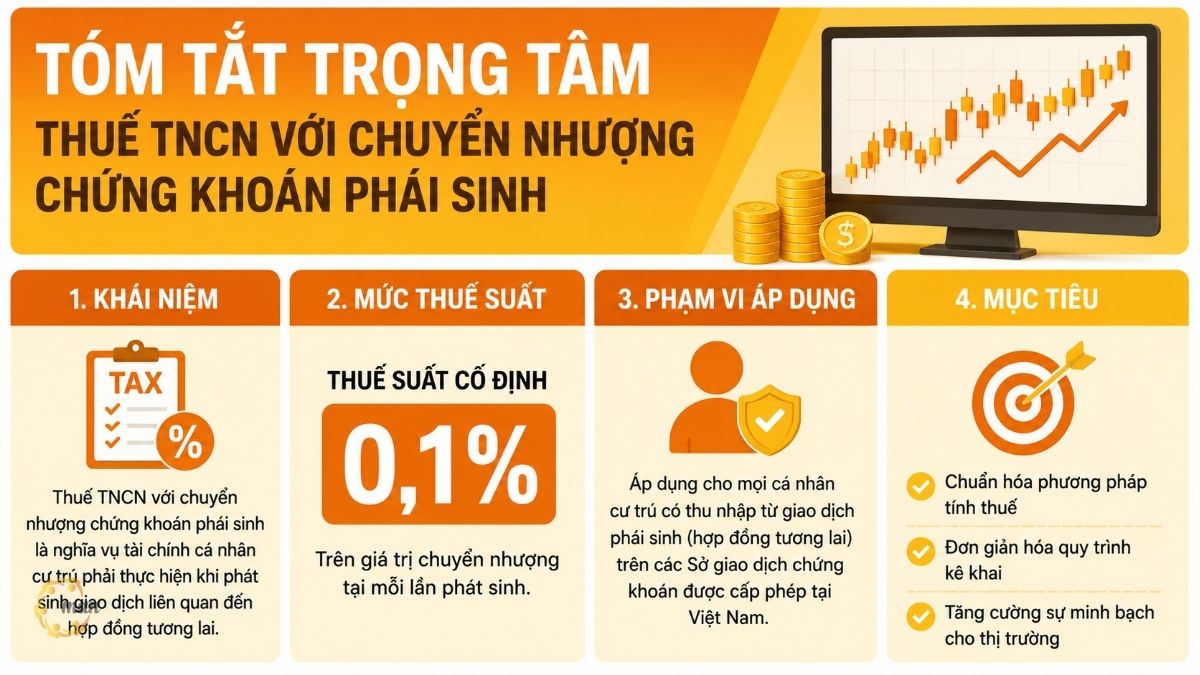
Personal income tax on the transfer of derivative securities is a financial obligation that resident individuals must fulfill when transactions related to derivative instruments, specifically futures contracts, occur. According to new regulations effective from July 1, 2026, the fixed tax rate is set at 0.11% of the transfer value for each transaction.
This regulation applies to all individuals with income from derivative transactions on licensed stock exchanges in Vietnam, aiming to standardize tax calculation methods, simplify declaration procedures, and enhance market transparency.
Legal regulations on personal income tax on the transfer of derivative securities.
Changes in tax policy always have a certain impact on market sentiment and investment strategies. To understand the nature of the issue, investors need to have a firm grasp of the current legal basis.
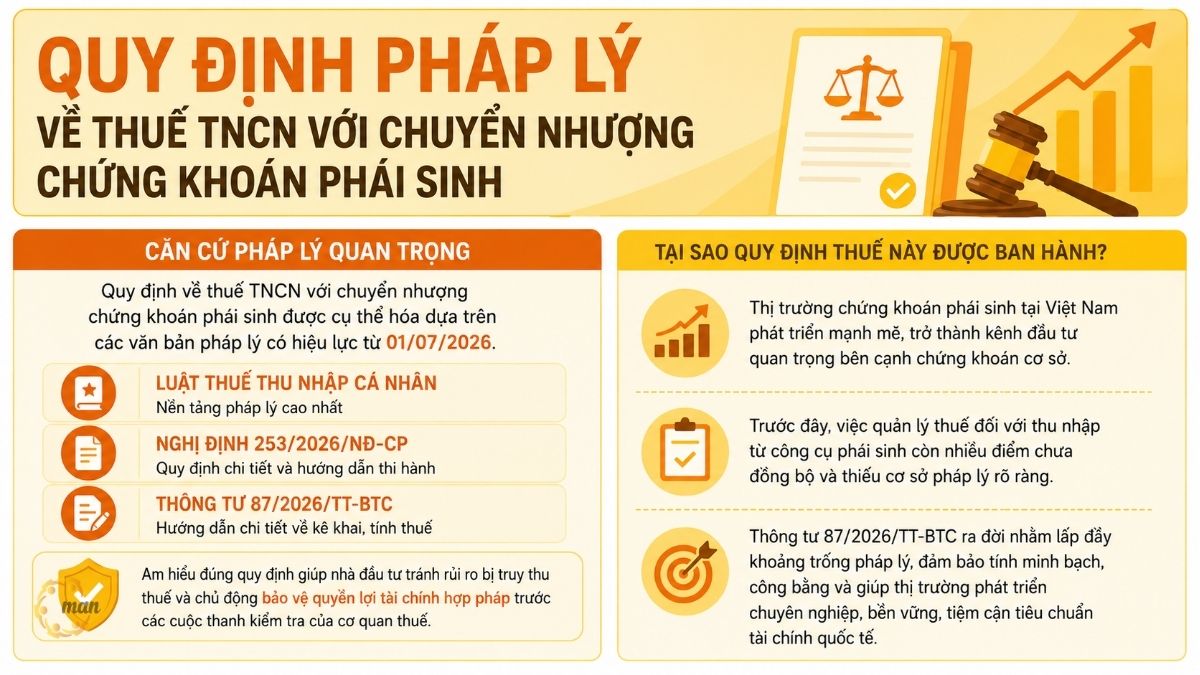
Important legal basis
This regulation is based on the Personal Income Tax Law and is guided in detail by... Decree 253/2026/ND-CP Along with Circular 87/2026/TT-BTC, these are the highest-level legal documents, effective from July 1, 2026, serving as a guiding principle for all tax declaration and settlement activities of investors.
Experts at MAN – Master Accountant Network emphasize that understanding each provision in Circular 87/2026/TT-BTC not only helps individuals avoid the risk of tax arrears but also proactively protects their legitimate financial rights against tax audits by the tax authorities.
Why was this tax regulation enacted?
The derivatives market in Vietnam has developed strongly in recent years, becoming an important investment channel alongside underlying securities. However, tax management on income from derivative instruments has previously been inconsistent in many aspects.
Circular 87/2026/TT-BTC was issued to fill the legal gap, ensuring that regulatory agencies have an accurate basis for calculating taxes on actual transactions. This is a necessary step to develop the market in a more professional and sustainable direction, approaching the international financial standards that Vietnam is striving for.
How to determine the amount of personal income tax payable on the transfer of derivative securities.
Understanding how to calculate taxes is the most important aspect every investor needs to grasp to avoid errors during the tax filing process. Below is a detailed guide from the MAN team of experts.
Detailed formula for calculating personal income tax.
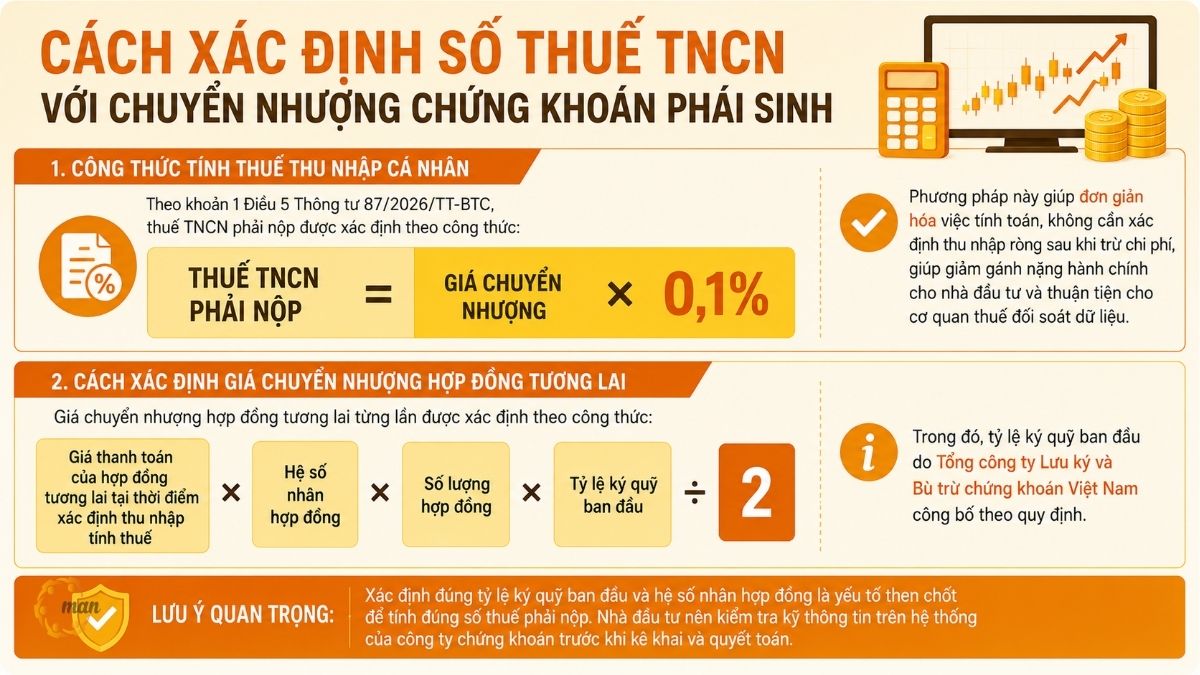
According to Clause 1, Article 5 of Circular 87/2026/TT-BTC, personal income tax The amount payable is determined by the following formula:
|
Personal income tax payable = Transfer price x 0.1% |
This method simplifies the calculation process, avoiding the need for investors to determine net income after deducting expenses themselves. The consulting team at MAN – Master Accountant Network considers this the optimal method to reduce the administrative burden for individual investors, while also making it easier for tax authorities to cross-check transaction data from the stock exchange.
How to determine the transfer price of a futures contract.
For futures contracts, determining the transfer price is a crucial step. Specifically, the transfer price of each futures contract is determined using the following formula:
|
Futures contract transfer price per transaction = Settlement price of the futures contract at the time of taxable income determination x Contract multiplier x Number of contracts x Initial margin rate / 2 |
In this context, the initial margin ratio is announced by the Vietnam Securities Depository and Clearing Corporation as per regulations. Accurately determining the margin ratio and multiplier is crucial for obtaining precise figures. MAN's solution always recommends that clients carefully check these parameters on their securities company's system before performing periodic settlements.
Time of determining taxable income and declaration obligations
The timing of income recognition is a decisive factor in determining the tax filing period for investors. According to the new regulations, the timing for determining taxable income from derivative securities, specifically futures contracts, is clearly stipulated in Circular 87/2026/TT-BTC as follows:
- The time when an investor's buy or sell order for a futures contract is matched on the stock exchange's trading system.
- The expiration date of the futures contract.
Closely monitoring this timeframe helps investors prepare the necessary funds and documentation. Errors in filing deadlines often lead to unnecessary late payment penalties. Experts at MAN, with 30 years of experience, always remind clients to maintain real-time transaction logs for verification. If you encounter difficulties in compiling data for personal income tax declarations related to derivative securities transfers, MAN's professional tax settlement services are always ready to assist.
The impact of the new regulations on investors and businesses.
The new policy not only directly affects investors' wallets but also impacts how they manage their personal finances and the transparency of the market.
Viewed from a tax risk management perspective.
Many investors consider taxes to be just a fixed expense. However, from the perspective of controlling and optimizing tax costs in Vietnam, this is a potential risk if not properly planned. Failure to declare taxes fully or miscalculating them can lead to investors being placed on the tax authority's inspection list, affecting their reputation and transaction history.
Experts at MAN have witnessed numerous cases where investors have paid the price with significant penalties simply due to a lack of awareness of new policies. Our deep understanding of the realities of tax risk management in Vietnam is our guiding principle in supporting clients to invest with peace of mind.
Comparison of Tax Calculation Methods (Expert's Perspective)
From July 1st, 2026, the method for calculating personal income tax on the transfer of derivative securities will be significantly simplified according to Circular 87/2026/TT-BTC. Compared to previous regulations, the new calculation method applies a fixed tax rate of 0.1% on the transfer price, making tax declaration, determination of tax obligations, and record management more transparent and easier for both investors and businesses.
| Criteria | Before July 1, 2026 | From July 1, 2026 |
| Calculation method | Complex, controversial. | Simply put, based on the transfer price. |
| Tax rate | Depending on the circumstances | Fixed 0.1% |
| Tax base | Net income (profit/loss) | Transfer value (according to the formula) |
| Declaration procedures | Difficult to track | Easier, more transparent |
The data above shows a shift towards simplifying procedures, helping investors reduce the time and effort spent on tax calculations. However, simplification of the formula does not mean neglecting data preparation.
Real-world case study: Mr. Nam and the problem of taxing derivative securities.
To better understand how this applies, consider the case of Mr. Nam, a derivatives investor in Hanoi, who used MAN's advisory services to optimize his process.
Hypothetical scenario
Mr. Nam executed 10 futures contracts with a settlement price of 1,500 points at the time of execution, a contract multiplier of VND 100,000, and an initial margin ratio of 15%. According to the formula, the personal income tax Mr. Nam has to pay is calculated as follows:
| Transfer price = 1,500 x 100,000 x 10 x (15% / 2) = 11,250,000 VND. Personal income tax payable = 11,250,000 x 0.1% = 11,250 VND |
Analysis from MAN experts
From the example above, it can be seen that the tax amount per transaction is not very large, but when thousands of transactions accumulate over a year, this number becomes significant and requires strict data management. Mr. Nam proactively contacted the team of experts at MAN for advice on how to automatically store data.
As a result, year-end tax filing went smoothly without any discrepancies. This is the smart approach we always encourage investors to adopt: transforming tax obligations into a systematic financial management process instead of simply paying taxes at the end of the period.
Conclude
Understanding the new regulations on personal income tax for derivative securities transfers is crucial preparation for any investor. The changes, effective July 1, 2026, are not only administrative but also reflect the development of Vietnam's financial market towards greater transparency and efficiency. Proper understanding, accurate calculation, and full payment will not only help you avoid unnecessary legal risks but also create a solid foundation for long-term investment activities.
Tax services at MAN – Master Accountant Network
- Tax accounting services
- Tax consulting services
- Tax settlement services
- Tax reporting services
- VAT refund service
Service contact information at MAN – Master Accountant Network
- Address: No. 19A, Street 43, Tan Thuan Ward, Ho Chi Minh City
- Mobile/Zalo: 0903 963 163 – 0903 428 622
- E-mail: man@man.net.vn
- Google Business Profile: View MAN – Master Accountant Network's Google Business Profile
- LinkedIn Founder: View expert Le Hoang Tuyen's LinkedIn profile.
Responsible for production and professional content review by: Mr. Le Hoang Tuyen – Founder & CEO of MAN – Master Accountant Network, CPA Vietnam with over 30 years of experience in accounting, auditing, taxation, and corporate financial consulting.
Frequently Asked Questions about Personal Income Tax on the Transfer of Derivative Securities
According to the current tax calculation formula, tax is calculated on the transfer value, not on the profit. Therefore, you still have to pay 0.1% tax on the transfer price regardless of whether the transaction results in a profit or a loss.
The initial margin requirement is published by the Vietnam Securities Depository and Clearing Corporation (VSDC). You can find this information on their website or from the securities company where you opened your account.
Currently, tax filing is usually done by investors themselves. However, if you use our comprehensive tax accounting services, we can handle these procedures on your behalf accurately and legally.
This regulation is clearly stated in Circular 87/2026/TT-BTC. You should keep this document for reference when needed.
Circular 87/2026/TT-BTC focuses on derivative securities (futures contracts). For warrants, you need to refer to legal documents on underlying securities or other specific tax guidelines. If the transaction results in a loss, do I have to pay taxes?
How can I find out the exact initial margin requirement?
Can I authorize the securities company to file my tax returns on my behalf?
Which document specifically stipulates the tax rate of 0.1%?
Does this regulation apply to secured warrants?




