


The 2026 Personal Income Tax regulations introduce new provisions that are particularly important for freelancers, KOLs/KOCs, affiliates, and self-employed service providers in Vietnam. Decree 253/2026/ND-CP Effective from July 1, 2026, if an individual provides services but does not register their business, the income may be classified by the tax authorities as salary or wages, resulting in the highest progressive tax rate of up to 35% instead of approximately 7% for individuals operating a business. This is content that the Tax Department has included in its official promotional materials, demonstrating the priority given to reviewing this income group.
This article comprehensively summarizes the legal basis, how to distinguish the nature of income, the applicable tax rates for each industry, and the practical risks commonly encountered by freelancers, KOLs/KOCs, and affiliates, from the perspective of... MAN – Master Accountant Network, a tax, accounting, and auditing consulting firm with a team of experts boasting over 30 years of practical experience in tax risk management in Vietnam.
Summary of key points regarding personal income tax in 2026 for freelancers, KOLs/KOCs, and affiliates.
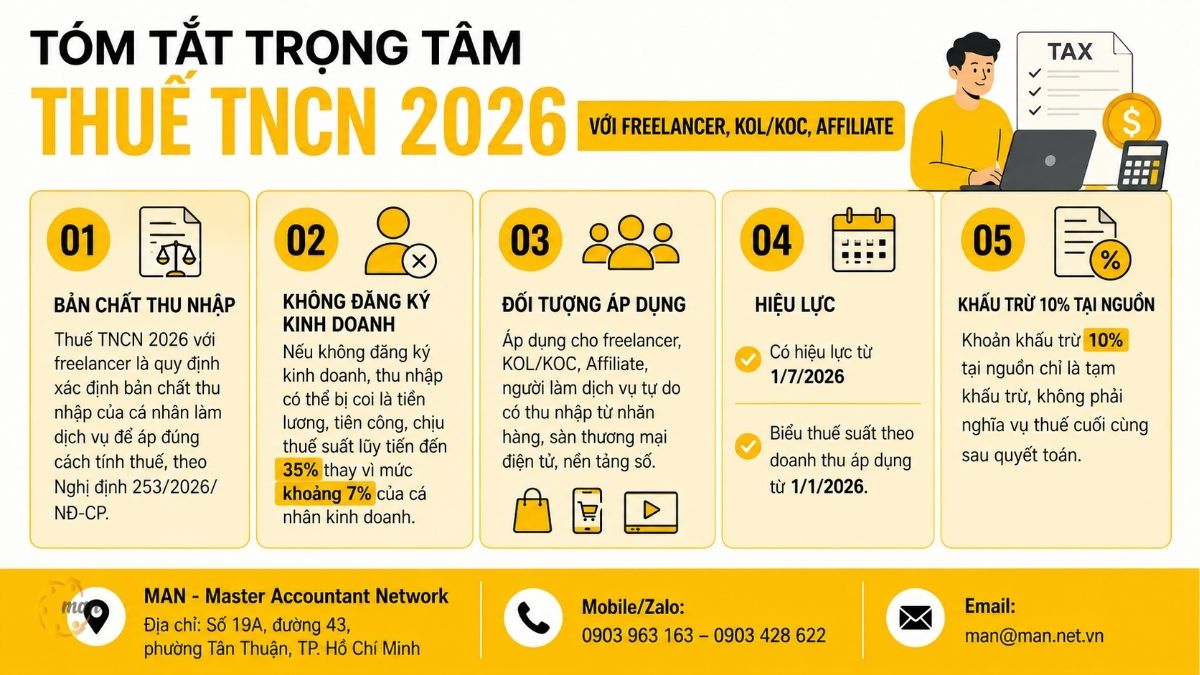
- The 2026 personal income tax regulations for freelancers determine the nature of income earned by individuals providing services in order to apply the correct tax calculation method, according to Decree 253/2026/ND-CP.
- Without business registration, income may be considered salary or wages, subject to a progressive tax rate of up to 35% instead of the approximately 7% tax rate for self-employed individuals.
- Applicable to freelancers, KOLs/KOCs, affiliates, and self-employed individuals who earn income from brands, e-commerce platforms, and digital platforms.
- Effective from July 1, 2026; revenue-based tax rates apply from January 1, 2026.
- The 10% withholding tax is only a provisional deduction and not the final tax liability after tax settlement.
What are the new regulations on personal income tax for freelancers, KOLs/KOCs, and affiliates in 2026?
New regulations on personal income tax in 2026 for freelancers, KOLs/KOCs, and affiliates. This revolves around correctly determining the nature of personal income received: whether it is business income or income from salaries and wages. According to point c, clause 2, Article 8. Decree 253/2026/ND-CP, If an individual provides services but does not register their business or register for tax purposes related to business activities, the tax authorities may determine that income as salary or wages depending on the nature of the actual transaction.
The difference between the two methods of determination lies not only in the terminology but also in the amount of tax payable. This is why this regulation has become a top concern for freelancers, KOLs/KOCs, and affiliates as they head into the 2026 tax year.
Why does the Tax Department pay special attention to freelancers, KOLs/KOCs, and affiliates?
- Income generated from digital platforms, social media, and e-commerce sites is growing rapidly, but the rate of business registration remains low.
- Many individuals receive fees and commissions from multiple brands simultaneously, making it difficult to control unless they proactively declare them.
- The 10% withholding tax at source can easily mislead freelancers into thinking they have fulfilled their tax obligations.
How do the two methods of calculating personal income tax in 2026 for freelancers, KOLs/KOCs, and affiliates differ?
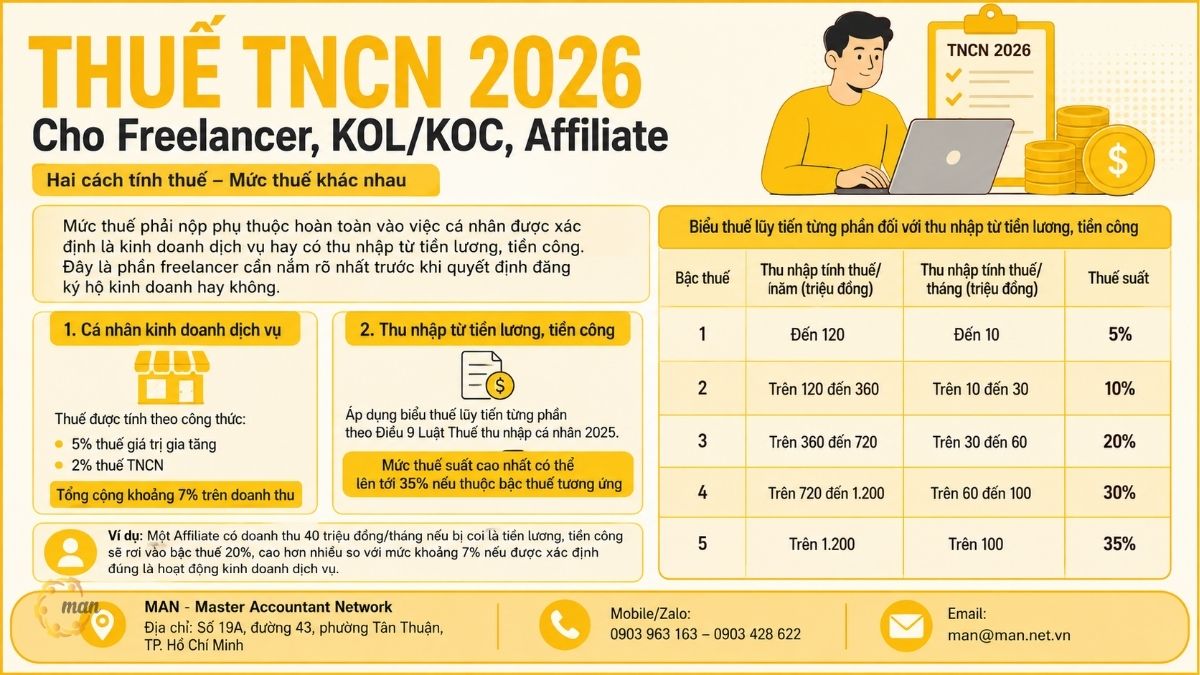
The amount of tax payable depends entirely on whether the individual is classified as a service business or has income from salaries and wages. This is the most important point freelancers need to understand before deciding whether or not to register as a sole proprietorship.
- If identified as an individual providing services: The tax is calculated using the formula 5% value-added tax plus 2% personal income tax In terms of revenue, the total is approximately 7%.
- If determined to be income from salaries and wages: Applying the progressive tax rate schedule as per Article 9 of the Personal Income Tax Law 2025, the highest tax rate can reach 35% if it falls within the corresponding tax bracket.
As can be seen, an affiliate with a monthly revenue of 40 million VND, if considered as salary or wages, would fall into tax bracket 20%, much higher than approximately 7% if it were correctly classified as a service business activity.
| Tax rates | Taxable income/year (million VND) | Taxable income/month (million VND) | Tax rate |
| 1 | Up to 120 | Up to 10 | 5% |
| 2 | Over 120 to 360 | Between 10 and 30 | 10% |
| 3 | Over 360 to 720 | Between 30 and 60 | 20% |
| 4 | Between 720 and 1,200 | Between 60 and 100 | 30% |
| 5 | Over 1,200 | Over 100 | 35% |
Which industry group do freelancers, KOLs/KOCs, and affiliates belong to in order to calculate the correct tax rate?
When identified as an individual business owner, freelancers need to correctly identify their business sector to apply the appropriate tax rate on their revenue, as each sector has significantly different tax rates according to the Appendix to Decree 253/2026/ND-CP.
| STT | Industry/Occupational Group | Specific activities | Tax rate |
| 1 | Distribution and supply of goods (point b, clause 3, Article 7) | Wholesale and retail of goods (excluding the value of goods sold at the correct price with commission); bonuses, sales support, promotions, payment discounts, cash or non-cash support for individual businesses; distribution of goods not subject to VAT, not required to declare VAT, or subject to VAT (0%); business cooperation with organizations that have declared VAT on all revenue; bonuses and support associated with goods and services not subject to VAT or subject to VAT (0%); compensation for breach of contract, other compensation. | 0,5% |
| 2 | Services and construction without material procurement (point c, clause 3, Article 7) | Accommodation services (short-term for tourists and visitors; long-term non-apartment accommodation for students and workers; accommodation including meals or entertainment); cargo handling and transportation support (docking, ticket sales, vehicle parking); postal services, mail and parcel delivery; brokerage, auction, agency commissions; legal, financial, accounting, and auditing consulting; tax and customs administrative procedures; data processing, leasing of portals, IT and telecommunications equipment, advertising; office support and other business support; sauna, massage, karaoke, nightclubs, billiards, internet; tailoring, laundry, haircutting, hairdressing, shampooing; computer and household appliance repair; consulting, design, and supervision of basic construction; other services subject to deductible VAT 10%; construction and installation without material procurement (including installation of industrial machinery and equipment); Services not subject to VAT, not required to declare VAT, or subject to VAT (0%); business cooperation with organizations that have declared VAT on all revenue; compensation for breach of contract, other compensation. | 2% |
| 2b | Leasing of property and certain other activities (same as point c, clause 3, Article 7) | Leasing of houses, land, shops, factories, warehouses (excluding accommodation services); leasing of transport vehicles, machinery and equipment without operators; leasing of other assets without accompanying services; lottery agency, insurance agency, multi-level marketing; compensation for breach of contract, other compensation | 5% |
| 3 | Production, transportation, services related to goods, and construction with material procurement included (point d, clause 3, Article 7) | Manufacturing, processing, and production of goods; mining and processing of minerals; freight transport and passenger transport; services accompanying the sale of goods such as training, maintenance, and technology transfer; food and beverage services; repair and maintenance of machinery, equipment, transport vehicles, automobiles, motorcycles, and other motor vehicles; construction and installation with material procurement included (including installation of industrial machinery and equipment); other activities subject to deductible VAT (10%); activities not subject to VAT, not required to declare VAT, or subject to VAT (0%); business cooperation with organizations that have declared VAT on all revenue. | 1,5% |
| 4 | Digital information content (point d, clause 3, Article 7) | Providing digital content products and services related to entertainment, video games, digital movies, digital photos, digital music, and digital advertising. | 5% |
| 5 | Other business activities (point e, clause 3, Article 7) | Manufacturing products subject to deductible VAT at a VAT rate of 5%; providing services subject to deductible VAT at a VAT rate of 5%; other activities not listed in groups 1, 2, 3, and 4. | 1% |
In practice, affiliates selling through e-commerce platforms typically fall under group 1; freelancers providing consulting, design, and data processing services fall under group 2; while the majority of KOLs/KOCs producing entertainment content, reviews, and digital advertising fall under group 4, with a tax rate of 51% on revenue. Correctly identifying the industry group during registration is crucial to determining the amount of tax payable, as both are service provision activities, but "consulting services" are subject to a 21% tax rate while "property leasing" is subject to a 51% tax rate.
Which freelancers, KOLs/KOCs, and affiliates will be affected by the new regulations?
This regulation applies broadly to all individuals with income from providing services, regardless of revenue size, including:
- Freelancers provide design, content writing, programming, and translation services to a variety of clients and businesses.
- KOLs and KOCs receive fees for reviewing products and advertising on social media and video platforms.
- Affiliates earn commissions from sales made through their affiliate links on e-commerce platforms.
- Individuals providing other freelance services such as consulting, brokerage, and outsourced customer service.
- Organizations that pay income to these groups (brands, e-commerce platforms, MCNs, agencies) are also affected because they must fulfill their deduction obligations.
Timeline for the application of the 2026 personal income tax regulations for freelancers, KOLs/KOCs, and affiliates.
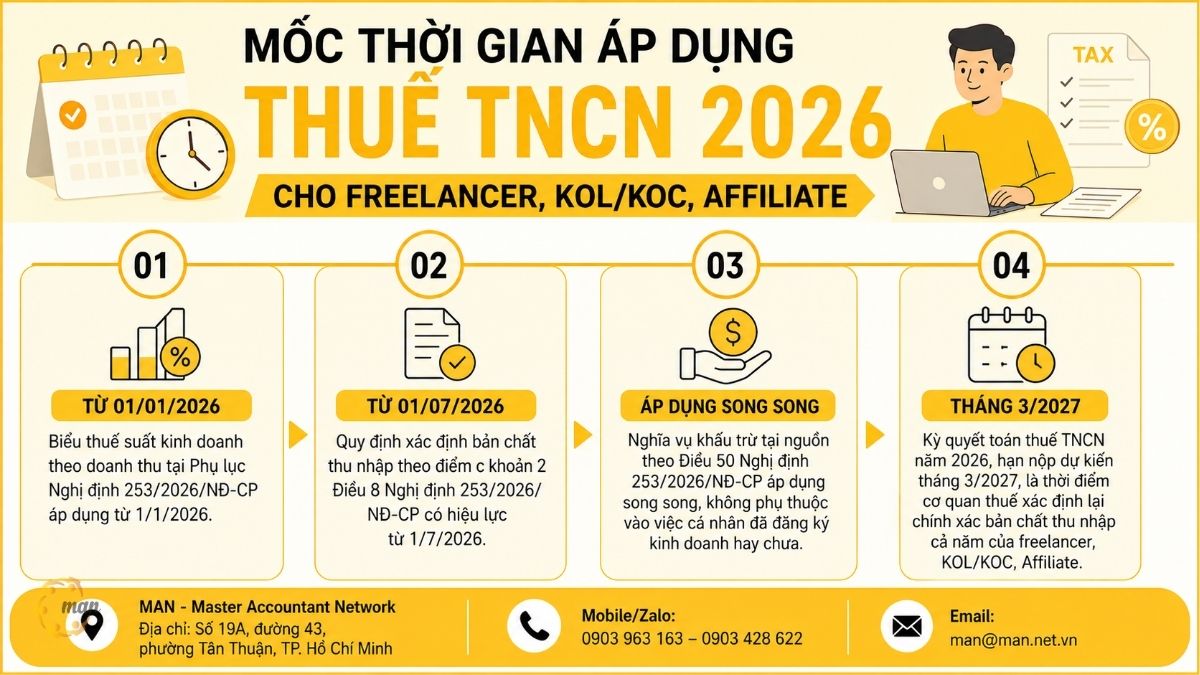
- The business tax rate schedule based on revenue in the Appendix to Decree 253/2026/ND-CP applies from 1/1/2026.
- The regulations defining the nature of income, as stipulated in point c, clause 2, Article 8 of Decree 253/2026/ND-CP, are effective from... 1/7/2026.
- The obligation to deduct at source under Article 50 of Decree 253/2026/ND-CP applies simultaneously, regardless of whether the individual has registered a business or not.
- The 2026 personal income tax settlement period, with the expected deadline in March 2027, is when the tax authorities will accurately determine the nature of the full-year income of freelancers, KOLs/KOCs, and affiliates.
Compilation of legal documents related to personal income tax in 2026 for freelancers, KOLs/KOCs, and affiliates.
Below are the key legal documents governing the determination, declaration, deduction, and payment of income for freelancers, KOLs/KOCs, affiliates, and individuals providing services. This summary table helps you quickly look up the document number, effective date, and key content of each relevant document.
| Document | Number / Validity | The main content relates to Freelancers, KOLs/KOCs, and Affiliates. |
| Personal Income Tax Law 2025 | Resolution No. 109/2025/QH15, effective July 1, 2026 | The regulations stipulate a 5-tier progressive tax system and the classification of business income in Clause 3, Article 7. |
| Decree 253/2026/ND-CP | Effective July 1, 2026 (Tariff rates applicable from January 1, 2026) | Determine the nature of service income as specified in point c, clause 2, Article 8; the tax rate schedule by industry in the Appendix; and the withholding obligation as specified in Article 50. |
| Decree 252/2026/ND-CP | 2026 | Detailed regulations of the Law on Tax Administration related to declaration and deduction. |
| Circular 89/2026/TT-BTC | Issued on June 30, 2026 | Detailed guidance on the Law on Tax Administration and Decree 252/2026/ND-CP |
| Tax Department's promotional materials | Published July 25, 2026 | Specific notes for freelancers, KOLs/KOCs, affiliates, and service providers. |
How to calculate personal income tax for freelancers in 2026: A real-world example.
Mr. C is a freelance graphic designer with a monthly income of 25 million VND from multiple clients, but he is not registered as a business. If the tax authorities determine his income as salary or wages, after deducting the 15.5 million VND personal allowance, his taxable income would be 9.5 million VND, subject to the 5% tax rate, equivalent to 475,000 VND per month, not including the possibility of being subject to retroactive tax collection for the difference compared to the amount already provisionally withheld.
Conversely, if Mr. C registers a design service business under group 2 (tax rate 2%), the tax payable on a revenue of 25 million VND would only be around 500,000 VND, but this is tax on the entire revenue and not eligible for personal deductions. Choosing the appropriate registration form requires balancing the actual revenue scale and the stability of the business.
Case Study: How will KOLs/KOCs earning income from multiple brands be subject to personal income tax in 2026?
Background
Ms. D is a Key Opinion Leader (KOC) working on a short-video platform, receiving product review fees from over 15 different brands annually, with a total income of approximately 480 million VND/year, equivalent to 40 million VND/month. Previously, Ms. D only received payments after deducting tax (10%) at source and did not declare any additional funds.
Risks arise
According to the review MAN – Master Accountant Network, Because the business was not registered, the entire 480 million VND is at risk of being classified by the tax authorities as income from salaries and wages. After deducting personal allowances of 186 million VND/year, the taxable income is approximately 294 million VND/year, falling into tax bracket 20%, meaning the tax payable according to the progressive tax rate is significantly higher than the amount of 10% that was provisionally deducted previously.
Solutions to be implemented
Ms. D was advised to register a business providing digital content services under group 4, with a tax rate of 5% on revenue, and to gather all advertising cooperation contracts with each brand to prove that the nature of the transactions was a business activity providing digital content services, not an employment relationship.
Result
After registering under the correct business type, the tax payable on annual revenue of 480 million VND decreased to approximately 24 million VND according to the 5% rate, significantly lower than the option considered as salaries and wages. Complete contract documentation also helped Ms. D be proactive when the tax authorities cross-referenced data from the brands.
Expert opinion: Common risks faced by freelancers, KOLs/KOCs, and affiliates.
Experts at MAN – Master Accountant Network With over 30 years of experience in tax consulting in Vietnam, we identify the four most common risks that freelancers, KOLs/KOCs, and affiliates face when entering the period of personal income tax application in 2026.
- Risk number one This involves confusing the 10% deduction at source with the final tax liability, leading to surprises when additional tax is due during tax settlement.
- Second risk This means not registering a business despite having a stable and regular income, putting all income at risk of being subject to the progressive tax rate of 35%.
- Third risk The lack of contracts and documents proving the nature of transactions with each brand makes it difficult for tax authorities to determine whether these are legitimate business activities.
- Fourth risk This involves incorrectly identifying the business sector group during registration, for example, confusing the service group 2% with the digital content group 5%, leading to incorrect tax rate declaration.
Solutions from MAN – Master Accountant Network This involves reviewing all income sources, properly classifying each item, standardizing contracts with partners, and selecting appropriate registration methods before revenue increases significantly, avoiding situations where the amount of back taxes and late payment penalties exceeds the initial tax savings.
Conclude
The 2026 Personal Income Tax regulations place clearer demands on freelancers, KOLs/KOCs, affiliates, and service providers: proactively determine the true nature of their income, register their business correctly, and prepare complete documentation. The difference between a tax rate of approximately 71% and a progressive tax rate of up to 35% is too significant to ignore, especially for individuals with stable income from multiple sources.
Tax services at MAN – Master Accountant Network
- Tax accounting services
- Tax consulting services
- Tax settlement services
- Tax reporting services
- VAT refund service
Service contact information at MAN – Master Accountant Network
- Address: No. 19A, Street 43, Tan Thuan Ward, Ho Chi Minh City
- Mobile/Zalo: 0903 963 163 – 0903 428 622
- E-mail: man@man.net.vn
- Google Business Profile: View MAN – Master Accountant Network's Google Business Profile
- LinkedIn Founder: View expert Le Hoang Tuyen's LinkedIn profile.
Responsible for production and professional content review by: Mr. Le Hoang Tuyen – Founder & CEO of MAN – Master Accountant Network, CPA Vietnam with over 30 years of experience in accounting, auditing, taxation, and corporate financial consulting.
Frequently Asked Questions about Personal Income Tax in 2026 for Freelancers, KOLs/KOCs, and Affiliates
Will freelancers who don't register their business be fined?
Not registering a business does not automatically result in a penalty, but income may be classified as salary or wages and subject to progressive tax rates up to 35%, and may be subject to retroactive tax collection if previously under-declared.
Is the 10% withholding tax the final tax amount?
No. This is just a provisional deduction. When settling accounts, the tax authorities will reassess the tax liability based on the nature of the transaction, documentation, and applicable regulations.
What tax rate should KOLs/KOCs register for?
Most content production and digital advertising activities by KOLs/KOCs fall under group 4 according to the Appendix of Decree 253/2026/ND-CP, with a tax rate of 5% on revenue, but specific details need to be compared with each type of contract.
Is the paying organization required to deduct taxes from affiliate earnings?
Yes. According to Article 50 of Decree 253/2026/ND-CP, if the payment is subject to withholding tax, the paying organization must still withhold tax before payment, regardless of whether the individual has registered a business or not.
What documents do freelancers need to prepare to avoid high tax rates?
It is necessary to register a business or register for tax purposes when operating independently and regularly; keep complete records of contracts and payment documents with each partner; and not confuse temporary deductions (10%) with tax obligations after final settlement.




