
Contractor tax rate for international transportation services This is a key factor directly impacting the cost structure and cash flow management efficiency of import-export businesses. Understanding and accurately applying current legal documents helps businesses proactively negotiate trade contracts, correctly calculate tax obligations, and eliminate legal risks arising from incorrect or late declarations.
The new legal framework includes: Decree 320/2025/ND-CP, Decree 181/2025/ND-CP and Circular 20/2026/TT-BTC This has created a synchronized adjustment mechanism for cross-border freight transactions. The team of experts at MAN – Master Accountant Network, with over 30 years of practical experience, provides a comprehensive analysis of contractor tax obligations and related preferential regulations in the in-depth article below.
Summary of key points regarding contractor tax rates for international transportation services.
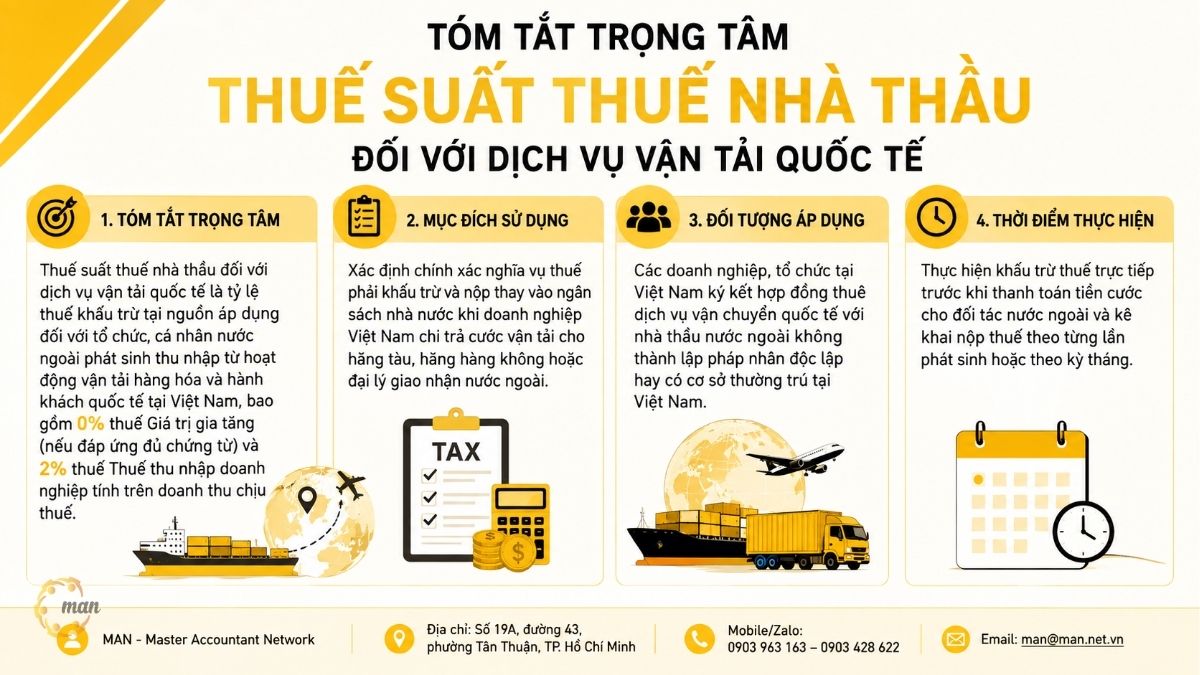
- The contractor tax rate for international transport services is the withholding tax rate applied to foreign organizations and individuals generating income from international freight and passenger transport activities in Vietnam, including Value Added Tax (if sufficient documentation is provided) and Corporate Income Tax calculated on taxable revenue.
- Purpose of use: Accurately determine the tax obligations that must be withheld and remitted to the state budget when Vietnamese businesses pay freight charges to foreign shipping companies, airlines, or forwarding agents.
- Applicable objects: Businesses and organizations in Vietnam that sign international transportation service contracts with foreign contractors who do not establish independent legal entities or have permanent establishments in Vietnam.
- Time of execution: The tax is deducted directly before payment of freight charges to foreign partners, and taxes are declared and paid on a transaction-by-transaction or monthly basis.
What are the detailed regulations regarding the contractor tax rate for international transportation services?
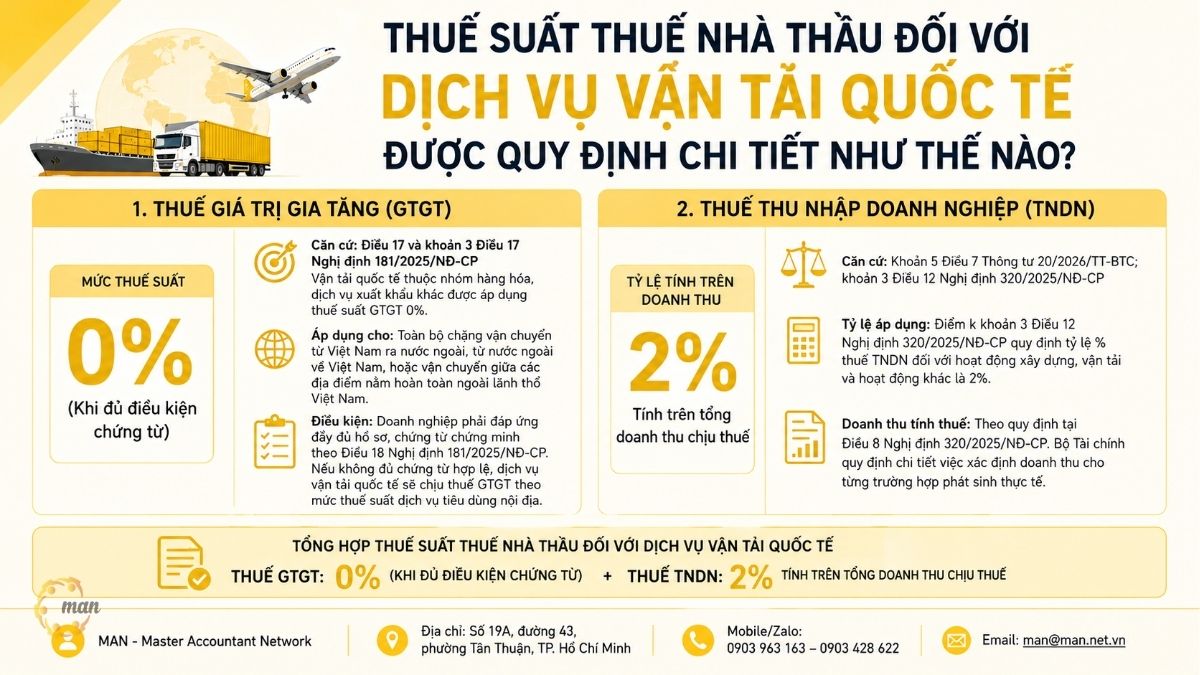
The contractor's tax obligations for cross-border transportation services consist of two independent taxes: Value Added Tax (VAT) and Corporate Income Tax. Each type of tax has its own method of determination and application conditions, which are detailed in the system of legal regulations.
Value Added Tax (VAT) rates for international transportation.
Based on the provisions of Article 17 of Decree 181/2025/ND-CP, the VAT rate 0% is applied to exported goods and services as stipulated in Clause 1, Article 9 of the Value Added Tax Law. Specifically, Clause 3, Article 17 of Decree 181/2025/ND-CP stipulates that international transportation falls under the category of other exported goods and services, and is subject to a VAT rate of 0%. This regulation applies to all transportation routes from Vietnam to abroad, from abroad to Vietnam, or transportation between locations entirely outside the territory of Vietnam.
To be eligible for the 0% tax rate, businesses must fully meet the requirements regarding documentation and supporting evidence as stipulated in Article 18 of Decree 181/2025/ND-CP. If a business does not prepare all the required valid documents, international transportation services will not be eligible for the 0% tax rate and will be subject to VAT at the rate prescribed for domestic consumption services.
The % rate of corporate income tax (CIT) is calculated on international transportation revenue.
- Based on the provisions of Clause 5, Article 7 of Circular 20/2026/TT-BTC, the % ratio on taxable corporate income applicable to foreign enterprises operating in Vietnam shall be implemented according to the provisions of Clause 3, Article 12 of Decree 320/2025/NĐ-CP.
- On the other hand, Clause 3, Article 12 of Decree 320/2025/ND-CP stipulates the method for calculating tax for foreign enterprises without a permanent establishment in Vietnam.
- Specifically, point k, clause 3, Article 12 of Decree 320/2025/ND-CP stipulates that the corporate income tax rate calculated on taxable revenue generated in Vietnam for construction, transportation, and other activities is 2%.
- Taxable corporate income is determined according to the provisions of Article 8 of Decree 320/2025/ND-CP, in which the Ministry of Finance specifies the detailed method for determining revenue for each actual case.
Therefore, the contractor tax rate for international transportation services includes: VAT at 0% (when documentation is sufficient) and Corporate Income Tax at 2% calculated on the total taxable revenue.
The concept and legal nature of contractor tax in the field of international transport.
Foreign Contractor Tax (FCT) is a tax collection mechanism implemented by the State for foreign organizations and individuals doing business or generating income in Vietnam. For the international transportation services industry, this mechanism helps the tax authorities collect corporate income tax on the portion of freight revenue received by foreign contractors.
Which legal document governs foreign-owned transportation businesses?
Foreign contractors engaged in transportation business operate within the legal framework stipulated in Decree 320/2025/ND-CP, Decree 181/2025/ND-CP, and Circular 20/2026/TT-BTC. If the foreign contractor does not establish a legal entity in Vietnam and does not comply with Vietnamese accounting regulations, the Vietnamese party is responsible for withholding and paying taxes on their behalf. If the foreign contractor's country has signed a Double Taxation Avoidance Agreement (DTA) with Vietnam, the corporate income tax exemption process will be considered and resolved according to separate procedures.
How is the taxable revenue of a transportation service contractor determined?
- Taxable revenue for corporate income tax purposes in international transportation is the total freight charges collected from the leg of the journey from Vietnam to abroad or from abroad to Vietnam.
- Taxable revenue includes both the main fee and any additional fees (surcharges) that the foreign contractor is entitled to under the service contract.
- Taxable revenue excludes the portion of transportation fees for which corporate income tax has already been paid in Vietnam for domestic routes, or the portion of transportation fees that have been outsourced to a third party.
Summary of current legal documents regulating transportation contractor tax
To assist businesses in quickly accessing relevant information, MAN has compiled a system of currently effective legal documents regulating this field.
| Document number | Text type | Summary of relevant legal content |
| Corporate Income Tax Law 2025 | Law | Articles 12 and 14 stipulate the principles for applying corporate income tax incentives and incentives for expansion investment projects. |
| Decree 320/2025/ND-CP | Decree | Point k, Clause 3, Article 12 stipulates the 2% corporate income tax rate calculated on revenue for transportation activities. |
| Decree 181/2025/ND-CP | Decree | Articles 17 and 18 stipulate the VAT rate of 0% for international transportation and the accompanying documentation requirements. |
| Circular 20/2026/TT-BTC | Circular | Clause 5 of Article 7 provides guidance on determining the % ratio for calculating corporate income tax on revenue according to Decree 320/2025/NĐ-CP. |
| Circular 69/2025/TT-BTC | Circular | Regulations on declaration procedures, declaration forms, and the process for paying contractor taxes through the electronic portal. |
| High-Tech Law 2025 | Law | Clause 7 of Article 25 amends and supplements the list of business sectors eligible for corporate income tax incentives in the Corporate Income Tax Law 2025. |
| Cybersecurity Law 2025 | Law | Clause 9 of Article 43 adds cybersecurity products and information security services to the group eligible for tax incentives. |
Detailed conditions for enjoying the VAT rate 0% for international transportation services.
The VAT rate of 0% offers significant financial benefits to businesses; however, tax authorities always closely monitor the validity of the documentation.
Valid transport contract and transport documents
The transportation contract signed between the charterer and the contractor must clearly state that the transportation route includes a point of origin or destination outside the territory of Vietnam. The contract can be in the form of a directly signed document or other legally equivalent delivery documents such as a Bill of Lading or an Airway Bill of Lading. The information regarding the name of the goods, quantity, sender, and recipient on the bill of lading must be completely consistent with the commercial contract and sales invoice.
Non-cash payment vouchers
Vietnamese businesses must make freight payments to foreign contractors through commercial banks or legally recognized credit institutions. The money transfer documents must show the flow of funds originating from the carrier's account to the account of the foreign contractor or authorized agent. Any cases of offsetting freight charges must be clearly agreed upon in the contract and a periodic reconciliation statement must be prepared as required.
Common errors that lead to businesses being charged VAT rate 5% instead of 0%.
- The most common error is that the business name or address on the Bill of Lading differs from the information on the customs declaration and the foreign trade contract.
- The second error is that businesses process payment by depositing cash into accounts or transferring money to unregistered personal accounts.
- The third error is the failure to separate domestic and international transportation costs on the same service invoice.
When the documentation fails to prove the continuity of the international leg of the journey, the tax authorities have the right to apply the VAT rate 5% to the entire contract.
How to calculate international freight contractor tax: Gross-up and Net methods
Whether the contract price is agreed upon as a Gross price (including tax) or a Net price (excluding tax) directly determines the formula for calculating contractor tax.
Formula for calculating tax when the contract specifies a gross price.
In cases where the contract specifies a payment value for the foreign contractor. Contractor tax included:
- VAT payable = Taxable revenue × 0% = 0 dong, if international transport services meet the conditions for applying tax rate 0%.
- Taxable revenue for corporate income tax = The total contract value includes tax..
- Corporate income tax payable = Taxable revenue × 2%.
Gross-up formula when the contract specifies a Net price.
In cases where the contract specifies a payment value for the foreign contractor. Excluding contractor tax., The Vietnamese party pays the tax on behalf of the taxpayer and must convert the net price to taxable revenue.
- Corporate income tax (Gross-up) = Revenue excluding tax / (1 – 2%).
- Corporate income tax payable = Corporate income taxable revenue (Gross-up) × 2%.
- VAT payable = 0 dong, if international transportation services meet the conditions for applying VAT rate 0%.
Practical case study: Calculating contractor tax for import orders under EXW terms.
To clearly illustrate the practice process, MAN analyzes a real-world audit case study that arose at an electronic component import company in Ho Chi Minh City.
Transaction context and contract parameters
Company A in Ho Chi Minh City imported a shipment of components from a Japanese partner under EXW Tokyo terms.
Company A signed a shipping contract with Shipping Line K (registered in Singapore, with no permanent establishment in Vietnam) to transport goods from Yokohama Port to Cat Lai Port.
The agreed international freight rate is USD 20,000. The contract stipulates that this rate is the net price, and Company A is responsible for paying all taxes incurred in Vietnam.
The exchange rate at the time of payment through the bank was 25,500 VND/USD.
Detailed steps for calculating tax obligations.
Step 1: Determine the contract value in Vietnamese Dong using the current exchange rate.
Net revenue = 20,000 USD x 25,500 VND/USD = 510,000,000 VND.
Step 2: Determine VAT.
Since Company A provided sufficient bills of lading showing the Yokohama – Cat Lai route and a bank transfer, the applicable VAT rate is 0%.
VAT payable = 510,000,000 x 0% = 0 VND.
Step 3: Determine taxable corporate income using the Gross-up method.
The corporate income tax rate for transportation services, according to point k, clause 3, Article 12 of Decree 320/2025/ND-CP, is 2%.
Corporate income taxable revenue (Gross-up) = 510,000,000 / (1 – 0.02) = 520,408,163 VND.
Step 4: Calculate the corporate income tax payable on behalf of the plaintiff.
Corporate income tax paid on behalf of others = 520,408,163 x 2% = 10,408,163 VND.
Thus, Company A transferred VND 510,000,000 to Shipping Company K and deposited VND 10,408,163 into the State Treasury.
Practical lessons from MAN experts.
Experts at MAN, with 30 years of experience, note that the aforementioned corporate income tax payment of VND 10,408,163 is deductible as an expense when calculating corporate income tax for Company A. A mandatory condition is that the clause regarding tax payment on behalf of the contractor must be clearly stated in the transportation service contract, and Company A must keep complete records of tax payments. If the contract does not specify a Net clause, the tax expense paid on behalf of the taxpayer will be separated from the deductible expenses by the tax authorities during tax settlement.
Common contractor tax risks and expert recommendations from MAN.
During the process of advising and representing businesses in tax matters, MAN has identified numerous risks that could lead to businesses being subject to back taxes and administrative penalties.
- Risk of not separating domestic and international leg costs: Many shipping contracts include international freight charges along with the costs of loading, unloading containers, and domestic transportation (trucking) in Vietnam. The tax authorities will separate and determine the VAT (VAT 5%) and corporate income tax (CIT 5%) for the entire contract value if the business does not have a detailed allocation table. MAN's experience shows that it's necessary to require service providers to separate the value of each segment in the quotation and contract addendum right from the start.
- Risks associated with logistics surcharges: Additional charges such as documentation fees (Doc fee), port handling fees (THC), and container cleaning fees incurred at Vietnamese ports often cause problems. If surcharges are included in international freight charges by foreign shipping companies, the applicable VAT is 0% and the corporate income tax is 2%. In cases where surcharges are collected by the delivery agent in Vietnam and a domestic VAT invoice is issued, that amount is subject to VAT under code 5% or 10% as per regulations for domestic services.
- Comprehensive solutions from MAN – Master Accountant Network: MAN provides a comprehensive review solution for all transportation service contracts and logistics documents for businesses. Our team of experts assists in verifying the legality of payment documents and bills of lading before filing tax returns. MAN directly represents businesses in explaining their expenses to the tax authorities to protect their legitimacy and optimize the amount of tax payable.
Are manufacturers of key digital technology products and services eligible for corporate income tax incentives?
Besides the issue of transportation contractor tax, many businesses operating in the digital logistics technology sector have questions about corporate income tax incentives.
Legal basis for tax incentives in the digital technology sector
According to point b, clause 2, Article 12 of the Corporate Income Tax Law 2025 (amended and supplemented by clause 7, Article 25 of the High-Tech Law 2025 and clause 9, Article 43 of the Cybersecurity Law 2025), the principles and subjects eligible for corporate income tax incentives include:
- Venture capital investment for high-tech development is prioritized for strategic technology development; high-tech incubation, strategic technology incubation, high-tech enterprise incubation, and strategic technology enterprise incubation as stipulated in the High-Tech Law; and investment in the construction and operation of high-tech incubation facilities and high-tech enterprise incubation facilities.
- Software product manufacturing.
- The production of cybersecurity products and the provision of cybersecurity services must comply with the legal regulations on cybersecurity.
- Manufacturing key digital technology products and services, and producing electronic equipment in accordance with the law on the digital technology industry.
- Research and development, design, manufacturing, packaging, and testing of semiconductor chip products.
- Build an artificial intelligence data center.
Based on the above regulations, the production of key digital technology products and the provision of digital technology services are officially included in the list of industries and professions eligible for corporate income tax incentives under current law.
Policy implications for digital technology businesses
Tax incentives provide a strong impetus for businesses to develop warehouse management software, digital logistics platforms, and supply chain solutions. Businesses investing in key digital technology sectors will be eligible for preferential tax rates, tax exemptions, and corporate income tax reductions, as specified in detail for each locality and project scale.
Corporate income tax incentives for expansion investment projects under the Corporate Income Tax Law 2025.
Clause 5, Article 14 of the Corporate Income Tax Law 2025 specifies the mechanism for applying corporate income tax incentives to investment projects that expand scale, increase capacity, and innovate technology.
In the case where the project is currently enjoying tax incentives.
Businesses with ongoing investment projects aimed at expanding scale, increasing capacity, innovating technology, reducing pollution, or improving the environment, within industries, professions, and geographical areas eligible for corporate income tax incentives as stipulated in Article 12 of the 2025 Corporate Income Tax Law, shall:
- The additional income generated from the expansion investment is eligible for tax incentives under the current project for the remaining period.
- Businesses are not required to separately account for additional income from expansion investments from income from ongoing projects.
In cases where the project has exceeded the tax incentive period.
In cases where an operating project has exceeded its tax incentive period, the additional income from the expanded investment project that meets the criteria specified in Clause 6, Article 14 of the Corporate Income Tax Law 2025 will be exempt from tax, subject to tax reduction, and will not be entitled to preferential tax rates.
The tax exemption and reduction period for additional income resulting from investment expansion is the same as the tax exemption and reduction period applied to new investment projects in the same industry, profession, and geographical area eligible for corporate income tax incentives, and is calculated from the year the investment project completes its registered investment capital. Businesses are required to separately account for the additional income from expansion investments in order to qualify for incentives.
If separate accounting is not possible, income from expanded investment activities shall be determined according to the ratio between the original cost of newly invested fixed assets put into use for production and business and the total original cost of fixed assets of the enterprise.
| Revenue from expansion investments = Taxable income x (Original cost of newly invested fixed assets / Total original cost of fixed assets of the enterprise) |
Exceptions to which expanded investment incentives do not apply
The tax incentives for expansion investments stipulated in this clause absolutely do not apply to cases of expansion investments resulting from mergers, acquisitions of businesses, or existing investment projects. Businesses conducting mergers and acquisitions (M&A) transactions should note this point to avoid misdeclaring tax incentives, which could lead to the risk of tax arrears and penalties.
Comparison table of contractor tax obligations in the international transport industry with other service industries.
To help accounting departments clearly distinguish the contractor tax rates for international transportation services compared to other types of services, MAN has compiled the following comparison table.
| Comparison criteria | International transportation services | Consulting and management services | Software services, licensing | Construction and installation services |
| VAT rate | 0% (if all documents are complete) | 5% | Tax-exempt or 0% | 3% or 5% |
| Corporate income tax rate | 2% (Clause 3, Article 12, Decree 320/2025) | 5% | 10% (Copyright) / 5% (Service) | 2% (excluding transportation costs) / 1% (including transportation costs) |
| Legal basis for corporate income tax | Point k, Clause 3, Article 12 of Decree 320/2025 | Article 12 of Decree 320/2025 | Article 12 of Decree 320/2025 | Point k, Clause 3, Article 12 of Decree 320/2025 |
| Key documents | Bill of Lading, AWB, Money Transfer | Contract, Acceptance Certificate | Contracts, Copyright Certificates | Contract, Acceptance Certificate |
Conclude
Determining the correct contractor tax rate for international transportation services plays a crucial role in managing logistics costs and ensuring tax compliance. The coordination between the VAT rate (0%) and the corporate income tax rate (2%) requires businesses to prepare standardized payment and transportation documentation.
Tax services at MAN – Master Accountant Network
- Tax accounting services
- Tax consulting services
- Tax settlement services
- Tax reporting services
- VAT refund service
Service contact information at MAN – Master Accountant Network
- Address: No. 19A, Street 43, Tan Thuan Ward, Ho Chi Minh City
- Mobile/Zalo: 0903 963 163 – 0903 428 622
- E-mail: man@man.net.vn
- Google Business Profile: View MAN – Master Accountant Network's Google Business Profile
- LinkedIn Founder: View expert Le Hoang Tuyen's LinkedIn profile.
Responsible for production and professional content review by: Mr. Le Hoang Tuyen – Founder & CEO of MAN – Master Accountant Network, CPA Vietnam with over 30 years of experience in accounting, auditing, taxation, and corporate financial consulting.
Frequently Asked Questions (FAQ) about International Freight Contractor Tax
Are return shipping costs from overseas to Vietnam subject to contractor tax?
Yes. Revenue from transportation services from abroad to Vietnam, performed by foreign contractors, is subject to contractor tax with VAT (0%) and corporate income tax (2%).
If a foreign shipping company authorizes its agent in Vietnam to collect payments, which entity is responsible for paying the taxes?
The agent in Vietnam is responsible for deducting, declaring, and remitting contractor tax before transferring freight payments overseas to the shipping company.
Can corporate income tax paid on behalf of another party be considered a deductible expense for Vietnamese businesses?
Yes. If the contract clearly states that the payment value is the net price and the business has documentation proving tax payment to the government, then the tax paid on behalf of the company can be included as a deductible expense when calculating corporate income tax.
What are the deadlines for submitting contractor tax returns for each transaction?
The deadline for submitting contractor tax returns for each transaction is no later than the 10th day from the date the tax liability arises (the date payment is made to the contractor).
Can businesses apply the Double Taxation Avoidance Agreement to sea freight rates?
Yes. If the shipping company is from a country that has signed a Double Taxation Avoidance Agreement with Vietnam, the company must prepare a notification of corporate income tax exemption under the Agreement and submit it to the tax authorities.