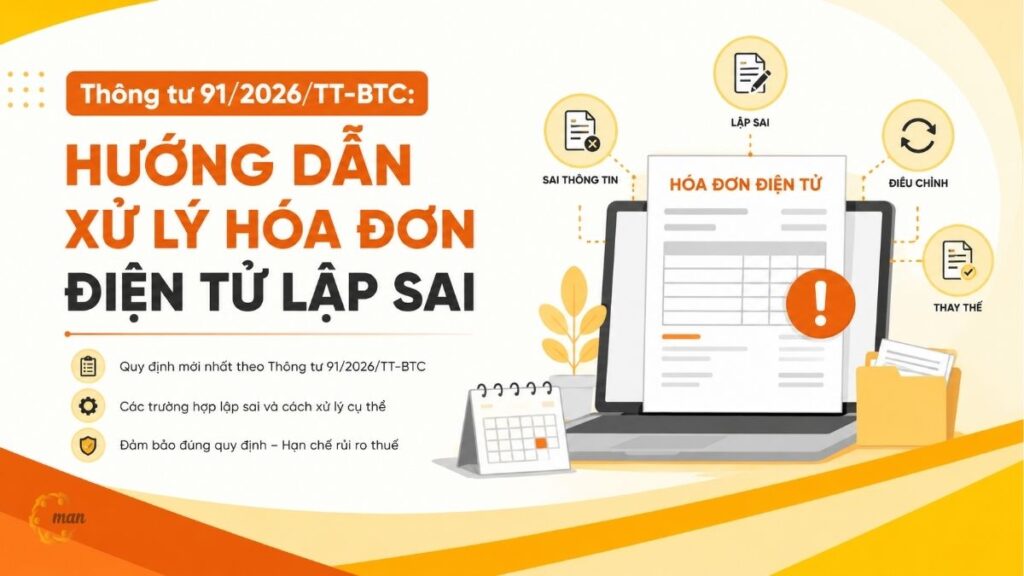
Circular 91/2026/TT-BTC Officially effective from July 1, 2026, this circular establishes a detailed and synchronized legal framework for handling erroneous electronic invoices. This is a key document that helps the business community standardize accounting processes, minimizing risks related to tax assessments or the disallowance of legitimate expenses during tax settlement. Adhering to the principles in this circular is not only a compliance obligation but also a measure to protect the assets and reputation of businesses.
With over 30 years of experience in auditing and tax consulting, experts at MAN – Master Accountant Network believe that Circular 91/2026/TT-BTC requires accounting departments to thoroughly understand and handle each specific situation. This article systematizes the regulations and provides practical solutions to help businesses apply them accurately, avoiding common errors in business operations in Vietnam.
Summary of key points in Circular 91/2026/TT-BTC
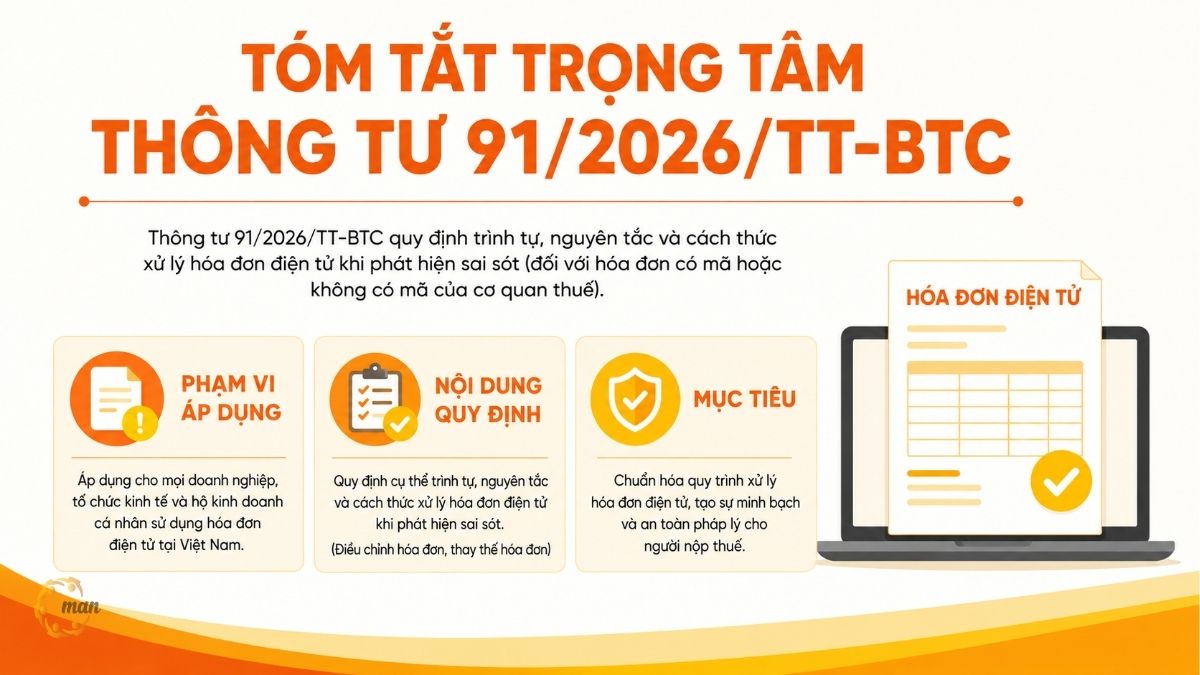
Circular 91/2026/TT-BTC is a document regulating the procedures, principles, and methods for handling electronic invoices when errors are detected (for invoices with or without tax authority codes). This applies to all businesses, economic organizations, and individual business households using electronic invoices in Vietnam. The core objective of the circular is to standardize the process of adjusting and replacing invoices, creating transparency and legal security for taxpayers.
The role of Circular 91/2026/TT-BTC in tax administration.
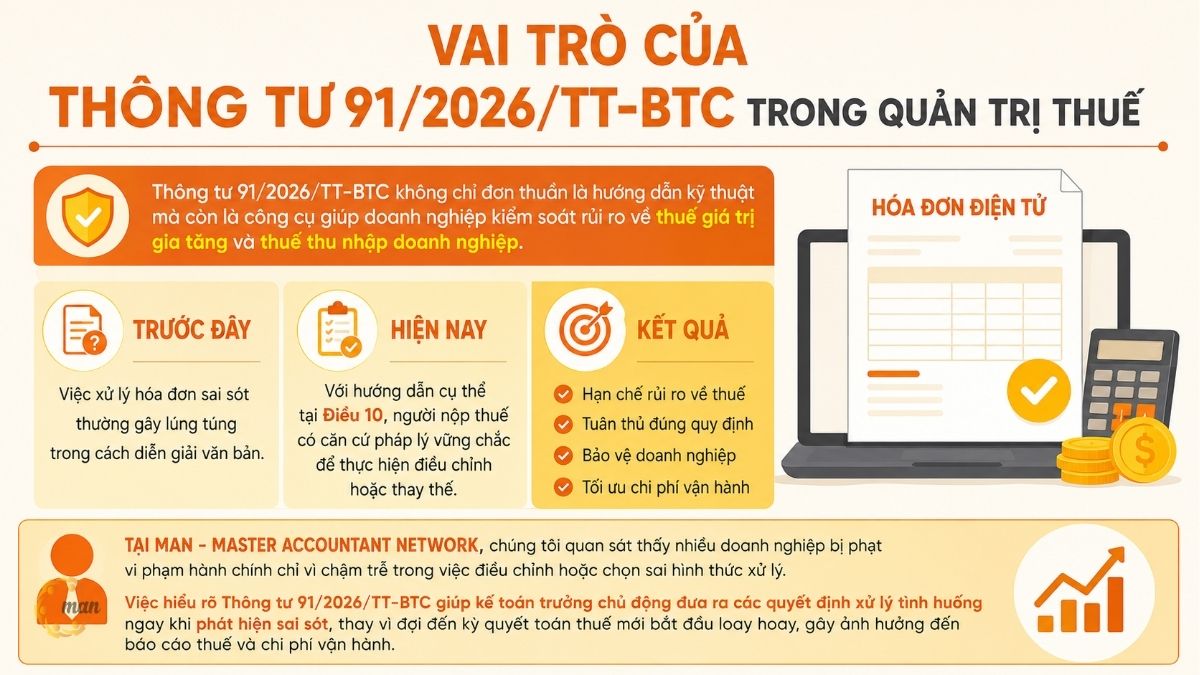
Circular 91/2026/TT-BTC is not merely a technical guideline but also a tool to help businesses control risks related to value-added tax and corporate income tax. Previously, handling erroneous invoices often caused confusion in interpreting the document. Now, with the specific guidance in Article 10, taxpayers have a solid legal basis to make adjustments or replacements.
At MAN – Master Accountant Network, we observe that many businesses are fined for administrative violations simply because of delays in making adjustments or choosing the wrong method of handling them. Understanding Circular 91/2026/TT-BTC helps chief accountants proactively make decisions to address situations as soon as errors are detected, instead of waiting until the tax settlement period to start scrambling, which can affect tax reporting and operating costs.
See more articles at: Decree 254/2026/ND-CP: Comprehensive guidance on electronic invoices and documents
Summary table of 13 cases of incorrect electronic invoice processing. Circular 91/2026/TT-BTC
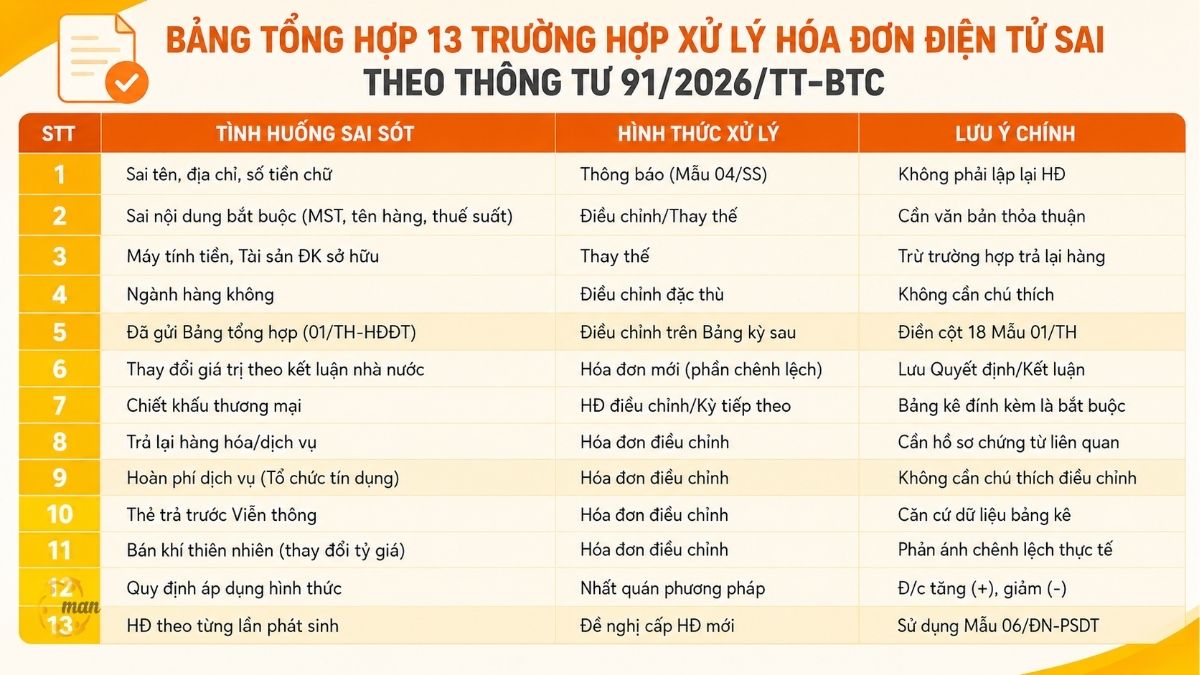
To assist businesses and accounting departments in quickly searching for information and making accurate decisions in any situation, we have systematized all 13 cases of electronic invoice processing according to Circular 91/2026/TT-BTC into the summary table below:
| STT | Error situation | Form of handling | Key notes |
|---|---|---|---|
| 1 | Incorrect name, address, or amount in words. | Notification (Form 04/SS) | No need to repeat the contract. |
| 2 | Incorrect required information (Tax ID, product name, tax rate) | Adjust/Replace | A written agreement is required. |
| 3 | Cash register, Registered Asset | Replace | Except in the case of returns. |
| 4 | Aviation industry | Specific adjustments | No annotation needed. |
| 5 | Summary Table (01/TH-HĐĐT) has been submitted. | Adjustments on the Table for the next period | Fill in column 18 of Form 01/TH |
| 6 | Changes in value according to state conclusions. | New invoice (difference) | Save Decision/Conclusion |
| 7 | Trade discount | Contract adjustment/Next period | The attached statement is required. |
| 8 | Return goods/services | Adjustment invoice | Relevant documents are required. |
| 9 | Refund of service fees (Credit institutions) | Adjustment invoice | No adjustment notes needed. |
| 10 | Prepaid Telecommunications Card | Adjustment invoice | Based on the statement data |
| 11 | Selling natural gas (due to exchange rate fluctuations) | Adjustment invoice | Reflecting the actual discrepancies |
| 12 | Regulations on the application of the form | Methodological consistency | The number increases (+), decreases (-) |
| 13 | Contracts are based on individual transactions. | Request for a new contract | Use Form 06/DN-PSDT |
Details of 13 cases of handling incorrect electronic invoices according to Article 10. Circular 91/2026/TT-BTC
Article 10 of Circular 91/2026/TT-BTC specifies the procedures for handling errors depending on their nature and content.
1. In case of incorrect name, address, or amount in words.
In cases where there are errors in the invoice's contents such as name, address, amount in words, or other details, but not in the tax code, amount recorded on the invoice, tax rate, tax amount, or goods listed on the invoice, the seller must notify the buyer that the invoice is incorrect and does not need to reissue it. The seller must notify the tax authority about the incorrect electronic invoice using Form No. 04/SS-HĐĐT, Appendix III, attached to Circular 91.
2. In case of errors in mandatory information (tax code, product name, tax rate)
When an invoice contains errors regarding the tax identification number, product name, specifications, quality, amount, tax rate, or other mandatory information, the seller can choose to adjust or replace it.
- Adjust: A note detailing the adjustment to the invoice number, symbol, form number, and date must be included.
- Replace: A note indicating the replacement of the invoice number, symbol, form number, and date must be included. The seller digitally signs the new invoice and then sends it to the buyer or the tax authority (for invoices with a code) for code issuance. If multiple invoices with the same information are incorrectly issued to the same buyer within a month, the seller may issue one adjustment or replacement invoice for all invoices, attaching a list according to Form No. 01/BK-ĐCTT.
Note from MAN: A written agreement must be drawn up between the two parties (except in the case of e-commerce and aggregated data). This document must be kept at the unit for inspection purposes.
3. Receipts from cash registers and goods registered under ownership rights.
For electronic invoices generated from cash registers or invoices for the sale of goods that are assets subject to registration of ownership or use rights (such as cars, motorcycles, real estate), the regulations require stricter procedures. If errors are discovered, the seller must... Issuing a replacement invoice is mandatory. This applies to invoices that have been incorrectly issued, except in cases of returning goods or services. This measure aims to ensure consistency between asset records and accounting documents.
4. Adjusting invoices with the airline industry.
For the aviation industry, Circular 91/2026/TT-BTC provides a flexible mechanism to reduce administrative procedures:
- Air freight exchange or refund documents are considered adjustment invoices without needing to include the information "Adjustment increase/decrease for invoice Form No… symbol… date… month… year".
- Air freight carriers are permitted to issue their own invoices for cases involving refunds or exchanges of shipping documents issued by agents.
5. Note regarding cases where the seller has already sent the Summary of Electronic Invoice Data.
When an electronic invoice has been incorrectly issued and the seller has submitted the Summary of Electronic Invoice Data (Summary Table) to the tax authority, the processing procedure cannot be carried out in the usual way:
Principle: Seller Failure to send notification Form No. 04/SS-HĐĐT Instead of submitting the information to the tax authorities, the seller submits the adjustments and replacements directly on the Summary Data Sheet for subsequent periods.
Handling Errors/Missing Items in the Summary Table: If the data in the submitted Summary Table is missing or incorrect, the seller must resubmit it. Summary table of supplementary electronic invoice data.
Technical requirements: When adjusting data on the Summary Table, the seller must fill in all the following information: Invoice form symbol, invoice symbol, and invoice number. Column 18 “Related invoice information” as per Form No. 01/TH-HĐĐT Appendix III attached to Circular 91.
Exceptions (Column 18 is not mandatory):
- Electronic invoices do not necessarily have to contain all the information regarding the form number symbol, invoice symbol, and invoice number as stipulated in point 9 of the Appendix to Decree No. 254/2026/ND-CP.
- Adjustment or replacement invoices require the preparation of a statement using Form No. 01/BK-ĐCTT.
Transaction details table: If the transaction details database attached to the Summary Table is incomplete or incorrect, the seller must send a replacement. Additional transaction details table.
Analysis from MAN: Synchronization between the Summary Report and actual data is crucial. Businesses need to closely monitor the submission status of the Summary Report immediately after each filing period.
6. In cases where the invoice value or quantity changes based on the conclusions of a state agency.
For electronic invoices issued for the sale of goods or provision of services that are not incorrect but show changes in value or quantity during actual payment or settlement based on conclusions from competent state agencies in accordance with relevant laws, the seller shall issue a new electronic invoice reflecting the difference.
How to do it: Invoice the difference (record a negative number for a decrease or a positive number for an increase).
Applicable cases:
- Adjust the final settlement value of the investment project when there are changes in unit prices or quantities.
- Adjust selling prices in accordance with relevant laws and regulations.
- Adjust the value and quantity based on the conclusions and decisions of competent state agencies in accordance with relevant laws.
- Adjusting wholesale electricity prices between Vietnam Electricity Group and the Electricity Corporations, and between Electricity Companies and other Electricity Companies.
Note from MAN experts: This invoice is not a correction invoice, but rather an invoice reflecting the actual transactions that occurred after the tax settlement. Therefore, businesses are required to retain the Decision/Conclusion of the state agency as a legal basis for issuing invoices and for explanation when the tax authorities conduct an audit.
7. Cases involving invoice adjustments for trade discounts.
In cases where trade discounts are based on quantity or sales volume of goods or services, adjustments are made using two methods:
- Method 1: The adjustment will be made directly on the invoice of the last purchase or the next period (the total discount amount must not exceed the value of the goods stated on the invoice).
- Method 2: Prepare a separate adjustment invoice along with a detailed list of the invoices requiring adjustment, the adjusted amounts, and the adjusted tax amounts.
Note from MAN experts:
- Regarding the Statement: The statement under method 2 is a mandatory document that must include the adjustment invoice. This statement must be stored at the unit and presented in full when requested by the tax authorities.
- Regarding Accounting: Both buyers and sellers must declare and account for the discount adjustment invoice in the correct period. The lack of a statement or confirmation document for the discount is often the reason for the disallowance of expenses during corporate income tax settlement; therefore, ensure this documentation is always complete and transparent.
8. Handling electronic invoices in cases of goods or services returns.
- In case of returning goods: When the buyer returns all or part of the goods (including in cases of exchange resulting in a change in value), the seller issues an adjusted invoice. If agreed upon by both parties, the buyer may issue a return invoice to the seller. Both parties are responsible for fulfilling their respective tax obligations as stipulated by law when selling goods.
- In cases where the goods are assets requiring registration: For assets subject to registration of use/ownership rights (cars, real estate) and already registered in the buyer's name, if the return complies with relevant legal regulations, the buyer, being the user of electronic invoices, must issue a return invoice to the seller.
- Regarding premium refunds/reductions, and reductions in insurance brokerage commissions: Based on the original invoice, the seller issues an adjusted invoice to the customer (regardless of whether payment has been made or not). The invoice must clearly state the reason and the amount of the refund/reduction. In cases where insurance premiums have not yet been collected: Insurance companies issue consolidated adjustment invoices for outstanding premiums from the previous month, along with a detailed list of invoices, adjusted amounts, and adjusted tax amounts.
- In case of transaction cancellation/termination: For real estate and construction transactions, when a transaction is canceled/terminated or a part of a service is canceled, the seller adjusts the issued invoice similarly to the case of returning goods.
Note from MAN experts: For return transactions, documentation is crucial. Besides the adjustment invoice, businesses need to keep complete records of: the contract, the goods return record (clearly stating the reason), the warehouse receipt (for the seller) or the warehouse delivery note (for the buyer), and payment/debt offsetting documents. Tax authorities regularly verify discrepancies between the date of the adjustment invoice and the actual date of goods delivery based on the delivery receipt.
9. Cases where credit institutions refund service fees.
For credit institutions and non-cash payment service providers, when a transaction involves refunding service fees to a customer after the fee has already been invoiced:
- The service provider will issue an invoice to make the adjustment.
- Points to note: On the invoice No need to fill in the information. “"Adjustment for invoice number…. Form number… symbol… dated… month… year".
- If there is a written agreement before invoicing, this document should be kept along with the service receipt at the unit for easy presentation upon request.
Note from MAN experts: The exemption from recording adjustment information represents a significant procedural simplification for the financial industry. However, credit institutions need to ensure their internal accounting systems match the data on adjustment invoices, as refund transactions often occur frequently and on a large scale. The management of archived agreement documents should be digitized for easy retrieval during audits.
10. Cases requiring adjustment of prepaid telecommunications service card invoices.
For customers using prepaid mobile telecommunications cards to pay for accepted services, and telecommunications businesses have issued VAT invoices when selling cards/providing services, the following procedures apply in case of errors or adjustments:
- Businesses base their decisions on data on the statement (including: subscriber number, pre-tax card value, corresponding VAT) to create an adjustment invoice.
- Points to note: This statement is the most important legal basis for the tax authorities to determine the reasonableness of the tax adjustment amount. Businesses need to keep this statement securely stored.
Note from MAN experts: Using summary sheets instead of detailed invoices significantly saves telecommunications companies printing and data costs, but the pressure to ensure data accuracy on these summary sheets is immense. Accountants need to ensure the accounting system accurately reflects the data summarized on the summary sheets before issuing adjustment invoices.
11. In cases where the face value of a natural gas sales invoice changes.
For the sale of natural gas in the Vietnamese market (price stated in the contract in foreign currency, payment in VND):
- When an invoice has been issued correctly but the actual payment changes due to currency exchange rate fluctuations, the seller is allowed to issue an adjusted invoice for the difference resulting from the exchange rate.
- Procedure: This adjustment invoice accurately reflects the actual difference in the amount paid.
Note from MAN experts: This is a unique characteristic of the gas/oil industry. Businesses need to retain documents related to exchange rates at the time of payment (usually bank documents) to directly compare with the difference on the adjusted invoice. This is often the first item that tax authorities check when auditing foreign currency revenue.
12. Instructions on applying the form of adjustment and replacement invoices
Businesses need to adhere to general principles when making adjustments or replacements:
- Principle of consistency: If a particular method of correction (Adjustment or Replacement) was used for the initial correction, then subsequent corrections for the same error must follow the same method.
- The invoice has no markings: For invoices that do not have a sample number, invoice symbol, or invoice number as prescribed, the seller is only allowed to issue an adjustment invoice.
- The rule of value: Adjusting upwards is recorded as a positive number (+), adjusting downwards is recorded as a negative number (-).
- Time of declaration: The seller declares the adjusted invoice in the period in which it is issued; the buyer declares it in the period in which the adjusted invoice is received.
Note from MAN experts: Frequent incorrect reporting periods often lead to late payment penalties. Accountants need to establish a "reconciliation of invoices" process with the purchasing department to ensure that adjusted invoices from suppliers are included in the reporting period on time.
13. Cases where invoices are adjusted on a transaction-by-transaction basis.
For cases where electronic invoices are issued on a transaction-by-transaction basis (not for taxpayers who use invoices regularly):
- When adjustments or replacements are needed, the organization/individual must submit a request form as follows: Form No. 06/DN-PSDT (Appendix III, Circular 91) to the tax authority.
- The tax authorities will issue electronic invoices with codes to adjust or replace previously issued invoices.
Note from MAN experts: For these entities, the process of working with tax authorities often takes longer due to the processing time of the regulatory agency. We recommend that businesses proactively submit their requests as soon as errors are discovered to avoid affecting the progress of project settlement or acceptance.
Expert opinion on tax risk management.
With over 30 years of practical experience, experts at MAN – Master Accountant Network emphasize that invoices are the most important legal evidence.
Three common risks:
- Lack of written agreement: The adjustment invoice will be rejected during the audit.
- Discrepancies between the summary sheet and the invoice: This leads to high risks and frequent surprise inspections.
- Lack of regulatory annotation: The new invoice is not legally valid.
Conclude
Understanding the regulations in Circular 91/2026/TT-BTC is a mandatory requirement for all accountants and financial managers. If your business is struggling with tax management, contact MAN – Master Accountant Network for expert support.
Tax services at MAN – Master Accountant Network
- Tax accounting services
- Tax consulting services
- Tax settlement services
- Tax reporting services
- VAT refund service
Service contact information at MAN – Master Accountant Network
- Address: No. 19A, Street 43, Tan Thuan Ward, Ho Chi Minh City
- Mobile/Zalo: 0903 963 163 – 0903 428 622
- E-mail: man@man.net.vn
- Google Business Profile: View MAN – Master Accountant Network's Google Business Profile
- LinkedIn Founder: View expert Le Hoang Tuyen's LinkedIn profile.
Responsible for production and professional content review by: Mr. Le Hoang Tuyen – Founder & CEO of MAN – Master Accountant Network, CPA Vietnam with over 30 years of experience in accounting, auditing, taxation, and corporate financial consulting.
FAQ: Frequently Asked Questions about Circular 91/2026/TT-BTC
A formal notification should be sent via email or a confirmed written confirmation to keep a record.
Yes, if you issue multiple incorrect invoices to the same buyer within the same month, you are allowed to issue an adjustment invoice accompanied by a statement using Form No. 01/BK-ĐCTT.
Adjusting upwards results in a positive number, adjusting downwards results in a negative number.
Yes. We provide tax consulting services and support for periodic invoice reviews, helping businesses detect potential errors early. What happens if the buyer refuses to cooperate and sign the agreement?
Is it permissible to create a single adjustment invoice for multiple invoices?
Should the adjustment invoice show a positive or negative value?
Does MAN - Master Accountant Network offer support for handling invoice errors?