


Quarterly provisional tax payments This will be a mandatory obligation for hundreds of thousands of businesses in Vietnam from July 1, 2026, when Decree 252/2026/ND-CP Officially in effect. The new regulations set a minimum threshold of 80% for the amount of tax payable according to the annual settlement, based on the total provisional payments made for the four quarters, while also tightening the responsibility of taxpayers who underpay. Corporate income tax and remaining after-tax profits payable to the state budget are two mandatory revenue items subject to this mechanism that corporate accountants need to understand thoroughly.
Previously, many businesses struggled to determine the amount of quarterly provisional tax payments due to a lack of clear justification, leading to overpayments or underpayments that dragged on into the annual tax settlement period. This article, compiled from the perspective of... MAN – Master Accountant Network, a tax and auditing consulting firm with over 30 years of practical experience in Vietnam, will provide a detailed analysis of regulations, deadlines, calculation methods, and risks businesses need to avoid when fulfilling this obligation.
Summary of key points regarding Quarterly Tax Provisions
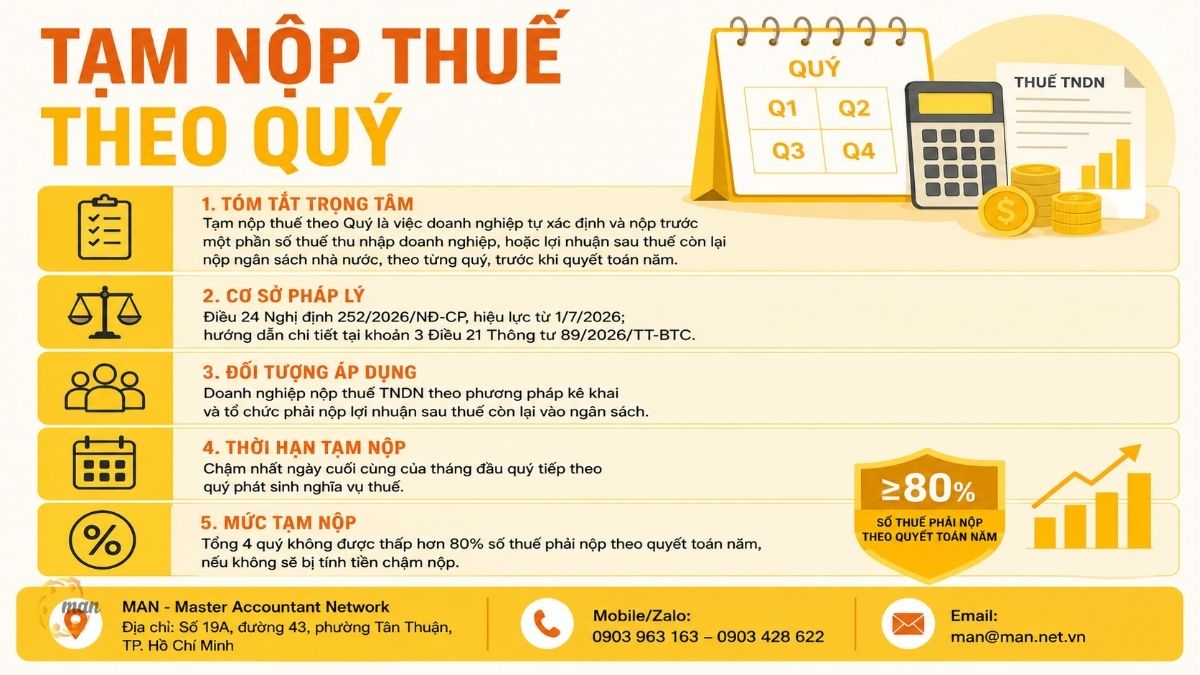
- Quarterly tax advance payment is when a business determines and pays a portion of its corporate income tax, or remaining after-tax profit, to the state budget on a quarterly basis, before the annual tax settlement.
- Legal basis: Article 24 of Decree 252/2026/ND-CP, effective from July 1, 2026; detailed guidance in Clause 3, Article 21 of Circular 89/2026/TT-BTC.
- Applicable entities: businesses paying corporate income tax using the declaration method and organizations required to remit remaining after-tax profits to the state budget.
- Deadline for provisional payment: no later than the last day of the first month of the quarter following the quarter in which the tax liability arises.
- Provisional payment amount: The total for all four quarters must not be less than 80%, the amount of tax payable according to the annual tax return; otherwise, late payment penalties will be charged.
What is quarterly provisional tax payment? Standard definition according to Decree 252/2026/ND-CP

According to Article 24 Decree 252/2026/ND-CP, Quarterly provisional tax payment is when taxpayers determine and pay a portion of their corporate income tax obligation, or remaining after-tax profit, to the state budget on a quarterly basis during the fiscal year, before finalizing the annual tax return. This is not a separate tax payment but rather a method of advance payment, which is deductible from the tax payable at the end of the year.
In simpler terms, businesses don't wait until the end of the year to pay their full corporate income tax. Instead, at the end of each quarter, they estimate their business results and proactively pay a provisional amount to the government. At the annual tax settlement, the provisional payment will be deducted from the actual tax payable.
Legal basis for determining quarterly provisional tax payments.
- Main basis: Article 24 of Decree 252/2026/ND-CP, effective from July 1, 2026.
- Two revenue sources apply: corporate income tax and remaining after-tax profits remitted to the state budget in accordance with the law on the management and investment of state capital in enterprises.
- Specific implementation guidelines for corporate income tax: Clause 3, Article 21 of Circular 89/2026/TT-BTC.
- Deadline for filing quarterly tax returns (general application): Article 10 of Decree 252/2026/ND-CP.
Why are quarterly tax payments important for businesses?
Before the current clear regulations, many businesses considered quarterly tax payments as a mere formality, making rough estimates and accumulating the difference at the end of the year. This approach carries significant risks, as Decree 252/2026/ND-CP clearly stipulates a minimum threshold of 80% and applies late payment penalties if this threshold is not met.
From this perspective MAN – Master Accountant Network, After years of assisting manufacturing and trading businesses with tax settlements, quarterly provisional tax payments are not only a legal obligation but also reflect a company's cash flow management capabilities. Accurate estimates and timely provisional tax payments help businesses avoid financial pressure at the end of the year and minimize financial losses. tax risk when entering the settlement period.
Which entities are required to make quarterly provisional tax payments?
Not all organizations are subject to these regulations. According to Decree 252/2026/ND-CP and... Circular 89/2026/TT-BTC, The two main groups required to make quarterly provisional tax payments include:
- Businesses that pay corporate income tax using the declaration method are required to finalize their corporate income tax return as guided in point c, clause 1, Article 21 of Circular 89/2026/TT-BTC.
- Organizations with remaining after-tax profits must remit them to the state budget in accordance with the law on the management and investment of state capital in enterprises, usually state-owned enterprises or enterprises with state capital.
Point to note: Real estate businesses that collect payments in installments and apply a provisional payment of 1% on revenue but have not yet handed over the house or infrastructure will not include this amount in their records. corporate income tax settlement year. That provisional payment will only be included in the final settlement file upon handover of part or all of the project, in accordance with the regulations in Circular 89/2026/TT-BTC.
What are the regulations regarding the deadline and amount for quarterly provisional tax payments?

What is the deadline for making quarterly tax payments?
According to Clause 2, Article 24 of Decree 252/2026/ND-CP, the deadline for quarterly provisional tax payments is no later than the last day of the first month of the quarter following the quarter in which the tax liability arises. For example, the provisional tax payable in the first quarter, ending on March 31st, must be paid no later than the last day of April. This regulation is consistent with the deadline for quarterly tax declarations in Article 10 of Decree 252/2026/ND-CP.
See more articles: Deadline for filing the Q2/2026 tax return.
What is the minimum quarterly provisional tax payment amount?
Businesses have the right to determine their own quarterly provisional tax payments based on actual business results. However, the law sets a mandatory safety threshold: the total provisional tax payments for four quarters must not be less than the annual tax payable as declared by the business. This is a crucial point that businesses need to consider when planning their year-end cash flow.
If the total amount already paid in advance is less than this 80% amount, the business must pay late payment penalties on the remaining amount, from the day immediately following the last day of the deadline for the 4th quarter advance payment until the day immediately preceding the date the remaining amount is actually paid into the budget. This regulation applies even in cases where the business discovers the discrepancy and makes a supplementary declaration.
How does the quarterly tax filing deadline differ from the deadlines for other tax periods?
In addition to the specific regulations for quarterly tax payments in Article 24, Decree 252/2026/ND-CP also stipulates general regulations on the deadline for submitting tax returns in Article 10, applicable to various tax periods, not just corporate income tax. Businesses need to clearly distinguish between these to avoid applying the wrong deadlines for different types of taxes.
| Tax period type | Deadline for filing tax returns |
| Declare on a case-by-case basis. | No later than the 10th day following the date the tax liability arises, except in cases where tax declaration and payment must be made before the tax authority issues an electronic invoice with a code for each transaction, as stipulated in point b, clause 3, Article 26 of the Law on Tax Administration. |
| Monthly filing | No later than the 20th day of the month following the month in which the tax liability arises. |
| Filing on a quarterly basis | No later than the last day of the first month of the quarter following the quarter in which the tax liability arises. |
| Filing by year | No later than the last day of the first month of the following calendar year or fiscal year. |
| Filing tax returns | According to the four specific cases in Clause 5 of Article 10, detailed below. |
Regarding tax return filings, Clause 5 of Article 10 of Decree 252/2026/ND-CP separates them into four specific cases, applying differently to businesses and individuals:
- Point a: No later than the last day of the third month from the end of the tax settlement period, applicable to regular tax settlements.
- Point b: No later than 45 days from the date the taxpayer issues a decision to cease operations, dissolve, declare bankruptcy, terminate contracts, privatize state-owned enterprises, divide, separate, merge, or consolidate.
- Point c: The deadline for submitting personal income tax returns for individuals with income from salaries and wages who directly settle their tax obligations is no later than the last day of the fourth month from the end of the calendar year. In cases where an individual is present in Vietnam for less than 183 days in a calendar year, but the total number of consecutive days in 12 months from the first day of arrival in Vietnam is 183 or more, the deadline for submitting the first annual tax return is no later than the last day of the fourth month from the last day of the month that completes the 12 consecutive months.
- Point d: This applies to foreign individuals residing in Vietnam who have terminated their employment contracts. The deadline for submitting the tax return is before departure, but no later than 45 days from the date of termination of the employment contract.
From the perspective of MAN – Master Accountant Network, understanding both the quarterly tax payment deadlines in Article 24 and the tax filing deadlines for each tax period in Article 10 helps businesses build a comprehensive annual tax compliance schedule, avoiding missed obligations when businesses incur multiple types of taxes with different filing cycles.
See more articles at: How to extend the 2026 tax payment deadline online: Detailed instructions according to Decree 245/2026/ND-CP
Legal documents related to quarterly provisional tax payments.
Important note: As of now, some of the Ministry of Finance's additional detailed guidance under Clause 4, Article 24 is still being updated. Experts at MAN recommend that businesses closely monitor the new guidance documents to ensure accurate application and avoid risks during the 2026 year-end settlement.
| Legal documents | Number / Validity | Related content |
| Decree 252/2026/ND-CP | Government, effective July 1, 2026 | Article 24 stipulates the deadline, amount of provisional tax payments, and responsibilities for quarterly provisional tax payments; Article 10 stipulates the deadline for submitting tax returns for each tax period; Article 26 stipulates the method for calculating late payment penalties when an audit or inspection reveals an increase in the amount payable. |
| Circular 89/2026/TT-BTC | Ministry of Finance, 2026 | Clause 3 of Article 21 provides detailed guidance on how to determine the quarterly provisional corporate income tax payments and how to deduct the amount already paid from the annual tax return. |
| Regulations on the management and investment of state capital in enterprises. | Reference | Basis for determining the obligation to make quarterly provisional payments of remaining after-tax profits to the state budget. |
| Supplementary guidance document (tentative) | Ministry of Finance | According to Clause 4, Article 24 of Decree 252/2026/ND-CP, the Minister of Finance will provide more specific guidance on quarterly provisional tax payments and other revenues. |
Calculation method and illustrative examples for quarterly provisional tax payments.
Many accountants confuse making provisional payments for all four quarters with making provisional payments reaching the 80% threshold. In reality, the law does not require each quarter to pay exactly 25% of the annual tax amount, but only requires the total provisional payments for all four quarters to reach at least 80% of the annual tax settlement amount.
Example: Company B estimates its corporate income tax payable for the year 2026 to be 2,000,000,000 VND. The minimum amount to be paid in advance for all four quarters is 80% multiplied by 2,000,000,000 VND, equivalent to 1,600,000,000 VND. Assuming Company B has already made advance payments for the quarters as follows: Q1: 300 million VND, Q2: 400 million VND, Q3: 350 million VND, Q4: 250 million VND, totaling 1,300,000,000 VND, equivalent to 65% of the annual tax amount.
Because the amount of VND 1,300,000,000 is lower than the minimum of VND 1,600,000,000, Company B must pay a late payment penalty of VND 300,000,000 on the remaining difference, calculated from the day immediately following the deadline for the Q4 provisional payment until the actual payment date. This is the direct financial consequence if a company underestimates its provisional payment compared to its actual business performance.
| Case | Total provisional payments for 4 quarters | Compared to the 80% annual settlement | Consequence |
| Meets standards | From 1,600,000,000 VND onwards | Equal to or higher | No late payment penalty will be charged. |
| Underpayment | Under 1,600,000,000 VND | Lower | Late payment penalties were charged on the amount underpaid. |
| Overpaying | Higher than the actual settlement amount | Exceed 100% | Offset or processed according to the annual settlement. |
Case Study: How do businesses handle quarterly provisional tax payments?
Background
C Precision Mechanical Joint Stock Company (illustrated name), operating in the field of mechanical processing in Dong Nai, experiences significant revenue fluctuations depending on the season and export order volume. The company typically has low profits in the first and second quarters due to fewer orders, while profits increase sharply in the third and fourth quarters thanks to the peak export season at the end of the year.
Process according to regulations for quarterly provisional tax payments.
According to advice from MAN – Master Accountant Network, Instead of making provisional tax payments of 25% each quarter as before, Company C takes three steps: (1) reviewing the actual business results of each quarter to estimate the provisional tax payment close to the generated profit; (2) making provisions for additional provisional tax payments in the 3rd and 4th quarters when profits increase, ensuring that the total for the 4 quarters reaches at least 80% of the annual settlement amount; (3) comparing the amount already made provisionally before submitting the annual settlement documents to proactively supplement if there is a shortfall, avoiding waiting for the tax authority to check before discovering it.
The measured results
- The total amount of provisional tax paid by company C for the four quarters reached 85% in the annual settlement amount, exceeding the minimum threshold of 80% as stipulated by regulations.
- The company could avoid an estimated late payment penalty of approximately 45 million VND if it continued with its previous method of making regular provisional payments.
- The annual tax return was accepted by the tax authorities without any problems, and the data reconciliation process was shortened to approximately 3 working days.
Expert opinion: Common risks when filing taxes quarterly
Experts at MAN – Master Accountant Network With over 30 years of experience in auditing and tax consulting in Vietnam, we identify four common risks that businesses often encounter when making quarterly provisional tax payments:
- Risk 1: The provisional tax estimate is too low compared to actual business performance. Many businesses tend to make provisional tax payments to maintain cash flow, resulting in their total for the four quarters failing to reach the 80% threshold. Consequently, they are charged late payment penalties on the shortfall, even though they did not intentionally evade taxes.
- Risk 2: Confusion between submitting 25% quarterly and reaching the 80% threshold for the entire year: The law does not require quarterly interim payments, but only a minimum total of 80% for all four quarters. Strictly applying the equal payment method could lead to businesses underpaying in quarters with exceptionally high profits at the end of the year.
- Risk 3: Failure to update in a timely manner when audited or inspected after final settlement: If, after the business has finalized its accounts, the competent authority discovers an increase in the amount payable, the calculation of late payment penalties will be applied according to the specific regulations in Clause 2, Article 26 of Decree 252/2026/ND-CP, which are generally stricter than in cases where the business discovers and adjusts the amount itself.
- Risk 4: Missing specific provisional payments for real estate businesses: Real estate businesses that make provisional payments of 1% based on revenue collected according to progress often mistakenly include this amount in their final settlement documents. According to regulations, this amount should only be included upon handover of the house or infrastructure, not in the year in which the provisional revenue is generated.
Conclude
Quarterly tax payments are not simply an administrative procedure repeated four times a year. They are a tool that helps tax authorities ensure a stable revenue stream while requiring businesses to estimate their business results more accurately. The 80% threshold under Decree 252/2026/ND-CP, while not fundamentally new compared to previous regulations, comes with a clear mechanism for calculating late payment penalties, forcing accounting departments to proactively review data quarterly instead of waiting until the end of the year.
Tax services at MAN – Master Accountant Network
- Tax accounting services
- Tax consulting services
- Tax settlement services
- Tax reporting services
- VAT refund service
Service contact information at MAN – Master Accountant Network
- Address: No. 19A, Street 43, Tan Thuan Ward, Ho Chi Minh City
- Mobile/Zalo: 0903 963 163 – 0903 428 622
- E-mail: man@man.net.vn
- Google Business Profile: View MAN – Master Accountant Network's Google Business Profile
- LinkedIn Founder: View expert Le Hoang Tuyen's LinkedIn profile.
Responsible for production and professional content review by: Mr. Le Hoang Tuyen – Founder & CEO of MAN – Master Accountant Network, CPA Vietnam with over 30 years of experience in accounting, auditing, taxation, and corporate financial consulting.
Frequently Asked Questions about Quarterly Tax Provisions
Which taxes are eligible for quarterly provisional tax payments?
This applies to corporate income tax and remaining after-tax profits payable to the state budget, as per Article 24 of Decree 252/2026/ND-CP.
What is the latest deadline for making quarterly provisional tax payments?
No later than the last day of the first month of the quarter following the quarter in which the tax liability arises.
What happens if the total of the four quarterly provisional payments is less than the annual settlement amount of 80%?
Businesses must pay late payment penalties on the outstanding amount, from the day immediately following the deadline for the Q4 provisional payment until the date the full amount is actually paid.
Can businesses determine their own quarterly provisional tax payments?
Yes. Businesses determine the amount of provisional tax payable based on their quarterly financial statements or quarterly business results, provided that the total for all four quarters reaches at least 80% of the annual tax settlement amount.
If the tax authorities discover an increase in the amount payable after the final tax settlement, how is the late payment penalty calculated?
In accordance with the specific provisions of Clause 2, Article 26 of Decree 252/2026/ND-CP, the usual method for calculating late payment penalties for quarterly provisional payments will not be applied.




