

Do I have to pay personal income tax on money received from abroad? This is a crucial legal question for individuals, business households, and investors in Vietnam. The explosive growth of cross-border e-commerce transactions, global freelance work, and remittances from overseas Vietnamese have made determining tax obligations complex. Decree 253/2026/ND-CP The regulations have established a transparent legal framework, clarifying the boundary between tax-exempt income and income subject to personal income tax.
Tax audits have revealed that many individuals are being charged back taxes and late payment penalties due to a misunderstanding of the nature of money sent to support family and service fees. Understanding the legal basis, preparing the necessary documents for money transfers, and applying the correct tax exchange rates according to current regulations are key to protecting legitimate assets. This article provides a comprehensive analysis of the latest regulations to help you be fully prepared when engaging in international financial transactions.
Summary of key points regarding whether receiving money from abroad is subject to personal income tax.
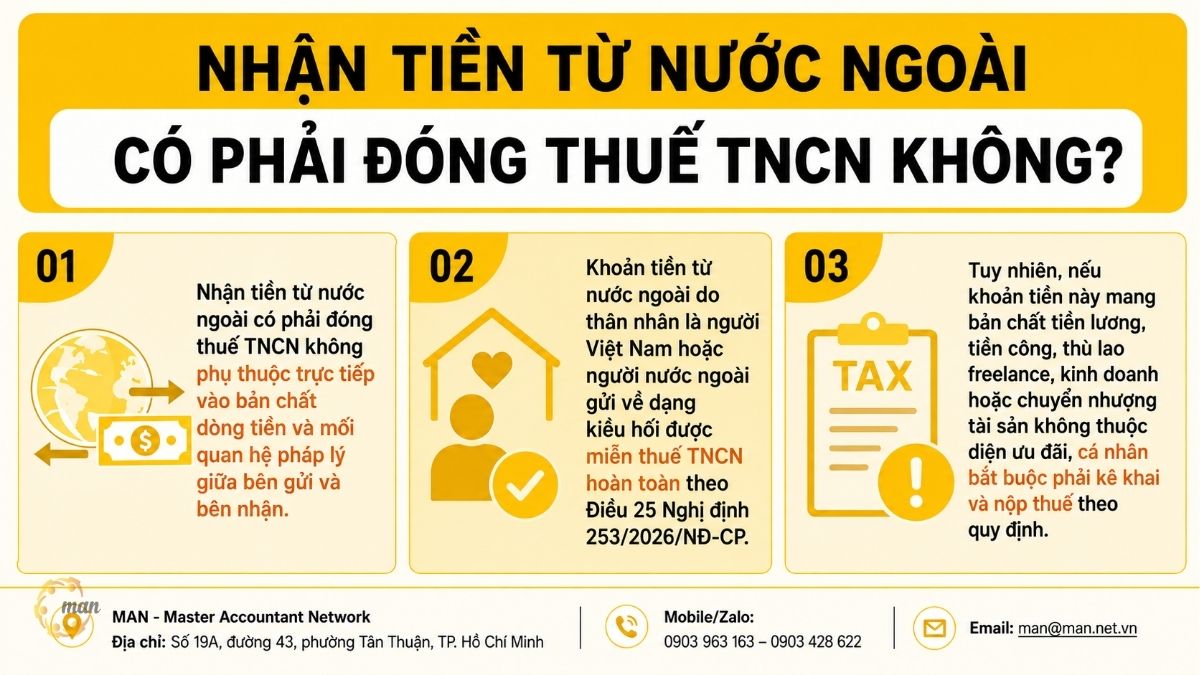
- Do I have to pay personal income tax on money received from abroad? It depends directly on the nature of the cash flow and the legal relationship between the sender and the receiver.
- Remittances from overseas sent by Vietnamese or foreign relatives are completely exempt from personal income tax according to Article 25 of Decree 253/2026/ND-CP.
- However, if this amount is in the nature of salary, wages, freelance fees, business income, or asset transfer not eligible for tax incentives, the individual is required to declare and pay taxes according to regulations.
How is the nature of foreign capital flows into Vietnam classified?
Tax authorities manage the flow of money transferred from abroad based on the actual economic nature of the transaction, not on the name written on the transfer order. A deposit from an international bank to Vietnam can serve various purposes such as supporting living expenses, paying for services, or distributing dividends.
Each type of cash flow is subject to a separate legal regulatory mechanism. Misidentifying the nature of funds is a leading cause of tax audits when bank account data is automatically reconciled.
According to professional guidance from MAN – Master Accountant Network, cash flows from overseas to personal accounts in Vietnam are divided into two main groups based on tax obligations:
Group 1: Cash flows eligible for personal income tax exemption
- Remittances from relatives in Vietnam: Money sent back to relatives in Vietnam by Vietnamese people who have settled, worked, or studied abroad.
- Remittances from overseas relatives: Money sent by relatives abroad meets the conditions for encouraging remittances set by the State Bank of Vietnam.
- Transfer, inheritance, and gifting of real estate: Real estate assets can be transferred between relatives as stipulated by law.
- Specific social assistance: Support for treatment of serious illnesses and transportation costs for employees are provided according to internal regulations.
Group 2: Cash flows that are required to be declared and subject to personal income tax.
- Salaries and wages: Income from employment contracts, freelance work, and remote consulting for foreign organizations or individuals.
- Income from capital investments: Dividends and profits are distributed from owning shares or contributing capital to establish businesses abroad.
- Common gifts and inheritances: Cash or assets gifted or inherited by individuals or organizations who are not relatives.
- Income from royalties and franchisees: Software royalties, intellectual property, and revenue sharing from cross-border digital platforms.
Is receiving money from abroad subject to personal income tax according to Decree 253/2026/ND-CP?
To get an accurate answer to the question of whether receiving money from abroad requires payment, personal income tax No, individuals need to refer to the detailed provisions in Decree 253/2026/ND-CP. The State maintains a consistent preferential policy towards remittances to attract foreign currency for national development.
Based on Article 25 Decree 253/2026/ND-CP The regulations regarding income from remittances are as follows:
Article 25. Income from remittances
- Personal income tax is exempted for money received from abroad by Vietnamese relatives residing overseas, or Vietnamese people working, studying, or living abroad who send money back to their relatives in Vietnam.
- Individuals who receive money from abroad, sent by relatives who are foreign nationals, and meet the conditions for encouraging remittances to Vietnam as stipulated by the State Bank of Vietnam, are also exempt from tax as prescribed in this Article.
- The basis for determining tax-exempt income is documentation proving the source of funds received from abroad and payment vouchers from the paying organization (if any).
Specifically, individuals receiving money from overseas relatives who meet the conditions for encouraging remittances to Vietnam as stipulated by the State Bank of Vietnam are exempt from personal income tax. However, the responsibility to provide documentation proving the origin of the funds rests with the recipient.
Individuals receiving payments from abroad are exempt from personal income tax, and allowances are not subject to tax.
Decree 253/2026/ND-CP supplements and clarifies many types of income and allowances that are not included in taxable personal income. A thorough understanding of these cases helps employees and businesses optimize their financial obligations.
Income from remittances from relatives.
In the case of remittances from overseas by Vietnamese citizens residing, working, or studying abroad to their relatives in Vietnam, these are exempt from tax. Relatives here are defined according to the provisions of the Law on Marriage and Family.
For senders who are relatives of foreign nationals, remittances are also tax-exempt if the transaction complies with the legal framework for encouraging remittances issued by the State Bank of Vietnam.
Financial assistance for treatment of serious illnesses and transportation allowance.
Clause 4 of Article 8 of Decree 253/2026/ND-CP stipulates the following regarding income from salaries and wages:
Article 8. Income from salaries and wages
Income from salaries and wages as stipulated in Clause 2, Article 3 of the Personal Income Tax Law includes:
[…]
- Income that is not considered a salary or wage and is not included in taxable personal income includes:
[…]
- b) Financial support from the employer for the examination and treatment of serious illnesses for the employee and their family members, including: biological children, adopted children, stepchildren of the spouse; spouse; biological father, biological mother; father-in-law, mother-in-law (or father-in-law, mother-in-law); stepfather, stepmother; adoptive father, adoptive mother.
The amount of support not included in taxable income is the actual amount of support provided by the employer according to invoices and documents, but not exceeding the amount of medical expenses paid by the employee and their relatives after deducting the amount paid by the insurance organization (if any).
The determination of a terminal illness is governed by regulations issued by the Minister of Health.;
- c) Amounts received under regulations related to the use of transportation within state agencies, public service units, Party organizations, and mass organizations; transportation for employees to and from work according to the unit's regulations;
Accordingly, financial assistance provided to employees for the treatment of serious illnesses for themselves and their relatives (including those mentioned in point b) is not included in taxable personal income. The maximum assistance amount shall not exceed the actual hospital fees paid after deducting insurance. Furthermore, any amount received under the regulations for the use of transportation or shuttle services from the employee's residence to the workplace, as stipulated in the unit's internal regulations, is also exempt from tax.
Income from the transfer, inheritance, or gift of real estate.
According to Article 18 of Decree 253/2026/ND-CP detailing income from real estate:
Article 18. Income from the transfer, inheritance, or gift of real estate.
- Personal income tax is exempted for income from the transfer, inheritance, or gift of real estate (including houses and future construction projects as stipulated by the law on real estate business) between: husband and wife; biological parents and their children; adoptive parents and their adopted children; father-in-law and mother-in-law and daughter-in-law (even after the husband's death); father-in-law and mother-in-law and son-in-law (even after the wife's death); paternal grandparents and grandchildren; maternal grandparents and grandchildren; and siblings.
- In cases where real estate (including houses and future construction projects as regulated by real estate business laws) is divided by agreement or court ruling upon divorce, the income from this division is exempt from tax.
- The procedures and documentation for tax exemption are carried out in accordance with the laws on tax administration.
This regulation applies to both future real estate developments and assets divided during divorce. Through this regulation, personal income tax is exempted on income from real estate transfers between: spouses; biological parents and their children; adoptive parents and their adopted children; father-in-law and mother-in-law and daughter-in-law (even after the husband's death); father-in-law and mother-in-law and son-in-law (even after the wife's death); paternal grandparents and grandchildren; maternal grandparents and grandchildren; and siblings.
Individuals need to prepare complete personal identification documents to complete the tax exemption procedure in accordance with tax management laws.
Airfare costs for foreign experts
In international financial transactions and overseas personnel management, the question of whether airfare for foreign experts is subject to personal income tax under Decree 253 is a top concern for businesses.
According to regulations, the cost of round-trip airfare paid by the employer for foreign employees working in Vietnam (or Vietnamese employees working abroad) to take leave once a year is not included in taxable personal income. This expense must be based on a valid employment contract and airfare documentation. If the expense exceeds one trip per year, or if it is for family members accompanying the expert (unless there is a specific agreement classifying it as business travel expense), the excess amount must be included in taxable income.
Individuals receiving money from abroad are required to pay personal income tax and comply with exchange rate conversion rules.
Not all payments received through international banks are tax-exempt. Individuals generating the following types of income are required to fulfill their tax obligations to the State.
Income from salaries and wages earned working for foreign companies.
Individuals residing in Vietnam who work for international companies and receive payments via bank transfer from abroad are subject to personal income tax according to the progressive tax rate schedule (tax rates ranging from 5% to 35%).
If an individual receives net income (after tax deductions abroad), that income must be converted to gross income before tax for declaration in Vietnam. In cases where the two countries have signed a Double Taxation Avoidance Agreement, the tax paid abroad is deductible accordingly, but not exceeding the amount of tax payable calculated according to the Vietnamese tax schedule.
Income from freelance work, programming, and digital content.
Freelancers, designers, software developers, affiliate marketers, or content creators on cross-border platforms (Google, YouTube, Facebook, TikTok) who receive payments from overseas to Vietnamese banks are subject to tax.
- Registered as a sole proprietor/individual business: Taxes are paid at a rate of 1% of revenue (typically 1% personal income tax and 2% VAT for the service industry).
- Not yet registered as a business: The amount received is classified as income from salaries, wages, or non-fixed business income and is subject to a progressive tax collection rule.
Income from international capital investments, securities, and dividends.
When an individual receives dividends, investment interest, or capital gains from overseas investments into a Vietnamese account:
- Dividends, profits received: Apply tax rate 5% to the entire amount received.
- Transfer of capital and securities: A tax rate of 0.1% is applied to the transfer price of securities for each transaction, or 20% on net income for equity contributions.
Rules for determining the exchange rate for personal income tax purposes with foreign currencies.
A common question is how the exchange rate for calculating personal income tax on salaries or income paid in foreign currency is determined for foreigners?
Based on current tax regulations, taxable income generated in foreign currency must be converted into Vietnamese Dong (VND). The applicable exchange rate is the actual transaction rate of the commercial bank where the individual has an account to receive the money at the time the income is generated. If the individual does not receive the money through an account in Vietnam, the transfer buying rate of the Vietnam Foreign Trade Joint Stock Commercial Bank (Vietcombank) at the time the income is generated will be applied.
Timeline, supporting documents, and procedures for filing personal income tax returns from overseas.
To avoid administrative penalties for tax violations or late payment fees, individuals receiving income from abroad need to be familiar with the procedures.
Documents proving the source of tax-exempt remittances.
Recipients of remittances need to retain the following documents to present during tax audits:
- Documents proving family relationship (Birth certificate, Civil registry extract, Marriage certificate, Residence registration certificate).
- Documents proving the sender is abroad (Passport, Business/Student Visa, Residence Permit, International Employment Contract).
- Documents proving money transfer from a foreign bank or remittance payment organization (Swift code, wire transfer, credit advice from a Vietnamese commercial bank).
Deadline for declaring and paying taxes on taxable income.
Individuals receiving income directly from foreign organizations or individuals (without withholding tax at source) are obligated to self-declare their taxes according to a specific schedule:
- Tax return for Quarter I: The deadline for submitting documents and paying taxes is April 30th.
- Tax return for Quarter II: The deadline for submitting documents and paying taxes is July 31st.
- Tax return for Quarter III: The deadline for submitting documents and paying taxes is October 31st.
- Tax return for the fourth quarter: The deadline for submitting documents and paying taxes is January 31st of the following year.
- Annual tax settlement: The deadline for submitting personal income tax returns in person is no later than the last day of the fourth month from the end of the calendar year (April 30th of the following year).
Summary of legal regulations and guiding documents on income from foreign sources.
The legal framework governing tax obligations related to international money flows includes:
| Document number | Date of issuance | Issuing authority | Summary of content |
| Decree 253/2026/ND-CP | 15/01/2026 | Government | Regulations detailing the implementation of the Personal Income Tax Law; exemption from remittance tax (Article 25); allowances for serious illness treatment and transportation (Article 8); exemption from property tax for relatives (Article 18). |
| Circular 111/2013/TT-BTC | 15/08/2013 | Ministry of Finance | Guidelines for implementing Personal Income Tax, rules for determining taxable income for resident individuals with income from foreign sources. |
| Decree 126/2020/ND-CP | 19/10/2020 | Government | Detailed regulations on the Law on Tax Administration, and the mechanism for banks to share personal account transaction data with tax authorities. |
| Official Document 4384/TCT-TNCN | 12/11/2021 | General Department of Taxation | Instructions for filing taxes for individuals receiving payments from cross-border platforms (Google, Facebook, YouTube). |
| Official Document 2110/CTHN-TTHT | 18/04/2023 | Hanoi Tax Department | Guidelines for determining personal income tax and exchange rates for salaries received from foreign companies. |
Comparison table of personal income tax obligations according to different types of foreign income.
To help readers quickly find out the financial obligations for each payment, MAN has compiled a detailed comparison table:
| Type of cash received | The sender | Applicable personal income tax rate | Documentation required |
| Remittance support | Relatives (Blood relatives, marital relatives) | 0% (Tax-free) | Personal identification documents + Money transfer slip for overseas remittance |
| Salary / Freelance | Foreign company/organization | 5% – 35% (Progressive) | Employment contract / Payslip / Salary notice |
| Dividends / Capital Investment | Foreign businesses | 5% (Full tax rate) | Dividend payment notification + Bank statement |
| Real estate transfer | Relatives as stipulated in Article 18 | 0% (Tax-free) | Land use rights certificate + Personal identification documents |
| Cash gifts | Outsiders / Organizations | 10% (The amount exceeding 10 million) | Gift contract + Payment documents |
Real-world case study: Risks of tax recovery from foreign remittances in Vietnam.
Experts at MAN, with 30 years of experience, note that the tax industry is enhancing its auditing capabilities thanks to automated systems that connect bank data. The following scenario clearly reflects the current reality of tax audits.
Situational context
Mr. Tran Van B (residing in Ho Chi Minh City) was contracted to provide technology consulting services to a partner in Singapore. From 2024 to 2026, Mr. B received a total of 1.2 billion VND through his personal bank account in Vietnam. When transferring the money, the partner recorded the transaction description as "Family support". Mr. B did not declare the money for tax purposes because he thought that remittances from abroad were automatically tax-exempt.
The tax authority's review process
In early 2026, the Ho Chi Minh City Tax Department reviewed the list of personal accounts generating large international cash flows. The tax authorities issued a notice inviting Mr. B to explain the nature of the 1.2 billion VND.
Mr. B was unable to provide documentation proving that the sender in Singapore had a family relationship with him according to the Marriage and Family Law. Further verification by the tax authorities revealed that the money was transferred regularly on the 5th of each month, in an amount equivalent to the agreed-upon fee in the service contract.
Results of handling violations
The tax authorities determined that 1.2 billion VND was undeclared income from wages and salaries received abroad. The decision on how to handle this includes:
- Collection of back taxes on personal income: Applying the progressive tax rate schedule, the total amount of back taxes collected is 145 million VND.
- Late payment penalty for taxes: Calculated at 0.03%/day on the overdue tax amount, totaling 28 million VND.
- Administrative penalties: A fine of 20% was imposed on the amount of underdeclared tax, equivalent to 29 million VND.
The total amount Mr. B has to pay to the state budget is 202 million VND.
Lessons learned from MAN
Based on Mr. B's case, taxpayers need to remember two principles:
- The content of the money transfer order does not determine the taxable nature of the transaction. The tax authorities verify the transaction based on the personal relationship and the original transaction.
- If the money is not remittances from relatives, individuals should proactively file their tax returns within the tax period to avoid incurring long-term late payment penalties.
MAN experts' assessment of tax risk management for cross-border money flows.
From MAN's perspective, Vietnam's financial management mechanism is moving towards absolute transparency through digital data. The information linkage between the State Bank of Vietnam, commercial banks, and the General Department of Taxation helps regulatory agencies easily identify unusual transactions.
The biggest risk for individuals is the habit of combining accounts for receiving remittances from relatives with accounts for receiving income from business or freelance services. When audits occur, the failure to separate the money flows makes the process of explaining the documentation extremely complicated.
The solution recommended by MAN – Master Accountant Network for individuals with international money transactions:
- Clearly separate accounts: Open separate accounts specifically for receiving remittances from family and for receiving payments for work-related expenses.
- Maintain accurate records: Keep complete records of contracts, bank statements, email exchanges, and personal identification documents for each transaction.
- Proactively review your tax obligations: Regularly assess your total taxable income for the year to ensure you file your tax return on time and minimize the risk of late payment penalties.
Conclude
Whether or not receiving money from abroad is subject to personal income tax depends entirely on the origin and economic nature of the funds. While remittances from relatives are tax-exempt under Decree 253/2026/ND-CP, income from salaries, service fees, or investments must be declared and fully taxed. Understanding the legal regulations and preparing the necessary documents is the best way to protect personal assets.
Tax services at MAN – Master Accountant Network
- Tax accounting services
- Tax consulting services
- Tax settlement services
- Tax reporting services
- VAT refund service
Service contact information at MAN – Master Accountant Network
- Address: No. 19A, Street 43, Tan Thuan Ward, Ho Chi Minh City
- Mobile/Zalo: 0903 963 163 – 0903 428 622
- E-mail: man@man.net.vn
- Google Business Profile: View MAN – Master Accountant Network's Google Business Profile
- LinkedIn Founder: View expert Le Hoang Tuyen's LinkedIn profile.
Responsible for production and professional content review by: Mr. Le Hoang Tuyen – Founder & CEO of MAN – Master Accountant Network, CPA Vietnam with over 30 years of experience in accounting, auditing, taxation, and corporate financial consulting.
Frequently Asked Questions about Personal Income Tax on Receiving Money from Abroad (FAQ)
Do I have to pay personal income tax when friends abroad send me money as a gift?
Yes. Gifts from non-relatives (spouse, parent, child, sibling, etc.) exceeding 10 million VND per receipt are subject to personal income tax at tax rate 10%.
Are airline tickets for foreign experts subject to personal income tax according to Decree 253?
Round-trip airfare paid by the employer for foreign experts on leave once a year is not included in taxable personal income. Expenses exceeding once a year are subject to tax.
How is the exchange rate for calculating personal income tax on salaries of foreigners determined?
The actual exchange rate of the commercial bank where the receiving account is opened at the time the income is generated will be applied. If the income is not received through an account in Vietnam, the Vietcombank transfer buying rate at the time the income is generated will be applied.
Do relatives living abroad who send money back to Vietnam to buy real estate on their behalf have to pay taxes?
No tax is payable if it can be proven that this is an authorized purchase transaction. Individuals must create a notarized power of attorney contract and retain proof of money transfer clearly stating the authorization.
If I have already paid income tax abroad, do I have to pay it again when I return to Vietnam?
Individuals are not subject to double taxation if the country where the income is generated has signed a Double Taxation Avoidance Agreement with Vietnam. The tax paid abroad can be deducted from the tax payable in Vietnam, but not exceeding the amount of tax calculated according to Vietnamese law.




