
Decree 254/2026/ND-CP It is the most important legal document in the field of electronic invoices since Law on Tax Administration No. 108/2025/QH15 Issued. Signed by the Government on June 30, 2026, and effective just one day later, on July 1, 2026, this decree replaces the entire old system of regulations. Decree 123/2020/ND-CP, It also adds many new points regarding the target users, invoice content, and how to determine the time of invoice issuance.
With the issuance and almost immediate effect of regulations, many businesses, household businesses, and individual business owners are still confused about updating their processes. This is the time when businesses need to immediately review their invoicing software systems to avoid the risk of penalties due to content discrepancies or delayed data transfer.
| Decree 254/2026/ND-CP is a document providing detailed guidance on the Law on Tax Administration No. 108/2025/QH15 regarding electronic invoices and electronic documents. |
| Issued on June 30, 2026, effective from July 1, 2026, replacing Decree 123/2020/ND-CP and related amendments. |
| This applies to economic organizations, business households, individual businesses, organizations collecting taxes, fees and charges, and all parties involved in invoices and documents. |
| Key content: regulations on the buyer's name on the invoice, the time of invoice creation and digital signing, and the subjects using electronic invoices with or without tax authority codes. |
| Businesses need to review their accounting software and invoicing processes starting July 1, 2026, to avoid errors during tax audits. |
What is Decree 254/2026/ND-CP? Legal basis and scope of application.
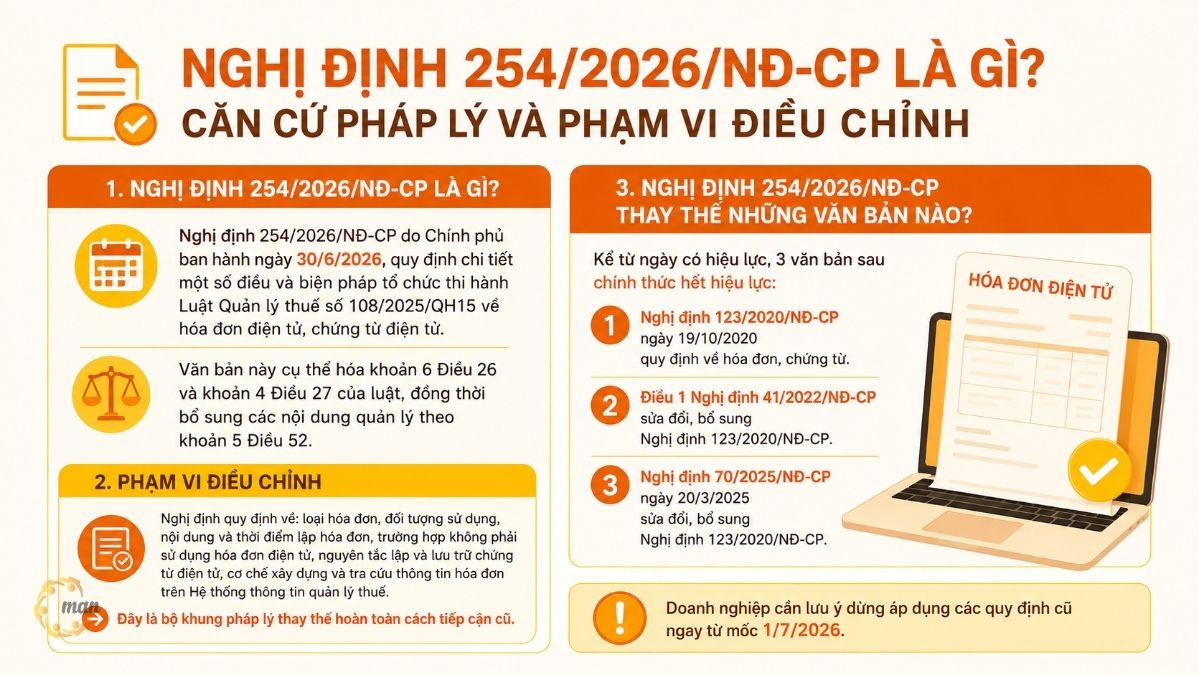
Decree 254/2026/ND-CP Issued by the Government on June 30, 2026, this document details certain provisions and organizational measures for the implementation of Law No. 108/2025/QH15 on Tax Administration regarding electronic invoices and electronic documents. This document clarifies Clause 6 of Article 26 and Clause 4 of Article 27 of the law, and also supplements management content according to Clause 5 of Article 52.
The decree's scope covers many issues: types of invoices, users, content and timing of invoice issuance, cases where electronic invoices are not required, principles for creating and storing electronic documents, as well as the mechanism for building and searching invoice information on the Tax Management Information System. This is a legal framework that completely replaces the old approach.
Which documents does Decree 254/2026/ND-CP replace?
From the effective date, the following three documents officially cease to be in effect: Decree 123/2020/ND-CP dated October 19, 2020, regulating invoices and documents; Article 1 of Decree 41/2022/ND-CP amending and supplementing Decree 123/2020/ND-CP; and Decree 70/2025/ND-CP dated March 20, 2025, amending and supplementing Decree 123/2020/ND-CP. Businesses should note that they must stop applying the old regulations from July 1, 2026.
The role of Decree 254/2026/ND-CP in corporate tax and accounting management.
Electronic invoices are the primary data source for tax authorities to determine tax obligations, and also serve as the basis for businesses to account for expenses and declare value-added tax. When Decree 254/2026/ND-CP changes the method of determining the buyer's name, the time of invoice creation, or the recipient of invoices from cash registers, the entire internal accounting process of businesses must be adjusted accordingly.
According to experts at MAN – Master Accountant Network, Failure to promptly update changes to invoice content can render invoices invalid, leading to a series of consequences: expenses cannot be deducted when calculating taxes. corporate income tax, number input value-added tax It is not deductible, and there is a risk of being subject to retroactive tax collection during final settlement. This is why businesses need to view this decree as a mandatory part of tax risk management, not just a technical issue for the IT department.
Which entities are affected by Decree 254/2026/ND-CP?
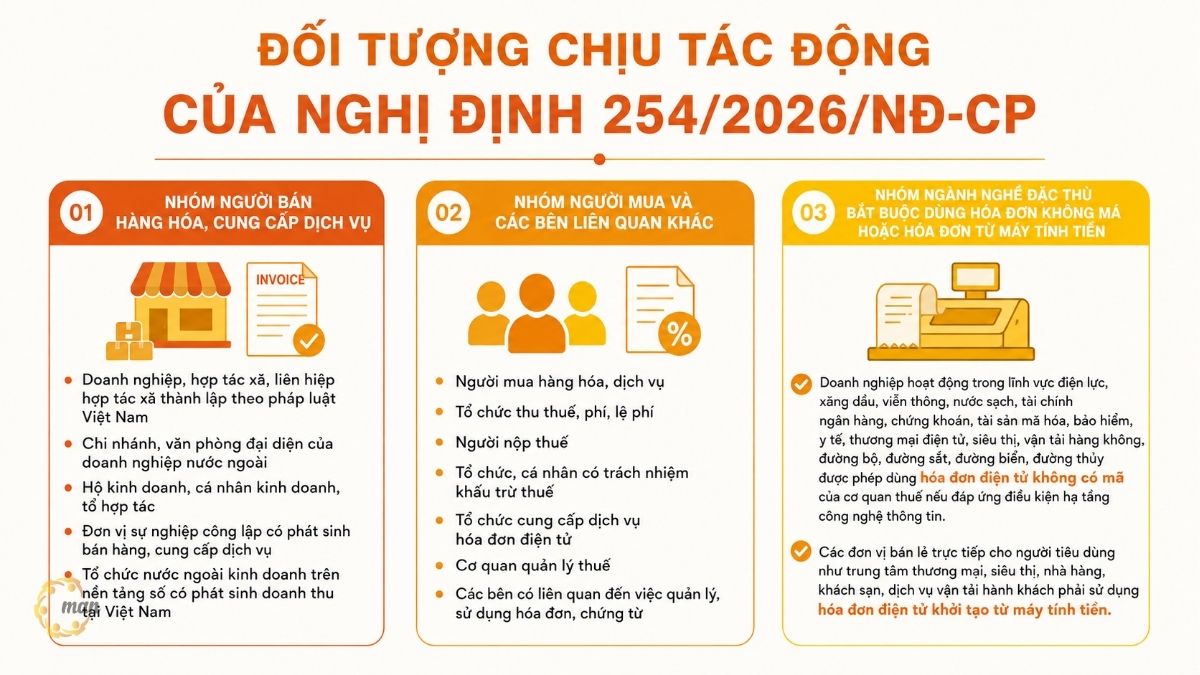
Decree 254/2026/ND-CP applies to a very broad range of subjects, including sellers, buyers, and intermediary organizations in the invoice issuance chain.
- Group of people who sell goods or provide services: This group includes businesses, cooperatives, and cooperative unions established under Vietnamese law; branches and representative offices of foreign businesses; household businesses, individual businesses, and cooperative groups; public service units that generate sales or provide services; and foreign organizations doing business on digital platforms that generate revenue in Vietnam.
- Buyer group and other stakeholders: Besides the buyers of goods and services, the decree also regulates organizations collecting taxes, fees, and charges; taxpayers; organizations and individuals responsible for tax deduction; organizations providing electronic invoice services; tax authorities; and other parties involved in the management and use of invoices and documents.
- Certain industries are required to use invoices without codes or invoices from cash registers: Businesses operating in the fields of electricity, petroleum, telecommunications, clean water, finance and banking, securities, crypto assets, insurance, healthcare, e-commerce, supermarkets, air, road, rail, and sea transport are permitted to use electronic invoices without tax authority codes if they meet the information technology infrastructure requirements. Meanwhile, retail businesses that directly sell to consumers, such as shopping malls, supermarkets, restaurants, hotels, and passenger transport services, must use electronic invoices generated from cash registers.
When does Decree 254/2026/ND-CP take effect?
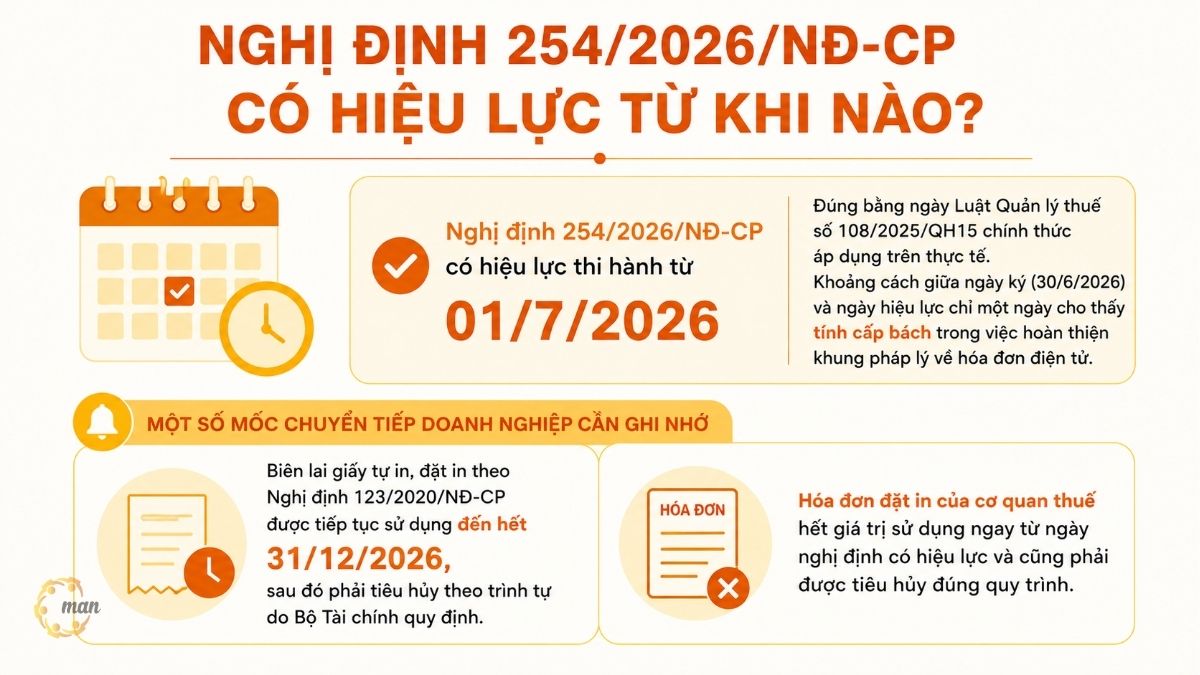
Decree 254/2026/ND-CP takes effect on July 1, 2026, exactly the same date as the official implementation of Law No. 108/2025/QH15 on Tax Administration. The one-day gap between the signing date (June 30, 2026) and the effective date demonstrates the urgency in completing the legal framework for electronic invoices.
Some transitional points for businesses to remember: self-printed and pre-printed paper receipts under Decree 123/2020/ND-CP can continue to be used until December 31, 2026, after which they must be destroyed according to the procedures stipulated by the Ministry of Finance. Pre-printed invoices issued by the tax authorities become invalid from the date the decree takes effect and must also be destroyed according to the correct procedure.
Regulations regarding the buyer's name on electronic invoices according to Decree 254/2026/ND-CP
This is the topic of greatest interest to many accountants because it directly relates to the validity of invoices when accounting for expenses.
In the case where the buyer is a business entity with a tax identification number.
The buyer's name, address, and tax identification number must be accurately recorded as stated in the business registration certificate, household business registration certificate, tax registration certificate, or equivalent documents. If the buyer provides a budget-related unit code, the invoice must show this code instead of the regular tax identification number.
With overly long names and addresses, sellers are allowed to abbreviate some common nouns such as Ward to P, City to TP, Limited Liability Company to TNHH, Industrial Park to KCN, Branch to CN, as long as the address as registered in the business can still be accurately identified.
In the case where the buyer is an individual consumer
The invoice must show the name, address, and personal identification number of the buyer. For foreign buyers, the address and identification number may be replaced by their passport number or entry/exit document of the same nationality. If the buyer does not provide this information, the invoice should clearly state "For consumer use only".
Notably, invoices without buyer information or invoices issued to consumers are invalid for use by other organizations or businesses for expense accounting or tax settlement purposes. Certain specific activities, such as sales at supermarkets, shopping malls, cinemas, gasoline sales to individuals without providing information, casino operations, electronic games with prizes, or e-commerce invoices, are exempt from the requirement to include full buyer information and digital signatures.
Entities required to use electronic invoices according to Decree 254/2026/ND-CP
According to Article 6 of the decree, the subjects using electronic invoices are divided into four main groups. The first group includes economic organizations, business households, ordinary business individuals, and high-risk tax cases, which are required to use electronic invoices with tax authority codes. The second group includes businesses in specialized fields with information technology infrastructure that meets the requirements, which are allowed to use invoices without codes.
The third group consists of organizations, household businesses, and individuals selling goods directly to consumers, who must use electronic invoices generated from cash registers connected to the tax authority's data system. The fourth group includes household businesses and individuals with annual revenue exceeding 1 billion VND or those selling assets requiring registration of ownership or usage rights, who are required to use electronic invoices with codes or invoices from cash registers connected to the tax authority's data system.
In addition, the decree stipulates the cases in which the tax authorities issue electronic invoices with codes for each transaction, applicable to non-business organizations that have sales transactions, or businesses that are temporarily suspended, ceased operations, or are subject to invoice enforcement but still need to issue invoices to fulfill previously signed contractual obligations.
The time of invoice creation and the time of digital signature are regulated by new rules.
The time of issuing an invoice for the sale of goods is the time of transferring ownership or the right to use the goods, regardless of whether payment has been received or not. For the provision of services, the time of issuing an invoice is when the service is completed, except in cases where payment is received in advance, in which case the invoice is issued immediately upon receipt of payment.
For specialized sectors such as telecommunications, insurance, banking, aviation, and postal services that require periodic data reconciliation, the decree allows invoices to be issued no later than the 7th of the following month or according to a pre-agreed period between the parties. For retail gasoline sales, invoices are issued at the end of each sale.
Regarding the time of digital signature, this is when the seller and buyer use their digital signatures to sign the electronic invoice, displayed in the Gregorian calendar date format. If the time of digital signature differs from the time the invoice is created, the submission to the tax authority for code issuance or data transfer must be completed no later than the next working day. The seller declares taxes based on the time the invoice is created, while the buyer declares taxes based on the time they receive the valid invoice.
Compilation of legal documents related to Decree 254/2026/ND-CP
To uniformly implement regulations on electronic invoices and documents from July 1, 2026, Decree 254/2026/ND-CP was issued based on the Law on Tax Administration No. 108/2025/QH15, and simultaneously replaces previous regulations in Decree 123/2020/ND-CP and its amending and supplementing decrees.
Below is a compilation of relevant legal documents and their scope of application for the convenience of businesses, organizations, and individuals in searching and applying them.
| Legal documents | Number / Date of Issue | Related content |
| Law on Tax Administration | No. 108/2025/QH15 | Basis for issuing the framework regulations on electronic invoices and documents. |
| Decree 254/2026/ND-CP | June 30, 2026, effective July 1, 2026 | Regulations detailing the types of invoices, users, content, and timing of invoice issuance. |
| Decree 123/2020/ND-CP | October 19, 2020 | The old regulations on invoices and supporting documents have expired since July 1, 2026. |
| Decree 41/2022/ND-CP | June 20, 2022 | Amendments and additions to Decree 123/2020/ND-CP, the relevant parts of which are no longer in effect. |
| Decree 70/2025/ND-CP | March 20, 2025 | Amendments and additions to Decree 123/2020/ND-CP, which is no longer in effect. |
| Decree 181/2025/ND-CP | Reference | Detailed regulations on the Value Added Tax Law, regarding cases where invoices are not required. |
| Decree 186/2025/ND-CP | Reference | Regulations on the management and use of public assets, sample invoice for the sale of public assets. |
Important Note: Businesses need to continue monitoring the Ministry of Finance's guidelines on standard data formats, invoice symbol templates, and registration procedures, as Decree 254/2026/ND-CP assigns many technical details to the Minister of Finance for regulation.
Case Study: Retail businesses transforming according to Decree 254/2026/ND-CP
Background
The Y chain of household goods retailers in Ho Chi Minh City, with 25 direct sales points to consumers, previously issued electronic invoices with tax authority codes for all transactions, including small-value transactions where customers did not request an invoice.
Processing after July 1, 2026
According to advice from MAN – Master Accountant Network, the business should take three steps: first, review all 25 sales points to identify which ones are required to use electronic invoices generated from cash registers as stipulated in point c, clause 1, Article 6; second, connect the sales software to the Tax Management Information System to transmit data in real time; and third, rebuild the invoice template to ensure that the buyer's name (as an individual) is correctly displayed according to the new regulations, along with a section for consumers when they do not provide this information.
The measured results
After completing the transition, the business reduced its end-of-day reconciliation time from approximately 2 hours to just 20 minutes thanks to the automatic synchronization of data with the tax authorities. When the tax authorities conduct periodic audits, invoice records are verified online directly on the system, eliminating the need to present paper invoices, thus shortening the audit time compared to the previous cycle.
Comparison table of Decree 254/2026/ND-CP with the old regulations
Prior to July 1, 2026, the management of invoices and supporting documents was governed by Decree 123/2020/ND-CP and its amendments. From July 1, 2026, Decree 254/2026/ND-CP officially replaces it, introducing several changes regarding the subjects eligible to use electronic invoices, applicable revenue thresholds, mechanisms for encouraging reporting violations, and the roadmap for transitioning from paper invoices and receipts. The table below summarizes the key differences between the new and previous regulations.
| Criteria | Decree 123/2020/ND-CP (old) | Decree 254/2026/ND-CP (new) |
| Basis for issuance | Tax Administration Law 2019 | Law on Tax Administration No. 108/2025/QH15 |
| Target users of cash register receipts | Apply restrictions based on specific industry groups. | Expand to the entire direct-to-consumer sales team. |
| The revenue threshold for household businesses requires the use of electronic invoices with codes. | There is no specific limit set at over 1 billion VND. | For annual revenue exceeding 1 billion VND, invoices with codes or those from cash registers must be used. |
| Reward mechanism for whistleblowing | The exact bonus amount has not yet been specified. | The regulations clearly state the maximum reward amount for the fine imposed, not exceeding 10,000,000 VND per case. |
| Validity of old stamps and paper receipts | Apply according to the old schedule. | Valid for use until December 31, 2026, after which it must be destroyed. |
Expert opinion: Common business risks when applying Decree 254/2026/ND-CP
Experts at MAN – Master Accountant Network With over 30 years of experience in auditing and tax consulting in Vietnam, we identify four common risks that businesses need to proactively prevent.
- The first risk is incorrectly recording buyer information when applying address abbreviation rules, resulting in the invoice not accurately identifying the business as registered.
- The second risk is the delay in transferring invoice data to the tax authorities, especially for businesses that submit invoices directly and have a large volume of invoices, which can easily lead to discrepancies between accounting records and tax returns.
- The third risk is confusion between the group using coded invoices and invoices from cash registers, leading to the application of the wrong type of invoice to the same point of sale.
- The fourth risk is the failure to update accounting software to meet the new data standard format, making it difficult to reconcile figures during the annual settlement period.
From MAN's perspective, the optimal solution for tax cost savings in Vietnam lies not in delaying the transition but in standardizing processes from the outset, combined with periodic reviews between the accounting and IT departments to minimize errors during the transition period.
Principles for creating, managing, and storing invoices according to Decree 254/2026/ND-CP
Article 4 of Decree 254/2026/ND-CP stipulates that sellers must issue electronic invoices when selling goods or providing services, including promotional items, advertising materials, samples, gifts, payments in lieu of employee salaries, or internal consumption. The invoice must conform to the standard data format, contain all required information, and accurately reflect the economic transaction. Sellers may authorize a third party to issue invoices on their behalf, but remain responsible for the legality of the invoice.
Regarding storage, Article 5 stipulates that electronic invoices and documents must be preserved as data messages, ensuring safety and integrity throughout the legally mandated storage period, and readily available for printing or retrieval upon request. The conversion of electronic invoices into paper invoices may only be carried out upon request from inspection, auditing, or investigation agencies, or for accounting purposes. Furthermore, converted paper invoices used in accounting records do not have transactional or payment value.
In which cases is it not necessary to use electronic invoices according to Decree 254/2026/ND-CP?
Article 7 lists several transactions that are exempt from electronic invoicing. Notably, these include: household businesses and individual businesses required to prepare a list of purchased goods and services according to corporate income tax law; household businesses with income from real estate rentals or providing digital content and advertising to foreign organizations; lottery agents, insurance agents, and multi-level marketing agents who have already had taxes withheld at source.
Furthermore, income from reinsurance activities, deposit taking, securities issuance, debt sales, foreign exchange transactions, and derivative products is also exempt from electronic invoicing. Similarly, capital contributions in the form of assets, internal asset transfers between the parent company and its subsidiaries, or lending machinery and equipment free of charge are also included in this exemption group.
What types of invoices are stipulated in Decree 254/2026/ND-CP?
According to Article 8, the invoice system comprises various types corresponding to different tax declaration methods and business sectors. Value-added tax invoices are for organizations declaring taxes using the deduction method, applicable to domestic sales, international transportation, exports, and cross-border e-commerce activities. Sales invoices are for organizations and business households declaring taxes using the direct method or operating in non-taxable zones.
Besides the two main types, the decree also stipulates electronic commercial invoices for export activities with electronic data connection to the tax authorities, electronic invoices for the sale of public assets, invoices for the sale of national reserves, and other types of invoices such as stamps, tickets, cards, and receipts for collecting fees and bank service charges prepared according to international practices.
Regulations on electronic documents according to Decree 254/2026/ND-CP
In addition to invoices, Chapter III of the decree is dedicated to electronic documents, comprising two main types: personal income tax withholding certificates and receipts for tax, fees, and charges. Personal income tax withholding certificates must fully detail the paying organization, the individual receiving the income, the taxable income, and the amount of tax withheld. For individuals with employment contracts of 3 months or more, the paying organization only needs to issue one withholding certificate for the entire tax year.
Regarding receipts, Article 25 allows tax, fee, and levy collection organizations to authorize a third party to issue written receipts, while simultaneously notifying the directly managing tax authority at least 3 days before the authorized party begins issuing receipts. Self-printed or pre-printed paper receipts under the old regulations may be used until December 31, 2026, according to the transitional roadmap in Article 44.
Rights and obligations of sellers and buyers according to Decree 254/2026/ND-CP
According to Article 17, sellers of goods and services have the right to use legally valid invoices for business purposes, request the e-commerce platform's managing entity to provide buyer information for invoice creation, and have the right to sue organizations and individuals who infringe upon their right to create and use invoices. In return, sellers have the obligation to create and deliver invoices when selling goods, register for the use of electronic invoices in accordance with regulations, and publicly disclose how customers can look up their invoices.
From the buyer's perspective, Article 18 stipulates the right to request the seller to issue and deliver a legally valid invoice, and the right to search for and receive the original electronic invoice file. The received invoice serves as the basis for the buyer to confirm the transaction, prove ownership, declare taxes, or claim compensation for damages. The buyer also has the responsibility to use the invoice for its intended purpose and provide the information on the invoice to the competent authority when requested.
A mechanism to reward consumers who report instances of failure to issue invoices.
A notable new feature in Article 41 is the mechanism for rewarding consumers who report sellers who fail to issue and deliver electronic invoices. Whistleblowers will be considered for rewards if they provide truthful information, including evidence to determine the time, location, and nature of the violation, and if the tax authorities have issued a penalty decision based on that information. Reporting can be done through the Tax Management Information System, the National Public Service Portal, or by submitting it directly to the tax authorities.
The reward expenditure limit is no more than 10% of the administrative penalty amount and a maximum of VND 10,000,000 per case. From the perspective of MAN – Master Accountant Network, this regulation creates an additional layer of social oversight regarding invoice compliance, thus businesses need to standardize their invoicing process at the point of sale to avoid complaints and surprise inspections.
Required information on electronic invoices
Article 10 of Decree 254/2026/ND-CP stipulates that a valid invoice must fully display: the name, symbol and invoice form number symbol; invoice number; name, address, and tax code of the seller and buyer; name, unit of measurement, quantity, unit price of goods and services; total amount before tax, tax rate, and value-added tax amount; signatures of the parties; date of issuance and date of digital signing; and the tax authority code if it is a coded invoice.
With invoices generated from a cash register, the content can be simpler, only requiring the seller's name, address, tax code, product name, unit price, quantity, and total payment amount. Buyer information is only required if requested by the customer.
The invoice number, as stipulated in the Appendix to the decree, is a sequence of Arabic numerals with a maximum of 8 digits, starting from 1 at the beginning of the year or from the date the invoice is first used, ending on December 31st of each year, and must be generated consecutively in ascending order within the same numbering system. This is a technical detail that businesses need to configure correctly in their invoicing software to avoid being denied a code.
In which cases is an electronic invoice with a unique code issued for each transaction?
In addition to the group of entities that regularly use invoices, Article 6, Clause 2 stipulates that the tax authority issues electronic invoices with codes on a case-by-case basis for certain special cases: non-business organizations that generate taxable sales transactions; businesses that have temporarily suspended or ceased operations, have not yet terminated their tax identification number, but need invoices to liquidate assets or fulfill signed contracts; businesses that are compelled to stop using invoices; or businesses undergoing bankruptcy proceedings but still operating under court supervision.
This mechanism allows businesses in the legal transition period to fulfill their obligations to partners without violating invoicing regulations, while also enabling tax authorities to closely monitor each transaction arising in high-risk situations.
In which cases can electronic invoices be used free of charge?
Article 11 stipulates that small and medium-sized enterprises, cooperatives, business households, and individual businesses in areas with difficult or extremely difficult socio-economic conditions are entitled to free use of electronic invoices for the first 12 months from the start of use. The Tax Department will directly provide or delegate this task to an electronic invoice service provider.
Besides the above group, other economic organizations, household businesses, and individual businesses using electronic invoices through a service provider still have to pay fees according to the contract agreed upon between the two parties. From the perspective of MAN – Master Accountant Network, newly established businesses in disadvantaged areas should take advantage of this policy to reduce operating costs in the initial phase, and proactively register to switch to a paid service package before the free period expires to avoid interruptions in invoice issuance.
The process for issuing electronic invoices with and without tax authority codes.
For invoices with codes, Article 12 stipulates that sellers can directly access the Tax Management Information System or use a service provider to create invoices, digitally sign them, and then send them to the tax authority for code issuance. Invoices issued with codes must fully meet the content requirements, be in the correct format, contain the correct registration information, and not be subject to code suspension. The Tax Department's system will automatically issue the code and provide the results almost immediately.
For invoices without codes, Article 13 allows businesses to use their own software to create, digitally sign, and send them directly to buyers without going through the code issuance step, but they must still transfer the data to the tax authorities within the prescribed timeframe and format. This is why only businesses that meet the IT infrastructure requirements are allowed to apply this method.
Troubleshooting when creating electronic invoices according to Decree 254/2026/ND-CP
Article 14 anticipates various incidental scenarios. If the seller encounters a problem preventing them from issuing invoices with codes, they should contact the tax authority or a service provider for assistance; while awaiting resolution, the seller may go directly to the tax authority to issue invoices. If the problem originates from the tax authority's code issuance system, the Tax Department must activate the backup system and publicly announce the scope of impact.
In cases of force majeure such as war, riots, strikes, or natural disasters that disrupt the creation, issuance of codes, or transmission of invoice data, sellers are allowed to create and send invoices within 3 working days of the incident being resolved, and must retain documentation proving the force majeure situation for explanation when needed.
Responsibilities of the commissioning organization, the service provider, and the tax authority.
According to Article 19, organizations authorized to issue electronic invoices must issue invoices within the scope of their authorization, accurately reflect the nature of the transaction, fully display the information of the authorizing party, and maintain data security, without using invoice data for purposes other than those assigned. The e-commerce platform owner is also responsible for providing transaction information to enable sellers to issue invoices in accordance with regulations.
According to Article 20, organizations providing electronic invoicing services must publicly disclose their operating methods and service quality, ensure the security of invoice information, and provide at least 30 days' notice if they plan to discontinue the service to protect customer rights. Regarding the tax authorities, Article 21 stipulates that the Tax Department shall build an invoice database for state management purposes, while the directly managing tax authority shall be responsible for registering, inspecting the use, and storing invoices within its jurisdiction.
Connectivity, data transmission, and free services for electronic documents.
Article 27 stipulates that organizations collecting taxes, fees, and charges, and organizations deducting taxes, must connect, transmit, and receive electronic document data with the tax administration agency through the Tax Management Information System, ensuring information security, data integrity, and accessibility upon request. If the system experiences a technical malfunction, the relevant unit must promptly notify and complete data transmission within 3 working days after the problem is resolved.
Regarding costs, Article 28 stipulates that business households and individual businesses employing fewer than 10 workers and not subject to the use of electronic invoices, along with income-paying organizations not subject to the application of electronic invoices, are entitled to use electronic personal income tax withholding certificates free of charge through the Tax Management Information System or organizations authorized by the Tax Department.
Building and retrieving electronic invoice information on the Tax Management Information System.
Chapter IV of the decree is dedicated to building a database and a mechanism for searching invoice information. According to Article 31, the information system on invoices and documents must be built uniformly from the central to local levels, ensuring safety, security, and connectivity with the databases of relevant ministries and agencies. When inspecting goods circulating in the market, Article 35 allows authorities to directly search electronic invoice information on the system without requiring the presentation of paper invoices.
According to Article 36, the entities that are provided with and use electronic invoice information include sellers, buyers, state management agencies, credit institutions, electronic invoice service providers, and foreign tax authorities in accordance with international treaties. Each party using the information must register as the primary contact, be granted an access account, and is responsible for maintaining the confidentiality and using the data only for the assigned purposes.
Responsibilities for implementation and transitional arrangements under Decree 254/2026/ND-CP
Article 45 assigns the Ministry of Finance the responsibility of guiding and organizing the implementation of electronic invoicing solutions nationwide, while the People's Committees of provinces and cities direct local agencies and units to coordinate implementation. This forms the basis for the detailed circulars guiding the data format and registration forms that will be issued in the near future.
Regarding transitional arrangements, Article 44 stipulates that the management of paper-based national reserve sales invoices will continue to be carried out according to the old regulations until the Ministry of Finance announces the conversion to electronic invoices; at that time, unused paper invoices must be destroyed according to the procedures prescribed by the Ministry of Finance. Businesses need to closely monitor these conversion announcements to avoid using both forms of invoices simultaneously in violation of regulations.
Conclude
Decree 254/2026/ND-CP marks a significant shift in the management of electronic invoices and documents in Vietnam, synchronizing the entire process from creation and digital signing to data transmission to tax authorities. Businesses that understand and comply with the new regulations will significantly reduce the risk of being subject to tax audits and optimize internal accounting operations.
MAN – Master Accountant Network We are a tax, accounting, and auditing consulting firm with a team of experts boasting over 30 years of practical experience and a deep understanding of tax risk management in Vietnam. For specific support tailored to your business's circumstances when applying Decree 254/2026/ND-CP, please contact MAN – Master Accountant Network for detailed consultation.
Tax services at MAN – Master Accountant Network
- Tax accounting services
- Tax consulting services
- Tax settlement services
- Tax reporting services
- VAT refund service
Service contact information at MAN – Master Accountant Network
- Address: No. 19A, Street 43, Tan Thuan Ward, Ho Chi Minh City
- Mobile/Zalo: 0903 963 163 – 0903 428 622
- E-mail: man@man.net.vn
- Google Business Profile: View MAN – Master Accountant Network's Google Business Profile
- LinkedIn Founder: View expert Le Hoang Tuyen's LinkedIn profile.
Responsible for production and professional content review by: Mr. Le Hoang Tuyen – Founder & CEO of MAN – Master Accountant Network, CPA Vietnam with over 30 years of experience in accounting, auditing, taxation, and corporate financial consulting.
Frequently Asked Questions about Decree 254/2026/ND-CP
From July 1, 2026, the same date that the Law on Tax Administration No. 108/2025/QH15 comes into effect.
This replaces Decree 123/2020/ND-CP, Article 1 of Decree 41/2022/ND-CP, and Decree 70/2025/ND-CP on invoices and documents.
While this revenue threshold is not mandatory, registration for electronic invoices with codes or invoices from cash registers is still permitted if needed.
No. The decree clearly stipulates that invoices without buyer information or invoices issued to consumers are not valid for expense accounting or tax settlement.
These paper receipts can continue to be used until December 31, 2026, after which all unused receipts must be destroyed according to the procedures of the Ministry of Finance. When does Decree 254/2026/ND-CP take effect?
Which document does Decree 254/2026/ND-CP replace?
Are businesses with revenue under 1 billion VND required to use electronic invoices?
Can invoices without buyer information be used to record expenses?
How long can old paper receipts still be used?