


Goods exempt from tax must have their usage reported annually. This is a new obligation for project owners with duty-free imported goods, effective from July 1, 2026. Circular 86/2026/TT-BTC regarding management export tax, import. The regulations require businesses to proactively report periodically to customs, instead of just declaring once when registering for the tax-exempt list. FDI businesses, export processing enterprises, and businesses with investment incentive projects using tax-exempt imported goods need to be aware of this point to avoid being subject to back taxes or tax assessments during customs inspections.
In reality, many businesses still confuse the obligation to notify the list of tax-exempt goods upon import with the obligation to report the annual use of tax-exempt goods that arises afterward. From the perspective of MAN – Master Accountant Network, a tax, accounting, and auditing consulting firm with over 30 years of practical experience in Vietnam, this confusion is a common reason why businesses are penalized for administrative violations or have their taxes assessed during inspections. This article provides a detailed analysis of the regulations, applicable entities, implementation deadlines, and risks to be aware of.
Key summary: Duty-free goods must report their annual usage status.
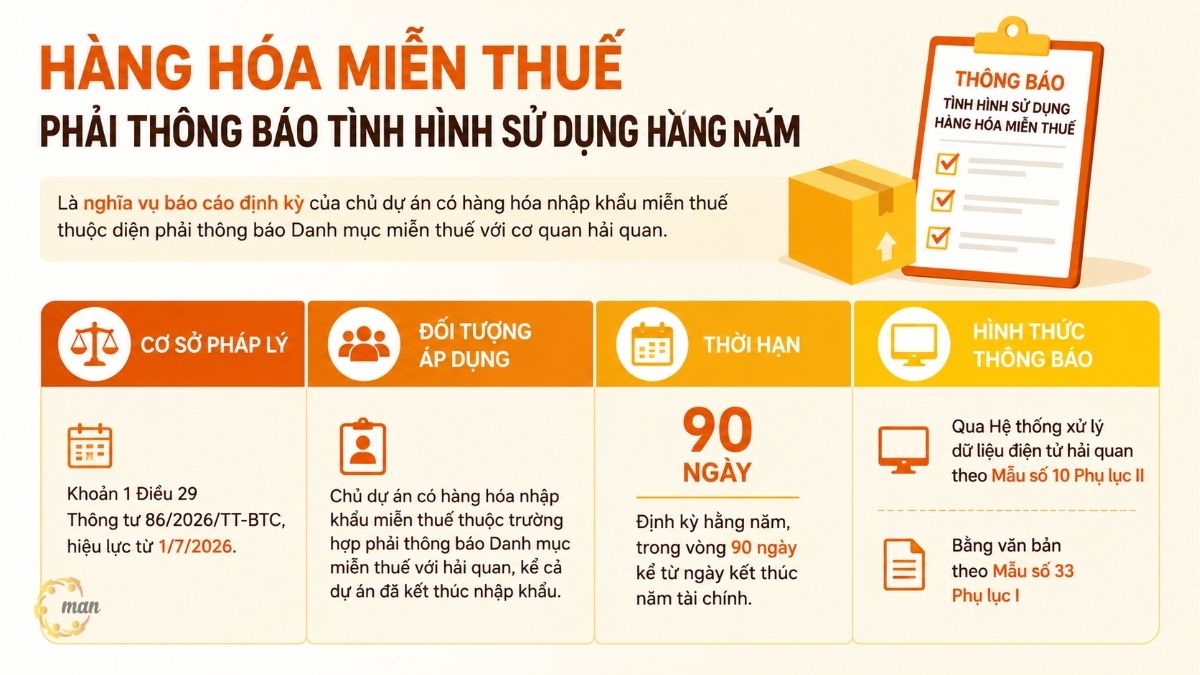
The annual reporting of usage status for duty-free goods is a periodic reporting obligation of project owners with duty-free imported goods that are subject to notification of the list of duty-free goods to the customs authorities.
- Legal basis: Clause 1, Article 29 of Circular 86/2026/TT-BTC, effective from July 1, 2026.
- Applicable subjects: Project owners with tax-exempt imported goods who are required to notify customs of the list of tax-exempt items, including projects where the import has been completed.
- Deadline: Annually, within 90 days of the end of the fiscal year.
- Format: via the Customs Electronic Data Processing System using Form No. 10, Appendix II, or in writing using Form No. 33, Appendix I.
What are the duty-free goods for which annual usage reports must be submitted?
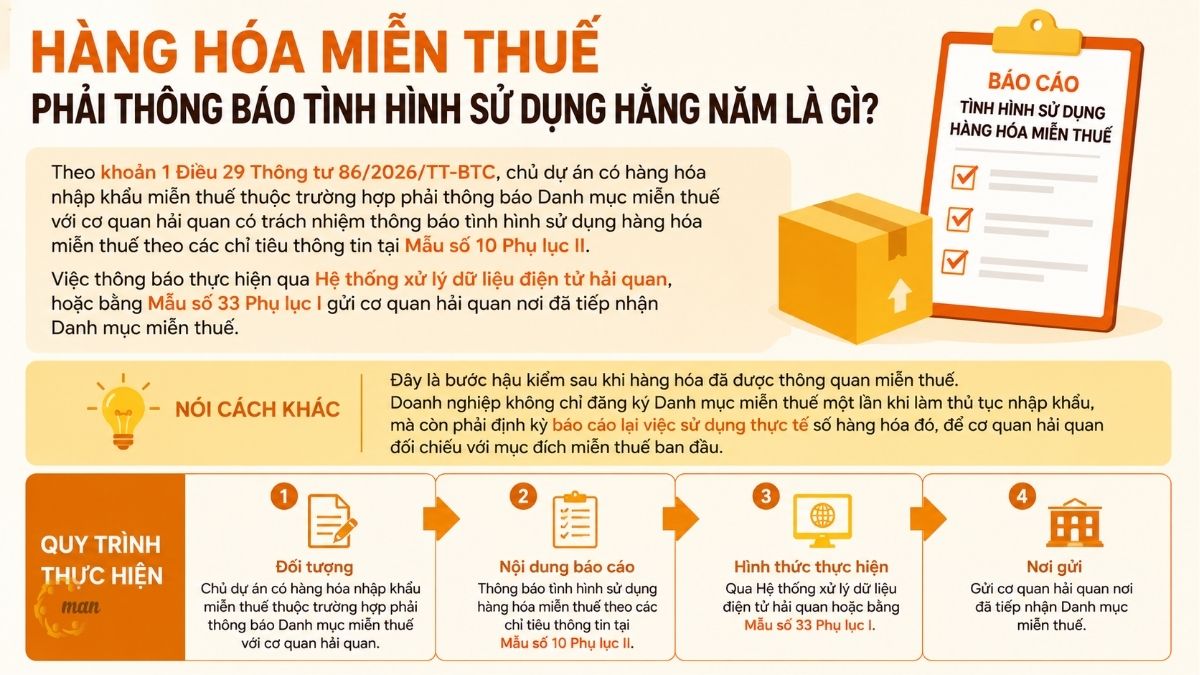
According to Clause 1, Article 29 of Circular 86/2026/TT-BTC, project owners with tax-exempt imported goods that are required to notify the customs authority of the list of tax-exempt goods are responsible for reporting the status of use of the tax-exempt goods according to the information criteria in Form No. 10, Appendix II. This notification is made through the Customs Electronic Data Processing System, or by sending Form No. 33, Appendix I to the customs authority that received the list of tax-exempt goods.
In other words, this is a post-clearance inspection after the goods have been cleared for tax exemption. Businesses not only register. Tax-exempt items In addition to the initial import procedures, a periodic report on the actual use of the goods must be submitted so that customs authorities can verify it against the original tax exemption purpose.
Why are businesses required to report their annual use of duty-free goods?
Duty-free imported goods are usually associated with a specific purpose: creating fixed assets for investment incentive projects, serving as raw materials for export production, or facilitating processing. Without a post-clearance monitoring mechanism, the risk of goods being misused, transferred, or consumed domestically without declaring and paying taxes is very high.
The annual notification mechanism helps customs authorities to apply risk management, This means that on-site inspections at the business premises should only be conducted when there are signs of irregularities, instead of conducting widespread inspections. At the same time, this also serves as a basis for businesses to self-assess and detect early signs of goods needing a change in intended use, and proactively declare and pay taxes before they are assessed.
Which entities are required to report the use of duty-free goods?
The scope of application of this obligation is quite broad, encompassing the following groups:
- Project owners with tax-exempt imported goods are required to notify the customs authorities of the list of tax-exempt items.
- Projects that have completed imports under the duty-free list or whose list has expired must still continue to submit periodic notifications every three years.
- Organizations and individuals receiving the transfer of all or part of a project eligible for investment incentives are responsible for continuing to report on the use of duty-free imported goods.
- In cases of import duty exemption under Articles 15 and 23 of Decree 134/2016/ND-CP, and some cases of tax exemption under the Law on Export and Import Taxes, annual notification must be given for a period of 5 years.
What are the regulations regarding the deadline and frequency for reporting on the use of duty-free goods?
The deadline for reporting the use of duty-free goods varies depending on the project phase. The table below summarizes the three most common scenarios that import/export accountants and personnel need to be aware of to avoid missing reporting deadlines.
One point to note: for projects where import has been completed, the 3-year periodic reporting cycle begins. from the year in which the import of goods under the Duty-Free List ends or the year the Duty-Free List expires., not calculated from the most recent annual report. Mistaking this timeframe is a common mistake that leads businesses to report late or on the wrong period.
| Case | Frequency | Submission deadline | Until when will this apply? |
| The project is currently in the process of importing goods under the duty-free list. | Yearly | 90 days from the end of the fiscal year | Until all goods listed in the Catalog are imported or the Catalog expires. |
| The project has completed the import process or the list has expired. | Every 3 years | 90 days from the end of the fiscal year | Until the project ceases operation or the goods are re-exported, repurposed, transferred for domestic consumption, or destroyed. |
| Tax exemption under Articles 15 and 23 of Decree 134/2016/ND-CP | Yearly | Within 5 years from the date of occurrence. | After 5 years, if there are any unused raw materials, a new declaration must be filed and taxes paid within 30 days. |
Additionally, if there is a change in the purpose for which the tax exemption is granted or a shift to domestic consumption, the taxpayer must register. new customs declaration According to regulations, it cannot simply be shown in a usage report.
These are two independent but closely related obligations: the annual report on the use of duty-free goods is only for informational purposes, reflecting the status of the goods at the time of reporting, while the new customs declaration is the legal basis for declaring and paying the tax incurred when the goods no longer meet the conditions for exemption. Businesses that submit a new declaration but forget to update it in the next periodic report, or vice versa, may be considered to have made inconsistent declarations when customs officials compare the records.
Legal documents related to reporting the use of duty-free goods.
To properly fulfill the obligation to report on the use of duty-free goods, businesses need to refer to current legal documents. Specifically, Circular 86/2026/TT-BTC It is a document that provides direct guidance on documents, forms, and notification deadlines, and also links to Decree 134/2016/ND-CP and Law on Export and Import Taxes To determine the eligible subjects, tax exemption conditions, and resulting obligations, the table below summarizes the important documents to note.
| Legal documents | Number / Validity | Related content |
| Circular 86/2026/TT-BTC | Ministry of Finance, effective July 1, 2026 | Tax management for exported and imported goods; Article 29 stipulates the obligation to report the annual use of tax-exempt goods, accompanied by Form No. 10 in Appendix II and Form No. 33 in Appendix I. |
| Decree 134/2016/ND-CP | Government, Article 15, Article 23 | The regulations specify cases of exemption from import tax on raw materials, supplies, and components; this serves as the basis for the groups required to submit annual reports for five years. |
| Law on Export and Import Taxes | Reference | Basis for determining cases of import duty exemption and related obligations in the List of Exemptions. |
Important note: The forms in Circular 86/2026/TT-BTC (Form No. 10 Appendix II, Form No. 33 Appendix I) have replaced the forms stipulated in previous documents. Experts at MAN recommend that businesses update to the latest version of the forms before submitting to avoid having their applications rejected due to incorrect forms.
How to submit the annual report on the use of duty-free goods.
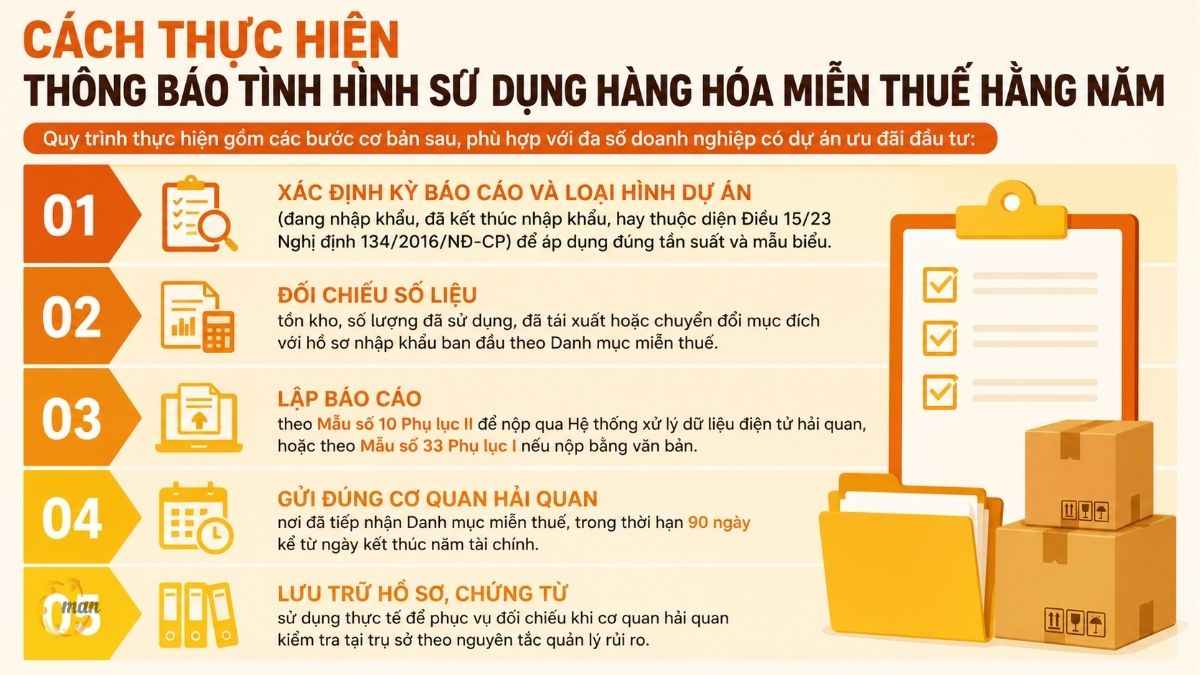
The implementation process includes the following basic steps, suitable for most businesses with investment incentive projects:
- Determine the reporting period and project type (currently importing, completed import, or falling under Article 15/23 of Decree 134/2016/ND-CP) to apply the correct frequency and form.
- Compare inventory figures, quantities used, re-exported, or repurposed with the original import records according to the Duty-Free List.
- Prepare a report using Form No. 10, Appendix II, for submission via the Customs Electronic Data Processing System, or use Form No. 33, Appendix I, if submitting in writing.
- Submit the Tax Exemption List to the correct customs authority that received it, within 90 days from the end of the fiscal year.
- Maintain records and documents used in practice for verification purposes when customs authorities conduct inspections at the office, in accordance with risk management principles.
How do customs authorities inspect and handle violations related to duty-free goods?
The customs authority that receives the notification of the list of tax-exempt goods is the competent unit to inspect the use of tax-exempt goods at the project owner's premises. The inspection is not carried out indiscriminately against all businesses, but is conducted based on the principle of risk management, meaning priority is given to inspecting cases with unusual figures regarding import, usage, or inventory.
If the inspection results determine the business Not eligible for tax exemption, The customs authority will then assess the tax in accordance with the tax administration law. This means that businesses must pay additional import tax that would have been due for the portion of goods that no longer meet the tax exemption conditions, and may incur late payment penalties according to general regulations.
Because the inspection mechanism is based on risk management, a complete, timely, and accurate report on the use of duty-free goods, consistent with accounting records, is a key factor in reducing the likelihood of being subject to inspection and shortening the time required for on-site inspections.
Case Study: FDI Enterprises Handling Notifications Regarding the Use of Duty-Free Goods
Background
This is an illustrative case study based on real-world projects that MAN – Master Accountant Network has advised on. Company Y, a foreign-invested enterprise manufacturing electronic components in Dong Nai, has a project eligible for investment incentives and has imported a line of machinery and equipment duty-free to create fixed assets during the period from 2023 to 2025. By 2026, the company has completed the import of all goods according to the registered duty-free list.
Problem arises
Because the project had completed its import, the company's accounting department assumed that the reporting obligation had ended and ceased monitoring. This is a misinterpretation of the regulations in Circular 86/2026/TT-BTC, as the company is still required to report on the use of duty-free goods periodically every three years until the project ceases operation or the goods are re-exported, repurposed, sold domestically, or destroyed.
Solutions and results
After reviewing the matter with MAN, the company re-established a 3-year periodic reporting reminder schedule, linked to the tracking of fixed assets acquired from duty-free goods. Thanks to the thorough preparation of supporting documents, the subsequent customs inspection went smoothly, without any retroactive collection or penalties. This demonstrates that tax risk management needs to look beyond the customs clearance stage, not just the initial import phase.
Expert opinion: Common business risks when reporting the use of duty-free goods.
Experts at MAN – Master Accountant Network, with over 30 years of auditing and tax consulting experience in Vietnam, point out the four most common risks that businesses need to proactively prevent:
- Risk 1: Missing reporting obligations after the import is completed: Many businesses believe that once they have imported all goods included in the tax-exempt list, their reporting obligations end. In reality, regulations still require periodic reporting every three years until the project ceases operation or the goods are disposed of for their intended purpose. Omitting this step leaves businesses unprepared when inspections occur.
- Risk 2: Submitting the wrong form or to the wrong customs authority: Using outdated forms that are not updated to Form No. 10 Appendix II or Form No. 33 Appendix I of Circular 86/2026/TT-BTC, or submitting them to the wrong customs authority (not the one that received the list of tax-exempt items), will render the report invalid and may be considered as not fulfilling the obligation on time.
- Risk 3: Lack of supporting documents during customs inspection at the headquarters: Customs authorities have the right to inspect the use of duty-free goods at the project owner's premises based on risk management. If the business does not keep complete records of import documents, fixed asset tracking records, and inventory records, proving that the goods are being used for the intended purpose will be difficult, leading to the risk of tax assessment.
- Risk 4: Delayed processing after the preferential period expires according to Decree 134/2016/ND-CP: In cases of tax exemption under Articles 15 and 23 of Decree 134/2016/ND-CP, after the 5-year period expires, if there are still unused raw materials, supplies, and components, businesses only have 30 days to register a new customs declaration and declare and pay taxes. Many businesses miss this short deadline because they lack an internal warning system.
Conclude
Reporting the annual usage of duty-free goods is an ongoing obligation throughout the entire lifecycle of an investment incentive project, not just at the time of customs clearance or after all goods on the duty-free list have been imported. Businesses need to build a system for tracking, reminding them of reporting deadlines, and maintaining records from the outset to proactively respond to customs inspections based on risk management principles.
Tax services at MAN – Master Accountant Network
- Tax accounting services
- Tax consulting services
- Tax settlement services
- Tax reporting services
- VAT refund service
Service contact information at MAN – Master Accountant Network
- Address: No. 19A, Street 43, Tan Thuan Ward, Ho Chi Minh City
- Mobile/Zalo: 0903 963 163 – 0903 428 622
- E-mail: man@man.net.vn
- Google Business Profile: View MAN – Master Accountant Network's Google Business Profile
- LinkedIn Founder: View expert Le Hoang Tuyen's LinkedIn profile.
Responsible for production and professional content review by: Mr. Le Hoang Tuyen – Founder & CEO of MAN – Master Accountant Network, CPA Vietnam with over 30 years of experience in accounting, auditing, taxation, and corporate financial consulting.
Frequently Asked Questions about the Annual Report on the Use of Duty-Free Goods
The circular, effective from July 1, 2026, regulates tax management for exported and imported goods, including the obligation to report the annual use of tax-exempt goods.
If the customs authorities' inspection determines that the business does not qualify for tax exemption or cannot prove that the funds were used for the intended purpose, the customs authorities will assess the tax in accordance with the tax administration laws.
Yes. Projects that have completed imports under the duty-free list or whose list has expired must still notify the authorities periodically every three years, until the project ceases operation or the goods are disposed of in accordance with regulations.
Businesses must notify the customs authority that received the list of tax-exempt items via the Customs Electronic Data Processing System using Form No. 10, Appendix II, or in writing using Form No. 33, Appendix I.
When transferring all or part of a project eligible for investment incentives, the transferee organization or individual is responsible for continuing to report on the use of duty-free imported goods as prescribed. From what date does Circular 86/2026/TT-BTC come into effect?
What are the consequences of not submitting the notification on time?
If the project has completed the import process, is it still necessary to report it?
How do businesses submit reports?
In the event of a project transfer, who is responsible for reporting it?